
Compare Office & Operations Services for UK Businesses
A structured route through payroll, accountancy, premises, security, fleet, print, mail and delivery support
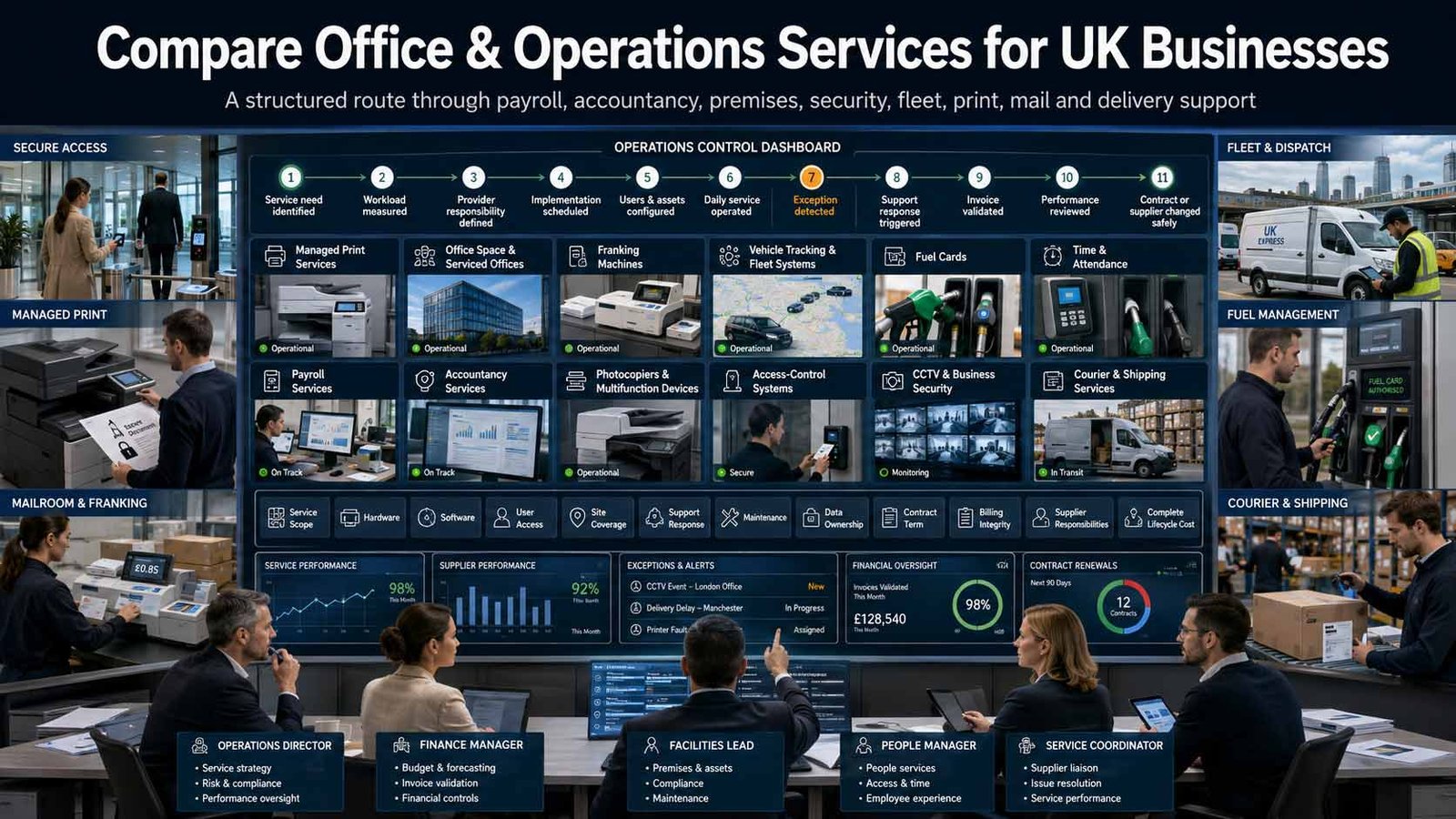
Office and operations services help UK businesses organise premises, payroll, mail, security, fleet, records and day-to-day workflows. Use this hub to identify which operational support category best fits your office setup, staffing structure, compliance duties, service volumes, budget and growth pressures.
Why Office & Operations services matter to UK SMEs
Operational services touch finance, facilities, people management, dispatch, customer service, security and compliance at the same time.
- Reduce hidden admin drag across payroll, mail, print and fleet workflows
- Improve visibility over premises, access, documents and mobile teams
- Support repeatable, auditable processes as the business grows
- Move from informal workarounds into scalable operating controls
Office and operational weaknesses often build gradually before they become visible. Payroll errors, incomplete accounts, poor attendance records, weak access control, untracked vehicles, unmanaged print, ageing equipment, delayed post and inconsistent shipping can increase cost and management effort across several teams.
Use this category to separate people administration, financial support, premises, documents, fleet and delivery services before requesting proposals. That keeps service boundaries, responsibilities, data, hardware, implementation and lifecycle cost comparable.
The appropriate service depends on headcount, pay cycles, locations, visitors, vehicles, print and mail volumes, parcel activity, existing contracts, internal capability and the operational impact of failure.
Translate operational friction into the right service category
Most businesses do not start by asking for an office and operations service. They start with a cost, control, risk or workflow problem.
Too much admin time
Payroll, accountancy, time and attendance, print and workflow tools help standardise repeated tasks and reduce rework.
Poor premises control
Access control, CCTV, serviced office choices and security systems improve accountability, visitor management and site resilience.
Field operations are unclear
Vehicle tracking, fuel cards and courier services support route visibility, cost control, delivery confidence and operational evidence.
Documents are fragmented
Managed print, franking and MFDs improve print, scan, outbound post and record-handling discipline across teams.
Growth needs better structure
As staff, sites and service volumes grow, informal processes need clearer ownership, reporting and supplier fit.
Office & Operations needs by service category
Use this overview to identify the correct starting point before reviewing individual providers.
| Primary operational need | Best-fit service category | Typical trigger | Best suited to |
|---|---|---|---|
| Run payroll accurately and on time | Payroll Services | Headcount growth, PAYE complexity, multiple pay cycles, pensions administration | Employers with recurring payroll obligations |
| Improve finance visibility and reporting | Accountancy Services | Month-end support, management accounts, tax planning, compliance oversight | Owner-managed SMEs and growing companies |
| Track attendance and simplify timesheets | Time & Attendance Systems | Manual rotas, clocking disputes, overtime leakage | Shift-based, multi-site or hourly workforce businesses |
| Control office printing and device uptime | Managed Print Services | High print spend, poor toner control, unmanaged support calls | Document-heavy offices and distributed teams |
| Secure entrances and internal zones | Access Control Systems | Lost keys, multi-site access, visitor management gaps | Businesses with premises, staff and restricted areas |
| Monitor premises and deter incidents | CCTV / Business Security Systems | Security incidents, insurance pressure, weak evidence trails | Premises-based businesses with security obligations |
| Reduce fleet leakage and improve visibility | Vehicle Tracking / Fleet | Fuel misuse, routing inefficiency, service-level misses | Field-service, logistics and multi-vehicle businesses |
| Improve parcel delivery and shipping workflows | Courier / Shipping Services | Late deliveries, inconsistent service levels, returns complexity | Ecommerce, trade and multi-location businesses |
Operational needs by business size and model
The right operational mix changes with headcount, premises, service volumes and field activity.
| Business profile | Operational priorities | Most relevant service categories | Decision lens |
|---|---|---|---|
| Micro-business / sole trader | Keep fixed costs low, reduce admin drag, create basic compliance | Accountancy Services, Courier / Shipping Services, Fuel Cards, basic Franking where needed | Choose simplicity, low commitment and fast implementation |
| Small office-based SME | Professional admin processes, reliable payroll, print control, secure access | Payroll Services, Managed Print Services, Photocopiers / MFDs, Access Control, CCTV | Focus on visibility, uptime and predictable monthly costs |
| Multi-site SME | Consistent controls across locations, staff tracking, site security, shared reporting | Time & Attendance, Access Control, CCTV, Payroll, Office Space solutions | Prioritise standardisation and central reporting |
| Field-service or fleet-led business | Vehicle visibility, fuel control, dispatch confidence, payroll accuracy | Vehicle Tracking / Fleet, Fuel Cards, Payroll Services, Courier / Shipping Services | Measure driver productivity, leakage and service performance |
| Regulated or client-facing firm | Audit trails, financial accuracy, secure records, controlled premises access | Accountancy Services, Payroll, Access Control, CCTV, Managed Print | Assess compliance support, data handling and accountability |
Use one evidence framework across every operational purchase
The service changes across this category, but buyers should apply the same discipline to scope, data, responsibility, implementation, service quality, cost and exit.
| Control area | What the buyer should define | Evidence to request before award | Why it matters |
|---|---|---|---|
| Business scope and operating baseline | List legal entities, sites, staff, shifts, vehicles, devices, rooms, access points, mail, parcels, payrolls, accounting periods and service volumes included or excluded. | Verified estate and volume schedule, current contracts, asset register, process map, pain-point baseline, ownership matrix and growth assumptions. | Provider proposals are not comparable when each supplier prices a different estate, volume or responsibility boundary. |
| People, roles and authority | Define employees, workers, managers, finance users, drivers, administrators, visitors, approvers and external advisers who create, review or act on operational information. | Role matrix, access levels, approval thresholds, segregation of duties, escalation contacts, joiner and leaver process and out-of-hours responsibilities. | Operational tools can automate a process while leaving decision authority, review and exception ownership unclear. |
| Data, records and integrations | Identify payroll, HR, accounting, banking, vehicle, security, print, mail, shipping and reporting systems; source records; interfaces; retention; exports and reconciliation needs. | Data map, integration design, field definitions, failed-sync handling, audit trail, retention schedule, migration test and ownership of custom configuration. | Disconnected data creates duplicate entry, inconsistent records, payroll or billing errors and weak management reporting. |
| Premises, equipment and technical readiness | Record locations, power, networks, door types, camera positions, workspace requirements, device condition, vehicle hardware, installation access, landlord constraints and planned changes. | Site survey, design assumptions, equipment schedule, installation plan, permissions, risk assessment, acceptance tests, warranties and maintenance responsibilities. | Hardware and premises quotations cannot be compared when one supplier includes enabling work and another assumes the site is ready. |
| Privacy, security and compliance | Define personal-data use, monitoring, access logs, CCTV purpose, payroll confidentiality, accounting records, vehicle data, document security, user notices and statutory responsibilities. | Data-processing terms, privacy information, access model, lawful-use assessment where relevant, security controls, subprocessor list, deletion process and compliance ownership. | Operational systems frequently handle employee, financial, visitor, customer and location data that requires controlled access and transparent use. |
| Implementation, adoption and continuity | Plan discovery, configuration, data migration, installation, user communication, training, testing, cutover, parallel running, rollback, business continuity and post-launch support. | Implementation plan, milestones, internal resource assumptions, acceptance criteria, continuity arrangements, issue process, training deliverables and support handover. | Operational services fail when implementation disrupts payroll, access, delivery or daily workflows without a tested fallback. |
| Service levels and operating governance | Set support hours, response, restoration, engineer attendance, payroll deadlines, reporting, collection, delivery, account reviews, complaints, maintenance and escalation requirements. | Service schedule, clock definitions, example report, escalation map, performance evidence, service-credit terms, governance calendar and named account owner. | Headline support claims are weak unless the event, response, outcome, exclusions and customer actions are contractually defined. |
| Complete cost, change and exit | Model subscriptions, users, devices, rental, leases, implementation, support, consumables, postage, mileage, transactions, collections, training, overage, indexation, internal time and termination. | Three-year cost model, unit rates, minimum commitments, change prices, renewal terms, asset ownership, complete export, transition assistance and deletion confirmation. | A low monthly price can exclude essential implementation, usage, maintenance or exit costs and create long-term operational lock-in. |
Office & Operations service categories
This category covers twelve service areas that shape how work is processed, controlled, documented and delivered across a business.
Print control
Managed Print Services
Outsourced print management for consumables, support, device performance, volumes and document output costs.
Compare managed print services providersFlexible workspace
Office Space / Serviced Offices
Workspace options for extra capacity, regional presence, hybrid teams, meeting rooms and managed facilities.
Compare office space and serviced office providersMail control
Franking Machines
Structured postage processes for businesses sending regular outbound letters, invoices, contracts or parcel labels.
Compare franking machine providersFleet visibility
Vehicle Tracking / Fleet
Vehicle, route, utilisation and field activity visibility for mobile teams, engineers and delivery-led operations.
Compare vehicle tracking and fleet providersFuel spend control
Fuel Cards
Fuel purchasing and reporting tools for fleets, field teams and businesses with recurring vehicle use.
Compare business fuel card providersWorkforce records
Time & Attendance Systems
Clocking, shift, overtime, absence and attendance data for payroll accuracy and labour visibility.
Compare time and attendance systemsPay accuracy
Payroll Services
Payroll calculation, deductions, deadlines, pensions and compliant outputs for growing employers.
Compare payroll service providersFinancial control
Accountancy Services
Bookkeeping oversight, reporting, statutory preparation, tax support and advisory routines for SMEs.
Compare accountancy service providersDocument hardware
Photocopiers / MFDs
Print, scan, copy and document workflow hardware for offices with shared document needs.
Compare photocopier and MFD providersEntry governance
Access Control Systems
Premises, zone, staff, visitor and time-based entry controls for workplaces and restricted areas.
Compare business access control systemsSite protection
CCTV / Business Security Systems
Security monitoring, deterrence, evidence review and premises protection for business sites.
Compare business CCTV and security systemsDelivery workflow
Courier / Shipping Services
Delivery, returns, proof-of-delivery and parcel workflow support for ecommerce, trade and multi-site firms.
Compare courier and shipping service providersPrioritise the process causing the highest recurring friction
Start with the area creating the greatest recurring cost, delay, control weakness or management workload.
- If people administration is the pain point, start with payroll, accountancy and time & attendance.
- If premises control is the pain point, start with office space, access control and CCTV.
- If document handling is the pain point, start with managed print, photocopiers / MFDs and franking.
- If field operations are the pain point, start with vehicle tracking, fuel cards and courier or shipping services.
- Open the most relevant live service pages, prepare one requirements brief and compare providers against the same volumes, sites, responsibilities and contract assumptions.
How to structure an Office & Operations comparison
Separate the operational problem from the product label before contacting suppliers. Each service has a different scope, evidence base, pricing unit, implementation requirement and contract boundary.
- Define whether the priority concerns people, finance, premises, equipment, vehicles, documents or delivery
- Separate process failures from hardware faults, supplier performance and compliance duties
- Give every provider the same volumes, locations, users, assets and service assumptions
- Compare implementation, support, data ownership, service levels and complete lifecycle cost
- Keep payroll, accountancy, timekeeping, print and security responsibilities distinct
- Confirm a workable handover and exit route before signing a long-term agreement
Operational fit comes before supplier choice
Driver disputes may indicate a need for vehicle tracking, fuel controls or clearer management processes. Overtime disputes may require reliable attendance records rather than a payroll replacement. Weak management information may require accountancy support rather than additional spreadsheets.
Correct service selection reduces duplicated contracts and exposes responsibilities that would otherwise remain between suppliers or internal teams.
Why data matters before shortlisting suppliers
Office and operations buying decisions are vulnerable to both underbuying and overbuying. A business can underbuy by choosing a basic payroll setup that becomes unstable as headcount grows, or a low-visibility fleet arrangement that hides fuel and route inefficiency.
It can also overbuy by paying for enterprise workflows, multi-site security capability, advanced reporting or high-volume device estates that will never be properly used.
Before shortlisting services, assess employee numbers, number of sites, print volumes, mail volumes, vehicles, monthly payroll complexity, parcel volumes, visitor traffic and the direct cost of manual workarounds.
Office & Operations service pages in this category
Use these pages to move from category overview into service-specific comparison.
- Compare Managed Print Services
- Compare Office Space / Serviced Offices
- Compare Franking Machines
- Compare Vehicle Tracking / Fleet
- Compare Fuel Cards
- Compare Time & Attendance Systems
- Compare Payroll Services
- Compare Accountancy Services
- Compare Photocopiers / MFDs
- Compare Access Control Systems
- Compare CCTV / Business Security Systems
- Compare Courier / Shipping Services
Frequently Asked Questions
Quick answers for UK businesses reviewing office and operations services.
What is included in office and operations services for a business?
Office and operations services cover practical systems that keep a business running day to day, including payroll, accountancy, premises, print, mail, security, fleet oversight and delivery workflows. The right mix depends on headcount, premises, service volumes and operational risk.
When should a small business outsource payroll or accountancy support?
A small business should review outsourced support when payroll deadlines, pension administration, statutory deductions or year-end reporting begin taking too much owner time or create avoidable errors. The trigger is usually complexity, not just size.
Do I need both CCTV and access control systems?
Not always. Access control manages entry permissions, while CCTV records or monitors activity. Premises layout, visitor traffic, restricted zones, insurance expectations and incident history usually determine whether both are justified.
How do I know whether to choose managed print or just replace photocopiers?
If the core issue is unreliable hardware, scan workflow or lease renewal, a photocopier or MFD review may be enough. If the problem is wider print control, support, consumables and reporting, managed print is usually the better category to assess.
What is the easiest way to prioritise operational service purchases?
Start with the process causing the most recurring cost, delay or risk. Rank issues by frequency, business impact, compliance exposure and management time consumed, then shortlist the category that directly addresses that bottleneck first.
Authoritative UK Office & Operations guidance
Reviewed by Bhav Giva, Founder & Lead Analyst at CompareServices.co.uk, on 4 August 2026.
Use the following primary sources alongside the relevant live service comparison when assessing payroll, annual accounts, franking, business premises, workplace monitoring and CCTV. Obtain legal, accounting, employment, tax, property, privacy, security or health-and-safety advice where the organisation’s circumstances require specialist input.
- PAYE and Payroll for Employers — GOV.UK
- Prepare and File Annual Accounts for a Limited Company — GOV.UK
- Business Franking Guidance — Royal Mail
- Business Rates Revaluation 2026 — GOV.UK and Valuation Office Agency
- CCTV and Dashcams Guidance — Information Commissioner’s Office
- Monitoring Workers Guidance — Information Commissioner’s Office