
Compare Fuel Cards Providers UK
Compare Network Coverage, Fuel Pricing, Card Controls, VAT Invoicing, Credit Terms, Reporting, Fees, Support And Complete Account Cost
Compare fuel cards UK business providers by accepted forecourts, route fit, diesel and petrol coverage, HGV access, alternative-fuel eligibility, pump-price or fixed-weekly pricing, discounts, card and transaction charges, purchase restrictions, PIN and driver controls, online administration, transaction alerts, HMRC-ready invoicing, VAT evidence, payment frequency, credit limits, support, card replacement, contract terms and data export. Give every provider the same vehicle profile, monthly litres, operating routes, fuel types, purchasing rules and credit assumptions before comparing proposals.
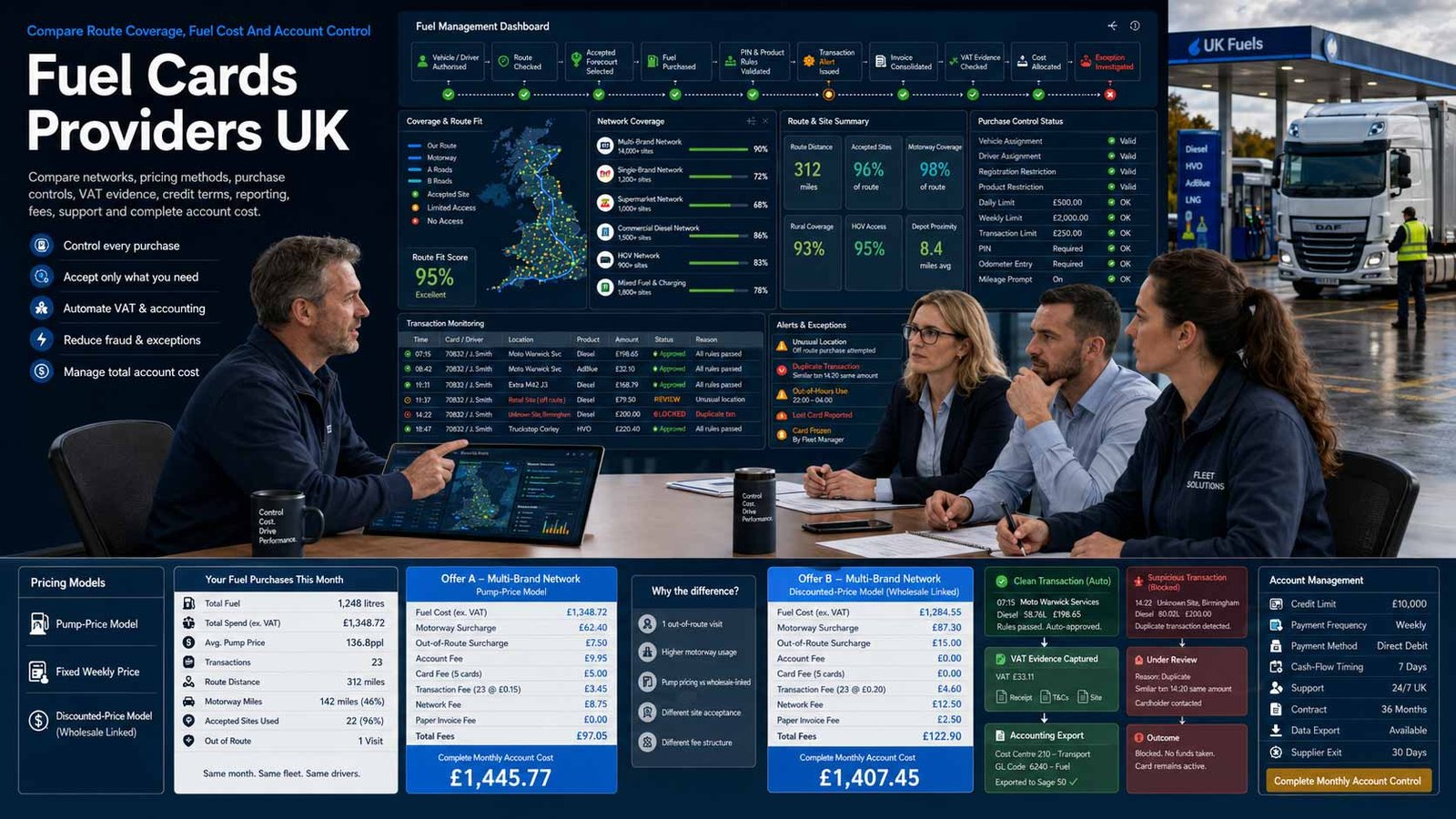
Buy A Controlled Fuel-Payment Service, Not Just A Plastic Card
A useful fuel-card account should fit the journeys drivers actually make, produce reliable transaction evidence and reduce avoidable administration without hiding cost in detours, surcharges or restrictive credit terms.
- Map real routes against accepted and practical forecourts
- Separate pump-price, fixed-price, discount and surcharge models
- Restrict permitted products, values, times and users
- Confirm invoice validity, fees, credit, renewal and exit in writing
A business fuel card is a controlled payment and account-management service used to purchase approved fuel or related products at an agreed network of forecourts. Transactions are normally consolidated into periodic invoices and online reports, removing much of the receipt collection and employee reimbursement workload. Depending on the card, the business may pay pump price, a fixed weekly price, a discounted rate at selected locations or another published commercial basis.
The right card depends on fuel type, vehicle mix, monthly litres, route geography, motorway and HGV needs, driver behaviour, transaction controls, credit profile, accounting workflow and the value placed on network flexibility. A large network is not automatically better when the closest accepted sites are consistently expensive or require operational detours.
This page compares commercial fuel-card products and account services. It does not compare vehicle tracking systems or fleet insurance. Those adjacent services use different data, risk, provider and contract criteria and should be evaluated independently.
Choose The Right Fuel Card Operating Model
Pricing and acceptance can differ materially between broad networks, single-brand cards, supermarket options, commercial diesel networks and mixed fuel-and-charging accounts.
| Card Model | What It Usually Includes | Best-Fit Question |
|---|---|---|
| Broad Multi-Brand Network Card | Access across major brands, supermarkets and independent sites through one account, with central invoicing and card controls. | Does the network cover real routes without costly diversions or brand surcharges? |
| Single-Brand Or Partner-Network Card | A card led by one fuel brand, sometimes extended through partner forecourts, with brand-specific pricing, rewards or service options. | Are partner-site transactions priced and treated differently from core-brand sites? |
| Supermarket Fuel Card | Pump-price purchasing at selected supermarket forecourts, often suited to smaller car and van fleets operating near urban or retail locations. | Can drivers use practical sites during working routes rather than making special journeys? |
| Fixed Weekly Price Card | A notified commercial rate applies for a defined period at eligible locations, helping budget visibility but requiring comparison with local pump prices. | How is the weekly rate set, when is it communicated and which sites carry surcharges? |
| HGV And Commercial Diesel Card | A diesel-led network with truck-accessible forecourts, high-speed pumps, bunkering locations, AdBlue or specialist route coverage. | Are vehicle access, opening hours, lanes, parking and fuel products suitable for the operation? |
| Fuel And EV Charging Card | One account combines conventional fuel with public charging access and consolidated reporting for a mixed or transitioning fleet. | Are charging tariffs, roaming charges, VAT evidence and driver reimbursement handled clearly? |
| European Or Cross-Border Card | Multi-country acceptance, country-specific invoices and services designed for international transport, logistics or mobile workforces. | Which countries, currencies, tolls, taxes, security controls and assistance services are included? |
| Digital Or Mobile-Authorised Fuel Payment | App, generated PIN, token or digital-card controls reduce dependence on a physical card at supported locations. | What happens when a phone, network, app, forecourt integration or driver authentication fails? |
Eight Areas That Determine Fuel Card Fit
Use the same litres, vehicle types, routes, products, controls, payment schedule and reporting requirements for every provider.
Comparison Criterion
Network Coverage And Route Fit
Compare accepted locations against actual depots, customer areas, trunk roads, motorway use, rural work, HGV access and opening hours. Request a site list or mapping exercise using representative routes. Count operational detour time, not only the headline number of forecourts.
Comparison Criterion
Fuel Types, Vehicles And Permitted Purchases
Confirm petrol, diesel, premium fuels, AdBlue, HVO, lubricants, car wash, parking, toll or charging eligibility. Set card-level restrictions so each driver or vehicle can purchase only authorised products. Check whether non-fuel items appear on the same invoice and how they are coded.
Comparison Criterion
Pump Price, Fixed Price And Discount Method
Require a written explanation of how each transaction is priced: visible pump price, fixed weekly price, wholesale-linked rate, selected-site discount or another method. Ask how motorway, partner, out-of-network and premium-fuel transactions are treated and how price notices are delivered.
Comparison Criterion
Fees, Charges And Complete Cost
Compare application, account, card, replacement, transaction, network, paper invoice, failed payment, late payment, minimum-use, non-use, administration and termination charges. A small pence-per-litre difference can be outweighed by detours, fees or buying at higher-cost sites.
Comparison Criterion
Card Security And Fraud Controls
Assess PINs, driver or vehicle assignment, registration prompts, mileage capture, product controls, daily and weekly limits, time and location rules, unusual-spend alerts, rapid card blocking, disputed transaction handling and liability. Test how quickly lost cards can be stopped outside office hours.
Comparison Criterion
Invoices, VAT Evidence And Accounting
Review invoice frequency, supplier and VAT details, line-level transaction information, fuel type, litres, vehicle or driver reference, non-fuel separation, credit notes, downloadable formats and accounting integration. Confirm with the business accountant that records support the intended VAT and expense treatment.
Comparison Criterion
Credit, Payment And Cash-Flow Terms
Compare credit checks, security deposits, payment frequency, direct debit timing, credit limits, temporary holds, limit reviews, declined transactions and consequences of late payment. Model the largest plausible weekly or monthly fuel bill rather than the current average alone.
Comparison Criterion
Administration, Reporting, Support And Exit
Assess online card ordering, activation, cancellation, user roles, reports, exports, APIs, account contacts, service hours, complaint handling, renewal, annual price changes, card migration and historical-data access. The business should be able to reconcile and leave the service without losing evidence.
Measures To Define Before Opening An Account
Translate network and savings claims into auditable pricing, control, invoice, support and contract evidence.
| Measure | What It Should Define | Evidence To Request | Common Weakness |
|---|---|---|---|
| Usable network coverage | Whether accepted sites genuinely support daily routes, vehicle access and operating hours | Route map, postcode sample, HGV access, opening hours, fuel types and exception list | A national site count hides poor local or motorway suitability |
| Pricing transparency | How the charged price is calculated and communicated before purchase | Pump-price rule, weekly price notice, discount basis, surcharges, premium fuels and examples | The headline saving applies only at a narrow subset of locations |
| Total fee exposure | All recurring, transaction and event-driven charges during the full term | Standard charges schedule, scenario invoice, renewal increases, payment events and exit costs | Low card fees conceal network, administration or late-payment charges |
| Transaction control | Whether unauthorised products, values, locations or usage patterns can be prevented or flagged | Card rules, limits, PIN, driver/vehicle assignment, alerts, blocking and audit log | Controls are available but not enabled or cannot differ by card |
| Invoice evidence | Whether records support reconciliation and the intended tax treatment | Sample invoice, VAT fields, line items, credit note, transaction export and retention | The invoice lacks references needed to allocate business and private use |
| Credit resilience | Whether the account can support peak fuel spend without avoidable declines | Credit limit, review process, payment cycle, temporary increase and decline procedure | A limit based on average spend fails during seasonal or project peaks |
| Fraud response | How quickly suspicious, lost, cloned or misused cards are detected and contained | Alert timing, 24/7 stop method, case handling, liability terms, evidence and escalation | The business discovers misuse only when the periodic invoice arrives |
| Reporting usability | Whether finance and operations can identify spend, exceptions and missing evidence | Dashboard, card/driver/vehicle fields, VAT export, cost centres, scheduled reports and API | Reports look detailed but cannot match internal account codes |
| Support performance | How account, card, forecourt and payment problems are resolved | Service hours, channels, response targets, emergency contact, ownership and complaints | Sales support is strong but live account issues enter a generic queue |
| Contract portability | Whether cards, records and account controls can be changed or transferred cleanly | Minimum term, notice, auto-renewal, export, closure, deletion, credit balance and final invoice | The business is locked into cards that no longer fit its routes or fuel mix |
Fuel Card Providers UK Businesses Can Consider
Shortlist providers whose accepted network, pricing method, controls, invoicing, credit and support model fit the business. Confirm the current product, legal supplier and complete terms before opening an account.
Provider Profile
Allstar One
Allstar One is a broad-network business fuel card with access across major brands, supermarkets and independent sites, online account administration, purchase controls and consolidated invoicing. Include it where route flexibility and broad UK acceptance are important. Confirm current accepted locations, discount-site eligibility, pump versus commercial pricing, card and transaction fees, permitted products, maintenance or toll add-ons, driver and vehicle controls, invoice detail, payment terms, annual changes, support, card replacement and exit conditions.
Review official Allstar One informationProvider Profile
bp Plus
bp Plus provides fuel-card options for UK fleets through bp and participating partner locations, with account management, reporting and card controls. Include it where bp coverage, motorway access or a brand-led network aligns with regular journeys. Confirm which bp Plus product is proposed, accepted partner sites, fuel and charging eligibility, pump or fixed pricing, off-network treatment, fees, rewards, online administration, purchase categories, payment cycle, credit limit, invoices, support and contract terms.
Review official bp Plus informationProvider Profile
Shell Card
Shell Card combines fuel and, for eligible products, electric charging access with online account and transaction management. Include it where Shell and partner-site coverage, mixed-energy purchasing or multi-country capability fits the operation. Confirm the exact UK network, card type, charging availability, site pricing, partner and motorway treatment, permitted purchases, security rules, invoice format, roaming or service fees, payment and credit terms, support arrangements and any differences between small-fleet and larger-fleet service models.
Review official Shell Card informationProvider Profile
Esso Card National
Esso Card National, provided through WEX, offers access to Esso and participating network locations with online fuel-spend reporting and card controls. Include it where the Esso-led network and partner acceptance fit national car, van or mixed fleet journeys. Confirm current sites, petrol and diesel availability, pump or commercial pricing, partner-network charges, Nectar or other benefits, transaction controls, invoice evidence, fees, credit, payment frequency, support, disputed transactions, European use and renewal or termination terms.
Review official Esso Card National informationProvider Profile
UK Fuels
UK Fuels, part of Radius, offers several business fuel-card options across its own network and brand or supermarket partnerships. Include it where a tailored card, route-based network selection or commercial diesel coverage is needed. Confirm which underlying card and network are quoted, fixed or pump pricing, surcharged locations, minimum usage, HGV access, fuel types, app and reporting functions, invoice detail, account and card charges, credit terms, support entity, annual changes and whether products from different networks can be combined.
Review official UK Fuels business cardsProvider Profile
Keyfuels
Keyfuels focuses on commercial fuel networks and services, including options for high-volume diesel users, HGVs and businesses with structured fuel purchasing. Include it where truck-accessible locations, commercial diesel pricing or direct and pay-as-you-go arrangements are relevant. Confirm the selected card, accepted sites, vehicle access, minimum volumes, price-notification method, bunkering or direct-supply responsibilities, AdBlue and alternative fuels, reporting, security, fees, payment and credit, account support and the process for unused fuel or account closure.
Review official Keyfuels card optionsProvider Profile
fuelGenie
fuelGenie offers business fuel cards centred on supermarket forecourts, with an expanded fuelGenie+ option covering additional locations. Include it where pump-price transparency, supermarket routes and low administration are priorities for cars and vans. Confirm the exact card, current accepted sites, pump-price and surcharge policy, card and paper-invoice charges, no-use or minimum-spend conditions, product restrictions, transaction evidence, credit and direct-debit terms, driver controls, online support, replacement, declined transactions and suitability for motorway or HGV use.
Review official fuelGenie informationProvider Profile
Certas Energy Fuel Cards
Certas Energy provides fuel-card and digital-fuelling options with access to a UK network that includes commercial and HGV-oriented sites. Include it where diesel, HVO, AdBlue, specialist vehicle access or Certas bunker locations are relevant. Confirm the exact card or FuelTapp proposition, network and vehicle fit, fuel availability, pump or commercial price, digital authorisation, invoice and VAT fields, security, fees, credit, account support, card or app failure procedures, contract flexibility and alternative-fuel claims.
Review official Certas Energy fuel cardsWhat Changes Fuel Card Cost
Compare the effective delivered cost of fuel and administration, not a headline discount or card fee in isolation.
| Cost Driver | Why It Changes Spend | What A Comparable Quote Should Show |
|---|---|---|
| Fuel purchase price | The account may charge visible pump price, a fixed weekly rate, a wholesale-linked rate, selected-site discounts or a mix | Method, notice period, eligible sites, petrol/diesel difference, premium fuel, HVO, charging and examples |
| Motorway, partner and out-of-network treatment | Convenient sites can carry higher pump prices, a surcharge or different commercial rules | Site categories, surcharge schedule, exceptions, route examples and transaction-level identification |
| Card and account fees | Some products have no standard card fee; others charge per card, account, month or year | Active and spare cards, minimums, free period, renewal, dormant cards and VAT |
| Transaction and network fees | A charge can apply per transaction, per litre, at selected networks or for non-core purchases | Amount, trigger, affected sites, fuel and non-fuel products, cap and invoice coding |
| Replacement and administration | Lost cards, urgent delivery, paper invoices, returned payments, duplicate documents or account changes can create event costs | Complete standard charges schedule and likely annual events |
| Credit and payment structure | Weekly, fortnightly or monthly collection changes cash flow, credit exposure and decline risk | Credit limit, security deposit, direct debit date, temporary increase, late payment and suspension |
| Minimum use or volume commitment | Some commercial cards or prices depend on monthly litres, vehicle count or active-card usage | Minimum litres, spend, cards, consequences, review period and growth/downturn flexibility |
| Implementation and finance workload | Card setup, driver allocation, cost centres, accounting imports, policy and training require internal time | Configuration, data, training, support, export and internal owner |
| Fraud and exception cost | Misuse, delayed blocking, weak controls and disputed transactions can exceed fee savings | Liability, alerting, stop method, claims process, evidence and resolution time |
| Renewal and exit | Annual increases, automatic renewal, minimum term, card return, closure and data access affect lifecycle cost | Notice, termination, final invoice, credit balance, historical export, card destruction and deletion |
| Indicative Fee Model | Typical Position | What Must Be Confirmed |
|---|---|---|
| No-Standard-Card-Fee Model | Some supermarket or digital propositions advertise no routine card fee, while fuel is purchased on the provider’s stated pricing basis | Confirm paper, failed-payment, replacement, late-payment, network and other event charges |
| Low Single-Figure Per Card Each Month | A common planning allowance for fee-bearing business cards before fuel, transaction or optional-service costs | Confirm whether the charge applies to active, issued, spare or replacement cards and whether it increases |
| Network Or Transaction Charge Model | Fees or pence-per-litre adjustments vary by site, transaction, fuel or partner network | Use sample routes and a representative month of litres to calculate the weighted effective price |
| Negotiated High-Volume Account | Larger fleets may receive custom pricing, account support, credit and reporting based on volume and risk | Require the pricing formula, eligible litres, review rights, minimums, credit support and renewal assumptions |
Match The Card To The Fuel-Buying Pattern
The right shortlist depends on vehicle type, routes, fuel mix, monthly litres, motorway exposure, finance controls and the people who administer the account.
Sole Trader Or One-To-Five-Vehicle Business
Prioritise practical local sites, no or low routine fees, simple pump-price visibility, easy card blocking, clear invoices and manageable credit collection. Avoid broad-network complexity when drivers use the same reliable forecourts each week.
Regional Car And Van Fleet
Prioritise supermarkets and major-brand coverage around depots and customer areas, driver or vehicle cards, purchase restrictions, mileage capture, cost centres, accounting exports and enough credit for seasonal peaks.
National Field-Service Or Delivery Operation
Prioritise route coverage, motorway availability, low detour time, partner-network price transparency, rapid card replacement, alerts, multi-site administration, scheduled reports and account support that can resolve forecourt problems quickly.
HGV, Coach Or High-Volume Diesel Fleet
Prioritise truck-accessible sites, high-speed pumps, commercial diesel pricing, AdBlue or HVO availability, driver facilities, robust credit, detailed transaction data, named support and transparent minimum-volume and surcharge rules.
How To Compare Fuel Card Proposals
Issue one fuel profile containing vehicle types, card count, monthly petrol and diesel litres, HGV or motorway use, regular routes, depots, private-use policy, permitted products, current forecourts, payment cycle, credit requirement, invoice format, accounting fields, alerts and support needs. Require a response matrix rather than relying on a savings headline.
- Accepted sites are tested against representative routes
- The charged-price method and every surcharge are documented
- Card, transaction, administration and event fees are itemised
- Security, product limits and blocking controls are demonstrated
- Invoice, VAT, export and reconciliation fields are supplied
- Credit, renewal, annual increases and exit are explicit
Compare The Same Month Of Fuel
Ask every provider to reprice the same transaction file or scenario using identical litres, sites, fuel grades, motorway exposure, cards, fees and payment assumptions.
A lower quoted rate is not comparable when drivers must detour, partner sites carry surcharges, fees are excluded or the account cannot support peak spend.
Six Questions To Put To Every Fuel Card Provider
The answers expose impractical coverage, hidden price adjustments, weak controls, incomplete invoices and contract risk.
Where Can Each Card Actually Be Used?
Request a current location file or route map covering regular postcodes, motorway sites, HGV access, opening hours, fuel products and any excluded or surcharge locations.
How Is Every Litre Priced?
Ask whether transactions use pump price, a fixed weekly price, a discount, a wholesale-linked price or another method, and how changes and exceptions are communicated.
Which Charges Can Appear On The Account?
Obtain the complete schedule for cards, transactions, network use, replacements, paper, failed payments, late payment, administration, non-use, renewal and termination.
How Are Cards Restricted And Misuse Handled?
Confirm PINs, driver or vehicle allocation, permitted products, values, frequency, location, alerts, immediate blocking, disputed transactions, liability and evidence.
Will Invoices Support Finance And VAT Workflows?
Review an actual sample for supplier and VAT details, fuel, litres, card, driver or vehicle reference, non-fuel items, credit notes, exports, cost centres and retention.
What Happens At Peak Spend, Renewal Or Exit?
Confirm credit-limit reviews, temporary increases, collection dates, automatic renewal, annual price changes, notice, card closure, final invoice, data export and deletion.
A Seven-Stage Fuel Card Provider Evaluation
Move from actual routes and transaction evidence to a controlled account rather than selecting a card from its headline network or discount.
- Create a verified fuel baseline covering vehicles, fuel types, monthly litres, current suppliers, forecourts, pump prices, motorway purchases, card or receipt administration, payment timing, private use, missing evidence and accountable owners.
- Map representative routes and locations, including depots, regular customers, rural areas, trunk roads, motorway services, HGV restrictions, operating hours, alternative fuels and likely growth regions.
- Define mandatory card controls, permitted products, driver or vehicle assignment, transaction limits, PIN and blocking process, alerts, invoice fields, cost centres, accounting export, payment cycle, credit and data retention.
- Prepare one supplier brief and transaction scenario with the same card count, litres, fuel mix, sample sites, pricing dates, support needs, contract period and annual change assumptions.
- Shortlist providers by usable network, transparent pricing, control capability, invoice evidence, credit suitability, online administration, support coverage, financial stability and referenceable customers with similar buying patterns.
- Pilot or validate the preferred account using representative cards, drivers, petrol and diesel purchases, a partner or motorway site, a blocked product, an alert, invoice export, credit note and card-cancellation process.
- Roll out through controlled card issue, driver policy, administrator training, accounting mapping and baseline reporting. Review effective pence per litre, detours, exceptions, fees, fraud events, credit headroom and account fit before renewal.
Fuel Cards Comparison Checklist
Use this table before opening, replacing or renewing a fuel-card account for a UK business.
| No. | Requirement | Evidence To Obtain Before Award | Confirmed |
|---|---|---|---|
| 01 | Fuel and card baseline complete | Vehicles, fuel types, monthly litres, cards, drivers, sites, prices, motorway use, receipts, payment and owners | |
| 02 | Representative routes mapped | Depots, customers, trunk roads, motorways, rural locations, HGV access, hours and future regions | |
| 03 | Network suitability proven | Accepted sites, practical detour, fuel products, vehicle access, exclusions and surcharged locations | |
| 04 | Pricing method documented | Pump, weekly fixed, discount, wholesale link, notice, premium fuel, partner and motorway treatment | |
| 05 | Complete charges schedule obtained | Account, card, transaction, network, replacement, paper, payment, non-use, renewal and exit fees | |
| 06 | Purchase permissions configured | Fuel grades, AdBlue, HVO, charging, car wash, oil, parking, shop goods and card-specific restrictions | |
| 07 | Security and blocking accepted | PIN, driver/vehicle assignment, registration, mileage, limits, alerts, immediate stop and dispute process | |
| 08 | Invoice and VAT fields approved | Supplier, VAT number, transaction, litres, fuel, card, vehicle/driver, non-fuel separation and credit notes | |
| 09 | Accounting and reporting mapped | Cost centres, coding, CSV/API, scheduled reports, exceptions, users, retention and reconciliation owner | |
| 10 | Credit and cash flow tested | Limit, security, collection frequency, direct debit date, seasonal peak, temporary increase and declined purchase | |
| 11 | Implementation responsibilities agreed | Application, credit information, cards, activation, drivers, policy, training, accounting and support contacts | |
| 12 | Support and forecourt failure route confirmed | Hours, emergency stop, declined card, lost card, site issue, escalation, complaints and replacement | |
| 13 | Contract and annual changes approved | Term, minimum use, automatic renewal, notice, price and fee changes, suspension and termination | |
| 14 | Data access and account closure tested | Historical invoices, transaction export, credit balance, final invoice, cards, deletion and closure confirmation | |
| 15 | Tax and private-use treatment reviewed | Business/private allocation, employee fuel, mileage policy, VAT method, evidence and professional advice where needed |
Common Fuel Card Buying Mistakes
Most avoidable problems begin with headline-network selection, incomplete pricing, weak controls or tax evidence that has not been checked.
| Mistake | Why It Creates Risk | Better Control |
|---|---|---|
| Choosing the largest network without route testing | Many accepted sites may be irrelevant, expensive or inaccessible to the vehicles | Map real journeys and calculate detour cost |
| Comparing only the advertised discount | The discount may apply only to selected diesel sites or be offset by fees and higher local prices | Reprice a representative transaction month |
| Assuming fixed weekly is always cheaper | A fixed rate can be above local pump price in some places or periods | Compare both methods over time and geography |
| Ignoring motorway and partner-site treatment | Convenient sites can carry pump premiums or provider surcharges | Identify and price each site category |
| Leaving purchase controls at defaults | Cards may permit products, values or transaction patterns the business did not intend | Configure per-card rules and alerts |
| Using one card across several drivers or vehicles | Shared cards weaken accountability, mileage evidence and investigation | Assign cards and references deliberately |
| Treating the consolidated invoice as automatic VAT entitlement | Tax treatment depends on the supply, use, evidence and the business circumstances | Review invoice validity and HMRC rules with the accountant |
| Underestimating credit headroom | Seasonal, project or price increases can trigger declined transactions and operational disruption | Model peak spend and temporary-limit procedures |
| Not reading the standard charges document | Replacement, payment, paper, network or termination events can create unexpected cost | Obtain and score every charge before signing |
| Allowing automatic renewal without performance review | Routes, fuel mix, prices, fees and vehicle numbers change during the term | Review effective cost and fit before notice dates |
Frequently Asked Questions
Answers to common questions from UK businesses comparing fuel-card networks, pricing, controls, invoices and account terms.
What Is A Business Fuel Card?
A business fuel card is a controlled payment method linked to a company account. Drivers use authorised cards or digital credentials at accepted forecourts, and the business receives consolidated transaction records and invoices. Products, network, pricing, credit, controls and fees vary by provider and card.
How Do Fuel Cards Work For UK Businesses?
The provider approves an account and issues cards assigned to drivers, vehicles or cost centres. Drivers purchase permitted fuel at accepted sites, usually entering a PIN and sometimes registration or mileage. The provider then invoices the business according to its stated pricing and payment cycle.
Are Fuel Cards Cheaper Than Paying At The Pump?
Not always. Some cards provide selected-site discounts or commercial weekly prices; others charge pump price for the convenience, control and invoicing service. The effective result depends on locations, fuel type, timing, detours, motorway use, discounts, fees and the business alternative.
Can A Small Business Get A Fuel Card?
Yes. Several providers serve sole traders and small fleets, although approval, identity checks, credit limits, payment terms and card options vary. A small business should compare practical local coverage, routine and event fees, minimum use, payment timing and the administrative value of consolidated records.
Can Fuel Cards Be Used For Petrol And Diesel?
Many broad or mixed-fleet cards support both petrol and diesel, while some commercial networks or prices focus primarily on diesel. Cards may also permit AdBlue, HVO, charging, lubricants or car washes. Confirm fuel and product permissions for every vehicle before applying.
Do Fuel Cards Provide A Valid VAT Invoice?
Many providers issue consolidated invoices designed to support business records, but the business remains responsible for checking the supplier, VAT information, direction of supply, business use and evidence. VAT recovery depends on the facts and HMRC rules, so confirm the proposed invoice with the accountant.
What Fuel Card Fees Should A Business Check?
Check account and card charges, transaction or network fees, pence-per-litre adjustments, partner and motorway surcharges, replacement cards, paper invoices, returned direct debits, late payment, minimum use, dormant cards, administration, automatic renewal and termination.
How Can A Business Reduce Fuel Card Fraud?
Assign cards to a driver or vehicle, use PINs, require registration or mileage, restrict permitted products and values, set daily or weekly limits, enable unusual-use alerts, review exceptions promptly and provide a 24-hour process for stopping lost or compromised cards.
Should A Business Choose Pump Price Or Fixed Weekly Pricing?
Neither model is universally better. Pump price reflects the forecourt price and can benefit from low-cost local sites. Fixed weekly pricing can improve predictability but may be higher or lower than local pumps. Compare representative routes and litres across several pricing periods.
How Should UK Businesses Compare Fuel Card Providers?
Give every provider the same vehicle, route, litres, fuel, site, card, control, invoice, credit, support and term assumptions. Calculate the weighted effective fuel price plus every fee, detour and internal administration cost, then review security, evidence, service and exit—not headline savings alone.
Official Guidance And Provider Resources
Reviewed by Bhav Giva, Founder & Lead Analyst at CompareServices.co.uk, on 31 July 2026.
Use current HMRC, GOV.UK and provider documentation to verify invoice treatment, tax records, network coverage, pricing, fees, credit and contract terms. Fuel prices, accepted sites, card products and charges can change. VAT, employee-fuel and private-use treatment depends on the business circumstances, so obtain professional advice where required.
- GOV.UK — VAT On Motoring Expenses
- GOV.UK — Reclaim VAT On Business Expenses
- HMRC — Fuel Cards And Direction Of Supply
- GOV.UK — Company Cars And Fuel Benefits
- GOV.UK — Advisory Fuel Rates
- Allstar — Allstar One Fuel Card
- bp — bp Plus Card
- Shell — Shell Card
- Esso Card — National Fuel Card
- UK Fuels — Business Fuel Cards
- Keyfuels — Fuel Card Options
- fuelGenie — Business Fuel Cards
- Certas Energy — Fuel Cards