
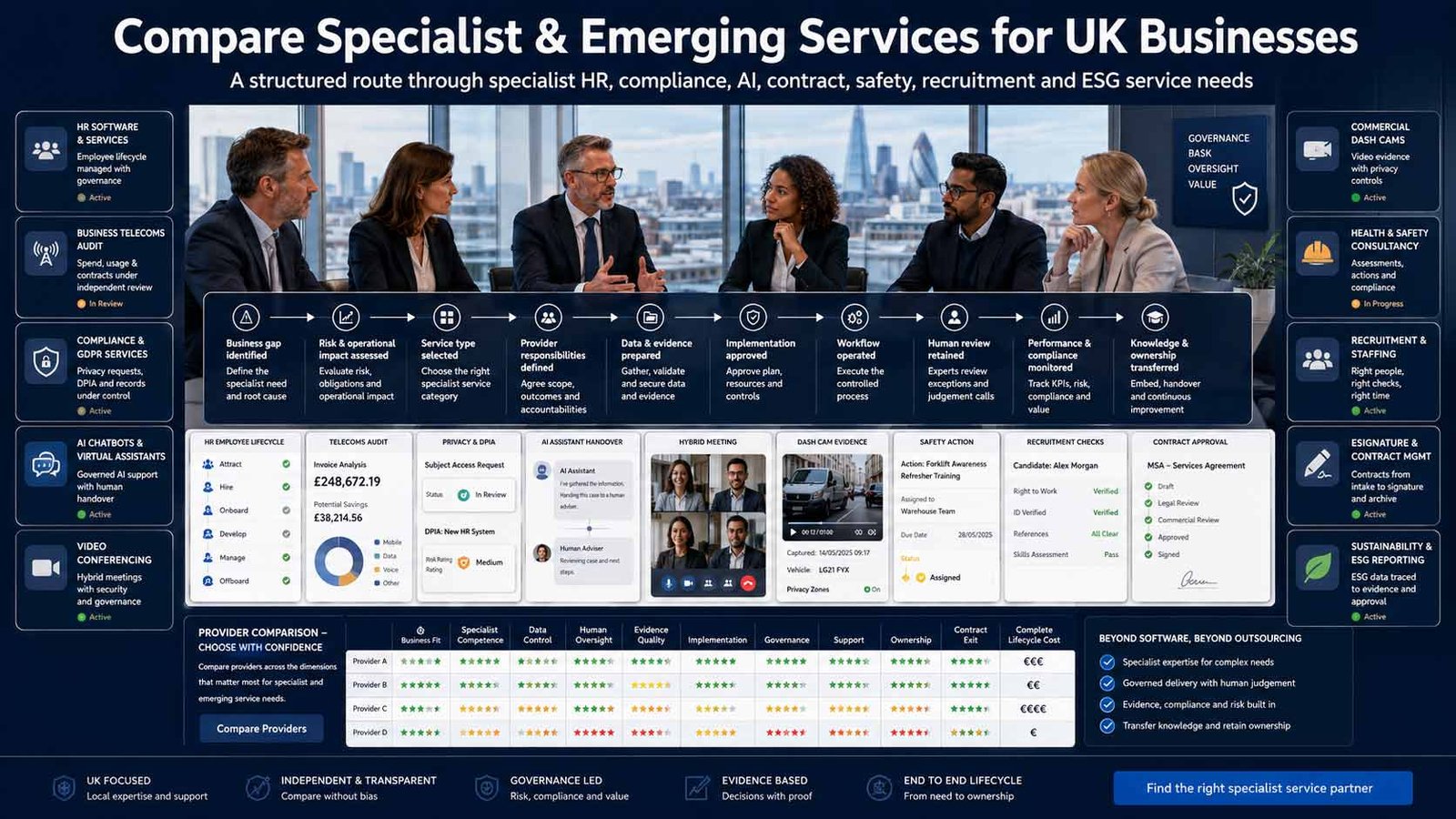
Compare Specialist & Emerging Services for UK Businesses
A structured route through specialist HR, compliance, AI, contract, safety, recruitment and ESG service needs
Specialist and emerging business services help UK organisations close fast-moving operational gaps that standard software or traditional outsourcing often miss. Use this hub to identify whether HR, GDPR, AI chatbots, video collaboration, dash cams, safety, recruitment, eSignature or ESG reporting is the right starting point.
Why specialist and emerging services matter to UK SMEs
Growth often slows because specialist gaps are left unresolved for too long. Standard tools may be in place, yet HR, compliance, recruitment, contracts, customer support or reporting can still drag operations down.
- Formalise processes that are currently trapped in inboxes or spreadsheets
- Reduce avoidable cost, evidence gaps and manual review work
- Support customer, supplier, workforce and stakeholder expectations
- Adopt proportionate tools before heavyweight enterprise systems are needed
Specialist requirements usually appear when an existing process no longer gives the business enough control, evidence or capacity. The trigger may be slow recruitment, fragmented employee records, contract delays, telecoms cost leakage, privacy questions, inconsistent meetings, safety gaps, repetitive customer enquiries or sustainability information requested by customers and lenders.
Use this category to separate software, consultancy, audit, outsourced execution and managed-service requirements before requesting proposals. That keeps responsibilities, data, implementation, evidence, support and lifecycle cost comparable.
The appropriate service depends on the operating problem, accountable owner, affected people, information sensitivity, regulatory exposure, internal capability, required evidence and consequences of delay or failure.
Translate the operational gap into the right service type
Most businesses do not start with a category label. They start with a process that is too slow, too manual, too risky or too hard to evidence.
| Business problem | What it usually looks like | Most relevant service types |
|---|---|---|
| Manual people, policy and process admin | HR files spread across email, shared drives and paper records; inconsistent onboarding; weak document trails | HR Software / Services, eSignature / Contract Management |
| Cost leakage and poor visibility | Unclear telecom bills, missed renewals, duplicated lines or no benchmark of actual usage | Business Telecoms Audit |
| Compliance pressure from customers or regulators | GDPR questions, supplier due diligence, policy gaps, safety risks or reporting obligations | Compliance / GDPR Services, Health & Safety Consultancy, Sustainability / ESG Reporting |
| Rising service demand without matching headcount | Repetitive inbound queries, slow first response or limited support capacity | AI Chatbots & Virtual Assistants |
| Hybrid work and collaboration friction | Low-quality meetings, inconsistent room setup, unclear user adoption or poor governance | Video Conferencing Solutions |
| Fleet risk and incident disputes | Unclear evidence after accidents, poor driver visibility or weak monitoring governance | Dash Cams (Commercial) |
| Slow or inconsistent hiring | Vacancy backlogs, hard-to-fill roles, seasonal staffing pressure or limited candidate pipelines | Recruitment / Staffing Solutions |
Use one evidence framework across every specialist-service purchase
The service and delivery model change across this category, but buyers should apply the same discipline to scope, data, responsibility, evidence, implementation, cost and exit.
| Control area | What the buyer should define | Evidence to request before award | Why it matters |
|---|---|---|---|
| Business outcome and service boundary | State the process, risk, capacity, cost or reporting problem; the affected people, sites and business units; the intended result; and work that remains with internal teams or another supplier. | Written scope, exclusions, assumptions, responsibility matrix, dependencies, deliverables, acceptance criteria and named business owner. | Specialist proposals are not comparable when one supplier prices software, another prices advice and a third assumes the buyer will perform implementation. |
| Current process and operating baseline | Record current workflows, volumes, response times, error rates, records, contracts, policies, channels, staffing, costs, complaints, incidents and reporting requests. | Process map, sample records, baseline metrics, known issues, current supplier terms, backlog, stakeholder requirements and agreed measures of improvement. | Without a verified baseline, buyers cannot distinguish a real operational improvement from a change in reporting or scope. |
| Users, data and system connections | Identify employees, customers, applicants, drivers, signers, administrators and managers; personal or commercially sensitive data; source systems; integrations; exports and retention. | Data-flow map, user-role model, field definitions, integration design, migration plan, failed-sync handling, retention schedule and ownership of configuration or custom work. | Most services in this category depend on trusted records and controlled access rather than standalone features. |
| Legal, governance and professional responsibility | Define who provides advice, who makes decisions, who approves communications, who is responsible for employment, privacy, monitoring, safety, contracts and reporting, and where external specialists are required. | Professional credentials where relevant, engagement terms, limitation of responsibility, approval workflow, compliance schedule, escalation route and documented customer duties. | Purchasing a platform or consultancy does not automatically transfer the organisation’s legal or management responsibilities. |
| Implementation and change management | Plan discovery, design, configuration, data preparation, pilot, training, communication, consultation where relevant, testing, cutover, rollback and post-launch support. | Implementation plan, milestones, internal resource assumptions, test cases, acceptance criteria, training deliverables, issue process and change-control method. | Specialist services underperform when implementation stops at account setup or a one-off report without operational adoption. |
| Service quality and evidence | Set support hours, response, review cadence, audit trails, reporting, document standards, candidate or case handling, content quality, monitoring, remediation and continuous-improvement expectations. | Service-level schedule, example deliverables, sample reports, governance calendar, escalation map, quality controls, performance history and comparable customer references. | Claims such as expert support, automation or compliance-ready are weak unless outputs and responsibilities are measurable. |
| Complete commercial model | Model subscriptions, users, records, conversations, meetings, vehicles, hires, audits, consultancy days, implementation, integrations, training, support, storage, reporting, overage and internal time. | Three-year cost model, unit definitions, minimum commitments, rate card, included work, indexation, change pricing, renewal assumptions and reduction rights. | A low entry price can exclude implementation, specialist review, additional usage or the support needed to keep the service effective. |
| Exit, portability and knowledge transfer | Decide how employee records, audit evidence, chatbot content, contracts, reports, recordings, candidate data, policies, configurations, integrations and open work will transfer or be deleted. | Exit plan, export formats, transition support, documentation, credential handover, access revocation, deletion confirmation, retention limits and post-termination charges. | Operational continuity and evidence may depend on information held by the provider after the contract ends. |
Specialist & Emerging service categories
This category covers ten focused service areas that help UK businesses improve process maturity, governance, automation, hiring, safety, contracts and reporting.
People process maturity
HR Software / Services
Supports employee administration, onboarding, policies, records and HR workflows when spreadsheets and inbox-led admin become fragile.
Compare HR software and service providersCost and contract visibility
Business Telecoms Audit
Reviews telecoms contracts, usage, tariffs, billing patterns and legacy arrangements to identify waste or poor-fit services.
Compare business telecoms audit providersData protection governance
Compliance / GDPR Services
Helps structure privacy responsibilities, policies, transparency, records, training and practical data protection controls.
Compare compliance and GDPR service providersService automation
AI Chatbots & Virtual Assistants
Automates routine customer or internal queries, improves triage and extends service capacity without immediately adding headcount.
Compare AI chatbot and virtual assistant providersHybrid collaboration
Video Conferencing Solutions
Improves meeting quality, room setup, user adoption and collaboration consistency for hybrid or multi-site teams.
Compare video conferencing solution providersFleet evidence
Dash Cams (Commercial)
Supports incident evidence, driver accountability and risk review for fleet, logistics and field-service operations.
Compare commercial dash cam providersSafety governance
Health & Safety Consultancy
Helps document workplace risks, responsibilities, safety controls and compliance processes across sites or activities.
Compare health and safety consultanciesHiring capacity
Recruitment / Staffing Solutions
Supports permanent, temporary, specialist or urgent hiring when internal recruitment capacity is slowing growth.
Compare recruitment and staffing providersContract workflow control
eSignature / Contract Management
Improves digital signing, approval routing, version control, contract visibility and renewal tracking.
Compare eSignature and contract management providersStakeholder reporting
Sustainability / ESG Reporting
Helps structure sustainability data, evidence and reporting for customers, boards, lenders or procurement requirements.
Compare sustainability and ESG reporting providersNeeds by business size and maturity
Not every specialist service belongs in every business at the same time. Prioritise by complexity, exposure and implementation capacity.
| Business size / stage | Most common needs | Highest-priority specialist services | Buying logic |
|---|---|---|---|
| Sole trader / micro business | Keep admin light, avoid manual bottlenecks and stay compliant without over-building | Compliance / GDPR Services, eSignature, AI Chatbots, lightweight HR support where relevant | Focus on simplicity, low friction and immediate time savings |
| Small business (5–49 staff) | Formalise people processes, improve responsiveness and control operational risk | HR Software, Telecoms Audit, Video Conferencing, Recruitment, Health & Safety | Buy for visibility, process consistency and proportionate controls |
| Medium-sized business (50–249 staff) | Strengthen governance, speed hiring and reduce fragmentation across teams | GDPR Services, eSignature, AI Chatbots, Dash Cams, ESG Reporting | Prioritise auditability, integration readiness and cross-team reporting |
| Larger organisation / group | Standardise controls, evidence governance and manage complex stakeholders | Health & Safety, ESG Reporting, Recruitment, Telecoms Audit, GDPR Services | Assess governance depth, multi-site suitability and implementation discipline |
Keep each specialist requirement within a clear service boundary
Several services in this category connect to wider business systems, but they should not be merged into a single broad procurement exercise. A clear boundary helps buyers select the correct expertise, evidence and commercial model.
- HR process and records support, rather than payroll execution alone
- Telecoms contract and usage analysis, rather than connectivity supply comparison
- Data-protection governance, rather than managed cyber security operations
- AI chatbot and virtual-assistant workflows, rather than general AI transformation
- Electronic signing and contract lifecycle control, rather than basic document storage
- Sustainability and ESG reporting, rather than green energy tariff comparison
Clear boundaries create comparable proposals
Ask providers to state the work, systems, locations, data, users, advice, implementation, ongoing support and exclusions included in the quotation. Where several services are connected, retain a named owner and separate acceptance criteria for each workstream.
How to choose the right service without overbuying
Many SMEs need a proportionate approach: define the problem first, then decide whether the answer is software, advisory support, outsourced execution or a hybrid model.
What is breaking down?
Clarify whether the issue is cost, speed, compliance, visibility, hiring, customer experience or evidence.
Who owns the problem?
Identify whether the owner is HR, operations, finance, IT, compliance, procurement or leadership.
What happens if nothing changes?
Assess whether the business loses time, margin, trust, candidates, evidence or reporting credibility.
Tool, advice or both?
Workflow issues may suit software; governance gaps may need consultancy, audit support or implementation help.
What evidence is required?
If auditors, customers or regulators need evidence, documentation and audit trails matter more than surface-level features.
How to structure a Specialist & Emerging service comparison
Begin with the business outcome and evidence requirement rather than a preferred technology or supplier type. Each service has a different scope, implementation model, professional responsibility and pricing unit.
- Define the process, risk, delay or reporting requirement that must change
- Identify the accountable owner and every team that supplies information or approvals
- Give each provider the same users, sites, data, workflows and expected outputs
- Compare software, consultancy, managed support and hybrid delivery separately
- Review privacy, monitoring, employment, safety, contractual and reporting responsibilities
- Confirm data export, documentation, knowledge transfer and exit support before award
Fit first. Supplier second.
A recruitment bottleneck, GDPR control gap, telecoms cost problem and contract workflow delay require different evidence and expertise. Selecting the correct service type prevents broad software proposals from displacing the actual operational or governance requirement.
Where the need spans several workstreams, appoint one internal owner and retain separate scopes, measures and acceptance criteria.
Specialist & Emerging service pages
Use these pages to move from category-level understanding into service-specific comparison.
- Compare HR Software / Services
- Compare Business Telecoms Audit
- Compare Compliance / GDPR Services
- Compare AI Chatbots & Virtual Assistants
- Compare Video Conferencing Solutions
- Compare Dash Cams (Commercial)
- Compare Health & Safety Consultancy
- Compare Recruitment / Staffing Solutions
- Compare eSignature / Contract Management
- Compare Sustainability / ESG Reporting
Frequently Asked Questions
Quick answers for UK business buyers comparing specialist and emerging service categories.
What are specialist and emerging business services?
Specialist and emerging business services are focused solutions that address specific operational, compliance, automation, collaboration, recruitment, contract, safety or reporting needs. They usually become relevant when a business outgrows informal processes but does not need a full enterprise transformation.
How do I know which service in this category is right for my business?
Start with the operational problem, not the tool name. If the issue is compliance, service capacity, contract delays, hiring, safety governance or telecom cost visibility, that problem usually points to the correct service category before provider research begins.
Are these services mainly for larger companies?
No. Many of these services are valuable for UK SMEs because they help smaller teams work more consistently, reduce manual admin and build stronger controls without immediately hiring large internal specialist teams.
Do I need software, consultancy or outsourced support?
That depends on the problem. Workflow issues often suit software, while governance gaps may need consultancy or audit support. Many businesses benefit from expert setup or review first, followed by software or ongoing managed support.
What information should a business prepare before requesting proposals?
Prepare the business problem, affected users and sites, current process, systems and data involved, required outcomes, evidence or reporting needs, implementation deadline, internal responsibilities, budget assumptions and known compliance or contract constraints. Give every provider the same written brief.
Authoritative UK specialist-service guidance
Reviewed by Bhav Giva, Founder & Lead Analyst at CompareServices.co.uk, on 4 August 2026.
Use the following primary sources alongside the relevant live service comparison when assessing data protection, AI transparency, vehicle surveillance, workplace safety, recruitment, electronic execution and sustainability reporting. Obtain legal, employment, privacy, safety, technical or reporting advice where the organisation’s circumstances require specialist input.
- Data Protection — GOV.UK
- Guidance on AI and Data Protection — Information Commissioner’s Office
- CCTV and Dashcams Guidance — Information Commissioner’s Office
- Surveillance in Vehicles Guidance — Information Commissioner’s Office
- Managing Health and Safety — Health and Safety Executive
- Recruitment Guidance — Acas
- Electronic Execution of Documents — GOV.UK and the Law Commission
- UK Sustainability Reporting Standards S1 and S2 — GOV.UK