Compare Cloud Phone System Providers UK (2026)
A structured way to choose the right cloud phone system before the PSTN switch-off
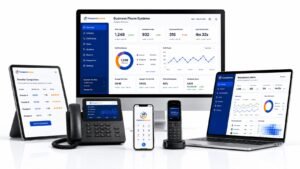
Compare cloud phone systems for UK businesses, including hosted VoIP, cloud PBX, UCaaS and Microsoft Teams Phone options. Check provider suitability, GBP pricing, call routing, mobile apps, CRM integrations, AI features, number porting, internet requirements and PSTN switch-off readiness before choosing the cloud calling platform for your team in 2026.
Cloud first, but check readiness
Choose a cloud phone system only after checking users, numbers, broadband quality, call routing and PSTN migration needs.
Choose The Cloud Phone Route That Fits Your Business
The colour-coded cards separate low-cost hosted VoIP, structured cloud PBX, collaboration-led UCaaS and specialist Microsoft or self-managed routes.
Hosted VoIP
Best for sole traders and SMEs that want quick cloud calling, number porting, mobile apps and simple call routing.
Cloud PBX
Best for offices that need auto-attendants, queues, ring groups, extensions and receptionist-style call control.
UCaaS
Best for hybrid teams that want voice, video, messaging, presence, analytics and integrations in one platform.
Teams / Self-Managed
Best when Microsoft 365, SIP trunks, IT governance or a more controlled deployment shapes the decision.
Compare cloud phone systems for UK businesses, including hosted VoIP, cloud PBX, UCaaS and Microsoft Teams Phone options. Check provider suitability, GBP pricing, call routing, mobile apps, CRM integrations, AI features, number porting, internet requirements and PSTN switch-off readiness before choosing the cloud calling platform for your team in 2026.
Last updated: September 2026
Reviewed by: CompareServices Editorial Team
Reading time: 18–20 minutes
Quick Verdict
Compare cloud phone systems for UK businesses, including hosted VoIP, cloud PBX, UCaaS and Microsoft Teams Phone options. Check provider suitability, GBP pricing, call routing, mobile apps, CRM integrations, AI features, number porting, internet requirements and PSTN switch-off readiness before choosing the cloud calling platform for your team in 2026.
For most UK businesses, a cloud phone system is the practical default in 2026 because it removes on-site PBX dependency, supports app-based calling, enables number portability, and helps companies prepare for the UK PSTN switch-off. GoTo Connect is a strong all-round SME option, bOnline is suitable for startups and micro businesses, and RingCentral is better for teams that need enterprise-grade collaboration and integrations.
Best-fit summary
| Business scenario | Best-fit cloud phone route | Why it fits | Check before choosing |
|---|---|---|---|
| Sole trader or micro business | Low-cost hosted VoIP | Quick setup, UK number, mobile app and simple call handling | Renewal price, number fees and app reliability |
| Small office with reception calls | Cloud PBX or hosted PBX | Auto-attendant, ring groups, queues and department routing | Call-flow limits and setup support |
| Hybrid or remote team | UCaaS platform | Voice, video, messaging, presence and apps in one system | Licence tiers, unused features and integration limits |
| Microsoft 365-led business | Microsoft Teams Phone / Operator Connect | Calling stays inside the Teams environment | Licensing model, routing route and implementation support |
| International calling team | UCaaS provider with international bundles | Predictable calling costs and global number options | Fair-use policy, excluded destinations and mobile rates |
| IT-managed organisation | Self-managed cloud PBX or 3CX-style route | Greater deployment control and SIP provider flexibility | Security updates, backups, support ownership and SIP costs |
| PSTN migration project | Cloud phone system with migration support | Replaces legacy lines and supports digital calling | Number porting, alarms, lifts, fax, payment terminals and failover |
Start here: shortlist providers only after confirming user count, current numbers, contract end dates, required call flows, remote-working needs, call recording policy, Microsoft/CRM integration requirements and any PSTN-dependent equipment.
Why Trust CompareServices?
CompareServices is an independent UK comparison platform. We are not paid to favour any provider. Our editorial team researches every category using verified UK pricing, documented feature sets, and published user reviews from Trustpilot and G2. We cover 105 business services across 9 categories for UK companies of all sizes.
We researched every provider on this page by reviewing UK-specific plan information, GBP pricing where publicly available, support positioning, feature sets and PSTN switch-off readiness. Where a provider uses quote-based pricing, treat the figure as supplier-confirmed-at-time-of-review only after checking directly before purchase.
How we rank providers → | Affiliate disclosure →
What Is a Cloud Phone System?
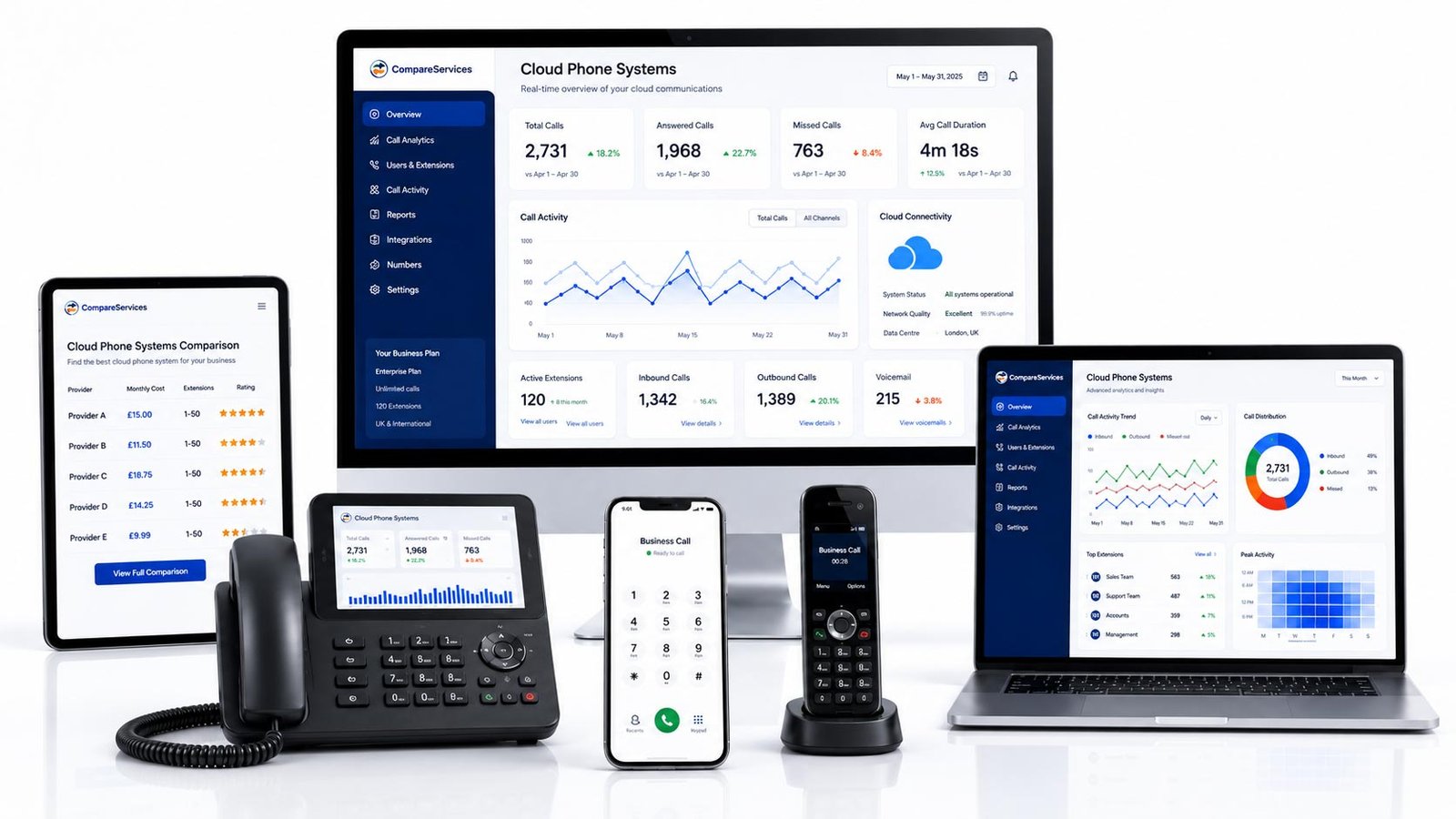
A cloud phone system is a business telephone solution where all the infrastructure — the servers, software, and call routing logic — lives in a remote data centre and is managed by your provider, rather than on physical hardware in your office.
Sometimes called a cloud-based phone system, cloud hosted phone system, or cloud telephone system, it delivers calls over the internet using VoIP (Voice over Internet Protocol) technology instead of traditional copper phone lines.
In practical terms, your team makes and receives business calls through a desktop app, mobile app, or IP desk phone — with no PBX hardware to maintain, no physical lines to manage, and no engineer visits when something needs changing. Everything is configured through a web portal.
What a cloud phone system replaces:
- Traditional analogue landlines (PSTN)
- ISDN phone lines
- On-premise PBX hardware
- Legacy key telephone systems
What a cloud phone system gives you instead:
- A fully managed, cloud-hosted telephony platform
- Per-user monthly subscription (no large upfront capital)
- Mobile and desktop softphone apps so staff can work from anywhere
- Advanced call management: auto-attendant, call queues, ring groups, IVR
- Built-in call recording, voicemail-to-email, analytics, and CRM integration
- Instant scalability — add or remove users in minutes via a web portal
- Full PSTN switch-off compliance ahead of the January 2027 deadline
Cloud Phone System vs Hosted VoIP vs Cloud PBX
These three terms are used interchangeably across the market — but they have slightly different emphases. Here is how to tell them apart.
Cloud Phone System
The broadest term. A cloud phone system is any business telephony platform where the infrastructure is hosted remotely and delivered over the internet. It encompasses cloud VoIP, hosted PBX, and UCaaS within a single umbrella term. When someone searches “cloud phone system UK,” they typically want a modern, hosted, internet-based business phone platform.
Hosted VoIP / Cloud VoIP Phone System
VoIP (Voice over Internet Protocol) is the underlying technology — the engine that makes calls travel over the internet rather than copper lines. Hosted VoIP specifically means the VoIP infrastructure is hosted by a third-party provider rather than managed on your own servers. A cloud VoIP phone system and a cloud phone system are functionally the same thing in 2026.
Cloud PBX (Cloud-Based PBX)
PBX stands for Private Branch Exchange — the telephony switch that routes calls between users and to the outside world. A cloud PBX delivers traditional PBX functionality (extensions, ring groups, auto-attendant, call queues) via the cloud. The distinction from “cloud phone system” is mainly emphasis: cloud PBX leans into the structured call routing capability, while “cloud phone system” is more general.
Cloud UCaaS (Unified Communications as a Service)
UCaaS goes further than a cloud phone system by adding video conferencing, team messaging, file sharing, and collaboration tools alongside voice calling — all in a single platform. Most modern cloud phone systems in 2026 are UCaaS platforms, or have a UCaaS tier.
Quick Reference
| Term | What it means | Primary focus |
|---|---|---|
| Cloud phone system | Umbrella term for all cloud-hosted business telephony | Voice + features |
| Cloud VoIP phone system | Internet-based calling hosted by provider | Voice calls |
| Cloud-based phone system | Same as cloud phone system — alternative phrasing | Voice + features |
| Hosted VoIP | Provider-managed VoIP infrastructure | Voice calls |
| Cloud PBX | Cloud-hosted call routing and exchange | Call management |
| UCaaS | Cloud comms including voice, video, chat, messaging | Full collaboration |
For this guide, we use “cloud phone system” to cover all of the above — because in practice, the best platforms in 2026 blur the boundaries between these categories.
Best Cloud Phone System Providers for UK Businesses (2026)
We evaluated each provider against eight criteria: UK availability and GBP pricing, core calling features, call routing capability, mobile and desktop app quality, integration depth, PSTN switch-off readiness, support quality, and overall value for UK SMEs.
1. GoTo Connect — Best All-Round Cloud Phone System for UK SMEs
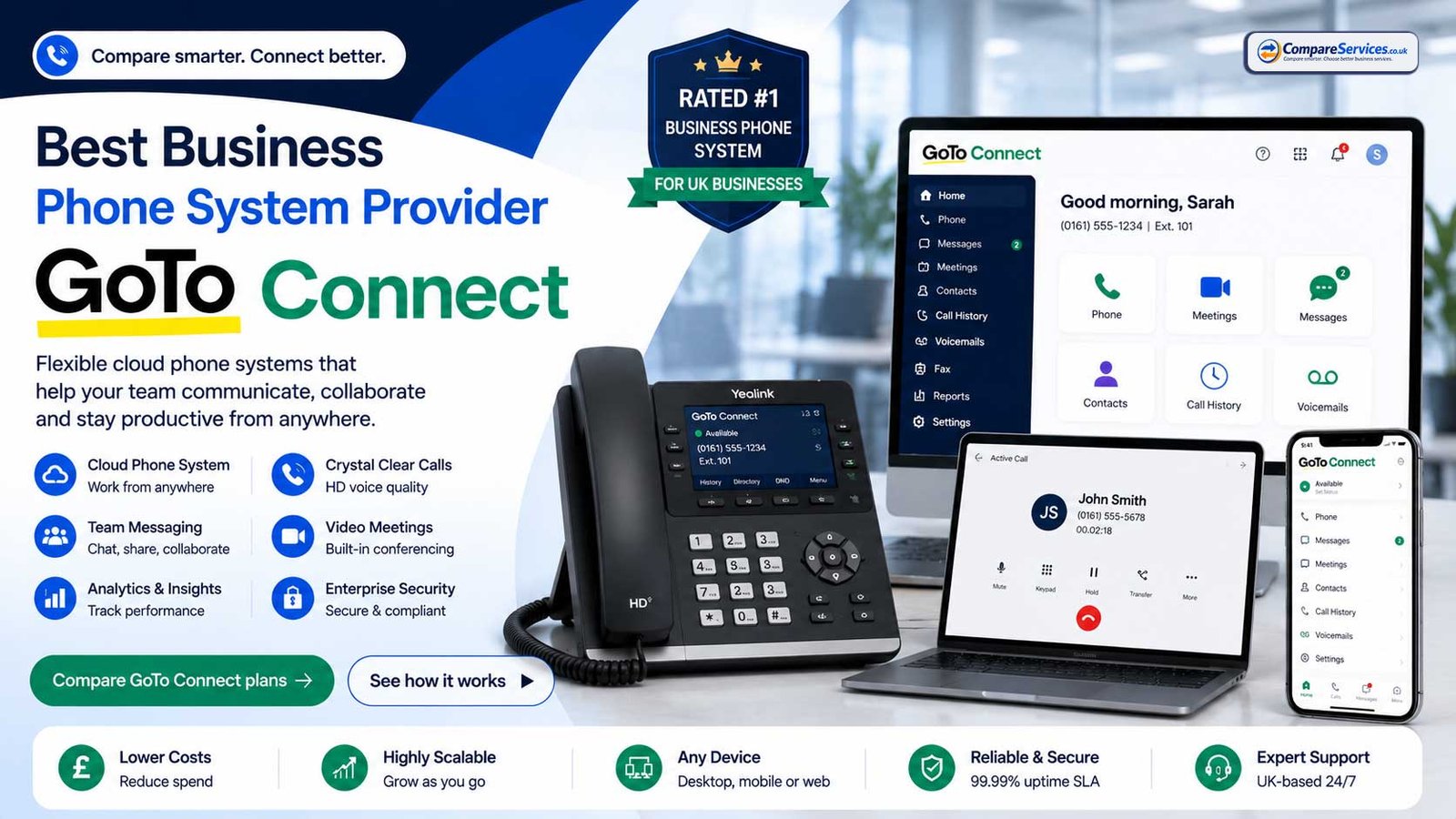
Best for: UK businesses of 5–100 users wanting a reliable cloud phone system with strong call routing, built-in meetings, and international calling.
UK starting price: From ~£18/user/month (billed annually)
Free trial: ✅ Available
PSTN/ISDN ready: ✅ Yes
Overall rating: ★★★★★
GoTo Connect is our top overall pick for UK businesses switching to a cloud phone system in 2026. It balances genuine ease of use with a deep call routing feature set, and its drag-and-drop dial plan builder is the best we have seen for configuring auto-attendants and IVR flows without needing technical expertise.
The platform’s headline advantage for UK businesses is its inclusion of free calling to 50+ countries on the Standard plan — more generous than any competitor at a comparable price point. For businesses with international calling requirements, this alone can generate significant savings.
What we like:
- Drag-and-drop dial plan builder makes configuring complex IVR and call routing genuinely accessible — not just for IT teams
- Unlimited calling to 50+ countries included on Standard plan
- 500-participant video meetings on all plans
- Auto-attendants, call queues, ring groups, and shared voicemail inboxes all included as standard
- Visual call analytics dashboard is easy to interpret and act on
- Broad IP phone compatibility (Poly, Yealink, Cisco) for businesses keeping desk phones
- Instant Response feature automatically texts back missed callers — useful for trades and service businesses
What to watch out for:
- The Basic plan is heavily restricted: limited to 20 users, 1 ring group, 1 call queue, and 1 auto-attendant
- Standard plan pricing requires a direct quote — GoTo does not publish rates publicly
- SMS credits are capped on both plans
Key features: Multi-level auto-attendant · Drag-and-drop dial plan editor · Unlimited call queues (Standard) · Ring groups · 500-seat video meetings · Team messaging · Real-time analytics · International calling (50+ countries) · Shared voicemail inbox · Instant Response auto-text · Mobile and desktop apps · Number porting
Cloud phone system type: Cloud UCaaS
Ideal for: UK SMEs (5–100 users) replacing a PSTN, ISDN, or legacy PBX system; businesses with international teams; trades, clinics, and service businesses needing strong inbound call routing.
2. RingCentral — Best Cloud Phone System for Collaboration and Enterprise Features
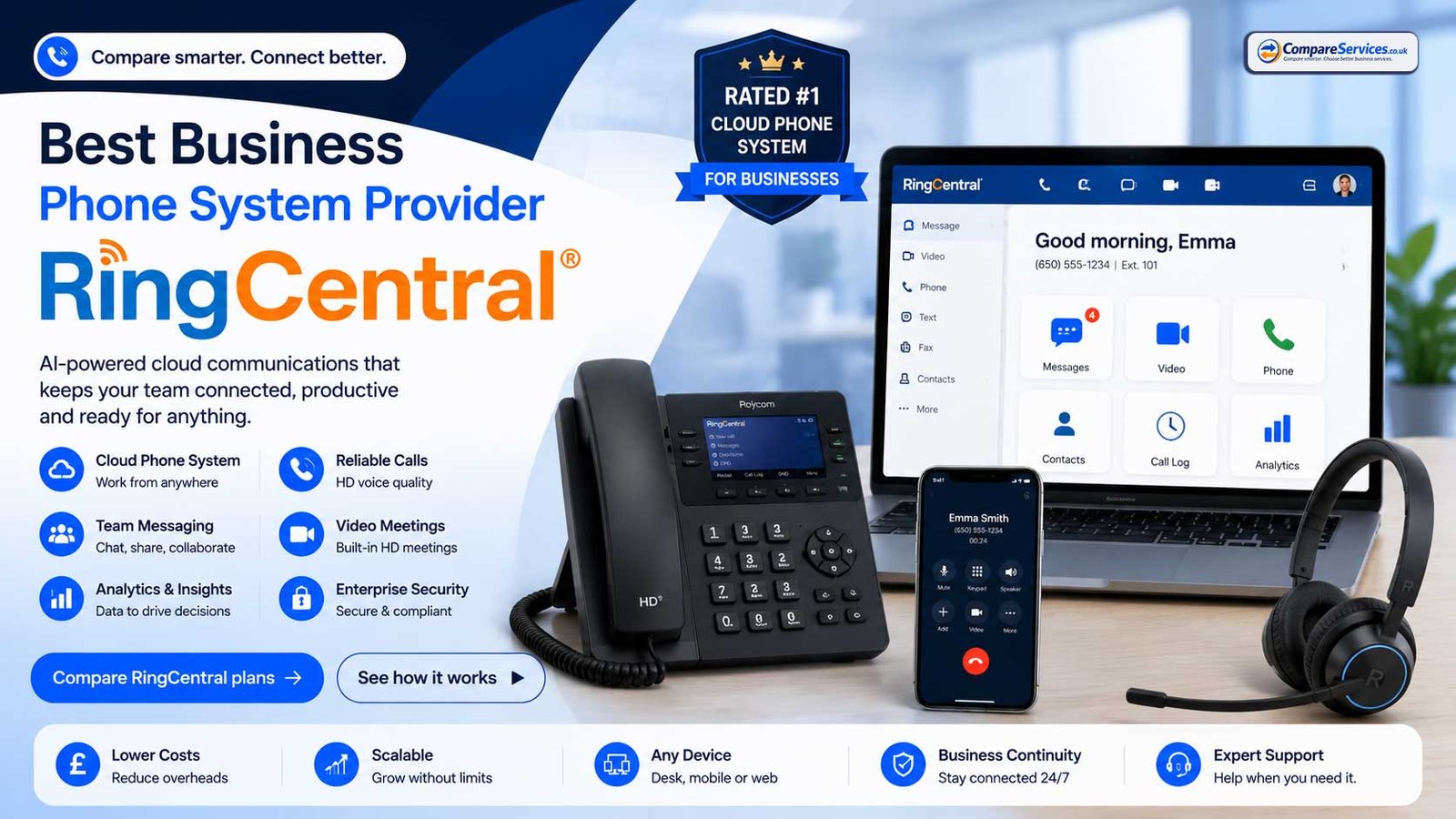
Best for: UK businesses wanting a premium, enterprise-grade cloud phone and UCaaS platform with best-in-class integrations.
UK starting price: From £12.99/user/month (Core, billed annually)
Free trial: ✅ 14-day trial available
PSTN/ISDN ready: ✅ Yes
Overall rating: ★★★★★
RingCentral is one of the most feature-complete cloud phone systems available to UK businesses in 2026. Its cloud PBX delivers 99.999% uptime — the strongest SLA on this list — alongside a 300+ integration ecosystem, customisable analytics, and a collaboration suite that rivals dedicated tools like Slack and Zoom.
RingCentral Ultimate is a strong contender for the best cloud phone system plan for UK businesses, combining best-in-class VoIP call management with powerful staff coaching tools and delivering smooth day-to-day usability.
What we like:
- 99.999% uptime SLA — best in class for mission-critical cloud telephony
- Drag-and-drop IVR editor supports up to 250 IVR call menus
- Ring groups with up to 16 phone numbers per group
- AI call transcription and post-call summaries on the Ultra plan
- Team chat with task management, unlimited channels, and team huddles
- 300+ third-party integrations including Salesforce, HubSpot, Microsoft 365, Zendesk
- Highly customisable analytics dashboards across all tiers
- Video meetings for up to 200 participants with breakout rooms and whiteboards
What to watch out for:
- SMS allowances are capped at 25–200 per user depending on plan — restrictive for text-heavy teams
- Month-to-month pricing is significantly more expensive than annual contracts
- Advanced analytics and AI features require the higher-tier Ultra plan
- Feature depth can feel overwhelming for very small teams with simple needs
UK Plans:
| Plan | UK Price (per user/month) | Key inclusions |
|---|---|---|
| Core | £12.99 | Unlimited UK calls, IVR, call routing, video |
| Advanced | £19.99 | Call queues, advanced reporting, toll-free |
| Ultra | £27.99 | AI transcription, unlimited SMS, intelligent routing |
Key features: Cloud PBX · 99.999% uptime · UCaaS (voice + video + chat) · 250-menu IVR · Call recording · Real-time analytics · 300+ integrations · AI call summaries · Mobile and desktop apps · Number porting
Cloud phone system type: Enterprise cloud UCaaS
Ideal for: UK businesses (10–500 users) that need a full UCaaS platform, deep CRM integration, and enterprise-grade reliability.
3. bOnline — Best Value Cloud Phone System for UK Startups and Micro Businesses
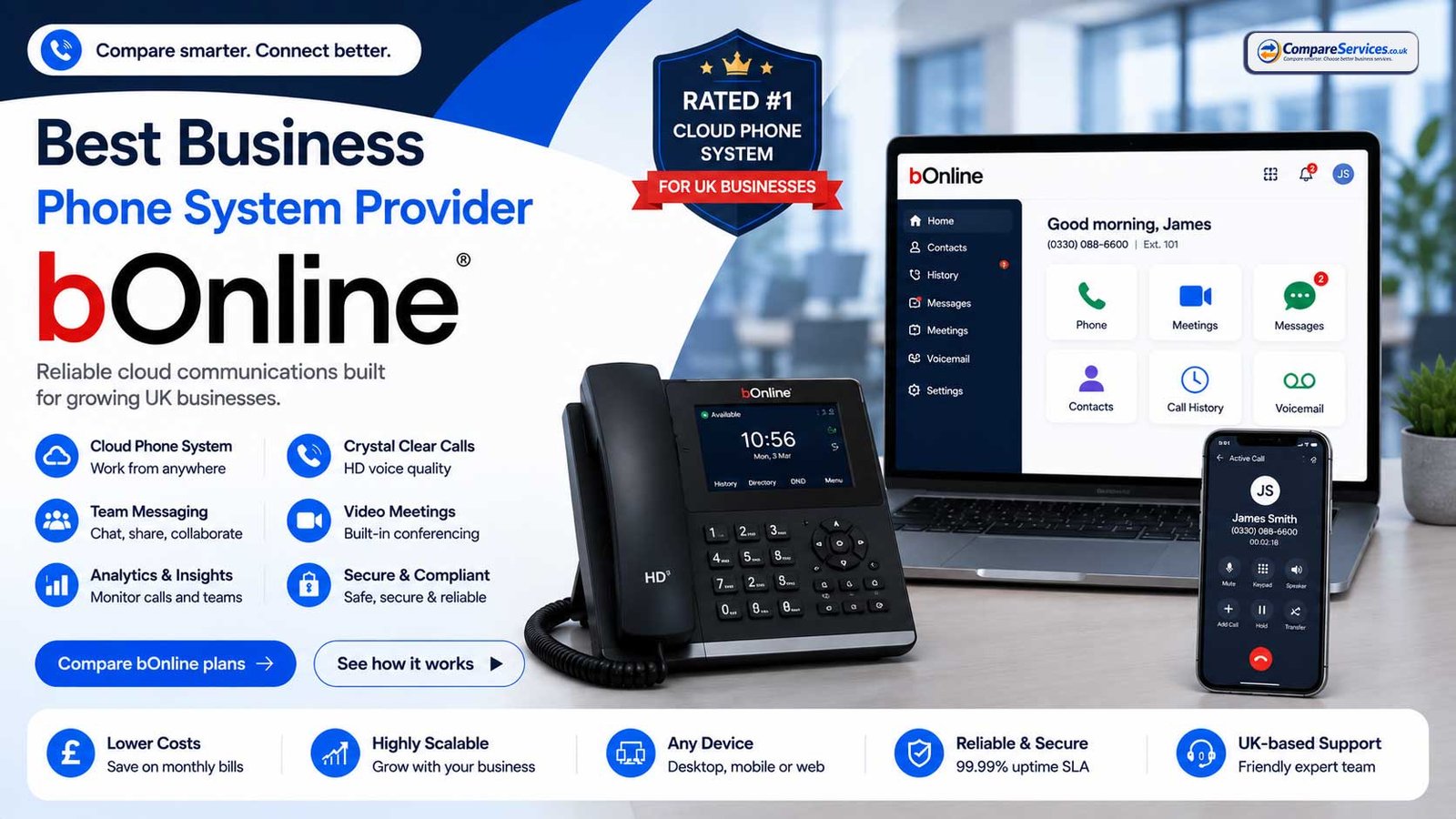
Best for: Sole traders, startups, and micro businesses (1–10 users) wanting an affordable UK cloud phone system fast.
UK starting price: From £6/user/month (introductory); standard from £13.95/user/month + VAT
Free trial: ✅ Available
PSTN/ISDN ready: ✅ Yes
Overall rating: ★★★★☆
bOnline is the most accessible entry point into cloud-based phone systems for UK small businesses. Cloud phone system licences for small businesses start from around £9.98 per user per month in 2026, and bOnline’s pricing sits at the competitive end of that range. The platform is built specifically for the UK market, with UK-based support and same-day setup.
For a sole trader or small team that simply needs a dedicated UK business number, professional auto-attendant, and mobile app — bOnline does the job without the complexity or cost of enterprise platforms.
What we like:
- Quick setup — most customers are live the same day
- Unlimited UK calls included on the core plan
- UK-based customer support
- Clean mobile app for call handling on the go
- Dedicated UK business number from day one
- Very competitive per-user pricing for 1–10 user businesses
What to watch out for:
- No advanced analytics, deep CRM integrations, or AI call features
- International calling costs extra
- Not suitable for businesses with complex multi-site call routing
- Feature set will feel limited as a business scales past 20 users
Key features: Unlimited UK calls · UK business number · Auto-attendant · Call forwarding · Voicemail to email · Mobile softphone app · Call recording (higher plans) · Number porting
Cloud phone system type: Entry-level hosted VoIP
Ideal for: Sole traders, freelancers, startups, and 1–10 user micro businesses needing fast, affordable cloud telephony.
4. 8×8 — Best Cloud Phone System for International Calling
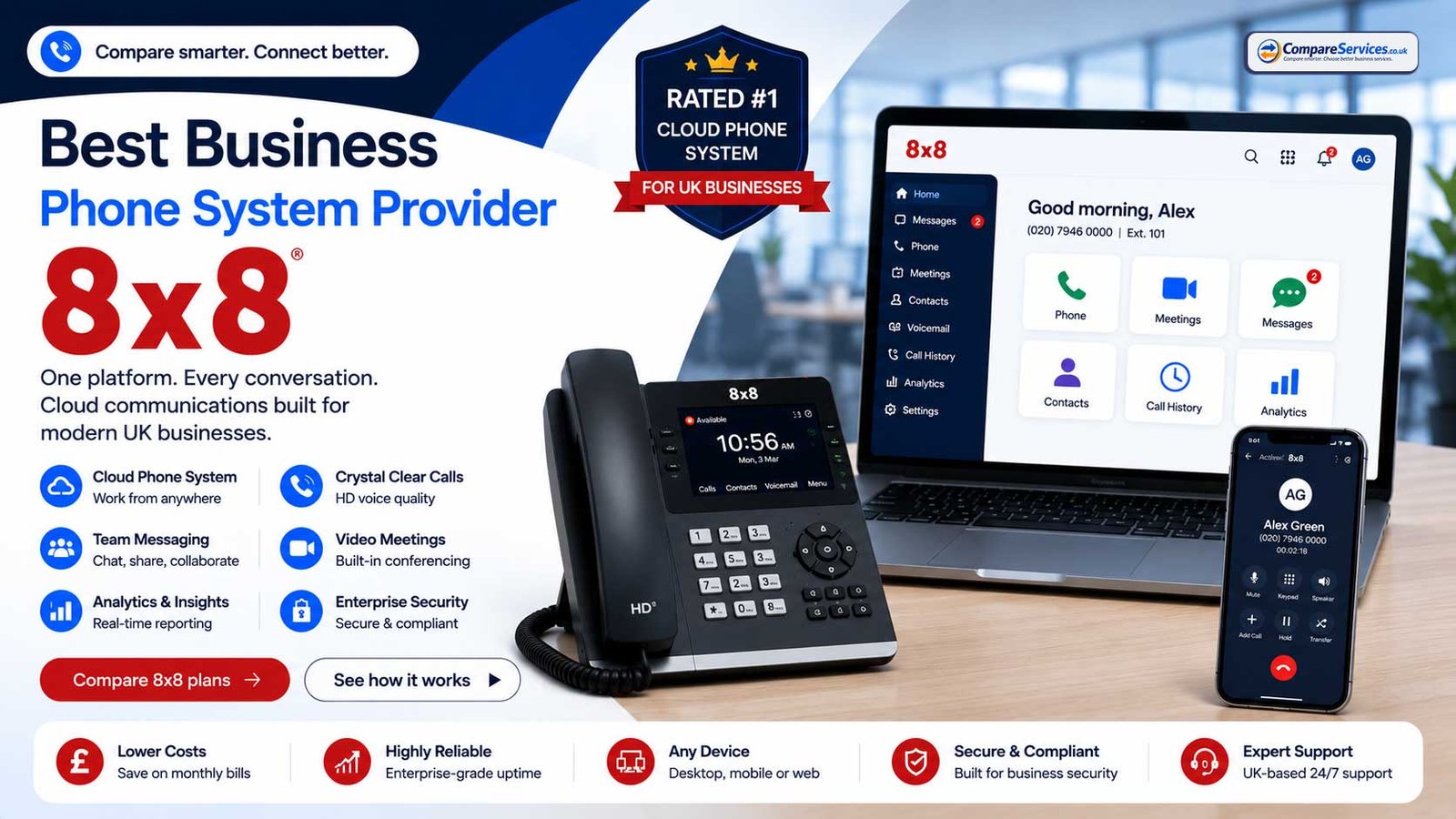
Best for: UK businesses with regular international calling requirements or distributed global teams.
UK starting price: Quote required (contact sales)
Free trial: ❌ No standard trial
PSTN/ISDN ready: ✅ Yes
Overall rating: ★★★★☆
8×8 is one of the strongest cloud phone systems on this list for international calling, with unlimited calling to up to 48 countries on its higher-tier plans. For UK businesses calling regularly into the US, Europe, Australia, and beyond, this can deliver substantial monthly savings compared to per-minute international call rates.
The platform also includes strong supervisor features — listen, whisper, barge, and takeover — making it well-suited for small contact centre operations and customer service teams.
What we like:
- Unlimited international calling to 48 countries — more generous than any competitor at comparable tier
- 500-participant video meetings with breakout rooms and polls across all plans
- Frontdesk interface designed specifically for high-volume reception and operator workflows
- Supervisor features (listen/whisper/barge) available on mid-tier plans
- Strong UK data centre infrastructure
What to watch out for:
- Pricing is not published — requires a sales conversation to get a quote
- International calling excludes mobile numbers in some countries
- Setup and configuration can feel complex without technical support
- Heavier platform than needed for simple SME use cases
Key features: Unlimited calling to 48 countries · Cloud PBX · 500-seat video meetings · Supervisor tools (listen/whisper/barge) · Call queues · Multi-level IVR · Voicemail transcription · CRM integration · 8×8 Frontdesk · Analytics
Cloud phone system type: Enterprise cloud UCaaS
Ideal for: UK businesses (20+ users) with international calling needs, distributed global teams, or small customer service operations.
5. Dialpad — Best AI-Powered Cloud Phone System
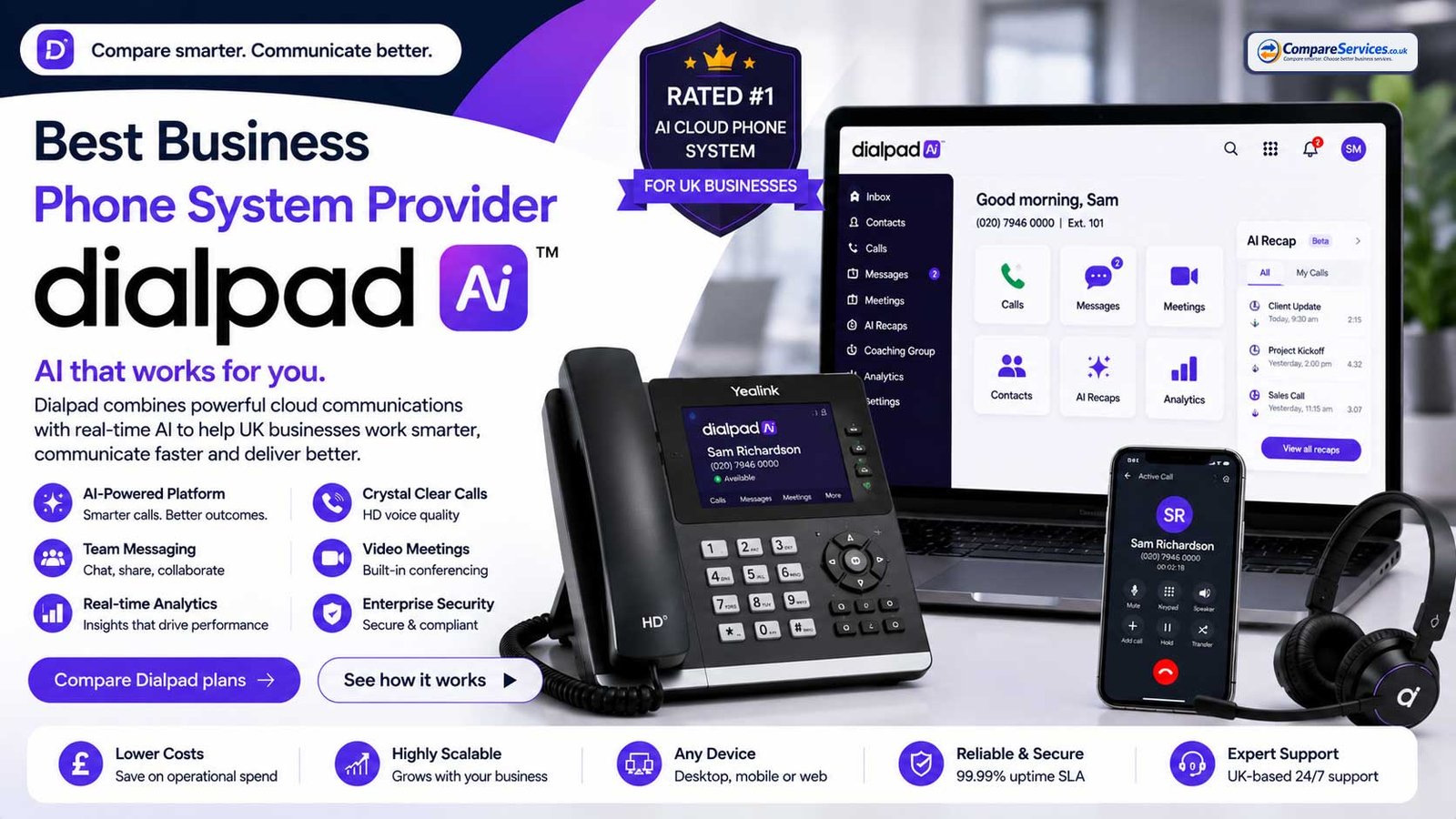
Best for: UK businesses wanting built-in AI features — live transcription, call summaries, and real-time analytics — on every plan.
UK starting price: From £15/user/month (billed annually)
Free trial: ✅ 14-day trial available
PSTN/ISDN ready: ✅ Yes
Overall rating: ★★★★☆
Dialpad is one of the most AI-forward cloud phone systems available to UK businesses in 2026. Every plan — including the entry-level Standard tier — includes live call transcription, real-time analytics, and AI-generated post-call summaries. For sales teams, customer service teams, and any manager who wants to coach staff using call content, Dialpad stands apart from the competition on AI depth alone.
What we like:
- Live call transcription with speaker identification on every plan — not locked behind enterprise tiers
- Real-time AI analytics showing call sentiment, competitor mentions, and keyword flags
- Post-call summaries with automatic action items reduce admin time significantly
- Clean, modern interface with a genuinely low learning curve for day-to-day use
- Virtual phone numbers available in 70+ countries
What to watch out for:
- CRM integrations (Salesforce, HubSpot) require the Pro plan (£25/user/month) or above
- Video meetings are limited to 10 participants — too small for team-wide calls
- 24/7 support only available from the Pro plan upward
- Automatic call recording requires upgrading from the Standard plan
UK Plans:
| Plan | UK Price (per user/month) | Key inclusions |
|---|---|---|
| Standard | £15 | Live transcription, AI summaries, real-time analytics, IVR |
| Pro | £25 | CRM integration, 24/7 support, 25 ring groups |
| Enterprise | POA | 100% uptime SLA, unlimited ring groups |
Key features: Live AI call transcription · AI post-call summaries · Real-time sentiment analytics · Cloud PBX · Multi-level IVR · Call queues · Mobile and desktop apps · Team messaging · CRM integration (Pro+)
Cloud phone system type: AI-first cloud UCaaS
Ideal for: Sales teams, customer service teams, and UK SMEs that want to use AI to reduce post-call admin, improve coaching, and capture insights from call content.
6. Vonage Business — Best Cloud Phone System for API Flexibility
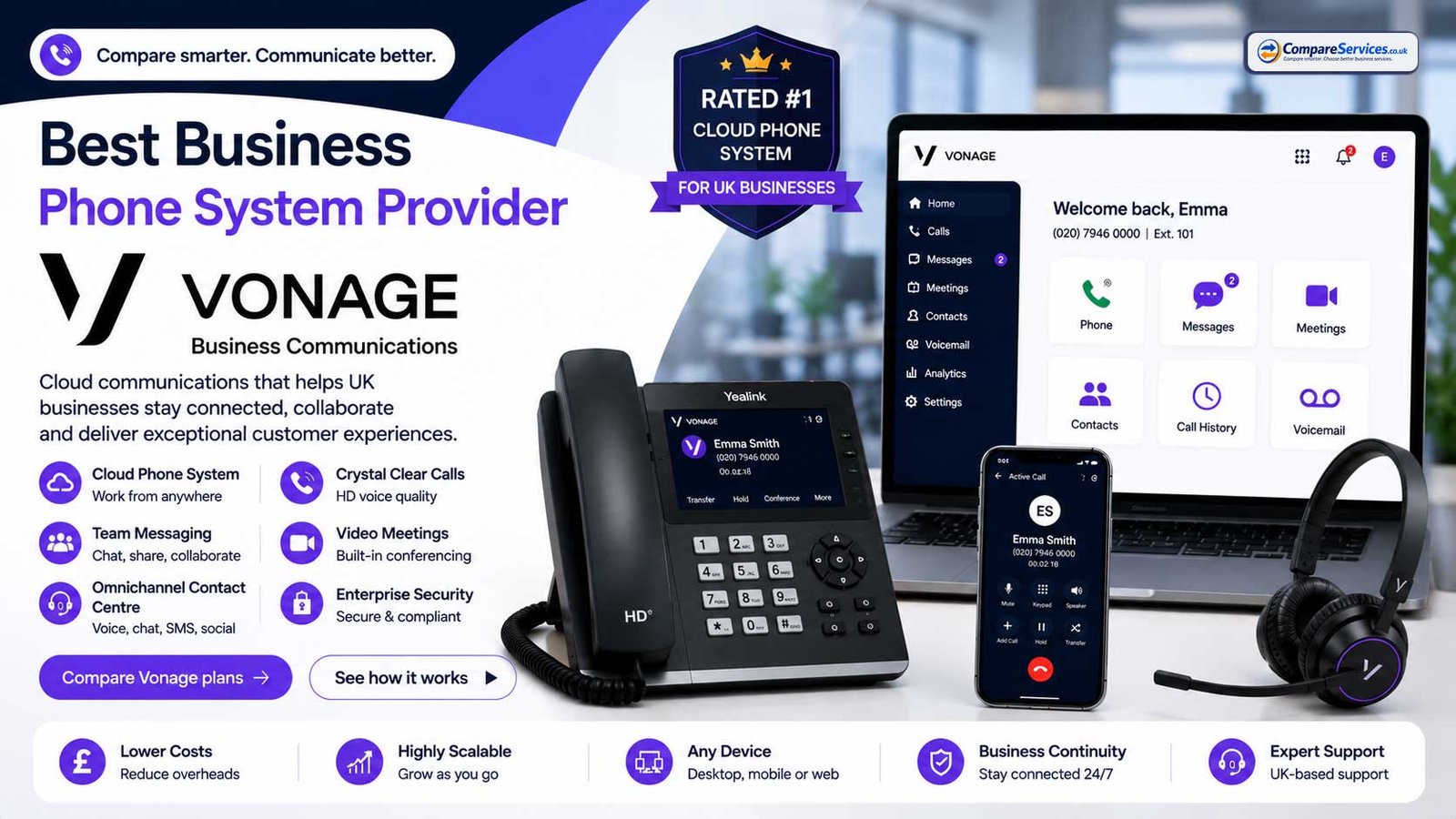
Best for: UK businesses that need API access, custom call workflows, or unlimited UK/US/Canada calling and texting.
UK starting price: From £10/user/month + VAT (billed annually)
Free trial: ✅ 14-day trial available
PSTN/ISDN ready: ✅ Yes
Overall rating: ★★★★☆
Vonage’s cloud-based phone system offers 50+ standard call features, unlimited domestic calling, and a developer-grade Communications API that allows businesses to embed voice and messaging directly into their own applications. For businesses with a development team, Vonage’s API layer is genuinely powerful.
At the standard business communications level, Vonage is also a strong choice for teams that make regular calls to the US, Canada, and Mexico — included free on all plans — or that need unlimited SMS texting alongside their cloud calling.
What we like:
- Unlimited calling to UK, US, and Canada — good for businesses with North American operations
- Communications API is one of the most capable in the market for custom telephony development
- 50+ standard calling features included, including live call controls (hold, park, flip, transfer)
- Wide virtual number options: local, toll-free, and international
- Scalable feature selection — buy features individually rather than paying for bundles
What to watch out for:
- Essential features like call queuing, automatic recording, and AI assistant are paid add-ons
- Basic Mobile plan does not include video conferencing or IVR
- Customer support response times can be inconsistent
- Costs can accumulate once add-ons are included
Key features: Cloud VoIP · API access · 50+ calling features · Video meetings (200 participants) · Team messaging · Unlimited UK/US/Canada calling · CRM integration · Virtual numbers · Mobile and desktop apps
Cloud phone system type: Cloud UCaaS with API layer
Ideal for: UK businesses with development resource wanting custom telephony, teams with US/Canada calling needs, and growing SMEs needing flexible feature selection.
7. Microsoft Teams Phone — Best Cloud Phone System for Microsoft 365 Users
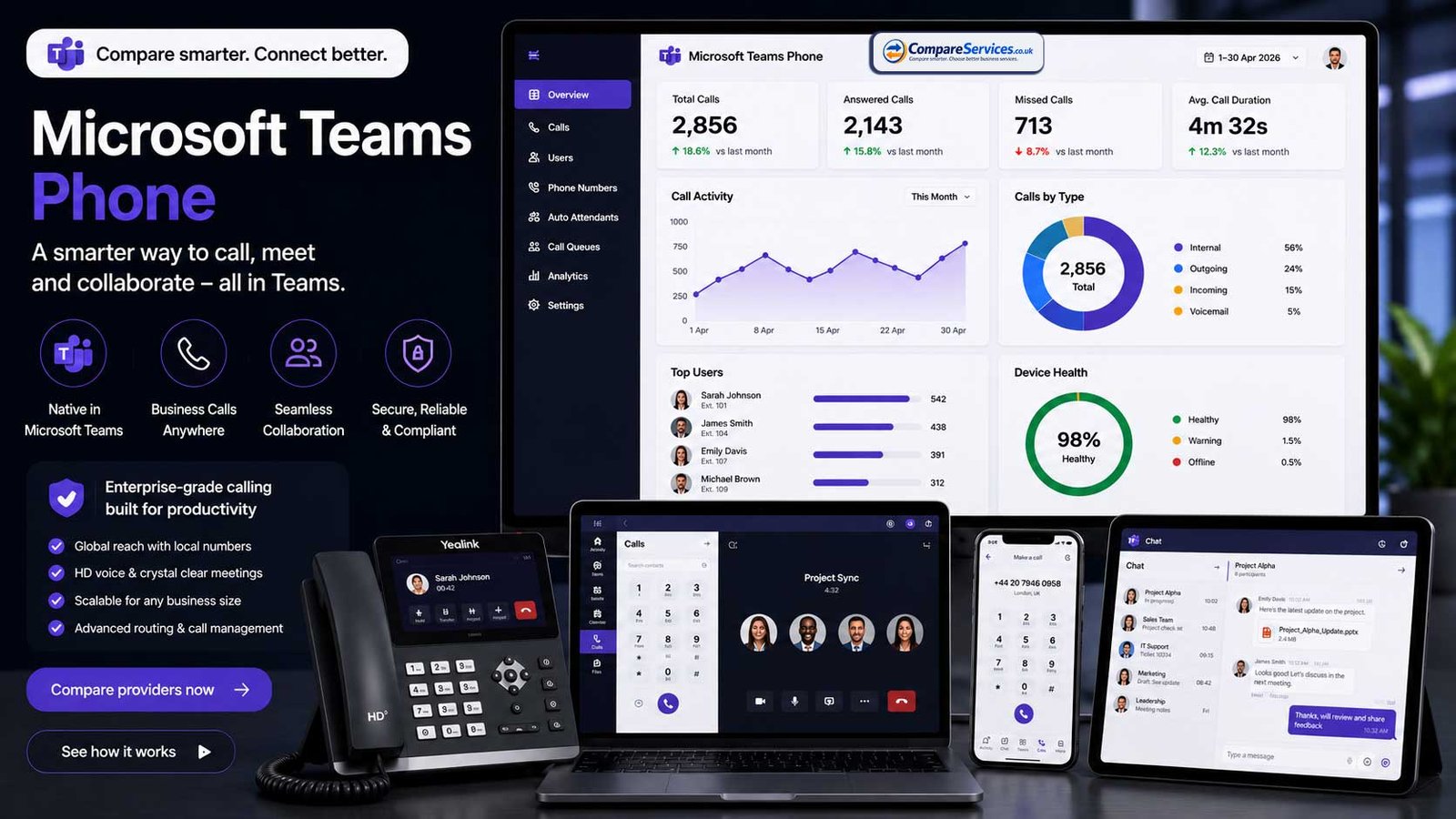
Best for: UK businesses already using Microsoft 365 who want calling integrated directly into Teams.
UK starting price: From £8/user/month (Teams Phone licence) + Microsoft 365 subscription
Free trial: ✅ Microsoft 365 trials available
PSTN/ISDN ready: ✅ Yes
Overall rating: ★★★★☆
For UK businesses already deeply embedded in the Microsoft 365 ecosystem, integrating cloud calling into Teams is the most seamless path to a modern cloud phone system. Rather than introducing a separate app, Teams Phone makes external calls part of the same interface where your team already messages, meets, and shares files.
Delivered via Direct Routing, Operator Connect, or Microsoft Calling Plans, Teams Phone allows businesses to make and receive external calls on their existing business numbers — all within the Teams interface.
What we like:
- Zero context switching — calls happen inside Teams, alongside chat, meetings, and files
- Familiar interface means minimal training for existing Teams users
- Operator Connect simplifies number porting and PSTN connectivity through certified UK partners (BT, Vodafone, and others)
- Strong integration with Microsoft 365 apps: Outlook, SharePoint, Dynamics
- Call recording stored in SharePoint and accessible via Teams admin centre
What to watch out for:
- Teams Phone licence required in addition to existing Microsoft 365 costs
- Advanced call routing (call queues, IVR) requires additional Auto Attendant licences
- Not ideal for businesses with complex call centre requirements without significant add-ons
- Direct Routing requires technical configuration and a Session Border Controller
Delivery options:
- Microsoft Calling Plans — Microsoft provides numbers directly (limited UK PSTN coverage)
- Operator Connect — A UK-certified telecoms provider connects your numbers to Teams
- Direct Routing — Your SIP provider connects to Teams via a Session Border Controller
Key features: Cloud calling in Teams · External number calling · Auto Attendant (add-on licence) · Call queues (add-on licence) · Call recording · Voicemail in Teams · Outlook integration · Number porting · Operator Connect
Cloud phone system type: Microsoft ecosystem cloud telephony
Ideal for: UK businesses (any size) already on Microsoft 365 that want a unified cloud communications environment without a separate phone app.
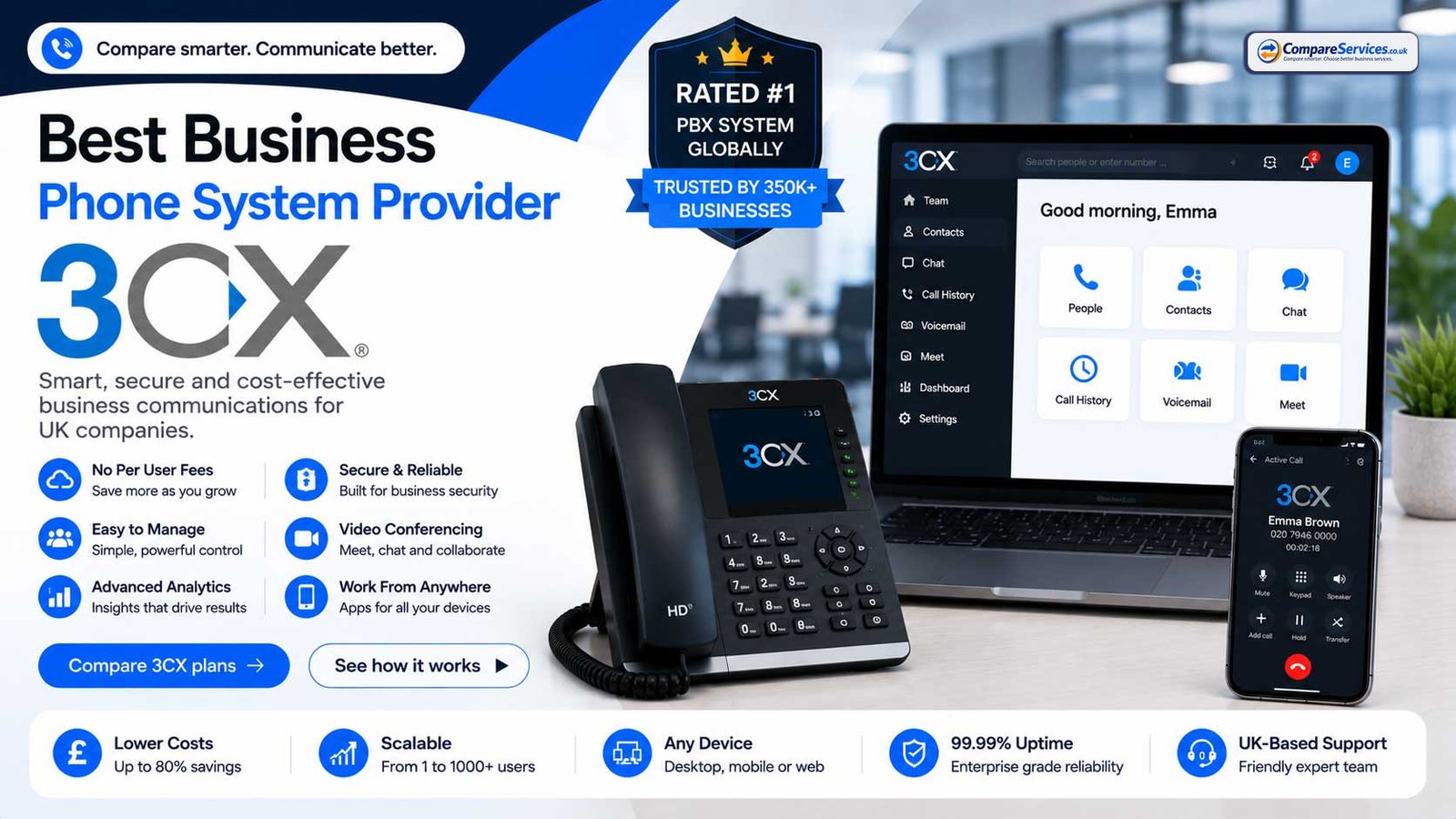
8. 3CX — Best Self-Managed Cloud Phone System
Best for: IT-savvy UK businesses or regulated industries wanting full control over their cloud phone system.
UK starting price: Free for up to 10 users; from £150/year for the system (SIP trunk costs additional)
Free trial: ✅ Free tier available
PSTN/ISDN ready: ✅ Yes (with SIP trunking)
Overall rating: ★★★★☆
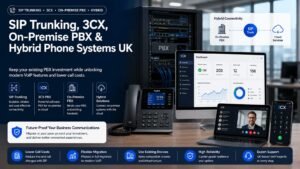
3CX gives businesses the software to run their own cloud-based PBX — either hosted on their own infrastructure or deployed in a cloud environment (AWS, Azure, Google Cloud). Unlike the fully managed platforms above, 3CX puts the business in control of their own telephony stack.
SIP trunking connects an existing on-premise PBX to the internet, replacing traditional phone lines. A cloud phone system replaces the on-premise PBX entirely. If you have a modern on-premise system you want to keep, SIP trunking is the right choice. If you want to eliminate on-premise hardware and move everything to the cloud, a hosted cloud phone system is the better option.
What we like:
- Genuinely free for up to 10 simultaneous calls — one of the few platforms with a permanent free tier
- Full control over data location, security configuration, and system management
- Broad SIP device and desk phone compatibility
- Video conferencing, WebRTC browser calling, and CRM integration built in
- Microsoft Teams integration available
What to watch out for:
- Requires meaningful technical knowledge to deploy, configure, and maintain
- Your team is responsible for security patches and system updates
- SIP trunk provider required separately — adds cost and configuration complexity
- No built-in UK PSTN support — relies on UK partner network for PSTN connectivity
Key features: Self-hosted or cloud deployment · Cloud PBX · Video conferencing · WebRTC calling · Live chat · CRM integration · Teams integration · IVR · Call queues · Mobile apps
Cloud phone system type: Self-managed cloud PBX
Ideal for: IT-managed UK businesses, regulated industries requiring data sovereignty, and organisations with specific compliance requirements.
Provider Quick Comparison
| Provider | Best For | UK Price From | Free Trial | AI Features | PSTN Ready | Rating |
|---|---|---|---|---|---|---|
| GoTo Connect | All-round SME | ~£18/user/mo | ✅ | ⚠️ Basic | ✅ | ★★★★★ |
| RingCentral | Enterprise UCaaS | £12.99/user/mo | ✅ 14-day | ✅ Ultra plan | ✅ | ★★★★★ |
| bOnline | Startups / micro | £13.95/user/mo | ✅ | ❌ | ✅ | ★★★★☆ |
| 8×8 | International calling | Quote | ❌ | ⚠️ Mid-tier | ✅ | ★★★★☆ |
| Dialpad | AI-first cloud calling | £15/user/mo | ✅ 14-day | ✅ All plans | ✅ | ★★★★☆ |
| Vonage | API / flexibility | £10/user/mo | ✅ 14-day | ⚠️ Add-on | ✅ | ★★★★☆ |
| Teams Phone | Microsoft 365 users | £8/user/mo + M365 | ✅ | ⚠️ Copilot add-on | ✅ | ★★★★☆ |
| 3CX | IT-managed / self-hosted | Free–£150/yr | ✅ | ❌ | ✅ (SIP) | ★★★★☆ |
Cloud Phone System Features Explained
When comparing cloud-based phone systems, these are the features you will encounter most frequently — and what they actually mean for your business.
Auto-Attendant (Virtual Receptionist)
A recorded greeting that answers incoming calls automatically and presents a menu to route callers (“Press 1 for sales, Press 2 for support”). Every cloud phone system includes at least a single-level auto-attendant. Multi-level auto-attendants allow nested menus for larger organisations with multiple departments.
Essential for: Any business receiving more than 10 inbound calls per day. Without an auto-attendant, callers hear a standard ring with no guidance.
IVR (Interactive Voice Response)
An advanced version of auto-attendant that uses caller input — via keypad or voice — to route calls dynamically, serve self-service information, or trigger automated workflows. Enterprise-grade cloud phone systems support multi-level IVR with conditional logic, time-of-day routing, and caller ID matching.
Call Queues
When all agents are busy, call queues hold callers in a virtual waiting line rather than directing them to voicemail or a busy signal. Configurable with on-hold music, position announcements, maximum wait times, and overflow routing.
Ring Groups (Hunt Groups)
Routes an incoming call to a group of extensions simultaneously (blast ring) or sequentially (linear hunt) until someone answers. Essential for sales and support teams sharing a single inbound number.
Call Recording
Records inbound and outbound calls and stores them — typically in cloud storage — for a defined retention period. Used for training, compliance (particularly in regulated sectors: financial services, legal, healthcare), dispute resolution, and quality assurance.
UK compliance note: Under UK GDPR and the Data Protection Act 2018, businesses must inform callers that their call may be recorded. Most cloud phone systems handle this via an auto-attendant announcement.
Softphone App
A mobile or desktop application that allows users to make and receive calls on their business number from any device with an internet connection. The most important feature for remote and hybrid working — no dedicated desk phone hardware required.
Voicemail to Email
Converts voicemail messages into audio files (typically MP3) and delivers them to the user’s email inbox with a transcript. Ensures messages are never missed and can be reviewed without dialling in.
CRM Integration
Connects your cloud phone system to your CRM — Salesforce, HubSpot, Zoho, Microsoft Dynamics — so that calls are logged automatically, caller details pop up on screen before you answer, and you can click-to-dial directly from contact records.
Call Analytics and Reporting
Real-time and historical dashboards showing call volumes, queue wait times, missed calls, agent call duration, and performance metrics. Ranges from basic call logs (included on most plans) to AI-powered real-time analytics on premium tiers.
Number Portability
The ability to keep your existing business phone numbers when switching to a cloud phone system. UK number porting takes 5–15 working days. Your new provider manages the process — you do not need to contact your current provider separately (they are legally obligated to release the number).
Direct Dial Numbers (DDIs)
Individual phone numbers assigned to specific users or departments, allowing callers to bypass the main number and auto-attendant. Standard on all hosted cloud phone systems.
HD Voice
High-definition audio codec technology (such as Opus or G.722) that delivers significantly clearer call audio than traditional PSTN lines. Most cloud phone system providers support HD voice as standard.
Video Conferencing
Integrated video meetings accessible within the cloud phone platform. Quality and participant limits vary significantly — from 10 participants (Dialpad Standard) to 500 participants (GoTo Connect, 8×8).
Presence Indicators
Real-time status indicators showing whether a colleague is available, on a call, in a meeting, or away. Helps teams route calls efficiently and reduces missed connections.
Call Flip
The ability to move an active call from one device to another — for example, from a desk phone to a mobile — without interrupting the conversation. Available on most cloud phone systems.
How Much Does a Cloud Phone System Cost in the UK?
Cloud phone system pricing in the UK is structured primarily on a per-user, per-month subscription model. Here is a realistic overview of what UK businesses pay in 2026.
Monthly Per-User Costs by Tier
| Tier | Typical UK Cost (per user/month) | What’s typically included |
|---|---|---|
| Entry / Basic | £6–£15 + VAT | Unlimited UK calls, auto-attendant, voicemail, mobile app |
| Standard / Professional | £15–£25 + VAT | Call recording, call queues, video, CRM integration, analytics |
| Advanced / Enterprise | £25–£40+ + VAT | AI features, supervisor tools, advanced IVR, contact centre add-ons |
Additional Costs to Budget For
- IP desk phones: £80–£400 per handset (purchase) or £4–£15/month (hardware-as-a-service)
- Number porting: Usually free, or £10–£25 per number depending on provider
- Setup and onboarding: Free on most cloud platforms; £500–£2,000 for managed enterprise deployments
- CRM integration add-ons: Often free on mid-tier plans; £5–£15/user/month on entry plans
Real-World Cost Example: 15-User UK SME
| Item | Monthly Cost |
|---|---|
| 15 users × £18/month (GoTo Connect Standard) | £270 |
| 15 IP desk phones at £8/month rental | £120 |
| Number porting (one-off, amortised) | ~£5 |
| Total monthly | ~£395 + VAT |
Compare to: Legacy ISDN30 (15 channels) at £40–£55/channel/month = £600–£825/month
Estimated saving: £200–£430/month, or £2,400–£5,160/year.
Free Tiers and Trials
- 3CX: Free for up to 10 simultaneous calls permanently
- GoTo Connect: Free trial available
- RingCentral: 14-day free trial
- Dialpad: 14-day free trial
- Vonage: 14-day free trial
Get a personalised cloud phone system quote for your team size →
Cloud Phone System for Small Business
A cloud phone system is particularly well-suited to small businesses in the UK for five specific reasons.
1. No Upfront Capital Expenditure
Traditional PBX phone systems required upfront investment of £2,000–£10,000+ in hardware before a single call could be made. There is no bulky PBX box sitting in your server room, no expensive line rental, and no engineer visit every time you want to add a new user. A cloud phone system has zero upfront hardware cost — you pay a monthly subscription from day one.
2. Professional Image from Day One
A cloud-based phone system gives a small business all the telephony infrastructure of a large company: a dedicated UK business number, multi-level auto-attendant, hold music, call recording, and voicemail-to-email. Callers experience a polished, professional system regardless of whether the “office” is a kitchen table or a shared workspace.
3. Works for Remote and Hybrid Teams
With a traditional on-premise PBX, your business owns and maintains a physical telephone exchange. A cloud business phone system replaces all of that with a subscription-based service you manage through a web portal or app — no server room required. Every team member, whether in the office, at home, or on the road, uses the same app on their device and presents the same business number to customers.
4. Scales Instantly
Adding a new team member to a cloud phone system takes minutes via a web portal — no engineer visit, no new hardware provisioning, no waiting. This is particularly important for fast-growing small businesses and those with seasonal staffing requirements.
5. PSTN Switch-Off Compliance
Any small business still on a traditional PSTN or ISDN landline must migrate before the January 2027 switch-off deadline. A cloud phone system is the fastest and most cost-effective migration path.
What Small Businesses Should Look for in a Cloud Phone System
- Mobile-first: Can staff use a smartphone app as their main business phone? This is non-negotiable for flexible small teams.
- Quick setup: Can the system be configured and live within 24–48 hours?
- UK number: Does the plan include a dedicated UK geographic or non-geographic business number?
- Auto-attendant: Even a single-level auto-attendant (“You’ve reached [Business Name], press 1 for sales…”) makes a significant difference to how professional a small business appears.
- Fair pricing: For a 1–5 user business, £10–£15/user/month is a reasonable target for a fully functional cloud phone system.
Cloud-Based Phone System vs On-Premise PBX
The most significant technology decision in UK business telephony right now is whether to migrate to a cloud-based phone system or retain an on-premise solution. The January 2027 PSTN switch-off has made this question urgent for any business still on ISDN.
| Factor | Cloud-Based Phone System | On-Premise IP PBX |
|---|---|---|
| Upfront cost | None | £2,000–£10,000+ |
| Monthly cost | Per-user subscription | SIP trunk costs only (post-installation) |
| Setup time | Hours to days | Days to weeks |
| Hardware on site | No (softphones) or IP phones only | Server + handsets + network infrastructure |
| IT expertise required | Low — provider manages the system | High — in-house or partner |
| Scalability | Instant | Hardware provisioning required |
| Remote working | Fully supported via app | Requires additional configuration |
| Feature updates | Automatic — included in subscription | Manual — requires IT resource |
| Uptime guarantee | 99.9%–99.999% (provider managed) | Dependent on your infrastructure |
| PSTN/ISDN switch-off | Fully compliant | Compliant only with SIP trunk upgrade |
| Best suited to | Most UK SMEs | Large enterprise, regulated sectors |
The verdict for 2026: For businesses with under 200 employees, cloud-based phone systems deliver better value, faster setup, lower total cost of ownership, and full PSTN switch-off compliance. The on-premise case only holds for large enterprises with specific security, compliance, or data sovereignty requirements.
How to Set Up a Cloud Phone System
Setting up a cloud phone system for your UK business is significantly simpler than installing traditional telephony. Here is the complete process.
Step 1: Audit Your Current Telephony
Before choosing a provider, document what you currently have:
- How many active phone lines and numbers?
- Are they PSTN, ISDN, or already VoIP?
- Do you have a physical PBX? Make and model?
- What other devices use the phone lines (fax, alarm, lift, PDQ terminal)?
- What is your current monthly telecoms bill?
Step 2: Define Your Requirements
Answer these questions to build your shortlist:
- How many users need phone access?
- Are users office-based, remote, or hybrid?
- Do you receive high inbound call volumes needing queuing and routing?
- Do you need international calling, and to which countries?
- Which software needs phone integration? (CRM, helpdesk, ticketing)
- Do you have compliance requirements (call recording, UK data residency)?
- What is your budget per user per month?
Step 3: Test Your Internet Connection
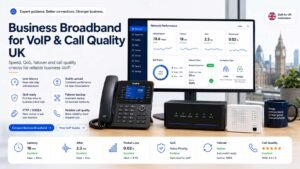
Cloud phone systems depend on your broadband. Run a VoIP readiness check before choosing a provider. You need at minimum 1 Mbps upload speed per concurrent call, with latency under 150ms and packet loss under 1%.
Step 4: Choose Your Provider and Plan
Select a provider based on your requirements from Step 2. Sign up for a free trial where available — use the trial period specifically to test call quality, configure your auto-attendant, and test the mobile app.
Step 5: Configure Your Cloud Phone System
Most providers include a guided setup wizard. You will need to:
- Create user accounts and assign extensions
- Set up your auto-attendant greeting and menu options
- Configure ring groups and call queues
- Set business hours routing (in-hours vs out-of-hours behaviour)
- Upload on-hold music or messages
- Configure voicemail for each user
Step 6: Port Your Existing Numbers
Request number porting to transfer your existing UK business numbers to your new cloud phone system:
- Geographic numbers (01/02): 5–10 working days
- Non-geographic numbers (03/08): 10–15 working days
- Request porting at least 3 weeks before your old service ends
Step 7: Train Your Team
Most cloud phone systems are designed for self-service, but a one-hour team walkthrough covering the mobile app, voicemail setup, and call transfer procedures saves significant friction on day one.
Step 8: Cancel Your Legacy Lines
Once the cloud phone system is live and numbers are ported, cancel your legacy PSTN/ISDN lines. Most providers will port your numbers before this step is needed — confirm the numbers are live and working before cancelling.
Total setup time: A basic cloud phone system for a 10-user business can be configured and live within 24–48 hours. Number porting adds 5–15 working days.
Internet Requirements for a Cloud Phone System
Your cloud phone system’s call quality depends entirely on the quality of your internet connection. Here are the requirements and recommendations.
Minimum Broadband Specifications
| Metric | Minimum | Recommended |
|---|---|---|
| Upload speed | 1 Mbps per concurrent call | 2+ Mbps per concurrent call |
| Latency (RTT) | Under 150ms | Under 80ms |
| Jitter | Under 30ms | Under 10ms |
| Packet loss | Under 1% | Under 0.5% |
For a 10-user office where up to 5 calls may run simultaneously, you need at minimum 5 Mbps dedicated upload bandwidth.
Internet Types Ranked for Cloud VoIP
Full Fibre (FTTP) — Best. Symmetrical speeds up to 1Gbps, low latency, no contention at the cabinet. Recommended for any office with 5+ concurrent calls.
FTTC (Fibre to the Cabinet) — Good for small teams (up to 10 concurrent calls on a good connection). Upload speeds of 10–20 Mbps are typically sufficient for most SMEs.
Leased Line — Recommended for businesses where telephony is mission-critical. A dedicated, uncontended connection with guaranteed uptime SLA. Required for contact centres or businesses with 20+ concurrent calls.
4G/5G — Acceptable as a backup connection but not reliable as a primary for a cloud phone system. Use as a failover option only.
Quality of Service (QoS)
Configure QoS settings on your router to prioritise voice traffic (RTP packets) over other data. This prevents large file downloads or video streams from degrading call quality. Most business-grade routers support QoS; consumer routers typically do not.
Compare business broadband for cloud VoIP →
Cloud Phone System and the PSTN Switch-Off
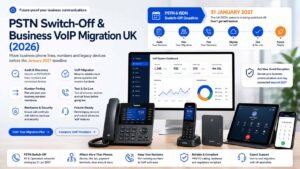
The UK’s legacy PSTN (Public Switched Telephone Network) and ISDN infrastructure is being permanently retired on 31 January 2027. This makes migrating to a cloud phone system no longer optional for any business currently using analogue or ISDN lines.
What Gets Switched Off
- All PSTN analogue landlines
- ISDN2 and ISDN30 business lines
- Legacy PBX systems that connect via ISDN
What Still Needs Individual Solutions
Not everything can simply be plugged into a cloud phone system. These connected devices need their own migration plan:
- Fax machines — Migrate to cloud fax or email-to-fax service
- Door entry systems — Replace with IP-based entry or GSM-connected units
- Lift emergency lines — Replace with GSM or IP emergency call units
- PDQ/card payment terminals — Migrate to IP or mobile connectivity
- Burglar and fire alarm diallers — Replace with GSM or IP communicators
Migration Timeline
A realistic PSTN migration timeline for a 20-user UK SME:
| Week | Activity |
|---|---|
| Week 1–2 | Audit all connected devices and phone lines |
| Week 3–4 | Choose cloud phone system provider and sign up |
| Week 4–5 | Configure system, train users |
| Week 5–7 | Submit number porting request (allow 5–15 working days) |
| Week 7–8 | Go live on cloud phone system, test all numbers |
| Week 8–9 | Cancel legacy PSTN/ISDN lines |
Start now. Businesses should avoid leaving migration planning until late 2026, because number porting, equipment checks and supplier onboarding can take longer than expected.
Get a free PSTN switch-off migration quote →
AI Features in Cloud Phone Systems (2026)
Artificial intelligence has transformed cloud phone systems in 2026. Here is what AI now delivers across leading platforms and which providers include it without additional cost.
Live Call Transcription
Converts a phone call into text in real time, displayed on screen as the conversation happens. Useful for note-taking, compliance, and identifying key information without distraction.
Included as standard on: Dialpad (all plans), RingCentral Ultra
Post-Call Summaries and Action Items
Automatically generates a written summary of each call, highlights key discussion points, and extracts action items. Reduces the time agents spend writing call notes after each conversation.
Included as standard on: Dialpad (all plans), GoTo Connect (higher plans), RingCentral Ultra
Real-Time Sentiment Analysis
Analyses the emotional tone of a call in real time — detecting when a customer becomes frustrated, for example — and alerts supervisors or surfaces coaching prompts for agents. Useful for customer service and sales teams.
Included as standard on: Dialpad Pro and above
AI-Powered Call Routing (Intelligent IVR)
Uses natural language processing (NLP) to understand what a caller says and route them accordingly — removing the need for callers to navigate numeric menus. Callers can say “I want to check my account” rather than pressing 3.
Available on: RingCentral Ultra and selected advanced UCaaS plans
Smart Voicemail Transcription
Converts voicemail messages to text and delivers them via email, allowing users to read messages without listening to audio. Standard on most cloud phone systems, but AI-powered versions are more accurate and include caller identification.
Included on: Most mid-tier cloud phone system plans
AI-Powered Analytics
Identifies patterns in call data — peak call times, common customer queries, agent performance trends — and surfaces actionable recommendations rather than simply presenting raw data.
Available on: Dialpad (all plans), RingCentral Advanced and Ultra, 8×8 (mid-tier+)
Cloud Phone System FAQs
What is a cloud phone system?
A cloud phone system is a business telephone platform hosted entirely by a third-party provider in remote data centres, rather than on physical hardware at your premises. Calls are delivered over the internet using VoIP technology. Also called a cloud-based phone system, hosted VoIP, or cloud PBX.
What is the difference between a cloud phone system and VoIP?
VoIP (Voice over Internet Protocol) is the underlying technology that enables calls to travel over the internet. A cloud phone system is a complete business telephony platform built on VoIP technology. All cloud phone systems use VoIP, but not all VoIP solutions are full cloud phone systems — some are simple call apps without the business features (auto-attendant, call recording, analytics, etc.).
What is the best cloud phone system for small business UK?
For most UK small businesses in 2026, GoTo Connect (5–50 users) and bOnline (1–10 users) are the strongest options. GoTo Connect offers the best all-round feature set at a competitive price. bOnline is the most affordable entry point for sole traders and micro businesses. If AI call features matter, Dialpad includes live transcription on its standard plan.
How much does a cloud phone system cost in the UK?
Cloud phone systems for UK businesses start from around £6–£15/user/month at entry level, rising to £25–£40/user/month for full UCaaS platforms with AI features and advanced analytics. A typical 10-user UK SME on a mid-tier cloud phone system spends approximately £200–£350/month including any desk phone rental.
Does a cloud phone system need special hardware?
No. Most cloud phone systems work via a softphone app on your existing laptop, tablet, or smartphone — no additional hardware required. If your team prefers physical desk phones, you need IP phones (SIP phones) that connect via your office network. Popular choices include Yealink T-series, Poly Edge, and Cisco 8800 series.
Can I keep my business phone number when switching to a cloud phone system?
Yes. UK number porting allows you to transfer your existing geographic (01/02) and non-geographic (03/08) numbers to your new cloud phone system. The process takes 5–15 working days and is managed by your new provider.
What internet speed do I need for a cloud phone system?
A minimum of 1 Mbps upload speed per concurrent call. A 10-user office typically needs 5 Mbps upload minimum. For the best call quality, full fibre (FTTP) broadband or a leased line is recommended. Latency should be under 150ms and packet loss under 1%.
Is a cloud phone system the same as hosted VoIP?
In practice, yes — the terms are used interchangeably in 2026. Technically, “hosted VoIP” refers specifically to the provider hosting the VoIP infrastructure, while “cloud phone system” is a broader commercial term. Both describe the same fundamental setup: internet-based business calling with no on-site hardware, managed by a third-party provider.
Does a cloud phone system work when the internet goes down?
Most cloud phone systems include failover routing — automatically forwarding calls to a mobile number if your internet connection drops. For mission-critical telephony, a 4G/5G backup internet connection eliminates virtually all risk of call disruption during broadband outages.
What is a cloud PBX?
A cloud PBX is a cloud-hosted Private Branch Exchange — the switch that routes calls between users and to the outside telephone network. It delivers traditional PBX functionality (extensions, ring groups, auto-attendant, IVR, call queues) via the cloud, without on-site hardware.
How does the PSTN switch-off affect cloud phone systems?
Positively. Cloud phone systems are already PSTN switch-off compliant — they use the internet rather than legacy copper phone lines. Businesses migrating from PSTN to a cloud phone system are not just managing the switch-off; they are gaining a significantly more capable, scalable, and cost-effective telephony platform.
What is UCaaS and how does it relate to a cloud phone system?
UCaaS (Unified Communications as a Service) is a cloud phone system that also includes video conferencing, team messaging, file sharing, and collaboration tools alongside voice calling — all in a single platform. Most leading cloud phone systems in 2026 are UCaaS platforms, or have a UCaaS tier.
Can a cloud phone system integrate with my CRM?
Yes. All mid-tier and enterprise cloud phone systems integrate with popular CRM platforms including Salesforce, HubSpot, Zoho CRM, Microsoft Dynamics, Pipedrive, and others. Integration typically enables click-to-dial from contact records, automatic call logging, and caller ID screen pops before you answer.
Get Free UK Cloud Phone System Quotes
CompareServices connects UK businesses with vetted cloud phone system providers. Tell us your team size and requirements — we match you with appropriate UK providers for a free, no-obligation comparison.
What you get:
- Quotes from multiple UK cloud phone system providers
- GBP pricing specific to your team size and feature needs
- PSTN switch-off readiness assessment
- No unsolicited calls from providers you did not select
Compare cloud phone systems now.
CompareServices is an independent UK comparison platform. We are transparent about affiliate relationships — read our full disclosure. Provider pricing and features are verified at time of publication and subject to change. Always confirm current pricing directly with the provider before purchase. All prices quoted are for UK plans in GBP and exclude VAT unless stated.
Page last reviewed: September 2026 | Next scheduled review: September 2026
Find The Right Cloud Phone System With Less Effort
Compare hosted VoIP, cloud PBX, UCaaS, Teams Phone and self-managed cloud PBX options using a structured buyer checklist rather than relying on a single supplier recommendation.