Business Phone System Cost UK (2026)
Pricing, setup fees, handsets, porting, support and hidden costs explained
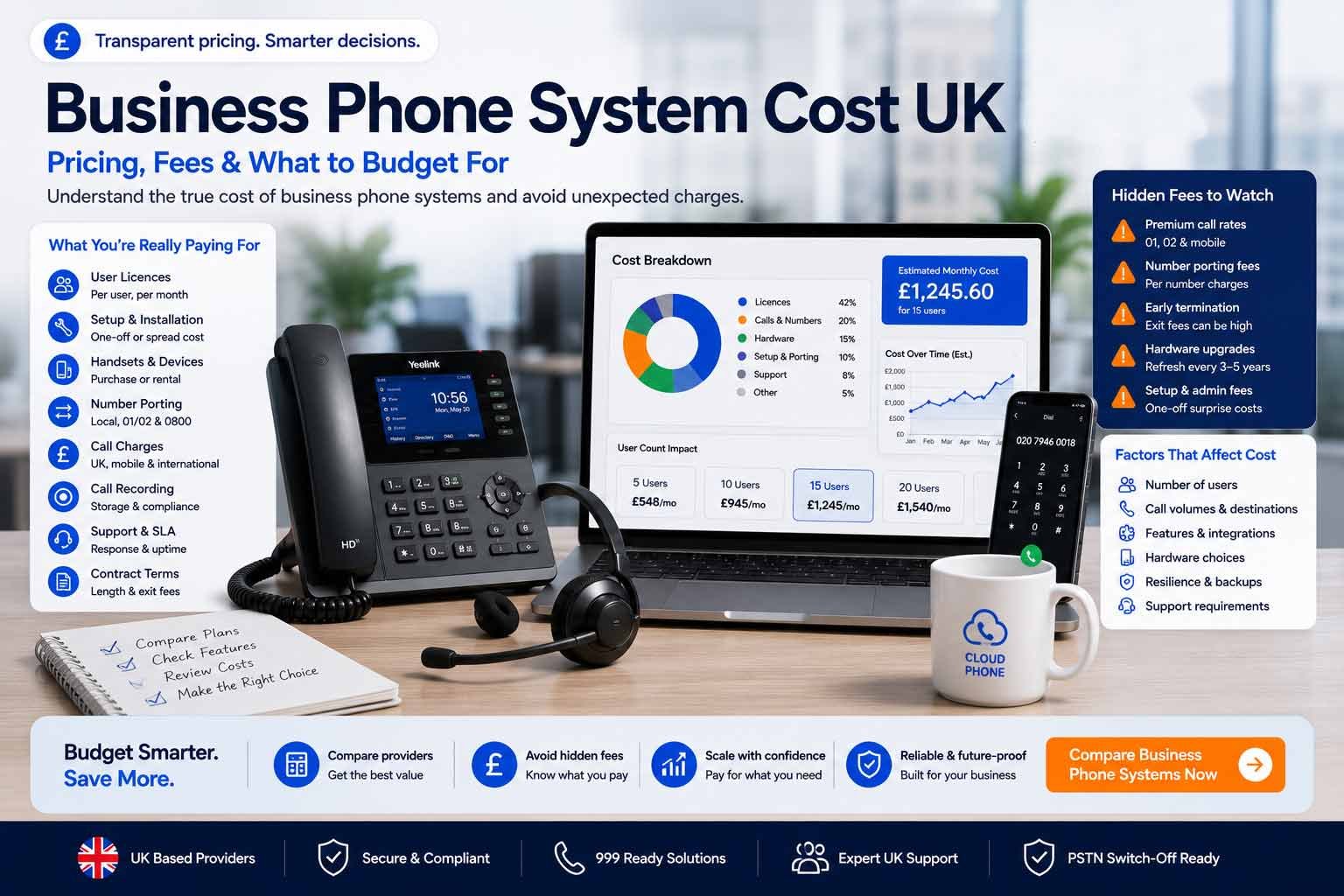
Understand the real cost of a UK business phone system before comparing quotes. This guide explains user licences, setup fees, handsets, number porting, call recording, support tiers, broadband readiness, contract terms and hidden add-ons so you can compare total first-year cost instead of relying on headline monthly pricing.
Price is only one line
Compare licences, setup, porting, handsets, recording, support, connectivity and contract terms before judging any headline monthly price.
Four Cost Layers Every UK Business Should Check
The cheapest-looking phone system can become expensive once setup, handsets, porting, call recording, support and contract terms are added.
Monthly Licences
User seats, call bundles, apps, queues, recording, analytics and UCaaS features determine the recurring cost.
Setup & Migration
Onboarding, call-flow configuration, number porting, training and project support can affect first-year value.
Hardware & Network
Desk phones, headsets, routers, Wi-Fi, broadband upgrades and failover can be required for reliable calling.
Contract Risk
Renewal pricing, minimum user counts, add-ons, storage, support tier and cancellation terms decide long-term cost.
Understand UK business phone system costs before comparing suppliers. Most quotes include more than a monthly user licence, so check setup, handsets, number porting, call recording, storage, support, connectivity, contract length and renewal terms. The safest comparison is total first-year cost matched to your real users, numbers and call flows.
Last updated: June 2026
Reviewed by: CompareServices Editorial Team
Reading time: 16–18 minutes
Quick Verdict
The real cost of a UK business phone system is not only the advertised monthly price per user. A reliable quote should separate licence costs, setup fees, number porting, handset costs, call recording, support, connectivity changes and contract risk. For most SMEs, cloud VoIP or hosted PBX is usually the lower-upfront-cost route, while Teams Phone, SIP trunking, UCaaS and hybrid systems can cost more when implementation and governance requirements are included.
| Buyer situation | Likely cost model | Main cost risk | Best comparison method |
|---|---|---|---|
| Micro business | Low-cost hosted VoIP per user | Promotional pricing, number fees and limited support | Compare monthly cost after renewal |
| Small office | Cloud PBX or hosted PBX licences | Queues, recording, handsets and setup add-ons | Compare first-year cost with call-flow setup |
| Hybrid team | UCaaS per-user licence | Paying for collaboration features not everyone uses | Split users by role and required features |
| Microsoft 365-led business | Teams Phone licence plus calling route | Licensing, Operator Connect, Direct Routing and support | Compare full deployment cost, not one licence line |
| Existing PBX user | SIP trunking, channels and PBX support | Maintenance, security, failover and specialist support | Compare run cost against hosted replacement |
| Multi-site estate | Mixed or custom quote | Site surveys, porting, devices and project management | Compare by site, number range and migration phase |
Cost rule: ask every supplier for a full first-year total that includes users, numbers, devices, setup, support, recording, storage, porting, training, connectivity assumptions and cancellation/renewal terms.
Why Business Phone System Costs Vary
Business phone system pricing varies because suppliers package the same underlying needs differently. One provider may include call queues, recording and support in the base plan; another may advertise a lower user price and charge separately for the same items. This is why a like-for-like quote table is essential.
The main cost variables are user count, call volume, number estate, provider model, handset requirements, setup support, support tier, integrations, recording policy and contract flexibility.
- User count: more staff normally means more monthly licences, but volume discounts may apply.
- Feature depth: recording, call queues, analytics, AI summaries and integrations often sit in higher tiers.
- Hardware: softphones are usually cheaper; desk phones, reception phones and conference devices add cost.
- Migration complexity: number porting, call-flow design, training and legacy-device checks affect setup cost.
- Connectivity: broadband, router, Wi-Fi, QoS and failover may need improvement before VoIP rollout.
- Contract risk: renewal clauses, minimum users and exit fees can be more important than the first quote.
Typical Monthly Costs By System Type
The ranges below are indicative planning ranges. They should be used to build a shortlist, not as a final quote. Always confirm live UK pricing, VAT, call bundles, contract term and support before purchase.
| System type | Indicative UK monthly model | Usually includes | Watch-outs |
|---|---|---|---|
| Basic hosted VoIP | Around £7–£15 per user/month | Business number, app, voicemail, basic routing | Limited queues, recording, analytics or support |
| Hosted PBX | Around £10–£30 per user/month | Extensions, groups, auto-attendant, admin controls | Setup, handsets and advanced routing may cost extra |
| UCaaS | Around £15–£40+ per user/month | Voice, video, messaging, collaboration, apps | Unused features can inflate cost for simple users |
| Teams Phone | Microsoft licence plus PSTN calling route | Calling inside Teams, admin through Microsoft environment | Operator Connect, Direct Routing, support and licences vary |
| SIP trunking | Channels/trunks/numbers plus PBX support | Digital replacement for ISDN into compatible PBX | PBX maintenance, SBC, security and failover ownership |
| On-premise IP PBX | Hardware/software/support plus SIP | Greater control and local ownership | Higher upfront cost and ongoing technical responsibility |
| Hybrid migration | Mixed subscription and project cost | Phased migration across users, sites or systems | Can become expensive if there is no final target design |
First-Year Cost Model
A useful business phone quote should show the total first-year cost. This gives a much fairer comparison than a monthly licence price because it includes setup and transition costs.
| Cost line | What to ask | Why it matters |
|---|---|---|
| User licences | What features are included by user type? | A cheap seat can become expensive if every feature is an add-on. |
| Numbers | Are main numbers, DDIs and number rental included? | Large number estates can add recurring cost. |
| Porting | Is number porting included and how many numbers are covered? | Porting delays can affect go-live and cancellation dates. |
| Setup | Who configures users, call flows, queues and greetings? | DIY setup may be cheaper but riskier for complex call routing. |
| Hardware | Are handsets rented, purchased or optional? | Handset rental can increase long-term cost. |
| Training | Is admin and user training included? | Poor adoption can reduce value even if the system works. |
| Recording | Is recording included and how is storage charged? | Compliance and QA requirements can create extra recurring cost. |
| Support | What support tier is included? | Business-critical phones may need stronger support than basic tickets. |
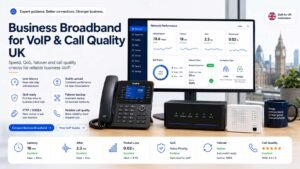
| Connectivity | Does the current broadband and router support the deployment? | Call quality problems may require broadband or network upgrades. |
| Contract | What are renewal, reduction and cancellation terms? | Exit and renewal risk can outweigh a low starting price. |
Example Cost Scenarios
The examples below are simplified planning scenarios. They are not provider quotes, but they show why total cost should be compared by business size and workflow.
Scenario 1: five-user micro business
| Item | Planning assumption | Cost impact |
|---|---|---|
| User licences | 5 hosted VoIP users | Low monthly recurring cost |
| Hardware | Mostly mobile/desktop app, 1 reception handset | Low one-off or rental cost |
| Setup | Basic auto-attendant and voicemail | Minimal setup complexity |
| Risk | Promotion and renewal pricing | Check the price after initial offer |
Scenario 2: 25-user office
| Item | Planning assumption | Cost impact |
|---|---|---|
| User licences | Hosted PBX or UCaaS mix | Recurring cost depends on tier split |
| Hardware | Reception handsets, some desk phones, headsets | Medium upfront or rental cost |
| Setup | Call queues, departments, out-of-hours routing | Managed setup may be worth paying for |
| Risk | Recording, analytics and support tier | Can materially change first-year cost |
Scenario 3: multi-site or existing PBX business
| Item | Planning assumption | Cost impact |
|---|---|---|
| User licences | Mixed hosted, SIP or hybrid route | Needs site-by-site pricing |
| Hardware | Existing PBX, handsets and network equipment | Compatibility checks and maintenance matter |
| Setup | Number ranges, porting, staged go-live | Project management may be required |
| Risk | Legacy lines, alarms, lifts, fax and payment devices | Specialist migration costs may be outside phone quote |
Hidden Costs To Check Before Signing
Hidden costs are not always deliberate. They often appear because the buyer compares a basic licence against a real-world requirement that needs extra services.
- VAT: confirm whether all prices include or exclude VAT.
- Contract length: a low monthly price may require an annual or multi-year commitment.
- Renewal pricing: promotional pricing may increase after the first term.
- Minimum users: some contracts do not let you reduce licences easily.
- Call recording: recording and storage may be charged separately.
- Call queues: queues, IVR and advanced routing can sit in higher tiers.
- Numbers: DDI rental, porting and port-away charges should be listed.
- International calls: bundles may exclude mobiles, premium numbers or certain countries.
- Support: faster support, onboarding and account management can cost more.
- Hardware: handset rental may cost more over time than purchase.
- Connectivity: poor call quality may require broadband, router or Wi-Fi upgrades.
- Legacy devices: alarms, lifts, fax, door entry and PDQ equipment may need separate supplier work.
Cloud VoIP vs Teams Phone vs SIP Trunking Costs
Different routes structure costs differently. The best value depends on what you already have and what you are trying to simplify.
| Route | Cost shape | Best when | Cost risk |
|---|---|---|---|
| Cloud VoIP | Per-user subscription | You want simple, managed business calling | Add-ons for recording, queues, integrations or support |
| Hosted PBX | Per-user subscription plus setup | You need office-style routing without on-site hardware | Call-flow setup and handset costs |
| UCaaS | Higher per-user platform licence | You want voice, video and messaging together | Paying for collaboration tools some users do not need |
| Teams Phone | Microsoft licence plus calling route | Your business already works heavily in Microsoft Teams | Licensing complexity, implementation and route choice |
| SIP trunking | Channels, numbers, SIP service and PBX support | You want to keep compatible PBX infrastructure | Maintenance, security, failover and specialist support |
| Hybrid | Mixed model during migration | You need phased change across sites or systems | Running two models for too long |
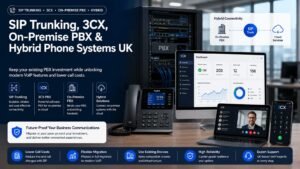
Related guides: compare broader system routes in Business Phone Systems UK, cloud-first options in Cloud Phone System UK, and infrastructure-led routes in SIP Trunking, 3CX, PBX & Hybrid Phone Systems UK.
Quote Comparison Template
Use this template when reviewing multiple suppliers. Ask every provider to complete the same fields so the comparison is fair.
| Quote item | Provider A | Provider B | Provider C |
|---|---|---|---|
| Monthly user licence | £ | £ | £ |
| Number rental | £ | £ | £ |
| Call bundle included? | Yes/No | Yes/No | Yes/No |
| Call recording included? | Yes/No | Yes/No | Yes/No |
| Queues/IVR included? | Yes/No | Yes/No | Yes/No |
| CRM integration included? | Yes/No | Yes/No | Yes/No |
| Handset cost/rental | £ | £ | £ |
| Setup/onboarding | £ | £ | £ |
| Number porting | £ | £ | £ |
| Support tier | Included/Add-on | Included/Add-on | Included/Add-on |
| Contract length | Months | Months | Months |
| Total first-year cost | £ | £ | £ |
How To Reduce Business Phone System Cost
- Split user types: not every user needs the highest licence tier.
- Use softphones where suitable: reduce handset spend for mobile and hybrid staff.
- Limit paid add-ons: buy recording, analytics or integrations only where needed.
- Audit numbers: remove unused lines and numbers after migration sign-off.
- Check renewal terms: avoid short promotional savings that create long-term cost.
- Bundle carefully: bundles can be convenient but should still be compared against specialist providers.
- Plan porting early: delays can extend old contract costs.
- Improve network readiness: fixing Wi-Fi and router issues before go-live reduces support disruption.
PSTN Migration Costs To Include
The move away from legacy PSTN and ISDN services can create costs outside the phone-system quote. Businesses should check line dependencies before cancelling old services.
| Migration item | Why it may cost extra | Who should confirm? |
|---|---|---|
| Number porting | Multiple numbers or ranges may need coordinated porting | New phone provider |
| Alarms | Alarm diallers may need IP or mobile communicators | Alarm/security supplier |
| Lift phones | Emergency lines may need specialist replacement | Lift maintenance supplier |
| Fax | Analogue fax may need cloud fax or process replacement | IT/compliance owner |
| PDQ/card terminals | Older terminals may need IP, Wi-Fi or mobile connectivity | Payment provider |
| Door entry | Old dial-out entry systems may need upgrade | Access-control supplier |
| Broadband/failover | Cloud calling may require stronger connectivity | Connectivity provider |
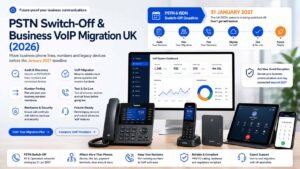
Migration tip: use the PSTN Switch-Off & Business VoIP Migration UK checklist before approving cancellation of old lines.
Buyer Checklist Before Signing
- Confirm exact number of users and user types.
- List every number, DDI, branch number and published phone number.
- Map call flows, queues, voicemail and out-of-hours routing.
- Separate must-have and optional features.
- Check which users need desk phones, headsets or only apps.
- Confirm whether call recording, analytics and CRM integration are included.
- Ask for total first-year cost including setup and porting.
- Check VAT, contract length, renewal terms and cancellation rules.
- Confirm support response and onboarding level.
- Check broadband, router, Wi-Fi, QoS and failover readiness.
- Audit alarms, lifts, fax, payment terminals and door entry before cancelling lines.
- Keep old services active until number porting and testing are complete.
Frequently Asked Questions
How much does a business phone system cost in the UK?
UK business phone systems commonly range from basic hosted VoIP plans at around £7–£15 per user per month to UCaaS and advanced cloud platforms at around £15–£40+ per user per month. The final cost depends on users, features, hardware, number porting, support and contract terms.
What is usually included in a monthly business phone system licence?
A monthly licence may include business calling, a user extension, voicemail, desktop or mobile apps, basic call routing and admin access. Advanced features such as call recording, analytics, CRM integrations, AI summaries, call queues or international calling may require a higher plan or add-on.
Are desk phones included in business phone system pricing?
Desk phones are not always included. Some providers rent handsets monthly, some sell them upfront, and some expect users to work through mobile or desktop softphone apps. Reception desks, warehouses and shared offices may still need physical IP handsets.
How much does number porting cost?
Some providers include number porting, while others charge per number, per range or per porting request. The bigger risk is not only the fee but the timing, paperwork and whether old services stay active until porting and testing are complete.
What hidden costs should businesses check before signing?
Common hidden costs include setup, onboarding, handsets, call recording storage, number rental, call queues, CRM integrations, support upgrades, out-of-bundle calls, international calls, premium numbers, early termination charges and renewal price increases.
Is cloud VoIP cheaper than an on-premise PBX?
For many SMEs, cloud VoIP is cheaper to start because there is little or no upfront PBX hardware cost. An on-premise IP PBX can be cost-effective for some larger or IT-managed organisations, but it requires maintenance, SIP connectivity, support and internal ownership.
Should I compare monthly price or first-year cost?
Compare total first-year cost, not only the monthly user price. Add licences, devices, setup, porting, training, support, call recording, connectivity changes, legacy-device migration and any cancellation or renewal costs before deciding which quote is better value.
Can I reduce users during a business phone system contract?
This depends on the provider and contract. Some cloud plans are flexible, while others lock in a minimum user count or annual commitment. Always ask whether you can reduce users, change tiers or remove add-ons before the renewal date.
Does call recording increase the cost?
Often, yes. Call recording may require a higher licence tier, storage add-on, compliance settings or retention controls. Businesses should check whether recording is per user, per queue, per call group, or included across the whole account.
Do I need to upgrade broadband for VoIP?
Not always, but VoIP needs stable upload speed, low latency, low jitter and low packet loss. Larger teams, call-heavy departments and sites with weak Wi-Fi may need router upgrades, QoS configuration, FTTP, leased-line connectivity or mobile failover.
Is Microsoft Teams Phone cheaper than a normal VoIP system?
It can be cheaper for some Microsoft 365-led businesses, but the full cost depends on Teams Phone licensing, calling route, Operator Connect or Direct Routing, auto attendants, call queues, support and implementation. It should be compared as a full deployment, not a single licence price.
What is the best way to avoid overpaying for a phone system?
Start with a user, number and call-flow audit. Separate must-have features from nice-to-have features, compare total first-year cost, check contract terms, avoid unused UCaaS licences and confirm whether support, porting and training are included.
Get Business Phone System Cost Quotes
CompareServices helps UK businesses compare phone-system options using a structured cost checklist. Instead of comparing only a headline monthly licence, review total first-year cost, setup, devices, number porting, support, contract terms and migration risk.
What you can compare:
- Cloud VoIP, hosted PBX, UCaaS, Teams Phone, SIP and hybrid routes
- Monthly user licence costs
- Setup, porting and migration support
- Hardware, recording and support add-ons
- Contract length, renewal and exit terms
Compare Business Phone System Quotes Beyond The Headline Price
Review licences, setup, handsets, porting, recording, support, connectivity and contract terms before choosing a cloud VoIP, hosted PBX, UCaaS, Teams Phone, SIP or hybrid route.