VoIP Security, GDPR, 999 & Call Recording Compliance UK (2026)
Security, privacy, emergency calling and call-recording checks before choosing a VoIP provider
Learn the key UK VoIP security, GDPR, emergency calling, 999, call recording, PCI, MiFID II and data-retention checks for business phone systems. Compare supplier controls, caller notices, payment-call handling, remote-worker risks, admin permissions and resilience requirements before moving business calls to cloud VoIP, hosted PBX or UCaaS.
Security before supplier choice
Check access controls, call recording, emergency calling, payment handling and resilience before comparing price alone.
Four Security And Compliance Areas Every Buyer Should Check
VoIP compliance is not only about the provider. It also depends on your call recording policy, payment workflow, emergency-calling setup and user access controls.
Security Controls
MFA, admin roles, fraud alerts, device controls, encryption support, audit logs and incident response.
GDPR & Recording
Lawful basis, caller notice, retention, access control, privacy information and supplier processing terms.
999 & Resilience
Emergency access, caller location, remote users, power cuts, backup routing and site failover planning.
Payments & Sectors
PCI phone-payment controls, MiFID II relevance, healthcare/legal confidentiality and contact-centre governance.
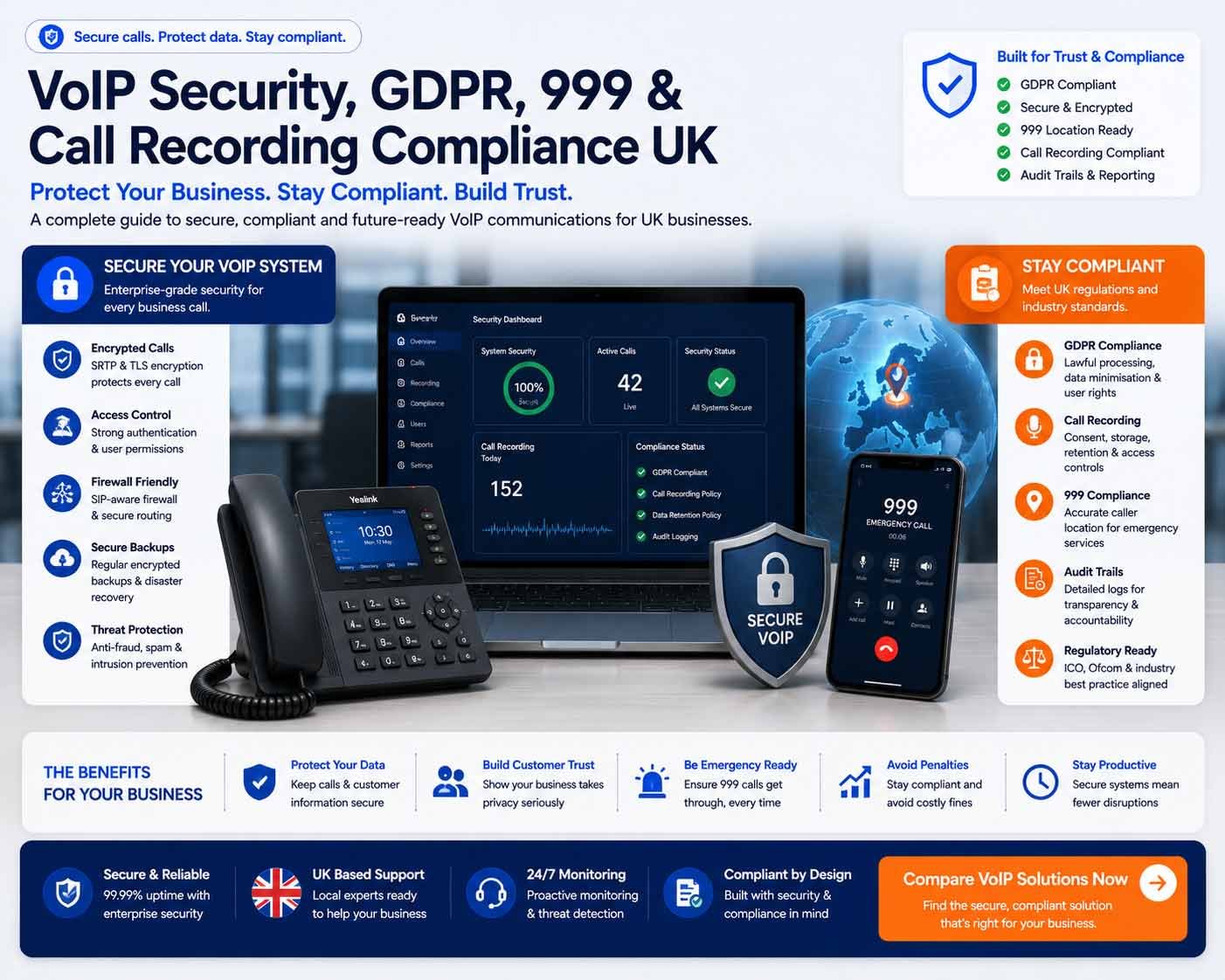
UK businesses using VoIP should check security, GDPR, call recording, emergency calling, payment-card handling and retention before choosing a provider. A safe setup uses strong access controls, clear caller notices, accurate 999 location information, compliant recording storage, fraud monitoring, resilient connectivity and documented policies for users, admins and remote workers.
Last updated: June 2026
Reviewed by: CompareServices Editorial Team
Reading time: 16–18 minutes
Quick Verdict
VoIP security and compliance should be checked before a business signs a phone-system contract, not after the system is live. The main risks are weak admin access, call fraud, unclear call-recording notices, poor retention controls, payment-card exposure, emergency-calling gaps, remote-worker misconfiguration and supplier responsibility gaps.
For most UK SMEs, the safest route is a reputable cloud VoIP or hosted PBX provider with multi-factor authentication, role-based admin controls, encrypted signalling/media where supported, secure recording storage, documented data-processing terms, emergency-call support, number-porting governance and clear support ownership.
| Risk area | What to check | Why it matters | Evidence to request |
|---|---|---|---|
| Account access | MFA, strong password policy, role-based admin access | Reduces unauthorised changes and account takeover | Admin security controls and audit logs |
| Call fraud | International call limits, geo-blocking, alerts and usage caps | Prevents large unexpected bills from compromised accounts | Fraud-monitoring policy and alert examples |
| GDPR | Lawful basis, transparency, retention, processors and rights handling | Voice records and recordings can contain personal data | DPA, privacy wording, retention controls |
| Call recording | Caller notice, storage security, access and deletion rules | Recording without controls creates privacy and compliance risk | Recording settings and access-permission model |
| 999/112 | Emergency access, location records, remote-worker handling | Incorrect location or unavailable calls can create safety risk | Emergency-call policy and address-management process |
| Payments | PCI handling, pause/resume, DTMF masking or secure payment links | Card details should not be exposed in call recordings | PCI/payment workflow documentation |
Compliance note: this guide is buyer guidance, not legal advice. Regulated businesses should confirm requirements with legal, compliance, data-protection and sector specialists before rollout.
Why VoIP Security Matters For UK Businesses
A modern VoIP system is part phone system, part cloud application and part customer-data platform. It may hold phone numbers, names, recordings, voicemail, transcripts, CRM notes, call analytics, device registrations, admin activity and routing rules.
If poorly configured, a phone system can expose the business to fraud, data leakage, operational disruption, failed emergency calling or compliance issues. The risk is higher when remote workers, multiple sites, payment calls or call recording are involved.
- Attackers may compromise weak user accounts and make expensive calls.
- Unauthorised admins may change call routes, voicemail or recording rules.
- Recordings may contain personal data, payment details or sensitive customer information.
- Remote workers may present the wrong emergency location if 999 records are not managed.
- Businesses may keep call recordings for too long without a documented purpose.
UK GDPR, VoIP Call Data And Transparency
VoIP systems often process personal data. Caller ID, call logs, voicemail, recordings, transcripts, CRM notes, analytics and support tickets may all identify individuals or contain personal information.
The ICO’s UK GDPR guidance says organisations need a lawful basis for handling personal information and individuals have a right to be informed about how their data is used. In practice, this means a business should understand what call data is collected, why it is collected, how long it is kept, who can access it and which supplier processes it.
| GDPR area | VoIP example | Buyer action |
|---|---|---|
| Lawful basis | Recording calls for quality, dispute handling or compliance | Define and document the purpose before enabling recording |
| Transparency | Caller hears a notice or sees privacy information | Add call-recording wording to IVR, website and privacy notice |
| Data minimisation | Only record calls that need recording | Avoid recording every call by default unless justified |
| Retention | Recordings kept for a defined period | Set automatic deletion rules where available |
| Access control | Managers access recordings and transcripts | Restrict by role, team and business need |
| Processor governance | VoIP provider hosts recordings or analytics | Review DPA, subprocessors, location and breach process |
Practical rule: do not enable call recording, transcription or analytics until you know the purpose, lawful basis, notice wording, retention period and access-permission model.
Call Recording Compliance Checklist
Call recording can help with training, quality assurance, complaint handling, evidence and regulated workflows. It can also create privacy, storage and security risk if enabled without policy controls.
Before enabling call recording
- Define why calls are being recorded.
- Decide which departments or call types need recording.
- Add clear caller notices where appropriate.
- Update privacy notices and staff policies.
- Set retention rules and deletion periods.
- Restrict who can listen, download, export or delete recordings.
- Decide whether recordings can be shared externally.
- Check whether transcripts and AI summaries have separate retention settings.
Recording controls to compare
- On-demand recording
- Always-on recording by user, group or queue
- Pause and resume for payment details
- Role-based recording access
- Search, tags and audit history
- Retention automation
- Export controls
- Encrypted storage
PCI, Phone Payments And Sensitive Card Data
Businesses taking payments over the phone must avoid exposing cardholder data in recordings, transcripts, notes or screen captures. The PCI Security Standards Council has published guidance on protecting telephone-based payment card data, and businesses should treat payment calls as a separate workflow rather than an ordinary recorded call.
| Payment risk | Better control | Why it helps |
|---|---|---|
| Card numbers captured in audio recordings | Pause/resume recording during payment | Reduces exposure of cardholder data |
| Agents hearing full card details | Secure payment link or payment IVR | Limits staff exposure to sensitive data |
| DTMF tones recorded | DTMF masking or secure payment platform | Prevents card digits being recoverable |
| Payment notes entered into CRM | Field controls and staff training | Stops card data being written into free-text notes |
| Long retention of payment calls | Short retention or payment-call exclusion | Reduces risk and audit burden |
Buyer warning: if a provider offers call recording, that does not automatically make payment calls compliant. Ask specifically how card-payment calls are handled.
999, 112 And Emergency Calling
Digital voice services can support emergency calling, but businesses must understand address data, remote users, power cuts, broadband outages and provider responsibility. Ofcom’s compliance material highlights the importance of accurate and reliable caller-location information for 999 and 112 calls where technically feasible.
For traditional office setups, the emergency location may be the site address. For remote users, hot desks, softphones and mobile apps, the position can be less obvious. This is why every VoIP rollout should include an emergency-calling review.
Emergency-calling checklist
- Confirm 999/112 access with the provider.
- Maintain correct address information for every business site.
- Understand how remote users are handled.
- Check what location is presented from mobile/desktop apps.
- Document what happens during broadband or power failure.
- Train staff on emergency-calling limitations where relevant.
- Review lift phones, alarms and other safety systems separately.
Power-cut and outage planning
- UPS for router, firewall, switches, ONT and critical desk phones.
- Mobile failover for inbound calls.
- Backup broadband or leased-line resilience for critical sites.
- Alternative routing to mobiles or another branch.
- Clear internal escalation path for outages.
Technical VoIP Security Controls To Ask For
A secure VoIP deployment needs more than a reputable brand. Configuration matters. The provider, reseller and business all have responsibilities.
| Control | What to ask | Why it matters |
|---|---|---|
| MFA | Can MFA be enforced for admins and users? | Reduces account takeover risk |
| Role-based access | Can admin permissions be restricted by role? | Stops ordinary users changing critical settings |
| Audit logs | Are changes to users, numbers and routes logged? | Supports investigation and governance |
| Encryption | Is signalling/media encryption supported and documented? | Protects call sessions where supported by devices and routes |
| Fraud alerts | Are call-spend alerts and international restrictions available? | Limits unexpected bills after compromise |
| Device provisioning | How are handsets registered, reset and removed? | Prevents orphaned or unmanaged devices |
| Retention controls | Can recordings and transcripts auto-delete? | Supports storage and privacy governance |
| Backup and failover | How are outages handled? | Protects business continuity |
Remote Workers, Mobile Apps And BYOD Risk
Remote VoIP users create extra governance questions. A desk phone in the office sits on a managed network. A remote worker may use a home broadband connection, personal mobile, softphone app, headset and cloud login.
Remote calling can still be safe, but the business should define clear rules for accounts, devices, recordings and customer data.
- Use MFA and strong identity controls.
- Avoid shared logins.
- Control which devices can use business calling apps.
- Keep apps and operating systems updated.
- Train users on call recording, customer data and secure working.
- Review emergency-location handling for remote users.
- Decide whether personal devices are allowed.
Supplier Due Diligence Questions
Ask these questions before choosing a VoIP, hosted PBX, UCaaS, Teams Phone or SIP provider.
- Where are call recordings, voicemail and transcripts stored?
- Is a Data Processing Agreement available?
- Which subprocessors may access or process call data?
- Can MFA be enforced?
- Can access be restricted by role, user group and department?
- Are admin changes logged?
- Can recordings be retained and deleted automatically?
- How does 999/112 calling work for office and remote users?
- How is caller-location information maintained?
- What fraud controls and spend alerts are included?
- How are security incidents notified?
- What uptime, support and escalation process is offered?
- How are payment-card calls handled?
- What happens if the business leaves the provider?
Sector-Specific Checks
Some businesses need extra checks because calls may contain sensitive, regulated or high-risk information.
| Sector | Additional checks | Why it matters |
|---|---|---|
| Financial services | Call recording policy, MiFID II relevance, retention, retrieval and supervision | Some activities have strict communications-record rules |
| Healthcare and care | Confidentiality, access control, emergency calling and supplier assurance | Calls may involve sensitive personal information |
| Legal and professional services | Client confidentiality, recording consent/notice and retention | Call data may contain privileged or confidential information |
| Retail and ecommerce | PCI phone-payment workflow, call recording pause/resume and staff training | Payment details should not be exposed in recordings |
| Property, construction and facilities | Mobile users, lone workers, emergency calling and site-specific routing | Users may work across multiple locations |
| Contact centres | Recording scale, QA, monitoring, analytics, retention and reporting | Large call volumes increase governance risk |
VoIP Security And Compliance Implementation Checklist
Use this checklist before go-live.
Policy and governance
- Document call-recording purpose and lawful basis.
- Update privacy notice and caller recording message.
- Set recording and transcript retention periods.
- Define who can access, export and delete recordings.
- Confirm DPA and supplier responsibilities.
- Document payment-call handling.
Security configuration
- Enable MFA for admins and users where available.
- Restrict admin roles.
- Disable unused international and premium routes.
- Set fraud alerts and spend caps.
- Remove inactive users and devices.
- Review audit logs and admin alerts.
Emergency and resilience
- Confirm 999/112 access for each site and user type.
- Maintain accurate site address records.
- Check remote-user location handling.
- Plan UPS or failover for critical sites.
- Test call routing during outage scenarios.
- Document escalation and support contacts.
Official References Checked
This guide uses official and primary guidance sources as reference points. Businesses should still confirm their own legal, regulatory and contractual obligations before deployment.
- ICO guide to lawful basis
- ICO right to be informed guidance
- Ofcom emergency-services access compliance programme
- Ofcom guidance on emergency access during power cuts
- PCI SSC telephone-based payment card data guidance
Frequently Asked Questions
Is VoIP secure enough for UK businesses?
VoIP can be secure enough for UK businesses when providers use strong authentication, encryption, access control, call-route protection, monitoring and resilient infrastructure. Buyers should still check supplier security documentation, admin permissions, device management, audit logs, fraud controls and incident response before rollout.
Does UK GDPR apply to VoIP calls and call recordings?
Yes. If a VoIP system processes personal data, such as caller numbers, names, recordings, transcripts, notes or analytics, UK GDPR principles apply. Businesses need a lawful basis, transparency information, retention controls, access rules and a process for handling data rights requests.
Do businesses have to tell callers that calls are recorded?
Businesses should normally tell callers when calls are recorded and explain the purpose, such as training, quality monitoring, dispute handling or compliance. The notice should be clear before or at the point of collection, and recording should be covered in privacy information.
Can card details be recorded during phone payments?
Card-payment calls create PCI DSS risk. Businesses should avoid storing sensitive authentication data in recordings and should use pause-and-resume, secure payment links, DTMF masking, payment IVR or compliant payment tools rather than keeping card details in audio files.
How do 999 calls work with VoIP?
VoIP providers that offer public telephone services should support emergency calling and provide accurate caller-location information where technically feasible. Businesses should confirm how 999 and 112 calls work for each site, remote user, branch and failover scenario before go-live.
What happens to emergency calling during a power cut?
Digital phone services depend on powered equipment such as routers, switches, handsets, ONTs and Wi-Fi. Businesses that need phone access during outages should plan UPS backup, mobile failover, alternative routing or backup connectivity for critical sites and users.
What VoIP security features should a business ask for?
Ask about multi-factor authentication, role-based admin access, encryption, device provisioning controls, call-fraud alerts, geo-permission controls, SIP protection, audit logs, retention settings, secure recording storage, backup, incident response and uptime commitments.
Is call recording legal in the UK?
Call recording can be lawful in the UK when handled correctly, but it depends on purpose, transparency, lawful basis, retention, access controls and sector rules. This page is buyer guidance only; regulated organisations should obtain legal or compliance advice before deployment.
Does MiFID II affect business call recording?
MiFID II-related recording obligations can affect some financial services firms and regulated activities. Businesses in regulated sectors should not rely on generic VoIP features alone; they should confirm retention, retrieval, tamper protection, policy and supervisory requirements with compliance advisers.
How long should VoIP call recordings be kept?
There is no single retention period for every business. Keep recordings only as long as needed for the stated purpose, such as training, complaint handling, contractual evidence or regulatory compliance, and document the retention rule in privacy and internal policies.
Can remote workers use VoIP safely?
Remote workers can use VoIP safely if accounts, devices and networks are managed properly. Use MFA, strong passwords, approved apps, device policies, VPN or secure access where needed, regular updates and clear rules for calls, recordings and customer data.
What is the safest first step before choosing a VoIP provider?
Start with a risk checklist covering call recording, emergency calling, admin access, data storage, supplier security, payment calls, remote users, retention periods, audit logs, incident response and legacy device migration. Then compare providers against those requirements.
Get Help Comparing Secure VoIP Options
CompareServices helps UK businesses compare phone-system providers using practical buyer criteria. For compliance-sensitive deployments, compare not only monthly price but also emergency calling, recording controls, access security, payment-call handling, supplier documentation, retention and support responsibility.
What you can compare:
- Cloud VoIP, hosted PBX, UCaaS, Teams Phone, SIP and hybrid routes
- Call recording and retention controls
- Emergency-calling and failover support
- Provider security and admin controls
- Payment-call and PCI workflow options
- Implementation, training and support ownership
Compare Secure VoIP Options Before You Commit
Compare cloud VoIP, hosted PBX, UCaaS, Teams Phone, SIP and hybrid routes using security, GDPR, emergency-calling and recording criteria as well as price.