SIP Trunking, 3CX, On-Premise PBX & Hybrid Phone Systems UK (2026)
Compare SIP trunks, 3CX, self-managed PBX and hybrid phone-system routes before replacing existing infrastructure
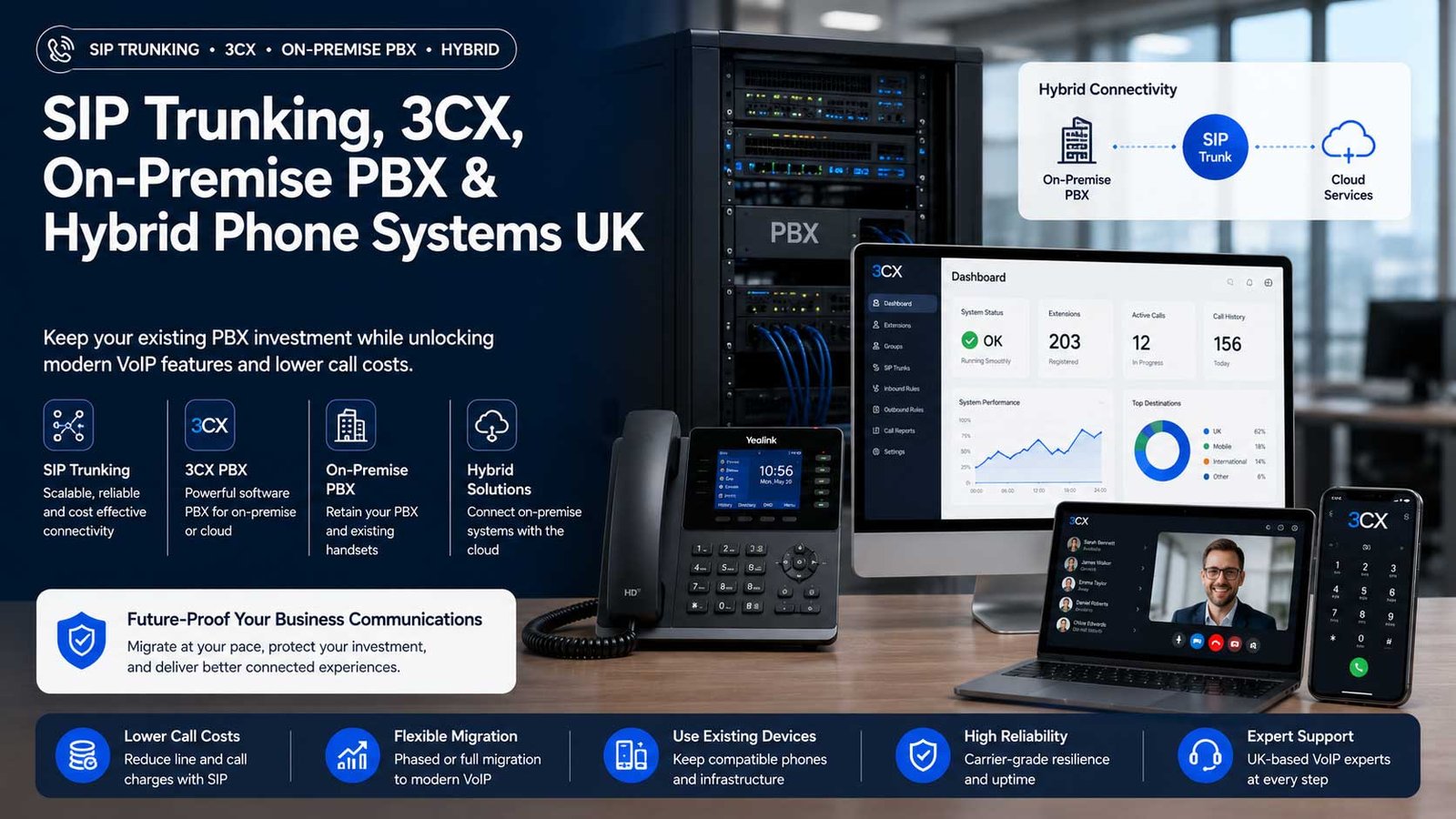
SIP trunking, 3CX, on-premise IP PBX and hybrid phone systems help UK businesses modernise calling without replacing every existing system at once. They suit companies with PBX hardware, number ranges, multi-site estates, technical control needs or phased migration plans before PSTN and ISDN services are fully retired safely by 2027.
Keep, upgrade or replace?
Choose the right path for existing PBX hardware, SIP trunks, 3CX deployments and phased cloud migration.
Choose The Right Route Before Replacing A Working PBX
These options are for businesses where a simple fully hosted cloud phone system may not be the best first step.
SIP Trunking
Best when a compatible PBX can be kept while ISDN-style connectivity is replaced with digital SIP channels.
3CX Phone System
Best for IT-led teams wanting software PBX control, SIP trunk flexibility and app-based calling without a simple per-user hosted model.
On-Premise IP PBX
Best for regulated, complex or highly controlled environments with internal technical ownership and clear support processes.
Hybrid Migration
Best when sites, numbers, PBX hardware or legacy devices need to move in phases rather than all at once.
SIP trunking, 3CX, on-premise IP PBX and hybrid phone systems help UK businesses modernise calling without replacing every existing system at once. They suit companies with PBX hardware, number ranges, multi-site estates, technical control needs or phased migration plans before PSTN and ISDN services are fully retired safely by 2027.
Last updated: June 2026
Reviewed by: CompareServices Editorial Team
Reading time: 17–20 minutes
Quick Answer
SIP trunking, 3CX, on-premise IP PBX and hybrid phone systems are best suited to UK businesses that already have phone infrastructure, technical support, number ranges, multi-site routing or migration constraints. They are not usually the simplest option for a very small team that only needs basic app-based calling.
The key decision is whether you want to keep and modernise existing PBX infrastructure, move to a software PBX such as 3CX, maintain local PBX control, or migrate in phases using a hybrid model.
| Business situation | Best-fit route | Why it fits | Main risk to check |
|---|---|---|---|
| Existing PBX still works | SIP trunking | Replaces legacy line connectivity while keeping compatible PBX features | PBX compatibility, security and failover |
| IT-led business wants software PBX control | 3CX phone system | Supports PBX-style control, SIP trunks, apps and flexible deployment options | Hosting, licensing, updates and support ownership |
| Regulated or complex environment | On-premise IP PBX | Offers more local control over configuration, access and data handling | Maintenance, resilience and internal expertise |
| Multiple sites with different readiness levels | Hybrid phone system | Lets the business move users, numbers or sites in stages | Long-term complexity and double-running costs |
| Small team with no PBX investment | Hosted cloud phone system | Simpler to manage and usually faster to deploy | May not give the same technical control |
Why This Guide Exists
Most business phone system guides focus on fully hosted cloud VoIP platforms. That is useful for many SMEs, but it does not answer every real-world migration scenario.
Some UK businesses already have:
- A working PBX with extensions, reception routing and number ranges
- Existing desk phones, call queues and branch-level call flows
- Internal IT or a telecoms partner that manages telephony
- Regulatory or operational reasons to keep tighter control
- Multiple sites that cannot be migrated at the same time
- Legacy ISDN or PSTN connectivity that needs replacing before final retirement
For those organisations, the question is not simply “which cloud phone provider is cheapest?” The question is whether to use SIP trunks, 3CX, an on-premise IP PBX, a hybrid route or a full cloud replacement.
What Is SIP Trunking?
SIP trunking is a way of connecting a business phone system to external phone networks using internet protocol. Instead of using older ISDN-style circuits, the business uses SIP trunks delivered over a suitable data connection.
In practice, SIP trunking is usually considered when a business wants to keep a compatible PBX but replace legacy line connectivity. It can support number ranges, direct dial numbers, call routing and multiple concurrent calls.
What SIP trunking normally includes
- SIP channels for concurrent calls
- Number presentation and number ranges
- Support for inbound and outbound calling
- Connection to an existing compatible PBX
- Disaster recovery or failover routing where configured
- Lower reliance on legacy PSTN or ISDN circuits
When SIP trunking is a good fit
- Your PBX is still suitable and supported
- You have invested in handsets, call routing or internal telephony skills
- You need to keep branch or department routing stable during migration
- You want to replace ISDN without changing every user workflow at once
- You understand that SIP still needs broadband, security and support planning
When SIP trunking may not be the best route
- You have no existing PBX investment
- Your PBX is old, unsupported or difficult to secure
- You want app-based calling with minimum management responsibility
- You need voice, video, messaging and collaboration in one hosted platform
- You do not have internal or partner support for PBX administration
What Is A 3CX Phone System?
3CX is a software-based business phone system that can be used as a PBX-style platform with SIP trunks, extensions, desktop and mobile apps, call routing and administration controls. It is often considered by businesses that want more flexibility than a simple hosted VoIP subscription while avoiding some traditional hardware PBX limitations.
3CX should not be treated as “just another cloud phone provider”. The buying model, deployment responsibility and support model can be different. Depending on the setup, a business may need to consider software licensing, hosting, SIP trunk provider costs, handsets, security, updates and partner support.
| 3CX consideration | What to check before choosing |
|---|---|
| Deployment route | Hosted, partner-managed, self-managed or on-premise options |
| SIP trunk provider | Supported provider, call bundles, channels, number porting and failover |
| Licensing model | Edition, simultaneous call limits, features and renewal terms |
| Support owner | Whether support is from 3CX, a partner, internal IT or all three |
| Security responsibility | Updates, firewall rules, access controls, backups and monitoring |
| Feature fit | Call queues, reporting, CRM integration, recording, apps and admin controls |
What Is An On-Premise IP PBX?
An on-premise IP PBX is a business phone system hosted and managed on infrastructure controlled by the organisation or its telecoms partner. It connects users, extensions and call routing internally, then connects to external calling using SIP trunks or another digital route.
This model is less common for smaller companies now, but it still has a place where technical control, custom call routing, security policy, data handling or operational continuity require more than a standard hosted cloud phone system.
Typical reasons to keep or deploy on-premise IP PBX
- Strong internal IT ownership
- Complex site-to-site call routing
- Regulated-sector governance requirements
- Existing investment in PBX, phones and support contracts
- Specialist integrations that are difficult to replicate in cloud
- Preference for local control over updates, access and configuration
Trade-offs to understand
- Higher internal responsibility
- Security and updates must be actively managed
- Backup, resilience and disaster recovery need clear design
- Scaling may need more licensing or infrastructure work
- Support depends on in-house skills or a specialist telecoms partner
What Is A Hybrid Business Phone System?
A hybrid phone system mixes more than one telephony model. It may combine a legacy or IP PBX with SIP trunks, cloud users, hosted call routing, remote apps or phased site migration.
Hybrid is not automatically better than cloud. It is useful when the business cannot safely move everything in one go. The danger is allowing the hybrid setup to become permanent without a clear end-state plan.
| Hybrid use case | Why businesses choose it | Risk to manage |
|---|---|---|
| Multi-site estate | Move sites in phases rather than forcing a single cutover | Inconsistent user experience and support complexity |
| PBX still under contract | Avoid wasting existing investment immediately | Double-running costs if cloud and PBX both remain active |
| Legacy connected devices | Test alarms, lifts, fax or payment devices separately | Assuming every PSTN dependency has been migrated |
| Department-by-department migration | Move lower-risk teams before critical call groups | Confusing call routing if the plan is not documented |
| Technical control requirement | Keep core routing controlled while cloud users are added | Security and fault ownership gaps |
SIP Trunking vs 3CX vs On-Premise PBX vs Hybrid
| Route | Best for | Commercial model | Control level | Complexity | Remote working fit |
|---|---|---|---|---|---|
| SIP trunking | Existing PBX users replacing ISDN | Channels, numbers, calls and support | Medium to high | Medium | Depends on PBX |
| 3CX | IT-led firms wanting software PBX control | Software, hosting, SIP and support | Medium to high | Medium | Good if configured well |
| On-premise IP PBX | Regulated or complex organisations | Hardware/software, support and SIP | High | High | Moderate to good with design |
| Hybrid phone system | Phased migrations and mixed estates | Mixed cloud, SIP, PBX and support | Mixed | High | Varies by site/team |
| Hosted cloud phone system | Most SMEs without PBX constraints | Per user/month | Lower | Lower | Strong |
Costs And Quote Factors
Infrastructure-led phone systems are harder to compare than simple per-user hosted VoIP because the price can be shaped by channels, licences, hosting, support, hardware, call traffic and migration work.
Cost items to separate in every quote
- SIP trunk or channel charges
- Number rental and number ranges
- Inbound and outbound call bundles
- Software licences or PBX edition
- Hosting, server or appliance costs
- Support and maintenance contract
- Implementation and call-flow configuration
- Security hardening, firewall and SBC work
- Desk phones, headsets and adapters
- Backup and disaster recovery route
- Number porting and temporary forwarding
- Training and handover documentation
Quote comparison table
| Cost area | SIP trunking | 3CX | On-premise PBX | Hybrid |
|---|---|---|---|---|
| Upfront setup | Medium | Medium | High | Medium to high |
| Monthly user cost | Not always per-user | Depends on licence/support model | Lower user licence, higher support burden | Mixed |
| Technical ownership | Shared with PBX/support partner | Internal/partner-led | Mostly internal/partner-led | Shared and more complex |
| Best value when | PBX still has useful life | IT can manage or partner can support it | Control requirements justify overhead | Phased migration reduces disruption |
Migration Checklist For Existing PBX, SIP And 3CX Routes
Use this checklist before approving a SIP, 3CX, PBX or hybrid migration plan.
- Audit all active numbers. Include main numbers, DDIs, hidden numbers, branch numbers and lines used for devices.
- Confirm PBX status. Check make, model, software version, support status, warranty and compatibility with SIP.
- Map current call flows. Document reception, departments, hunt groups, queues, out-of-hours routing and failover.
- Check connected devices. Include fax, alarms, lift phones, door entry systems, payment terminals and fire panels.
- Test the data connection. SIP and software PBX routes still need suitable broadband or dedicated connectivity.
- Define emergency calling behaviour. Confirm 999 access, location data and what happens during power or internet outages.
- Plan number porting. Do not cancel old services before numbers are confirmed live on the new route.
- Design failover. Decide where calls route if the PBX, SIP trunk, broadband or site fails.
- Confirm support ownership. Avoid gaps between broadband provider, SIP provider, PBX partner and internal IT.
- Run a pilot. Test a small group, branch or non-critical number before full cutover.
Security And Resilience Checks
SIP, 3CX, self-managed PBX and hybrid systems need stronger governance than a simple provider-managed phone service. The flexibility is useful, but it can introduce security and fault-management risk if ownership is unclear.
Minimum security checks
- Use strong admin credentials and role-based access
- Restrict management access to trusted networks or secure VPN where appropriate
- Apply PBX and 3CX updates promptly
- Use supported SIP providers and secure trunk configuration
- Disable unused extensions, routes and international destinations
- Monitor unusual call patterns and failed login attempts
- Document backup and recovery processes
Minimum resilience checks
- Secondary call route or failover number
- Backup broadband or mobile failover for critical sites
- Power resilience for routers, switches and PBX hardware
- Tested recovery process for PBX or hosting failure
- Clear escalation route for faults across all suppliers
Questions To Ask SIP, 3CX And PBX Providers
- Is our current PBX compatible with your SIP trunks?
- How many SIP channels do we actually need?
- Can we keep all existing numbers and DDI ranges?
- What happens if our internet connection fails?
- Who owns security updates and PBX maintenance?
- How is 999/emergency calling handled?
- Are international and premium-rate calls restricted by default?
- Can we block fraud-prone destinations?
- What monitoring and call-spend alerts are available?
- How will number porting be staged?
- What does the first-year cost include?
- What support is available during and after migration?
- Can the setup later move fully cloud if required?
Frequently Asked Questions
What is SIP trunking?
SIP trunking connects a compatible business phone system or PBX to external phone networks over internet protocol. It replaces traditional ISDN-style connectivity while allowing the business to keep suitable PBX hardware, extensions, number ranges and call routing under its own control.
Is SIP trunking the same as VoIP?
SIP trunking uses VoIP technology, but it is not the same as a fully hosted cloud phone system. SIP trunks usually connect an existing PBX to digital calling, while hosted cloud VoIP replaces most or all of the PBX infrastructure with a provider-managed platform.
What is a 3CX phone system?
3CX is a software-based business phone system that can support SIP trunks, extensions, softphones, call routing and PBX-style control. It is often considered by IT-led businesses that want more control than a simple fully hosted cloud phone system.
Is 3CX better than a hosted cloud phone system?
3CX can be better where technical control, SIP flexibility, deployment choice and PBX-style administration matter. A hosted cloud phone system is often better for businesses that want simpler provider-managed calling, faster setup and less internal technical responsibility.
Who should consider an on-premise IP PBX?
An on-premise IP PBX can suit regulated organisations, IT-managed firms, sites with complex routing or businesses that want strong local control. It is less suitable for companies that do not want to manage updates, resilience, security, backups and specialist support.
What is a hybrid business phone system?
A hybrid business phone system combines existing PBX infrastructure, SIP trunks, cloud services or hosted users during a phased migration. It is useful where a business cannot replace every site, device or call flow at the same time.
Can SIP trunking replace ISDN?
Yes, SIP trunking is a common route for replacing ISDN where the existing PBX is compatible or can be upgraded. Businesses should check PBX support, number ranges, channels, emergency calling, failover and security before ordering SIP trunks.
How many SIP channels does a business need?
SIP channel requirements depend on concurrent calls, not only user count. A 40-user business might need far fewer than 40 channels if only 10 to 15 calls happen at once, but busy sales, support or reception teams may need more capacity.
Can I keep my existing phone numbers with SIP trunking or 3CX?
Usually yes, but number porting must be planned carefully. Check number ownership, current contract terms, number ranges, DDI allocation, porting lead times and fallback routing before cancelling the old service.
Is a hybrid phone system more expensive than moving fully cloud?
It can be. Hybrid systems may protect existing investment and reduce migration risk, but they can also create two environments to manage. Compare short-term migration savings against support, licensing, SIP trunk, hardware and long-term maintenance costs.
What are the biggest risks with SIP, 3CX or self-managed PBX systems?
The main risks are weak security, poor failover, unmanaged updates, unclear support ownership, bad call routing design, number-porting disruption and underestimating internal technical responsibility. These systems need proper governance and documented support processes.
Should small businesses use SIP trunking or 3CX?
Some technically confident small businesses can use SIP trunking or 3CX successfully, but many small businesses are better served by a simple hosted cloud phone system. The right choice depends on support skills, existing hardware, call complexity and control requirements.
Compare SIP, 3CX And Hybrid Phone System Routes
CompareServices helps UK businesses understand whether SIP trunking, 3CX, on-premise IP PBX, hybrid migration or a fully hosted cloud phone system is the best fit.
What you can compare:
- SIP trunk and channel requirements
- 3CX and software PBX suitability
- Existing PBX compatibility
- Number porting and DDI planning
- Hybrid migration risk
- Support and maintenance ownership
- Failover, security and emergency calling
Find The Right Route For Existing PBX, SIP Or Hybrid Estates
Compare SIP trunking, 3CX, on-premise PBX, hybrid migration and fully hosted cloud routes using a structured business checklist.