
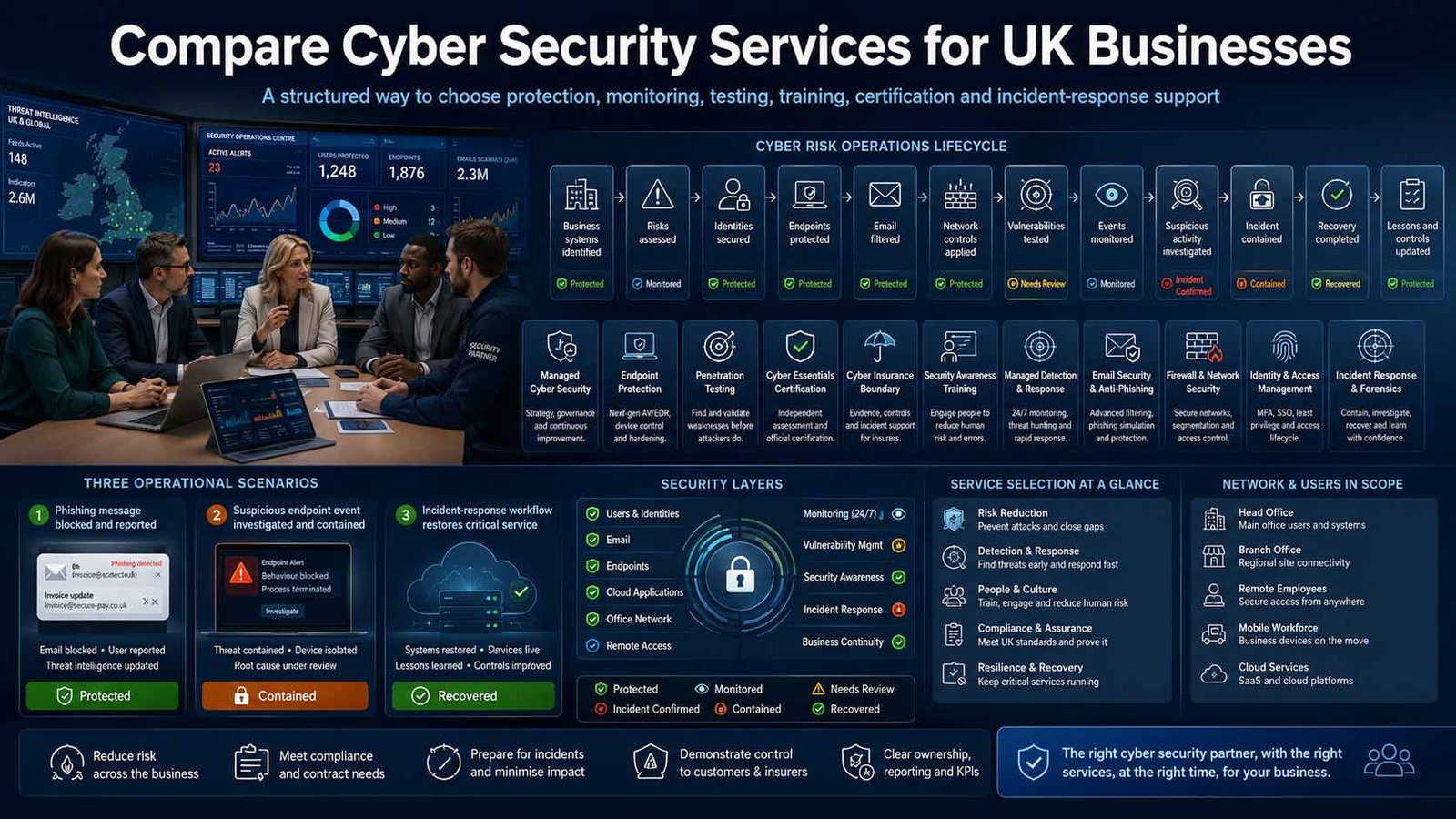
Compare Cyber Security Services for UK Businesses
A structured way to choose protection, monitoring, testing, training, certification and incident-response support
Cyber security services help UK businesses reduce phishing, ransomware, data loss, fraud and operational disruption. Use this hub to identify whether your organisation should start with managed cyber security, endpoint protection, penetration testing, Cyber Essentials, email security, identity controls, MDR, cyber insurance or incident response.
Why cyber security matters to UK businesses
Cyber security is no longer only an IT issue. It affects trading continuity, customer trust, cash flow, supplier confidence, data protection duties and board-level risk.
- Reduce preventable risk across people, devices, email and access
- Validate systems before weaknesses become incidents
- Prepare response routes for ransomware, fraud or data loss
- Choose the right security service layer before comparing providers
Cyber security is a connected operating model rather than one product purchase. Protection, identity, monitoring, testing, training, certification, insurance and incident response address different parts of business risk.
A retail chain, law firm, healthcare business, manufacturer, ecommerce seller and professional services firm may need different control layers. The appropriate starting point depends on systems, data sensitivity, user behaviour, supplier exposure, customer requirements, existing controls and the operational impact of disruption.
Use this hub to select the correct service family before reviewing named providers. That reduces unsuitable shortlists, duplicated technology, unmanaged gaps and contracts that place important responsibilities outside the purchased scope.
Map cyber risk to the right service category
Most businesses start with a practical concern: phishing, weak access controls, unknown vulnerabilities, certification requirements, limited monitoring or a recent incident.
| Business problem | What it usually signals | Relevant cyber security categories |
|---|---|---|
| Staff are clicking suspicious emails or sharing credentials | Weak awareness, poor email controls or limited identity protection | Email Security / Anti-Phishing, Security Awareness Training, Identity & Access Management |
| Leadership wants stronger all-round protection without building a large internal team | Limited in-house capability and fragmented security ownership | Managed Cyber Security (MSSP), Managed Detection & Response, Endpoint Protection |
| The business needs proof of security maturity for bids, customers or contracts | Assurance requirements, policy gaps or supply-chain expectations | Cyber Essentials Certification, Managed Cyber Security, Identity & Access Management |
| Systems, websites or remote access may have unknown weaknesses | No recent independent validation, legacy exposure or rapid operational change | Penetration Testing, Firewall / Network Security, Endpoint Protection |
| The business is worried about ransomware or malicious activity going undetected | Incomplete monitoring, limited visibility or slow response capability | Managed Detection & Response, Endpoint Protection, Incident Response & Digital Forensics |
| Senior management wants financial protection and incident support after a cyber event | Recovery, liability, continuity and crisis-support concerns | Cyber Insurance, Incident Response & Digital Forensics, Managed Cyber Security |
Cyber needs by business size and operating model
This table does not rank providers. It shows how different business profiles usually line up with different cyber security priorities.
| Business profile | Typical cyber priorities | Service types usually reviewed first | Main buying objective |
|---|---|---|---|
| Sole traders and micro businesses | Basic protection, phishing reduction, account security and practical guidance | Endpoint Protection, Email Security, IAM, Security Awareness Training, Cyber Essentials | Reduce avoidable risk with manageable controls |
| Small businesses and growing SMEs | Better visibility, policy discipline, customer assurance and remote-working controls | MSSP, Endpoint Protection, Email Security, Firewall / Network Security, Cyber Essentials | Build a reliable baseline without overcomplicating operations |
| Medium-sized organisations | More formal detection, response readiness, stronger governance and supplier assurance | MDR, MSSP, Penetration Testing, IAM, Incident Response, Cyber Insurance | Improve resilience, response quality and audit confidence |
| Larger or regulated businesses | Layered visibility, formal access control, response maturity and external validation | MDR/XDR/SOC, Penetration Testing, Firewall Security, IAM, Incident Response | Coordinate multiple control layers and reduce disruption risk |
| Multi-site or distributed teams | Secure connectivity, identity consistency, endpoint control and response preparedness | Firewall / Network Security, IAM, Endpoint Protection, MSSP, MDR, Email Security | Secure people, devices and systems across changing environments |
Use one evidence framework across every cyber security purchase
The control layer changes between services, but buyers should apply the same discipline to scope, responsibility, evidence, service levels, cost and exit.
| Control area | What the buyer should define | Evidence to request before award | Why it matters |
|---|---|---|---|
| Business services and risk boundary | Identify critical services, sensitive information, revenue processes, user groups, sites, cloud systems, suppliers and the operational consequences of loss, fraud, unauthorised access or prolonged disruption. | Current asset and service map, risk assumptions, priority systems, recovery objectives, accountable executives and the business outcomes the purchased service must protect. | A provider cannot design or price a reliable service when the organisation has not agreed which systems and outcomes matter most. |
| Technical and organisational scope | Record devices, servers, cloud tenants, applications, identities, networks, email domains, locations, remote users, privileged accounts, logs, integrations and third parties included or excluded. | Scope schedule, asset counts, discovery method, exclusions, dependency map, onboarding process and treatment of new or previously unknown assets. | Security gaps and fee disputes often appear at boundaries between the buyer, IT supplier, cloud provider and specialist cyber service. |
| Responsibility and escalation | Define who configures controls, reviews alerts, approves containment, contacts users, preserves evidence, manages suppliers, reports breaches and communicates with senior management or external authorities. | Responsibility matrix, named contacts, decision thresholds, emergency authority, escalation routes, out-of-hours coverage and a tested scenario walkthrough. | A tool can generate an alert without anyone being authorised or available to make the operational decision that follows. |
| Service quality and measurable evidence | Set service hours, coverage, detection, triage, response, containment support, vulnerability handling, reporting, remediation follow-up, false-positive management and improvement expectations. | Service-level definitions, clock rules, sample reports, detection-use cases, escalation evidence, service review format, performance history and comparable customer references. | Broad claims such as continuous monitoring or rapid response are not comparable until the event, clock, action and customer responsibility are defined. |
| Security of the security provider | Assess provider access, privileged administration, analyst locations, subcontractors, data regions, encryption, logging, tenant separation, remote tools, incident response, continuity and staff screening. | Security schedule, assurance reports, subprocessor list, access model, data-flow diagram, incident-notification terms, recovery evidence and deletion process. | A cyber provider can hold extensive access and sensitive telemetry, making its own controls and supply chain part of the buyer’s risk. |
| Implementation and integration | Plan discovery, deployment, agents, connectors, policies, allow lists, logging, identity integration, testing, legacy-tool removal, change windows, user communication, rollback and acceptance. | Implementation plan, prerequisites, milestones, internal resource assumptions, test cases, acceptance criteria, issue process and confirmation that required telemetry is complete. | Security services underperform when sensors are missing, logs are incomplete, policies conflict or implementation stops at licence activation. |
| Complete commercial model | Model licences, devices, users, sites, log volumes, retention, data ingestion, identity checks, tests, incident call-outs, project work, onboarding, minimum commitments, inflation and expected growth. | Three-year cost model, unit definitions, volume bands, overage rates, included incidents, professional-service rates, price review, reduction rights and renewal assumptions. | A low headline price can exclude essential onboarding, monitoring data, remediation, emergency response or the capacity needed as the estate grows. |
| Exit, continuity and evidence retention | Decide how configurations, alerts, cases, reports, logs, policies, test results, incident evidence, integrations, credentials and open remediation will transfer at termination. | Exit plan, export formats, retention periods, transition assistance, access revocation, supplier handover, deletion confirmation and charges after notice. | Security coverage must continue during a supplier change, and historical evidence may still be needed for investigations, insurance, audits or legal obligations. |
Understand how the service categories work together
One provider may deliver several layers, but each responsibility should remain visible in the scope, service levels and reporting.
Reduce common attack paths
Endpoint protection, email security, identity and access management, firewalls and staff awareness reduce different routes into the organisation. They should be configured against a current estate, consistent account lifecycle and defined policy ownership rather than installed as disconnected products.
Validate controls and assurance
Penetration testing and Cyber Essentials provide different forms of evidence. Testing examines defined systems and attack paths at a point in time. Certification assesses a specified baseline scope. Neither replaces ongoing operation, remediation, monitoring or senior accountability.
Detect and investigate activity
MDR, XDR and SOC services collect and analyse security information, investigate suspicious behaviour and support response. Buyers should confirm telemetry, coverage, use cases, analyst actions, customer decisions, out-of-hours handling and the point at which an alert becomes an incident.
Respond, recover and transfer risk
Incident response and digital forensics support containment, investigation and recovery, while cyber insurance may cover specified financial consequences under policy conditions. These services work best when suppliers, contacts, evidence, decision authority and continuity plans are agreed before an incident.
Cyber Security service categories
This category covers 11 service areas. Each one solves a different layer of business cyber resilience.
Ongoing security support
Managed Cyber Security (MSSP)
Broad managed protection, triage, governance and operational security support for SMEs that do not want to build every cyber capability in-house.
Compare managed cyber security providersDevice-level defence
Endpoint Protection
Protection for laptops, desktops, servers and staff devices that are common entry points for malware, ransomware and unauthorised access.
Compare endpoint protection providersControlled security testing
Penetration Testing
Independent assessment of websites, applications, infrastructure and exposed systems to identify exploitable weaknesses before attackers do.
Compare penetration testing providersBaseline assurance
Cyber Essentials Certification
A recognised UK certification route that helps businesses demonstrate baseline technical controls against common internet-based threats.
Compare Cyber Essentials certification providersFinancial resilience
Cyber Insurance
Commercial risk-transfer support that can help with certain recovery, legal, interruption and incident costs depending on policy terms.
Compare cyber insurance providersHuman risk reduction
Security Awareness Training
Training to help staff recognise phishing, social engineering, unsafe downloads, weak password habits and poor data-handling behaviours.
Compare security awareness training providersThreat monitoring
Managed Detection & Response (MDR/XDR/SOC)
Detection, investigation and response support for suspicious activity where internal teams cannot monitor security events continuously.
Compare managed detection and response providersInbox protection
Email Security / Anti-Phishing
Filtering, authentication and protection layers that reduce phishing, impersonation, malware delivery and credential-theft risk.
Compare email security and anti-phishing providersNetwork control
Firewall / Network Security
Protection and policy control for traffic entering, leaving and moving around offices, cloud-connected environments and remote access setups.
Compare firewall and network security providersAccess governance
Identity & Access Management (MFA/SSO)
Controls for who can access which systems, using multi-factor authentication, single sign-on and account lifecycle discipline.
Compare identity and access management providersRecovery readiness
Incident Response & Digital Forensics
Specialist containment, investigation and recovery support when a cyber incident has happened or when response planning needs structure.
Compare incident response and digital forensics providersHow to shortlist cyber services without overbuying
Start with risk, operating model and control maturity before buying tools or managed services.
What must be protected?
Identify critical systems, user accounts, devices, email, customer data, payment flows and operational records.
Which attack paths are most plausible?
Phishing, weak passwords, exposed systems, malware, supplier compromise and remote access should be reviewed separately.
What controls already exist?
Review current tools, policies, backups, MFA adoption, device controls, monitoring and response procedures before buying more.
What proof is needed?
Client contracts, insurer questions, tender requirements and board governance can change the right service path.
How fast could you respond?
If suspicious activity appears, know who investigates, who decides, who communicates and how recovery is managed.
What gives the highest risk reduction?
Prioritise the service types that reduce the most realistic business risks per pound spent.
Cyber priorities by operating model
Different business models often need different security layers first.
Professional services firms
Usually need email protection, identity control, endpoint security, staff training and response planning because client information and advice workflows are central.
Retail and ecommerce businesses
Often prioritise payment-adjacent resilience, website testing, email security, endpoint protection, fraud awareness and recovery routes.
Healthcare and care-adjacent organisations
Need stronger data-handling discipline, access controls, awareness training, endpoint protection, incident response and supplier assurance.
Multi-site operators
Usually need consistent identity, device, firewall, network and monitoring controls across branches, sites and remote teams.
Manufacturing and operational environments
Often need stronger network segmentation, backup discipline, endpoint visibility, incident planning and managed monitoring.
Growing SMEs without internal cyber teams
Often benefit from MSSP-style coordination so security responsibilities, monitoring, triage and governance do not rely on one busy person.
How CompareServices structures cyber security comparisons
CompareServices separates this category into eleven commercial decisions so UK businesses can identify the correct control layer before comparing providers. Each live service page uses its own scope, evidence requirements, provider criteria, pricing factors and boundary.
- Start with critical services, plausible attack paths and business impact
- Keep prevention, detection, testing, assurance, risk transfer and response distinct
- Use the same written scope and estate assumptions for every provider
- Compare responsibilities, implementation, operating evidence and lifecycle cost
- Check how each service connects to existing IT, data, continuity and governance
- Route buyers to the most relevant live comparison without assuming one universal stack
Risk first. Product second.
A business worried about phishing may need email authentication, identity controls and staff training before a wider managed service. An organisation with prevention tools but no investigation capability may need detection and response. A company preparing for certification may need scope and asset control before purchasing additional platforms.
Correct service selection reduces duplicated controls while exposing responsibilities that would otherwise remain unowned.
Move from cyber concern into a focused shortlist
Use this sequence before comparing providers or buying another platform.
- Write down the specific cyber concern in one sentence.
- Map the concern to the problem / solution table.
- Check your business size and operating model against the profile table.
- Review the 11 service-category summaries.
- Open the 1 to 3 most relevant cyber service pages rather than comparing everything at once.
Cyber Security service pages in this category
Use these pages to move from category overview into service-specific comparison.
- Compare Managed Cyber Security (MSSP)
- Compare Endpoint Protection
- Compare Penetration Testing
- Compare Cyber Essentials Certification
- Compare Cyber Insurance
- Compare Security Awareness Training
- Compare Managed Detection & Response (MDR/XDR/SOC)
- Compare Email Security / Anti-Phishing
- Compare Firewall / Network Security
- Compare Identity & Access Management (MFA/SSO)
- Compare Incident Response & Digital Forensics
Frequently Asked Questions
Quick answers for UK business buyers comparing cyber security service categories.
How often should a business review its cyber security services mix?
Most businesses should review their cyber service mix at least annually and after major changes such as cloud migrations, new remote-working models, acquisitions, compliance requirements or a significant incident.
What is usually the best starting point for a smaller business with limited cyber maturity?
For many smaller organisations, the best starting point is a practical baseline: email protection, multi-factor authentication, endpoint protection, staff awareness training and a structured look at Cyber Essentials.
Is cyber insurance enough on its own to protect a business?
No. Cyber insurance may help with the aftermath of a covered incident, but it does not replace preventative controls, detection capability, user awareness or incident readiness.
When does a business need managed detection and response?
A business should consider MDR when leadership needs better visibility into threats, faster investigation of suspicious activity and a clearer route to containment, especially where internal monitoring is limited.
Why does incident response planning matter before anything serious happens?
Incident response planning matters because confusion during a cyber event increases downtime, cost and decision errors. A defined response path helps the business act faster and recover more confidently.
Authoritative UK cyber security guidance
Reviewed by Bhav Giva, Founder & Lead Analyst at CompareServices.co.uk, on 4 August 2026. Bhav reviews category structure, service boundaries, comparison criteria and UK business relevance across the CompareServices platform.
Use the following primary sources alongside the relevant live service comparison when assessing cyber risk, baseline controls, governance, certification, personal-data breaches and incident response. Obtain legal, regulatory, technical, insurance or forensic advice where the organisation’s systems, sector or incident circumstances require specialist input.
- Cyber Security Breaches Survey 2025/2026 — GOV.UK
- Small Organisations Guide to Cyber Security — National Cyber Security Centre
- Cyber Essentials Overview — National Cyber Security Centre
- Cyber Governance Code of Practice — National Cyber Security Centre
- Incident Management Guidance — National Cyber Security Centre
- Personal Data Breach Guidance — Information Commissioner’s Office