
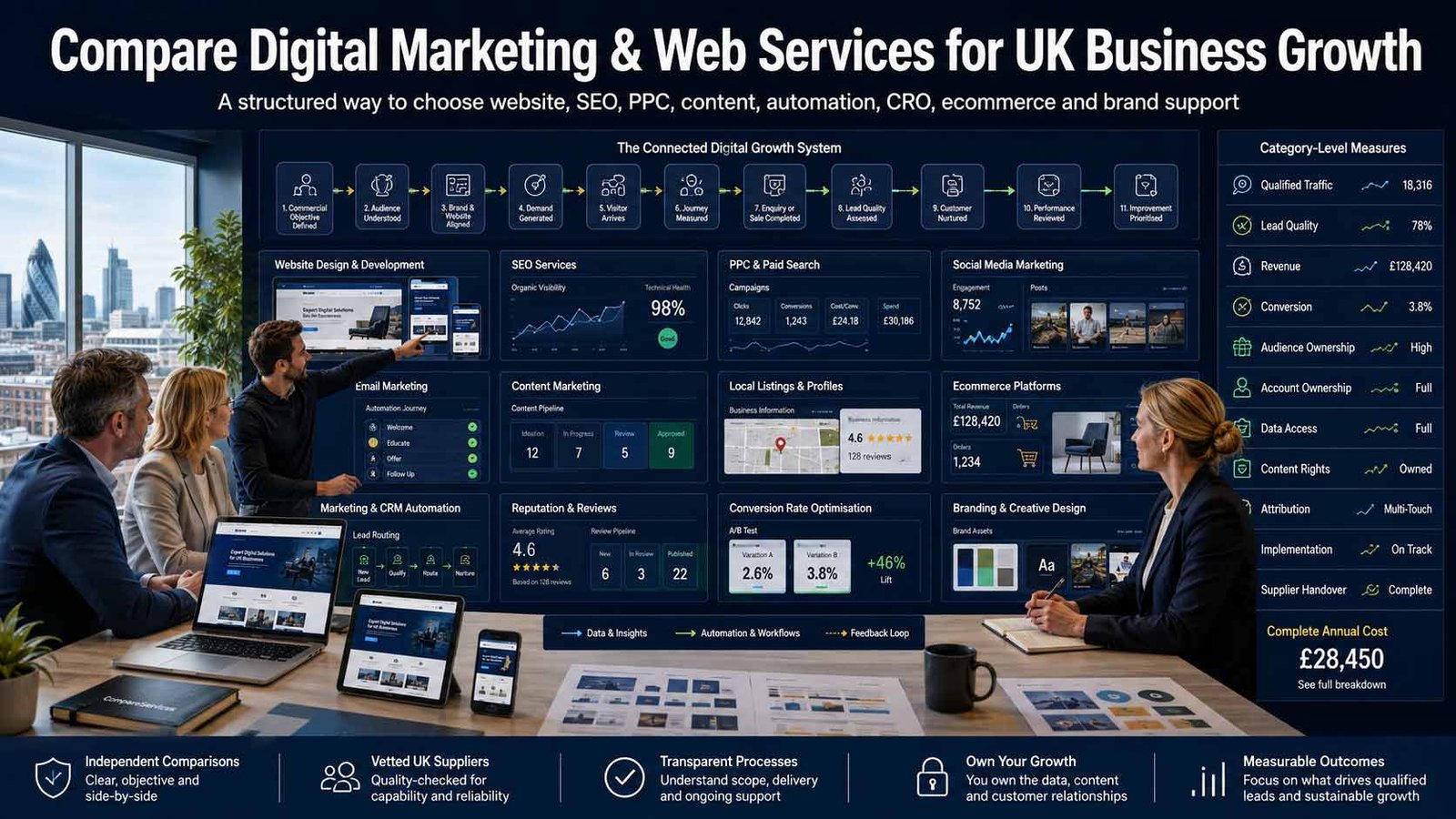
Compare Digital Marketing & Web Services for UK Business Growth
A structured way to choose website, SEO, PPC, content, automation, CRO, ecommerce and brand support
Digital marketing and web services help UK businesses attract demand, convert visitors, retain customers and measure growth. Use this hub to identify whether your next step should be website design, SEO, PPC, social media, email, content, local visibility, ecommerce, automation, reputation, CRO or branding.
Why this category matters to UK businesses
Digital performance is now tightly connected to commercial performance. Your website, search visibility, paid campaigns, local presence, reputation, automation and conversion paths all affect whether demand becomes revenue.
- Align website, search, paid, local and lifecycle channels
- Avoid paying for broad packages before the bottleneck is clear
- Improve lead quality, conversion efficiency and customer follow-up
- Choose the right service page before comparing providers
Digital growth decisions should begin with the commercial bottleneck. A business may need a stronger website foundation, more qualified search visibility, faster paid acquisition, better local discovery, improved follow-up, a more suitable ecommerce platform, stronger trust signals or higher conversion from existing traffic.
Use this category to separate infrastructure, acquisition, content, retention, reputation and conversion services before requesting proposals. That keeps deliverables, ownership, data access, measurement, implementation and cost comparable across providers.
The correct service choice helps prevent duplicated retainers, disconnected tools, unsuitable channel spend and reporting that cannot be reconciled to leads, sales or customer value.
Map the commercial bottleneck to the right service category
Most buyers know the business problem before they know the service label. Use the table to avoid buying the wrong channel first.
| Business problem | What is usually going wrong | Service types that often help first |
|---|---|---|
| Low website enquiries | Traffic may be weak, pages unclear, trust signals thin or conversion paths broken | Website Design & Development, SEO Services, PPC / Google Ads, CRO |
| Poor visibility in search or maps | Buyers cannot find the business for commercial, local or category terms | SEO Services, Local Listings / Google Business, Content Marketing |
| Paid ads feel expensive | Campaigns may be too broad, landing pages weak or measurement incomplete | PPC / Google Ads Management, CRO, Marketing Automation / CRM Automation |
| Too much manual follow-up | Warm leads are not nurtured consistently and sales teams lose opportunities | Marketing Automation / CRM Automation, Email Marketing Platforms |
| Ecommerce growth has stalled | Product discovery, platform flexibility, checkout flow or retention may be weak | E-commerce Platforms, SEO Services, PPC, Email Marketing Platforms |
| Brand perception feels inconsistent | The market does not clearly understand the offer or why the business is credible | Branding & Creative Design, Website Design & Development, Reputation Management |
| Local lead generation is underperforming | Business profile accuracy, review signals and local landing pages may be weak | Local Listings / Google Business, Reputation Management, SEO Services |
| Content is being produced but not monetised | Publishing does not connect to intent, funnel stage or conversion paths | Content Marketing, SEO Services, Marketing Automation / CRM Automation |
Digital needs by business type and maturity
Use the business profile, commercial objective and internal capability to decide which service should be evaluated first.
| Business profile | Most common priorities | Service types usually reviewed first | Typical buying focus |
|---|---|---|---|
| Sole trader / micro-business | Credibility, local discovery, lead capture and budget control | Website Design, Local Listings, SEO, Reputation Management | Simple setup, visible trust signals and manageable monthly spend |
| Growing SME | Consistent lead generation, measurable ROI and stronger search coverage | SEO, PPC, CRO, Content Marketing | Balance long-term visibility with short-term demand |
| Multi-location business | Local discoverability, review control, brand consistency and landing pages | Local Listings, Website Design, Reputation Management, SEO | Governance, local accuracy and scalable rollout |
| Ecommerce business | Platform fit, product discovery, paid acquisition and lifecycle retention | E-commerce Platforms, PPC, SEO, Email Marketing | Revenue growth, checkout performance and repeat purchase |
| Sales-led B2B business | Qualified lead capture, CRM integration, nurture workflows and content authority | Website Design, Marketing Automation, Content Marketing, SEO | Pipeline quality, attribution and handoff efficiency |
| Established brand with traffic but weak conversion | Better landing pages, testing, segmentation and stronger offers | CRO, Website Design, Email Marketing, Marketing Automation | Lift revenue from existing traffic before expanding spend |
Use one evidence framework across every digital service purchase
The channel changes across this category, but buyers should apply the same discipline to scope, ownership, measurement, compliance, delivery, cost and exit.
| Control area | What the buyer should define | Evidence to request before award | Why it matters |
|---|---|---|---|
| Commercial objective and baseline | Define the audience, product or service, geography, current traffic, leads, sales, conversion, retention, average value, sales cycle, margins and the outcome the service must change. | Verified analytics baseline, CRM or ecommerce data, channel history, customer segments, current funnel, priority pages and agreed success measures. | Providers cannot design or price comparable work when each proposal uses a different interpretation of success. |
| Service scope and dependencies | Separate strategy, technical work, content, creative, media buying, development, automation, testing, reporting and internal responsibilities. Identify website, CRM, data and brand dependencies. | Statement of work, responsibility matrix, assumptions, exclusions, dependencies, acceptance criteria, revision limits and treatment of additional requests. | Broad retainers often hide gaps between agency disciplines and create disputes over who owns implementation. |
| Account, data and asset ownership | Decide who owns domains, hosting, analytics, advertising accounts, Business Profiles, social accounts, CRM records, email lists, audiences, pixels, feeds, source files, creative and code. | Account inventory, administrator access, ownership confirmation, permissions, credential process, asset register, data-export rights and handover obligations. | Business-critical channels should not depend on an agency-controlled login or an account the buyer cannot transfer. |
| Measurement and attribution | Define events, conversions, consent signals, lead quality, offline outcomes, revenue, attribution assumptions, call tracking, CRM stages, ecommerce data and reporting frequency. | Measurement plan, tag and consent design, data-flow map, test evidence, reconciliation method, dashboard definitions, limitations and named data owner. | Activity metrics such as clicks, impressions or content volume are insufficient when the business cannot connect them to qualified demand or revenue. |
| Search, advertising and platform compliance | Set expectations for search-engine guidance, advertising policies, claims, pricing transparency, promotions, local-profile eligibility, reviews, endorsements, accessibility and sector restrictions. | Compliance checklist, claim substantiation, approval workflow, platform-policy process, review policy, escalation route and responsibility for rejected or suspended assets. | Short-term tactics can create account suspensions, misleading claims, consumer-law exposure or long-term visibility loss. |
| Privacy, consent and direct marketing | Map cookies, tracking pixels, audiences, CRM records, email and text marketing, lead forms, profiling, processors, retention, international transfers and opt-out handling. | Data-processing terms, consent design, privacy information, lawful-basis assessment, suppression process, subprocessor list, retention schedule and deletion workflow. | Marketing technology can create compliance and trust risk when personal information and tracking are added without clear governance. |
| Delivery governance and quality | Set discovery, research, strategy, production, QA, approvals, publishing, change control, testing, meeting cadence, reporting, escalation and continuous-improvement requirements. | Delivery plan, named team, capacity assumptions, sample outputs, quality checks, approval workflow, service levels, issue process and comparable references. | A strong proposal can underperform when delivery depends on unavailable specialists, slow approvals or undefined quality standards. |
| Complete cost, contract and exit | Model setup, retainer, media, software, hosting, content, creative, development, integrations, data, tracking, support, internal time, renewal, notice and transition. | Three-year cost model, rate card, media separation, software ownership, minimum term, price review, termination rights, complete export, handover and deletion confirmation. | Headline retainers are not comparable when essential production, media, technology or exit work is charged separately. |
Understand how the twelve digital service categories connect
One provider may deliver several disciplines, but each outcome, account, dataset and responsibility should remain visible in the contract and reporting.
Build the commercial foundation
Website design, ecommerce platforms and branding establish the experience, technical environment and proposition that other channels depend on. Buyers should clarify platform ownership, accessibility, content management, integrations, performance, security, maintenance and the conversion journeys that must be supported.
Create qualified discovery and demand
SEO, PPC, content, local listings and social media influence different forms of discovery and demand. They should be compared by audience, intent, geography, timescale, media cost, landing-page readiness, content requirements and the quality of leads or sales produced.
Convert and retain more value
CRO, email platforms and marketing automation improve the use of existing traffic, customer data and sales opportunities. Effective programmes require reliable tracking, consent, segmentation, CRM stages, test design, clear ownership and operational follow-up beyond campaign launch.
Protect trust and measurement
Reputation management, review processes, brand governance, analytics, consent and account control support every growth channel. Claims, endorsements, reviews and public responses should be accurate, approved and consistent with consumer, advertising and data-protection requirements.
Digital Marketing & Web service categories
This category covers 12 service areas. Each one solves a different part of the growth, conversion and customer-retention journey.
Website foundation
Website Design & Development
For businesses whose website no longer supports credibility, mobile usability, landing page structure, speed, conversion or brand trust.
Compare website design and development providersOrganic visibility
SEO Services
For businesses that need stronger discoverability across commercial, service, location and informational search demand.
Compare SEO services providersPaid acquisition
PPC / Google Ads Management
For businesses that need faster visibility, high-intent lead generation, testing, remarketing or controlled campaign growth.
Compare PPC and Google Ads management providersAudience engagement
Social Media Marketing
For businesses that need stronger content distribution, brand visibility, audience trust and ongoing social communication.
Compare social media marketing providersOwned audience
Email Marketing Platforms
For newsletters, segmentation, onboarding flows, customer retention, repeat purchase and consent-led communication.
Compare email marketing platformsAuthority building
Content Marketing
For guides, articles, landing page content, case studies and assets that support SEO, education and trust.
Compare content marketing providersLocal discovery
Local Listings / Google Business
For map visibility, profile accuracy, reviews, local trust signals and location-based lead generation.
Compare local listings and Google Business servicesOnline selling
E-commerce Platforms
For catalogue management, product pages, checkout, payment workflows, integrations and scalable store operations.
Compare ecommerce platform providersLead follow-up
Marketing Automation / CRM Automation
For lead routing, nurture workflows, segmentation, lifecycle messaging and sales handoff consistency.
Compare marketing and CRM automation providersTrust signals
Reputation Management / Review Management
For review acquisition, sentiment monitoring, local credibility and conversion confidence.
Compare reputation and review management providersConversion yield
Conversion Rate Optimisation (CRO)
For businesses with traffic but weak enquiry, booking, sale or lead-capture performance.
Compare conversion rate optimisation providersCommercial clarity
Branding & Creative Design
For positioning, visual consistency, creative assets and clearer brand communication across channels.
Compare branding and creative design providersHow to choose the right digital service page next
Start with the commercial outcome you need to change, then move into the matching comparison page.
Is the problem visibility?
If buyers cannot find you, start with SEO, local listings, content or PPC depending on urgency and competition.
Is the problem credibility?
If prospects land but do not trust or understand the offer, review website design, branding and reputation signals.
Is the problem conversion?
If traffic exists but leads or sales lag, prioritise CRO, website UX, landing pages and checkout clarity.
Is the problem follow-up?
If leads are lost after enquiry, marketing automation, CRM automation and email platforms may matter more than more traffic.
Is the problem ecommerce scale?
If online selling is constrained, assess platform fit, product discovery, feed quality, checkout, paid acquisition and retention.
Is the problem measurement?
If attribution is unclear, review tracking readiness, campaign structure, landing pages, CRM handoff and reporting discipline.
How digital priorities change as a business grows
Early-stage firms usually need credibility and discoverability. More mature firms usually need efficiency, integration and conversion yield.
Early-stage local business
Usually needs a credible website, local profile accuracy, basic SEO foundations, review signals and clear enquiry routes before wider channel spend.
Growing service business
Often needs SEO, PPC, content, conversion-focused service pages and stronger CRM follow-up to create a steadier pipeline.
Multi-location organisation
Needs local landing pages, profile governance, review management, consistent brand messaging and scalable content systems.
Ecommerce operation
Needs platform flexibility, product discoverability, conversion-friendly checkout, paid acquisition control and email retention.
B2B sales-led team
Needs stronger lead capture, nurture workflows, content authority, attribution and integration between website, CRM and sales process.
Established brand with traffic
Should usually improve conversion, segmentation, landing pages, offers and automation before simply adding more acquisition budget.
How CompareServices structures Digital Marketing & Web comparisons
CompareServices separates this category into twelve commercial decisions so UK businesses can identify the correct service before comparing named providers. Each live service page uses its own scope, evidence requirements, pricing factors and service boundary.
- Start with the measurable business outcome and current baseline
- Keep website infrastructure, acquisition, content and retention distinct
- Give every provider the same audiences, channels, assets and data assumptions
- Compare implementation, ownership, measurement and complete lifecycle cost
- Protect account access, first-party data, creative files and platform portability
- Route buyers to the relevant live comparison without universal agency claims
Fit first. Channel second.
A weak website can waste paid-search budget. Strong traffic with poor enquiry rates may require conversion work before more acquisition. Inconsistent lead follow-up may require CRM and marketing automation before another campaign.
Correct service selection reduces duplicated activity and exposes the operational dependencies that must be fixed for marketing spend to produce measurable commercial value.
Move from broad research into a focused digital shortlist
Use this sequence to prepare a controlled shortlist before requesting proposals.
- Define the commercial problem in one sentence.
- Decide whether the issue is visibility, acquisition, conversion, retention, trust or measurement.
- Use the problem/solution table to match the issue to the right service category.
- Review the business profile table for stage and operating-model fit.
- Open the most relevant live service pages, prepare one written brief and compare providers against the same deliverables, data and commercial assumptions.
Digital Marketing & Web service pages in this category
Use these pages to move from category overview into service-specific comparison.
- Compare Website Design & Development
- Compare SEO Services
- Compare PPC / Google Ads Management
- Compare Social Media Marketing
- Compare Email Marketing Platforms
- Compare Content Marketing
- Compare Local Listings / Google Business
- Compare E-commerce Platforms
- Compare Marketing Automation / CRM Automation
- Compare Reputation Management / Review Management
- Compare Conversion Rate Optimisation (CRO)
- Compare Branding & Creative Design
Frequently Asked Questions
Quick answers for UK business buyers comparing digital marketing and web services.
Which digital marketing service usually matters first for a small business?
For many small businesses, the first priority is usually a credible website, local visibility and a clear route for enquiries. After that, SEO, paid search or review-building often becomes the next decision depending on urgency, budget and competition.
Should I choose SEO or PPC first?
Choose based on time horizon and demand pressure. SEO usually supports longer-term search equity, while PPC can create faster visibility and testing. Many businesses review both, but the better first move depends on budget control, competition and landing page readiness.
When is conversion rate optimisation more valuable than more traffic?
CRO becomes especially valuable when a business already has meaningful traffic but weak enquiry or sales performance. Improving page clarity, trust signals, testing and user flow can lift returns before additional spend is committed to acquisition channels.
Do ecommerce businesses need a different service mix from lead-generation businesses?
Yes. Ecommerce businesses usually review platform flexibility, product discovery, paid acquisition, email retention and checkout performance. Lead-generation businesses more often prioritise service pages, SEO, PPC landing pages, CRM automation and faster follow-up processes.
When should a business review its digital marketing stack?
Review the stack when business goals, website infrastructure, customer journeys, privacy requirements, CRM processes, platforms, agencies or channel economics change materially. A planned governance review should also check account ownership, duplicated tools, tracking quality, unused licences, data flows and contract renewal dates.
Authoritative UK digital marketing guidance
Reviewed by Bhav Giva, Founder & Lead Analyst at CompareServices.co.uk, on 4 August 2026. Bhav reviews category structure, service boundaries, comparison criteria and UK business relevance across the CompareServices platform.
Use the following primary sources alongside the relevant live service comparison when assessing search visibility, local profiles, direct marketing, cookies and tracking, online reviews and advertising compliance. Obtain legal, privacy, consumer-law, accessibility or sector-specific advice where the organisation’s activities require specialist input.
- Google Search Essentials — Google Search Central
- SEO Starter Guide — Google Search Central
- Guidelines for Representing a Business on Google — Google Business Profile
- Direct Marketing Guidance — Information Commissioner’s Office
- Storage and Access Technologies Guidance — Information Commissioner’s Office
- Online Consumer Reviews Guidance and Enforcement — Competition and Markets Authority
- UK Code of Non-broadcast Advertising and Direct & Promotional Marketing — ASA and CAP