
Compare Business Insurance Services for UK Companies (2026)
A structured way to choose the right commercial cover
Protect your people, premises, vehicles, products, and professional advice. Understand the nine core insurance types before comparing providers with confidence.
Transparent scoring
Clear criteria, visible disclosures, and a more consistent way to evaluate insurance providers.
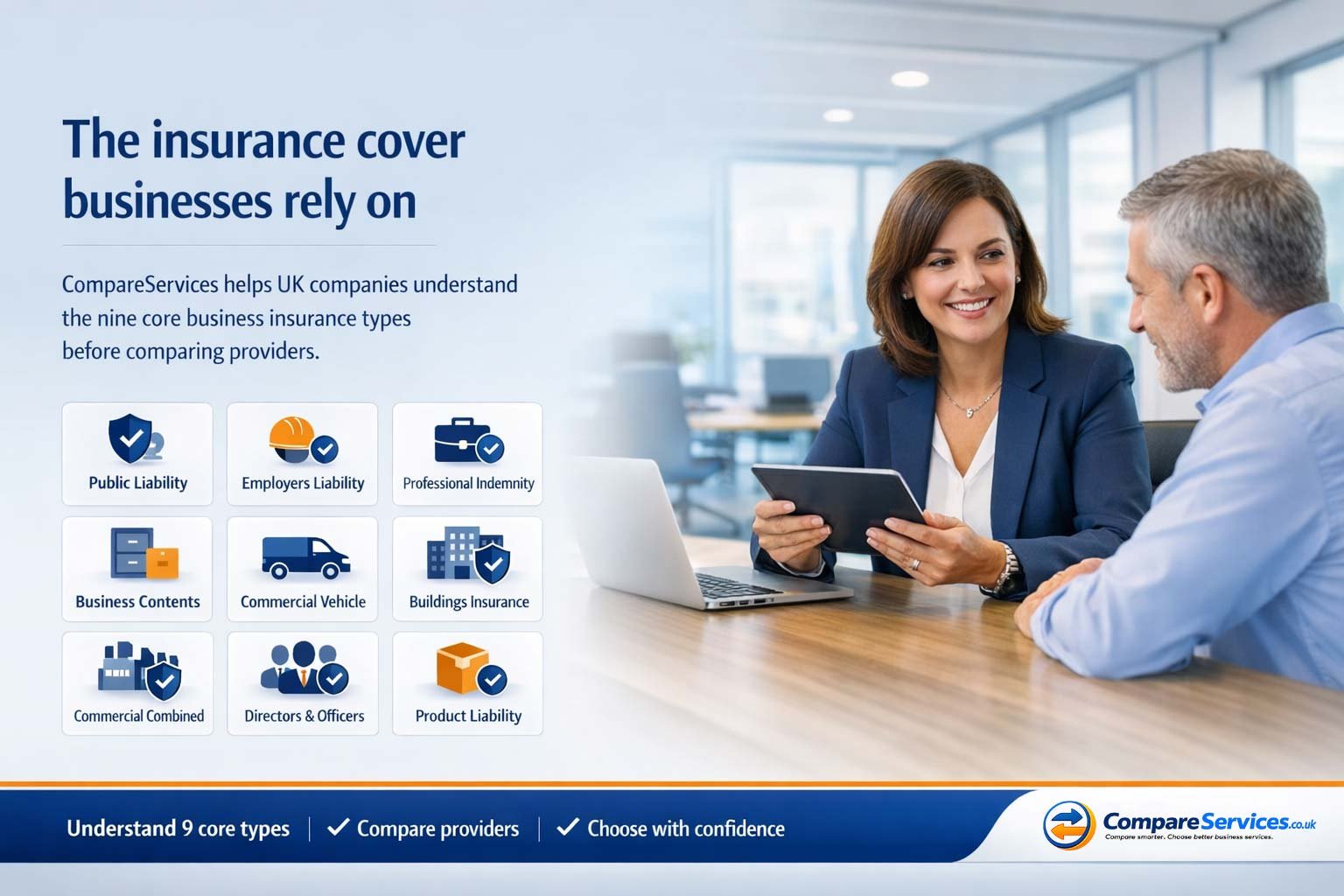
The insurance cover businesses rely on
CompareServices helps UK companies understand the nine core business insurance types before comparing providers.

Choose the route that matches your insurance stage
Some visitors need a fast overview. Others need to validate gaps, compare providers, or check regulatory requirements. Start with the route that fits.
How CompareServices helps you choose
CompareServices helps you move towards the right insurance category with more confidence, before you start comparing quotes.
The Problem & The Solution
Why insurance selection becomes difficult
Business owners usually start with a practical concern: protecting staff, serving customers, safeguarding premises, meeting a contract or covering vehicles and products. Comparing quotations before identifying the correct policy type can produce unsuitable shortlists and gaps that only become visible after a claim.
How structured comparison improves decision quality
A structured approach helps you identify the relevant cover first and then move into a focused provider comparison:
Business Insurance Category Overview
Nine core service types UK SMEs compare most often
| Service type | What it protects | Best fit for | Why compare |
|---|---|---|---|
| Public Liability | Third-party injury/property damage | Customer-facing firms | Required by clients/venues |
| Employers Liability | Employee injury/illness claims | Businesses with staff | Generally compulsory for employers |
| Professional Indemnity | Advice, design, service claims | Consultants, agencies | Critical for expertise-based firms |
| Business Contents | Stock, equipment, contents | Offices, shops, studios | Asset protection & continuity |
| Commercial Vehicle | Business-use vehicles | Delivery, field service | Vehicles as operations |
| Commercial Combined | Multi-risk packaged cover | Overlapping exposures | Coordinated protection |
| Directors & Officers | Management decisions | Limited companies, boards | Governance protection |
| Product Liability | Products supplied/sold | Manufacturers, retailers | Physical goods exposure |
| Buildings Insurance | Commercial premises structure | Premises owners | Property resilience |
Compare by Business Need
Most businesses start with an operational need, contract requirement or identifiable exposure rather than a policy name. Use this table to connect that business need with the most relevant insurance comparisons.
| Business need or scenario | Insurance categories | Why it matters |
|---|---|---|
| You employ staff | Employers Liability & Public Liability | People risk should be handled separately from customer risk. |
| You advise clients | Professional Indemnity Insurance | Advice or service disputes can create financial exposure. |
| You own premises | Buildings & Business Contents | Buildings and contents are different exposures. |
| You sell products | Product Liability / Commercial Combined | Product claims sit in a different lane from professional risk. |
| You run work vehicles | Commercial Vehicle Insurance | Driving risk should not be mixed with premises cover. |
| Overlapping risks | Commercial Combined Insurance | Simplifies administration for multiple risk areas. |
| Strategic decisions | Directors & Officers Insurance | Leadership decisions can create separate governance exposure. |
Small vs Larger Business Insurance Priorities
Business size changes the comparison lens. Smaller firms often prioritise essentials and affordability, while larger or more complex firms need to think more carefully about operational overlap, exclusions, and programme design.
| Business profile | Typical priority | What matters most |
|---|---|---|
| Sole trader / Micro | Essential cover only | Affordability and contractual requirements. |
| Small employer | Legal & people-related | Staff risk and manageable policy structures. |
| Growing SME | Broader protection stack | Exclusions, continuity, and multi-site needs. |
| Established Multi-site | Structured layered cover | Governance, buildings, and board-level liability. |
| Professional services | Advice-related protection | Policy wording and retroactive considerations. |
| Product-led / Trading | Liability & asset protection | Stock, products, and supplier dependency. |
What To Compare Across Business Insurance Providers
Once the correct insurance type is identified, apply the same business information and commercial assumptions to every quotation so differences in wording, limits, service and cost remain visible.
Confirm the exact legal entity, trading names, activities, locations, territories and associated companies covered. A policy can appear suitable while describing a narrower trade than the work actually delivered. Every material service, product, process and work location should be declared consistently.
Compare liability limits, vehicle values, contents sums insured and commercial-building reinstatement values on a like-for-like basis. Check whether limits apply to each claim or in aggregate, whether legal costs sit inside the limit and whether inflation or average clauses can affect recovery.
Read the schedule, statement of fact, policy wording and endorsements together. Check trade restrictions, hazardous activities, security conditions, unoccupancy, subcontractors, geographic limits, vehicle use, product territories and every excess the business must fund before the insurer contributes.
Identify the insurer, broker, claims handler and emergency contacts. Compare notification deadlines, evidence requirements, legal representation, repair networks, loss adjusters, interim payments, complaints routes and the support available when a claim affects customers, staff, vehicles, products or premises.
Use the FCA Firm Checker or Financial Services Register to establish whether the firm is authorised and what role it performs. Distinguish the insurer carrying the risk from a broker, comparison service, underwriting platform, appointed representative or claims administrator.
Compare annual premium, Insurance Premium Tax, deposit, instalment or finance charges, broker fees, administration charges, policy amendments, cancellation, automatic renewal and document access. A low monthly figure is not a complete price when finance costs, exclusions or higher excesses differ.
What Changes Business Insurance Cost For UK Companies
Business insurance does not have one reliable universal price. Premiums depend on the risk presented, the cover selected and the provider’s current appetite. Reprice every option using the same information.
| Cost Driver | Why It Matters | Information To Keep Consistent |
|---|---|---|
| Trade And Activities | Manual work, advice, treatments, food, products, hazardous processes and customer-site work can change claim frequency and severity. | Exact occupation, activity split, methods, products, territories and prohibited work. |
| Turnover, Payroll And Workforce | Business scale can indicate the number of transactions, employees, customers and opportunities for claims. | Actual and forecast turnover, payroll, employee types, subcontractors and seasonal changes. |
| Premises, Visitors And Locations | Footfall, owned buildings, rented sites, work away, storage and multiple premises create different liability and property exposures. | Every address, occupancy, construction, public interaction, security and unoccupied period. |
| Vehicles, Products And Assets | Vehicle class, mileage, stock, equipment, product type, import activity and replacement values affect potential loss. | Vehicle schedules, product categories, territories, asset registers and current values. |
| Limits And Sums Insured | Higher liability limits and asset values increase the amount the insurer may need to pay. | Contract requirements, maximum-loss scenarios, professional valuations and selected excesses. |
| Claims And Incidents | Previous losses, near misses and unresolved circumstances influence underwriting and required controls. | Complete requested history, values, circumstances, status and corrective action. |
| Risk Controls | Training, contracts, maintenance, alarms, fire protection, vehicle controls and quality procedures can reduce exposure. | Certificates, inspection records, written procedures, responsibilities and review dates. |
| Payment And Policy Structure | Instalments, finance, broker fees and bundled sections can change total payable and obscure like-for-like comparison. | Annual premium, IPT, deposit, finance cost, fees, included sections and cancellation terms. |
Practical pricing rule: do not compare advertised examples or monthly figures in isolation. Compare the complete annual amount for the same business activities, limits, sums insured, excesses, optional sections, claims history, inception date and payment method.
Information To Prepare Before Comparing Business Insurance
A complete risk brief reduces inconsistent quotations, repeated questions and the chance that a material activity or asset is omitted.
- Legal entities and trading names: record the companies, partnerships, sole traders, subsidiaries and interested parties that may need to be insured or noted.
- Business activities: describe primary, secondary and incidental work, including advice, manual tasks, installations, treatments, events, products and overseas activity.
- People and subcontractors: prepare employee numbers, payroll, roles, labour-only and bona-fide subcontractors, volunteers and responsibility for their insurance.
- Premises and property: list each site, ownership or lease responsibility, construction, use, occupancy, security, contents, stock and current commercial-building reinstatement values.
- Vehicles and driving: provide vehicle details, drivers, use, mileage, overnight location, goods carried, claims and any specialist equipment or modifications.
- Products and territories: identify products manufactured, imported, altered, distributed or sold, along with turnover, destinations, safety controls, testing and traceability.
- Contracts and required limits: collect client, landlord, lender, venue, tender, regulator and professional-body requirements, including deadlines and certificate wording.
- Claims, incidents and changes: disclose the requested history accurately and explain corrective action, planned acquisitions, new activities, premises changes or expected growth.
- Existing documents: retain current schedules, statements of fact, wordings, endorsements, certificates, claims contacts, renewal notices and cancellation dates.
- Commercial assumptions: give every provider the same inception date, limit choices, excess tolerance, annual or monthly payment preference and optional-cover requirements.
The nine Business Insurance services in this category
Use the summaries below to identify the insurance types that match your workforce, customers, advice, products, vehicles, premises and management responsibilities. Open the relevant comparison guide to review provider fit, wording, limits, exclusions, claims support and complete cost.
Public Liability Insurance
For businesses that interact with customers, visitors, venues, sites, or third-party premises and need cover aligned to public-facing risk.
Employers Liability Insurance
For UK businesses with staff that need cover linked to employee injury or illness arising through work and employment conditions.
Professional Indemnity Insurance
For consultancies, advisers, agencies, designers, and specialists where professional judgement, advice, or deliverables create financial exposure.
Business Contents Insurance
For businesses that need to protect equipment, stock, furniture, and operational assets kept inside commercial premises.
Commercial Vehicle Insurance
For firms that rely on vans, cars, or specialist vehicles to deliver services, visit sites, transport goods, or support field operations.
Commercial Combined Insurance
For businesses with multiple overlapping risks that may benefit from a more coordinated insurance structure instead of isolated policies.
Directors & Officers Insurance
For limited companies and leadership teams that want cover linked to governance, management decisions, and board-level exposure.
Product Liability Insurance
For manufacturers, wholesalers, importers, retailers, and distributors where physical products create a distinct liability profile.
Office / Commercial Buildings Insurance
For premises owners or businesses responsible for the commercial structure itself rather than only the items kept inside it.
Why data matters before you compare
Insurance comparison should not begin with price alone. The right service choice depends on what your business looks like in practice: workforce profile, premises responsibility, turnover shape, vehicle usage, product exposure, and client requirements all influence whether you are even comparing the right category.
The wrong data leads to the wrong shortlist. If the business under-describes how it trades, the first quotes may look cheaper but be poorly aligned. If it overstates complexity, it may be pushed into options that do not match the real exposure.
Accurate inputs improve category selection
How to choose the right starting point
If you are unsure where to begin, move through these steps in order. It keeps the process commercially sensible and stops the comparison from becoming too broad too early.
1. Check legal necessity first
If you employ people, employers’ liability should usually be confirmed early.
2. Check contractual pressure next
Client contracts, landlord requirements, and tender packs often shape what must be evidenced.
3. Map your operating model
Ask whether your business is advice-led, product-led, premises-led, people-led, or vehicle-dependent.
4. Separate property from contents
The building structure and the contents inside it are different exposures and should be reviewed separately.
5. Decide whether governance risk is material
If leadership and board decisions carry meaningful exposure, D&O may be relevant.
6. Compare the relevant providers
Once the insurance type is right, provider comparison becomes far more useful.
Common business scenarios
Start with the main exposure in each scenario, then review the linked insurance comparisons that address that risk directly.
| Business scenario | Main risk focus | Insurance comparisons to review |
|---|---|---|
| Consultancy or agency | Advice, recommendations, deliverables | Professional Indemnity, Employers Liability |
| Visitor-facing premises | Public interaction, staff, contents | Public Liability, Contents, Employers Liability |
| Field-service business | Vehicles, staff, customer locations | Commercial Vehicle, Public Liability |
| Product seller / Maker | Product claims, stock, premises | Product Liability, Commercial Combined |
| Growing limited company | Governance, leadership, multi-risk | Directors & Officers, Commercial Combined |
| Premises owner | Property structure, continuity | Commercial Buildings, Business Contents |
How CompareServices helps you compare business insurance
CompareServices.co.uk helps UK businesses identify relevant insurance types before comparing providers. The comparison starts with the legal entity, activities, workforce, premises, vehicles, products, contracts, claims history and required limits so different policies are not treated as interchangeable. Reviewed by Bhav Giva, Founder & Lead Analyst at CompareServices.co.uk, on 6 August 2026.
Useful business insurance resources
Official business insurance guidance
FAQs
Find the right business insurance with less effort
Compare smarter, reduce supplier confusion, and move forward with more confidence. Explore the nine core insurance types your business needs.