
Compare Payments & Finance Services for UK Businesses
A structured route through payment acceptance, cash flow, business banking, borrowing and financial operations tools
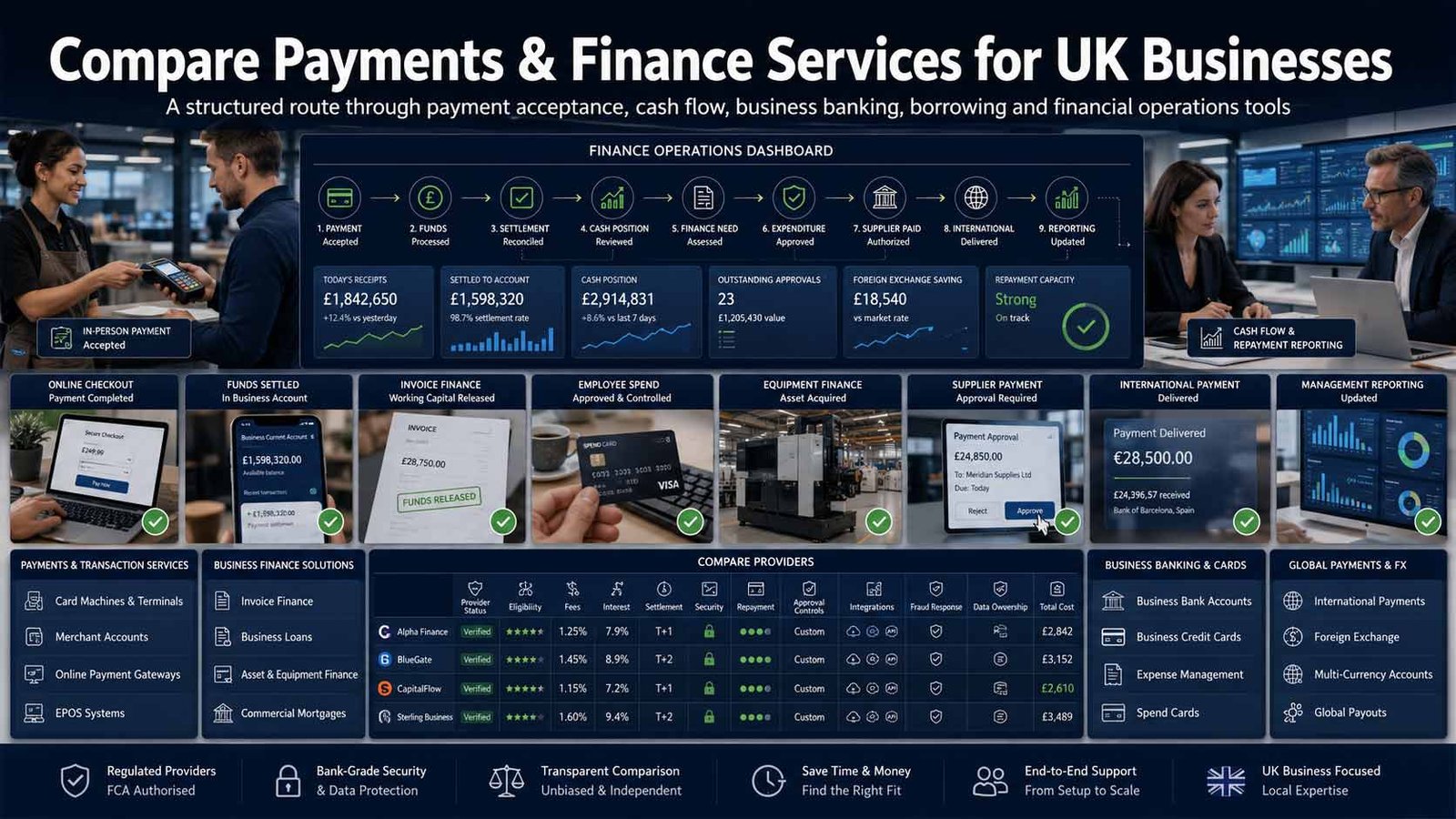
Payments and finance services help UK businesses take card payments, manage cash flow, borrow for growth, control spending and move money securely. Use this hub to identify whether payment acceptance, funding, banking, spend control or international payments is the right starting point.
Why this category matters to UK businesses
Payments and finance are not back-office details. They affect revenue capture, checkout experience, working capital, borrowing structure, spend control and operational confidence.
- Accept payments in person, online or through invoice-led workflows
- Match funding tools to the real cash-flow pressure point
- Control team spend, banking visibility and reconciliation
- Plan asset, property and international trading decisions with more structure
Payments and finance decisions should begin with the commercial job the service must perform. A card terminal captures an in-person payment, while a merchant account supports processing and settlement. Invoice finance releases value from receivables, while a business loan funds a broader purpose. Spend platforms control team purchasing, while credit products provide borrowing capacity.
Use this category to separate acceptance, banking, working capital, asset funding, property finance, tax timing, spend control and international money movement before requesting proposals. That keeps eligibility, pricing, security, integrations and repayment structures comparable.
The right service improves revenue collection, cash visibility, approval control, reconciliation and funding discipline without adding unsuitable debt or unnecessary payment complexity.
Map the finance problem before choosing the product
Businesses often add payment and finance tools gradually. Over time, that patchwork can create avoidable cost, friction and weak visibility.
Payment friction
Card terminals, gateways, merchant accounts and EPOS systems help improve in-person and online payment acceptance.
Cash-flow timing
Invoice finance, loans, VAT finance and credit cards can support timing gaps, debtor pressure and growth-related spend.
Disconnected controls
Bank accounts, expense platforms, spend cards and EPOS reporting improve governance, approvals and reconciliation.
Capital investment
Asset finance, equipment finance, loans and commercial mortgages help match funding to the asset life and strategic purpose.
International trading
Foreign exchange and international payment tools help reduce friction, improve transparency and manage currency exposure.
Payments & Finance service paths at a glance
Use this table to identify what kind of service should be reviewed first.
| Business problem | What usually causes it | Service types to review first | What improves |
|---|---|---|---|
| Card payments are accepted, but total cost feels unclear | Terminal rental, acquiring charges, gateway fees and reporting sit across different suppliers | Card Machines, Merchant Accounts, EPOS Systems, Payment Gateways | Pricing visibility, cleaner reporting and smoother checkout flow |
| Sales are strong, but cash flow is tight | Long debtor terms, stock purchases, payroll timing, tax liabilities or fast growth | Invoice Finance, Business Loans, Tax Loans / VAT Finance, Business Credit Cards | Working-capital resilience and more predictable cash planning |
| Approvals, reconciliations and spending controls are weak | Too many cards, manual expenses, fragmented banking and low visibility | Business Bank Accounts, Expense Management / Spend Cards, EPOS Systems | Stronger governance and clearer spend control |
| International trading creates payment delays or margin leakage | FX spread, slow settlement and unsuitable banking or payment routes | Foreign Exchange / International Payments, Payment Gateways, Business Bank Accounts | Better currency visibility and cross-border payment handling |
| Growth requires equipment, refits or premises | Large capital outlays are considered without the right funding structure | Asset Finance, Commercial Mortgages, Business Loans | Cash preservation and finance matched to asset life |
Payments & Finance needs by business stage
Start-ups, growing SMEs, multi-site businesses and international traders usually need different first steps.
| Business stage / need | Typical priority | Most relevant service types | Why it matters |
|---|---|---|---|
| Start-up / early trading | Simple acceptance, basic banking and cash discipline | Business Bank Accounts, Card Machines, Payment Gateways, Business Credit Cards | Keeps setup clear while separating company finances and payment acceptance |
| Growing SME | Cash flow, multi-channel selling and team spend control | Merchant Accounts, EPOS Systems, Invoice Finance, Spend Cards, Business Loans | Growth exposes working-capital gaps and transaction complexity |
| Multi-site / operationally complex | Reporting, settlement control and system integration | EPOS Systems, Merchant Accounts, Payment Gateways, Spend Cards, Business Bank Accounts | More locations and users increase reconciliation and approval demands |
| Asset-heavy or property-led business | Structured finance for equipment and premises | Asset Finance, Commercial Mortgages, Business Loans | Large purchases need longer-term funding choices rather than short-term fixes |
| International / cross-border trading | Currency management and payment transparency | Foreign Exchange / International Payments, Payment Gateways, Business Bank Accounts | FX, settlement speed and overseas supplier payments can affect margin |
| Tax pressure / lump-sum obligations | Planned support around periodic liabilities | Tax Loans / VAT Finance, Business Bank Accounts | Helps distinguish scheduled tax timing support from broader operational weakness |
Use one evidence framework across every payment and finance decision
The product changes across this category, but buyers should apply the same discipline to purpose, eligibility, pricing, security, servicing, implementation and exit.
| Control area | What the buyer should define | Evidence to request before award | Why it matters |
|---|---|---|---|
| Commercial purpose and service boundary | State whether the requirement is payment acceptance, settlement, banking, spend control, working capital, equipment, property, tax timing or international money movement. | Written use case, in-scope entities, locations, channels, users, transaction or borrowing purpose, exclusions and accountable owner. | Products can appear similar while solving different financial jobs and creating different obligations. |
| Business and transaction baseline | Record turnover, trading history, sectors, customer type, card turnover, average transaction, channels, currencies, invoices, debtor terms, asset cost, property value, staff spend and forecast growth. | Management accounts, bank statements, processing statements, debtor ledger, transaction data, asset or property information, tax position and a common pricing scenario. | Provider pricing, approval and risk decisions depend on the accuracy and comparability of the submitted baseline. |
| Eligibility and regulated-entity checks | Identify the contracting firm, regulated entity, permissions, broker or introducer role, credit assessment, security, guarantees, ownership requirements and excluded sectors. | FCA or other relevant registration details, legal entity, product terms, eligibility criteria, credit process, security documents, broker disclosure and complaint route. | A familiar brand or software interface does not by itself identify who provides the regulated or contractual service. |
| Pricing and complete cost | Model transaction rates, authorisation, gateway, terminal, rental, settlement, chargeback, monthly, account, FX, interest, arrangement, valuation, legal, early-repayment, default and support charges. | Itemised pricing schedule, representative scenario, total amount repayable where relevant, annual percentage or equivalent rate, volume bands, minimums, indexation and additional-service rates. | Headline rates are not comparable when essential fees, settlement terms or product conditions use different definitions. |
| Funds, settlement and cash-flow behaviour | Define settlement timing, reserves, holds, refunds, chargebacks, cut-off times, account access, repayment profile, invoice notifications, collections and treatment of failed or delayed transactions. | Funds-flow diagram, settlement schedule, safeguarding explanation where applicable, reserve policy, repayment schedule, collections process and scenario testing. | Cash availability and control can matter more than the headline fee, particularly during growth, disputes or provider failure. |
| Security, fraud and user control | Set authentication, permissions, approval limits, device and card controls, supplier verification, fraud monitoring, chargeback handling, account recovery, logging and incident-response requirements. | Security responsibilities, fraud controls, user-role model, audit logs, reimbursement or dispute scope, incident process, data-flow map and customer actions. | Payment and finance tools can reduce friction while increasing loss exposure if authority and fraud controls are weak. |
| Integration, implementation and reconciliation | Identify ecommerce, EPOS, accounting, banking, payroll, CRM, expenses, invoicing and treasury connections; migration; testing; training; cutover and ongoing administration. | Integration scope, API or connector limits, data ownership, reconciliation design, failed-sync handling, implementation plan, acceptance tests and named support. | A commercially attractive product can create manual work or reporting errors when systems and settlement data do not reconcile. |
| Contract, servicing and exit | Define minimum term, renewal, notice, service levels, complaint handling, account review, limit changes, refinancing, portability, data export, terminal or card return, settlement after termination and deletion. | Executed terms, service schedule, renewal and variation clauses, exit process, outstanding-transaction treatment, export format, transition support and final-account timetable. | Long-term value depends on service quality and the ability to change provider without losing data, access or cash-flow continuity. |
Understand how the thirteen service categories connect
One business may need several services, but each contract should have a distinct purpose, owner, data flow and cost model.
Accept and reconcile customer payments
Card machines, merchant accounts, online gateways and EPOS systems cover different parts of acceptance, authorisation, settlement, checkout, till operations, stock and reporting. Buyers should map the complete payment flow before comparing individual components.
Hold money and control business spend
Business bank accounts, credit cards and expense-management platforms support different combinations of account access, short-term credit, approvals, receipt capture, limits and reconciliation. User roles and accounting integration should be designed before cards are issued widely.
Fund working capital, assets and property
Invoice finance, business loans, asset finance, commercial mortgages and tax-related finance differ by funding purpose, security, term, repayment source and eligibility. Compare them against a defined cash-flow or investment need rather than treating all borrowing as interchangeable.
Move money across currencies and borders
Foreign exchange and international-payment services should be assessed by currency pairs, volumes, pricing method, settlement, beneficiary controls, speed, hedging needs, account structure, regulatory entity and integration with treasury or accounting workflows.
Payments & Finance service categories
This category covers thirteen service areas across payment acceptance, working capital, banking, spend control, property finance and international money movement.
In-person payment acceptance
Card Machines / Payment Terminals
For shops, cafés, clinics, mobile teams, events and service environments that need reliable face-to-face card payment acceptance.
Compare card machines and payment terminalsCard acquiring and settlement
Merchant Accounts
For businesses reviewing transaction authorisation, settlement arrangements, reserve policies, acquiring risk and the payment flow behind checkout.
Compare merchant account providersDigital checkout
Payment Gateways (Online)
For ecommerce, subscription and online checkout-led businesses that need secure payment pages, recurring billing and fraud controls.
Compare online payment gatewaysPoint-of-sale operations
EPOS Systems
For retail, hospitality and multi-site operators that need sales, stock, staff and reporting capability beyond a standalone terminal.
Compare EPOS systemsDebtor-led working capital
Invoice Factoring / Finance
For B2B businesses that invoice customers and need to release cash from unpaid invoices to reduce timing pressure.
Compare invoice factoring and financeGrowth and working capital
Business Loans
For expansion, refurbishment, strategic investment or broader funding needs where term lending may be suitable.
Compare business loan providersEquipment and asset funding
Asset Finance / Equipment Finance
For businesses funding vehicles, machinery, specialist equipment or major assets while protecting operating cash.
Compare asset and equipment financePremises and property finance
Commercial Mortgages
For businesses buying, refinancing or investing in trading premises or commercial property with a longer-term view.
Compare commercial mortgage providersOperational banking
Business Bank Accounts
For day-to-day banking, account access, cash handling, integrations, support model and finance workflow separation.
Compare business bank accountsShort-term spend flexibility
Business Credit Cards
For company purchases, travel, online spending and working-capital smoothing with clearer business spending separation.
Compare business credit cardsTeam spend control
Expense Management / Spend Cards
For businesses that need approval workflows, receipts, policy control, spend visibility and faster reconciliation.
Compare expense management and spend cardsScheduled tax timing
Tax Loans / VAT Finance
For businesses assessing structured support around VAT or tax liabilities while distinguishing HMRC plans from third-party finance.
Compare tax loans and VAT financeCross-border money movement
Foreign Exchange / International Payments
For importers, exporters, global payroll users and businesses paying or receiving foreign currencies.
Compare foreign exchange and international paymentsHow to compare Payments & Finance services more effectively
The right first question is not which provider is cheapest. It is what financial job the service needs to perform.
- Decide whether you are trying to take money, hold money, control spend or borrow money.
- Identify whether the pressure point is checkout conversion, cash-flow timing, capital investment or oversight.
- Map the trading model: retail, hospitality, B2B invoicing, ecommerce, field-based, property-backed or international.
- Decide whether this is one operational fix or a stack decision involving payments, banking and finance together.
- Open the most relevant service page and compare providers only after the category is clear.
How CompareServices structures Payments & Finance comparisons
CompareServices separates this category into thirteen commercial decisions so UK businesses can identify the correct service before comparing named providers. Each live service page has its own scope, provider criteria, pricing factors and negative boundary.
- Separate payment acceptance, banking, borrowing and spend control
- Define the transaction, cash-flow or investment problem first
- Give each provider the same turnover, volume and business assumptions
- Compare eligibility, implementation, servicing, risk and complete cost
- Keep regulated advice and approval decisions with appropriately authorised firms
- Route buyers to the relevant live comparison without universal product claims
Fit first. Finance product second.
A company with slow-paying B2B customers may need receivables-linked finance rather than a general-purpose loan. Weak staff-expense controls may require approval software rather than more credit. A retailer may need an integrated EPOS and acquiring design before adding another standalone payment product.
Correct service selection reduces duplicate fees, unsuitable borrowing, fragmented reconciliation and proposals that cannot be compared on the same basis.
UK payments and business-finance context
The UK market includes banks, building societies, specialist lenders, asset-finance providers, invoice-finance firms, merchant acquirers, payment institutions, electronic-money firms, card issuers, foreign-exchange providers and software-led spend platforms. Similar marketing language can therefore describe materially different legal, commercial and operational arrangements.
FCA safeguarding requirements for payment and electronic-money firms were strengthened from 7 May 2026. Businesses should still identify the regulated entity, understand how relevant funds are handled, review settlement and failure arrangements, and check the permissions and status of firms involved in payment or finance services.
HMRC payment plans are arrangements agreed directly with HMRC and are different from third-party tax or VAT finance. APP scam reimbursement protections also apply within a defined scope, so businesses should not treat reimbursement as a substitute for payment approval, supplier verification, account controls and fraud prevention.
Use this comparison for commercial research and preparation. Eligibility, affordability, security, tax treatment, legal obligations and suitability depend on the applicant, product and provider. Obtain regulated, legal, accounting or tax advice where required.
Payments & Finance service pages in this category
Use these pages to move from category overview into service-specific comparison.
- Compare Card Machines / Payment Terminals
- Compare Merchant Accounts
- Compare Payment Gateways (Online)
- Compare EPOS Systems
- Compare Invoice Factoring / Finance
- Compare Business Loans
- Compare Asset Finance / Equipment Finance
- Compare Commercial Mortgages
- Compare Business Bank Accounts
- Compare Business Credit Cards
- Compare Expense Management / Spend Cards
- Compare Tax Loans / VAT Finance
- Compare Foreign Exchange / International Payments
Frequently Asked Questions
Quick answers for UK businesses reviewing payments and finance service categories.
What is the difference between a payment gateway and a merchant account?
A payment gateway handles the secure transfer of payment data during checkout, while a merchant account supports the authorisation and settlement of card transactions. Many businesses need both, but they perform different jobs inside the payment flow.
When should a business look at invoice finance instead of a standard loan?
Invoice finance is usually worth considering when cash is tied up in unpaid B2B invoices and the issue is timing rather than long-term borrowing need. A standard loan may suit broader funding goals, but invoice finance is often more directly linked to receivables.
How often should a business review its payments and finance setup?
Most businesses should review their stack at least annually and again when trading changes significantly, such as launching online, opening new sites, hiring teams, exporting, or taking on larger projects.
Are tax loans or VAT finance the same as HMRC payment plans?
No. HMRC payment plans are arrangements made directly with HMRC if you cannot pay on time, while tax loans or VAT finance are third-party finance products. They solve similar timing pressures but work through different routes and obligations.
What is the best first step if a business is not sure which finance service it needs?
Start by identifying the exact pressure point: taking payments, controlling spend, covering a short-term cash gap, funding an asset, or supporting international trade. Once the problem is clear, it becomes easier to compare the right service type.
Authoritative UK payments and business-finance guidance
Reviewed by Bhav Giva, Founder & Lead Analyst at CompareServices.co.uk, on 4 August 2026. Bhav reviews category structure, service boundaries, comparison criteria and UK business relevance across the CompareServices platform.
Use the following primary sources alongside the relevant live service comparison when assessing funding markets, payment-firm safeguards, fraud protections, invoice finance and tax-payment options. Obtain regulated financial, legal, accounting or tax advice where the business, product or transaction requires specialist input.
- Small Business Finance Markets Report 2026 — British Business Bank
- Invoice Finance Guidance — British Business Bank
- Safeguarding Requirements for Payment and E-Money Firms — FCA
- Check Whether a Financial Firm Is Authorised — FCA
- APP Fraud Reimbursement Protections — Payment Systems Regulator
- Setting Up an HMRC Payment Plan — GOV.UK
- UK Open Banking Information — Open Banking Limited