
Compare IT & Technology Services for UK Businesses
A structured way to compare managed IT, cloud, AI, CRM, software, automation, analytics and finance tools
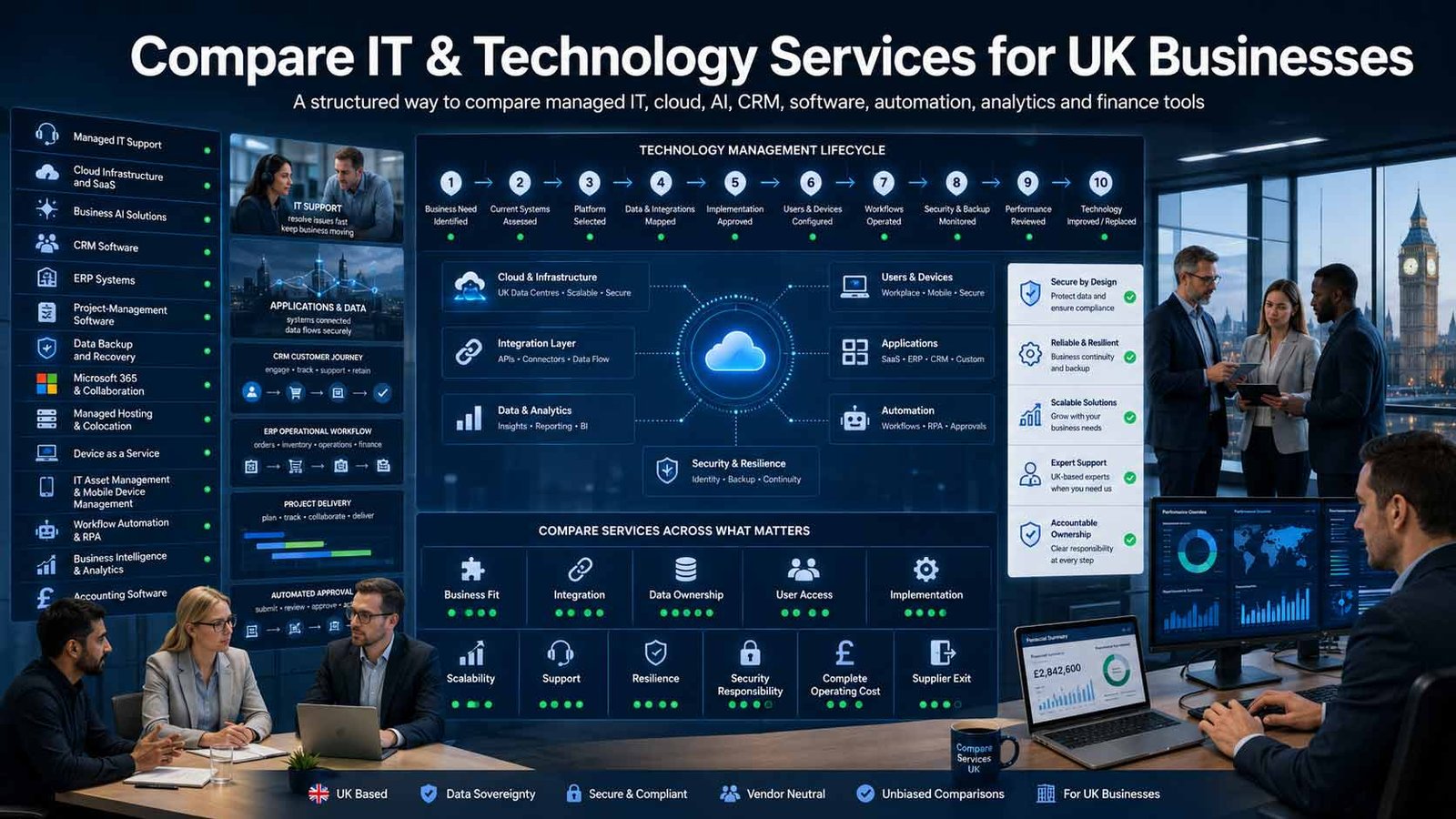
IT and technology services help UK businesses run operations, modernise systems, improve data visibility, support staff, automate work and choose scalable software. Use this hub to identify whether your next comparison should focus on managed IT, cloud, AI, CRM, ERP, project tools, backup, collaboration, hosting, hardware, device management, automation, analytics or accounting software.
Why IT & Technology services matter to UK businesses
Technology now affects service quality, staff productivity, cost control, customer experience, reporting accuracy, resilience and future growth.
- Keep users, devices and systems operating reliably
- Connect collaboration, customer data and reporting workflows
- Reduce manual process drag through automation and AI
- Choose scalable software before vendor comparison begins
IT & Technology is not one buying decision. It is a connected category covering fourteen services that solve different operational problems across support, cloud, software, collaboration, infrastructure, automation, analytics and finance.
This hub helps UK SMEs identify the right service path before comparing vendors, contracts or feature lists. The goal is to reduce mismatch between business needs and technology selection.
Many businesses do not under-invest; they invest in the wrong type of solution at the wrong stage. Category-level clarity helps avoid that waste.
Map the operating issue to the right technology category
Most technology buying should start with the business problem, not the product label.
| Business problem | Likely service type | Why it fits | Typical buyer signal |
|---|---|---|---|
| Staff are wasting time on technical issues, onboarding and user support | IT Support / Managed Services | Provides operational support, endpoint management, troubleshooting and service continuity | Growing headcount, recurring support issues or no dedicated internal IT lead |
| Teams use disconnected apps and files | Cloud Services, Microsoft 365 / Google Workspace, CRM Software | Improves shared access, collaboration, standardisation and operational visibility | File sprawl, email-led workflows or poor cross-team access |
| Repetitive admin is slowing the business down | Workflow Automation / RPA, CRM Software, Project Management Software | Reduces duplication, speeds up execution and creates more consistent workflows | Manual data entry, repeated approvals or inconsistent follow-up |
| Leadership needs better performance visibility | Business Intelligence / Analytics Platforms, ERP Systems, Accounting Software | Centralises data into clearer reporting and decision support | Conflicting reports, slow board packs or weak dashboards |
| Device, infrastructure or hosting complexity is increasing | Managed Hosting / Colocation, Device as a Service, IT Asset Management / MDM | Supports infrastructure reliability, lifecycle planning and device governance | Estate growth, remote staff, hardware renewal pressure |
| The business wants to modernise with AI or smarter systems | Business AI Solutions, Workflow Automation / RPA, CRM Software | Uses process logic, data and automation to improve productivity and service delivery | Leadership interest in AI, productivity targets or repeated admin burden |
Why data matters before you compare providers
One of the biggest mistakes in IT procurement is choosing platforms before understanding how the business actually works. Buyers often compare features without reviewing process maturity, data quality, internal ownership, adoption readiness and total operating cost.
Technology buying should be based on business fit, adoption likelihood and measurable outcomes rather than vendor positioning alone.
Better visibility creates better buying decisions
A business may think it needs a new CRM when the deeper issue is sales process discipline. Another may want analytics software before agreeing what should be measured. AI initiatives also perform better when source records, workflows and owners are already clear.
Technology priorities change with scale and complexity
The right shortlist depends on headcount, systems, data maturity, compliance pressure and internal capability.
| Business size / profile | Likely priorities | Usually relevant service types | Main buying focus |
|---|---|---|---|
| Micro-businesses and sole traders | Reliability, cost control, simple collaboration and finance visibility | Microsoft 365 / Google Workspace, Accounting Software, Data Backup & Recovery, IT Support | Simplicity, predictable pricing and ease of adoption |
| Small and growing SMEs | Better support, process consistency, sales visibility and scalable software | IT Support / Managed Services, CRM Software, Project Management Software, Cloud Services, Workflow Automation / RPA | Scalability, integration and reduced manual work |
| Established SMEs | Clear reporting, stronger governance, structured automation and device control | ERP Systems, Business Intelligence / Analytics Platforms, IT Asset Management / MDM, Managed Hosting / Colocation | Operational visibility, control and governance |
| Larger organisations / multi-site firms | Service continuity, estate management, system interoperability and advanced analytics | Managed Services, Device as a Service, Managed Hosting / Colocation, Business Intelligence, ERP, MDM | Efficiency, resilience, standardisation and compliance |
Use one commercial framework across every IT service decision
The product changes from one service page to another, but the evidence needed for a controlled procurement decision remains broadly consistent.
| Control area | What the buyer should define | Evidence to request before award | Why it matters |
|---|---|---|---|
| Business outcome and service boundary | State the operational problem, users affected, measurable outcome, in-scope responsibilities and work that must remain with internal teams or another supplier. | Written scope, responsibility matrix, exclusions, assumptions, dependencies, acceptance criteria and named business owner. | Technology projects fail when a provider is selected before the organisation agrees what success means or who owns each part of delivery. |
| Users, sites, devices and workload | Record current and forecast users, locations, devices, applications, data volumes, transactions, peak demand, remote-working patterns and support requirements. | Baseline inventory, growth model, usage assumptions, capacity thresholds and a pricing schedule tied to the same units. | Supplier proposals are not comparable when each provider prices a different estate, volume or service level. |
| Data, integrations and system ownership | Identify source systems, records, fields, interfaces, synchronisation frequency, quality issues, migration requirements and the authoritative system for each data type. | Data map, integration design, API or connector limits, reconciliation method, failed-sync handling, migration test and ownership of custom code. | Features can appear complete in a demonstration while the real implementation depends on unreliable data or unsupported connections. |
| Security, privacy and resilience | Define identity, access, privileged administration, encryption, logging, data locations, retention, recovery, incident notification, supplier access and continuity requirements. | Security schedule, processor terms, subprocessor list, access model, recovery evidence, incident process, assurance reports and customer responsibilities. | A service can meet functional needs but still create unacceptable operational, contractual or personal-data risk. |
| Migration, adoption and change | Plan discovery, design, cleansing, configuration, pilots, user communication, training, cutover, rollback, support and the measures that prove adoption. | Implementation plan, milestones, resource assumptions, acceptance tests, training deliverables, issue process and post-launch adoption reporting. | Software value depends on people changing how they work; licence activation alone is not successful implementation. |
| Service levels and operating governance | Define support channels, operating hours, priorities, response, restoration, resolution, maintenance, escalation, reporting, service reviews and improvement ownership. | Service-level schedule, example report, escalation map, governance calendar, service-credit rules and evidence from comparable customers. | Headline uptime or response claims are weak unless the clock, exclusions, business outcome and reporting method are clear. |
| Complete cost and commercial flexibility | Model licences, implementation, migration, integrations, storage, support, training, internal administration, overage, project work, inflation and forecast growth. | Three-year cost model, unit rates, minimum commitments, renewal pricing, additional-service rate card and reduction rights. | A low entry price can become expensive when essential modules, implementation work or increased usage are charged separately. |
| Contract exit and operational portability | Decide how data, configurations, records, documentation, credentials, integrations, licences, open work and supplier knowledge will transfer at termination. | Exit plan, export formats, transition assistance, notice periods, deletion confirmation, administrator handover and charges after termination. | Exit terms determine whether the organisation can change provider without service interruption, data loss or an unplanned rebuild. |
IT & Technology service categories
This category covers fourteen service areas. Each one solves a different part of the wider support, software, collaboration, infrastructure, automation, reporting and finance challenge.
Operational support
IT Support / Managed Services
Day-to-day technical support, maintenance, monitoring, user help and operational continuity for teams without full internal IT coverage.
Compare IT support and managed servicesHosted systems
Cloud Services (IaaS/SaaS)
Hosted applications, infrastructure flexibility and remote access for businesses moving away from purely local systems.
Compare cloud services providersPractical AI adoption
Business AI Solutions
AI-enabled productivity, workflow enhancement, document handling, internal search and decision support for clearer business outcomes.
Compare business AI solutionsCustomer visibility
CRM Software
Customer data, sales pipeline, follow-up processes and service records in one more structured operating layer.
Compare CRM software providersIntegrated operations
ERP Systems
Joined-up control over finance, operations, inventory, procurement, fulfilment or wider cross-functional data.
Compare ERP systems providersDelivery control
Project Management Software
Task ownership, milestones, resource visibility, accountability and delivery reporting for project-led teams.
Compare project management softwareContinuity readiness
Data Backup & Recovery
Data protection, restore capability and operational resilience after loss, error, corruption or service disruption.
Compare data backup and recovery providersCollaboration suite
Microsoft 365 / Google Workspace
Email, documents, calendars, file sharing and cloud productivity for modern distributed teams.
Compare Microsoft 365 and Google WorkspaceInfrastructure reliability
Managed Hosting / Colocation
Hosting environments, infrastructure performance, uptime and platform support for websites, apps or specialist workloads.
Compare managed hosting and colocation providersHardware lifecycle
Device as a Service / Hardware Leasing
Predictable access to laptops, desktops and devices with clearer refresh planning and cash-flow control.
Compare device as a service providersDevice governance
IT Asset Management / MDM
Endpoint inventory, ownership, policy control and auditability for hybrid teams, larger estates and mobile workforces.
Compare IT asset management and MDMProcess efficiency
Workflow Automation / RPA
Structured triggers, rules and handoffs that reduce repetitive admin across finance, operations and customer workflows.
Compare workflow automation and RPA providersDecision visibility
Business Intelligence / Analytics Platforms
Dashboards, reporting, performance insights and data visualisation for stronger leadership decisions.
Compare business intelligence platformsFinancial control
Accounting Software
Financial records, invoicing, expenses, reporting and tax workflows for trading businesses.
Compare accounting software providersNeed type versus best-fit service path
Use this table to narrow the right service family before comparing named suppliers.
| Need category | What the business is trying to achieve | Best-fit service path | Secondary services that may support it |
|---|---|---|---|
| Operational continuity | Keep systems running, reduce downtime and improve user support | IT Support / Managed Services, Data Backup & Recovery | Managed Hosting / Colocation, MDM |
| Collaboration and productivity | Standardise communication, documents, shared access and routine work | Microsoft 365 / Google Workspace, Cloud Services | Project Management Software, Workflow Automation / RPA |
| Customer and commercial process control | Improve sales visibility, service records and pipeline discipline | CRM Software | BI / Analytics, Project Management Software |
| Financial and reporting clarity | Improve accounting, forecasting, dashboards and board-level visibility | Accounting Software, Business Intelligence / Analytics Platforms | ERP Systems, Cloud Services |
| Automation and efficiency | Reduce manual effort and improve repeatable execution | Workflow Automation / RPA, Business AI Solutions | CRM Software, Project Management Software |
| Estate governance and lifecycle control | Manage devices, hosting and technology assets more consistently | Device as a Service, IT Asset Management / MDM, Managed Hosting / Colocation | IT Support / Managed Services |
How UK operating realities affect technology decisions
Technology decisions should reflect AI adoption, cyber resilience, data protection, finance workflows and digital reporting pressures.
AI adoption
AI should be evaluated as part of medium-term technology planning, but practical value depends on data quality, process ownership and implementation discipline.
Cyber resilience
Support models, collaboration suites, device management, backup and hosting choices all affect operational resilience, even when cyber security is a separate category.
Data protection
Cloud, hosting, software, analytics and AI procurement should include governance, processor assessment and security scrutiny, not just feature comparison.
Finance workflows
Digital record-keeping and suitable accounting software are increasingly connected with compliance readiness, cash-flow visibility and reporting accuracy.
How CompareServices structures IT & Technology comparisons
CompareServices separates this category into fourteen distinct commercial decisions so businesses can identify the correct service before comparing named providers. Each service page uses its own scope, terminology, provider evidence, pricing factors and constraint boundary.
- Start with the operating problem and required business outcome
- Keep managed services, platforms, infrastructure and software decisions distinct
- Use the same written requirements for every shortlisted provider
- Compare implementation, adoption, governance and lifecycle cost
- Route buyers to the relevant live service comparison without product-ranking bias
Fit first. Platform second.
A firm searching for software may need managed support, while a business considering AI may first need cleaner data, clearer workflows or stronger CRM foundations. Selecting the correct service category reduces unsuitable shortlists, duplicated tools and avoidable implementation cost.
Move from broad research into a focused technology shortlist
Use this sequence before opening every service page at once.
- Identify whether the pressure is support, collaboration, customer visibility, reporting, automation, AI, infrastructure or finance control.
- Map the pressure to the problem/solution table.
- Check whether your stage is micro-business, growing SME, established SME or larger organisation.
- Open the 1 to 3 service categories most relevant to the current operating constraint.
- Compare providers only after the service type and implementation goal are clear.
IT & Technology service pages in this category
Use these pages to move from category-level understanding into the relevant comparison page.
- Compare IT Support / Managed Services
- Compare Cloud Services (IaaS/SaaS)
- Compare Business AI Solutions
- Compare CRM Software
- Compare ERP Systems
- Compare Project Management Software
- Compare Data Backup & Recovery
- Compare Microsoft 365 / Google Workspace
- Compare Managed Hosting / Colocation
- Compare Device as a Service / Hardware Leasing
- Compare IT Asset Management / MDM
- Compare Workflow Automation / RPA
- Compare Business Intelligence / Analytics Platforms
- Compare Accounting Software
Frequently Asked Questions
Quick answers for UK business buyers comparing IT and technology service categories.
How often should a business review its IT and software stack?
Most businesses should review their core technology stack at least annually, and sooner when headcount changes, new sites open, reporting obligations change, or teams start relying on manual workarounds.
What is the difference between this category hub and a service page?
This category hub helps you identify which type of IT or technology service fits your problem. A service page goes deeper into one solution area, such as CRM, managed support or accounting software.
Should smaller businesses buy all-in-one platforms or separate specialist tools?
That depends on process complexity, internal capability and integration needs. Smaller businesses often benefit from simpler stacks, but all-in-one tools are not automatically better.
Where should a business start if it wants to use AI but its systems feel messy?
Most businesses should begin by improving data quality, workflow clarity and ownership before buying advanced AI services. AI usually performs better when records and processes are already structured.
How can a business avoid paying for software it does not use?
Start with the operational problem, define the users, map the must-have outcomes and review adoption risk before comparing features. Overbuying usually happens without a clear workflow owner and rollout plan.
Authoritative UK guidance
Reviewed by Bhav Giva, Founder & Lead Analyst at CompareServices.co.uk, on 4 August 2026. Bhav reviews category structure, comparison criteria, service boundaries and UK business relevance across the CompareServices platform.
Use the following primary sources alongside the relevant service comparison when assessing cyber resilience, personal-data security, AI adoption and wider technology governance. Obtain legal, tax, security, procurement or implementation advice where the organisation’s risk, regulation or technical environment requires specialist input.