
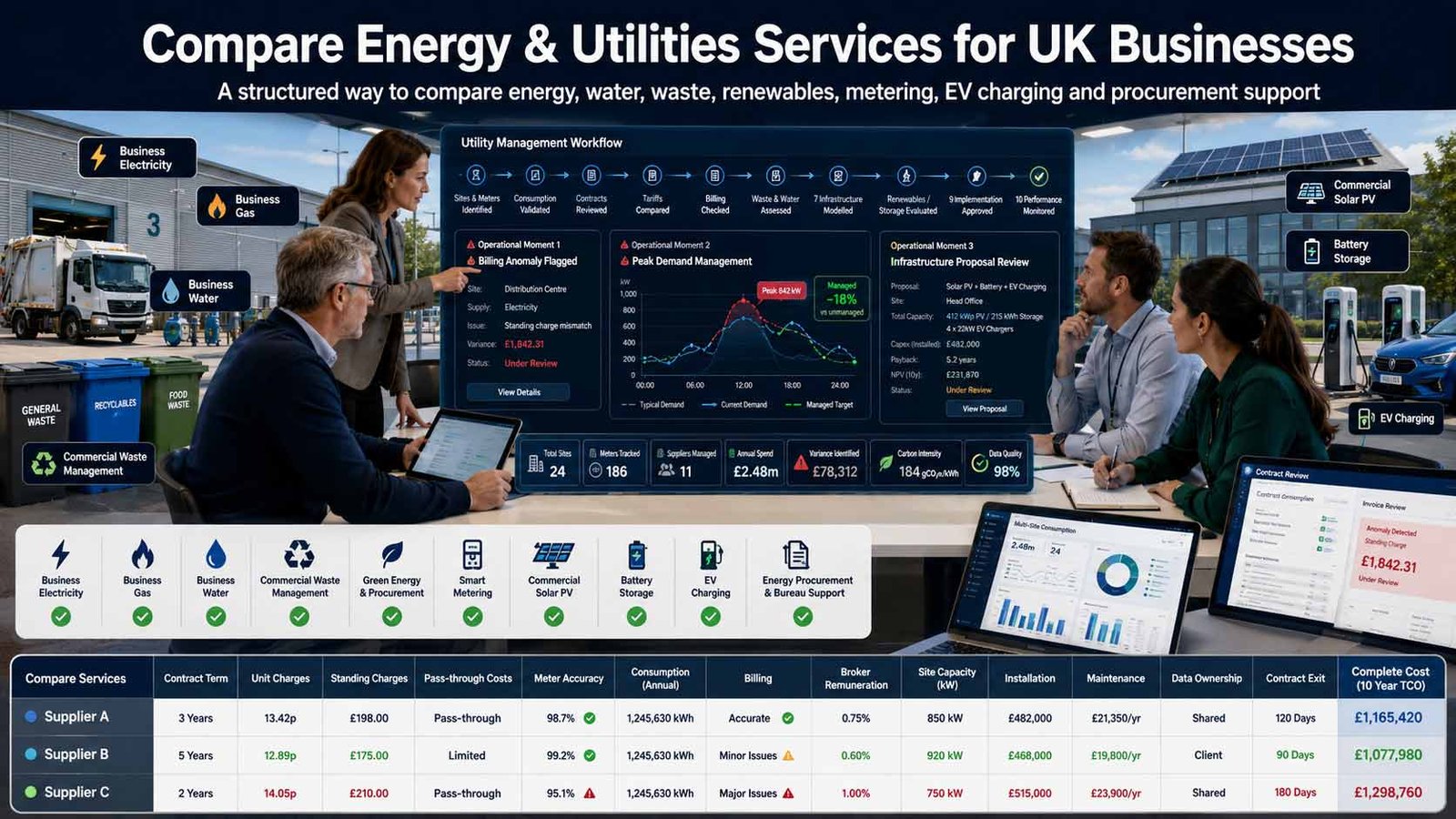
Compare Energy & Utilities Services for UK Businesses
A structured way to compare energy, water, waste, renewables, metering, EV charging and procurement support
Energy and utilities services help UK organisations control operating costs, maintain site resilience, meet environmental obligations and plan long-term infrastructure investment. Use this hub to identify whether your next comparison should focus on energy contracts, water, waste, renewables, smart metering, solar, batteries, EV charging or procurement support.
Why energy and utilities services matter for UK businesses
Energy and utilities are no longer simple back-office overheads. They influence margins, site resilience, compliance, sustainability planning and long-term infrastructure decisions.
- Control electricity, gas, water and waste costs more deliberately
- Improve usage visibility before choosing suppliers or infrastructure
- Plan realistic routes into renewables, solar, batteries and EV charging
- Move from broad utility pressure into the correct comparison page
Energy and utility decisions combine contracts, consumption data, site operations and infrastructure. Electricity and gas procurement, water retail, waste collections, metering, renewables, solar, batteries, EV charging and bureau support solve different commercial problems.
For SMEs, the main risk is choosing too narrowly or too late. A headline unit rate can hide standing charges, pass-through costs, contract duration, broker remuneration, billing weaknesses, meter issues, site capacity, implementation work and long-term maintenance.
Use this page to identify the relevant service family, prepare a consistent business brief and continue into the live service comparison that matches the actual cost, compliance, resilience or investment requirement.
Map the utilities problem to the right service category
Businesses usually arrive here because bills, usage, waste, compliance, sustainability or site infrastructure no longer feel controlled enough.
| Business problem | Likely service path | Why it fits |
|---|---|---|
| Electricity and gas costs are unpredictable or up for renewal | Business Electricity, Business Gas, Energy Procurement / Bureau Services | Helps compare supply structures, contract options, buying support and renewal discipline. |
| The business wants better sustainability outcomes without redesigning every site | Green Energy / Renewables, Commercial Solar PV | Supports lower-carbon sourcing, onsite generation planning and more credible environmental progress. |
| Site-level usage is unclear and savings are hard to track | Smart Metering, Business Water | Improves visibility, billing confidence, consumption analysis and decision quality. |
| Waste disposal rules or disposal costs are creating friction | Commercial Waste Management | Aligns collections, segregation, compliance and operational fit across premises. |
| The business is electrifying vehicles or wants future-ready facilities | EV Charging Solutions, Commercial Solar PV, Battery Storage | Supports charging infrastructure with links to generation, load planning and site readiness. |
| The company wants one clearer strategy across several utilities | Energy Procurement / Bureau Services, Business Electricity, Business Gas, Business Water | Useful for portfolio oversight, tender support, consolidated management and audit discipline. |
Energy & Utilities services at a glance
The ten services in this hub do not solve the same problem. Use this overview before moving into provider comparison.
| Service | What it helps with | Best fit for | Main value driver |
|---|---|---|---|
| Business Electricity | Buying electricity for commercial sites | Most businesses with dedicated premises | Contract control, cost management and service terms |
| Business Gas | Procuring gas supply for eligible business sites | Sites using gas for heating, hot water or process needs | Tariff structure, contract timing and billing oversight |
| Business Water | Retail water and wastewater choice where eligible | SMEs, multi-site firms and public bodies | Billing clarity, service quality and efficiency support |
| Commercial Waste Management | Collection, segregation, disposal and recycling | Offices, hospitality, retail, healthcare and multi-site operators | Compliance, collection efficiency and disposal cost control |
| Green Energy / Renewables | Lower-carbon energy sourcing and renewable options | Organisations with sustainability or emissions goals | Carbon reduction, brand positioning and procurement strategy |
| Smart Metering | Usage visibility and more accurate monitoring | Businesses wanting better data and usage control | Better measurement, consumption insight and fewer surprises |
| Commercial Solar PV | Onsite electricity generation from solar | Businesses with suitable roofs or land | Self-generation, resilience and long-term cost strategy |
| Battery Storage | Storing energy for later use or demand balancing | Sites with solar, peak-load issues or resilience goals | Load flexibility, resilience and optimisation |
| EV Charging Solutions | Workplace or fleet charging infrastructure | Businesses with staff, fleet or visitor charging demand | Future readiness and site amenity value |
| Energy Procurement / Bureau Services | Tendering, contract management and portfolio support | Multi-site, higher-spend or time-poor organisations | Market support, admin relief and governance |
Priorities change by estate complexity and operating model
The right utility shortlist depends on site count, consumption profile, reporting needs, capital appetite and internal capacity.
| Business size / operating model | Typical priorities | Usually lower priority at first | Common service mix |
|---|---|---|---|
| Sole traders and micro-businesses | Simple contract value, predictable billing and basic waste setup | Capital-intensive infrastructure unless premises or usage justify it | Business Electricity, Business Gas, Commercial Waste Management |
| Small growing SMEs | Better visibility, renewal control and some sustainability improvements | Overengineered procurement models or heavy infrastructure too early | Electricity, Gas, Water, Smart Metering, Green Energy |
| Multi-site SMEs | Contract alignment, consolidated reporting, waste consistency and procurement support | One-off site decisions without portfolio strategy | Electricity, Gas, Water, Waste Management, Procurement Services |
| Large organisations and complex estates | Governance, resilience, auditability, infrastructure planning and decarbonisation | Ad hoc contract shopping without a wider utilities strategy | Procurement Services, Smart Metering, Solar PV, Battery Storage, EV Charging |
Use one evidence framework across every utilities decision
The product, service and investment model changes across this category, but buyers should apply the same discipline to scope, data, responsibilities, commercial assumptions and exit.
| Control area | What the buyer should define | Evidence to request before award | Why it matters |
|---|---|---|---|
| Estate and service boundary | List legal entities, supply points, sites, meters, water accounts, waste locations, landlords, tenants, operating hours, fleet needs and assets included or excluded. | Verified site schedule, meter and account identifiers, responsibility matrix, lease constraints, existing supplier map and treatment of additions or closures. | Quotes become unreliable when suppliers price different locations, meters, volumes or responsibilities. |
| Usage, demand and data quality | Define electricity, gas and water consumption, interval data, seasonal patterns, maximum demand, waste volumes, contamination, charging demand, generation and forecast growth. | Recent bills, meter reads, half-hourly or interval files where available, waste audit, load profile, data gaps, estimates and reconciliation to finance records. | Contract, metering and infrastructure recommendations depend on the accuracy and completeness of the underlying demand profile. |
| Contract dates and commercial exposure | Record start, end, notice, termination, renewal, deemed or out-of-contract exposure, deposits, pass-through costs, broker terms and current service complaints. | Executed contracts, letters of authority, broker remuneration disclosure, renewal notices, invoices, complaint history and a comparison schedule using the same contract period. | Late or incomplete contract information can restrict options, create avoidable charges or lead to unauthorised procurement activity. |
| Compliance and reporting | Identify applicable energy, waste, water, environmental, planning, electrical, fire-safety, accessibility, fleet, landlord and reporting requirements. | Applicability assessment, permits or approvals, waste documentation, ESOS position where relevant, reporting definitions, accountable owners and evidence-retention rules. | A lower-cost proposal can still be unsuitable when it omits legal duties, reporting evidence or approval dependencies. |
| Technical feasibility and site readiness | For solar, batteries, metering and EV charging, define roof or land condition, grid capacity, electrical infrastructure, fire strategy, parking, communications, access, civil works and maintenance. | Survey, design assumptions, network or connection position, structural and electrical evidence, permissions, risk assessments, equipment schedule, warranties and acceptance tests. | Infrastructure prices are not comparable when one proposal includes enabling works and another assumes the site is already ready. |
| Service levels and operating support | Set billing, metering, collection, maintenance, outage, fault, response, reporting, complaint, emergency, account-management and escalation expectations. | Service schedule, response definitions, maintenance plan, sample reports, escalation map, performance evidence, service credits and comparable references. | Utility value depends on ongoing accuracy and operational support, not only the initial tariff or installation. |
| Complete lifecycle cost | Model unit rates, standing and pass-through charges, broker fees, collections, rental, maintenance, finance, installation, civils, connections, software, support, internal resource and growth. | Three-year operating-cost model or whole-life investment case, unit definitions, exclusions, indexation, tax treatment, overage, additional-work rates and sensitivity assumptions. | A headline saving or payback can be misleading when essential fees, degradation, maintenance, finance or site work is omitted. |
| Change, renewal and exit | Decide how accounts, data, meters, assets, warranties, licences, monitoring, maintenance, waste containers, contracts and open issues will transfer or end. | Renewal timetable, termination rights, data export, asset ownership, removal obligations, handover, final billing, transition assistance and deletion or access-revocation confirmation. | Exit controls protect continuity and prevent avoidable lock-in when sites, strategy or suppliers change. |
Understand how the ten utility services connect
Some services can be purchased independently, while others work best after contract, data or site-readiness issues have been resolved.
Secure supply and service control
Business electricity, gas and water decisions begin with verified accounts, consumption, contract dates and service problems. Energy procurement or bureau support may add value where spend, site count or internal workload makes direct management difficult.
Improve measurement and operational discipline
Smart metering, invoice validation, water analysis and waste audits can improve the evidence used for procurement and investment. Better data should lead to named actions, ownership and follow-up rather than remaining as an unused dashboard.
Control waste and compliance
Commercial waste management depends on site activities, waste streams, storage, collection frequency, contamination controls, documentation and national requirements. Collection models should be compared against real volumes and operational constraints.
Plan generation, storage and charging
Green energy, commercial solar, battery storage and EV charging involve different commercial and technical decisions. Site demand, grid position, property rights, safety, warranties, maintenance, finance and future operating plans should be considered together without merging the service comparisons.
Energy & Utilities service categories
This category covers ten service areas. Each one solves a different part of the wider cost, efficiency, compliance, resilience and sustainability challenge.
Contract Control
Business Electricity
Commercial electricity supply for premises and multi-site operations.
Compare business electricity providersGas Supply
Business Gas
Gas supply for eligible business sites using gas for heat, hot water or process needs.
Compare business gas providersWater & Wastewater
Business Water
Retail water and wastewater services where business customer choice applies.
Compare business water providersWaste Compliance
Commercial Waste Management
Collections, segregation, disposal and recycling services matched to site operations.
Compare commercial waste management providersCleaner Supply
Green Energy / Renewables
Lower-carbon supply routes and renewable options for sustainability-led procurement.
Compare green energy and renewable providersUsage Visibility
Smart Metering
Usage visibility, more accurate monitoring and better site-level decision data.
Compare smart metering providersOnsite Generation
Commercial Solar PV
Onsite solar generation for suitable roofs, land and long-term energy strategies.
Compare commercial solar PV providersEnergy Flexibility
Battery Storage
Energy storage for load balancing, resilience and optimisation alongside other assets.
Compare commercial battery storage providersCharging Infrastructure
EV Charging Solutions
Workplace, fleet, visitor or staff charging infrastructure for future-ready premises.
Compare business EV charging providersProcurement Support
Energy Procurement / Bureau Services
Tendering, renewal control, multi-site billing support and portfolio oversight.
Compare energy procurement and bureau servicesWhat buyers should compare before provider evaluation
The right evaluation points are broader than supplier name or headline rate.
What problem are you solving?
Decide whether the priority is cost, usage visibility, service quality, compliance, decarbonisation or infrastructure readiness.
Commercial, operational or infrastructure-led?
Some decisions are about better terms; others require site planning, capital investment or technical readiness.
One site or a portfolio?
Multi-site estates need stronger procurement governance, reporting discipline and service consistency than a single-site office.
What is the time horizon?
Contract changes may deliver near-term control, while solar, batteries and EV charging need longer planning horizons.
What data do you trust?
If current usage data is unreliable, smart metering or portfolio visibility may need to come before major procurement.
What must be evidenced?
Reporting, audit, ESG, compliance or board-level requirements may affect which service path matters most.
Operational need versus best-fit service path
Use this table to narrow the right service family before comparing named suppliers.
| Need category | What the business is trying to achieve | Best-fit service path | Secondary services that may support it |
|---|---|---|---|
| Cost control | Reduce avoidable spend and tighten contract discipline | Business Electricity, Business Gas, Energy Procurement / Bureau Services | Smart Metering, Business Water |
| Efficiency visibility | Understand consumption patterns and identify waste | Smart Metering, Business Water | Energy Procurement / Bureau Services |
| Compliance and housekeeping | Keep sites aligned with collection and service obligations | Commercial Waste Management | Business Water |
| Sustainability positioning | Lower emissions and improve environmental performance | Green Energy / Renewables, Commercial Solar PV | Battery Storage, EV Charging Solutions |
| Site resilience and future readiness | Make premises better prepared for operational change | Battery Storage, EV Charging Solutions, Commercial Solar PV | Smart Metering |
| Portfolio governance | Manage multiple sites, contracts, bills or service relationships more coherently | Energy Procurement / Bureau Services, Business Electricity, Business Gas | Business Water, Waste Management |
UK market and regulatory context buyers should know
Non-domestic energy contracts require active management because business terms, termination arrangements, billing structures and broker involvement differ from domestic supply. Ofgem publishes current guidance for businesses and rules intended to support fair treatment across the non-domestic market.
Most eligible businesses, charities and public-sector organisations in England can choose their water retailer, while eligibility in Wales is more restricted. Waste requirements also vary by nation; in England, workplace recycling rules changed on 31 March 2025, with a later compliance date for qualifying micro-firms.
Larger organisations may also need to assess ESOS obligations, while solar, battery and EV charging projects require site-specific technical, property, safety, planning, connection, funding and operational checks. The category decision should therefore begin with applicability and site evidence rather than a universal product recommendation.
Data first. Supplier second.
Compare providers only after checking actual usage, meter identifiers, contract dates, site count, billing accuracy, waste streams, electrical capacity, operating hours and planned changes.
Reliable evidence improves forecasting, exposes billing or consumption problems, makes proposals comparable and helps leadership distinguish immediate contract actions from longer-term infrastructure investment.
How CompareServices structures Energy & Utilities comparisons
CompareServices separates this category into ten commercial decisions so UK businesses can identify the correct service before comparing named providers.
- Start with the site, contract, consumption or infrastructure problem
- Keep supply, metering, waste, renewable and capital projects distinct
- Use the same estate and usage assumptions for every provider
- Compare implementation, responsibilities, evidence and lifecycle cost
- Route buyers to the relevant live service page without one-size-fits-all recommendations
A sole trader does not need the same utilities operating model as a corporate estate team. A hospitality group managing food waste and customer parking has different priorities from a warehouse assessing rooftop solar or a logistics operator planning fleet charging.
The right service depends on premises, consumption, contract dates, meter quality, waste streams, electrical capacity, landlord permissions, planning, funding, capital appetite and internal resource.
Separating these decisions reduces unsuitable quotations, avoids duplicated consultancy and keeps specialist design or procurement work within the correct service boundary.
Move from broad utilities pressure into a focused shortlist
Use this sequence before comparing named suppliers or requesting quotes.
- Identify whether the issue is cost, data, compliance, sustainability, resilience or infrastructure.
- Check whether the decision is single-site, multi-site or portfolio-wide.
- Confirm whether you need contract support, operational service, metering data or physical infrastructure.
- Open the one to three most relevant service pages rather than every option at once.
- Compare providers only after the correct service path is clear.
Explore the Energy & Utilities service pages
Use these links to move from category-level understanding into the correct comparison page.
Frequently Asked Questions
Quick answers for UK business buyers comparing energy and utilities categories.
How often should a business review its energy and utilities arrangements?
Most businesses should review contracts and service performance well before renewal, and review category fit whenever they add sites, change operating hours, expand fleets or launch sustainability targets. Waiting until deadlines reduces negotiating power and narrows the options available.
What information should a business gather before comparing utility providers?
Gather current contracts, renewal and termination dates, recent bills, meter identifiers, interval or consumption data, site addresses, opening hours, waste volumes, service problems, sustainability targets, landlord permissions and planned operational changes. Providers should price against the same verified baseline.
Which services are usually most relevant for small UK businesses?
Small businesses often start with business electricity, business gas, commercial waste management and sometimes business water. As complexity grows, smart metering, green energy options, procurement support and EV charging may become more relevant.
When should a business consider solar, batteries or EV charging instead of just switching contracts?
These options become more relevant when the business has a longer planning horizon, suitable premises, rising electricity demand, electrification plans or clear sustainability targets. They are infrastructure decisions and should be considered alongside wider site strategy.
Does every business need an energy procurement or bureau service?
No. Procurement support is most useful where spend, estate complexity or internal time pressure makes direct management inefficient. Smaller or simpler operations may not need it yet, while multi-site or higher-usage organisations often benefit from stronger portfolio oversight.
Authoritative UK Energy & Utilities guidance
Reviewed by Bhav Giva, Founder & Lead Analyst at CompareServices.co.uk, on 4 August 2026. Bhav reviews category structure, service boundaries, comparison criteria and UK business relevance across the CompareServices platform.
Use the following primary sources alongside the relevant live service comparison when assessing non-domestic energy, business water eligibility, energy-efficiency duties, workplace recycling, smart metering and EV charging support. Obtain legal, regulatory, tax, engineering, planning, property, environmental or financial advice where the organisation’s circumstances require specialist input.