
Compare Battery Storage Providers UK (2026)
Compare Capacity, Power, Controls, Safety, Grid Connection, Finance, Warranties And Lifetime Value
Compare commercial battery storage UK providers by usable capacity, charge and discharge power, duration, chemistry, cycle life, degradation, site survey, electrical integration, energy-management controls, grid application, fire and insurer requirements, resilience design, monitoring, maintenance, warranty, optimisation services, finance structure and complete lifetime value. Give every bidder the same half-hourly load data, tariff and operating constraints before comparing projected savings or revenue.
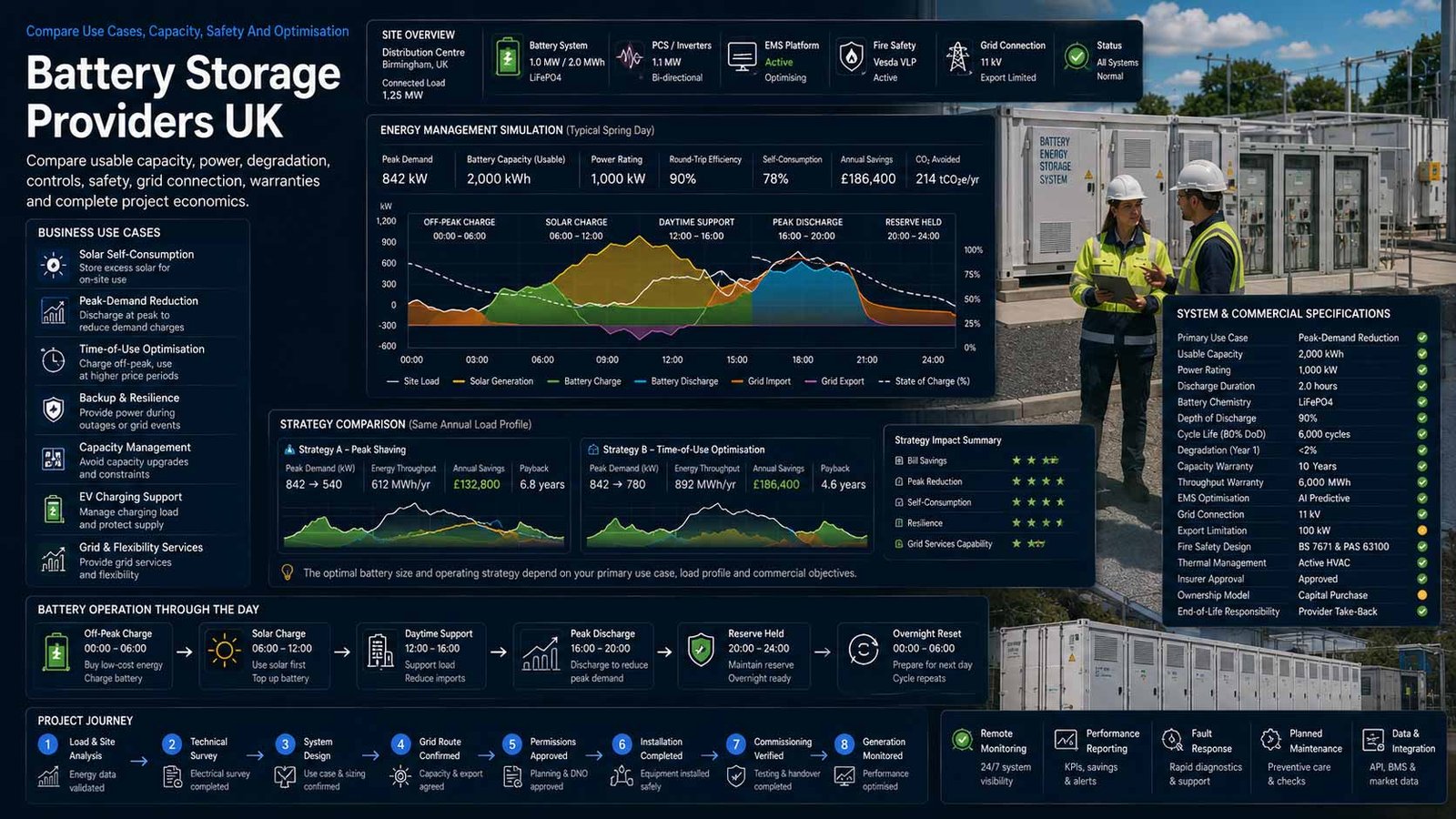
Define The Use Case Before Sizing The Battery
The same battery cannot maximise every objective at once. Capacity reserved for resilience is not always available for tariff shifting, peak shaving or flexibility-market dispatch.
- Use half-hourly or finer load data rather than annual consumption alone
- Separate power in kW from usable energy in kWh
- Model degradation, efficiency and operational constraints
- Treat external market revenue as variable—not guaranteed
Commercial battery storage is an on-site battery energy storage system designed around a business electricity profile, electrical connection and operating objective. It can charge from the grid, on-site generation or both, then discharge when the stored electricity has greater operational or financial value.
Common objectives include increasing renewable self-consumption, reducing import peaks, shifting consumption away from expensive periods, managing a constrained connection, supporting new electrical loads, participating in flexibility services and improving resilience for selected circuits. True backup operation requires a designed islanding or standby arrangement; a standard grid-connected battery does not automatically keep a building operating during an outage.
This page compares commercial and industrial storage systems only. It does not cover domestic backup batteries, household tariffs, consumer grants or home-installation advice. Solar PV and EV charging can influence the battery model, but their provider selection, installation design and economics remain separate service decisions.
Choose The Right Battery Ownership And Operating Structure
Funding and control determine who receives value, carries performance risk and decides how the battery is dispatched.
| Delivery Model | What It Usually Provides | Best-Fit Question |
|---|---|---|
| Capital purchase | The business owns the battery, controls the operating strategy and retains the verified savings or revenue | Does the organisation have capital, technical governance and appetite for degradation and market risk? |
| Asset finance or loan | The business owns the asset while repaying finance over an agreed term | Are interest, security, early repayment, warranty and residual-value assumptions transparent? |
| Operating lease | A provider or funder owns the system while the customer pays an agreed rental | Who controls dispatch, receives external revenue and funds major replacement? |
| Battery as a Service | The provider funds, installs, monitors and maintains the system for a service charge or shared benefit | Which availability, savings and replacement obligations are contractually guaranteed? |
| Energy-service or tariff model | Storage is combined with electricity procurement, optimisation software or a managed energy contract | Can tariff, software, asset and supplier obligations be separated and changed independently? |
| Solar-coupled behind-the-meter system | The battery stores surplus on-site generation and can also perform load shifting | Does the load and generation profile create enough repeated usable surplus? |
| Standalone load-shifting system | The battery charges from the grid and discharges against site peaks or higher-price periods | Do tariff spreads and demand patterns remain attractive after efficiency losses and degradation? |
| Large industrial or microgrid BESS | The storage integrates with generation, critical loads, controls and potentially islanded operation | Are protection, controls, safety, commissioning and operational authority appropriate for the complexity? |
Eight Areas That Determine Commercial Battery Storage Fit
Use the same site, tariff, load profile and operating priorities for every provider so projected value can be compared on a consistent basis.
Comparison Criterion
Use-Case Definition And Load Modelling
Compare how the provider analyses half-hourly demand, import limits, tariff periods, solar generation, planned electrification, outages, operating hours and future growth. Require separate value cases for peak shaving, load shifting, solar capture, connection support, resilience and market participation.
Comparison Criterion
Usable Capacity, Power And Duration
Assess usable kWh, charge and discharge kW, C-rate, depth of discharge, round-trip efficiency, state-of-charge reserve, overload capability and duration at the required load. A high-capacity battery can still fail the use case if its power rating or controls are insufficient.
Comparison Criterion
Chemistry, Degradation And Warranty
Review cell chemistry, expected cycles, calendar ageing, temperature effects, warranted throughput, retained capacity, operating window and exclusions. Compare the warranted duty cycle with the proposed dispatch schedule instead of relying on a simple ten-year headline.
Comparison Criterion
Energy Management And Optimisation
Compare forecasting, tariff integration, solar control, peak limits, state-of-charge strategy, remote dispatch, manual override, APIs, cyber security, event logs, reporting and change governance. The energy-management system often determines more value than a small difference in battery efficiency.
Comparison Criterion
Electrical Design, Grid Connection And Metering
Assess switchgear, transformers, protection, harmonic studies, cable routes, G98 or G99 process, G100 export limitation where relevant, import-capacity controls, generation metering and commissioning. Confirm whether the provider owns the DNO application and network-response process.
Comparison Criterion
Site Layout, Fire Safety And Insurer Acceptance
Review indoor or outdoor location, separation, ventilation, thermal management, fire detection, suppression strategy, emergency isolation, access, drainage, collision protection, signage, noise, hazardous-area constraints and fire-service information. Insurer and landlord requirements should be addressed before final design.
Comparison Criterion
Installation, Commissioning And Resilience Design
Compare civils, enclosure, lifting, shutdowns, temporary supply, protection testing, witness testing, control integration, islanding equipment, black-start logic, critical-load separation, functional testing and staff training. Backup claims must specify supported circuits, transfer time, duration and limitations.
Comparison Criterion
Monitoring, Maintenance, Optimisation And Exit
Assess remote monitoring, alarms, response times, preventative maintenance, software support, spare parts, augmentation, capacity testing, firmware, cyber patching, revenue-share reconciliation, performance reviews, decommissioning, recycling, data export and contract exit.
Measures To Define Before A Battery Contract Is Signed
Translate capacity, savings and resilience claims into auditable technical, operational and financial evidence.
| Measure | What It Should Define | Evidence To Request | Common Weakness |
|---|---|---|---|
| Usable-energy capacity | The kWh available within the permitted operating window rather than gross nameplate capacity | Gross kWh, usable kWh, minimum and maximum state of charge, temperature and reserve | The proposal quotes gross capacity while the financial model assumes all of it is available |
| Charge and discharge power | The maximum sustained kW available for the target duty | Charge kW, discharge kW, overload, duration, power factor, site limit and control setpoint | A battery has enough energy but cannot respond fast enough to the peak |
| Round-trip efficiency | The electricity retained after charging, conversion, standby and discharge losses | Test basis, load level, temperature, auxiliary loads, AC or DC boundary and model assumption | Financial savings ignore auxiliary consumption and partial-load efficiency |
| Cycle and calendar degradation | Expected capacity loss from use, time and operating conditions | Cycles, throughput, temperature, depth of discharge, retained capacity and augmentation plan | The warranty duty is lower than the proposed daily cycling schedule |
| Peak-shaving result | The verified reduction in site import during defined demand peaks | Baseline, interval, target, battery action, excluded events, monthly result and tariff value | The provider models the highest historic peak but not repeatable peak patterns |
| Solar-capture result | The additional on-site renewable electricity used because of storage | Generation, export before, battery charge, discharge, losses, curtailed energy and self-use | All battery discharge is counted as solar even when the battery charged from the grid |
| Connection-capacity support | Whether storage controls keep site import or export within an agreed network limit | Connection limit, sensor, setpoint, fail-safe, response, override, test and alarm | The business treats software control as a substitute for an unapproved network connection |
| Availability and fault response | The proportion of required operating time the system is ready to perform | Monitoring, alarm, acknowledgement, remote fix, site attendance, spare, exclusion and credit | Availability excludes software, communications or grid-control failures |
| Market-revenue outcome | The net external revenue after aggregator, supplier, degradation and operational constraints | Service, eligibility, availability, dispatch, gross revenue, fees, losses, degradation and net payment | A historic gross revenue figure is presented as a fixed future return |
| Lifetime value | The net benefit after equipment, finance, losses, O&M, degradation, replacement and exit | Cash flows, tariff, savings, revenue, fees, tax, maintenance, augmentation, disposal and sensitivity | The model ends before the finance or service contract and omits end-of-life obligations |
Battery Storage Providers UK Businesses Can Consider
Shortlist providers whose project scale, hardware route, controls and commercial model fit the site. Confirm live accreditations, insurer acceptance, pricing and contractual scope directly before award.
Provider Profile
Connected Energy
Connected Energy provides configurable commercial and grid-scale battery storage using second-life electric-vehicle batteries, supported by its own energy-management software and financing options. Include it where circular-economy credentials, modular expansion, leasing or Battery as a Service are relevant. Confirm the E-STOR configuration, second-life battery provenance, usable capacity, power, warranty and replacement model, site feasibility, fire and insurer approach, DNO scope, software controls, aggregator contract, availability commitment, maintenance, financing, revenue ownership, augmentation and end-of-life responsibility.
Review official Connected Energy storageProvider Profile
GivEnergy Commercial
GivEnergy manufactures commercial battery hardware and software ranging from integrated cabinet systems for SMEs to larger containerised solutions delivered through commercial teams and approved installers. Include it where a UK-focused manufacturer, scalable hardware and integrated controls are priorities. Confirm whether the contract is with GivEnergy or an installer, selected product, usable capacity, PCS rating, parallel expansion, backup capability, warranty throughput, connectivity requirements, design ownership, fire and siting requirements, DNO application, commissioning, portal access, support escalation, installer continuity and replacement obligations.
Review official GivEnergy commercial storageProvider Profile
AceOn Group
AceOn supplies and integrates commercial, industrial and utility battery energy storage systems across a wide power range, with experience in custom battery systems and energy-management projects. Include it where the site needs an engineering-led solution, front- or behind-the-meter design or non-standard integration. Confirm project scale, battery and PCS manufacturer, chemistry, control platform, design authority, grid studies, civils, fire strategy, direct and subcontracted work, commissioning, performance testing, warranty administration, maintenance, spares, market integration, project references and whether development or planning services are included.
Review official AceOn commercial storageProvider Profile
Wattstor
Wattstor designs, finances and operates commercial energy systems combining modular battery storage with its Podium energy-management platform. Include it where automated optimisation, solar integration, tariff management, multi-site rollout or a funded model is central to the case. Confirm ownership structure, hardware supplier, usable capacity and power, EMS decision logic, data access, tariff dependency, external trading, savings methodology, Price Protect obligations, roof or solar interfaces, insurer requirements, grid connection, maintenance, replacement, performance reporting, contract duration, assignment and exit.
Review official Wattstor energy storageProvider Profile
EvoEnergy
EvoEnergy designs and installs commercial battery storage as part of business energy infrastructure, including integration with solar PV, grid services and larger commercial systems. Include it where an established engineering contractor is needed to coordinate storage with existing or planned electrical assets. Confirm survey depth, selected OEM, system architecture, AC or DC coupling, load model, DNO and metering responsibility, resilience design, fire and insurer engagement, civil and electrical scope, commissioning, monitoring, optimisation partner, warranty, O&M, revenue assumptions, shutdown planning and project-size fit.
Review official EvoEnergy battery storageProvider Profile
E.ON Business
E.ON offers commercial battery storage within wider renewable-energy and net-zero projects, including on-site batteries integrated with solar, heat and energy-management solutions. Include it where a business values a major energy company able to combine project development, funding and operational energy services. Confirm the contracting entity, customer and project eligibility, hardware and EPC partners, tariff or supply dependencies, ownership, dispatch rights, grid and planning scope, savings and resilience model, external revenue, service fees, warranties, monitoring, maintenance, change control and the boundary from standard electricity supply.
Review official E.ON business storageProvider Profile
Clarke Energy
Clarke Energy provides engineering, procurement, construction, commissioning and lifecycle service for battery energy storage, microgrid and hybrid-power projects. Include it where an industrial, data-centre or mission-critical site needs high-power integration, complex controls and structured long-term service. Confirm minimum project scale, OEM and technology selection, EPC wrap, protection and grid studies, microgrid and backup functionality, civils, fire design, commissioning tests, cyber and control architecture, long-term service agreement, availability options, spare-parts strategy, augmentation, operational authority and references that match the proposed duty.
Review official Clarke Energy BESSProvider Profile
SolarSense
SolarSense designs, installs and maintains commercial battery storage for businesses and public-sector organisations, commonly alongside on-site renewable generation but also for tariff and resilience use cases. Include it where a turnkey specialist, funded option and ongoing monitoring are important. Confirm storage-only capability for the site, selected manufacturer, half-hourly modelling, capacity and power, grid and fire scope, solar dependency, installation resources, backup design, monitoring, O&M, warranty claims, finance or service agreement, monthly fee or ownership, data rights, end-of-contract treatment and current geographic coverage.
Review official SolarSense storageWhat Changes Commercial Battery Storage Cost
Battery proposals are site- and duty-specific. Compare complete installed and lifecycle cost rather than price per kWh of nameplate capacity.
| Cost Driver | Why It Changes Spend | What A Comparable Quote Should Show |
|---|---|---|
| Usable capacity and discharge power | More kWh and kW increase hardware, inverter, protection and installation requirements | Gross and usable kWh, kW, duration, reserve, efficiency, temperature and expansion |
| Battery chemistry and duty cycle | Chemistry, cycle frequency, depth of discharge and temperature influence life and warranty | Chemistry, cycles, throughput, degradation, retained capacity, exclusions and augmentation |
| Cabinet, rack or container design | Indoor racks, outdoor cabinets and containers need different space, civils and environmental controls | Dimensions, weight, plinth, ventilation, HVAC, weather rating, noise, access and replacement |
| Electrical integration | Transformers, switchgear, protection, metering, cable routes and shutdowns can materially change cost | Voltage, connection point, PCS, transformer, switchgear, studies, cable, isolation and outage |
| Grid application and export control | DNO studies, G98 or G99 process, G100 control or reinforcement can affect programme and size | Application, aggregate generation, export limit, offer, study, reinforcement, witness and owner |
| Fire, planning and insurer requirements | Separation, detection, suppression, access, drainage, noise and insurer controls can add design and civil work | Risk assessment, fire strategy, insurer review, planning, landlord, emergency plan and approvals |
| Energy-management and optimisation software | Forecasting, controls, data, trading and tariff integration may carry licences or revenue share | Licence, connectivity, algorithm, API, cyber support, aggregator, fee, revenue share and exit |
| Resilience and islanding equipment | Backup operation requires additional switchgear, controls, critical-load design and testing | Supported loads, transfer time, duration, island mode, black start, generator interface and tests |
| Monitoring, O&M and replacement | Remote support, inspections, spares, augmentation and end-of-life services affect lifecycle spend | Annual fee, response, callout, parts, testing, capacity checks, augmentation, recycling and disposal |
| Finance, service term and market risk | Lease, service or shared-saving structures allocate capital, degradation and revenue differently | Deposit, payment, term, escalation, savings guarantee, revenue, buyout, assignment, security and exit |
How Load Profile And Operational Risk Change The Shortlist
The right system depends on electrical demand, tariff, connection limits, resilience needs, on-site generation, future electrification, premises control and internal technical capability.
Manufacturing Or Cold-Storage Site
Prioritise repeatable demand peaks, high-quality interval data, production-critical loads, harmonic and protection studies, tariff exposure, resilience requirements, safe siting, fault response and maintenance that fits operational shutdown windows.
Warehouse, Retail Or Multi-Site Estate
Prioritise scalable standard designs, solar capture, import-limit control, common monitoring, site ranking, insurer approval, landlord permissions, remote fault management, portfolio reporting and consistent replacement strategy.
Fleet, Logistics Or Electrification Project
Prioritise future charging load, import-capacity limits, dynamic charge control, battery and charger coordination, tariff optimisation, expansion, connection agreements and a model that avoids counting the same flexibility twice.
Data Centre, Healthcare Or Critical Facility
Prioritise power quality, transfer architecture, supported circuits, UPS or generator interaction, fault-current studies, black-start and islanding logic, cyber security, safety case, redundancy, commissioning and guaranteed service response.
How To Compare Battery Storage Proposals
Give every bidder the same half-hourly electricity data, tariff, solar profile, connection limits, site drawings, outage requirements, future load forecast and financial assumptions. Require an editable dispatch model and responsibility matrix.
- Usable kWh and sustained kW are compared separately
- The dispatch model respects warranty and state-of-charge limits
- Grid, protection, planning, safety and insurer scope are explicit
- Backup claims identify circuits, transfer time and duration
- External market revenue is shown net of fees and degradation
- Maintenance, augmentation, recycling and exit are costed
Make Every Provider Simulate The Same Year
Use the same interval data, tariff, solar generation, connection limits, future loads, battery reserve and operating strategy.
Compare verified net value and operational fit—not only nameplate capacity.
Six Questions To Put To Every Battery Provider
The answers expose oversized systems, optimistic market revenue, incomplete safety work and service contracts that do not cover the full asset life.
What Exact Problem Is The Battery Solving?
Require separate quantified cases for peak shaving, tariff shifting, solar capture, capacity management, resilience and market participation.
Which Capacity And Power Are Guaranteed?
Confirm gross and usable kWh, charge and discharge kW, duration, efficiency, reserve, temperature, degradation and warranty duty.
Who Owns The Grid, Safety And Insurer Work?
Allocate DNO application, studies, planning, landlord consent, fire strategy, insurer approval, civils, emergency plan and commissioning.
How Does The Control Software Make Decisions?
Review forecasting, tariff data, solar and load inputs, overrides, fail-safe behaviour, cyber support, API, logs, software fees and exit.
Which Revenue Or Saving Assumptions Can Change?
Identify electricity spreads, demand charges, export, aggregator access, gross and net revenue, availability, fees, degradation and downside cases.
What Happens At Failure, Augmentation And Exit?
Confirm alarms, response, spare parts, capacity test, replacement, augmentation, manufacturer failure, buyout, assignment, removal, recycling and data export.
A Seven-Stage Commercial Battery Storage Evaluation
Move from verified load data and a defined use case to a controlled energy asset rather than selecting equipment before the operating strategy is known.
- Collect half-hourly electricity data, tariffs, solar generation, connection agreements, maximum demand, outage history, site drawings, future loads, operational constraints and accountable owners.
- Define the primary and secondary use cases, required reserve, target return, resilience boundary, data ownership, finance route and risk appetite for battery storage only.
- Complete electrical, structural or civil, fire, planning, noise, access, landlord, insurer and DNO feasibility before treating size, programme or price as fixed.
- Issue one written specification and obtain comparable proposals with hardware, controls, model files, approvals, safety case, programme, finance, O&M, warranty and exit.
- Normalise every proposal using the same tariff, load, solar, efficiency, degradation, reserve, finance, software, external revenue and downside assumptions.
- Contract only after performance definitions, commissioning tests, service levels, cyber responsibilities, change control, replacement, augmentation and end-of-life obligations are agreed.
- Operate through monitoring, alarm response, dispatch review, capacity testing, tariff and market updates, warranty compliance, safety drills, maintenance and controlled optimisation changes.
Commercial Battery Storage Comparison Checklist
Use this table before approving an owned system, financed asset, Battery as a Service agreement, microgrid project or optimisation contract.
| No. | Requirement | Evidence To Obtain Before Award | Confirmed |
|---|---|---|---|
| 01 | Use case and accountable owner agreed | Primary objective, secondary services, legal entity, energy owner, finance owner, approver and operator | |
| 02 | Load and tariff baseline validated | Half-hourly data, maximum demand, tariff periods, capacity charges, outages, seasonality and forecast | |
| 03 | Solar and future-load assumptions confirmed | Generation data, export, EV or heat loads, production changes, connection limits and implementation dates | |
| 04 | Usable capacity and power accepted | Gross kWh, usable kWh, charge kW, discharge kW, duration, reserve, efficiency and temperature | |
| 05 | Chemistry and degradation model accepted | Cell chemistry, cycle duty, throughput, calendar ageing, retained capacity, warranty and augmentation | |
| 06 | Site and electrical survey completed | Location, dimensions, weight, plinth, transformer, switchgear, protection, cable, shutdown and access | |
| 07 | Grid and export route agreed | G98 or G99 basis, aggregate generation, G100 where relevant, DNO offer, studies, witness and owner | |
| 08 | Fire, planning and insurer requirements approved | Risk assessment, detection, suppression strategy, separation, emergency plan, planning, landlord and insurer | |
| 09 | Control and cyber design approved | EMS logic, inputs, setpoints, override, fail-safe, network, user access, logging, patching and support | |
| 10 | Resilience scope tested | Critical loads, transfer, islanding, black start, duration, generator or UPS interface, test and limitation | |
| 11 | Financial model normalised | Tariff saving, peak reduction, solar capture, market revenue, losses, fees, finance, tax and downside | |
| 12 | Installation and commissioning plan agreed | Civils, lifting, enclosure, shutdown, RAMS, subcontractors, tests, DNO, training and defects | |
| 13 | Warranty and service package verified | Manufacturer, installer, throughput, labour, access, response, parts, software, availability and claims | |
| 14 | Complete lifetime cost compared | Equipment, grid, civils, finance, software, O&M, augmentation, insurance, removal and recycling | |
| 15 | Handover, data and exit controlled | As-builts, settings, certificates, portal, model, alarms, credentials, buyout, assignment, export and deletion |
Common Commercial Battery Storage Buying Mistakes
Most avoidable failures begin with unclear use cases, nameplate-only comparisons, optimistic revenue assumptions or safety and grid work left until after equipment selection.
| Mistake | Why It Creates Risk | Better Control |
|---|---|---|
| Sizing from annual consumption | Annual kWh does not show peaks, tariff periods or available charging windows | Use interval data |
| Comparing gross capacity | Usable energy can be lower after reserves and operating limits | Compare usable kWh |
| Ignoring discharge power | A large battery may still be unable to meet the required peak | Compare kW and duration |
| Assuming automatic backup | Most grid-connected systems stop during an outage without designed islanding | Specify resilience explicitly |
| Stacking incompatible revenues | The same capacity cannot always serve every use case simultaneously | Allocate energy and power budgets |
| Treating historic market revenue as guaranteed | Flexibility prices, access and dispatch can change | Model conservative net revenue |
| Ignoring fire and insurer requirements | Late redesign can delay the project or make the site uninsurable | Engage early |
| Using a warranty outside its duty cycle | Excess cycles or throughput can reduce cover and accelerate degradation | Match dispatch to warranty |
| Bundling solar or EV economics into one figure | Separate assets can hide weak individual business cases | Model each service separately |
| Skipping capacity and performance testing | Degradation or control failure can reduce value without obvious faults | Verify performance over time |
Frequently Asked Questions
Answers to common questions from UK organisations comparing commercial battery hardware, integration, controls, finance and lifecycle services.
What Is Commercial Battery Storage?
Commercial battery storage is an on-site battery energy storage system designed around a business load profile, tariff, connection and operating objective. It stores electricity and releases it later for uses such as peak shaving, tariff shifting, renewable self-consumption, capacity management or resilience.
Can A Commercial Battery Work Without Solar Panels?
Yes. A standalone battery can charge from the grid during selected periods and discharge when electricity is more expensive or site demand is high. The business case depends on tariff spreads, losses, degradation, demand patterns, connection limits and the operating strategy.
How Big Should A Commercial Battery Be?
The correct size depends on both power in kW and usable energy in kWh. Providers should analyse half-hourly demand, charging windows, tariff periods, solar generation, connection limits, reserve requirements and degradation. Annual electricity consumption alone is not enough.
Will A Battery Keep A Business Running During A Power Cut?
Not automatically. Standard grid-connected storage normally disconnects when the grid fails. Backup requires suitable switchgear, islanding controls, critical-load design, protection, black-start capability where required and testing. The proposal should state which circuits are supported and for how long.
Do Commercial Battery Systems Need DNO Approval?
Storage systems operating in parallel with the distribution network can fall under ENA G98 or G99 connection requirements depending on the installation. Larger or combined-generation systems commonly need prior approval, and export-limitation controls may also require agreement.
Do Commercial Batteries Need Planning Permission?
Planning depends on size, location, enclosure, noise, visual impact, land use and local requirements. Indoor cabinets, outdoor compounds and containerised systems can be treated differently. The provider should document the planning position and any landlord or building-control requirements.
How Long Does A Commercial Battery Last?
Useful life depends on chemistry, temperature, cycle frequency, depth of discharge, throughput, controls and maintenance. Capacity normally declines over time. Compare warranted throughput and retained capacity with the proposed duty, and include augmentation or replacement in the lifetime model.
Can A Battery Earn Grid Or Flexibility Revenue?
Some systems can participate through an aggregator or energy-service provider, subject to system size, controls, availability, connection, market access and changing prices. Treat revenue conservatively and compare net income after fees, charging losses, degradation and operational restrictions.
What Safety Controls Should A Battery Project Include?
Controls should reflect the system and site and can include suitable location, separation, ventilation or cooling, battery management, detection, emergency isolation, fire strategy, access, collision protection, signage, monitoring, maintenance and an emergency-response plan accepted by relevant stakeholders.
How Should A UK Business Compare Battery Storage Providers?
Give every provider the same interval data, tariff, solar profile, connection limit, future loads and use cases. Compare usable capacity, power, degradation, controls, grid and safety scope, installation, warranty, O&M, finance, net value and exit—not only price per kWh.
Official Guidance And Commercial Battery Provider Resources
Reviewed by Bhav Giva, Founder & Lead Analyst at CompareServices.co.uk, on 24 July 2026.
Use UK government, Energy Networks Association, the relevant DNO, insurer and official provider documentation to confirm current connection, safety, product, service and contract requirements. Flexibility markets, provider products and project eligibility can change.
- UK Government — Electrical Energy Storage Health And Safety
- Energy Networks Association — Energy Storage Connections
- Energy Networks Association — Connecting Commercial Generation
- Ofgem — Electricity Storage Regulation
- Connected Energy — Commercial Battery Storage
- GivEnergy — Commercial Battery Storage
- AceOn — Commercial Energy Storage
- Wattstor — Commercial Energy Storage
- EvoEnergy — Commercial Battery Storage
- E.ON — Business Battery Storage
- Clarke Energy — Battery Energy Storage Systems
- SolarSense — Commercial Battery Storage