
Compare Business Gas Providers UK (2026)
Compare Unit Rates, Standing Charges, Contract Terms, Metering, Billing And Total Cost
Compare business gas prices UK suppliers offer by unit rate, standing charge, fixed and pass-through components, contract length, renewal terms, deemed rates, MPRN and meter data, annual quantity, seasonal consumption, credit requirements, billing accuracy, account support, broker remuneration, environmental claims and complete annual cost. Use the same sites, usage history and contractual assumptions for every quote.
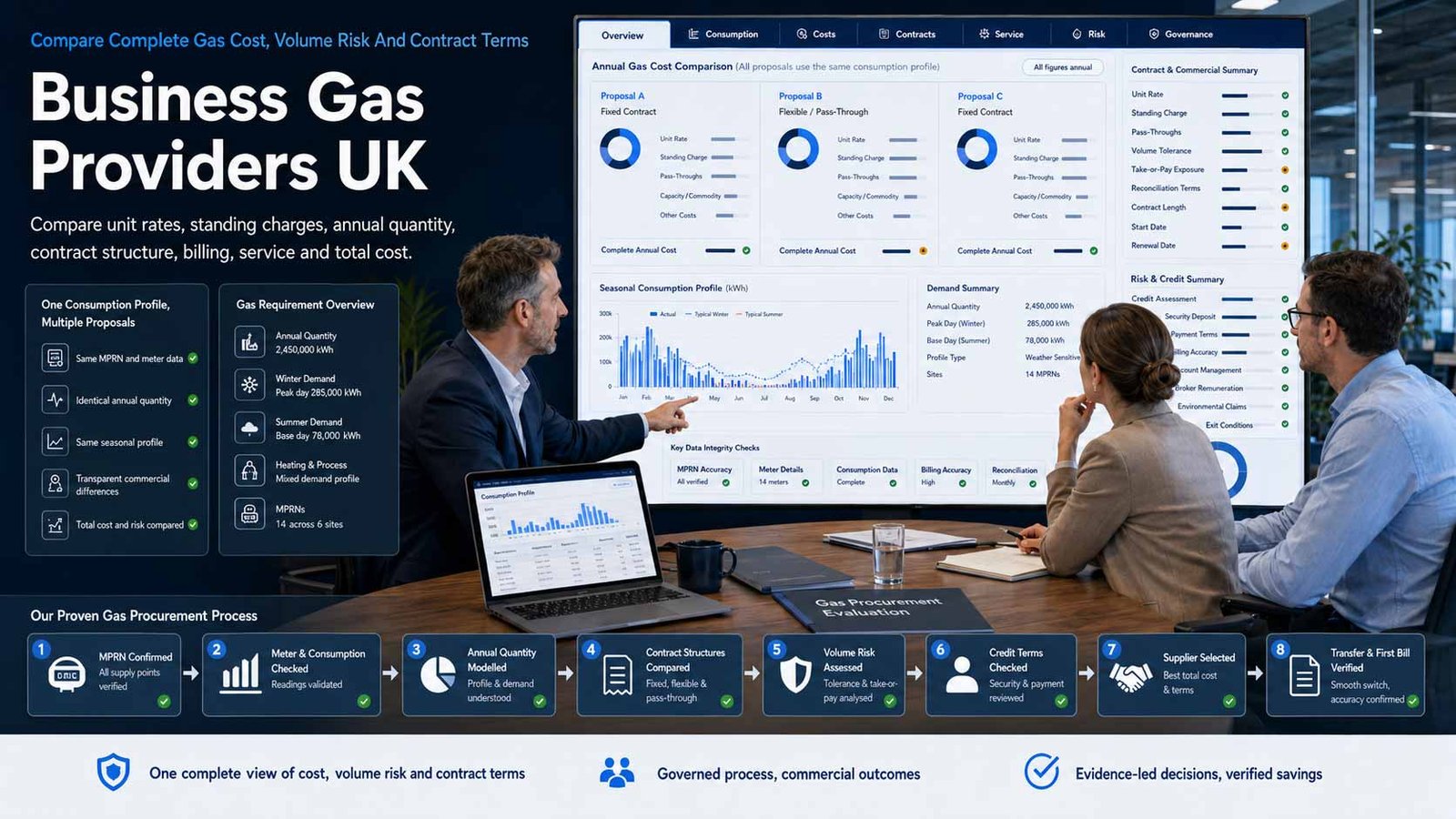
Compare The Complete Gas Bill—Not One Unit Rate
Two quotes with similar pence-per-kWh rates can produce different annual costs after standing charges, transportation, metering, taxes, broker remuneration and contractual adjustments are applied.
- Use the same annual quantity and seasonal profile for every quote
- Separate commodity cost from variable industry and network charges
- Check broker commission, supplier fees and renewal terms before signing
- Model early exit, volume variance, delayed switching and deemed rates
Business gas is supplied under a non-domestic contract that sets the commercial terms for natural gas delivered through one or more meter points. The supplier purchases gas, bills the customer and administers the account, while network and metering organisations operate the physical system and market records.
Business gas prices are normally quoted for a specific legal entity, premises, MPRN, meter, annual quantity and consumption profile. The domestic price cap does not set business contract rates. A buyer may choose a fully fixed contract, a product with specified pass-through costs, a variable arrangement or a flexible purchasing structure for larger consumption.
This page compares mains business gas supply contracts only. It does not compare bulk LPG, heating equipment, boilers, on-site generation, infrastructure installation or unrelated utility services. Metering and consumption data are included only where they affect quotation, billing, switching and contract management.
Choose The Right Business Gas Contract Structure
Supplier terminology varies. Compare which elements are fixed, which can change and which consumption assumptions become contractual.
| Contract Model | What It Usually Provides | Best-Fit Question |
|---|---|---|
| Fully fixed contract | Sets the quoted unit and standing-charge structure for a defined term, subject to the contract’s stated exclusions | Which transportation, policy, metering, tax or volume-related items can still change? |
| Fixed commodity with pass-through costs | Fixes the wholesale or supplier element while specified third-party charges remain variable | Which costs pass through, how are they calculated and how often can the supplier adjust them? |
| Variable or freedom-style contract | Allows rates to change under published terms and may provide shorter termination notice | What notice applies, how frequently can rates change and can the buyer move to a fixed term? |
| Deemed contract | Applies when gas is consumed without an agreed contract, commonly after moving into premises | What deemed rates apply and what occupancy evidence is required to establish a new account? |
| Flexible purchasing contract | Allows larger users to buy commodity volumes in tranches against an agreed strategy | Who makes purchasing decisions, how much volume remains open and how is performance measured? |
| Multi-site portfolio contract | Groups several MPRNs under one supply, billing and account-management arrangement | Are site data, end dates, billing, volume tolerances and responsibilities aligned? |
| Seasonal or volume-flex product | Provides agreed treatment for material changes in seasonal demand or production volume | Which tolerances apply and what happens if consumption moves outside the agreed range? |
| New occupier or meter-point supply | Establishes the commercial contract after a tenancy change, new connection or meter setup | Who coordinates MPRN, meter, occupancy evidence, opening read and contract start? |
Eight Areas That Determine Business Gas Fit
Use the same MPRN, consumption and contract assumptions for every supplier so a low headline rate does not hide volume, metering or renewal risk.
Comparison Criterion
Unit Rate, Standing Charge And Annual Cost
Compare the unit rate in pence per kWh, daily standing charge, metering charges and complete projected annual cost using one verified consumption figure. For larger sites, use monthly or daily profile data rather than applying a flat annual quantity without seasonality.
Comparison Criterion
Fixed, Pass-Through And Reconciliation Terms
Identify every element that is genuinely fixed and every transportation, balancing, policy, tax, metering or volume item that can change. Confirm reconciliation, retrospective adjustment, tolerance bands and whether new or restructured industry costs can be passed through.
Comparison Criterion
Contract Length, Start Date And Renewal
Review term, supply start, end date, termination notice, renewal window, extension rates, deemed or out-of-contract pricing and whether valid notice can be submitted early. Record written acknowledgements for every termination instruction.
Comparison Criterion
MPRN, Meter And Annual Quantity
Verify the meter point reference number, meter serial number, annual quantity, read frequency, site address and expected load. Incorrect data can invalidate pricing, delay a switch or produce later reconciliation. Multi-site buyers should reconcile every meter point before tender.
Comparison Criterion
Consumption Shape And Volume Tolerance
Compare winter concentration, process demand, seasonal closures, production changes, take-or-pay exposure, daily metering and tolerance clauses. A fixed unit price can still create financial risk when actual volume differs materially from the quotation.
Comparison Criterion
Credit, Deposit And Payment Requirements
Compare credit checks, security deposits, parent guarantees, advance payment, direct-debit conditions, invoice frequency, payment days, late-payment charges and supplier rights if credit deteriorates. A low rate may depend on stronger security or shorter payment terms.
Comparison Criterion
Billing, Data And Account Management
Assess bill clarity, validated reads, consolidated or site-level invoicing, online portals, user permissions, data downloads, cost-centre allocation, meter-read correction, query ownership and access to historic consumption after the contract ends.
Comparison Criterion
Service, Broker Remuneration And Environmental Claims
Review onboarding, switching support, complaint routes, account management, broker commission or fees, supplier identity, licence status, contract authority and any carbon-offset or renewable-gas evidence. Compare the environmental claim and cost without allowing it to obscure the core supply terms.
Measures To Define Before A Business Gas Contract Is Signed
Translate competitive pricing and reliable service into consistent cost, switching, billing and renewal evidence.
| Measure | What It Should Define | Evidence To Request | Common Weakness |
|---|---|---|---|
| Annual quantity accuracy | Whether quoted consumption reflects a recent, complete and representative period | Bills, reads, monthly data, seasonality, closures, growth, efficiency changes and forecast | An old estimated annual quantity is reused after operating hours or process demand changed |
| Whole-bill comparison | The annual cost produced by every quoted rate and charge using the same consumption | Unit rate, standing charge, metering, transportation, CCL, VAT, fees and variable items | Only the unit rate is compared while higher fixed and pass-through charges are ignored |
| Fixed-cost certainty | The proportion of projected annual spend contractually fixed for the term | Fixed items, variable items, adjustment formula, notice, reconciliation and examples | A product is described as fixed although material third-party charges can change |
| Volume-tolerance exposure | Whether under- or over-consumption can trigger repricing, reconciliation or additional charges | Forecast volume, tolerance, seasonal profile, notification, formula, cap and worked example | A business expands production without checking the agreed volume range |
| Meter and read accuracy | Whether invoices use the correct MPRN, meter and reliable consumption data | MPRN, serial, read type, period, consumption, correction, status and evidence | Estimated reads continue despite available actual or automated data |
| Switch completion | Whether the new supplier registers the correct meter point for the required date | Old supplier, new supplier, MPRN, termination, objection, opening read and completion | The contract is signed but the incumbent never receives valid notice |
| Query and complaint resolution | How quickly billing, switching and account problems are acknowledged and corrected | Case, owner, dates, evidence, correction, credit, escalation and closure | Queries close without correcting the underlying meter or industry record |
| Broker-remuneration transparency | Whether the buyer can identify how the intermediary is paid and the amount included in the contract | Broker, supplier, commission or fee, calculation, term, disclosure and authority | The service is described as free although commission is embedded for every kWh |
| Renewal readiness | Whether valid data, notice and authority are prepared before contract expiry | End date, notice deadline, usage, forecast, tender date, decision and acknowledgement | The review starts after the available supplier options have narrowed |
| Total cost per supplied site | The complete commodity, charge, tax, fee and internal-administration cost for each premises | Sites, kWh, charges, CCL, VAT, broker, deposits, service effort and exceptions | Portfolio savings hide one incorrectly billed or high-cost meter point |
Business Gas Providers UK Companies Can Consider
Shortlist suppliers whose contract structure, service model and eligibility fit the sites. Confirm live rates and complete terms directly because business gas quotes change with the market and customer profile.
Supplier Profile
British Gas Business
British Gas Business offers fixed-term, flexible rolling and tailored business gas arrangements, including more complex products for large users. Include it where a buyer wants a major supplier with direct quotation, online account tools and separate SME and larger-business routes. Confirm the exact product, unit and standing charges, fixed and variable components, term, annual quantity, payment, metering, support route, broker involvement, renewal, deemed pricing and any eligibility threshold for flexible purchasing.
Review official British Gas Business supplySupplier Profile
EDF Small Business Energy
EDF provides small-business gas tariffs through direct quotation, including fixed-price contracts with price-security terms that can extend for several years depending on the live offer. Include it where an SME values online account management, direct switching support and a major supplier route. Confirm gas-only pricing, contract length, standing charge, fixed-cost definition, consumption assumptions, payment discount, meter data, smart or automated reading support, renewal, customer service and every charge outside the headline rate.
Review official EDF business gas tariffsSupplier Profile
E.ON Next Business
E.ON Next supplies bespoke fixed business gas tariffs to eligible SMEs, with current guidance describing one-, two- and three-year pricing and the ability to agree a contract ahead of the current end date. Include it where a small business wants a digital account and direct supplier support. Confirm the quoted term, rate validity, fixed-price scope, annual consumption, meter eligibility, payment, smart-meter support, online tools, termination, no-auto-rollover treatment, deemed rates and renewal timing.
Review official E.ON Next business gasSupplier Profile
ScottishPower Business
ScottishPower provides one-, two- and three-year gas contracts for business customers through its For Business tariff. Its published structure separates a fixed energy element from industry costs that are variable and reviewed periodically. Include it where a buyer wants explicit separation of commodity and pass-through cost. Confirm the current fixed and variable schedule, standing charge, contract term, consumption, payment, metering, quarterly changes, renewal, standard-variable and deemed terms, support and broker route.
Review official ScottishPower gas tariffsSupplier Profile
Yü Energy Business Gas
Yü Energy is a business-focused supplier offering fixed, part-fixed, prepayment and more flexible gas plans for single and multi-site organisations. Include it where an SME wants a specialist supplier, quick quotation and a range of contract structures. Confirm the selected plan, fixed and pass-through elements, Freedom-plan notice where applicable, annual quantity, volume tolerance, payment, deemed and transition rates, meter services, account support, broker commission, additional charges and any environmental option.
Review official Yü Energy business gasSupplier Profile
Valda Energy Business Gas
Valda Energy supplies business gas to small organisations through online and adviser-led quotation, with digital account management, invoicing and smart-meter support. Include it where a small business wants a specialist supplier and a relatively simple service model. Confirm product availability, unit and standing charges, contract length, fixed-cost scope, payment, MPRN and consumption assumptions, metering, online account functions, renewal, deemed pricing, support, broker or direct channel and any minimum consumption or credit requirements.
Review official Valda Energy business gasSupplier Profile
SEFE Energy Business Gas
SEFE Energy is a specialist non-domestic gas supplier serving microbusiness, commercial, public-sector and large industrial customers through a range of fixed, flexible and renewable-gas products. Include it where gas expertise, large portfolios or tailored purchasing structures are important. Confirm the product selected, customer eligibility, commodity strategy, transportation and industry costs, volume tolerance, metering, data, credit, account team, renewable evidence, retainer or service fees, renewal and whether the quote is direct or intermediary-led.
Review official SEFE Energy productsSupplier Profile
npower Business Solutions
npower Business Solutions supplies fixed, flexible and hybrid gas contracts to eligible larger and multi-site organisations. Its published route is designed for more complex users and sets minimum eligibility criteria for large-business quotations. Include it where consumption, portfolio size and purchasing governance justify a tailored strategy. Confirm eligibility, commodity and non-commodity treatment, term, purchasing authority, volume flexibility, metering and data, carbon-offset option, credit, account management, consultant involvement, renewal and the boundary from optional advisory services.
Review official npower business gasWhat Changes Business Gas Prices UK Companies Receive
Supplier rates are customer-specific. Compare the complete projected bill and contractual exposure rather than treating one market average as a live quotation.
| Cost Driver | Why It Changes Spend | What A Comparable Quote Should Show |
|---|---|---|
| Wholesale gas and purchase timing | Supplier purchasing costs and the date a quote is accepted affect the commodity component | Quote issue, validity, contract start, term, fixed element, market assumptions and acceptance process |
| Annual quantity and seasonal profile | Total kWh and the concentration of winter or process demand affect purchasing and balancing exposure | Recent annual usage, monthly profile, daily data, operating hours, seasonality, closures and forecast |
| Unit rate and standing charge | The pence-per-kWh rate and daily charge create the basic annual cost before other adjustments | Rate, standing charge, days, annual kWh, meter points, calculation and projected total |
| Transportation, metering and industry costs | Network, balancing, metering and policy costs may be fixed, forecast or passed through | Included items, variable items, formula, forecast, reconciliation, notice and historical example |
| Capacity, volume and meter configuration | Larger or daily-metered sites may face capacity, annual quantity and tolerance considerations | MPRN, meter type, AQ, SOQ where relevant, read frequency, tolerance, notification and charge |
| Climate Change Levy and VAT | CCL and VAT are applied according to current rules and the customer’s eligibility | CCL rate, qualifying relief, VAT rate, certificate, evidence, start date and supplier confirmation |
| Credit and payment profile | Credit quality, deposits, guarantees, advance payment and payment days affect price and supplier eligibility | Credit decision, security, payment method, invoice frequency, late charges and review rights |
| Contract duration and volume risk | Longer terms can provide certainty but increase exit, site-change and forecast exposure | Term, termination, assignment, relocation, closure, tolerance, early exit and volume adjustment |
| Broker commission and service fees | Intermediary remuneration may be embedded in every kWh or charged separately throughout the term | Amount, calculation, duration, payer, disclosure, authority, services and additional fees |
| Renewal, deemed and out-of-contract exposure | Failure to renew, terminate or establish occupancy correctly can move a site onto different rates | End date, notice, acknowledgement, extension rate, deemed rate, switch route and owner |
How Consumption And Site Complexity Change The Shortlist
The right supplier depends on annual quantity, seasonality, meter type, number of sites, credit profile, process demand and internal purchasing capability.
Small Single-Site Business
Prioritise clear fixed pricing, reasonable standing charges, accurate MPRN and meter data, direct account service, manageable payment terms, understandable renewal rules and support that can resolve billing or switching issues.
Hospitality Or Seasonal Heating User
Prioritise monthly consumption shape, winter demand, estimated-read controls, site-opening patterns, cash-flow impact, volume tolerance and a contract that reflects seasonal rather than evenly distributed usage.
Multi-Site Property Or Retail Estate
Prioritise complete site inventory, aligned end dates, consolidated billing, occupancy changes, closures, new locations, meter reads, credit allocation and the ability to compare each MPRN as well as the total portfolio.
Large Industrial Or Process User
Prioritise flexible or hybrid purchasing, daily data, volume tolerance, capacity, transportation transparency, market governance, credit support, account management and documented performance against the purchasing strategy.
How To Compare Business Gas Quotes
Give every supplier the same legal entity, MPRN, site address, meter details, annual quantity, monthly profile, forecast, start date, term, payment, environmental requirement and credit information. Keep a signed comparison record showing every assumption.
- All quotes use the same consumption and contract start date
- Commodity and pass-through charges are separated line by line
- VAT, CCL, broker remuneration and supplier fees are visible
- Volume, renewal, termination and relocation terms are compared
- Supplier identity, quote validity and acceptance authority are verified
- Switching, opening reads and first-bill validation have named owners
Make Every Supplier Price The Same Gas Profile
Use the same annual kWh, monthly shape, standing-charge days, MPRNs, contract start and term.
Compare the projected annual bill, volume exposure and renewal risk before comparing the unit rate.
Six Questions To Put To Every Gas Supplier
The answers expose pass-through costs, inaccurate data, embedded commission and renewal risk before the contract becomes binding.
Which Parts Of The Price Are Fixed?
Request a line-by-line schedule of commodity, standing, transportation, metering, policy, tax and other charges, including adjustment rights and examples.
Which Consumption And Meter Data Created The Quote?
Confirm MPRN, meter, annual quantity, monthly profile, period, estimated data, forecast, closures, growth and volume tolerance.
What Happens At Contract End Or If The Site Changes?
Review termination notice, acknowledgement, renewal, deemed rates, relocation, closure, assignment, new occupier and early-exit treatment.
How Is The Broker Or Intermediary Paid?
Ask for the amount or calculation of commission and fees, the period over which they apply, authority and included service.
How Will Billing And Switching Problems Be Resolved?
Confirm named contacts, response targets, objections, meter records, disputed invoices, payment holds, complaints, escalation and redress eligibility.
What Supports Any Environmental Gas Claim?
Request the product description, certificate or offset standard, retirement or cancellation process, reporting period, permitted claim and additional cost.
A Seven-Stage Business Gas Evaluation
Move from verified MPRN and consumption data to a controlled contract award rather than accepting a short-lived rate without whole-bill analysis.
- Collect recent bills, MPRNs, meter details, monthly or daily data, contract terms, end dates, termination evidence, payment history, site changes and accountable owners.
- Define required contract start, term, fixed-cost appetite, environmental evidence, billing, service, credit, data and switching requirements for mains gas supply only.
- Reconcile site and consumption data, remove closed premises, forecast material changes and confirm whether each meter is non-daily or daily metered.
- Issue one written request and obtain comparable direct or broker-led supplier quotes with complete price schedules, terms, remuneration and validity dates.
- Normalise every quote into one annual-cost model using the same consumption, days, taxes, fees, fixed items and variable assumptions.
- Approve and sign only after supplier identity, authority, termination, switching, opening read, payment, environmental evidence and first-bill controls are assigned.
- Operate through bill validation, consumption review, query tracking, site-change control and a renewal process that begins well before contract expiry.
Business Gas Comparison Checklist
Use this table before approving a gas supplier, broker recommendation, renewal or multi-site contract.
| No. | Requirement | Evidence To Obtain Before Award | Confirmed |
|---|---|---|---|
| 01 | Gas-supply scope and accountable owner agreed | Legal entity, sites, MPRNs, contract owner, finance owner, approver and operational contacts | |
| 02 | Current contracts and termination rights recorded | Supplier, product, start, end, notice, acknowledgement, renewal, deemed rate and authority | |
| 03 | Meter and site inventory reconciled | MPRN, address, meter serial, read frequency, annual quantity, occupier and status | |
| 04 | Consumption baseline validated | Annual kWh, monthly or daily profile, read quality, seasonality, closures, growth and process changes | |
| 05 | Quote specification issued consistently | Start date, term, payment, environmental evidence, billing, service, data, credit and site assumptions | |
| 06 | Unit and standing charges normalised | Rate, standing charge, metering, annual days, kWh, MPRNs and projected total | |
| 07 | Fixed and pass-through items separated | Included charges, variable charges, formula, reconciliation, notice, forecast and worked example | |
| 08 | Volume and meter terms accepted | AQ, tolerance, capacity where relevant, read method, daily data, adjustment and notification | |
| 09 | Tax and relief treatment confirmed | CCL, VAT, certificate, qualifying use, evidence, effective date and supplier acceptance | |
| 10 | Credit and security terms accepted | Credit check, deposit, guarantee, advance payment, direct debit, payment days and review | |
| 11 | Broker remuneration disclosed | Broker identity, commission or fee, calculation, term, payer, services, authority and additional charges | |
| 12 | Supplier service and product checked | Account route, portal, bill formats, meter support, complaints, response, redress and references | |
| 13 | Switch and first-bill plan agreed | Termination, objection, registration, opening read, direct debit, invoice validation and escalation | |
| 14 | Complete annual and contract cost compared | Consumption, charges, taxes, fees, volume exposure, deposits, internal effort and exit risk | |
| 15 | Renewal and site-change controls scheduled | Tender start, notice, data refresh, decision dates, relocations, closures, new sites and ownership |
Common Business Gas Buying Mistakes
Most avoidable failures begin with incomplete meter data, unit-rate-only comparisons, unclear commission or contract-end dates that are not actively managed.
| Mistake | Why It Creates Risk | Better Control |
|---|---|---|
| Comparing the unit rate only | Standing, metering, pass-through, tax and fee differences can reverse the apparent saving | Compare the complete annual bill |
| Using estimated or wrong MPRN data | The quote may be invalid, delayed or reconciled later at a different cost | Verify every meter and consumption record |
| Assuming every fixed contract fixes every charge | Specified transportation and policy costs may still change | Read the price schedule and adjustment clauses |
| Ignoring seasonal demand | A flat annual estimate can hide winter concentration and volume risk | Use monthly or daily profile data |
| Waiting until the final renewal week | The business has less market choice and more risk of extension or deemed rates | Start with verified data early |
| Accepting undisclosed broker commission | Embedded remuneration can continue across every kWh for the full contract term | Require written disclosure |
| Signing without authority controls | Telephone or electronic acceptance can create a binding business contract | Limit authorised signatories |
| Failing to submit or retain termination notice | The incumbent supplier may object or apply different rates | Record notice and acknowledgement |
| Assuming the domestic price cap applies | Business gas contracts are priced separately from household default tariffs | Use non-domestic contract evidence |
| Skipping the first-bill audit | Incorrect dates, reads or rates can continue unnoticed for months | Reconcile the first invoice immediately |
Frequently Asked Questions
Answers to common questions from UK businesses comparing gas suppliers, tariffs and contract terms.
How Are Business Gas Prices Calculated?
Business gas prices reflect wholesale purchasing, annual quantity, seasonal demand, transportation, metering, supplier costs, policy charges, taxes, credit and contract terms. Suppliers quote individual meter points or portfolios, so two organisations can receive different rates.
Does The Energy Price Cap Apply To Business Gas?
No. The domestic price cap applies to household default tariffs, not negotiated business gas contracts. Companies should compare non-domestic quotations, complete annual cost and contractual terms rather than using household price-cap rates as a benchmark.
What Is A Microbusiness For Business Gas?
Ofgem says a business may qualify as a microbusiness if it has fewer than ten employees and turnover or balance-sheet total no more than £2 million, or if annual gas use is no more than 293,000 kWh. Applicable protections depend on the rules and contract.
What Is A Deemed Gas Contract?
A deemed contract commonly applies when a business moves into premises and consumes gas before agreeing a contract with the registered supplier. Deemed rates can be higher, so the occupier should notify the supplier, provide evidence and arrange a contract promptly.
Should A Business Choose A One-Year Or Multi-Year Gas Contract?
The right term depends on budget certainty, market risk, site plans, credit and forecast confidence. A longer fixed term can reduce short-term volatility but may increase exposure to early exit, operational change or an unfavourable purchase date.
What Is The Climate Change Levy On Business Gas?
The main Climate Change Levy rate for natural gas is £0.00801 per kWh from 1 April 2026. Exemptions or reduced rates can apply where the customer meets the relevant rules and provides the required evidence to the supplier.
How Is VAT Charged On Business Gas?
Business gas is normally standard-rated for VAT, although reduced-rate treatment can apply to qualifying low quantities or qualifying use. Buyers should verify the supplier's treatment and provide any required certificate instead of assuming one rate applies to every site.
Can A Business Switch Gas Supplier Before Contract End?
A switch can normally complete for the contract end date if termination and new-contract requirements are satisfied. Leaving early may create charges or be restricted by the contract. Keep written notice and acknowledgement from the incumbent supplier.
Should A Business Use An Energy Broker?
A broker can collect data, approach suppliers and support comparison, but the business should verify the broker's authority, supplier panel, service and remuneration. Require written commission or fee disclosure and retain final approval of every contract assumption.
How Should A UK Business Compare Gas Suppliers?
Give every supplier the same MPRNs, annual quantity, seasonal profile, start date, term, payment and environmental requirements. Compare projected annual cost, fixed and variable exposure, credit, billing, service, broker remuneration, renewal and exit—not only the unit rate.
Official Guidance And Business Gas Supplier Resources
Reviewed by Bhav Giva, Founder & Lead Analyst at CompareServices.co.uk, on 24 July 2026.
Use Ofgem, DESNZ, HMRC and official supplier documentation to confirm current non-domestic pricing context, contract rules, taxes, tariff structure, eligibility and live quotation terms. Supplier rates can change while a comparison is being completed.
- Ofgem — Get Energy For Your Business
- Ofgem — Set Up A Business Energy Contract
- Ofgem — Change Of Tenancy For Businesses
- DESNZ — Non-Domestic Gas Price Statistics
- HMRC — Climate Change Levy Rates
- HMRC — VAT On Fuel And Power
- British Gas Business — Gas Supply Quote
- EDF — Small Business Gas Tariffs
- E.ON Next — Business Gas
- ScottishPower — Business Gas Tariffs
- Yü Energy — Business Gas
- Valda Energy — Business Gas Quote
- SEFE Energy — Business Gas Products
- npower Business Solutions — Business Gas Contracts