
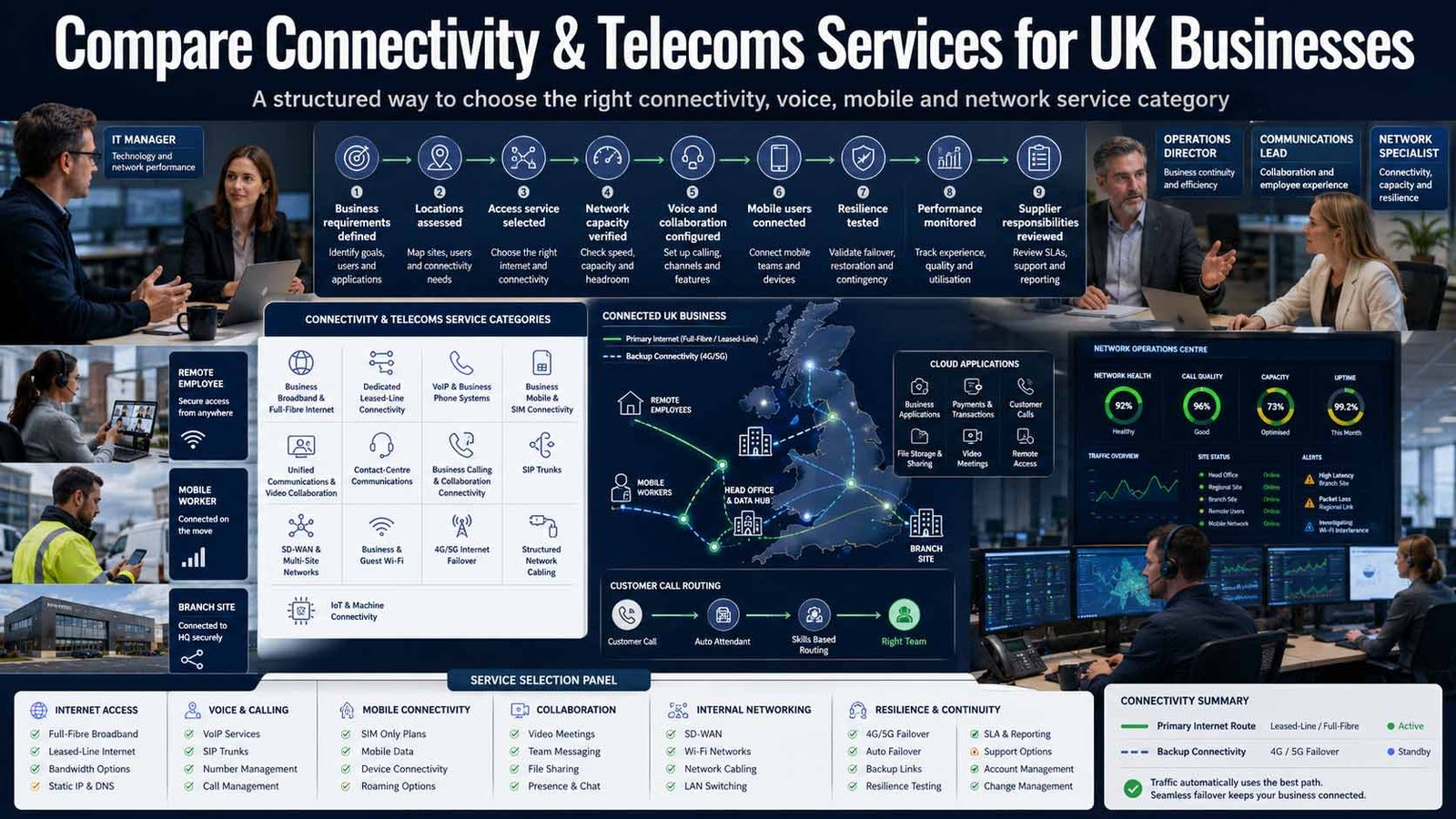
Compare Connectivity & Telecoms Services for UK Businesses
A structured way to choose the right connectivity, voice, mobile and network service category
Connectivity and telecoms services help UK businesses stay online, reachable and productive across offices, sites and remote teams. Use this hub to identify whether broadband, leased lines, VoIP, mobile, UCaaS, SD-WAN, Wi-Fi, failover or network installation is the right starting point.
Why this category matters to UK businesses
Connectivity is no longer a background utility. It sits under sales calls, cloud software, payment processing, remote access, video meetings, customer service, security systems and mobile work.
- Prevent avoidable downtime and operational friction
- Align access type with workload, growth and resilience needs
- Prepare voice and legacy services for digital migration
- Choose the right category before comparing providers
Connectivity and telecoms decisions should begin with the workload, location and consequence of failure. Internet access, voice, mobile, collaboration, customer contact, internal networks, failover and connected-device services address different parts of the operating environment.
Use this category to separate access, calling, mobility, multi-site networking, wireless coverage, physical infrastructure and resilience before requesting proposals. That keeps service levels, capacity, responsibilities, migration work and lifecycle cost comparable.
The appropriate route depends on users, sites, applications, call flows, devices, cloud dependence, current contracts, availability, growth plans and the financial or operational impact of downtime.
Map the operational problem to the right service category
Most businesses do not start by saying they need SD-WAN or SIP trunks. They start with a real operational problem.
| Business problem | What it usually signals | Relevant service categories |
|---|---|---|
| Slow or unreliable internet is affecting day-to-day work | Current access type is not aligned with usage, uptime or growth plans | Business Broadband, Full Fibre Broadband, Leased Lines, Internet Backup / 4G-5G Failover |
| Phone calls, customer contact or collaboration feel fragmented | Voice and collaboration tools are spread across outdated or disconnected systems | VoIP Phone Systems, Unified Comms (UCaaS), Microsoft Teams Operator Connect, SIP Trunks, Contact Centre Solutions |
| Multi-site performance is inconsistent | The business needs better network design, resilience or traffic control | Leased Lines, SD-WAN / Managed WAN, Business Wi-Fi / Guest Wi-Fi, Structured Cabling & Network Installation |
| Staff work across sites, from home or on the move | Connectivity needs extend beyond a single office line or desk phone | Business Mobile / SIM-Only, IoT / M2M SIM Connectivity, Internet Backup / 4G-5G Failover, Unified Comms (UCaaS) |
| The business is preparing for digital voice migration | Legacy PSTN, ISDN or older on-premise voice arrangements need replacing | VoIP Phone Systems, Microsoft Teams Operator Connect, SIP Trunks, Unified Comms (UCaaS) |
| Guest access, warehouse coverage or on-site mobility is poor | The issue may be internal wireless design rather than the line into the building | Business Wi-Fi / Guest Wi-Fi, Structured Cabling & Network Installation |
Service needs by business size and operating model
Use the business profile, operational dependency and internal capability to decide which telecoms service should be evaluated first.
| Business profile or need | Typical priority | Service categories reviewed first | What matters most in shortlisting |
|---|---|---|---|
| Sole trader or very small office | Keep costs controlled while maintaining dependable internet and calling | Business Broadband, VoIP Phone Systems, Business Mobile / SIM-Only | Entry cost, contract flexibility, essential calling features, support responsiveness |
| Small business with hybrid staff | Balance office connectivity with mobile and remote communications | Full Fibre Broadband, VoIP Phone Systems, UCaaS, Business Mobile | Reliability, collaboration features, scalability, user management |
| Multi-site SME | Standardise connectivity and communications between locations | Leased Lines, SD-WAN, UCaaS, Business Wi-Fi | Uptime, resilience, central control, integration between sites |
| Contact-heavy service team | Improve inbound handling, visibility and customer response | Contact Centre Solutions, VoIP Phone Systems, Teams Operator Connect | Call routing, reporting, agent features, customer experience |
| Field-based workforce | Keep users connected outside the office | Business Mobile, IoT/M2M SIMs, 4G/5G Failover | Coverage, device compatibility, tariff fit, resilience |
| Data-heavy or uptime-sensitive operation | Minimise disruption and support critical applications | Leased Lines, SD-WAN, Internet Backup / Failover | Service levels, performance consistency, failover, network oversight |
| Business moving away from legacy voice | Replace old calling infrastructure without operational disruption | VoIP Phone Systems, SIP Trunks, Teams Operator Connect, UCaaS | Migration path, handset strategy, calling continuity, admin simplicity |
Use one evidence framework across every telecoms purchase
The technology changes across this category, but buyers should apply the same discipline to scope, capacity, resilience, migration, service levels, cost and exit.
| Control area | What the buyer should define | Evidence to request before award | Why it matters |
|---|---|---|---|
| Sites, users and service boundary | List legal entities, locations, users, shifts, remote workers, vehicles, IoT devices, numbers, rooms, networks and services included or excluded. | Verified estate schedule, current service inventory, responsibility matrix, assumptions, dependencies, exclusions and treatment of new sites or users. | Telecoms proposals are not comparable when providers price different sites, users, devices or service boundaries. |
| Applications, traffic and capacity | Record cloud systems, voice, video, contact-centre traffic, uploads, downloads, guest access, backups, payment terminals, security devices, peak usage and forecast growth. | Usage data, performance baseline, bandwidth model, quality requirements, prioritisation design, capacity thresholds and a pricing schedule tied to the same assumptions. | Headline speed alone does not show whether a service will support real workloads consistently. |
| Availability and resilience | Define the operational and financial impact of outage, required recovery, diverse routes, power dependencies, failover behaviour, mobile coverage, monitoring and manual fallback. | Resilience design, route-diversity evidence, failover test, service availability definition, recovery process, monitoring scope and customer responsibilities. | A backup service can share the same physical path, power or provider dependency as the primary connection unless diversity is verified. |
| Voice, numbers and customer contact | Map inbound and outbound calls, numbers, queues, hunt groups, recordings, emergency calling, handsets, softphones, Teams, CRM, contact-centre agents and remote users. | Call-flow design, number-porting plan, emergency-location process, recording responsibilities, feature schedule, licence map, test cases and rollback arrangements. | Voice migration can disrupt customer access when numbers, routing, devices and user workflows are not tested together. |
| Internal network and site readiness | Assess cabling, cabinets, switches, wireless coverage, interference, guest networks, power, building access, landlord permissions, fire stopping, equipment rooms and installation windows. | Site survey, wireless or cabling design, equipment schedule, installation method, permissions, risk assessment, acceptance tests, labelling and as-built documentation. | External connectivity cannot correct poor internal coverage, damaged cabling or unsuitable network design. |
| Security, management and data | Define administrative access, network segmentation, authentication, device management, configuration backup, call or usage records, logging, retention, fraud controls and supplier access. | Security schedule, role model, data-flow map, subprocessor list, management portal controls, audit logs, fraud process, incident notification and deletion arrangements. | Telecoms platforms and managed networks can expose privileged access, calling data and business-critical configuration. |
| Service levels and governance | Set support hours, response, restoration, engineer attendance, performance thresholds, planned maintenance, escalation, reporting, service reviews and chronic-fault handling. | Service-level schedule, clock definitions, exclusions, example report, escalation map, performance evidence, service credits and governance calendar. | Broad claims such as business-grade or guaranteed support are weak unless the event, clock, outcome and customer action are defined. |
| Complete cost, contract and exit | Model installation, surveys, circuits, users, numbers, licences, hardware, rental, usage, support, maintenance, overage, porting, project work, indexation, minimum term and termination. | Three-year cost model, unit rates, committed volumes, renewal terms, change charges, asset ownership, number portability, configuration export, transition support and final billing. | A low monthly rate can exclude installation, usage, hardware, support or exit work and create avoidable long-term lock-in. |
Connectivity & Telecoms service categories
This category covers 14 service areas. Each one solves a different part of the wider connectivity and communications challenge.
Cost-aware internet access
Business Broadband (FTTC/SoGEA)
A business-grade internet starting point for smaller offices, local firms and growing teams that need stronger support and service terms than home broadband.
Compare business broadband providersFaster site connectivity
Full Fibre Broadband (FTTP)
A higher-capacity fibre route for businesses that need faster speeds, better consistency and more future-ready access where full fibre is available.
Compare full fibre broadband providersDedicated connectivity
Leased Lines
Dedicated connectivity for businesses that need predictable performance, stronger uptime expectations and critical application support.
Compare leased line providersModern business calling
VoIP Phone Systems
Modern business calling using cloud or IP-based systems, usually considered when replacing legacy phone systems or supporting flexible working.
Compare VoIP phone system providersMobile workforce
Business Mobile / SIM-Only
Mobile voice and data services for employees, field teams and organisations that need business tariff control and device flexibility.
Compare business mobile and SIM-only providersVoice + collaboration
Unified Comms (UCaaS)
A combined communications model for calling, messaging, meetings and collaboration across hybrid and multi-site teams.
Compare unified communications providersCustomer contact operations
Contact Centre Solutions
Advanced customer-contact platforms for inbound queues, outbound teams, agent visibility, reporting and service performance.
Compare contact centre solution providersTeams-based calling
Microsoft Teams Operator Connect
A Teams-based voice route for businesses already using Microsoft Teams and wanting external calling inside that environment.
Compare Microsoft Teams Operator Connect providersPBX connectivity
SIP Trunks
IP-based voice connectivity for businesses that want to keep compatible PBX infrastructure or manage a staged voice migration.
Compare SIP trunk providersMulti-site network control
SD-WAN / Managed WAN
Managed network control for multi-site businesses that need application prioritisation, resilience and centralised policy.
Compare SD-WAN and managed WAN providersInternal Wi-Fi experience
Business Wi-Fi / Guest Wi-Fi
Internal wireless design for offices, hospitality, retail, clinics, warehouses and premises where coverage inside the building matters.
Compare business and guest Wi-Fi providersResilience and continuity
Internet Backup / 4G-5G Failover
Backup connectivity for businesses where downtime affects calls, payments, cloud access, bookings or service delivery.
Compare internet backup and failover providersPhysical network layer
Structured Cabling & Network Installation
Physical network infrastructure for office moves, fit-outs, refurbishments, warehouses and internal network upgrades.
Compare structured cabling and network installersConnected devices
IoT / M2M SIM Connectivity
Connectivity for assets, sensors, terminals, equipment and machine-to-machine devices across sites or locations.
Compare IoT and M2M SIM connectivity providersHow to think about fit without over-complicating the decision
Start with operational requirements before product names. This prevents buying something too basic or too advanced for the actual problem.
Where is the pain point?
Identify whether the real issue is internet performance, voice calls, mobility, internal networking, resilience or multi-site control.
How many users, sites or devices matter?
A single ten-person office has a very different shortlist from three branches, a warehouse and a field team.
How expensive is downtime?
If an outage stops calls, bookings, payments or cloud access, resilience and failover should move higher in the shortlist.
How important is integration?
Some businesses need simple connectivity, while others need Teams, CRM, customer contact or workflow integration.
Is this a migration decision?
Replacing legacy broadband, moving from PSTN/ISDN or improving wireless coverage changes the correct route.
Connectivity needs by business type
Different business models often prioritise different telecoms outcomes.
Small offices and local service businesses
Need dependable connectivity, business-grade calling and enough flexibility to support small-team growth. The shortlist is usually broadband, fibre, VoIP and business mobile.
Multi-site organisations
Need consistency between branches, clinics, retail sites, regional offices or operating locations. The focus shifts to leased lines, SD-WAN, UCaaS, business Wi-Fi and resilient design.
Hybrid and remote teams
Need mobile, calling and collaboration to work together across office and remote environments. Fibre, VoIP, UCaaS, Teams-linked calling and mobile services often appear together.
Customer contact-led operations
Need more than standard phone features. Contact centre solutions, routing logic, reporting capability and user management become more important.
Operationally critical environments
Need resilience, backup lines, service commitments and internal network planning because downtime has a direct commercial or operational cost.
How to structure a Connectivity & Telecoms comparison
Begin with the service dependency and required outcome rather than a preferred access technology or supplier. Each telecoms service has a different scope, performance measure, migration path and pricing unit.
- Define users, sites, devices, applications, call flows and connected equipment
- Record current circuits, numbers, contracts, renewal dates and known service issues
- Give every provider the same bandwidth, resilience, coverage and support assumptions
- Separate external connectivity from internal Wi-Fi, cabling and network design
- Compare implementation, number porting, migration, testing and rollback responsibilities
- Confirm monitoring, reporting, service levels, escalation, contract exit and data portability
Fit first. Provider second.
A site that requires operational continuity may need diverse failover rather than a faster headline broadband package. Poor internal wireless coverage may require Wi-Fi design or cabling rather than replacing the external circuit.
Correct service selection reduces duplicated contracts and exposes the responsibilities that sit between carriers, managed providers, installers and internal IT teams.
Move from broad research into a focused shortlist
Use this sequence to prepare one controlled brief before requesting proposals.
- Define the operational problem in one sentence.
- Match that problem to the service categories in the problem/solution table.
- Check the business profile table for size and operating model fit.
- Review the short descriptions for the 14 services.
- Open the most relevant live service pages and compare providers against the same requirements, volumes, sites and commercial assumptions.
Connectivity & Telecoms service pages in this category
Use these live pages to continue into the service comparison that matches your operational requirement.
- Compare Business Broadband (FTTC/SoGEA)
- Compare Full Fibre Broadband (FTTP)
- Compare Leased Lines
- Compare VoIP Phone Systems
- Compare Business Mobile / SIM-Only
- Compare Unified Comms (UCaaS)
- Compare Contact Centre Solutions
- Compare Microsoft Teams Operator Connect
- Compare SIP Trunks
- Compare SD-WAN / Managed WAN
- Compare Business Wi-Fi / Guest Wi-Fi
- Compare Internet Backup / 4G-5G Failover
- Compare Structured Cabling & Network Installation
- Compare IoT / M2M SIM Connectivity
Frequently Asked Questions
Quick answers for UK business buyers comparing connectivity and telecoms categories.
What is the difference between business broadband and a leased line?
Business broadband is a shared access service that suits many smaller offices, while a leased line is a dedicated connection typically chosen for stronger performance consistency, resilience expectations and heavier operational reliance on connectivity.
Do UK businesses need to prepare for the PSTN switch-off now?
Yes. Businesses still relying on older fixed-line voice infrastructure should review their migration path now, because the UK’s legacy PSTN network is due to be switched off in January 2027 and affected services may need replacement or redesign.
When should a business look at UCaaS instead of a standard VoIP phone system?
A business should usually review UCaaS when it wants calling, messaging, meetings and collaboration tools to work as one joined-up environment rather than treating telephony as a standalone communications purchase.
Is 4G or 5G failover worth considering for a small business?
It can be. If even a short outage disrupts bookings, calls, card payments, cloud access or customer response times, a backup connection may be a sensible resilience measure rather than an unnecessary extra.
What information should a business prepare before requesting telecoms proposals?
Prepare the site list, users, devices, applications, current speeds and circuits, phone numbers, call flows, mobile requirements, Wi-Fi or cabling issues, resilience needs, contract dates, service incidents, implementation deadline and expected growth. Give every provider the same written brief.
Authoritative UK connectivity and telecoms guidance
Reviewed by Bhav Giva, Founder & Lead Analyst at CompareServices.co.uk, on 4 August 2026.
Use the following primary sources alongside the relevant live service comparison when assessing broadband availability, national rollout programmes and migration from analogue phone services. Obtain technical, contractual, security, property or accessibility advice where the organisation’s sites and critical services require specialist input.