
Compare Commercial Solar PV Providers UK (2026)
Compare Design, Yield, Structural Work, Grid Connection, Warranties, Finance, O&M And Lifetime Value
Compare commercial solar panels UK providers by survey quality, roof or ground-mount suitability, structural engineering, generation modelling, self-consumption, export assumptions, DNO application, planning, equipment selection, fire and electrical design, installation controls, monitoring, warranties, maintenance, finance structure and complete lifetime cost. Give every bidder the same electricity data and site constraints before comparing projected savings.
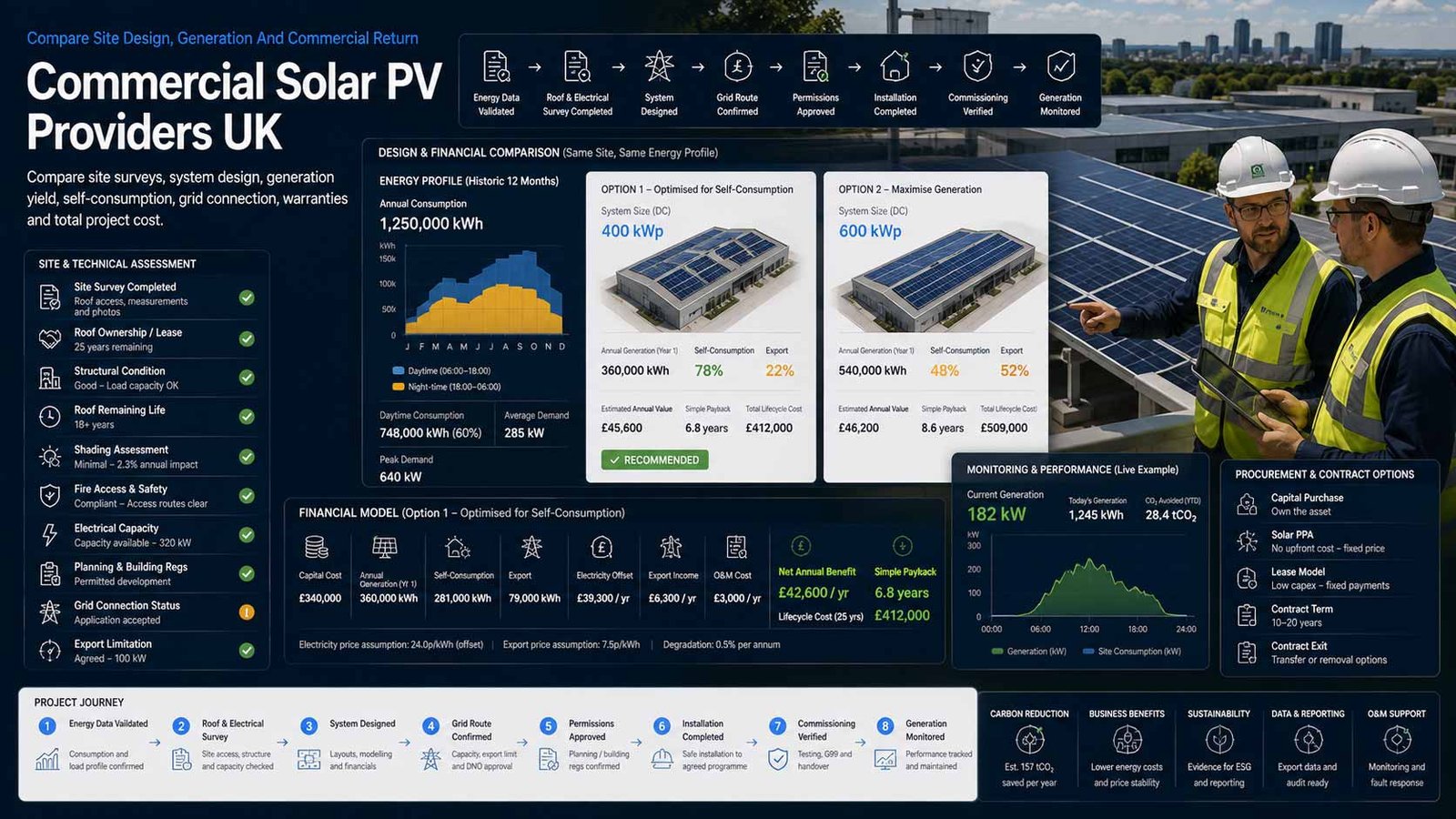
Compare The Energy Model—Not The Number Of Panels
A larger array is not automatically the better investment. The useful result depends on how much generation the business can consume, export, maintain and verify over the system life.
- Use interval electricity data, not one annual bill, where possible
- Separate technical yield from financial assumptions
- Check roof condition, structural loading and access before pricing
- Confirm DNO, planning, metering and export responsibilities
Commercial solar PV converts daylight into electricity for use at business premises. Systems are commonly installed on warehouses, factories, offices, farms, schools, retail units, car parks or available land. The commercial value normally comes from avoiding imported electricity, receiving payment for eligible export, supporting carbon targets and reducing exposure to future grid-price volatility.
A credible project starts with the building and load profile. The provider should examine roof ownership, lease rights, structure, condition, shading, fire strategy, electrical infrastructure, grid capacity, working hours, future demand and the proportion of generation likely to be used on site.
This page compares business-scale solar PV design, installation, finance and lifecycle support. It does not cover residential solar, household grants, domestic roof suitability or consumer buying advice. Battery storage and EV charging are separate services and should be assessed through their own commercial cases rather than automatically bundled into the solar quotation.
Choose The Right Commercial Solar Ownership Structure
Ownership changes who funds, operates, insures and benefits from the system. Compare project economics and legal obligations under the same generation assumptions.
| Delivery Model | What It Usually Provides | Best-Fit Question |
|---|---|---|
| Capital purchase | The business owns the system and normally receives the savings, export income and tax treatment | Does the organisation have capital, roof control and appetite for asset risk? |
| Asset finance or loan | The business pays for the owned system over an agreed finance term | Are interest, security, covenants, warranties and early repayment transparent? |
| Operating lease | A third party owns the system while the business pays an agreed rental | Who receives export value, tax benefits and residual asset ownership? |
| On-site power purchase agreement | A funder installs and owns the system and sells generated electricity to the occupier | Is the PPA rate, indexation, term, minimum purchase and roof obligation acceptable? |
| Roof lease | A developer leases roof space and may sell electricity to the occupier or export it | How are access, repairs, insurance, reinstatement and landlord rights controlled? |
| Design-and-build EPC | The business appoints one contractor for engineering, procurement and construction | Is output performance, grid approval, handover and defect liability contractually defined? |
| Solar-as-a-service | The provider combines funding, installation, monitoring and maintenance under one service | Which risks are genuinely transferred and which remain with the customer? |
| Ground-mount project | Panels are installed on land with civil works, fencing, planning and grid considerations | Does the land, planning status and connection capacity justify a larger project? |
Eight Areas That Determine Commercial Solar PV Fit
Use one site brief and one electricity dataset for every provider so differences in yield, cost and payback reflect the proposal—not different assumptions.
Comparison Criterion
Site Survey, Roof Rights And Structural Engineering
Compare roof ownership, lease permissions, remaining roof life, asbestos, drainage, loading, wind and snow calculations, access, fire routes, shading and ground conditions. A quotation based only on satellite imagery should remain provisional until intrusive or suitably detailed surveys are complete.
Comparison Criterion
Electricity Data And Self-Consumption Model
Assess the interval data period, operating hours, seasonal demand, weekends, closures, planned electrification and generation-consumption matching. Require annual and monthly figures for generated, self-consumed, curtailed and exported electricity rather than one headline saving percentage.
Comparison Criterion
System Design And Equipment Selection
Compare module technology, inverter architecture, mounting, string design, optimisers where justified, isolators, cabling, switchgear, monitoring, surge protection and manufacturer bankability. Equipment should be selected for the site and maintenance strategy, not only to maximise quoted capacity.
Comparison Criterion
Generation Yield And Degradation Assumptions
Review irradiation dataset, shading, orientation, losses, clipping, availability, soiling, degradation, curtailment and uncertainty. Require P50-style expected output and downside scenarios where the investment is material. Do not accept performance estimates without the underlying assumptions.
Comparison Criterion
Grid Connection, Metering And Export
Confirm whether the project follows G98, G99 or another connection route, who submits the DNO application, export limitation, reinforcement risk, generation metering, SEG or export contract eligibility and commissioning evidence. Grid approval can determine project size and programme.
Comparison Criterion
Planning, Building, Fire And Electrical Compliance
Compare planning advice, permitted-development assessment, listed-building or conservation constraints, building control, CDM responsibilities, fire strategy, roof access, signage, electrical certification, protection settings and handover documentation. The proposal should allocate each approval to a named party.
Comparison Criterion
Installation Quality, Programme And Business Continuity
Review scaffolding, lifting, roof protection, RAMS, isolations, shutdowns, temporary supply, weather risk, subcontractors, quality inspections, testing, commissioning and defects. Confirm how the contractor will work around production, tenants, customers and restricted operating windows.
Comparison Criterion
Warranties, Monitoring, O&M And Exit
Compare product, performance, workmanship and roof warranties; monitoring access; response targets; cleaning; inspections; inverter replacement assumptions; insurance; spares; performance reporting; decommissioning and data ownership. Long module warranties do not replace a funded operating plan.
Measures To Define Before A Solar Contract Is Signed
Translate design quality and projected savings into auditable technical, commercial and lifecycle evidence.
| Measure | What It Should Define | Evidence To Request | Common Weakness |
|---|---|---|---|
| Survey completeness | Whether the proposal reflects the real roof, structure, electrical system and access | Survey scope, drawings, photos, structural report, roof condition, exclusions and actions | A fixed price is offered before structural or asbestos information is available |
| Specific yield | Expected annual generation per installed kWp | Irradiation source, orientation, shading, system losses, degradation and uncertainty | Providers quote different yields without explaining the weather dataset or losses |
| Self-consumption ratio | The share of generated electricity expected to be used at the premises | Half-hourly load, generation profile, operating hours, closures and future load | Savings assume all generation offsets imported electricity |
| Export forecast | Electricity expected to leave the site and its financial treatment | Export volume, tariff, contract, metering, curtailment, VAT and term | A high export value is modelled without an eligible tariff or meter |
| Grid-connection status | Whether the DNO has accepted the proposed generation and export arrangement | Application, drawings, protection, export limit, offer, conditions, cost and date | The quotation treats connection approval as automatic |
| Installed-cost completeness | The complete capital or funded cost required to commission the system | Design, surveys, modules, inverters, structure, grid, metering, access, fees and contingency | Roof repairs, reinforcement or switchgear upgrades are excluded |
| Performance availability | The percentage of time the system is capable of producing when sunlight is available | Monitoring, alarm, response, repair, spare strategy, exclusions and service credit | The maintenance plan provides annual inspection only and no fault response |
| Warranty enforceability | Whether warranties remain usable if an installer or manufacturer changes | Provider, manufacturer, term, exclusions, claim route, insurance and assignment | A long warranty is quoted without labour, access or replacement-cost coverage |
| Carbon-accounting basis | How avoided emissions and renewable generation are calculated and evidenced | Generation meter, grid factor, reporting period, export treatment, REGO claim and method | Marketing claims double count exported electricity or use an outdated factor |
| Lifetime value | Net benefit after capital, finance, O&M, replacements, degradation and residual obligations | Cash flows, electricity assumptions, tax, export, finance, O&M, replacements and sensitivity | Payback excludes inverter replacement, finance cost or roof-access work |
Commercial Solar PV Providers UK Businesses Can Consider
Shortlist providers whose project scale, delivery model and technical capability fit the premises. Confirm current accreditations, insurance, live pricing and contractual scope directly before award.
Provider Profile
EvoEnergy
EvoEnergy designs and delivers large commercial rooftop solar projects and integrated energy infrastructure for organisations across the UK. Include it where the project requires detailed engineering, structural assessment, monitoring and coordination with wider electrical infrastructure. Confirm project-size fit, survey depth, direct and subcontracted delivery, DNO responsibility, module and inverter selection, yield methodology, programme, roof warranties, CDM roles, monitoring, O&M, performance guarantees, grid or switchgear exclusions, payment milestones and handover data.
Review official EvoEnergy commercial solarProvider Profile
Joju Solar
Joju Solar designs and installs commercial rooftop and public-sector solar projects, with experience integrating storage and EV charging where separately justified. Include it where a business values an established specialist with design, planning, grid and installation capability. Confirm commercial-project references, structural and roof survey scope, generation model, equipment, DNO application, planning, fire and electrical design, installation team, programme, monitoring, workmanship warranty, manufacturer claims, maintenance options, export support, exclusions and lifecycle costs.
Review official Joju commercial rooftop solarProvider Profile
Geo Green Power
Geo Green Power provides commercial rooftop and ground-mounted solar systems for farms, manufacturing, warehousing, retail, offices and industrial sites. Include it where a business wants a specialist installer with broad site and technology capability. Confirm site survey, structural engineer, planning and grid scope, in-house versus subcontracted work, module and inverter brands, yield and self-consumption model, groundworks where relevant, monitoring, warranties, maintenance, export metering, project programme, payment terms, roof liabilities and the boundary from optional battery or EV work.
Review official Geo Green Power commercial solarProvider Profile
SolarSense
SolarSense provides design, installation and maintenance of commercial renewable-energy systems and has operated in the UK market for several decades. Include it where a buyer values an established contractor with commercial rooftop experience and ongoing service capability. Confirm current geographic and project-size fit, survey and design resources, structural and roof responsibilities, DNO and planning work, equipment specification, yield assumptions, installation methodology, quality and safety certifications, monitoring, O&M response, warranties, insurance, replacement planning, financial assumptions and project references relevant to the premises.
Review official SolarSense servicesProvider Profile
Photon Energy
Photon Energy delivers commercial solar PV projects, operations and maintenance, battery integration and energy-management services for business clients. Include it where a project needs engineering, construction and ongoing asset-performance capability. Confirm whether Photon contracts as designer, EPC contractor, operator or funder; project-size and roof fit; surveys; grid application; equipment; yield model; commissioning; monitoring; O&M; performance reporting; warranty administration; commercial model; subcontractors; exclusions; and ownership of designs, portal data and environmental attributes.
Review official Photon Energy servicesProvider Profile
Shawton Energy
Shawton Energy provides commercial rooftop solar through capital-purchase and funded structures, including on-site power-purchase arrangements for eligible organisations. Include it where the business wants to compare ownership against a funded route. Confirm funder and contracting entity, PPA rate, indexation, term, minimum purchase, roof lease, landlord consent, access, insurance, generation shortfall, export rights, buyout, assignment, roof repairs, reinstatement, project design, grid approval, equipment, maintenance, monitoring and what happens if the occupier moves or the building is sold.
Review official Shawton Energy commercial solarProvider Profile
Low Carbon Energy
Low Carbon Energy designs and installs commercial solar and related low-carbon technologies for organisations seeking to reduce imported electricity and carbon emissions. Include it where a buyer wants a specialist contractor able to assess commercial buildings and provide ongoing support. Confirm survey scope, accreditation, structural and roof design, electrical infrastructure, DNO application, equipment, generation model, self-consumption, installation resources, commissioning, monitoring, warranties, maintenance, insurance, project references, payment schedule, exclusions and any assumptions concerning future storage or EV demand.
Review official Low Carbon EnergyProvider Profile
Custom Solar
Custom Solar delivers commercial and industrial solar PV projects for businesses, public-sector organisations and property portfolios. Include it where an organisation needs a contractor experienced with larger rooftops, multiple sites and structured project delivery. Confirm current corporate ownership and contracting entity, project-size fit, in-house engineering, structural and roof interfaces, grid and planning scope, supply chain, yield methodology, programme, health and safety, tenant coordination, monitoring, O&M, warranty administration, financial model, multi-site governance, handover documentation and data portability.
Review official Custom SolarWhat Changes Commercial Solar PV Cost
Commercial solar proposals are site-specific. Compare complete installed and lifecycle cost rather than a single price per panel or kWp.
| Cost Driver | Why It Changes Spend | What A Comparable Quote Should Show |
|---|---|---|
| System capacity and module density | Larger arrays can reduce unit cost but may increase grid, structural and access requirements | kWp, panel count, roof area, layout, module rating, spare area and expansion |
| Roof condition and structural work | Repairs, reinforcement, asbestos management and access can materially change cost | Survey, remaining roof life, loads, repairs, reinforcement, warranty and responsibility |
| Electrical infrastructure | Switchgear, transformers, protection, cable routes and shutdowns affect design and installation | Connection point, capacity, cable length, switchgear, protection, isolation and outage |
| DNO connection and export limitation | Application, reinforcement or export controls can change system size and programme | Application route, export capacity, offer, reinforcement, relay, control and responsibility |
| Scaffolding, lifting and site logistics | Height, fragile roofs, occupied sites and restricted access increase labour and plant cost | Scaffold, MEWP, crane, lifting plan, exclusion zones, permits, hours and contingency |
| Module, inverter and mounting specification | Equipment efficiency, warranty, durability and replacement strategy influence capital and lifetime cost | Manufacturer, model, efficiency, warranty, degradation, mounting, optimiser and spares |
| Monitoring and O&M | Fault detection, inspections, cleaning and repairs protect generation over time | Portal, alarms, response, inspection, cleaning, callout, labour, parts and annual fee |
| Finance or PPA structure | Interest, lease rental, PPA indexation and ownership allocate value and risk differently | Capital, rate, term, security, indexation, buyout, export, tax and residual ownership |
| Export and electricity assumptions | Savings depend on avoided import price, self-consumption and export value | Import rate, escalation, load profile, self-use, export tariff, curtailment and sensitivity |
| Tax, insurance and lifecycle replacements | Tax treatment, insurance, inverter replacement and decommissioning affect net value | Advice basis, premium, business rates where relevant, replacement, disposal and contingency |
How Premises And Ownership Change The Shortlist
The right provider depends on building control, electricity demand, roof or land condition, grid capacity, capital strategy and operational risk.
Owner-Occupied Warehouse Or Factory
Prioritise roof life, structural capacity, daytime load, grid capacity, safe installation around operations, production shutdowns, long-term ownership, monitoring and a maintenance plan that preserves generation.
Tenant Or Landlord-Controlled Premises
Prioritise lease rights, landlord consent, roof warranty, access, insurance, reinstatement, assignment, rent review, change of occupier and the commercial treatment of savings and export.
Multi-Site Property Portfolio
Prioritise consistent surveys, site ranking, interval data, standard designs, DNO status, capital allocation, programme governance, tenant communication, portfolio monitoring, performance benchmarking and common O&M.
Farm Or Ground-Mount Site
Prioritise land planning, grid distance, civil works, fencing, drainage, biodiversity, agricultural operations, security, transformer and cable routes, export economics and long-term land obligations.
How To Compare Commercial Solar Proposals
Give every bidder the same site drawings, lease information, electricity bills, half-hourly data, operating hours, future demand, roof reports, electrical information and commercial assumptions. Require a technical schedule and editable financial model.
- Generation and self-consumption use the same data period
- Roof, grid, planning and electrical exclusions are explicit
- Equipment, warranty and replacement assumptions are named
- Capital, finance, export and O&M cash flows are separated
- Installation, shutdown and handover responsibilities are allocated
- Downside cases test lower yield, lower prices and delayed connection
Make Every Provider Model The Same Site
Use the same roof area, structural constraints, connection point, demand profile, electricity price, export tariff and system life.
Compare realistic lifetime value, not only peak capacity or headline payback.
Six Questions To Put To Every Solar Provider
The answers expose provisional design, optimistic savings, unfunded maintenance and property obligations before the project becomes binding.
What Evidence Supports The Generation Forecast?
Request the weather dataset, shading model, losses, degradation, availability, clipping, curtailment and monthly output.
What Has Been Surveyed And What Is Still Provisional?
Confirm roof, structure, asbestos, access, electrical system, DNO, planning, fire strategy and intrusive-survey exclusions.
Who Owns Each Approval And Interface?
Allocate landlord consent, planning, building control, DNO, metering, CDM, roof warranty, shutdown and export contract.
Which Costs Are Excluded From The Price?
Ask for reinforcement, roof work, scaffold, crane, switchgear, metering, fees, civils, permits, VAT, finance, O&M and contingency.
How Are Warranties And Underperformance Handled?
Confirm product, performance, workmanship, labour, access, monitoring, response, claim administration, insurance and remedy.
What Happens If We Move, Sell Or Replace The Roof?
Review assignment, buyout, roof access, removal, reinstatement, landlord rights, decommissioning, data and outstanding finance.
A Seven-Stage Commercial Solar PV Evaluation
Move from verified building and electricity evidence to a controlled asset decision rather than accepting an automated roof estimate as a final investment case.
- Collect electricity bills, interval data, site plans, lease and title information, roof reports, electrical drawings, planned load changes, operational constraints and accountable owners.
- Define ownership, capital or funded route, target return, carbon reporting, export strategy, project life, maintenance standard and risk appetite for solar PV only.
- Complete site, structural, roof, electrical, fire, access, planning and grid feasibility before treating the design or price as fixed.
- Issue one written specification and obtain comparable proposals with design drawings, yield files, equipment, programme, approvals, financial model, exclusions and contract.
- Normalise every proposal using the same electricity prices, load, degradation, export, finance, tax, O&M, replacement and downside assumptions.
- Contract only after approvals, warranties, insurance, payment milestones, performance obligations, change control, commissioning and handover requirements are agreed.
- Operate through monitoring, alarm response, inspections, cleaning where justified, warranty administration, generation review, insurance and controlled roof or asset changes.
Commercial Solar PV Comparison Checklist
Use this table before approving a capital purchase, financed installation, roof lease, PPA or design-and-build contract.
| No. | Requirement | Evidence To Obtain Before Award | Confirmed |
|---|---|---|---|
| 01 | Project scope and accountable owner agreed | Legal entity, premises, asset owner, energy owner, finance owner, approver and operational contacts | |
| 02 | Property and lease rights confirmed | Title, lease, landlord consent, roof rights, access, insurance, assignment, reinstatement and term | |
| 03 | Electricity baseline validated | Bills, half-hourly data, tariffs, operating hours, closures, future load, export and data quality | |
| 04 | Roof and structural condition accepted | Roof type, age, warranty, asbestos, loading, wind, snow, drainage, repairs and remaining life | |
| 05 | Electrical infrastructure surveyed | Connection point, switchgear, transformer, capacity, protection, cable route, shutdown and upgrade | |
| 06 | Planning and building requirements assigned | Permitted development assessment, planning, listed status, building control, fire strategy and CDM | |
| 07 | DNO and export route defined | G98 or G99 route, application, export capacity, reinforcement, protection, metering and owner | |
| 08 | Generation model normalised | Irradiation, shading, losses, degradation, availability, clipping, curtailment, monthly yield and uncertainty | |
| 09 | Self-consumption and financial model checked | Load matching, import price, export value, escalation, finance, tax, O&M, replacement and downside | |
| 10 | Equipment and design schedule approved | Modules, inverters, mounting, optimisers, cabling, isolators, switchgear, monitoring and spares | |
| 11 | Installation and continuity plan agreed | Scaffold, lifting, roof protection, RAMS, isolations, hours, subcontractors, weather and recovery | |
| 12 | Warranties and insurance verified | Product, performance, workmanship, labour, roof, public liability, professional indemnity and claims | |
| 13 | Monitoring and O&M accepted | Portal, alarms, ownership, response, inspection, cleaning, callout, parts, reporting and annual fee | |
| 14 | Complete lifetime cost compared | Capital or PPA, grid, roof, finance, tax, O&M, replacements, insurance, decommissioning and residual value | |
| 15 | Commissioning and handover controlled | Tests, DNO witness, certificates, as-builts, manuals, training, portal, warranties, meter and defect period |
Common Commercial Solar PV Buying Mistakes
Most avoidable failures begin with optimistic load assumptions, incomplete surveys, unclear grid responsibility or long-term property obligations that were not modelled.
| Mistake | Why It Creates Risk | Better Control |
|---|---|---|
| Comparing panel count | Higher capacity can produce more export, grid cost or roof risk without better value | Compare generation matched to demand |
| Using one annual electricity total | It cannot show when the business can consume solar generation | Use interval or representative profile data |
| Treating a desktop survey as final | Roof, structure, electrical and access issues remain unpriced | Complete technical surveys |
| Ignoring remaining roof life | Panels may need removal for roof replacement soon after installation | Align roof and solar life |
| Assuming grid approval | Export limits or reinforcement can reduce capacity and delay the project | Secure the DNO route |
| Accepting one payback figure | Small changes in electricity, yield, export and finance can materially change returns | Review sensitivities |
| Confusing module warranty with project warranty | Labour, access, roof and inverter issues may remain outside cover | Map every warranty |
| Bundling storage without its own case | Battery economics and controls differ from solar generation | Assess storage separately |
| Ignoring property exit | A lease, PPA or roof agreement may restrict sale, relocation or reroofing | Review assignment and buyout |
| Skipping post-installation validation | Incorrect meters, alarms or commissioning can reduce savings unnoticed | Audit generation and first bills |
Frequently Asked Questions
Answers to common questions from UK organisations comparing commercial solar design, installation, finance and lifecycle services.
What Is Commercial Solar PV?
Commercial solar photovoltaic systems generate electricity from daylight for use at business premises. They can be installed on roofs, carports or land and are normally sized against site constraints, electricity demand, grid capacity and the organisation's ownership or finance strategy.
How Much Do Commercial Solar Panels Cost In The UK?
Cost varies with capacity, roof condition, structure, electrical infrastructure, grid connection, access, equipment, finance and maintenance. Businesses should compare complete installed and lifetime cost using the same site and generation assumptions rather than relying on a generic price per panel.
Do Commercial Solar Panels Need Planning Permission?
Many roof-mounted installations may qualify as permitted development, but limits and conditions apply. Listed buildings, conservation areas, unusual structures, large ground-mounted schemes and other circumstances can require consent. The provider should document the planning assessment for the actual site.
What Is A DNO Application For Solar PV?
The distribution network operator reviews how generation connects to the local electricity network. Smaller projects may follow a notification route, while larger or export-capable projects normally need prior approval. The connection offer may include export limits, protection or reinforcement requirements.
Can A Business Be Paid For Exported Solar Electricity?
Eligible small-scale generators can receive payments under a Smart Export Guarantee tariff or another export contract. Eligibility, metering and rates vary. The financial case should separate self-consumed electricity from exported electricity and should not assume an export rate without evidence.
Should A Business Buy Solar Or Use A PPA?
Capital purchase can provide greater long-term value and control but requires funding and asset management. An on-site PPA can reduce upfront cost while creating a long contractual commitment. Compare rate, indexation, roof rights, buyout, assignment, maintenance, export and property obligations.
How Long Do Commercial Solar Panels Last?
Modules are commonly modelled over 25 years or more, but output gradually degrades and inverters or other components may need replacement earlier. Useful life depends on equipment, design, environment, installation quality, monitoring, maintenance, roof condition and continued site access.
What Warranties Should A Commercial Solar Project Include?
Review module product and performance warranties, inverter and mounting warranties, installer workmanship, roof penetration, monitoring, labour and access costs, defect liability and claim administration. Confirm who remains responsible if an installer or manufacturer changes ownership.
Can Commercial Solar Be Installed On A Rented Building?
It can be possible, but the tenant normally needs landlord consent and sufficient lease term. The parties should agree roof rights, access, insurance, repairs, reinstatement, assignment, rent implications, electricity benefit and what happens when the lease or solar contract ends.
How Should A UK Business Compare Commercial Solar Providers?
Give every provider the same electricity data, site information and financial assumptions. Compare survey quality, yield, self-consumption, grid and planning scope, equipment, installation, warranties, monitoring, O&M, finance, property obligations and lifetime value—not only capacity or payback.
Official Guidance And Commercial Solar Provider Resources
Reviewed by Bhav Giva, Founder & Lead Analyst at CompareServices.co.uk, on 24 July 2026.
Use Ofgem, UK government, Planning Portal, MCS, Solar Energy UK, the relevant DNO and official provider documentation to confirm current grid, export, planning, quality, equipment and contract requirements. Project eligibility and provider capabilities can change.
- Ofgem — Smart Export Guarantee
- Ofgem — SEG Guidance For Generators
- UK Government — Solar Roadmap
- Planning Portal — Solar Panels And Permission
- MCS — Small-Scale Renewable Quality Scheme
- Solar Energy UK — Industry Information
- EvoEnergy — Commercial Rooftop Solar
- Joju Solar — Commercial Rooftop Solar
- Geo Green Power — Commercial Solar
- SolarSense — Commercial Renewable Energy
- Photon Energy — Solar Projects And O&M
- Shawton Energy — Commercial Solar Solutions
- Low Carbon Energy — Commercial Solar
- Custom Solar — Commercial And Industrial Solar