
Compare EV Charging Solutions Providers UK (2026)
Compare Site Design, Charger Power, Grid Capacity, Load Management, Payments, Support And Lifetime Cost
Compare business EV charging installation UK providers by site survey, workplace or fleet use case, AC and DC charging power, electrical capacity, DNO and ICP work, civils, accessibility, load management, charge-point management software, driver access, payment, reimbursement, public-use compliance, uptime, maintenance, funding, warranties and complete lifetime cost. Give every bidder the same vehicle, dwell-time and electricity-demand assumptions before comparing charger numbers.
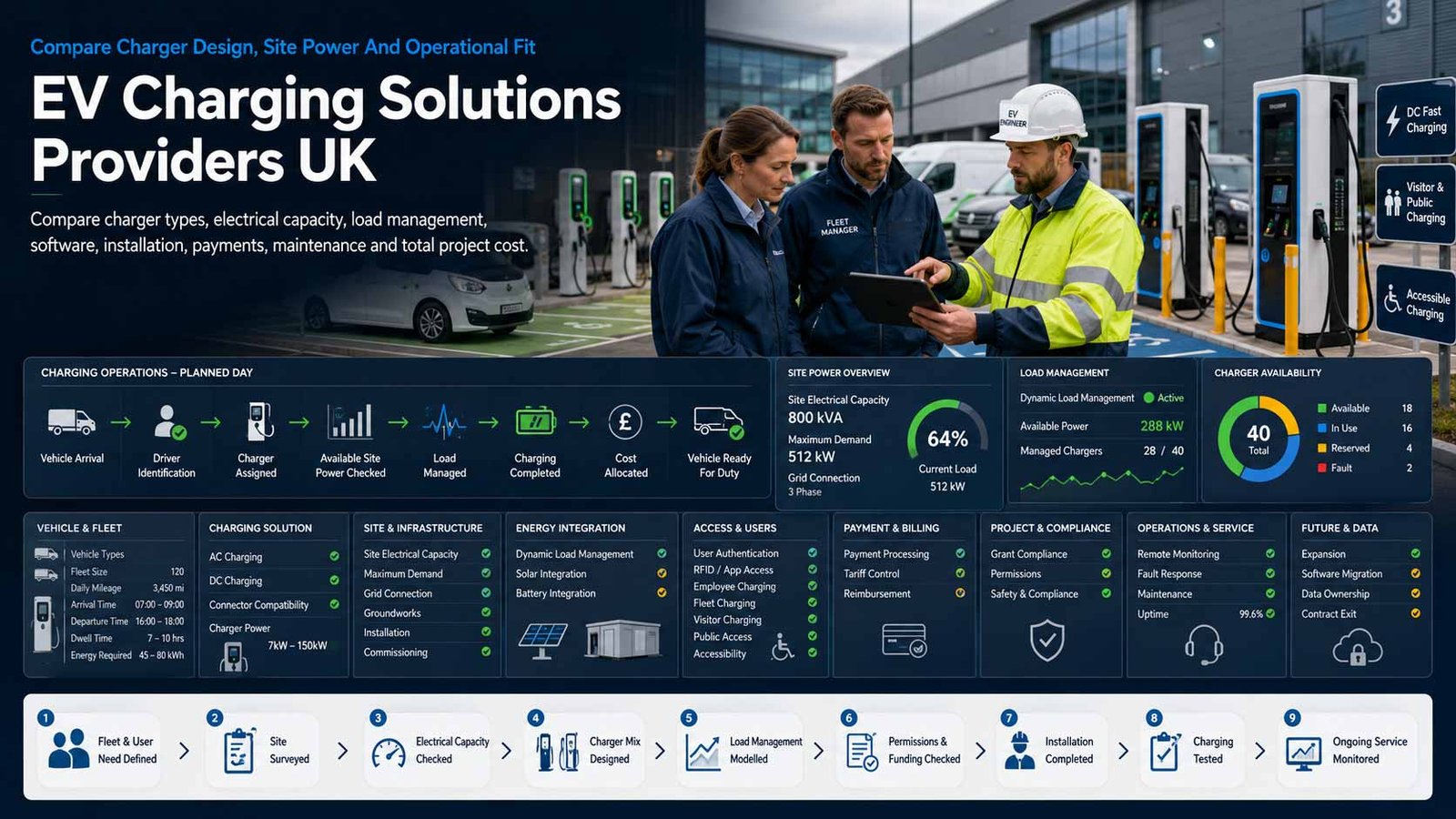
Design Around Vehicles, Dwell Time And Available Power
The correct solution is not simply the largest charger. A lower-power charger used for a full working shift can deliver more useful energy than a rapid charger installed where vehicles stop briefly or the grid cannot support it.
- Define vehicle arrival, departure and daily energy needs
- Verify electrical capacity before choosing charger power
- Use dynamic load management to protect site limits
- Model hardware, civils, software and service together
Business EV charging covers charge points, electrical infrastructure, controls and operating services used by employees, fleets, tenants, visitors or paying customers at commercial premises. A complete project can include strategy, site survey, DNO or independent connection work, chargers, cabling, civils, bay markings, protective equipment, charge-point management software, access control, payment, reimbursement, monitoring and maintenance.
Workplace and fleet charging have different priorities. Employees may remain parked for several hours and can often use managed AC charging. Vans, buses, taxis and operational fleets may need guaranteed energy by a departure time, higher power, route-based scheduling and stronger uptime commitments. Destination sites may need simple payment, driver support and compliance with rules for publicly accessible charging.
This page does not compare driver-location services, consumer roaming products or domestic electricity tariffs. It also does not rank driveway chargers for home users. Home charging can form part of a company-car or fleet programme, but the commercial comparison here focuses on the employer’s procurement, reimbursement, software and governance requirements rather than household buying advice.
Choose The Right Commercial EV Charging Model
Ownership, user type and vehicle duty determine charger power, software, payment and service requirements.
| Delivery Model | What It Usually Provides | Best-Fit Question |
|---|---|---|
| Workplace employee charging | AC chargers for staff and visitors with access control, reimbursement or paid use | How many vehicles can receive their required energy during the normal dwell period? |
| Fleet depot charging | Managed charging for vans, cars, buses or specialist vehicles returning to a base | Can the system guarantee route-ready energy by each departure time? |
| Destination charging | Charging for customers, guests or tenants at retail, hospitality, leisure or property sites | Is the power, payment and dwell-time model suitable for the site experience? |
| Rapid or ultra-rapid fleet charging | Higher-power DC charging for short turnaround or intensive operational duty | Does the operational value justify the grid, equipment and maintenance cost? |
| Fully funded host model | A charge-point operator funds, installs and operates equipment under a host or revenue-share agreement | Who controls pricing, bays, data, term, expansion and removal? |
| Customer-funded managed service | The business owns infrastructure while a provider supplies software, support and maintenance | Can hardware, software and service be changed without replacing the whole system? |
| Home charging for fleet drivers | Approved home chargers, installation and business-mile reimbursement managed for employees | How are private and business energy use separated, verified and reimbursed? |
| Phased infrastructure deployment | Electrical and civil capacity is prepared for future chargers installed as demand grows | Is the first phase designed to avoid repeated trenching, switchgear and DNO work? |
Eight Areas That Determine Business EV Charging Fit
Use the same vehicle schedule, site constraints and operating rules for every provider so charger quantities and projected value are comparable.
Comparison Criterion
Fleet, Workplace And Driver Requirement
Compare vehicle types, battery sizes, routes, arrival and departure times, daily mileage, dwell periods, employee demand, visitor use and expected adoption. Require an energy-per-vehicle model rather than sizing from the number of parking bays alone.
Comparison Criterion
Site Survey And Electrical Capacity
Assess incoming supply, maximum demand, headroom, earthing, switchgear, transformer, cable routes, parking layout, fire routes, drainage, lighting, accessibility, land ownership and future development. Clarify whether a DNO upgrade or independent connection provider is needed.
Comparison Criterion
AC, DC And Connector Mix
Compare 7 kW, 11 kW, 22 kW AC and appropriate DC power against actual dwell time and vehicle capability. Confirm socket or tethered format, connector standards, simultaneous output, power sharing, weather protection, impact resistance and replacement availability.
Comparison Criterion
Load Management And Energy Integration
Review static and dynamic load balancing, site-meter integration, solar or battery coordination, tariff signals, maximum-import control, priority groups, departure targets, fail-safe behaviour and manual override. Controls should protect operations when communications or cloud services fail.
Comparison Criterion
Charge-Point Management Software
Assess user authentication, RFID, app and web access, fleet groups, reservations, tariffs, reimbursement, VAT receipts, roaming where required, APIs, reporting, remote diagnostics, firmware, cyber security, data export and software-continuity provisions.
Comparison Criterion
Payments, Public Access And Accessibility
Where charging is publicly accessible, review contactless payment, price display, helpline, reliability, open data and other Public Charge Point Regulations duties that apply. Also compare bay design, signage, cable handling and accessibility against the intended user group and current guidance.
Comparison Criterion
Installation, Commissioning And Grant Compliance
Compare OZEV-authorised installer status where a grant is claimed, surveys, DNO notifications, civils, protective devices, testing, Building Regulations obligations, commissioning, labels, as-built drawings, training and evidence. The grant should not drive a technically unsuitable design.
Comparison Criterion
Maintenance, Uptime, Expansion And Exit
Review remote monitoring, fault triage, attendance targets, spare parts, vandalism, cable damage, payment-terminal support, software licences, connectivity, warranties, service credits, capacity expansion, charger replacement, data portability, decommissioning and contract exit.
Measures To Define Before An EV Charging Contract Is Signed
Translate convenient, reliable and scalable charging into consistent fleet, driver, service and cost evidence.
| Measure | What It Should Define | Evidence To Request | Common Weakness |
|---|---|---|---|
| Charger availability | The percentage of required operating time a charger can start and sustain sessions | Charger, period, planned downtime, fault, communications, payment, recovery and exclusion | Availability excludes software, connectivity or payment failures |
| Successful-session rate | The proportion of authorised charging attempts that deliver energy without avoidable failure | Attempt, user, vehicle, authentication, start, energy, stop reason and support case | A session is counted successful after delivering only a negligible amount |
| Energy delivered by departure | Whether each fleet vehicle receives the energy required for its next duty | Vehicle, required kWh, arrival, departure, charger, delivered kWh, shortfall and reason | Average utilisation hides vehicles that repeatedly leave undercharged |
| Site-peak compliance | Whether charging remains within the agreed import or transformer limit | Site load, charging load, setpoint, exceedance, duration, control action and alarm | The system reduces charger power after the site limit has already been exceeded |
| Charger utilisation | How often and how intensively each connector is used | Connector, sessions, occupied time, charging time, kWh, queue and user group | High parking occupancy is presented as high charging utilisation |
| Cost per delivered kWh | The full electricity, software, transaction, maintenance and asset cost per usable kWh | Electricity, losses, standing cost, licence, payment fee, service, depreciation and kWh | The calculation ignores failed sessions and fixed software charges |
| Payment and reimbursement accuracy | Whether user charges and employee reimbursements reconcile to verified sessions | Driver, session, kWh, tariff, VAT, fee, payment, refund, mileage and approval | Reimbursement uses a flat estimate despite available charger data |
| Fault-response performance | How quickly faults are acknowledged, diagnosed and restored | Severity, alarm, acknowledgement, remote action, attendance, repair, part and closure | The SLA stops at engineer dispatch rather than service restoration |
| Queue and access performance | Whether drivers can find an available, accessible and correctly allocated bay | Site, time, user, booking, occupied bay, queue, misuse, enforcement and resolution | Chargers are available but bays are blocked by non-charging vehicles |
| Total cost per active connector | The complete infrastructure and operating cost for each usable charging connector | Hardware, civils, grid, software, service, fees, grant, utilisation and replacement | A low equipment price hides high recurring platform and support costs |
EV Charging Solutions Providers UK Businesses Can Consider
Shortlist providers whose hardware, software, delivery model and service fit the vehicles and site. Confirm current ownership, accreditations, live pricing and support scope directly before award.
Provider Profile
Pod Commercial And EO Charging
Pod provides workplace, commercial and fleet charging, and in May 2026 acquired EO Charging, adding specialist depot design, commercial fleet software and charge-assurance capability. Include the combined group where a business wants a recognised UK provider with workplace and more complex fleet routes. Confirm which legal entity contracts, whether Pod or EO hardware and software are proposed, site and grid scope, ownership of designs, fleet-departure logic, payment, warranties, service levels, subscription, acquisition-related product continuity, data portability, home-fleet support and responsibilities across installation partners.
Review official Pod EV chargingProvider Profile
Mer UK
Mer provides workplace, fleet, depot, home-fleet and public or destination charging services, with design, installation, software, operations and energy-management options. Include it where a business wants end-to-end project support and a provider experienced in both workplace and operational fleets. Confirm the proposed hardware, direct or subcontracted installation, DNO and ICP work, load model, back-office platform, reimbursement, public-payment obligations, grant support, maintenance, uptime, charger ownership, electricity-supply dependencies, roaming, reporting, contract term and migration if software or network strategy changes.
Review official Mer UK solutionsProvider Profile
Rolec EV
Rolec manufactures AC and DC charging equipment in the UK and supplies commercial, workplace, fleet and destination solutions through installation partners and its management platforms. Include it where hardware breadth, UK manufacturing and scalable commercial configurations are priorities. Confirm the installer and contractual chain, selected charger, simultaneous output, load management, software and payment platform, OCPP support, DNO scope, warranty, spare parts, support ownership, public-use compliance, accessibility, grant eligibility, ongoing licences and whether the provider or local installer remains responsible for site performance.
Review official Rolec commercial chargingProvider Profile
ChargePoint
ChargePoint provides commercial charging hardware, cloud software and services for workplaces, fleets, car parks and other organisations. Include it where a business values a mature network-management platform, driver access controls, reporting and a broad hardware and partner ecosystem. Confirm UK installation delivery, charger model, software licence, roaming and payment route, fleet functions, OCPP or proprietary dependencies, data ownership, cyber support, replacement options, uptime and support responsibilities, public-access configuration, transaction fees, warranty, spare parts and the commercial impact if the business later changes network operator.
Review official ChargePoint workplace chargingProvider Profile
Blink Charging UK
Blink Charging UK supplies commercial AC and DC chargers, installation, network management, payment and ongoing operational support for workplaces, car parks, hospitality and other commercial sites. Include it where one provider for hardware, installation and managed operation is attractive. Confirm the charger and backend selected, direct and subcontracted work, grid and civils scope, payment and tariff controls, public-regulation responsibilities, maintenance response, connectivity, software fee, transaction fee, warranty, spare strategy, data export, charger replacement, grant support, site-owner revenue and whether any network or branded-service commitment restricts future switching.
Review official Blink commercial chargersProvider Profile
RAW Charging
RAW Charging specialises in destination charging for hospitality, leisure, retail, property and visitor sites, including fully funded, host-owned and managed commercial models. Include it where the objective is customer charging, dwell time and a funded or revenue-share route rather than fleet-depot operation. Confirm site eligibility, funding approval, charger quantity and power, pricing control, revenue share, electricity reimbursement, bay rights, exclusivity, term, indexation, planning and civils, grid costs, public-charge compliance, accessibility, maintenance, uptime, branding, data access, expansion, landlord obligations and removal or buyout at contract end.
Review official RAW ChargingProvider Profile
VPG EV Solutions
VPG EV Solutions, operating through the Vital EV web presence, provides commercial charger surveys, installation, fleet and workplace infrastructure, maintenance and support. Include it where a business wants an engineering-led UK installer able to deliver site works and ongoing service across mixed charger requirements. Confirm current legal and trading identity, manufacturer independence, direct workforce and subcontractors, accreditations, survey and DNO scope, AC and DC portfolio, charger software, payment, emergency response, maintenance coverage, spare parts, warranties, grant-authorised status, project references, design ownership and how support continues if the chosen charger manufacturer changes.
Review official VPG EV SolutionsProvider Profile
Connected Kerb
Connected Kerb develops long-life EV charging infrastructure for commercial, fleet, property and public-sector environments, with hardware designed around scalable underground infrastructure and managed operation. Include it where an organisation expects phased deployment, property-estate rollout or a durable low-impact solution across many bays. Confirm commercial-site fit, charger type and power, passive infrastructure, ownership and funding, installation and grid responsibilities, software, pricing, public and private access, fleet functions, maintenance, uptime, replacement, accessibility, term, data, expansion, landlord rights and whether the model is designed primarily for long-dwell rather than rapid fleet charging.
Review official Connected KerbWhat Changes Business EV Charging Installation Cost
Commercial EV charging prices are site-specific. Compare complete infrastructure and operating cost rather than the advertised price of one charger.
| Cost Driver | Why It Changes Spend | What A Comparable Quote Should Show |
|---|---|---|
| Number of bays and active connectors | More bays increase hardware, cable, protection, civil and software requirements | Current and future bays, active sockets, passive provision, phasing and utilisation |
| AC and DC charger power | Higher-power chargers cost more and can require larger grid and cooling infrastructure | Power per connector, simultaneous output, vehicle limit, dwell time and duty cycle |
| Electrical-capacity and grid work | New switchgear, transformer, DNO reinforcement or an independent connection can dominate cost | Supply capacity, maximum demand, headroom, DNO offer, transformer, ICP, timeline and risk |
| Civils and cable routes | Trenching, ducting, reinstatement, bollards, lighting and difficult surfaces vary by site | Route length, surface, crossings, drainage, permits, bay works, reinstatement and contingency |
| Load-management controls | Dynamic control can reduce upgrade cost but adds metering, software and integration | Site meter, controller, setpoints, priority, fail-safe, solar or battery interface and licence |
| Charge-point management software | User access, payment, reimbursement, reporting and remote support usually carry recurring fees | Licence, connector count, features, term, escalation, API, data export and migration |
| Payments and transaction charges | Public or paid workplace charging can create terminal, merchant and roaming costs | Terminal, contactless, app, tariff, transaction fee, roaming fee, VAT, refund and settlement |
| Connectivity and data | SIMs, Ethernet, Wi-Fi, private networks and back-office links create installation and recurring cost | Connection method, signal survey, data plan, cyber controls, outage behaviour and owner |
| Maintenance and uptime package | Response time, parts, labour, payment-terminal support and software support affect lifecycle cost | Remote SLA, attendance, restoration, planned maintenance, spares, credits and exclusions |
| Funding, grant and contract model | Grant, lease, fully funded or revenue-share structures change ownership and long-term value | Capital, grant, term, escalation, revenue, electricity, exclusivity, buyout, assignment and exit |
How Vehicle Duty And Site Use Change The Shortlist
The right provider depends on who charges, how long vehicles stay, how much energy they need, the site’s electrical capacity and whether charging is private, paid or publicly accessible.
Office Or Workplace Car Park
Prioritise employee demand, long dwell times, AC charging, fair access, reimbursement, visitor charging, load balancing, grant eligibility, bay policy and a scalable software model without unnecessary rapid-charging cost.
Van, Bus Or Operational Fleet Depot
Prioritise route-ready energy, charger-to-vehicle planning, DC or mixed power, depot electrical capacity, departure scheduling, resilience, telematics integration, uptime, spare strategy and a service SLA tied to vehicle operation.
Hotel, Retail Or Leisure Destination
Prioritise customer experience, dwell time, payment, public-access regulations, accessibility, pricing control, revenue share, visibility, bay enforcement, support and a funding model that fits property and brand obligations.
Landlord Or Multi-Site Property Portfolio
Prioritise tenant rights, common technical standards, phased infrastructure, billing allocation, landlord consent, lease events, data governance, central reporting, local installation support, expansion and the ability to change operator later.
How To Compare EV Charging Proposals
Give every bidder the same vehicle list, daily mileage, arrival and departure times, parking plan, electrical information, tariffs, payment rules, growth forecast and service requirements. Require a charger schedule, electrical single-line design and complete lifetime cost.
- Vehicle energy need and dwell time drive charger power
- Grid, DNO, switchgear and civils are priced consistently
- Load management and fail-safe behaviour are documented
- Software, payment, connectivity and transaction fees are visible
- Grant assumptions and public-use obligations are explicit
- Uptime, spare parts, data export and exit are contractually covered
Make Every Provider Model The Same Charging Day
Use the same vehicles, arrival times, departure deadlines, energy requirements, site load, tariff and available import capacity.
Compare operational success and lifetime cost—not only charger power or socket count.
Six Questions To Put To Every EV Charging Provider
The answers expose oversized hardware, unpriced grid work, software lock-in and service commitments that do not protect fleet or driver operations.
How Did You Calculate Charger Quantity And Power?
Request the vehicle, battery, mileage, dwell, simultaneous-use, diversity, queue, adoption and future-fleet assumptions.
Which Electrical And Grid Work Is Included?
Confirm survey, maximum demand, switchgear, transformer, DNO, ICP, earthing, protection, cable route, civils and contingency.
What Happens When Site Demand Is High?
Review dynamic load management, priorities, departure targets, solar or battery input, fail-safe, manual override and alarm.
Which Software And Payment Fees Continue Each Year?
Ask for connector licences, connectivity, payment, roaming, reimbursement, API, support, indexation, contract term and migration.
Who Restores Service When Charging Fails?
Confirm monitoring, fault ownership, remote response, attendance, spare parts, payment-terminal support, service credits and escalation.
What Can We Keep Or Transfer At Exit?
Confirm hardware ownership, charger unlock, SIM, configuration, user data, session history, payment records, API, warranties and replacement support.
A Seven-Stage EV Charging Solutions Evaluation
Move from verified vehicle and site data to controlled charging infrastructure rather than selecting chargers before demand and grid capacity are understood.
- Inventory vehicles, daily mileage, routes, arrival and departure times, parking bays, staff demand, visitor use, electricity data, existing loads, tariffs, sites and accountable owners.
- Define workplace, fleet, destination or mixed use; private or paid access; charging deadlines; future adoption; reimbursement; uptime; funding and data requirements.
- Complete electrical, grid, parking, civil, accessibility, landlord, planning and communications feasibility before treating charger quantity or price as fixed.
- Issue one written specification and obtain comparable proposals with hardware, software, DNO, civils, commissioning, grant, maintenance, payment, ownership and exit schedules.
- Normalise every proposal using the same vehicles, charging day, electricity tariff, site load, adoption, software term, service level, grant and replacement assumptions.
- Contract only after design ownership, approvals, public-use duties, payment, data, cyber security, warranties, service levels, change control and expansion responsibilities are agreed.
- Operate through session monitoring, fleet-energy review, load-limit checks, fault response, payment reconciliation, user support, software updates, maintenance and phased expansion.
EV Charging Solutions Comparison Checklist
Use this table before approving a workplace, fleet, destination, fully funded or multi-site charging programme.
| No. | Requirement | Evidence To Obtain Before Award | Confirmed |
|---|---|---|---|
| 01 | Charging use case and accountable owner agreed | Workplace, fleet, destination, legal entity, transport owner, facilities owner, finance owner and approver | |
| 02 | Vehicle and dwell-time baseline validated | Vehicle, connector, battery, daily miles, kWh, arrival, departure, route, reserve and growth | |
| 03 | Parking and user requirements mapped | Bays, user groups, accessibility, visitors, bookings, enforcement, public access and future capacity | |
| 04 | Electrical capacity surveyed | Supply, maximum demand, transformer, switchgear, headroom, earthing, protection, cable and shutdown | |
| 05 | Grid and connection route confirmed | DNO, ICP, application, reinforcement, lead time, new connection, ownership and contingency | |
| 06 | Charger mix and phasing accepted | AC and DC power, sockets, simultaneous output, passive bays, expansion, connector and location | |
| 07 | Load management approved | Site meter, controller, setpoint, priorities, departure logic, solar or battery, fail-safe and override | |
| 08 | Civils and bay design approved | Trench, duct, surface, drainage, bollards, markings, signage, lighting, permits and reinstatement | |
| 09 | Software and data controls accepted | Users, RFID, app, portal, tariffs, reimbursement, API, reports, cyber security, export and retention | |
| 10 | Payment and public-use duties confirmed | Contactless, price display, helpline, reliability, open data, VAT, refunds, accessibility and owner | |
| 11 | Grant and Building Regulations checked | WCS eligibility, authorised installer, evidence, Part S where applicable, certificates and audit trail | |
| 12 | Installation and commissioning plan agreed | Programme, RAMS, outages, subcontractors, testing, DNO notification, training, as-builts and defects | |
| 13 | Warranty and service package verified | Hardware, installation, software, connectivity, remote SLA, attendance, parts, credits and escalation | |
| 14 | Complete lifetime cost compared | Hardware, grid, civils, software, payment, electricity, service, grant, finance, replacement and exit | |
| 15 | Ownership, expansion and exit controlled | Asset title, network contract, configuration, data, unlock, assignment, removal, migration and deletion |
Common EV Charging Solutions Buying Mistakes
Most avoidable failures begin with charger-first procurement, incomplete electrical scope, software lock-in or service levels that do not protect vehicle operations.
| Mistake | Why It Creates Risk | Better Control |
|---|---|---|
| Buying the fastest charger | Vehicle dwell time and grid capacity may not justify high-power equipment | Model energy by departure |
| Counting parking bays instead of vehicles | Bays do not show daily energy, arrival patterns or charger sharing | Use fleet and user data |
| Ignoring the existing site load | Charging can exceed import or transformer limits during operational peaks | Survey maximum demand |
| Pricing hardware before civils and DNO work | Trenching, switchgear and reinforcement can dominate project cost | Compare complete installation |
| Assuming load management solves every grid issue | Control cannot replace approval or equipment required by the connection agreement | Confirm the network route |
| Choosing software without an exit plan | Charger configuration, payments and data can become locked to one operator | Require portability |
| Treating grant value as guaranteed | Eligibility, product and installer conditions must be satisfied | Verify before commitment |
| Offering public charging without regulation review | Payment, reliability, data and support duties may apply | Assess public-use obligations |
| Using installation warranty as an uptime SLA | A warranty repair route may not restore fleet charging quickly | Contract service response |
| Skipping first-month performance review | Access, load limits, billing and user problems can persist unnoticed | Audit sessions and costs |
Frequently Asked Questions
Answers to common questions from UK organisations comparing workplace, fleet, depot and destination EV charging services.
What Is A Business EV Charging Solution?
A business EV charging solution combines charge points with electrical design, load management, software and operating support for employees, fleets, tenants, visitors or customers. The correct design depends on vehicle energy needs, dwell time, site capacity, access and commercial objectives.
How Much Does Business EV Charging Installation Cost?
Cost depends on charger quantity and power, electrical capacity, DNO work, switchgear, cable routes, civils, software, payment, connectivity, maintenance and funding. Compare complete lifetime cost using the same site and vehicle assumptions rather than a generic charger price.
How Much Workplace Charging Grant Support Is Available?
From 1 April 2026, the Workplace Charging Scheme can provide eligible businesses, charities and public-sector organisations with up to £500 per socket for up to 40 sockets across their sites. The scheme is available until 31 March 2027, subject to current eligibility and installer conditions.
Should A Workplace Install 7 kW, 11 kW Or 22 kW Chargers?
The right power depends on vehicle capability, dwell time, daily energy and site capacity. Many workplace vehicles remain parked long enough for managed AC charging. A higher rating is useful only where vehicles support it and the site can deliver sufficient simultaneous power.
When Does A Fleet Need DC Rapid Charging?
DC charging can suit vehicles with short turnaround, high daily mileage or intensive routes. It carries higher equipment, grid and maintenance cost. Model route-ready energy and operational downtime before choosing rapid charging instead of longer-dwell AC charging.
What Is Dynamic Load Management?
Dynamic load management measures site demand and adjusts charger output to keep total electricity use within an agreed limit. It can reduce upgrade needs and allocate power by priority, but it must have reliable metering, controls, fail-safe behaviour and suitable user expectations.
Do Commercial EV Chargers Need DNO Approval?
The installer must assess the connection and follow the relevant DNO notification or application process. Larger charging loads, new connections or reinforcement can require advance work. The proposal should identify who owns the application, design, cost, programme and communication with the network.
Do The Public Charge Point Regulations Apply At A Business Site?
They can apply where charge points are publicly accessible. Requirements can include payment, pricing, reliability, helpline and open-data duties depending on charger type and date. Private workplace or fleet charging is treated differently, so classify each user and bay correctly.
Can A Business Charge Employees Or Visitors For Electricity?
Yes, software can authenticate users and apply free, subsidised or paid tariffs. The business should define VAT, receipts, payment fees, reimbursement, private use, refunds, price changes and employee policy. Publicly accessible charging may have additional regulatory requirements.
How Should A UK Business Compare EV Charging Providers?
Give every provider the same vehicle schedule, energy requirements, site load, parking plan and growth forecast. Compare charger mix, electrical and grid scope, load management, software, payment, accessibility, compliance, uptime, funding, data, lifetime cost and exit—not only hardware price.
Official Guidance And EV Charging Provider Resources
Reviewed by Bhav Giva, Founder & Lead Analyst at CompareServices.co.uk, on 24 July 2026.
Use OZEV, UK government, Building Regulations, the relevant DNO and official provider documentation to confirm current grant, public-access, electrical, product, software and support requirements. Grants, provider ownership and service propositions can change.
- OZEV — Workplace Charging Scheme
- OZEV — Grant Changes From 1 April 2026
- UK Government — Public Charge Point Regulations Guidance
- UK Government — Approved Document S
- Pod — Workplace And Commercial Charging
- Mer UK — Fleet And Workplace Charging
- Rolec EV — Commercial Charging
- ChargePoint — Workplace Charging
- Blink Charging UK — Commercial Chargers
- RAW Charging — Destination Charging
- VPG EV Solutions — Business Charging
- Connected Kerb — Commercial Charging Infrastructure