
Compare Commercial Waste Management Providers UK (2026)
Compare Collections, Waste Streams, Compliance, Containers, Reporting, Service And Total Cost
Compare commercial waste management UK providers by service coverage, direct collection or managed network, residual waste, mixed recycling, food waste, glass, cardboard, hazardous and specialist streams, bin sizes, collection frequency, duty-of-care documentation, waste transfer notes, treatment destinations, contamination controls, reporting, account support, contract terms, surcharges and complete annual cost. Use the same waste audit and site assumptions for every quote.
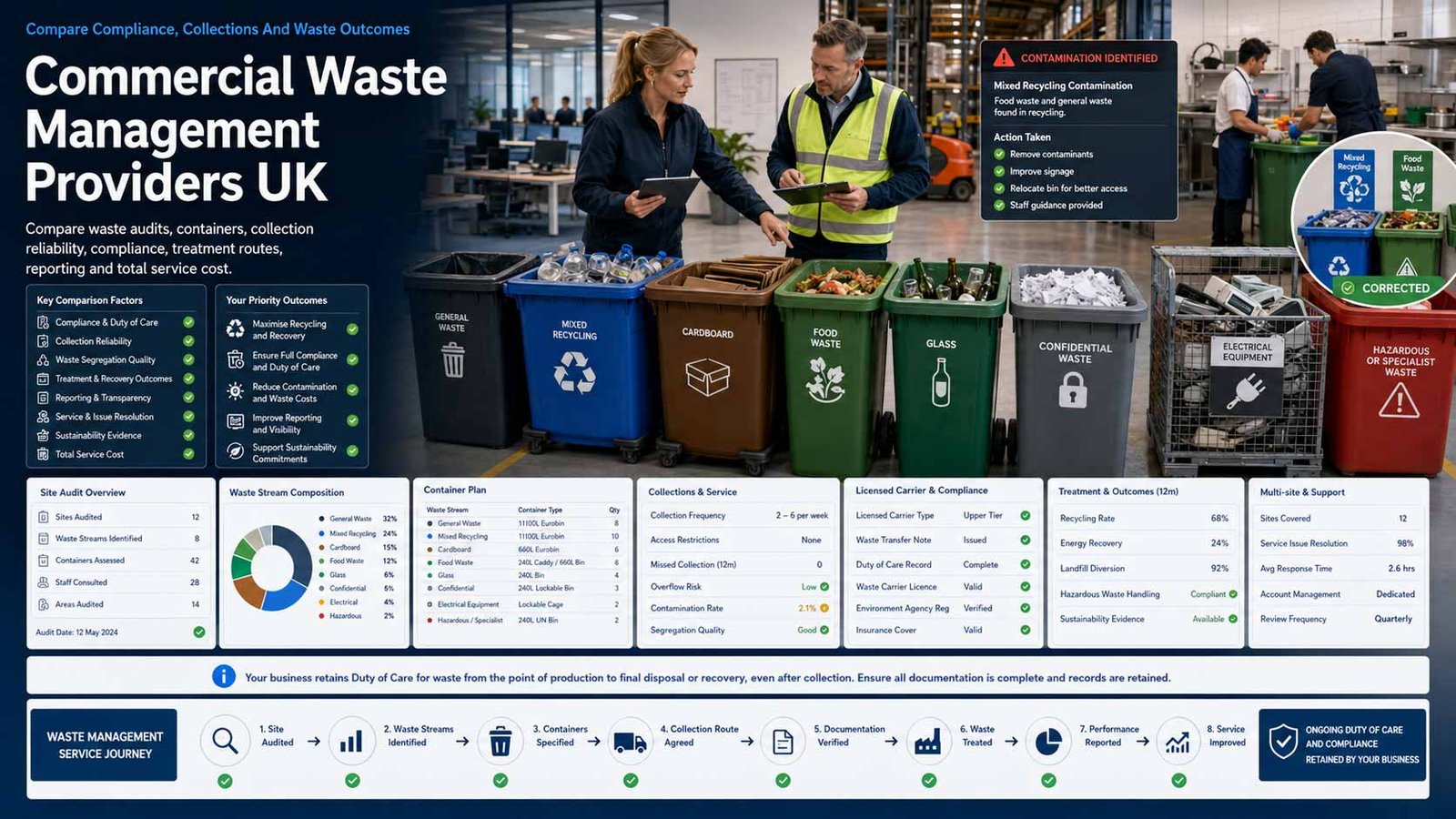
Your Duty Of Care Continues After The Bin Is Collected
A business must use authorised people, describe its waste accurately, store it safely and retain the required transfer documentation. Outsourcing collections does not remove those responsibilities.
- Verify carriers, brokers and treatment routes before contract award
- Use accurate waste descriptions and European Waste Catalogue codes
- Separate required streams and control contamination at the source
- Retain transfer notes, consignment records and service evidence
Commercial waste management covers the collection, transport, treatment, recovery and lawful disposal of waste produced by a business, charity, public body or other non-household organisation. A provider may collect waste directly using its own depots and vehicles, or manage a network of authorised local collectors under one contract and reporting platform.
The service can combine residual waste, mixed dry recycling, source-separated paper and card, glass, metals, plastics, food, bulky items, construction materials, hazardous waste and other specialist streams. The correct mix depends on the organisation, premises, waste composition and national separation rules.
This page compares complete commercial waste arrangements rather than recycling-only services. Recycling performance remains an important part of a total waste contract, but a provider must also manage residual waste, collections, compliance, missed-service escalation, specialist streams, data and contract governance. Confidential-document destruction is a separate future service because it requires secure chain of custody and destruction evidence.
Choose The Right Commercial Waste Operating Model
Direct collection and managed networks create different service, accountability and pricing trade-offs. Compare the actual delivery chain—not only the contract brand.
| Service Model | What It Usually Provides | Best-Fit Question |
|---|---|---|
| Direct national collector | Uses its own depots, vehicles, bins and treatment network across multiple regions | Does direct infrastructure improve service consistency at every required site? |
| Managed national network | Uses audited regional collection partners under one account, platform and commercial contract | Who is legally carrying each stream, and how is partner performance controlled? |
| Regional integrated provider | Provides collection, transfer, treatment and specialist services within a defined operating area | Does regional depth provide better service than nominal nationwide coverage? |
| Local authority trade-waste service | Some councils provide chargeable commercial collections separately from household services | Does the council offer every required stream, service frequency and reporting function? |
| Single-site scheduled collection | Provides recurring bins or sacks for routine waste streams at one premises | Are bin size, access, collection day and seasonal overflow matched to actual use? |
| Multi-site total waste management | Combines many locations and streams with consolidated billing, data and account governance | Can central reporting preserve clear site-level service and cost evidence? |
| On-demand and project waste service | Provides skips, roll-on-roll-off containers, clearances or ad hoc specialist collections | Are delivery, exchange, weight, permit, waiting-time and prohibited-item charges explicit? |
| Hazardous and specialist coordination | Manages waste needing consignment notes, specialist packaging, treatment or regulatory controls | Which specialist streams are handled directly and which are subcontracted? |
Eight Areas That Determine Commercial Waste Management Fit
Use the same waste audit, sites and collection assumptions for every provider so one low lift price does not hide container, contamination or contract costs.
Comparison Criterion
Site Audit And Waste-Stream Design
Compare how the provider measures current bin use, weights, contamination, seasonal demand, storage, access and employee behaviour. A credible proposal should specify which materials use each container, collection frequency, expected fill level and the operational change needed at the premises.
Comparison Criterion
Collection Coverage And Delivery Model
Review direct depots and vehicles, subcontracted partners, service areas, collection windows, key access, rural coverage, bank holidays, emergency collections and business continuity. Require the name and authorisation status of every material carrier where the provider uses a managed network.
Comparison Criterion
Legal Compliance And Documentation
Assess waste-carrier or broker registration, environmental permits, transfer notes, consignment notes, waste descriptions, codes, duty-of-care audits, document retention and final-destination evidence. The provider should support compliance without claiming to transfer the business’s legal responsibility.
Comparison Criterion
Containers, Access And Collection Reliability
Compare sacks, wheelie bins, front-end loaders, compactors, skips, roll-on-roll-off containers, food bins and specialist packaging. Confirm delivery, rental, locks, signage, weight limits, access distances, waiting time, overfilled-bin rules, missed collections and replacement responsibility.
Comparison Criterion
Segregation, Contamination And Treatment Routes
Review how the proposed service meets current national separation requirements, handles food and dry recyclables, detects contamination and identifies treatment destinations. Require clear rules for rejected loads, contamination charges and materials unsuitable for the standard recycling stream.
Comparison Criterion
Hazardous And Specialist Waste Capability
Compare batteries, chemicals, oils, aerosols, fluorescent lamps, clinical materials, WEEE, confidential items, construction waste and other controlled streams where relevant. Confirm packaging, classification, consignment records, subcontractors, permits, emergency arrangements and price basis.
Comparison Criterion
Data, Reporting And Sustainability Evidence
Assess weights versus estimates, weighbridge evidence, collection records, diversion and recycling calculations, carbon methodology, contamination data, portal export, site benchmarking and audit trail. Reporting should distinguish recycling, recovery, treatment and disposal without combining them into one unsupported percentage.
Comparison Criterion
Contract, Service Management And Exit
Review minimum term, auto-renewal, notice, indexation, fuel or environmental surcharges, minimum lifts, bin rental, broker fee, service credits, account reviews, complaint escalation, site changes, data export, container removal and transfer of duty-of-care records at exit.
Measures To Define Before A Waste Contract Is Signed
Translate reliable, compliant and sustainable service into consistent collection, documentation, treatment and cost evidence.
| Measure | What It Should Define | Evidence To Request | Common Weakness |
|---|---|---|---|
| Collection completion rate | Whether scheduled collections occur within the agreed window | Site, stream, due time, actual time, missed reason, recovery time and credit | The provider reports completed jobs without showing late or partial lifts |
| Container fill and overflow rate | Whether bin size and frequency match actual waste generation | Container, capacity, fill level, overflow, extra lift, season, change and owner | Frequent emergency collections make the quoted base schedule unrealistic |
| Contamination rate | The proportion of recycling or food collections rejected or downgraded | Site, stream, contamination type, evidence, charge, training, corrective action and trend | Photographic evidence is unavailable even though contamination fees are charged |
| Actual-weight coverage | The proportion of reporting based on measured weights rather than volume estimates | Collection, container, measured weight, estimate method, weighbridge, date and source | A recycling report presents estimated weights as precise measured tonnage |
| Duty-of-care document completeness | Whether every stream and movement has the required accurate documentation | Transfer note, description, code, carrier, destination, dates, signatures and retention | Annual notes omit occasional clearances or specialist collections |
| Authorised-destination verification | Whether waste is transferred only through suitable authorised carriers and facilities | Carrier registration, broker registration, permit, facility, expiry, stream and validation date | The main provider is checked but subcontracted local collectors are not |
| Recycling and recovery outcome | How waste is treated after collection and how outcomes are calculated | Stream, weight, destination, treatment, recycling, recovery, disposal, rejects and method | Energy recovery is reported as recycling or all collected material is assumed recycled |
| Billing accuracy | Whether invoices match contracted bins, lifts, weights, sites and fees | Invoice, site, stream, container, lifts, weight, rates, surcharge, credit and dispute | Closed sites and removed containers continue to be billed |
| Issue-resolution performance | How quickly missed collections, blocked access, damaged bins and billing disputes are resolved | Case, severity, owner, acknowledgement, recovery, root cause, credit and closure | A missed collection is closed after rebooking without addressing repeat route failure |
| Total cost per tonne and site | The complete collection, container, treatment, fee, surcharge and internal-administration cost | Sites, streams, tonnes, lifts, rental, fees, credits, extras and internal effort | A low lift rate produces a high annual cost because bins are oversized or collected too often |
Commercial Waste Management Providers UK Businesses Can Consider
Shortlist providers whose coverage, waste streams and delivery model fit the sites. Confirm registrations, local carriers, live pricing and contract terms directly before award.
Provider Profile
Biffa Business Waste
Biffa provides scheduled and one-off business waste collection, general waste, mixed recycling, food, glass, cardboard, skips and specialist services through a substantial UK collection and treatment network. Include it where an SME or national organisation values a direct integrated provider with broad waste-stream capability. Confirm local depot coverage, direct and subcontracted services, container ownership, collection windows, food and recycling arrangements, hazardous capability, reporting methodology, transfer notes, treatment routes, rental, overweight and contamination charges, contract term, annual price changes and missed-collection escalation.
Review official Biffa business wasteProvider Profile
Veolia Commercial Waste Collection
Veolia provides commercial waste and recycling collections, food, glass, mixed materials, hazardous waste, secure destruction and wider resource-management services for businesses of different sizes. Include it where a buyer wants an established integrated provider with collection, treatment and specialist capabilities. Confirm exact geographic coverage, direct collection model, waste streams, containers, service frequency, treatment destinations, local restrictions, documentation, sustainability reporting, digital account tools, emergency collections, pricing, surcharges, contract notice, service credits and the boundary from Veolia’s separate water or energy services.
Review official Veolia waste collectionsProvider Profile
SUEZ Recycling And Recovery UK
SUEZ provides business waste and recycling collection services for small, medium and large organisations, including mixed recycling, general waste, food, glass and specialist solutions supported by treatment infrastructure. Include it where a business wants an established direct provider with collection and resource-recovery capability. Confirm local service availability, container and frequency options, current England and Wales segregation support, treatment route, waste documentation, account management, reporting, contaminated-load policy, bin rental, excess-weight and delivery charges, annual uplifts, contract renewal and services delivered through third parties.
Review official SUEZ commercial wasteProvider Profile
FCC Environment Business Waste Solutions
FCC Environment provides commercial waste, recycling and hygiene services through dedicated business-waste operations and a wider network of treatment and resource facilities. Include it where an organisation values a direct waste-sector operator and service tailored through a site assessment. Confirm operating geography, waste streams, bin types, scheduled and ad hoc collections, direct versus partner delivery, recycling and treatment destinations, training, documentation, portal or reports, specialist services, container and collection fees, surcharge structure, complaint escalation, contract length and support outside normal collection windows.
Review official FCC commercial wasteProvider Profile
Grundon Waste Management
Grundon provides integrated commercial waste collection, treatment, recovery, recycling and disposal, including general, mixed recycling, food, glass, construction, hazardous and specialist streams. Include it where a business in its operating regions needs direct technical capability and a provider experienced with complex waste. Confirm geographic coverage, direct facilities, waste acceptance, hazardous packaging and consignment, collection frequency, reporting, carbon methodology, duty-of-care support, container and equipment charges, minimum lifts, overweight or contamination terms, contract notice, emergency support and whether remote sites use partner carriers.
Review official Grundon commercial wasteProvider Profile
Reconomy Waste Management
Reconomy provides technology-enabled outsourced waste and resource management through an extensive audited supply-chain network rather than one local fleet. Include it where a multi-site, construction, retail or complex organisation wants one contract, national coverage, data and supply-chain coordination. Confirm which Reconomy brand contracts the service, partner-selection controls, carrier and permit verification, local collector visibility, waste streams, portal data, weights and estimates, treatment evidence, missed-service escalation, account governance, management fee, supplier margin, transaction charges, indexation, contract exit and ownership of underlying supplier relationships.
Review official Reconomy waste managementProvider Profile
WasteManaged
WasteManaged provides commercial waste collection and account management across UK locations through a managed collection network, with general, recycling, food, glass and specialist service options. Include it where a small or multi-site business wants one contact and nationwide procurement without dealing with several local collectors. Confirm the contracted legal entity, actual carriers, local service availability, container delivery, collection schedule, transfer documentation, waste destinations, reporting, account support, free-bin conditions, rental, minimum service, overweight, contamination and failed-access fees, contract duration, renewal, annual uplifts and the process for replacing an underperforming local partner.
Review official WasteManaged servicesProvider Profile
Business Waste
Business Waste arranges commercial waste collection nationwide through a managed supplier network and offers a broad range of streams, audits, account management, duty-of-care administration and cost optimisation. Include it where a business wants brokered national coverage and one account for routine or complex streams. Confirm whether Business Waste acts as broker, dealer or principal for each service, the authorised carrier used at every site, supplier-panel breadth, stream coverage, free-bin conditions, waste-transfer paperwork, final destinations, reporting, rebate terms, management or embedded margin, extra collection and contamination charges, contract notice, complaint escalation and data transfer at exit.
Review official Business Waste serviceWhat Changes Commercial Waste Management Cost
Commercial waste prices depend on waste, containers, route, treatment and contract terms. Compare the complete annual operating model rather than one collection charge.
| Cost Driver | Why It Changes Spend | What A Comparable Quote Should Show |
|---|---|---|
| Waste stream and treatment requirement | Residual, food, glass, mixed recycling, hazardous and bulky streams have different collection and treatment costs | Stream, description, code, destination, treatment, container, frequency and price basis |
| Container type and capacity | Sacks, wheelie bins, front-end loaders, compactors, skips and specialist containers have different rental and handling costs | Size, quantity, delivery, rental, lock, exchange, damage, weight limit and removal |
| Collection frequency and route density | More frequent, remote, timed or difficult collections increase transport and operating cost | Frequency, collection window, access, distance, key or gate, bank holiday and emergency rate |
| Weight, volume and minimum lift | Some services charge per lift, weight, volume or a combination with minimum tonnage | Included weight, minimum, excess rate, weighing method, estimate, ticket and reconciliation |
| Contamination and rejected loads | Incorrect materials can create sorting, rejection, disposal and repeat-collection charges | Accepted materials, contamination threshold, evidence, charge, reclassification, training and appeal |
| Food and separated recyclable collections | Additional containers and routes can increase gross cost while reducing residual waste and compliance risk | Required streams, bin sizes, schedule, liners, cleaning, treatment and net annual model |
| Hazardous and specialist waste | Classification, packaging, consignment, specialist vehicles and permitted treatment create higher costs | Waste type, quantity, packaging, analysis, collection, consignment, treatment and minimum charge |
| One-off collections and skips | Delivery, exchange, rental days, weight, permits, waiting time and prohibited items drive project cost | Container, waste, hire period, included weight, permit, exchange, overweight and cancellation |
| Fuel, environmental and annual surcharges | Contracts may allow separate fuel, disposal, regulatory, labour or environmental adjustments | Surcharge name, baseline, formula, cap, frequency, notice, example and right to challenge |
| Contract term, broker margin and exit | Long terms, automatic renewal, embedded management margin and container-removal costs affect lifetime spend | Term, notice, renewal, indexation, commission, management fee, exit, data and container collection |
How Waste Streams And Site Complexity Change The Shortlist
The right provider depends on premises, waste composition, national rules, access, collection frequency, compliance risk and internal account-management capacity.
Small Office, Shop Or Professional Practice
Prioritise right-sized bins, simple dry recycling, food waste where produced, predictable collection days, clear transfer documentation, low minimum charges and an account team that resolves missed lifts without requiring specialist internal knowledge.
Hospitality, Food Service Or Retail
Prioritise food, glass, cardboard, packaging and residual segregation, hygiene, pest control, weekend collections, contamination support, seasonal capacity, reliable access and documented compliance with current workplace-separation rules.
Multi-Site Organisation
Prioritise national coverage, verified local carriers, common service standards, consolidated billing, site-level data, transfer notes, contract governance, missed-service management, site openings and closures, and the ability to compare direct and network delivery.
Manufacturing, Healthcare Or Complex Waste Producer
Prioritise accurate classification, hazardous or specialist capability, packaging, consignment notes, authorised facilities, emergency support, treatment evidence, auditability, process-specific containers and clear responsibility for subcontractors.
How To Compare Commercial Waste Proposals
Give every provider the same sites, opening hours, access, waste streams, quantities, existing bins, collection history, contamination, legal requirements, reporting and seasonal demand. Require one complete annual cost and delivery-responsibility matrix.
- Every carrier, broker and facility can be independently verified
- Container size and collection frequency follow measured waste volumes
- Accepted materials and contamination rules are site-specific
- All rental, delivery, weight, surcharge and extra-service fees are visible
- Reporting separates measured and estimated weights
- Notice, renewal, data export and container removal are covered at exit
Make Every Provider Price The Same Waste Audit
Use the same bins, expected weights, lifts, access, separated streams, specialist collections and seasonal overflow.
Compare annual cost, compliance evidence and service recovery before comparing the price of one bin lift.
Six Questions To Put To Every Waste Provider
The answers expose hidden subcontracting, unrealistic container plans, unsupported environmental claims and additional charges before the contract starts.
Who Actually Collects And Treats Our Waste?
Request the provider, carrier, broker, facility, authorisation, stream, region, subcontractor and validation process for every service.
Which Streams, Containers And Collections Are Included?
Confirm waste descriptions, codes, accepted materials, bin size, quantity, frequency, access, overflow, bank holidays and one-off requirements.
Which Charges Can Be Added To The Quote?
Ask for rental, delivery, duty-of-care, minimum lift, excess weight, contamination, rejected load, failed access, fuel, environmental, annual increase and exit fees.
How Will You Prove Compliance And Treatment Outcomes?
Review transfer and consignment notes, carrier checks, facility permits, weights, destination, treatment, recycling, recovery, disposal and document retention.
What Happens When A Collection Is Missed?
Confirm reporting route, acknowledgement, recovery time, emergency lift, escalation, root-cause review, service credit and repeated-failure remedy.
What Can We Take With Us At Exit?
Confirm waste audit, site schedule, bins, service history, weights, reports, transfer notes, supplier details, portal export, container removal and data deletion.
A Seven-Stage Commercial Waste Management Evaluation
Move from measured waste and legal obligations to a controlled contract rather than reproducing the existing bin schedule without challenge.
- Inventory premises, current providers, bins, waste streams, transfer records, collection frequencies, invoices, missed lifts, contamination, seasonal demand and accountable owners.
- Confirm applicable national separation and duty-of-care rules, then define residual, food, dry recycling, glass, cardboard, hazardous, bulky and specialist requirements.
- Complete a representative waste audit using actual weights where available and remove unnecessary containers, lifts or recycling-only assumptions.
- Issue one written specification and obtain comparable direct-collector or managed-network proposals with complete delivery, compliance and cost schedules.
- Normalise each proposal into an annual model covering scheduled service, rental, weight, extras, surcharges, contamination and site changes.
- Onboard containers, signage, staff guidance, access, documents, contacts, opening collection evidence, invoice validation and escalation before replacing the old service.
- Operate through service monitoring, contamination review, transfer-note checks, invoice audits, waste reduction, contract reviews and controlled renewal or exit.
Commercial Waste Management Comparison Checklist
Use this table before approving a direct collector, waste broker, managed network, renewal or multi-site service.
| No. | Requirement | Evidence To Obtain Before Award | Confirmed |
|---|---|---|---|
| 01 | Waste scope and accountable owner agreed | Sites, streams, legal entity, waste owner, finance owner, approver and operational contacts | |
| 02 | Current service and contract recorded | Provider, carriers, bins, lifts, term, notice, renewal, charges, failures and authority | |
| 03 | Waste audit completed | Stream, description, code, container, fill, weight, frequency, contamination, season and opportunity | |
| 04 | National separation requirements confirmed | Country, workplace size, required streams, food waste, implementation date, exceptions and evidence | |
| 05 | Carrier, broker and facility checks completed | Registration, permit, expiry, stream, region, subcontractor, facility and validation date | |
| 06 | Container and access plan accepted | Type, size, quantity, location, lock, delivery, collection window, key, route and overflow | |
| 07 | Collection schedule normalised | Stream, frequency, expected lifts, bank holidays, seasonal changes, emergency and missed-service recovery | |
| 08 | Accepted materials and contamination rules agreed | Allowed items, prohibited items, threshold, evidence, charge, rejected load, appeal and training | |
| 09 | Documentation process approved | Transfer note, consignment note, code, description, weight, destination, signatures, retention and portal | |
| 10 | Treatment and reporting method verified | Measured or estimated weight, facility, treatment, recycling, recovery, disposal, rejects and methodology | |
| 11 | All charges disclosed | Collection, rental, delivery, weight, minimum, contamination, failed access, fuel, surcharge, extras and exit | |
| 12 | Service management accepted | Contacts, acknowledgement, recovery, escalation, service credits, account reviews, complaints and root cause | |
| 13 | Hazardous and specialist streams controlled | Classification, packaging, storage, collection, consignment, facility, emergency and subcontractor | |
| 14 | Complete annual and contract cost compared | Scheduled lifts, bins, weights, extras, surcharges, fees, credits, internal effort and indexation | |
| 15 | Exit and transition terms agreed | Notice, final collection, bin removal, reports, notes, data, supplier details, outstanding disputes and deletion |
Common Commercial Waste Management Buying Mistakes
Most avoidable failures begin with unmeasured waste, lift-price-only comparisons, unclear subcontracting or compliance documents that are not checked.
| Mistake | Why It Creates Risk | Better Control |
|---|---|---|
| Copying the existing bin schedule | Oversized bins and excessive lifts continue without evidence that the service fits current waste | Start with a measured waste audit |
| Comparing one lift price | Rental, weight, contamination, surcharges and extra collections can dominate annual cost | Model the whole contract |
| Assuming the provider collects directly | A managed network may use several local carriers with different performance | Verify the delivery chain |
| Treating recycling as the whole service | Residual, food, specialist, documentation and service recovery remain essential | Compare total waste management |
| Using vague waste descriptions | Incorrect classification and codes weaken duty-of-care records | Describe every stream accurately |
| Failing to check authorisations | Waste can be transferred to an unregistered carrier or unsuitable facility | Validate registrations and permits |
| Ignoring contamination rules | Rejected loads and charges increase while recycling outcomes fall | Agree materials and evidence |
| Reporting recovery as recycling | Environmental performance appears better than the actual treatment outcome | Separate every treatment category |
| Accepting automatic renewal unnoticed | The business remains tied to old prices, bins and service levels | Control notice and review dates |
| Skipping the first invoice and transfer-note audit | Incorrect sites, bins, lifts and documentation can persist for months | Validate immediately after launch |
Frequently Asked Questions
Answers to common questions from UK businesses comparing commercial waste collectors, brokers and total waste-management services.
What Is Commercial Waste?
Commercial waste is waste produced by a business, charity, public body or other organisation through its activities. It can include residual waste, food, paper, card, glass, plastics, metals, packaging, equipment, construction materials, hazardous substances and other specialist streams.
Who Is Responsible For Business Waste?
The organisation producing the waste has a legal duty of care. It must store waste safely, describe it accurately, use authorised carriers and facilities, prevent unlawful disposal and retain required transfer or consignment records. Hiring a contractor does not remove that responsibility.
What Are The Simpler Recycling Rules For Businesses In England?
Since 31 March 2025, most workplaces in England must arrange separate collection of food waste and core recyclable materials. Workplaces with fewer than ten full-time-equivalent employees have until 31 March 2027. The exact collection arrangement should follow current government guidance.
Do Waste Rules Differ Across The UK?
Yes. England, Scotland, Wales and Northern Ireland have separate waste regulations and regulators. Wales has workplace-separation rules in force since April 2024. Scotland requires businesses to segregate specified materials and follow duty of care. Northern Ireland also requires controlled-waste documentation and authorised carriers.
What Is A Waste Transfer Note?
A waste transfer note records a transfer of non-hazardous controlled waste. It should accurately describe the waste, identify the parties, carrier and relevant details. Businesses can use individual notes or a season ticket for repeated transfers where the required conditions remain the same.
How Much Does Commercial Waste Management Cost?
Cost depends on waste stream, container, frequency, weight, access, region, treatment, contamination, specialist handling, rental, surcharges and contract term. Compare a realistic annual cost using measured waste and expected extra services rather than one advertised collection price.
What Is The Difference Between A Direct Collector And A Waste Broker?
A direct collector normally uses its own vehicles, depots and facilities in the areas it serves. A broker or managed provider arranges authorised local collectors under one contract. Either can work well, but buyers should know who physically carries and treats each waste stream.
Can A Business Use Household Bins Or Recycling Centres?
Business waste must not normally be placed in household bins or taken to household-only recycling centres. Some councils sell commercial collection or trade-waste disposal services. The organisation should use an authorised business service and retain the relevant records.
How Should Hazardous Waste Be Managed?
Hazardous waste needs accurate classification, suitable storage and packaging, authorised transport, permitted treatment and the correct consignment documentation. Requirements differ across UK nations and waste types, so use a competent specialist and verify every authorisation.
How Should A UK Business Compare Waste Providers?
Give every provider the same sites, streams, bins, weights, access, collection frequency and compliance needs. Compare the delivery chain, authorisations, documentation, treatment evidence, service recovery, complete annual cost, contract terms and exit—not only one lift price.
Official Guidance And Commercial Waste Provider Resources
Reviewed by Bhav Giva, Founder & Lead Analyst at CompareServices.co.uk, on 24 July 2026.
Use UK government, environmental-regulator and official provider documentation to confirm current separation rules, registrations, permits, service coverage, waste acceptance, treatment routes and contract terms. Provider networks and local services can change.
- GOV.UK — Dispose Of Business Or Commercial Waste
- GOV.UK — Simpler Recycling For Workplaces In England
- Welsh Government — Workplace Recycling
- SEPA — Zero Waste And Business Duties
- DAERA — Waste Duty Of Care In Northern Ireland
- Biffa — Small Business Waste Management
- Veolia — Commercial Waste Collection
- SUEZ — Commercial Waste And Recycling
- FCC Environment — Commercial Waste Services
- Grundon — Commercial Waste Management
- Reconomy — Waste Management Services
- WasteManaged — Commercial Waste Services
- Business Waste — Commercial Waste Collection