
Compare Energy Procurement / Bureau Services Providers UK (2026)
Compare Procurement Strategy, Supplier Tendering, Bill Validation, Data, Forecasting, Risk And Total Service Cost
Compare business energy procurement services by independent market access, supplier tendering, fixed and flexible purchasing strategy, risk governance, contract negotiation, commission transparency, bill validation, cost recovery, meter and portfolio data, accruals, budgets, forecasting, supplier query management, renewable sourcing, reporting, service levels, mobilisation, exit and complete lifetime fees. Give every adviser the same meter estate, consumption, contract dates and governance requirements before comparing savings claims.
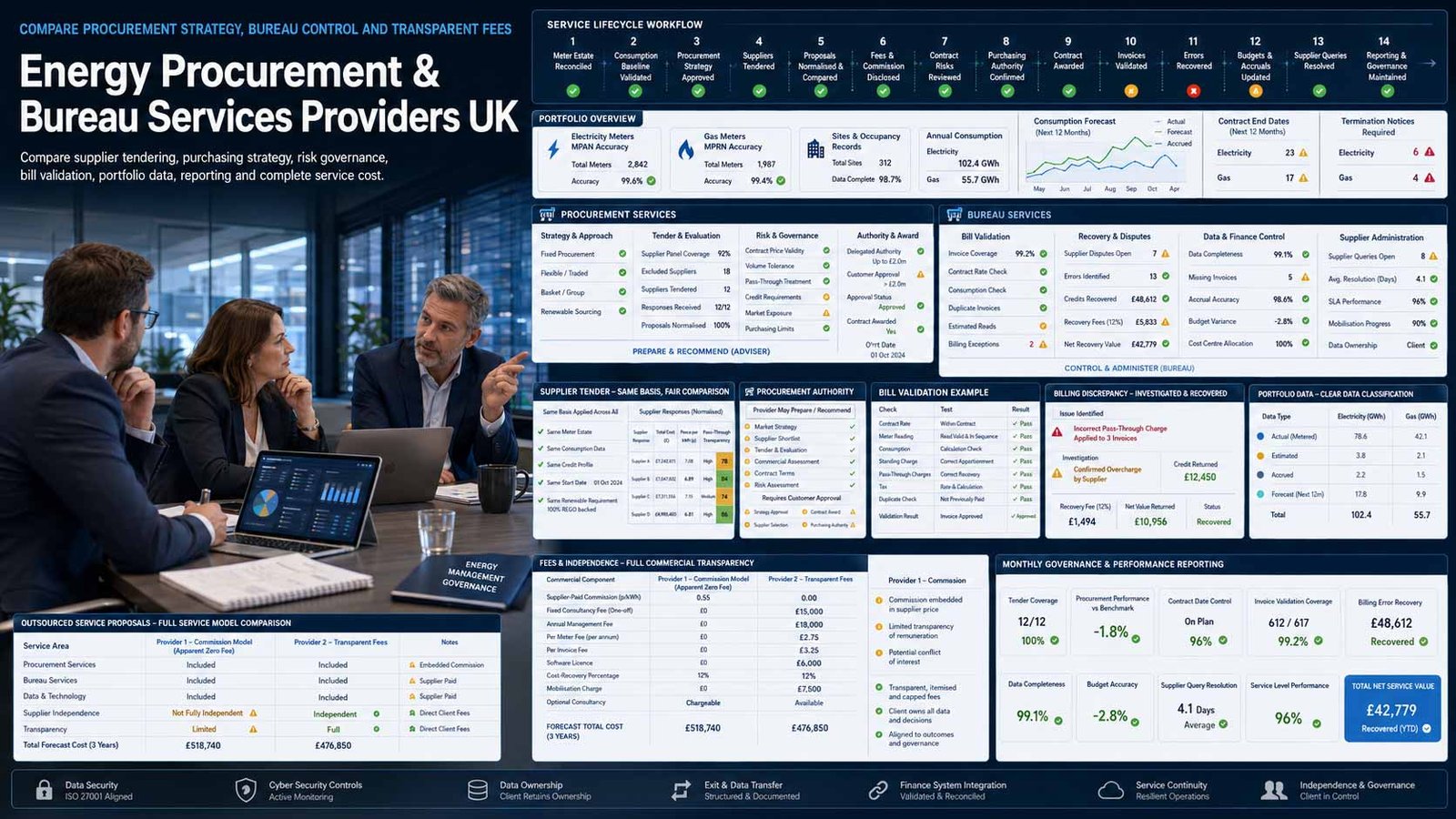
Buying The Contract Is Only The First Control
A competitive tender can still produce poor value if meter data is incomplete, commissions are unclear, invoices are not validated or contract dates are not actively managed.
- Verify every meter, contract end date and consumption baseline
- Require written disclosure of commission, fees and supplier relationships
- Define procurement authority and risk limits before market decisions
- Keep bill, query and cost-recovery evidence throughout the contract
Energy procurement and bureau services help organisations plan, tender, negotiate, administer and verify commercial electricity and gas contracts. Procurement work can include data preparation, market strategy, supplier tendering, contract negotiation, fixed or flexible purchasing and ongoing risk management. Bureau work can include invoice validation, payment files, supplier queries, cost recovery, meter-estate management, accruals, budgets, forecasting, consumption reporting and contract administration.
The provider may act as an independent adviser, a commission-paid broker, a consultant working under a fixed fee, a public-sector framework authority or an outsourced extension of the customer’s energy and finance teams. The business should understand exactly who the provider represents, which suppliers it approaches, how it is paid and who has authority to accept contracts or purchasing decisions.
This page does not rank direct retail tariffs or compare electricity and gas suppliers as the sole service. Supplier-price comparison belongs on the separate business electricity and business gas pages. Here, the commercial focus is the outsourced procurement, risk, data, validation and portfolio-management layer surrounding those supply contracts.
Choose The Right Procurement And Bureau Operating Model
Procurement, risk management and bureau administration can be bought together or separately. Compare accountability, independence and data ownership under each structure.
| Service Model | What It Usually Provides | Best-Fit Question |
|---|---|---|
| Fixed-price procurement | The adviser prepares data, tenders suppliers and recommends a contract with defined fixed-price treatment | Is cost certainty more important than the opportunity to purchase in stages? |
| Flexible or traded procurement | Energy is purchased in tranches under an agreed strategy and risk mandate | Who has trading authority, which limits apply and how is performance benchmarked? |
| Basket or group procurement | Several customers aggregate demand under one purchasing structure or framework | Does aggregation improve terms without reducing transparency or control? |
| Public-sector framework procurement | Eligible public bodies use an established compliant framework and approved supply route | Are framework fees, supplier selection, risk strategy and call-off obligations understood? |
| Procurement-only consultancy | The provider runs the tender and contract negotiation without ongoing bureau administration | Does the organisation have enough internal resource to manage bills, data and supplier queries? |
| Bureau-only outsourcing | The provider validates invoices, manages data, budgets, accruals and supplier queries under existing contracts | Who remains responsible for procurement dates, risk and contract decisions? |
| Integrated procurement and bureau | One provider manages strategy, tender, contract, bills, data and supplier administration | How are conflicts, performance and fee transparency governed across the full service? |
| Virtual energy manager | Specialists provide ongoing decision support, reporting and governance as an extension of the in-house team | Which responsibilities are delegated, retained or subject to customer approval? |
Eight Areas That Determine Energy Procurement And Bureau Fit
Use the same estate, supplier, data and governance requirements for every provider so commission, savings and service claims can be tested consistently.
Comparison Criterion
Independence, Supplier Panel And Remuneration
Compare whether the provider is independent, tied, supplier-funded or operating through a restricted panel. Require the amount or calculation of commission, fixed fees, management charges, supplier incentives, data fees and any ongoing margin applied for the contract term. A broad supplier list does not prove every supplier was approached for the specific tender.
Comparison Criterion
Meter Estate, Consumption And Tender Data
Assess MPANs, MPRNs, meter classes, annual quantities, half-hourly data, sites, occupancy, forecasts, contract dates, credit and renewable requirements. A procurement recommendation built on incorrect meters or old consumption can be invalid even when the market rate appears attractive.
Comparison Criterion
Procurement Strategy And Market Access
Review fixed, flexible, basket, block, pass-through, renewable and PPA-related routes relevant to the organisation. Require a written strategy that explains timing, market exposure, budget certainty, supplier eligibility, decision rights and how recommendations connect to the customer’s risk appetite.
Comparison Criterion
Tender, Contract And Legal Terms
Compare supplier selection, tender documentation, price validity, credit, payment, volume tolerance, pass-through treatment, change of tenancy, assignment, early termination, renewal, deemed rates and legal review. The adviser should present contract risks—not only headline unit rates.
Comparison Criterion
Risk Management And Market Reporting
Assess market intelligence, hedging policy, purchase windows, triggers, limits, delegated authority, exposure reporting, benchmark, mark-to-market, forecast and escalation. Flexible procurement needs documented governance rather than informal calls to buy when the market looks favourable.
Comparison Criterion
Bill Validation, Cost Recovery And Supplier Queries
Compare invoice capture, contract-rate checks, consumption checks, duplicate detection, tax, pass-through charges, estimated reads, exception workflow, supplier disputes, credit recovery, limitation periods and evidence. Confirm whether recovered sums attract a separate percentage fee.
Comparison Criterion
Data, Accruals, Budgets And Portfolio Reporting
Review database quality, missing-bill accruals, forecasts, cost-centre allocation, site benchmarking, meter changes, dashboards, carbon fields, finance-system integration, audit trail and data export. Reports should distinguish actual, estimated, accrued and forecast values.
Comparison Criterion
Mobilisation, Service Levels, Security And Exit
Assess onboarding, supplier authorities, historical data, portal users, case ownership, response targets, cyber security, business continuity, subcontractors, quality checks, complaint route, file formats, data retention, contract notice, open disputes and transfer assistance at exit.
Measures To Define Before An Energy-Bureau Contract Is Signed
Translate independent advice, cost control and accurate data into measurable procurement, validation and supplier-management outcomes.
| Measure | What It Should Define | Evidence To Request | Common Weakness |
|---|---|---|---|
| Tender coverage | Which suitable suppliers and product structures were genuinely tested | Supplier list, invitation, response, decline reason, eligibility, assumptions and evaluation | A provider advertises a large panel but tenders only two preferred suppliers |
| Commission and fee transparency | The complete amount or calculation paid to the intermediary over the contract | Fee, pence per kWh, percentage, supplier payment, term, volume, extras and disclosure | The service is described as free although commission is embedded in rates |
| Procurement benchmark | How purchasing performance is assessed against an agreed market or strategy | Benchmark, observation period, volume, transactions, fees, tolerance and result | A saving is measured against an unsuitable renewal quote rather than the agreed benchmark |
| Contract-date control | Whether every supply has a verified end date and valid termination route | Meter, supplier, end date, notice, acknowledgement, tender start, owner and status | A missed notice moves a site onto extension or out-of-contract rates |
| Invoice-validation coverage | The proportion of expected invoices checked against contract and consumption data | Invoice count, value, checks, exceptions, approvals, missing bills and audit sample | Only large invoices are reviewed while recurring smaller errors continue |
| Billing-error recovery | The value and age of errors identified, accepted and credited | Issue, evidence, supplier, amount, date raised, status, credit, cash and fee | Reported recovery includes credits not yet issued or received |
| Data completeness | Whether the portfolio has current, reconciled and auditable meter and invoice data | Meters, sites, contracts, bills, reads, gaps, estimates, corrections and quality score | Dashboards appear complete while missing invoices are silently excluded |
| Budget and accrual accuracy | How closely forecast and accrued costs align with later validated invoices | Budget, accrual, actual, variance, explanation, tariff, volume and correction | Finance receives a single annual estimate without meter-level assumptions |
| Supplier-query resolution | How quickly contractual, billing and meter issues reach a verified conclusion | Case, owner, supplier, evidence, target, response, credit, escalation and closure | Cases are closed after a supplier reply without checking the correction |
| Total outsourced-service value | The net financial and operational result after all fees and internal effort | Procurement benefit, recovery, avoided cost, fees, software, staff time, risk and outcome | Gross savings are reported without commission, service fees or implementation cost |
Energy Procurement And Bureau Providers UK Organisations Can Consider
Shortlist providers whose independence, supplier access, bureau depth and operating model fit the estate. Confirm current commercial terms, dispute arrangements and service scope directly before award.
Provider Profile
Inspired PLC
Inspired provides commercial energy and sustainability advisory services across procurement, market intelligence, risk, cost assurance, bureau, data and carbon management. Include it where a corporate, industrial, property or multi-site organisation wants a large UK advisory group with broad specialist teams. Confirm which Inspired company contracts the service, supplier-panel coverage, procurement model, commission and fixed fees, authority, flexible-purchasing governance, bill-validation scope, recovery fees, portal and data rights, service levels, subcontractors, acquisition-related service continuity, contract notice and the boundary between procurement, optimisation and wider sustainability work.
Review official Inspired servicesProvider Profile
Inenco
Inenco provides fixed, flexible and options-based procurement alongside bureau, cost assurance, invoice validation, reporting and utility optimisation. Include it where a large or multi-site organisation needs an integrated procurement and bill-management service with specialist trading support. Confirm current ownership and contracting entity, supplier tender breadth, delegated trading authority, benchmark, fee and commission model, bill-validation checks, recovery fees, invoice-processing scale, portal, forecasts, accruals, service levels, data export, open-case transfer, contract term and whether separate compliance or optimisation services are included.
Review official Inenco servicesProvider Profile
Consultus
Consultus provides fixed and flexible procurement, risk management, supplier tendering, bureau services, bill validation, cost recovery, metering, data analytics and PPAs. Include it where an organisation wants one consultancy for procurement strategy and ongoing portfolio administration. Confirm supplier panel, recommendation process, fee and commission disclosure, flexible-purchase mandate, myEnergy portal scope, invoice workflow, cost-recovery charging, budget and accrual methodology, meter-estate management, contract forensics, service levels, renewable sourcing, account team, data ownership, transition and exit from procurement or bureau modules separately.
Review official Consultus procurementProvider Profile
LASER Energy
LASER Energy, part of Commercial Services Group and owned by Kent County Council, provides energy procurement frameworks, fixed and flexible purchasing and energy-management or bureau services mainly for eligible public-sector organisations. Include it where compliant framework access, public-sector governance and large portfolio support are priorities. Confirm eligibility, framework and call-off structure, approved suppliers, procurement strategy, management charges, framework levies, bureau scope, portal, bill validation, public procurement obligations, contract authority, flexibility mandate, reporting, service standards, renewal, direct-award or further-competition route and transfer if the organisation later changes framework.
Review official LASER procurementProvider Profile
TEAM Energy
TEAM Energy provides outsourced energy bureau, bill validation, data management, accruals, forecasting, monitoring, carbon reporting and its Sigma energy-management platform. Include it where the main requirement is accurate utility data and finance administration rather than supplier tendering alone. Confirm whether procurement support is included or separate, invoice and meter coverage, data-capture methods, validation rules, recovery approach, software licence, service team, deployment, finance-system integration, reports, audit trail, carbon fields, supplier-query ownership, service levels, customer responsibilities, data export, retained history and how the bureau transfers to an internal team or another consultant.
Review official TEAM Energy bureauProvider Profile
Sustainable Energy First
Sustainable Energy First, built on the BiU consultancy heritage, provides fixed and flexible energy procurement, bureau services, revenue recovery, compliance and data through its Fusion platform. Include it where a complex estate wants procurement decisions connected to bill, carbon and site data. Confirm current legal entity, supplier relationships, tender method, remuneration, procurement authority, risk strategy, bill validation, recovery fees, Fusion access, data quality, meter changes, reporting, contract management, service-team structure, sustainability work, subcontractors, contract length, notice and the handling of historic records and unresolved supplier disputes at exit.
Review official Sustainable Energy First procurementProvider Profile
Mitie Energy And Carbon
Mitie provides energy-risk advice, procurement support, market intelligence, utility billing, data, supplier management and renewable-energy advice within a wider facilities and energy-services group. Include it where energy procurement and bureau services need to integrate with a large managed estate or facilities contract. Confirm whether the energy service is standalone, contracting entity, supplier panel, independence, commission and consultancy fees, data and bill-validation platform, recovery process, facilities-management dependencies, delegated authority, renewable procurement, service levels, finance integration, account governance, cyber security, data export and whether termination of the FM contract affects energy records or supplier relationships.
Review official Mitie energy consultingProvider Profile
Catalyst Commercial
Catalyst Commercial provides independent energy procurement, fixed and flexible strategies, invoice validation, bureau, market reporting and sustainability services for UK commercial organisations. Include it where an SME or mid-market buyer wants a specialist independent consultancy and access to a broad supplier tender. Confirm which suppliers are included for the specific customer, how independence is maintained, fee and commission disclosure, EaaSi platform scope, bill-validation rules, supplier-query service, flexible procurement governance, contract management, reporting, response times, public-framework availability, cyber and data controls, contract notice, claims concerning savings and the cost of optional carbon or technology services.
Review official Catalyst Commercial servicesWhat Changes Energy Procurement And Bureau Service Cost
Provider remuneration can be embedded, fixed, performance-based or mixed. Compare the complete contract value rather than accepting a zero-fee description.
| Cost Driver | Why It Changes Spend | What A Comparable Proposal Should Show |
|---|---|---|
| Meter and site count | More supplies increase data collection, tender, validation and query-management workload | Electricity and gas meters, sites, countries, contract groups, changes and annual service fee |
| Consumption and procurement complexity | Higher volume, flexible purchasing and complex pass-through costs require specialist risk and trading resource | Annual volume, profile, product, purchasing strategy, transactions, benchmark and governance |
| Commission embedded in supply prices | A pence-per-kWh or supplier-paid commission can continue across every unit for the contract term | Rate, volume, term, supplier, total forecast commission, reconciliation and disclosure |
| Fixed consultancy or management fee | Independent or bureau services may use annual, monthly, meter or project-based fees | Fee basis, included work, indexation, minimum, implementation, additional work and VAT |
| Bill-validation and processing volume | Invoice capture, checking, approval files and exceptions can be charged per invoice or meter | Expected invoices, formats, checks, payment file, exception, rework, archive and annual total |
| Cost-recovery fee | Historical-audit providers may retain a percentage of recovered credits or cash | Percentage, qualifying recovery, prior issue, supplier credit, cash receipt, cap and fee timing |
| Software and portal licensing | Data platforms, users, integrations, APIs and reporting modules can carry separate charges | Platform, users, meters, modules, storage, implementation, API, support, export and exit |
| Flexible trading and risk service | Market monitoring, purchase recommendations and delegated execution require ongoing specialist support | Traders, reports, meetings, transactions, out-of-hours support, authority, benchmark and fee |
| Mobilisation and data cleansing | Historic invoices, meter estates, contracts and supplier authorities can require substantial onboarding work | Sources, years, meters, document quality, corrections, upload, validation, timetable and charge |
| Contract term, indexation and exit | Long exclusivity, automatic renewal, annual increases and data-transfer fees affect lifetime cost | Term, notice, renewal, RPI or CPI basis, exclusivity, transition, data export and open-case support |
How Estate And Governance Change The Shortlist
The right provider depends on meter count, consumption, procurement risk, finance processes, internal expertise, public or private governance and the depth of outsourced administration.
Small Business With Limited Internal Resource
Prioritise accurate meter and renewal data, a documented supplier tender, clear commission, simple contract options, invoice checks, complaint support and a provider that does not impose complex flexible purchasing or software the business cannot govern.
Multi-Site Property, Retail Or Hospitality Estate
Prioritise meter reconciliation, common contract groups, site openings and closures, invoice processing, accruals, landlord or tenant recharges, supplier-query scale, site-level reporting, renewal governance and portability of historic data.
Manufacturing Or Energy-Intensive Organisation
Prioritise flexible procurement, risk policy, wholesale-market reporting, volume tolerance, non-energy costs, half-hourly data, budget forecasts, purchasing authority, carbon sourcing and performance measured against an agreed benchmark.
Public Sector, Education Or Healthcare
Prioritise compliant procurement routes, framework eligibility, governance, audit trail, budget certainty, public reporting, meter and bill accuracy, delegated authority, social value where applicable and services that align with public-sector contract controls.
How To Compare Procurement And Bureau Proposals
Give every provider the same meter estate, annual usage, half-hourly data, current contracts, renewal dates, credit profile, finance workflow, renewable requirements, risk policy, historical billing and service objectives. Require one responsibility and fee matrix.
- Every supplier and excluded supplier is identified for the tender
- Commission and fixed fees are calculated over the full term
- Procurement authority, benchmark and risk limits are written
- Bill-validation rules and recovery-fee treatment are explicit
- Actual, estimated, accrued and forecast data are separated
- Data export, open disputes and transition are covered at exit
Make Every Provider Run The Same Procurement Case
Use the same sites, consumption, contract start, credit, payment, fixed or flexible assumptions and renewable requirement.
Compare supplier terms, intermediary cost and operational service before comparing the headline saving.
Six Questions To Put To Every Procurement Or Bureau Provider
The answers expose restricted supplier panels, hidden remuneration, unclear trading authority and data dependencies before the service becomes embedded.
How Are You Paid And How Much Will It Cost?
Request every supplier commission, pence-per-kWh amount, fixed fee, management charge, recovery fee, software licence, indexation and full-term forecast.
Which Suppliers And Products Will You Test?
Confirm supplier panel, eligibility, exclusions, tender method, fixed and flexible products, credit constraints, renewable options and reasons for the shortlist.
Who Has Authority To Commit The Business?
Define tender approval, contract acceptance, flexible-purchase mandate, trading limits, deputies, audit trail, conflicts and emergency escalation.
Which Bills, Data And Errors Will You Manage?
Confirm invoice formats, validation checks, meter data, missing bills, accruals, supplier cases, historic audit, credit recovery, payment files and service levels.
How Will You Measure Procurement Performance?
Review market benchmark, observation window, volume, fees, contract terms, non-energy costs, budget outcome, risk and reporting frequency.
What Happens When We End The Service?
Confirm contract notice, exclusivity, supplier contracts, data export, portal history, open queries, recovered credits, authorities, passwords and transition assistance.
A Seven-Stage Energy Procurement And Bureau Evaluation
Move from verified data and governance to an auditable outsourced service rather than appointing an intermediary only because it promises a lower rate.
- Inventory meters, sites, suppliers, contracts, end dates, termination evidence, consumption, invoices, credits, complaints, software, authorities and accountable owners.
- Define procurement objectives, budget certainty, risk appetite, renewable requirements, bill-processing scope, data outputs, service levels, fee model and retained internal responsibilities.
- Clean and reconcile meter, contract and consumption data before asking providers to tender suppliers or estimate bureau workload.
- Issue one written specification and obtain comparable proposals covering supplier access, strategy, remuneration, bureau processes, data, mobilisation, governance and exit.
- Run a controlled procurement and invoice-validation scenario, then check references, dispute arrangements, financial standing, cyber controls, team capacity and subcontractors.
- Contract only after authority, commission, benchmarks, service levels, recovery fees, data ownership, conflicts, change control, notice and transition obligations are agreed.
- Operate through procurement reviews, purchase approvals, bill-quality reporting, supplier-query governance, data audits, budget variance, annual fee checks and planned renewal or exit.
Energy Procurement And Bureau Services Comparison Checklist
Use this table before approving an energy broker, procurement consultancy, bureau provider, public-sector framework route or integrated outsourced service.
| No. | Requirement | Evidence To Obtain Before Award | Confirmed |
|---|---|---|---|
| 01 | Service scope and accountable owners agreed | Procurement, bureau, finance, energy, sustainability, approver, legal entity and operational contacts | |
| 02 | Meter and site estate reconciled | MPAN, MPRN, address, supplier, contract, meter class, consumption, occupier and status | |
| 03 | Contract and renewal dates verified | Start, end, notice, acknowledgement, deemed or out-of-contract status, authority and tender date | |
| 04 | Consumption and forecast baseline accepted | Annual quantity, half-hourly data, seasonality, closures, growth, electrification and data quality | |
| 05 | Supplier panel and tender method disclosed | Eligible suppliers, exclusions, products, invitation, response, evaluation, conflicts and recommendation | |
| 06 | Commission and fee schedule accepted | Supplier payment, pence per kWh, percentage, fixed fee, software, recovery, indexation and total | |
| 07 | Procurement and risk authority approved | Strategy, benchmark, trigger, limit, delegation, deputies, approval, evidence and escalation | |
| 08 | Contract-term evaluation completed | Unit and standing charges, pass-through, tolerance, credit, payment, assignment, exit and renewal | |
| 09 | Bill-validation rules approved | Invoice intake, contract checks, reads, consumption, tax, duplicates, exception, approval and audit | |
| 10 | Cost-recovery rules accepted | Historic period, qualifying issue, evidence, supplier credit, cash, percentage fee, cap and timing | |
| 11 | Data, accrual and reporting outputs defined | Actual, estimate, accrual, forecast, budget, site reports, finance files, carbon fields and audit trail | |
| 12 | Supplier-query and complaint route tested | Case owner, response target, escalation, dispute scheme, evidence, correction, credit and closure | |
| 13 | Cyber, continuity and subcontractors checked | Hosting, access, MFA, backup, incident response, business continuity, suppliers and data locations | |
| 14 | Mobilisation and service levels agreed | Authorities, historic files, implementation, quality checks, training, contacts, KPIs and acceptance | |
| 15 | Exit and data-transfer terms controlled | Notice, exclusivity, supplier contracts, open cases, portal export, documents, credentials and deletion |
Common Energy Procurement And Bureau Buying Mistakes
Most avoidable failures begin with hidden remuneration, poor meter data, unclear authority or a procurement saving that is never checked against the invoices delivered.
| Mistake | Why It Creates Risk | Better Control |
|---|---|---|
| Choosing on a verbal saving | The baseline, supplier terms and intermediary cost may not be comparable | Require a written evaluation |
| Assuming the service is free | Supplier-paid commission is normally recovered through the commercial arrangement | Calculate full-term remuneration |
| Using incomplete meter data | Missing or duplicate supplies can invalidate tenders and budgets | Reconcile the estate first |
| Delegating trading without limits | Flexible purchasing decisions can exceed the board’s risk appetite | Approve a written mandate |
| Comparing unit rates only | Pass-through, tolerance, credit and contract terms can outweigh a small rate difference | Compare whole-contract value |
| Buying procurement without bureau control | Billing and meter errors can erode the negotiated benefit | Validate contract delivery |
| Paying recovery fees on known issues | The provider may charge for credits already identified internally | Define qualifying recovery |
| Letting the provider own the data | Exit becomes costly and unresolved disputes lose evidence | Retain export and audit rights |
| Ignoring complaints and redress | A dispute may have no clear independent route | Verify current scheme status |
| Missing the provider notice date | The advisory contract can renew before the energy supply contracts | Control all notices separately |
Frequently Asked Questions
Answers to common questions from UK organisations comparing energy brokers, procurement consultants, bureau services and outsourced energy management.
What Are Business Energy Procurement Services?
Business energy procurement services help an organisation prepare consumption data, choose a purchasing strategy, approach suitable suppliers, compare contracts, negotiate terms and manage market risk. The adviser may also monitor purchases and contract dates after the supply agreement starts.
What Does An Energy Bureau Service Do?
An energy bureau manages utility data and administration. Typical work includes invoice capture, bill validation, supplier queries, cost recovery, meter-estate records, accruals, budgets, forecasting, consumption reports and finance-system files. Scope and service levels vary significantly.
What Is The Difference Between An Energy Broker And Consultant?
A broker commonly arranges supplier contracts and may be paid commission by suppliers. A consultant can charge a direct fee and may provide broader procurement, risk or bureau work. Labels alone do not prove independence, so buyers should examine remuneration, supplier access and contractual duties.
Are UK Energy Brokers Regulated By Ofgem?
The government has stated its intention to appoint Ofgem as regulator for retail-energy third-party intermediaries, and Ofgem launched a market review in 2026. Buyers should check the current legal position, dispute-scheme participation and any new authorisation rules rather than assuming a future regime is already fully operational.
How Do Energy Procurement Companies Charge?
Common models include supplier-paid commission embedded per kWh, fixed project fees, annual management fees, per-meter or invoice charges, software licences and a percentage of recovered credits. Require the cash amount or calculation for the full expected contract term.
What Is Flexible Energy Procurement?
Flexible procurement buys electricity or gas in several transactions instead of fixing the entire requirement at once. It can spread timing risk but needs suitable scale, supply products, market expertise, approved limits, decision authority, reporting and acceptance that outcomes can be better or worse than a single fixed purchase.
Can A Bureau Provider Recover Energy-Billing Errors?
Yes. Providers can identify duplicate charges, incorrect contract rates, estimates, meter errors, tax issues and other exceptions, then pursue suppliers for correction. The contract should define the historical period, evidence, recovery fee and whether payment is due on supplier acceptance, credit note or cash receipt.
What Data Should A Business Receive From Its Provider?
The business should be able to export meter, site, contract, invoice, consumption, query, credit, budget, accrual and procurement records in usable formats. It should also retain tender documents, supplier responses, commission disclosure, purchase approvals and evidence supporting reported savings.
How Long Should An Energy Procurement Contract Last?
The adviser contract does not need to match the energy-supply term automatically. The right duration depends on procurement cycle, bureau need, software and mobilisation. Review exclusivity, automatic renewal, annual increases, notice, open disputes and data transfer separately from supplier contracts.
How Should A UK Business Compare Procurement And Bureau Providers?
Give every provider the same meters, consumption, contracts, finance process and risk rules. Compare supplier access, fee transparency, procurement method, authority, bill validation, recovery, data, service levels, security, complaint route and exit—not only the promised saving or headline tariff.
Official Guidance And Provider Resources
Reviewed by Bhav Giva, Founder & Lead Analyst at CompareServices.co.uk, on 24 July 2026.
Use Ofgem, UK government, dispute-scheme and official provider documentation to confirm the current regulatory position, supplier-contract guidance, remuneration, services, scheme participation and live commercial terms. TPI regulation and provider ownership can change.
- Ofgem — Third-Party Intermediaries Market Review
- Ofgem — Setting Up Energy Contracts: Good Practice
- Ofgem — What Microbusinesses Need To Know About TPIs
- UK Government — Response On Regulating Energy TPIs
- Inspired — Energy And Sustainability Advisory Services
- Inenco — Procurement And Bureau Services
- Consultus — Energy Procurement
- Consultus — Bureau Services
- LASER Energy — Energy Procurement
- TEAM Energy — Energy Bureau
- Sustainable Energy First — Energy Procurement
- Mitie — Energy And Carbon Consulting
- Catalyst Commercial — Commercial Energy Services