
Compare Smart Metering Providers UK (2026)
Compare Meter Types, Installation, Communications, Data Access, Support, Integration And Cost
Compare smart meter business UK providers by SMETS2, advanced and AMR meter capability, electricity and gas coverage, half-hourly data, meter-operation accreditation, installation planning, communications, data portals, API and building-management integration, fault response, maintenance, data consent, reporting, contract terms and complete lifecycle cost. Determine first whether the meter must be arranged through the energy supplier or can be procured through an independent commercial metering partner.
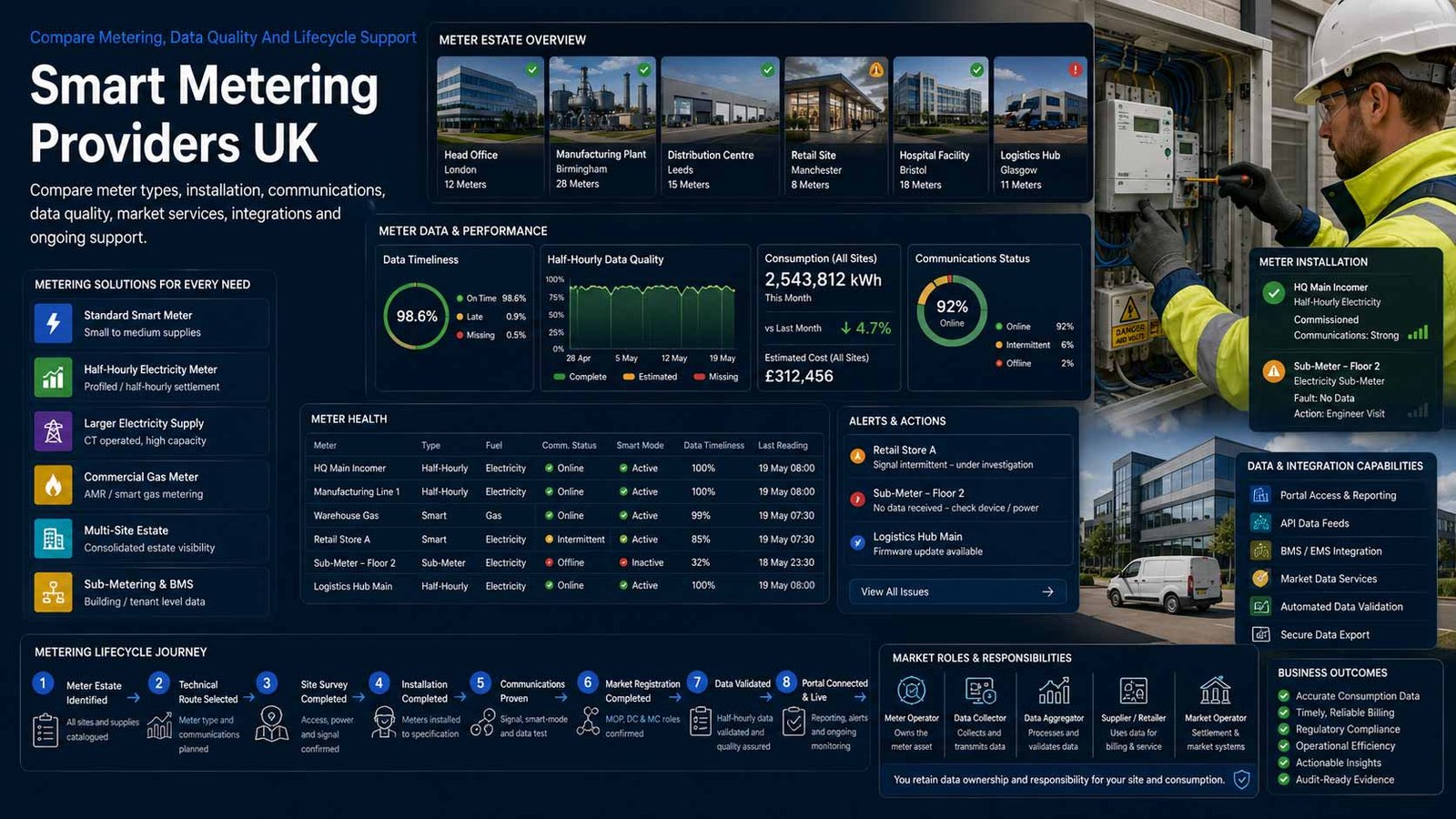
Choose The Metering Route Before Choosing The Provider
A smaller business normally obtains a smart meter through its energy supplier. Larger or more complex sites may appoint independent meter operators, data collectors or meter asset managers.
- Confirm whether the site needs SMETS2, advanced, AMR or half-hourly metering
- Define who owns, installs, operates, maintains and reads the asset
- Secure access to useful interval data—not only automated billing reads
- Test communications, commissioning, portal access and fault escalation
A smart or advanced meter records energy use digitally and sends readings remotely. For smaller non-domestic sites, SMETS2 smart meters use the national smart-meter communications infrastructure and can support automatic readings and customer-facing usage information. Advanced or AMR meters are also common in commercial settings and can provide half-hourly electricity or hourly gas data through other communications arrangements.
Smart metering is not one identical service. The buyer may need only a supplier-arranged meter exchange, or a wider commercial contract covering meter ownership, installation, maintenance, data collection, data aggregation, communications, monitoring and integration with energy-management systems. Half-hourly settlement and complex current-transformer metering introduce additional engineering and data responsibilities.
This page does not compare energy unit rates, tariffs, procurement or supplier-switching deals. Electricity and gas supply contracts remain on their dedicated pages. It also does not compare on-site solar, batteries, EV charging or general energy-bureau outsourcing. The scope is the meter, communications, data and supporting operational service.
Choose The Right Commercial Metering Arrangement
SMETS2, AMR, half-hourly and independently managed services use different communications, contracts and accredited roles.
| Metering Model | What It Usually Provides | Best-Fit Question |
|---|---|---|
| Supplier-arranged SMETS2 smart meter | A smaller business requests installation through its electricity or gas supplier, usually without a separate installation charge | Will the meter operate in smart mode at the premises and provide usable customer data after commissioning? |
| Advanced or AMR meter | A remotely read commercial meter provides interval or regular data without using every SMETS2 function | Which data granularity, communications method and supplier or third-party access are supported? |
| Half-hourly electricity metering | A commercial electricity meter records settlement-quality half-hourly data and normally requires accredited market agents | Who acts as meter operator, data collector and data aggregator, and how are exceptions resolved? |
| CT-operated electricity metering | Current transformers enable measurement of higher-load commercial supplies that cannot use simple whole-current meters | Has the provider surveyed CT ratios, wiring, access, shutdown and commissioning requirements? |
| Commercial gas AMR metering | A gas meter or logger sends regular consumption data for billing, monitoring and operational analysis | Who is the meter asset manager, which communications network is used and how are failed reads recovered? |
| Independent MOP, DC or DA contract | The business appoints accredited electricity agents separately from the energy supplier for meter and data services | Does independent appointment improve data control and service without duplicating supplier responsibilities? |
| Independent gas MAM and data service | A specialist owns, installs, operates or monitors commercial gas metering and AMR assets | Which asset, maintenance, data and emergency obligations sit with the MAM, supplier and network? |
| Multi-utility managed metering | One provider coordinates electricity, gas, water or submeter data across several sites and systems | Can one contract simplify the estate while preserving accredited roles, raw data access and site-level accountability? |
Eight Areas That Determine Smart Metering Fit
Use the same sites, meter points, data and integration requirements for every provider so an installation quote does not hide communications or lifecycle gaps.
Comparison Criterion
Meter Type, Capacity And Technical Fit
Compare SMETS2, advanced, AMR, half-hourly, whole-current, CT-operated and gas-meter options against the actual supply. Require confirmation of meter class, capacity, pulse outputs, CT ratios, gas pressure, communications, enclosure, isolation, access and whether existing equipment can be adopted or must be replaced.
Comparison Criterion
Survey, Installation And Commissioning
Review desktop checks, site survey, engineer competence, appointment lead time, shutdown requirements, method statement, permits, landlord approval, asbestos or access risks, meter exchange, commissioning, opening reads, photographs and evidence that the asset is communicating and registered correctly.
Comparison Criterion
Communications And Smart-Mode Reliability
Assess WAN coverage, DCC compatibility where applicable, cellular or fixed communications, antenna options, signal survey, retry process, remote diagnostics and recovery when the meter stops communicating. A newly installed meter has limited value if it operates in traditional or read-only mode.
Comparison Criterion
Data Granularity, Timeliness And Ownership
Compare half-hourly electricity, hourly gas, daily summaries, real-time or near-real-time feeds, data latency, validation, estimates, missing-interval repair, raw downloads, APIs and consent. Confirm the business can access and export data independently of the visual portal.
Comparison Criterion
Accreditation And Market-Agent Capability
Review Meter Operator, Data Collector, Data Aggregator, Meter Asset Manager, MAP and other relevant roles. Confirm current accreditation, scope, market systems, industry-flow handling, settlement performance and the exact legal entity carrying each responsibility.
Comparison Criterion
Portal, API And Building-System Integration
Compare dashboards, alerts, user roles, cost-centre grouping, portfolio views, exports, APIs, BMS, IoT and carbon-reporting integration. Establish data frequency, retention, authentication, change control and the cost of connecting third-party software or customer-owned hardware.
Comparison Criterion
Maintenance, Faults And Lifecycle Support
Assess proactive monitoring, failed-read detection, communication repair, meter faults, engineer response, emergency attendance, asset replacement, firmware, battery or communications lifecycle, obsolete technology, 2G and 3G retirement planning, service credits and evidence of successful restoration.
Comparison Criterion
Commercial Terms, Data Consent And Exit
Review installation, rental, asset, MOP, MAM, DC, DA, communications and data fees; contract length; indexation; auto-renewal; minimum sites; transfer; consent; third-party access; data return; agent deappointment; asset adoption and charges for replacement or removal at exit.
Measures To Define Before A Smart Metering Contract Is Signed
Translate accurate, automatic and useful metering into consistent commissioning, data, fault and lifecycle outcomes.
| Measure | What It Should Define | Evidence To Request | Common Weakness |
|---|---|---|---|
| Successful commissioning rate | Whether installed meters are communicating, registered and producing usable data after the visit | Site, meter, install date, commissioning result, first data, exceptions, owner and resolution | The installation is marked complete although no interval data reaches the customer portal |
| Smart-mode availability | The proportion of time meters communicate remotely rather than operating as traditional meters | Meter, communication status, last read, outage, diagnosis, recovery action and duration | Repeated communication loss is treated as a billing issue rather than an asset-service problem |
| Data completeness | The percentage of required intervals delivered without gaps or unexplained estimates | Expected intervals, actual intervals, missing data, estimate method, repair, validation and source | A dashboard hides missing half-hour periods by displaying only monthly totals |
| Data latency | The elapsed time between consumption and availability to the business or nominated third party | Interval end, collection time, validation, portal time, API time, SLA and exception | Data arrives too late to investigate abnormal overnight use or operational faults |
| Meter-read accuracy | Whether meter values reconcile with bills, physical reads and expected consumption | Meter register, remote read, manual verification, multiplier, CT ratio, correction and sign-off | An incorrect multiplier creates months of inaccurate consumption data |
| Fault-response performance | How quickly failed communications, meter faults and data exceptions receive a credible resolution plan | Report time, acknowledgement, diagnosis, plan, appointment, restoration, repeat and credit | A ticket is closed after remote checks even though no data has resumed |
| Installation first-time completion | Whether surveys, access and parts enable completion without repeated visits | Survey, appointment, access, shutdown, equipment, failed reason, repeat date and cost | The engineer discovers incompatible equipment or no isolation after arriving onsite |
| Accreditation and appointment accuracy | Whether every market role and meter point is registered to the correct accredited agent | MPAN or MPRN, role, provider, appointment date, industry flow, rejection and correction | The new agent is contracted but never appointed successfully in market systems |
| Data-access fulfilment | Whether the business and authorised third parties receive the required historic and ongoing data | Request, consent, format, period, response, access date, rejected reason and next step | The portal provides charts but no machine-readable export for analysis |
| Total lifecycle cost per meter point | The complete installation, asset, communication, data, maintenance and internal-administration cost | Meter points, hardware, install, rental, agent fees, portal, API, visits, replacements and exit | A low installation fee is offset by long data and asset contracts with annual increases |
Smart Metering Providers UK Businesses Can Consider
Shortlist providers whose contract route, accreditation, field capability and data service fit the meter estate. Confirm whether each provider contracts directly with the business or works through an energy supplier or industry partner.
Provider Profile
SMS Commercial Metering
SMS provides accredited gas and electricity meter installation, operation, asset management and data services across domestic, industrial and commercial markets. Its business route includes electricity Meter Operator and gas Meter Asset Manager capability, alongside data collection and nationwide field delivery. Include SMS where a business needs a direct commercial metering partner or where an energy supplier uses SMS for rollout and lifecycle service. Confirm which legal entity and channel contracts the work, meter types, survey, appointment, asset ownership, MOP or MAM role, data services, communications, maintenance, emergency response, fees and exit terms.
Review official SMS commercial meteringProvider Profile
IMServ Metering And Data
IMServ provides smart, AMR, half-hourly, CT and data services for energy suppliers, businesses, public-sector organisations and third-party intermediaries. It combines accredited metering roles with data collection, analytics and complex-site capability. Include IMServ where accurate commercial data, multi-site management, CT metering or integration into business systems is a priority. Confirm the exact MOP, DC, DA or other roles, electricity and gas scope, meter and communications options, site survey, data latency, portal and API access, settlement performance, exception management, support, contract term and ownership of raw data.
Review official IMServ meteringProvider Profile
Energy Assets Metering And Data
Energy Assets provides electricity Meter Operator, Data Collector and Data Aggregator services and is an independent gas Meter Asset Manager. It owns, installs, operates and maintains commercial meters and AMR equipment and offers multi-utility data services. Include it where a business wants independent agent appointments and consistent electricity, gas or wider utility data. Confirm meter-point eligibility, accreditation, asset rental, MOP or MAM appointment, DC and DA coverage, communications, data portal, API or exports, maintenance, failed-read recovery, site additions, contract indexation and the transfer or adoption process at exit.
Review official Energy Assets meteringProvider Profile
Stark Connect And Stark Data
Stark provides accredited business electricity Meter Operator services together with electricity and gas data collection, analytics and infrastructure services. It installs, adopts and maintains Code of Practice metering systems and can combine asset and data services for commercial portfolios. Include Stark where a buyer needs independent electricity metering, strong data capability and multi-site energy insight. Confirm meter classes, MOP scope, gas-data arrangements, new connections, CT metering, data collection frequency, validation, portal, API, service levels, field coverage, fault response, contract structure and whether data and metering are separately terminable.
Review official Stark meteringProvider Profile
Inspired Metering And Data Services
Inspired provides fully managed electricity, gas and water metering services for business users, including half-hourly and AMR solutions, meter operations, data collection and centralised reporting. Include it where a business wants one adviser to replace fragmented supplier-led arrangements and connect meter data to energy-management services. Confirm which accredited agents and field providers perform each role, direct versus subcontracted delivery, meter ownership, half-hourly readiness, data quality, portal or software integration, site survey, fault response, professional-service fees, recurring agent charges, minimum portfolio size and data transfer at exit.
Review official Inspired meteringProvider Profile
Calisen Smart Metering Infrastructure
Calisen is a major owner and manager of smart-meter assets in Great Britain and provides meter-asset, equipment-management and operational services mainly through energy suppliers and infrastructure partnerships. Include it where the procurement route involves a supplier, utility or large asset programme rather than a simple direct SME purchase. Confirm whether Calisen is the contracting party or underlying asset provider, meter type, installation partner, asset ownership, communications, maintenance, fault responsibility, data access, geographic coverage, supplier dependency, lifecycle replacement and how the business escalates a service issue when several parties are involved.
Review official Calisen smart meteringProvider Profile
M Group Energy Metering
M Group delivers large-scale gas, electricity and water field metering services, including industrial and commercial installations, smart-meter reading, industry-flow management, maintenance and technical support. It typically operates for suppliers and other industry clients rather than selling a standard direct business package. Include it where the proposed supplier or programme uses M Group and installation capacity, field governance and complex-site delivery need scrutiny. Confirm the customer-facing contract route, survey ownership, engineer accreditation, appointment and access controls, I&C meter capability, commissioning evidence, emergency work, data handoff, quality assurance, subcontracting and complaint escalation.
Review official M Group meteringProvider Profile
TMA Data Management
TMA provides smart-meter data management, DCC integration, data collection, data aggregation and energy-market services for suppliers and service users. Its role is primarily data and market operation rather than a full direct installation proposition for every SME. Include it where reliable data processing, settlement, DCC connectivity or large-volume meter-point management is central to the requirement. Confirm the contracting route, metering versus data-only scope, DCC role, DC and DA accreditation, supported meter classes, data validation, exception handling, customer data access, APIs, cyber controls, service reporting, market-transition support and termination assistance.
Review official TMA data servicesWhat Changes Smart Metering Cost
There is no single standard price because supplier-arranged smart meters and independent commercial agent contracts use different charging models.
| Cost Driver | Why It Changes Spend | What A Comparable Proposal Should Show |
|---|---|---|
| Supplier-arranged or independent route | A smaller-site SMETS2 installation may not have a separate upfront charge, while independent commercial metering uses direct contracts | Contracting party, installation charge, asset charge, recurring fees, supplier dependency and eligibility |
| Meter type and technical complexity | CT metering, half-hourly systems, gas AMR, high-load sites and unusual equipment need more survey and engineering work | Meter class, capacity, CTs, pressure, enclosure, communications, isolation, parts and labour |
| Site survey and installation conditions | Access, shutdown, landlord consent, asbestos, permits, escorting and out-of-hours work change delivery cost | Desktop survey, physical survey, visit, shutdown, permits, abortive visit, overtime and remedial work |
| Asset ownership and rental | A provider may fund and own the meter in return for recurring asset or rental charges | Asset owner, rental, term, indexation, adoption, replacement, transfer, removal and residual liability |
| MOP, MAM, DC and DA services | Accredited market-agent roles can be contracted and charged separately for electricity and gas | Role, meter points, annual charge, minimum, appointment, service level, accreditation and termination |
| Communications and data collection | SIMs, DCC, fixed links, antennas, polling, validation and exception management create recurring cost | Network, data frequency, retries, estimated data, monitoring, repair, licence and communications fee |
| Portal, API and analytics | Basic data may be included while advanced dashboards, alerts, API feeds and long retention cost more | Users, sites, intervals, retention, export, API, integration, alert, support and annual fee |
| Faults, maintenance and engineer visits | Some contracts include routine maintenance but charge separately for access failures, damage or non-standard work | SLA, remote support, visit, parts, emergency, customer-caused issue, repeat and service credit |
| Portfolio size and geographic coverage | Minimum meter counts, remote sites and fragmented estates can change unit pricing and mobilisation | Meters, regions, travel, minimum charge, rollout waves, scheduling, local engineer and subcontractor |
| Contract term, indexation and exit | Long asset and data agreements can outlast internal projects or supplier arrangements | Term, renewal, index, termination, deappointment, data return, asset transfer, removal and exit fee |
How The Meter Estate Changes The Shortlist
The right route depends on site size, supply type, interval-data needs, market roles, technical complexity and whether the business can appoint independent agents.
Small Business Needing Its First Smart Meter
Start with the current energy supplier because smaller non-domestic SMETS2 installations are normally supplier-led. Prioritise appointment flexibility, successful smart-mode commissioning, customer-facing data, accurate bills and a clear fault route.
Multi-Site SME Or Public-Sector Estate
Prioritise meter and MPAN or MPRN reconciliation, common data standards, national field coverage, staged surveys, half-hourly or hourly access, portfolio dashboards, exception management and simple site additions or closures.
Half-Hourly Or High-Load Electricity User
Prioritise accredited MOP, DC and DA capability, CT survey, Code of Practice fit, shutdown planning, settlement data, completeness, latency, market-flow accuracy, fault response and transition support for industry change.
Complex Gas And Multi-Utility Estate
Prioritise gas MAM and AMR capability, electricity integration, communications coverage, reliable interval data, common portals, BMS or API integration, asset lifecycle and clarity about which provider owns each operational responsibility.
How To Compare Smart Metering Proposals
Give every provider the same sites, MPANs or MPRNs, meter classes, supply capacity, current equipment, access, desired data frequency, integrations, accredited roles, response requirements and rollout dates. Require one complete responsibility and cost schedule.
- The meter type and procurement route are correct for every site
- Survey, shutdown, installation and commissioning are fully scoped
- Communications and data-access outcomes are measurable
- Every MOP, MAM, DC, DA or asset role is named
- Recurring asset, data, portal and support charges are itemised
- Data export, deappointment and asset transfer are covered at exit
Make Every Provider Demonstrate The Same Meter Journey
Use one straightforward small site, one poor-communications site, one CT electricity site and one gas AMR site.
Compare survey, installation, first data, missing-data recovery and fault resolution before comparing dashboard appearance.
Six Questions To Put To Every Metering Provider
The answers expose incorrect meter routes, fragmented responsibilities, inaccessible data and long asset contracts before installation begins.
Which Meter And Contract Route Applies To Each Site?
Confirm SMETS2, advanced, AMR, half-hourly, CT or gas metering, together with supplier-led or independently appointed delivery.
Who Owns And Operates Every Asset And Market Role?
Request the MAP, MOP, MAM, DC, DA, communications provider, installer, maintainer, data controller and customer escalation route.
How Will You Prove The Meter Is Working Properly?
Define commissioning, smart mode, first valid interval, register and multiplier checks, portal visibility, missing-data tests and acceptance evidence.
Which Data Can We Access And Export?
Confirm interval frequency, latency, historic period, machine-readable formats, API, retention, estimated data, nominated-third-party access and fees.
What Happens When Communications Or Data Fail?
Review monitoring, diagnosis, remote fix, engineer appointment, resolution plan, service level, repeated fault, compensation and fallback reads.
What Will It Cost To Change Or Leave The Service?
Confirm deappointment, asset adoption, data transfer, meter exchange, contract termination, access removal, final exports and exit charges.
A Seven-Stage Smart Metering Evaluation
Move from a verified meter estate to measured data outcomes rather than treating installation as complete when the device is physically fitted.
- Inventory MPANs, MPRNs, meters, serials, classes, supply capacity, CTs, communications, current agents, data availability, faults, sites and accountable owners.
- Define the required meter type, installation route, interval data, integrations, market-agent roles, support, maintenance and lifecycle scope while excluding energy pricing and procurement.
- Complete desktop and physical surveys for complex sites, including access, isolation, shutdown, communications, landlord permission and safety constraints.
- Issue one written specification and obtain comparable supplier-led or independent-provider proposals with complete technical, responsibility and cost schedules.
- Evaluate sample sites and data journeys covering commissioning, interval delivery, missing-data repair, portal export, API integration and fault escalation.
- Deploy in controlled waves with appointments, communications, opening reads, market appointments, first data, acceptance, staff access and rollback for failed installs.
- Operate through data-quality monitoring, fault review, asset and contract records, accreditation checks, lifecycle replacement and a controlled exit or renewal plan.
Smart Metering Comparison Checklist
Use this table before approving a supplier-arranged rollout, independent meter operator, data service or multi-site metering contract.
| No. | Requirement | Evidence To Obtain Before Award | Confirmed |
|---|---|---|---|
| 01 | Metering scope and accountable owner agreed | Sites, legal entity, electricity, gas, project owner, facilities owner, data owner and approver | |
| 02 | Meter-point inventory reconciled | MPAN or MPRN, address, serial, meter class, capacity, CT ratio, gas details, supplier and agent | |
| 03 | Correct metering route selected | SMETS2, advanced, AMR, HH, CT, supplier-arranged, MOP, MAM, DC, DA and rationale | |
| 04 | Site survey and installation constraints confirmed | Access, isolation, shutdown, landlord, asbestos, permits, communications, enclosure and remedial work | |
| 05 | Accredited roles verified | Provider legal entity, role, accreditation, scope, expiry, market systems and subcontractor | |
| 06 | Meter asset and ownership terms accepted | Asset owner, rental, term, indexation, replacement, adoption, damage, transfer and removal | |
| 07 | Communications design accepted | DCC or network, signal, antenna, fallback, commissioning, remote diagnostics and lifecycle | |
| 08 | Data specification agreed | Interval, latency, validation, estimates, retention, export, API, users, consent and nominated third parties | |
| 09 | Commissioning acceptance defined | Installation record, meter registers, multiplier, market registration, first read, first interval and portal | |
| 10 | Fault and maintenance service accepted | Monitoring, acknowledgement, resolution plan, visit, emergency, parts, service credit and repeat failure | |
| 11 | Portal and integration tested | Sites, roles, dashboards, alerts, download, API, BMS, authentication, support and data ownership | |
| 12 | Rollout and change control approved | Waves, appointments, communication, access, failed visits, reschedule, site additions and closures | |
| 13 | All recurring and one-off charges disclosed | Survey, install, asset, agent, communications, data, portal, visit, support, indexation and minimums | |
| 14 | Complete lifecycle cost compared | Meter points, contract years, recurring services, replacements, faults, internal effort and exit | |
| 15 | Exit and transition terms agreed | Notice, deappointment, data export, credentials, asset adoption, exchange, removal, final bill and deletion |
Common Smart Metering Buying Mistakes
Most avoidable failures begin with the wrong procurement route, incomplete commissioning, inaccessible data or responsibilities split across suppliers and agents.
| Mistake | Why It Creates Risk | Better Control |
|---|---|---|
| Assuming every business can choose any installer | Smaller-site smart meters are often arranged through the energy supplier | Confirm the procurement route first |
| Treating physical installation as completion | The meter may not be commissioned, communicating or visible in the portal | Accept only after valid data arrives |
| Using the wrong meter type | A basic meter may not suit CT loads, half-hourly settlement or required gas data | Survey technical requirements |
| Ignoring communications coverage | The meter can operate in traditional mode and still require manual or estimated reads | Test signal and recovery |
| Buying a dashboard without raw data access | The business becomes locked into one visual tool and cannot perform independent analysis | Require exports and API rights |
| Leaving agent roles unclear | MOP, MAM, DC, DA, supplier and installer issues can be passed between parties | Create a responsibility matrix |
| Failing to verify multipliers and CT ratios | Incorrect configuration can materially distort recorded consumption | Reconcile physical and remote data |
| Signing long asset and data contracts separately | Different end dates create avoidable lock-in and transition cost | Align term and exit planning |
| Assuming smart data automatically saves energy | Data creates value only when people, alerts or systems use it | Define operational actions |
| Ignoring future communications retirement | Older communication technologies may require planned asset work | Require lifecycle and replacement plans |
Frequently Asked Questions
Answers to common questions from UK businesses comparing smart, advanced, AMR and independently managed metering services.
What Is A Smart Meter For Business?
A business smart meter is a digital electricity or gas meter that records usage and sends readings remotely. Depending on the meter and service, it can provide automatic billing reads, half-hourly or hourly consumption data, customer dashboards and third-party data access.
How Does A Small Business Get A Smart Meter?
A smaller business normally contacts its current energy supplier. Smart Energy GB states that households and small businesses across England, Scotland and Wales can request a smart meter at no extra installation charge. Site and technical eligibility still need to be checked.
What Is The Difference Between SMETS2 And AMR?
SMETS2 meters use the national smart-meter technical and communications framework. AMR or advanced meters also transmit readings remotely but can use different communications and commercial arrangements. Both can serve non-domestic sites, depending on supply and installation date.
What Is A Meter Operator?
An electricity Meter Operator installs, operates and maintains metering equipment used for settlement. Larger or half-hourly sites may appoint an accredited MOP independently. Data Collector and Data Aggregator roles retrieve, validate and aggregate consumption data for market processes.
What Is A Gas Meter Asset Manager?
A Meter Asset Manager owns, installs, operates or maintains gas metering equipment under recognised industry arrangements. A commercial gas AMR service may combine the MAM role with remote data collection, communications and monitoring.
Can A Business Access Its Smart Meter Data?
Yes. Non-domestic consumers and authorised third parties can request free access to up to 12 months of historic smart or advanced meter data from the energy supplier. Suppliers must respond within ten working days. Smaller organisations must also receive free regular usage information.
Does A Smart Meter Automatically Reduce Energy Use?
No. A smart meter provides more accurate and timely data, but savings depend on how the business uses that information. Alerts, operational reviews, maintenance, staff action and building-system integration are what turn data into reduced consumption.
How Much Does Business Smart Metering Cost?
A supplier-arranged small-business smart meter may not have a separate installation charge. Independent commercial metering can include survey, installation, asset rental, MOP or MAM, data, communications, portal, maintenance and exit fees. Compare lifecycle cost per meter point.
What Happens If A Smart Meter Stops Communicating?
The meter may continue recording consumption but operate in traditional mode, causing delayed or manual reads. Report the problem to the responsible supplier or metering provider and require a diagnosis, resolution plan, data recovery and confirmation that remote operation has resumed.
How Should A UK Business Compare Smart Metering Providers?
First identify the correct meter and contract route. Then give every provider the same meter points, technical constraints, data, integration and support requirements. Compare commissioning, accreditation, communications, data access, faults, lifecycle cost and exit—not only installation price.
Official Guidance And Smart Metering Provider Resources
Reviewed by Bhav Giva, Founder & Lead Analyst at CompareServices.co.uk, on 24 July 2026.
Use DESNZ, Ofgem, Smart Energy GB, metering-industry registers and official provider documentation to confirm current obligations, accreditation, meter compatibility, data access, service coverage and commercial terms. Provider roles and regulatory arrangements can change.
- DESNZ — Non-Domestic Smart Metering
- DESNZ — Energy Supplier Obligations
- Ofgem — Getting A Smart Meter
- Ofgem — Metering News And Standards
- Smart Energy GB — Benefits For Small Businesses
- Association Of Meter Operators — Members
- SMS — Commercial Metering
- IMServ — Metering And Data Services
- Energy Assets — Electricity Metering And Data
- Stark — Business Electricity Meter Services
- Inspired — Metering And Data Services
- Calisen — Smart Metering Infrastructure
- M Group — Metering Services
- TMA — Data Collection And Aggregation