
Compare Green Energy / Renewables Providers UK (2026)
Compare Renewable Evidence, Generator Links, Matching, PPAs, Reporting, Support And Total Cost
Compare green energy business UK providers by renewable electricity and gas evidence, REGO or RGGO treatment, annual and hourly matching, named-generator traceability, existing-asset and new-build corporate PPAs, additionality, volume and shape risk, contract length, carbon-reporting support, claim governance, account service, data, credit requirements and complete cost. Use the same consumption profile, sustainability objective and reporting standard for every proposal.
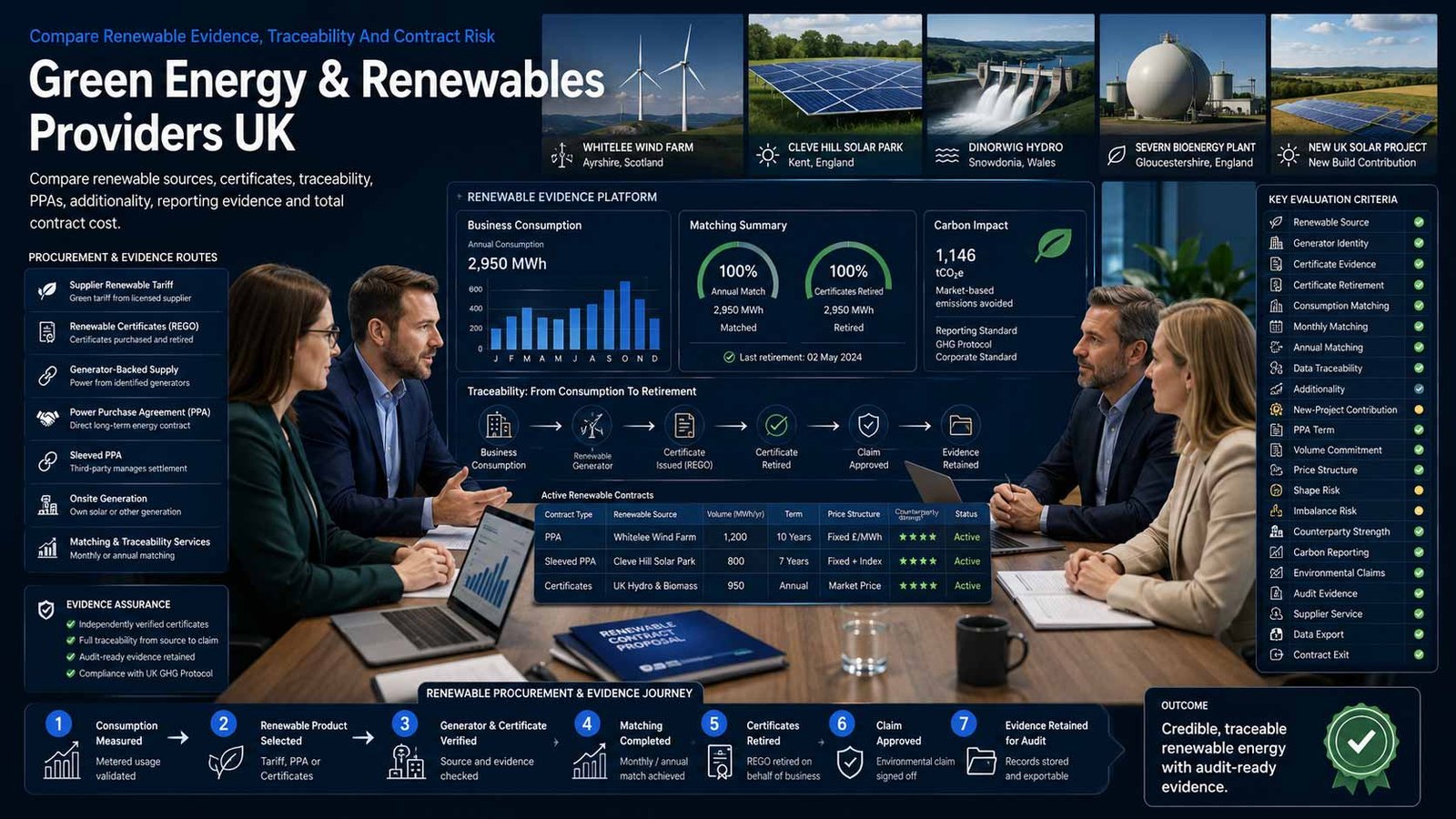
Buy The Renewable Attribute You Intend To Claim
All grid electricity is physically mixed. The commercial difference lies in the contract, renewable evidence, generator relationship, matching period and contribution to new capacity.
- Verify certificates are retired against the same reporting period and volume
- Separate annual matching from hourly or more granular matching
- Distinguish an existing-asset product from a new-build CPPA
- Approve public claims through legal and sustainability governance
Business green-energy procurement uses contracts and recognised energy-attribute evidence to match an organisation’s purchased energy with renewable generation. In Great Britain, Ofgem issues Renewable Energy Guarantees of Origin, or REGOs, to accredited generators. One certificate represents one megawatt-hour of eligible renewable electricity. Suppliers use certificates for fuel-mix disclosure and can allocate them to renewable products.
A REGO-backed contract can support a market-based Scope 2 calculation when it meets the organisation’s reporting methodology, but the certificate alone does not prove that electricity was generated at the same hour as consumption or that the purchase financed a new renewable project. Generator-linked products, hourly matching and corporate power purchase agreements provide different levels of traceability, risk and potential additionality.
This page does not compare ordinary business electricity or gas contracts whose primary purpose is price rather than renewable evidence. It also excludes residential green tariffs and the design or installation of commercial solar PV, battery storage, EV charging or other on-site infrastructure. Those require separate technical and commercial comparisons.
Choose The Right Renewable-Energy Evidence And Contract
Annual certificate matching, named assets and new-build CPPAs are not equivalent. Choose the model that fits the business claim, risk tolerance and consumption profile.
| Procurement Model | What It Usually Provides | Best-Fit Question |
|---|---|---|
| REGO-backed renewable electricity | Matches annual electricity use with Renewable Energy Guarantees of Origin retired for the relevant disclosure period | Which certificates, generation countries, technologies and retirement evidence are included? |
| Directly sourced renewable supply | Bundles energy and certificates from a disclosed portfolio of renewable generators | Does the supplier buy both power and certificates from the named or described generators? |
| Hourly or granular matching | Compares consumption with renewable generation in shorter time intervals rather than annual totals | What percentage is matched hourly, which data are used and how are unmatched periods reported? |
| Named-asset renewable supply | Links an agreed volume to an identified wind, solar, hydro or other renewable asset | Does the customer receive asset, output, certificate and allocation evidence for the same period? |
| Portfolio corporate PPA | Provides renewable output from a portfolio of existing assets under a medium- or long-term structure | How are volume, shape, imbalance, market price and asset substitution handled? |
| New-build corporate PPA | Supports a specific renewable project through a long-term offtake commitment | What demonstrates additionality, project delivery, credit support and treatment of construction delay? |
| Renewable gas or biomethane option | Matches gas consumption with recognised renewable-gas certificates or an evidenced biomethane arrangement | Which certificate scheme, source, lifecycle method and reporting claim are contractually supported? |
| Renewable procurement advisory service | Supports strategy, tendering, PPA structuring, reporting and supplier governance without necessarily supplying energy | Is the adviser independent, how is it paid and who carries counterparty and market risk? |
Eight Areas That Determine Green-Energy Fit
Use the same consumption profile, reporting objective and claim wording for every provider so a 100% renewable headline does not hide weaker traceability or mismatched evidence.
Comparison Criterion
Renewable Evidence And Certificate Retirement
Compare the certificate type, issuing scheme, country, technology, generation period, consumption period, ownership, transfer and retirement. Require a customer-specific annual statement showing volume supplied, evidence retired, any shortfall and treatment of residual electricity.
Comparison Criterion
Generator Source And Traceability
Review whether the product uses certificates purchased separately, bundled power and certificates, a disclosed generator portfolio or a named asset. Ask for generator identity, technology, location, commissioning date, production period, contract relationship and evidence that the same attributes are not allocated elsewhere.
Comparison Criterion
Matching Period And Consumption Data
Compare annual, monthly and hourly matching. Require the percentage of consumption matched at each level, interval-data source, time zone, losses, missing data, residual treatment and audit method. More granular matching can improve transparency but requires reliable half-hourly or smart-meter data.
Comparison Criterion
Additionality And Project Contribution
Assess whether the contract merely reallocates attributes from existing output or supports construction, financing or life extension of renewable capacity. A new-build CPPA may provide stronger evidence of contribution, but it introduces project, credit, volume, shape and long-term price risk.
Comparison Criterion
PPA Commercial And Risk Structure
Review physical, sleeved, portfolio, pay-as-produced, baseload and fixed-volume structures. Define contract term, price index, floor or cap, imbalance, shaping, curtailment, negative prices, change in law, force majeure, credit support, termination and replacement power.
Comparison Criterion
Carbon Reporting And Environmental Claims
Confirm how the supplier’s evidence supports the organisation’s chosen reporting framework. Keep location-based and market-based Scope 2 figures distinct. Public wording should describe what the contract proves and avoid implying that renewable electricity physically travels directly to the premises unless a private-wire arrangement exists.
Comparison Criterion
Supplier, Generator And Counterparty Strength
Assess supply licence, generation portfolio, PPA expertise, creditworthiness, parent support, collateral, project developer, balancing party, sleeving supplier, operational history and contingency. Long contracts expose the business to several counterparties rather than one annual tariff decision.
Comparison Criterion
Data, Service, Audit And Exit
Compare reporting frequency, interval-data quality, certificate portal, audit rights, named support, contract governance, claim approvals, asset substitution, novation, change of control, certificate export, final allocation, data retention and transition at contract expiry or early termination.
Measures To Define Before A Renewable Contract Is Signed
Translate renewable, traceable and additional into measurable evidence, matching, project and cost outcomes.
| Measure | What It Should Define | Evidence To Request | Common Weakness |
|---|---|---|---|
| Renewable evidence coverage | Whether eligible evidence covers the full contracted consumption volume | MWh consumed, MWh evidenced, certificate IDs, technology, country, period, retirement and shortfall | A supplier states 100% renewable but cannot provide customer-specific retirement evidence |
| Direct-sourcing share | The proportion of supply backed by bundled energy and certificates from contracted generators | Generator, technology, volume, PPA or purchase route, certificate transfer and allocation | Certificates are bought separately after the electricity supply period |
| Hourly matching percentage | How much interval consumption is matched with generation in the same hour | Consumption data, generation data, missing intervals, matching rule, unmatched periods and audit | An hourly-matching claim reports only selected sites or months |
| New-build contribution | Whether the contract supports capacity that would not otherwise have proceeded on the same basis | Project, financial close, commercial operation date, offtake term, volume, certificate rights and evidence | An existing asset is described as additional without a documented causal contribution |
| PPA volume coverage | The proportion of forecast consumption covered by contracted renewable output | Forecast demand, contracted volume, generation profile, shape, imbalance and residual supply | Annual volume appears aligned but solar output does not match winter or evening demand |
| Price-risk outcome | How the renewable contract changes budget exposure compared with market procurement | Fixed or indexed price, market reference, volume, shaping, imbalance, floor, cap and scenarios | A fixed PPA price excludes sleeving and imbalance costs |
| Certificate and claim auditability | Whether an independent reviewer can trace the claim from meter data to retired attributes | Meters, invoices, allocation, certificates, retirement, methodology, approvals and assurance | Marketing wording cannot be reconciled to the evidence used in carbon reporting |
| Counterparty exposure | The financial and operational exposure to supplier, generator, developer and sleeving parties | Credit rating, parent guarantee, collateral, replacement, default, step-in and termination | The buyer evaluates the generator but not the sleeving supplier or project developer |
| Project-delivery performance | Whether a new-build asset reaches agreed milestones and commercial operation | Planning, grid, construction, milestones, delay, longstop date, liquidated damages and replacement | The business has no renewable delivery if the project misses the start date |
| Total renewable procurement cost | The complete energy, certificate, sleeving, shaping, imbalance, advice and internal-governance cost | Supply, certificates, PPA price, fees, credit, data, assurance, legal and internal effort | A low PPA strike price excludes material third-party and governance costs |
Green Energy And Renewables Providers UK Businesses Can Consider
Shortlist providers whose evidence, matching and contract structure fit the organisation’s sustainability objective. Confirm current business products and eligibility directly before award.
Provider Profile
Drax Energy Solutions
Drax supplies renewable electricity to business customers and supports generator-linked procurement and corporate PPA structures. Include it where a larger organisation wants renewable supply, generation traceability, certificate support and a provider active in both business supply and renewable offtake. Confirm the exact renewable product, asset or portfolio, bundled REGO treatment, annual or granular matching, PPA term, volume and shape, sleeving and imbalance, credit requirements, generation technology, reporting, evidence retirement, claims support, account service and all charges outside the quoted energy price.
Review official Drax business energyProvider Profile
SmartestEnergy
SmartestEnergy focuses on renewable generators and business buyers, with renewable supply products, certificate services and corporate PPAs linked to existing or new-build assets. Include it where a business needs flexible structures and detailed generator relationships rather than a generic green label. Confirm consumption eligibility, named or portfolio asset, new-build status, additionality evidence, contract term, volume profile, balancing and shaping, certificate allocation, hourly data, price structure, credit support, project delay, reporting, supplier role and transition if an asset becomes unavailable.
Review official SmartestEnergy renewable supplyProvider Profile
Good Energy For Business
Good Energy supplies 100% renewable electricity to businesses using power sourced from a large network of independent British renewable generators and offers more granular matching insight for larger customers. Include it where an SME or mid-sized organisation values direct renewable sourcing, supplier transparency and a specialist green-energy position without a complex long-term PPA. Confirm the exact business product, generator portfolio, annual and hourly matching method, certificate retirement, electricity and any green-gas evidence, contract term, pricing, reporting, data requirements, customer-specific statement, account support and the environmental wording the supplier will substantiate.
Review official Good Energy business supplyProvider Profile
Ecotricity Business
Ecotricity supplies 100% green electricity to businesses and offers Real Time REGOs for more granular matching, alongside generator and on-site renewable options. Include it where a business values a supplier that invests in renewable generation and wants to compare annual versus time-matched evidence. Confirm the business contract rather than any residential product, generation sources, certificate ownership, matching interval, percentage matched, unmatched treatment, meter-data requirements, carbon-reporting statement, contract and renewal terms, pricing, service performance, any gas claim and the boundary from separate on-site generation projects.
Review official Ecotricity business electricityProvider Profile
SSE Energy Solutions
SSE Energy Solutions offers named-asset and portfolio corporate PPAs that link business consumption to UK wind, solar or hydro generation under terms that can be integrated with a supply agreement. Include it where a medium or large organisation wants traceability to SSE renewable assets and a structured hedge. Confirm named versus portfolio product, existing versus new-build asset, contract term, volume, fixed or indexed price, generation profile, REGO transfer, asset substitution, imbalance and residual supply, credit, change in law, project performance, carbon-reporting evidence and account governance.
Review official SSE corporate PPAsProvider Profile
npower Business Solutions
npower Business Solutions provides renewable electricity options and corporate PPAs linked to RWE wind or solar assets for eligible larger business customers. Include it where a sizeable user wants a named source, longer-term renewable procurement and integration with complex energy supply. Confirm eligibility and minimum volume, exact generator, new-build or operational status, percentage of demand covered, contract duration, PPA and supply relationship, certificate rights, market and volume risk, price review, collateral, sleeving, residual electricity, reporting, Scope 2 support and services supplied by related RWE entities.
Review official npower renewable energyProvider Profile
EDF Business Renewable Electricity
EDF offers renewable electricity products for small and large businesses, including fixed renewable contracts backed by UK REGOs and larger-business renewable options. Include it where an SME wants a simpler certificate-backed route or a larger organisation wants a choice of renewable evidence without immediately entering a CPPA. Confirm the product name, technology and country criteria, certificate retirement, Carbon Trust or other assurance scope, contract length, annual matching, generator declarations, market-based reporting statement, energy price, account support, renewal, fuel-mix disclosure and the distinction between renewable and nuclear-backed zero-carbon products.
Review official EDF renewable tariffProvider Profile
TotalEnergies Gas & Power
TotalEnergies Gas & Power offers business renewable-electricity products with different traceability levels, including REGO-backed options connected to contracted renewable assets, and provides PPA capability. Include it where a business wants to compare a certificate-only product with more directly linked renewable supply or renewable-gas evidence. Confirm the exact Your Green or Pure Green structure, bundled versus unbundled certificates, generator and technology, hourly-matching roadmap, consumption coverage, PPA rights, RGGO treatment where gas is included, contract price, data, carbon-reporting methodology, assurance, account service and all claims permitted by the evidence.
Review official TotalEnergies renewable energyWhat Changes Green Energy And Renewable Procurement Cost
Certificate-backed products can be relatively simple, while CPPAs combine energy, project, credit and legal risk. Compare the complete contract rather than one renewable premium.
| Cost Driver | Why It Changes Spend | What A Comparable Proposal Should Show |
|---|---|---|
| Renewable certificate type and market | UK REGOs, imported instruments where permitted, RGGOs and other attributes have different availability and value | Scheme, country, technology, year, volume, bundled status, retirement, eligibility and unit cost |
| Annual versus granular matching | Hourly or monthly matching requires interval data, generation data and more constrained certificate or asset supply | Matching interval, target percentage, data source, unmatched treatment, assurance, reporting and premium |
| Generator technology and location | Wind, solar, hydro, biomass and other sources have different output profiles and customer preferences | Technology, asset, country, commissioning date, sustainability criteria, output profile and evidence |
| Existing versus new-build generation | New-build capacity can require a longer commitment and stronger credit support | Project, commercial operation date, term, developer, financing, delay risk, additionality and price |
| PPA term and price structure | Longer contracts can support investment and hedging but expose the buyer to long-term market divergence | Years, fixed or indexed price, floor, cap, reopeners, market reference, termination and scenarios |
| Volume, shape and imbalance | Renewable generation rarely matches business demand perfectly, creating shaping and balancing costs | Forecast demand, contracted volume, generation profile, tolerance, imbalance, residual supply and settlement |
| Sleeving and supplier services | A licensed supplier may manage settlement, delivery, balancing, billing and certificates between generator and buyer | Sleeving fee, supplier margin, imbalance, losses, billing, data, credit, collateral and replacement |
| Credit and project security | CPPAs may require deposits, guarantees, letters of credit or parent support from either side | Credit test, collateral, parent guarantee, rating triggers, cure periods, step-in and default |
| Reporting, assurance and claims support | Detailed certificate statements, interval reports and external assurance create service and internal-governance cost | Reports, frequency, audit, legal review, assurance, data retention, methodology and support |
| Legal, advisory and implementation work | Complex PPAs require energy, legal, accounting, tax and sustainability expertise | Tender, modelling, legal drafting, accounting assessment, due diligence, implementation and annual governance |
How Sustainability Ambition Changes The Shortlist
The right route depends on consumption, reporting maturity, desired traceability, contract horizon, credit strength and whether the organisation wants to support new capacity.
Small Business Seeking Credible Renewable Supply
Prioritise a clearly documented business-only renewable electricity product, UK certificate evidence, understandable annual matching, customer-specific reporting, service quality and contract terms that do not require complex PPA governance.
Large Half-Hourly Energy User
Prioritise interval data, generator-linked supply, hourly matching, transparent residual treatment, multi-site allocation, flexible purchasing integration, account governance and detailed market-based Scope 2 reporting.
Organisation Seeking Additionality
Prioritise a new-build corporate PPA or equivalent long-term commitment with clear project causality, certificate rights, milestones, credit support, delay protection, replacement power and public-claim governance.
Business With Electricity And Gas Decarbonisation Goals
Prioritise separate evidence for renewable electricity and renewable gas, clear lifecycle and certificate rules, residual fossil exposure, reporting treatment and no assumption that a green-gas claim equals physical biomethane delivery to the site.
How To Compare Renewable-Energy Proposals
Give every provider the same sites, meter points, annual and half-hourly consumption, reporting year, renewable technologies, matching ambition, additionality objective, contract term, credit profile and public-claim requirements. Require a complete evidence and cost schedule.
- Certificates, generation period and retirement are customer-specific
- Annual and hourly matching percentages are reported separately
- Existing and new-build assets are clearly distinguished
- PPA volume, shape, imbalance and residual supply are modelled
- Public claims are limited to what the evidence demonstrates
- Data, certificate records and contract rights are covered at exit
Make Every Provider Support The Same Claim
Use one approved statement—for example, that purchased electricity is matched annually with UK renewable generation—and require each provider to show the evidence.
Then test a stronger hourly-matching or new-build claim separately rather than treating every renewable product as interchangeable.
Six Questions To Put To Every Renewable Provider
The answers expose certificate-only products, weak matching evidence, unsupported additionality and hidden PPA risks before the contract starts.
What Exactly Makes This Product Renewable?
Request the energy source, certificate scheme, country, technology, generation period, bundled status, retirement process, shortfall treatment and customer statement.
Is Matching Annual, Monthly Or Hourly?
Confirm the matching interval, target percentage, meter and generation data, time zone, missing data, unmatched hours, assurance and reporting.
Does The Contract Support New Capacity?
Ask for project name, development status, commercial operation date, offtake role, financing contribution, certificate rights and additionality explanation.
Which PPA Risks Remain With The Buyer?
Review volume, shape, imbalance, curtailment, negative prices, market divergence, project delay, credit, change in law, termination and replacement supply.
Which Carbon And Marketing Claims Will You Support?
Request written reporting methodology, location-based and market-based treatment, approved wording, evidence pack, assurance and limitations.
What Can We Transfer At Exit?
Confirm certificates, retirement statements, meter and generation data, reports, contracts, asset allocations, legal rights, access removal and data retention.
A Seven-Stage Green Energy And Renewables Evaluation
Move from a defined sustainability claim to verified evidence and risk-adjusted cost rather than selecting a product from a green headline.
- Inventory sites, meter points, consumption, half-hourly data, current supply contracts, reporting boundaries, renewable claims, target dates, credit and accountable owners.
- Define the required outcome: annual renewable matching, granular matching, named assets, renewable gas evidence, portfolio PPA or new-build additionality.
- Approve certificate, technology, geography, reporting, claim, contract-term, price-risk and counterparty requirements while excluding ordinary tariff and on-site infrastructure procurement.
- Issue one written specification and obtain comparable provider proposals with energy, evidence, matching, PPA, reporting, service and full-cost schedules.
- Model annual and interval outcomes under forecast, low and high consumption, renewable generation shape, market-price, project-delay and credit scenarios.
- Complete legal, accounting, sustainability, counterparty and project due diligence before signing and establish certificate, meter-data and claim approval controls.
- Operate through consumption reconciliation, certificate retirement, matching reports, project milestones, public-claim review, assurance and planned renewal or exit.
Green Energy / Renewables Comparison Checklist
Use this table before approving a certificate-backed supply product, named-asset contract, granular-matching service or corporate PPA.
| No. | Requirement | Evidence To Obtain Before Award | Confirmed |
|---|---|---|---|
| 01 | Renewable objective and accountable owner agreed | Annual matching, hourly matching, named asset, additionality, reporting boundary, owner and approver | |
| 02 | Consumption and meter data validated | Sites, MPANs, annual kWh, half-hourly profile, reporting year, growth, closures and residual supply | |
| 03 | Current energy contract interaction understood | Supplier, term, termination, flexible purchasing, metering, billing, novation and PPA compatibility | |
| 04 | Certificate criteria approved | Scheme, country, technology, vintage, bundled status, ownership, retirement and acceptable alternatives | |
| 05 | Matching method accepted | Annual, monthly or hourly interval, percentage, data sources, missing data, losses, residual and assurance | |
| 06 | Generator and asset evidence verified | Asset, owner, technology, location, commissioning, output, contract, certificates and substitution | |
| 07 | Additionality claim supported | New-build status, development milestone, financing role, offtake term, commercial operation and counterfactual | |
| 08 | PPA volume and shape model accepted | Contract volume, generation profile, demand profile, imbalance, shaping, curtailment and residual supply | |
| 09 | Price and market-risk model approved | Fixed or indexed price, reference market, floor, cap, negative prices, scenarios and accounting treatment | |
| 10 | Counterparty and credit controls accepted | Supplier, generator, developer, sleeving party, guarantee, collateral, default, step-in and replacement | |
| 11 | Carbon reporting method confirmed | Location-based, market-based, emission factor, certificates, reporting period, methodology and assurance | |
| 12 | Public claim wording approved | Claim, audience, evidence, qualifications, legal review, sustainability approval and review date | |
| 13 | Data and reporting service accepted | Meters, interval data, certificate portal, report frequency, audit, support, retention and export | |
| 14 | Complete contract cost compared | Energy, certificate, PPA, sleeving, imbalance, advice, legal, assurance, credit and internal effort | |
| 15 | Exit and transition terms agreed | Notice, termination, certificate allocation, data, reports, asset rights, access removal and replacement supply |
Common Green Energy And Renewables Buying Mistakes
Most avoidable failures begin with an undefined claim, certificate evidence that is not reviewed or a long-term PPA assessed only through its headline price.
| Mistake | Why It Creates Risk | Better Control |
|---|---|---|
| Treating every renewable product as equivalent | Certificate-only, directly sourced, hourly matched and new-build arrangements support different evidence | Define the intended claim first |
| Assuming green electricity reaches the site directly | Grid electricity is physically mixed unless a private-wire arrangement exists | Describe contractual matching accurately |
| Calling annual matching 24/7 renewable | Annual certificates do not demonstrate renewable generation in every consumption hour | Report the matching interval |
| Claiming additionality without project evidence | An existing asset or certificate purchase may not cause new capacity | Require a documented contribution |
| Ignoring demand and generation shape | Annual PPA volume can hide expensive imbalance and residual supply | Model interval profiles |
| Comparing only the PPA strike price | Sleeving, shaping, imbalance, collateral and legal work can materially change cost | Compare the full structure |
| Using one carbon number without methodology | Location-based and market-based Scope 2 figures answer different questions | Document both methods |
| Allowing marketing to overstate the evidence | Unsupported environmental claims create regulatory and reputational risk | Approve claims through governance |
| Overlooking project and counterparty failure | A long-term contract can fail before or after commercial operation | Test credit and replacement rights |
| Failing to secure certificate and data rights | The business cannot substantiate historic claims after supplier change | Agree retention and export at signing |
Frequently Asked Questions
Answers to common questions from UK businesses comparing renewable electricity, renewable gas evidence and corporate PPAs.
What Is Green Energy For A Business?
Green energy for a business normally means purchased electricity or gas supported by recognised renewable attributes, generator contracts or renewable projects. The exact evidence can range from annual certificates to named assets, hourly matching and long-term corporate PPAs.
What Is A REGO Certificate?
A Renewable Energy Guarantee of Origin is issued by Ofgem for eligible renewable generation. One REGO represents one megawatt-hour of renewable electricity. Suppliers use REGOs for fuel-mix disclosure and can retire them to evidence renewable products.
Does A REGO Mean Renewable Electricity Physically Reaches The Business?
No. Electricity on the public grid is physically mixed. A REGO provides contractual evidence that renewable electricity was generated to match an allocated volume. It does not trace individual electrons from a generator to the premises.
What Is The Difference Between Annual And Hourly Matching?
Annual matching compares total yearly consumption with total renewable generation or certificates. Hourly matching compares consumption and renewable generation in the same hour. Hourly matching gives more granular evidence but requires interval data and sufficient generation coverage.
What Is A Corporate Power Purchase Agreement?
A corporate PPA is a long-term agreement through which a business buys renewable electricity or its financial output from a generator, usually with a licensed supplier handling delivery and settlement. Terms cover price, volume, certificates, imbalance, credit and project risk.
Does A PPA Always Create Additional Renewable Capacity?
No. A PPA with an existing asset can provide traceability and price structure without creating a new project. A new-build PPA may support financing and additional capacity, but the buyer should require evidence of its role and the project’s delivery milestones.
Can Renewable Electricity Be Reported As Zero Scope 2 Emissions?
A qualifying renewable contract can support a market-based Scope 2 emission factor under the organisation’s reporting framework. The business should also retain its location-based figure where required and document certificates, allocation, reporting period and methodology.
What Is Renewable Gas?
Renewable gas generally refers to biomethane or another qualifying gas attribute matched to consumption through a recognised certificate or contractual arrangement. Buyers should check source, lifecycle method, certificate retirement and the precise reporting claim rather than assuming physical delivery.
How Much Does Green Energy Procurement Cost?
Cost depends on certificates, source, matching interval, PPA term, generation profile, market structure, sleeving, imbalance, credit, reporting, assurance and legal work. Compare the complete renewable structure against the same energy forecast, not one premium or strike price.
How Should A UK Business Compare Renewable Providers?
Give every provider the same consumption, matching, technology, reporting, claim and contract requirements. Compare evidence, generator traceability, additionality, PPA risk, data, support, total cost and exit—not only a 100% renewable headline.
Official Guidance And Renewable-Energy Provider Resources
Reviewed by Bhav Giva, Founder & Lead Analyst at CompareServices.co.uk, on 24 July 2026.
Use Ofgem, UK government and official provider documentation to confirm certificate rules, fuel-mix disclosure, PPA structure, reporting evidence, products and contract terms. Renewable products, assets and schemes can change during procurement.
- Ofgem — Renewable Energy Guarantees Of Origin
- Ofgem — Great Britain Fuel Mix Disclosure 2026
- UK Government — Corporate PPA Call For Evidence Response
- UK Government — Environmental Reporting And SECR Guidance
- Drax — Business Renewable Energy Solutions
- SmartestEnergy — Renewable Supply
- Good Energy — Renewable Business Supply
- Ecotricity — Green Electricity For Business
- SSE Energy Solutions — Corporate PPAs
- npower Business Solutions — Renewable Energy
- EDF — Small Business Renewable Tariff
- TotalEnergies — Renewable Energy For Business