
Compare Payroll Services Providers UK
Compare Managed Payroll Scope, Data Cut-Offs, PAYE And RTI Processing, Pensions, Payments, Employee Queries, Security, Service Levels, Implementation And Complete Contract Cost
Compare payroll services UK providers by delivery model, responsibility split, employee and pay-run capacity, payroll calendars, variable-pay intake, validation, gross-to-net processing, PAYE and National Insurance handling, Real Time Information submissions, statutory payments, pension assessment, Bacs or payment-file support, payslips, employee queries, corrections, reports, security, business continuity, implementation, service levels, contract terms and full lifecycle cost. Give every provider the same employee profile, pay frequencies, entities, pay elements, pension schemes, approval timetable, integrations and payment responsibilities before comparing proposals.
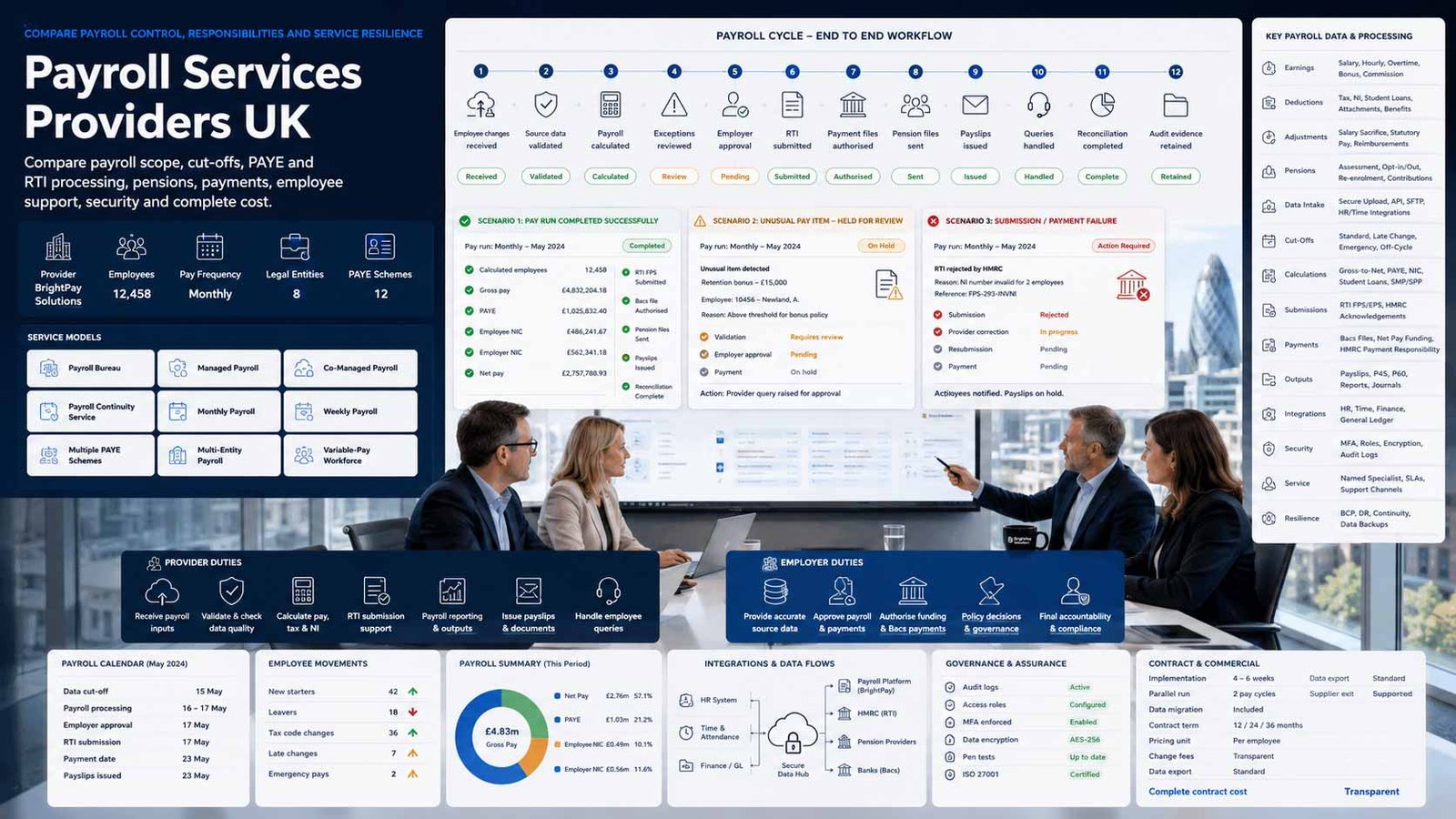
Buy A Controlled Payroll Operating Service, Not A Promise To “Handle Everything”
A dependable provider should define exactly what it receives, checks, calculates, submits, pays, reports and supports—and what remains with the employer—on every payroll cycle.
- Document employer and provider responsibilities line by line
- Set cut-offs, approvals, escalation and correction windows
- Separate payroll calculation from payment authority and funding
- Confirm security, continuity, records, liability and exit in writing
A payroll service is a specialist operating arrangement in which an external provider processes some or all of an employer’s recurring payroll work. Depending on the contract, the provider may validate employee changes, calculate gross-to-net pay, prepare or submit Real Time Information, produce payslips, assess pension duties, generate payment files, manage statutory payments, answer employee queries and provide reports. The employer still retains legal and governance responsibilities and must supply accurate, approved information on time.
The right service depends on workforce size, pay frequencies, variable pay, multiple PAYE schemes or entities, pension complexity, statutory payments, deductions, benefits, union or sector rules, employee query volumes, internal expertise, payment controls, business continuity and required integrations. A heavily automated service can work well for stable payrolls, while complex or high-change payrolls may require named specialists, stronger validation and more flexible cut-off arrangements.
This comparison covers payroll processing and managed payroll operations. It does not compare accountancy services or HR software. Those services have different scopes, professional responsibilities, implementation requirements and provider-selection criteria and should be assessed separately.
Choose The Right Payroll Delivery Model
Managed payroll, bureau processing, co-managed delivery and continuity cover allocate work and risk differently. Compare the responsibility model before comparing a provider name.
| Service Model | What It Usually Includes | Best-Fit Question |
|---|---|---|
| Fully Managed Payroll | The provider performs the agreed end-to-end processing after receiving approved changes, usually including calculations, checks, submissions, reports and employee outputs. | Which employer approvals, payments, liabilities and exception decisions remain outside the managed scope? |
| Part-Managed Or Co-Managed Payroll | The employer retains selected activities while the provider processes defined stages, provides software access or supplies specialist review. | Is the hand-off between internal and provider teams explicit enough to prevent duplicated or missed work? |
| Payroll Bureau Processing | The business supplies structured payroll data and the bureau calculates the pay run, produces reports and may submit RTI or pension files. | How much validation, query handling, payment support and responsibility sits outside the standard bureau fee? |
| Managed Payroll With Payment Services | The provider may create Bacs files, operate an approved bureau route, coordinate net-pay funding or support third-party disbursements. | Who authorises the file, holds funds, confirms settlement and handles rejected or recalled payments? |
| Payroll Continuity Or Temporary Cover | A specialist team provides short-term processing, absence cover, disaster recovery, backlog correction or transition support. | Can the service become operational quickly with sufficient data, authority, documentation and secure access? |
| Multi-Entity Or Group Payroll | One provider runs several PAYE schemes, legal entities, pay groups or calendars using common governance and consolidated reporting. | Can the provider preserve entity-level controls while standardising calendars, data and oversight? |
| Complex Or Sector-Specific Payroll | The service supports variable hours, multiple rates, tips, allowances, salary sacrifice, statutory pay, attachments, pensions or specialist schemes. | Has the provider demonstrated the exact rules and exception volumes present in the business? |
| International Payroll Coordination | A lead provider coordinates UK payroll alongside supported overseas payrolls, reporting, calendars and local partners. | Which legal entity contracts with each local processor and who owns country-level compliance, funding and escalation? |
Eight Areas That Determine Payroll Service Fit
Use the same workforce, pay cycles, pay elements, responsibilities, approval timetable, security standard and support requirements for every provider.
Comparison Criterion
Service Scope And Responsibility Matrix
Define every recurring task from employee change intake to final reports. Confirm who validates new starters and leavers, tax codes, pay elements, statutory leave, deductions, pensions, attachments, approvals, RTI, payment files, payslips, journals, queries, year-end work and corrections. Avoid phrases such as “fully managed” unless the contract translates them into named deliverables and employer dependencies.
Comparison Criterion
Data Intake, Cut-Offs And Validation
Compare secure input methods, templates, portal workflows, APIs, approval roles, cut-off dates, late-change handling, duplicate detection and reasonableness checks. The provider should identify missing or unusual data before calculation, preserve approved source evidence and show how emergency changes, retrospective items and off-cycle payments are controlled.
Comparison Criterion
Payroll Calculation, PAYE And RTI Processing
Assess gross-to-net calculation capability across pay frequencies, multiple rates, bonuses, overtime, salary sacrifice, statutory payments, student and postgraduate loans, attachments and deductions. Confirm the provider’s RTI workflow, submission evidence, rejection handling, amendment process and responsibility for information supplied by the employer.
Comparison Criterion
Pensions, Payments And Third-Party Disbursements
Review automatic-enrolment assessment, opt-ins and opt-outs, contribution files, provider interfaces, re-enrolment support and exception handling. Separately document net-pay, HMRC, pension and other payment responsibilities, authorisation controls, Bacs arrangements, funding deadlines, rejected payments, recalls and reconciliation.
Comparison Criterion
Employee Outputs And Query Service
Compare electronic or paper payslips, P45s, P60s, employee portals, accessibility, notification and identity verification. Define whether the provider answers employee queries directly, which topics are in scope, response times, escalation, language support, correction authority and how sensitive information is disclosed.
Comparison Criterion
Security, Privacy And Access Control
Payroll data includes identity, bank, pay, tax, pension, absence and deduction information. Assess controller-processor terms, roles, MFA, SSO, privileged access, segregation, encryption, audit logs, secure transfer, sub-processors, hosting, international transfers, incident notification, retention, deletion and leaver access. Require evidence rather than a general security statement.
Comparison Criterion
Service Levels, Expertise And Business Continuity
Evaluate named contacts, payroll qualifications, service hours, cycle-specific response targets, accuracy controls, escalation, staffing resilience, holiday cover, disaster recovery, cyber incident procedures and recovery testing. A provider should explain how payroll continues when a specialist, platform, payment route or client approver is unavailable.
Comparison Criterion
Reporting, Integrations, Change And Exit
Confirm payroll journals, liability reports, variance reports, payment files, pension outputs, general-ledger mapping, APIs, import/export formats and audit evidence. Price legislative updates, new entities, acquisitions, pay groups, calendar changes and custom reports. Require complete historic export, parallel-run support, final reconciliation and deletion confirmation at exit.
Measures To Define Before Appointing A Payroll Provider
Translate accuracy, compliance and “managed service” claims into auditable responsibilities, deadlines, controls and outputs.
| Measure | What It Should Define | Evidence To Request | Common Weakness |
|---|---|---|---|
| Responsibility coverage | Who owns each payroll task, decision, submission, payment and employee communication | Responsibility matrix, RACI, service description, exclusions, employer dependencies and acceptance criteria | “Fully managed” is used without defining retained employer work |
| Calendar and cut-off control | How recurring and exceptional payroll changes move from input to approved output | Annual calendar, input deadline, approval window, late-change route, off-cycle process and escalation | The standard cut-off leaves insufficient time for the organisation’s real approval process |
| Input validation | How missing, duplicate, unusual or unapproved data is identified before calculation | Validation rules, variance thresholds, exception report, maker-checker controls and audit trail | The provider processes whatever is supplied and relies on the employer to find errors afterwards |
| Calculation accuracy | How calculations are tested across the employer’s actual pay rules and edge cases | Parallel-run results, scenario scripts, variance analysis, sign-off and defect resolution | A headline accuracy claim is not tied to the client’s complex pay elements |
| Submission evidence | How FPS, EPS and other agreed submissions are authorised, transmitted and evidenced | Submission calendar, authorisation, receipt, rejection handling, resubmission and archive | The employer cannot see whether a submission succeeded before a deadline |
| Payment control | How net pay and third-party amounts are authorised, funded, transmitted and reconciled | Bacs status, approval levels, file control, funding deadline, failure route, recall and reconciliation | Calculation is included but payment responsibilities remain ambiguous |
| Pension operation | How assessment, contribution files, opt events and scheme exceptions are handled | Scheme mapping, assessment tests, file schedule, rejection handling, re-enrolment and audit evidence | A standard interface does not support the organisation’s scheme or pay-reference periods |
| Employee service | How payslips, tax documents, corrections and pay queries are delivered and resolved | Portal demo, identity checks, query categories, response targets, escalation and correction workflow | Employees are sent back and forth between employer and provider without ownership |
| Security and resilience | How payroll data and monthly delivery are protected from operational and cyber disruption | Security controls, processor terms, access review, incident SLA, continuity plan, recovery test and alternative payment route | Certifications are presented without explaining the actual payroll process and sub-processors |
| Exit and record portability | How historic payroll evidence, reports, configuration and open cases leave the service | Export specification, timing, reconciliation, parallel handover, retention, deletion and final service certificate | Only current employee totals are exportable, leaving the employer without reconstructable history |
Payroll Service Providers UK Businesses Can Consider
Shortlist providers whose service scope, expertise, controls, payment model, support and commercial terms match the payroll. Confirm the current product, contracting entity and full written terms before appointment.
Provider Profile
Moorepay
Moorepay offers managed payroll outsourcing for UK employers, with provider-led processing supported by payroll technology and specialist teams. Include it where a business wants a structured managed service with data submission, calculation, reporting and payroll support. Confirm the precise package, employer responsibilities, cut-offs, validation, RTI authorisation, pension scope, payment-file support, employee query route, implementation, service levels, security, business continuity, price basis, annual changes and exit assistance. Exclude unrelated HR products from the comparison unless separately required.
Review official Moorepay managed payroll informationProvider Profile
IRIS Payroll Services
IRIS Payroll Services provides outsourced and managed payroll options for UK organisations, including end-to-end processing and specialist sector propositions. Include it where scale, payroll-bureau capability, implementation support or multiple payroll environments matter. Confirm the operating platform, service location, responsibility split, payroll calendars, data intake, validation, pension and statutory-pay handling, RTI evidence, Bacs or payment support, employee portal, integrations, support model, sub-processors, continuity, migration, fees and record portability.
Review official IRIS Payroll Services informationProvider Profile
MHR Managed Payroll
MHR offers managed and transactional payroll services delivered by payroll specialists for organisations with varying scale and complexity. Include it where complex rules, multi-site operations, named payroll expertise or a co-managed model is required. Confirm whether the proposed service is fully managed or transactional, the retained client team, calculation and validation controls, statutory and pension processing, payment responsibilities, employee support, service metrics, integration design, security, implementation, change control and termination assistance.
Review official MHR managed payroll informationProvider Profile
Zellis Managed Payroll
Zellis provides managed payroll operations for larger and complex UK and Ireland organisations, with services that can include payroll processing, application management and operational support. Include it where scale, multi-entity complexity, varied pay rules, resilience or enterprise governance is central. Confirm supported jurisdictions, legal entities, service delivery locations, responsibility model, calendars, testing, payments, pensions, employee support, service credits, security, sub-processing, continuity, transformation dependencies, implementation milestones and exit data.
Review official Zellis managed payroll informationProvider Profile
ADP UK Payroll Outsourcing
ADP offers UK payroll outsourcing and managed payroll service tiers for organisations that want external processing supported by payroll technology and specialist operations. Include it where UK and international scale, standardised governance, multiple service levels or broader payment and reporting capability may be relevant. Confirm the selected service tier, UK-specific scope, RTI and pension responsibilities, data input, approvals, employee support, payment method, hosting and transfers, service hours, implementation, integration, pricing metrics, change requests and termination support.
Review official ADP UK payroll outsourcing informationProvider Profile
SD Worx Managed Payroll
SD Worx provides outsourced and managed payroll services for UK employers, with expert-led processing, payroll technology and support for different organisation sizes. Include it where a scalable managed model, complex payroll or international coordination is required. Confirm the UK delivery team, service and software components, cut-offs, validation, pension and statutory processing, payment and disbursement scope, employee queries, security controls, resilience, implementation, service measurements, contract pricing and record export.
Review official SD Worx payroll outsourcing informationProvider Profile
Ciphr Outsourced Payroll
Ciphr provides outsourced payroll and payroll bureau services delivered by a UK-based specialist team. Include it where an organisation wants payroll processing combined with defined managed support, employee outputs and a structured bureau relationship. Confirm whether the proposal is fully outsourced or bureau-led, the payroll platform, input and approval duties, year-end and benefits processing, pension scope, Bacs status, employee query support, data hosting, integrations, service levels, migration, per-payslip or minimum charges and exit assistance. Keep HR platform capabilities outside this payroll-only comparison.
Review official Ciphr outsourced payroll informationProvider Profile
PayCaptain Managed Payroll
PayCaptain offers a fully managed UK payroll service supported by cloud payroll technology and payroll professionals, with options for employer and employee interaction. Include it where a modern portal, employee-facing payroll experience, flexible pay frequencies or a provider-led payment model is relevant. Confirm the precise managed scope, authorised-agent and payment responsibilities, data cut-offs, validation, statutory and pension work, employee support, approval controls, Faster Payments or Bacs arrangements, funding, security, implementation, pricing, optional services and exit data.
Review official PayCaptain payroll outsourcing informationWhat Changes Payroll Service Cost
Compare the annual cost of the operating service, implementation, events and retained employer work—not a headline per-payslip figure in isolation.
| Cost Driver | Why It Changes Spend | What A Comparable Quote Should Show |
|---|---|---|
| Employee or payslip volume | Many bureau and managed services price partly by employees, payslips, pay runs or active records | Employee count by pay group, starters, leavers, nil-pay records, seasonal peaks, minimum fee and volume bands |
| Pay frequency and number of payrolls | Weekly, fortnightly, four-weekly and monthly runs create different processing and support workloads | Number of PAYE schemes, legal entities, calendars, regular runs, supplemental runs and parallel cycles |
| Service model and retained work | Fully managed, co-managed and bureau processing include different validation, query and approval activities | Line-by-line responsibility matrix, standard inclusions, employer duties and separately chargeable work |
| Implementation and migration | Discovery, data cleansing, history conversion, configuration, pension setup, parallel runs and training create one-off cost | Project plan, data volumes, supported formats, number of parallels, defect correction, go-live and contingency |
| Payroll complexity | Variable hours, multiple rates, statutory pay, attachments, salary sacrifice, tips, allowances and bespoke rules increase processing and testing | Pay elements, rule catalogue, employee groups, exception volume, collective agreements and scenario tests |
| Pension and third-party files | Multiple pension schemes, provider interfaces, opt events, re-enrolment and file failures require additional work | Scheme count, pay-reference periods, file formats, rejection handling, amendments and employer approvals |
| Payments and disbursements | Bacs bureau services, Faster Payments, net-pay funding and third-party payments have different controls and transaction costs | Payment route, authorisation, funding deadline, banking charges, rejected items, recalls and reconciliation |
| Employee and manager support | Direct query handling, portal support, corrections and enhanced service desks may be separate from processing | User population, query categories, expected volumes, channels, service hours, response targets and exclusions |
| Off-cycle, correction and year-end work | Additional runs, late changes, amended submissions, P11Ds, P60s, previous-year corrections and special reports may be charged separately | Rate card for planned and emergency events, approval process, lead time and maximum volumes |
| Contract, change and exit | Minimum term, annual uplift, change requests, integrations, new entities and termination assistance affect lifecycle cost | Price index, notice, auto-renewal, service credits, change-control rates, export, parallel handover and deletion |
| Indicative Commercial Model | Typical Position | What Must Be Confirmed |
|---|---|---|
| Per Payslip Or Per Employee Model | A recurring unit charge may apply for each employee, payslip or active record, often subject to a monthly minimum | Confirm the unit definition, nil-pay records, starters, leavers, extra runs, volume bands and annual uplift |
| Fixed Monthly Managed-Service Model | A base fee covers an agreed payroll population and standard operating scope | Confirm included runs, support, pension work, payments, reports, changes, overage and unused capacity |
| Hybrid Base Plus Transaction Model | A platform or management fee is combined with per-payslip, payment, portal or exception charges | Build a representative annual volume model using all recurring and event-driven transactions |
| Bespoke Enterprise Or Multi-Country Model | Pricing reflects entities, countries, complexity, service locations, technology, transformation and governance | Require a transparent charge catalogue, assumptions, indexation, project cost, service credits and exit support |
Match The Service To The Payroll Operating Pattern
The right shortlist depends on payroll volume, variability, internal expertise, pay frequencies, legal entities, employee service and appetite for retained control.
Small Employer With A Stable Monthly Payroll
Prioritise a clear monthly minimum, simple secure data intake, named support, HMRC and pension evidence, employee payslips, year-end outputs and predictable charges. Avoid enterprise complexity when the provider cannot explain who will actually run and check the payroll.
Growing SME With Variable Pay
Prioritise starter and leaver workflows, overtime and bonus validation, flexible cut-offs, pension handling, employee self-service, accounting journals, support capacity and a contract that can absorb headcount and pay-group changes without repeated reimplementation.
Multi-Site Or High-Volume Employer
Prioritise robust input controls, multiple calendars, high transaction capacity, exception reporting, delegated approvals, direct employee query handling, service-level governance, business continuity, detailed audit evidence and predictable handling of late changes.
Complex Group Or International Operation
Prioritise entity-level governance, specialist expertise, multiple PAYE schemes, complex rules, payment controls, consolidated reporting, secure integrations, sub-processor visibility, country coordination, formal change control and a tested transition and exit plan.
How To Compare Payroll Service Proposals
Issue one payroll specification containing employee and payslip volumes, PAYE schemes, legal entities, pay frequencies, calendars, pay elements, pensions, statutory events, deductions, attachments, variable-pay sources, cut-offs, approvals, payment routes, employee queries, reports, integrations, security, continuity and exit requirements. Require a response matrix rather than relying on a generic managed-service brochure.
- Every payroll task has an employer or provider owner
- Cut-offs, approvals, late changes and corrections are explicit
- RTI, pension and payment evidence is included
- Employee queries and exceptions have accountable service levels
- Implementation, parallel testing and continuity are priced
- Historic data, audit evidence and exit support are contractually portable
Compare The Same Payroll Year
Ask every provider to price the same twelve-month scenario using identical headcount, pay runs, starters, leavers, pension schemes, statutory events, off-cycle work, employee queries and integrations.
A low unit price is not comparable when validation, Bacs services, pension files, employee support, corrections, implementation or exit are excluded.
Six Questions To Put To Every Payroll Service Provider
The answers expose scope gaps, cut-off risk, weak submission evidence, payment ambiguity, inadequate continuity and expensive change.
What Exactly Will You Own Each Pay Cycle?
Request a responsibility matrix covering data receipt, validation, calculation, approvals, RTI, pensions, payment files, payslips, reports, employee queries, corrections and year-end activities.
What Are The Cut-Off, Approval And Late-Change Rules?
Ask for the annual payroll calendar, standard and emergency deadlines, escalation route, off-cycle process, extra charges and evidence that late changes cannot bypass approval controls.
How Do You Prove Calculations And Submissions Are Correct?
Confirm parallel testing, variance checks, maker-checker controls, client sign-off, FPS and EPS receipts, rejection handling, pension-file evidence, audit logs and error-resolution responsibility.
Who Controls And Funds Employee And Third-Party Payments?
Document Bacs or Faster Payments status, authorisers, funding deadlines, bank-file controls, HMRC and pension payment responsibility, rejected payments, recalls and reconciliation.
How Are Payroll Data And Monthly Delivery Protected?
Review access control, MFA, encryption, secure transfer, hosting, sub-processors, international transfers, incident notification, backup, recovery tests, alternative processing and continuity staffing.
What Happens When The Payroll Changes Or The Contract Ends?
Confirm new entities, acquisitions, pay groups, legislative updates, custom rules, integrations, annual price changes, notice, parallel handover, complete exports, open cases, retention and deletion.
A Seven-Stage Payroll Provider Evaluation
Move from a verified payroll baseline to controlled parallel testing and accountable service governance rather than selecting from a provider feature list.
- Create a verified payroll baseline covering employees, entities, PAYE schemes, pay frequencies, calendars, pay elements, pension schemes, statutory events, deductions, attachments, payment routes, employee queries, current errors, internal effort and accountable owners.
- Map the end-to-end payroll process from employee change through approved source data, calculation, validation, sign-off, HMRC and pension submissions, payments, payslips, journals, queries, corrections, records and year-end work.
- Define the target responsibility matrix, service calendar, cut-offs, late-change rules, approval levels, payment authority, query service, reports, security, continuity, implementation, integrations, retention and exit requirements.
- Prepare one supplier brief and annual pricing scenario with identical headcount, pay runs, starters, leavers, pension files, statutory events, off-cycle work, payment transactions, support volumes and transition assumptions.
- Shortlist providers by payroll-service fit, UK expertise, demonstrable controls, employee service, security, resilience, implementation capacity, financial stability and references from organisations with similar payroll complexity.
- Run discovery and parallel testing using representative payrolls and edge cases. Reconcile gross-to-net, liabilities, RTI outputs, pensions, payment files, payslips, journals, audit trails and employee-query routes before accepting go-live.
- Go live under formal sign-off, dual control and a documented contingency process. Review accuracy, timeliness, exception volumes, late changes, employee queries, service levels, retained employer effort and effective cost before renewal.
Payroll Services Comparison Checklist
Use this table before appointing, replacing or renewing a payroll service for a UK employer.
| No. | Requirement | Evidence To Obtain Before Award | Confirmed |
|---|---|---|---|
| 01 | Payroll baseline complete | Employees, entities, schemes, calendars, frequencies, elements, pensions, deductions, payments, queries and owners | |
| 02 | End-to-end process mapped | Source data, validation, calculation, approvals, submissions, payments, outputs, corrections, records and year end | |
| 03 | Responsibility matrix approved | Employer and provider ownership, exclusions, dependencies, decision rights, evidence and acceptance criteria | |
| 04 | Calendar and cut-offs accepted | Annual dates, inputs, approvals, banking, HMRC, pensions, late changes, off-cycle work and escalation | |
| 05 | Pay rules and scenarios tested | Rates, overtime, bonuses, salary sacrifice, statutory pay, loans, attachments, deductions and retrospectives | |
| 06 | RTI and HMRC evidence approved | FPS, EPS, authorisation, receipts, rejections, amendments, liabilities, deadlines and archive | |
| 07 | Pension operation approved | Schemes, assessment, opt events, contributions, files, rejections, re-enrolment, postponement and records | |
| 08 | Payment controls documented | Bacs status, net-pay file, authorisers, funding, HMRC and pension payments, failure, recall and reconciliation | |
| 09 | Employee service accepted | Payslips, P45, P60, portal, accessibility, identity checks, query scope, service levels and corrections | |
| 10 | Security and processor terms approved | Roles, MFA, SSO, encryption, logs, hosting, sub-processors, transfers, incidents, retention and deletion | |
| 11 | Continuity and recovery tested | People cover, platform outage, secure alternative input, payment route, backups, recovery target and exercise evidence | |
| 12 | Implementation responsibilities agreed | Discovery, cleansing, configuration, history, integrations, parallel runs, training, sign-off and contingency | |
| 13 | Service governance agreed | Named contacts, qualifications, reporting, meetings, accuracy, timeliness, response targets, escalation and credits | |
| 14 | Complete charges and contract approved | Base, unit, minimum, setup, events, support, payments, changes, annual uplift, renewal, notice and termination | |
| 15 | Exit and record portability proven | Historic detail, submissions, reports, audit, configuration, open cases, parallel handover, retention and deletion |
Common Payroll Service Buying Mistakes
Most avoidable failures begin with undefined responsibility, weak testing, payment ambiguity, insecure data transfer or a contract priced without real payroll events.
| Mistake | Why It Creates Risk | Better Control |
|---|---|---|
| Assuming “fully managed” means the provider owns every task | The employer may still own source data, approvals, payments, liabilities, employee queries and corrections | Convert the sales description into a signed responsibility matrix |
| Choosing on per-payslip price alone | Implementation, minimums, pension files, payment services, support, off-cycle work and exit can outweigh the unit fee | Price one complete payroll year and the retained internal workload |
| Setting cut-offs before mapping real business approvals | Managers may miss deadlines, creating late changes, corrections and emergency fees | Design the calendar around source owners, approval time and banking deadlines |
| Skipping detailed parallel testing | Totals can match while employee-level tax, pension, deduction or payment details are wrong | Test representative employees, edge cases, outputs and submission evidence |
| Leaving payment responsibility ambiguous | A correct payroll can still fail if funding, authorisation or transmission is late or rejected | Document every payment owner, deadline, control and fallback |
| Treating pension processing as a standard add-on | Scheme rules, files, pay-reference periods and rejection processes vary | Test each scheme, file and exception workflow before go-live |
| Sending payroll data through informal channels | Email attachments and uncontrolled spreadsheets increase privacy, integrity and version risk | Use secure, authorised input workflows with audit and approval |
| Ignoring employee query ownership | Payday issues can bounce between internal teams and the provider, delaying correction and damaging trust | Define query categories, identity checks, service levels and escalation |
| Underestimating business continuity | Payroll depends on specialist people, systems, banking routes and approvals arriving together | Test absence, cyber, platform, input and payment-failure scenarios |
| Allowing renewal without service evidence | Volume, complexity, fees, error patterns, support and retained workload change over time | Review accuracy, timeliness, effective cost, employee service and exit readiness before notice dates |
Frequently Asked Questions
Answers to common questions from UK employers comparing payroll outsourcing, bureau processing, payment support, security and service terms.
What Is An Outsourced Payroll Service?
An outsourced payroll service is an arrangement in which a specialist provider processes agreed payroll activities for an employer. The scope may include calculations, Real Time Information submissions, pension files, payslips, reports, payment support and employee queries. The employer must still provide accurate information, approvals and governance according to the contract.
What Is The Difference Between Managed Payroll And A Payroll Bureau?
A payroll bureau commonly calculates payroll from information supplied by the employer and returns reports and outputs. A fully managed service may take on more validation, administration, employee support, pension work and operational ownership. Labels vary, so buyers should compare the responsibility matrix rather than the service name.
Does Outsourcing Payroll Transfer The Employer’s Legal Responsibility?
No. A provider can perform calculations and agreed submissions, but the employer remains responsible for its employment, tax, pension, data-protection and payment obligations. The contract should define responsibilities, evidence, liability, approvals and escalation, and the employer should retain sufficient oversight.
What Information Does A Payroll Provider Need?
The provider normally needs approved employee details, tax and starter information, pay rates, hours or variable pay, statutory leave, deductions, pension data, bank and payment information, leavers, attachments and other agreed changes. Secure formats, cut-offs, approvals and validation rules should be documented.
Can A Payroll Provider Submit PAYE Information To HMRC?
Many UK payroll providers can prepare and submit Full Payment Submissions and Employer Payment Summaries when authorised and when that work is included. The employer should confirm the authorisation, deadline, submission receipt, rejection process, amendments and which liabilities it must pay.
Can A Payroll Service Manage Workplace Pension Processing?
Many managed services can assess workers, calculate contributions, create pension files and process opt-in, opt-out or re-enrolment events. Capability varies by pension scheme and service tier. The employer should test each scheme interface, rejection process, payment responsibility and record requirement.
How Much Do Payroll Services Cost In The UK?
Pricing usually depends on employee or payslip volume, pay frequency, number of payrolls, service scope, complexity, implementation, pension work, payment services, employee support and contract term. Providers may use per-payslip, fixed monthly, hybrid or bespoke enterprise pricing, often with minimum and event charges.
Should A Payroll Provider Pay Employees On The Employer’s Behalf?
Some providers create payment files, operate approved Bacs bureau services or provide managed payment arrangements; others stop at calculation and reporting. The employer should understand who authorises payments, who holds funds, banking deadlines, rejected-payment handling, reconciliation and liability.
What Security Checks Matter For Payroll Outsourcing?
Check controller and processor terms, MFA, privileged access, encryption, secure data transfer, audit logs, hosting, sub-processors, international transfers, incident notification, retention, deletion, business continuity and recovery testing. Payroll data is highly sensitive and should not be exchanged through uncontrolled channels.
How Should UK Businesses Compare Payroll Providers?
Give every provider the same payroll baseline, annual calendar, responsibility matrix, employee volumes, pay elements, pension schemes, payment method, support demand, security requirements and transition assumptions. Compare evidenced control, employee service, retained employer effort, implementation, total annual cost and exit—not brand or unit price alone.
Official Guidance And Provider Resources
Reviewed by Bhav Giva, Founder & Lead Analyst at CompareServices.co.uk, on 31 July 2026.
Use current HMRC, GOV.UK, The Pensions Regulator, ICO and provider documentation to verify employer duties, submission timing, records, pension responsibilities, data processing, service scope, security and contract terms. Payroll legislation, thresholds, statutory rates, provider services and charges can change. Obtain tax, pension, employment and data-protection advice where required.
- GOV.UK — PAYE And Payroll For Employers
- GOV.UK — Reporting Payroll Information To HMRC
- GOV.UK — Payroll Records Employers Must Keep
- GOV.UK — HMRC-Recognised Payroll Software
- The Pensions Regulator — Employer Automatic-Enrolment Duties
- ICO — Controllers And Processors Guidance
- Moorepay — Managed Payroll Services
- IRIS — Payroll Services
- MHR — Managed Payroll Services
- Zellis — Managed Payroll Services
- ADP UK — Payroll Outsourcing Services
- SD Worx — Outsourced Payroll Services
- Ciphr — Outsourced Payroll Services
- PayCaptain — Payroll Outsourcing