
Compare Accountancy Services Providers UK
Compare Scope, Qualifications, Statutory Accounts, Tax Compliance, Advice, Reporting, Digital Workflows, Service Levels, Fees And Exit Support
Compare accountancy services UK providers by business and entity fit, professional qualifications, regulatory and anti-money-laundering supervision, annual accounts, Corporation Tax or Self Assessment support, VAT and Making Tax Digital capability, management accounts, cash-flow and forecasting input, tax-planning boundaries, named adviser access, response standards, software compatibility, document controls, pricing, annual increases, professional indemnity, continuity and complete handover. Give every firm the same business profile, transaction complexity, reporting needs, deadlines, advisory expectations and responsibility matrix before comparing proposals.
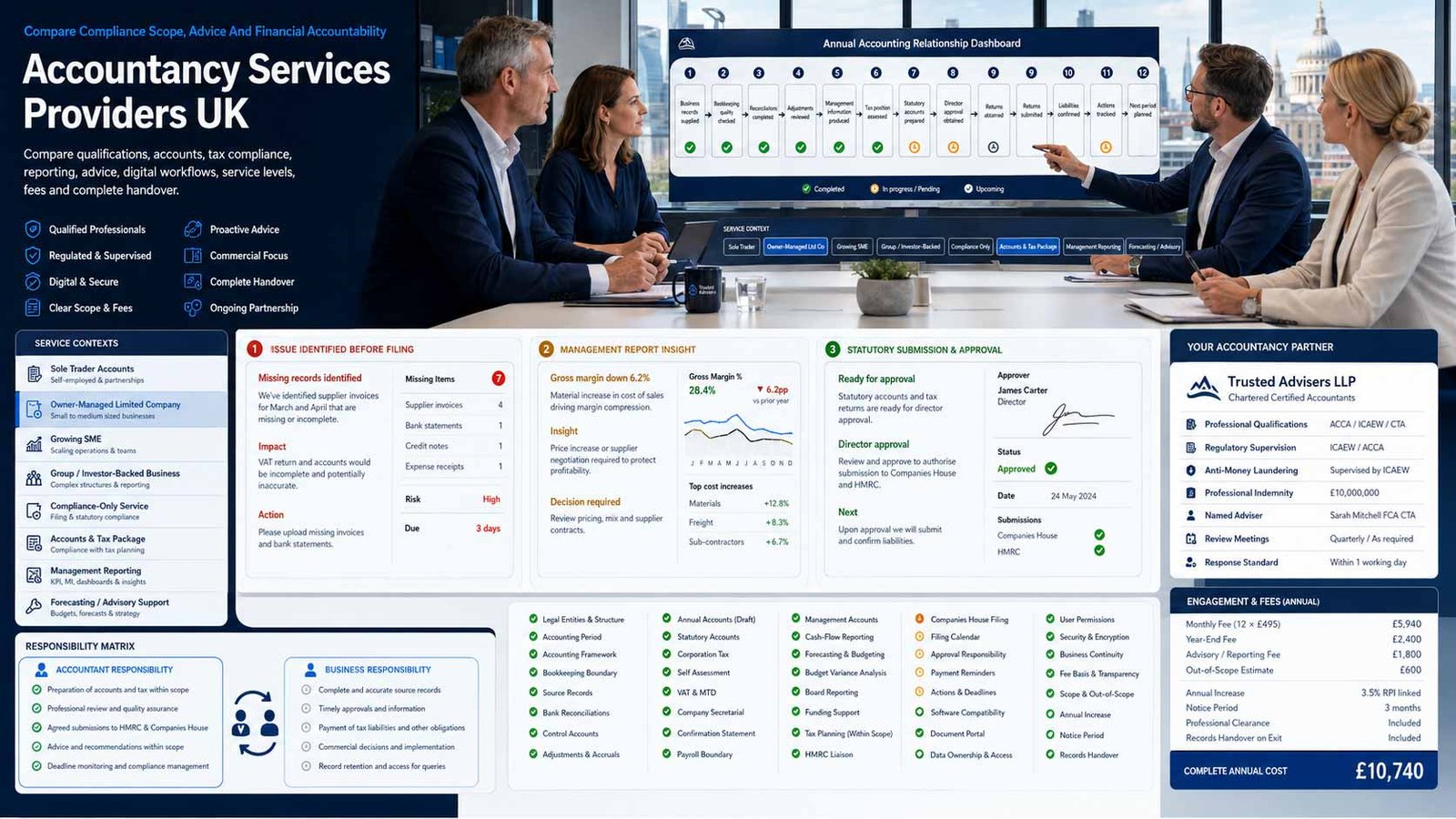
Buy An Accountable Finance And Compliance Relationship, Not Just A Filing Promise
A useful accountancy service should turn complete business records into accurate filings, timely decisions and clearly owned actions throughout the year. The engagement must state what the firm will do, what the business must supply and what remains outside scope.
- Define every filing, report, review and advisory responsibility
- Verify professional status, supervision, insurance and named expertise
- Agree source-data standards, deadlines, approvals and evidence
- Confirm fees, annual changes, continuity, records and exit in writing
Accountancy services combine professional accounting, statutory reporting, tax compliance and business-finance support under an agreed engagement. Depending on the provider and package, the service may cover annual accounts, Corporation Tax or Self Assessment returns, VAT, company secretarial work, management accounts, forecasting, cash-flow review, tax advice and liaison with HMRC or Companies House.
The correct provider depends on legal structure, turnover, transaction volume, VAT position, sector, ownership, finance-team capability, funding plans, international activity, reporting timetable, accounting framework and the level of proactive advice required. A low monthly fee is not comparable when one proposal assumes clean reconciled records and another includes regular management information, adviser meetings and year-round query support.
This page compares full accountancy relationships. It does not compare payroll-only services or bookkeeping-only services. Those adjacent services have different operational workflows, volumes, controls, pricing units and provider responsibilities and should be assessed separately.
Choose The Right Accountancy Service Model
The delivery model changes the provider relationship, data burden, review frequency, advice access and total cost.
| Service Model | What It Usually Includes | Best-Fit Question |
|---|---|---|
| Annual Compliance Service | Year-end accounts, tax computation and return, filing support and a defined annual review using records prepared by the client or another bookkeeper. | Are record-quality assumptions, filing responsibilities, review points and out-of-scope advisory work explicit? |
| Sole Trader Or Partnership Service | Self Assessment accounts, allowable-expense review, tax return preparation, payments-on-account planning and support with business records. | Does the adviser understand the trade, partnership structure, personal tax interactions and Making Tax Digital timetable? |
| Limited Company Full-Service Accountancy | Statutory accounts, Corporation Tax, director tax support, confirmation and company-secretarial options, VAT and scheduled advice. | Which entity, director, tax, filing and advisory tasks are included, and who owns each deadline? |
| Online Subscription Accountancy | Digital records and document capture combined with remote accountants, standard workflows, messaging, recurring fees and package limits. | Will the service model provide enough adviser continuity, response quality and support for exceptions? |
| Local Relationship-Led Practice | A named local accountant or partner with face-to-face access, annual compliance and business advice tailored to owner-managed companies. | Is service delivery dependent on one person, and what cover exists during absence, peak filing periods or succession? |
| Management Accounts And Growth Support | Monthly or quarterly reporting, variance analysis, cash-flow forecasting, board packs, budgeting and commercial meetings alongside compliance. | Are timeliness, management adjustments, commentary depth and decision-support responsibilities measurable? |
| Outsourced Finance Function | A wider team delivers transactional oversight, month end, reporting, controls, systems support, tax and finance-lead input. | Does the proposal distinguish accountancy, bookkeeping, finance operations, controller and finance-director responsibilities? |
| Group, International Or Complex Accounting | Multi-entity reporting, consolidations, UK subsidiaries, intercompany accounting, accounting-framework advice and cross-border coordination. | Which jurisdictions, frameworks, specialists and local-provider dependencies are included in the engagement? |
Eight Areas That Determine Accountancy Service Fit
Give every firm the same entity profile, records position, compliance scope, reporting timetable and advisory requirements.
Comparison Criterion
Scope, Responsibilities And Filing Calendar
List every legal entity, owner, tax registration, return, account, report, meeting and filing date. Require a responsibility matrix covering source data, reconciliations, estimates, approvals, submission, payment reminders, corrections and professional advice. A package name is not an adequate scope.
Comparison Criterion
Qualifications, Supervision And Insurance
Check the engagement firm, named adviser and relevant professional memberships rather than relying on a logo alone. Verify practising status where applicable, anti-money-laundering supervision, professional indemnity insurance, complaints process, specialist licences and which work is reviewed by qualified staff.
Comparison Criterion
Business, Sector And Complexity Fit
Assess experience with the same legal structure, ownership, accounting framework, VAT profile, transaction model, grants, stock, property, e-commerce, charities, regulated activity, international trade or investor reporting. Ask for comparable-client references and examples of edge cases handled.
Comparison Criterion
Accounts, Tax And Submission Control
Review year-end planning, accounting policies, estimates, tax computations, returns, authorisations, filing evidence, HMRC correspondence, Companies House submissions, amendments and deadline monitoring. Directors and taxpayers retain legal responsibility even when a provider prepares or files documents.
Comparison Criterion
Management Information And Proactive Advice
Define monthly or quarterly reporting, close timetable, accruals, deferred income, stock, project profitability, budgets, cash flow, tax forecasts, KPIs, commentary and meeting cadence. Require examples showing how the provider identifies issues before a statutory deadline.
Comparison Criterion
Digital Workflow, Software And Data Control
Compare accounting-platform compatibility, bank feeds, document capture, expense tools, approval workflows, secure portal, user permissions, integration, Making Tax Digital support, audit trails, exports, backup and ownership of subscriptions and administrator credentials.
Comparison Criterion
People, Access, Service Levels And Continuity
Identify the partner, manager, preparer and specialist roles; expected response times; channels; scheduled reviews; escalation; holiday and sickness cover; peak-season capacity; staff turnover; and who can make technical decisions. Test service availability before appointment.
Comparison Criterion
Fees, Change, Contract And Exit
Compare fixed and variable fees, assumptions, transaction or turnover bands, catch-up work, tax enquiries, meetings, reports, software, company changes, annual uplift, minimum term, notice, disengagement, professional clearance, data export, records, authorisations and final responsibilities.
Measures To Define Before Appointing An Accountant
Translate trust, expertise and proactive-service claims into verifiable scope, records, controls and handover evidence.
| Measure | What It Should Define | Evidence To Request | Common Weakness |
|---|---|---|---|
| Engagement scope | The precise services, entities, periods, responsibilities, assumptions and exclusions | Draft engagement letter, responsibility matrix, annual calendar, deliverable list and service boundaries | Marketing language is broader than the contractual engagement |
| Professional standing | Who performs, reviews and accepts responsibility for the work | Named team, qualifications, practising status, directories, AML supervisor, insurance and complaints route | A firm brand is verified but the assigned team and review level are unknown |
| Record readiness | The quality, frequency and format of records the provider expects | Data specification, chart of accounts, reconciliations, cut-off requirements, opening balances and exception process | The quoted fee assumes clean records that the business cannot produce |
| Filing control | How accounts and returns are prepared, reviewed, approved, submitted and evidenced | Workflow, review checklist, client approval, submission receipt, rejection handling and amendment process | The provider sends reminders but deadline ownership is ambiguous |
| Tax-service boundary | Which computations, returns, elections, claims, planning and enquiries are included | Tax matrix, advice process, written-opinion threshold, enquiry support, specialist referrals and fees | General tax support excludes the issue that matters to the business |
| Management reporting | Whether information is timely, reconciled and useful for decisions | Example pack, close calendar, adjustments, KPI definitions, commentary, meeting notes and action tracking | Reports are produced late or without explanation of material movements |
| Advice access | The people, frequency and service standard available outside filing season | Named adviser, scheduled reviews, response targets, technical escalation and included consultation time | Unlimited support is routed through a generic queue with no accountable adviser |
| Security and data roles | How financial, identity, tax and employee data is accessed, stored and shared | Controller/processor assessment, contract, MFA, encryption, access logs, sub-processors, retention and incidents | Sensitive documents are exchanged through ordinary email without agreed controls |
| Continuity | How statutory and management work continues during absence, outage or provider disruption | Team cover, capacity, backups, recovery, alternative access, succession and business-continuity evidence | A sole relationship manager holds critical knowledge with no documented substitute |
| Exit portability | Whether another accountant can continue without recreating history or missing deadlines | Professional clearance, trial balance, ledgers, working papers where releasable, returns, authorisations, exports and timetable | Data belongs to a provider-controlled platform or is delivered only as PDFs |
Accountancy Services Providers UK Businesses Can Consider
Shortlist firms whose delivery model, professional standing, service depth and relationship structure fit the business. Confirm the current legal entity, assigned team and complete engagement before appointment.
Provider Profile
TaxAssist Accountants
TaxAssist is a national network of locally operated practices focused on independent businesses, self-employed people and owner-managed companies. Include it where local access and a broad accounts-and-tax relationship are priorities. Confirm the specific practice and engagement partner, professional status, included entities and returns, record-keeping expectations, software, meeting access, tax-advice limits, response standards, franchise-level service variation, insurance, fees, annual increases, notice and professional-clearance process.
Review official TaxAssist informationProvider Profile
Crunch
Crunch combines online accounting software with remote accountancy packages for sole traders, contractors and limited companies. Include it where digital self-service, predictable package structures and online access suit a smaller business. Confirm the selected plan, transaction and complexity limits, assigned-adviser model, bookkeeping responsibilities, annual accounts and tax scope, VAT, software ownership, support channels, response standards, additional fees, professional qualifications, migration, records and exit.
Review official Crunch accountancy servicesProvider Profile
Accounts And Legal
Accounts and Legal provides small-business accounting, tax and wider commercial support, including annual accounts, management reporting and outsourced-finance options. Include it where a business wants compliance work alongside more frequent commercial input. Confirm the exact accountancy team, legal-service separation, deliverables, monthly close, forecasts, tax scope, software and record responsibilities, meeting cadence, service standards, fees, specialist work, regulated-activity boundaries, continuity and handover.
Review official Accounts and Legal informationProvider Profile
inniAccounts
inniAccounts provides digital accountancy services oriented towards contractors, consultants, freelancers and limited-company owners, with accounting support and integrated tools. Include it where contractor-specific workflows, company administration and remote support fit the business. Confirm sector eligibility, IR35-advice boundary, accounts and tax work, bookkeeping input, VAT, payroll exclusions, named support, software access, transaction complexity, additional-company or personal-tax charges, records, notice and switching assistance.
Review official inniAccounts informationProvider Profile
Mazuma
Mazuma offers recurring online accountancy packages for microbusinesses and small companies, combining routine records support, tax and accounts. Include it where a straightforward monthly service and remote document workflow suit a lower-complexity business. Confirm the actual package, entity and turnover fit, bookkeeping element, year-end accounts, returns, VAT, adviser access, qualification and review, catch-up work, software or postal workflow, extra transactions, tax enquiries, fees, no-tie-in wording, unfinished-year treatment and data export.
Review official Mazuma accounting servicesProvider Profile
Azets
Azets provides accounting, compliance, tax, advisory and outsourced-finance services to owner-managed, growing and more complex organisations through a national office network. Include it where scale, sector specialists, management accounting or broader outsourcing may be required. Confirm the responsible office and partner, service modules, accounts framework, monthly close, tax jurisdictions, technology, specialist referrals, team location, service levels, implementation, variable work, fee governance, independence considerations and exit deliverables.
Review official Azets informationProvider Profile
MHA
MHA provides accounts, advisory and outsourcing services for growth-focused organisations, including recurring accounting support and wider specialist capability. Include it where management information, sector expertise or a developing finance function is important. Confirm the legal contracting entity, named team, statutory and management-account scope, bookkeeping dependencies, tax specialists, reporting timetable, systems, governance, data roles, service standards, annual fee review, audit-independence considerations and transition support.
Review official MHA accounts and advisory servicesProvider Profile
BDO
BDO’s Business Services and Outsourcing practice provides accounting, compliance, advisory and back-office support for owner-managed, mid-market, international and complex organisations. Include it where multi-entity reporting, UK subsidiaries, accounting-framework support or scalable outsourcing is needed. Confirm scope by entity and jurisdiction, local and offshore delivery, bookkeeping dependency, statutory accounts, tax coordination, consolidations, management reporting, systems, controls, service governance, specialist fees, independence restrictions, data portability and exit.
Review official BDO outsourced accounting servicesWhat Changes Accountancy Service Cost
Compare the effective annual relationship cost, retained internal workload and risk—not a headline monthly package alone.
| Cost Driver | Why It Changes Spend | What A Comparable Proposal Should Show |
|---|---|---|
| Legal structure and entities | Sole traders, partnerships, limited companies, groups, charities and overseas-owned entities have different accounts, tax and filing work | Each entity, owner return, registration, framework and submission listed separately |
| Transaction volume and record condition | High volumes, unreconciled balances, mixed personal spending, stock, projects or historic errors increase preparation and review | Assumed monthly transactions, accounts, reconciliations, bookkeeping boundary and catch-up work |
| VAT and tax complexity | Multiple VAT schemes, partial exemption, overseas sales, property, R&D, capital allowances, benefits or reorganisations require specialist input | Included returns, computations, planning, elections, reviews, specialist referrals and exclusions |
| Reporting frequency | Annual compliance is cheaper than monthly management accounts, forecasts, board packs and adviser meetings | Close timetable, adjustments, reports, commentary, meetings and action follow-up |
| Software and digital workflow | Licences, migration, document tools, bank feeds, integrations, configuration and cleanup can be included or charged separately | Platform, subscription owner, implementation, support, integrations, administrator access and export |
| Service and adviser access | Named senior advisers, faster response, scheduled reviews and specialist access increase value and delivery cost | Team structure, included consultation, response targets, meeting allowance and escalation |
| Changes and event work | New entities, funding, acquisitions, disposals, tax enquiries, investigations, registrations and late records create non-routine fees | Rate card, estimates, approval threshold, urgency charges and responsibility for missed assumptions |
| Implementation or switching | Opening balances, professional clearance, software migration, authority transfer and historic cleanup require effort | Onboarding plan, records list, cut-off, prior-accountant dependency, setup fee and acceptance criteria |
| Professional risk and assurance | Complex frameworks, regulated sectors, public-interest work or higher-risk tax positions require stronger review and insurance | Review level, specialist sign-off, insurance, opinions and any work the firm will not accept |
| Renewal and exit | Annual uplifts, package changes, minimum term, work-in-progress and release of records affect lifecycle cost | Review date, uplift method, notice, final work, professional clearance, export, authorisation removal and deletion |
| Indicative Commercial Model | Typical Position | What Must Be Confirmed |
|---|---|---|
| Basic Sole-Trader Or Self-Assessment Relationship | Often priced as an annual fixed fee or a low recurring monthly amount where records are organised and advice needs are limited | Confirm bookkeeping is not assumed, how many income sources are included, Making Tax Digital support and charges for late or incomplete records |
| Micro Limited Company Compliance Package | Commonly a recurring monthly package covering statutory accounts, Corporation Tax and defined support, with VAT or director returns added | Confirm transaction, turnover, employee, director and software assumptions and whether tax planning or meetings are genuinely included |
| Growing SME Accounts And Advisory Package | A higher recurring fee may combine management accounts, cash-flow review, tax planning, meetings and year-end compliance | Define close timetable, report quality, adviser seniority, meeting frequency, specialist work and whether scope scales with growth |
| Outsourced Accounting Or Finance Function | Usually a tailored monthly or project fee based on people, processing, entities, reporting, systems and control responsibilities | Separate bookkeeping, month end, statutory accounts, tax, controller, finance-director and transformation work so proposals are comparable |
Match The Accountant To The Finance And Compliance Requirement
The right shortlist depends on legal structure, record quality, reporting frequency, complexity, growth plans and how much finance capability remains in-house.
Sole Trader Or Early-Stage Business
Prioritise clear record requirements, Self Assessment and tax-payment planning, Making Tax Digital readiness, accessible advice and a simple fixed scope. Avoid paying for corporate reporting that the business does not need.
Owner-Managed Limited Company
Prioritise statutory accounts, Corporation Tax, director and dividend support, VAT where relevant, annual planning, named accountability, Companies House coordination and enough year-round advice to prevent last-minute decisions.
Growing Multi-Department SME
Prioritise monthly close, management accounts, budgets, cash flow, project or departmental reporting, finance-process improvement, tax forecasting, specialist access and service governance that can scale beyond one relationship manager.
Group, International Or Investor-Backed Business
Prioritise multi-entity reporting, consolidations, accounting frameworks, UK subsidiary compliance, intercompany control, board and investor packs, audit readiness, cross-border coordination, security, continuity and formal exit deliverables.
How To Compare Accountancy Service Proposals
Issue one business brief covering legal entities, owners, turnover, transaction profile, bank and card accounts, VAT, accounting year ends, record condition, systems, existing deadlines, statutory accounts, tax returns, management reporting, forecasts, meetings, specialist issues, HMRC contact, security, continuity and handover. Require a response matrix rather than accepting a package description.
- Every entity, return, report and deadline is listed
- Provider and client responsibilities are separated
- Assigned qualifications and review levels are evidenced
- Record assumptions and cleanup work are explicit
- Advice, meetings, reporting and service levels are measurable
- Complete annual fees, renewal and exit are documented
Compare The Same Accounting Year
Ask every provider to price the same representative year using identical entities, transaction volumes, returns, VAT periods, management reports, meetings, advisory events, software, onboarding and record-quality assumptions.
A lower package price is not comparable when the business must complete reconciliations, buy separate software, pay for every query or accept slower reporting and weaker adviser continuity.
Six Questions To Put To Every Accountancy Provider
The answers expose scope gaps, hidden record assumptions, weak accountability, limited advice, service inconsistency and expensive disengagement.
What Exactly Is Included For Each Entity And Owner?
Request a responsibility matrix for accounts, tax returns, VAT, Companies House work, management reports, meetings, advice, HMRC correspondence, payments, records and all exclusions.
Who Will Perform, Review And Own The Work?
Identify the contracting firm, partner, manager, preparers and specialists; verify qualifications, practising status, AML supervision, insurance, complaints and continuity cover.
What Records Must We Provide And By When?
Confirm bookkeeping boundary, reconciliations, document format, bank feeds, cut-offs, estimates, late records, quality checks, correction fees and the consequences of missing information.
How Will You Control Filings, Tax Positions And Approvals?
Review calendars, review checklists, tax computations, written advice, client approval, HMRC and Companies House authorisation, receipts, rejections, amendments and deadline escalation.
What Service Will We Receive Between Deadlines?
Define named access, included questions, response targets, management reports, tax forecasts, scheduled reviews, proactive alerts, specialist escalation and how actions are recorded.
What Happens When Scope Changes Or We Leave?
Confirm new entities, funding, enquiries, acquisitions, urgent work, annual uplift, minimum term, notice, work in progress, professional clearance, full exports, authorisation removal, retention and deletion.
A Seven-Stage Accountancy Provider Evaluation
Move from a verified accounting baseline to an accountable engagement and controlled handover rather than selecting from reputation or price alone.
- Create a verified finance and compliance baseline covering entities, owners, accounting periods, registrations, filings, transactions, bank accounts, systems, record quality, reporting, current adviser responsibilities, overdue work, known risks and accountable internal owners.
- Map the annual accounting cycle from source records through reconciliations, month or quarter close, management reporting, estimates, statutory accounts, tax computations, approvals, filings, payments, HMRC contact, corrections, retention and director or owner decisions.
- Define the target responsibility matrix, service calendar, source-data standards, qualification requirements, reporting pack, advice access, tax scope, service levels, security, software, continuity, implementation, fee governance and exit requirements.
- Prepare one provider brief and annual pricing scenario with identical entities, transactions, VAT returns, management packs, owner returns, meetings, likely advice events, onboarding work, software and record-quality assumptions.
- Shortlist firms by business and sector fit, professional standing, demonstrable review controls, adviser quality, technology, capacity, security, financial stability, continuity and references from clients with similar complexity.
- Run structured meetings and sample-work review. Examine an engagement letter, annual calendar, example management pack, tax workflow, approval evidence, portal, service reports, complaints route, continuity arrangements and a sample exit file.
- Appoint through documented authorisations, professional clearance, record transfer, opening-balance acceptance, deadline confirmation, portal and access setup, service-owner assignment and a 90-day review. Monitor timeliness, errors, advice value, internal effort, open actions and effective annual cost before renewal.
Accountancy Services Comparison Checklist
Use this table before appointing, replacing or renewing an accountancy provider for a UK business.
| No. | Requirement | Evidence To Obtain Before Award | Confirmed |
|---|---|---|---|
| 01 | Business and entity baseline complete | Entities, owners, periods, registrations, filings, turnover, transactions, systems, records, reporting and accountable owners | |
| 02 | Annual accounting cycle mapped | Records, reconciliations, close, reports, accounts, tax, approvals, submissions, payments, corrections and retention | |
| 03 | Engagement scope and exclusions approved | Every service, entity, period, deliverable, assumption, dependency, professional judgement and out-of-scope item | |
| 04 | Professional standing verified | Firm and team, qualifications, practising status, professional directories, AML supervision, insurance and complaints | |
| 05 | Record and bookkeeping boundary accepted | Source data, reconciliations, document standards, cut-offs, estimates, cleanup, errors and late information | |
| 06 | Accounts and tax responsibilities approved | Framework, policies, statutory accounts, returns, computations, elections, claims, advice, approval and filing evidence | |
| 07 | VAT and Making Tax Digital scope approved | Registrations, schemes, digital records, returns, adjustments, partial exemption or special rules, software and evidence | |
| 08 | Management reporting accepted | Close date, accruals, stock, deferred items, KPIs, budgets, forecasts, commentary, meetings and action ownership | |
| 09 | Adviser access and service levels agreed | Named contacts, included queries, response targets, scheduled reviews, technical escalation and proactive alerts | |
| 10 | Technology and data controls approved | Software, subscription owner, integrations, portal, MFA, roles, exports, backups, sub-processors, retention and incidents | |
| 11 | Continuity and capacity evidenced | Team cover, peak deadlines, absence, succession, outage, recovery, alternative access and business-continuity testing | |
| 12 | Implementation and switching plan agreed | Professional clearance, records, authorisations, opening balances, migration, deadline acceptance, training and 90-day review | |
| 13 | Complete annual cost approved | Base fee, entities, owners, VAT, reports, meetings, software, events, cleanup, specialist work, uplift and VAT | |
| 14 | Contract, complaints and liability approved | Engagement terms, client money if relevant, limitations, insurance, complaints, minimum term, notice and termination | |
| 15 | Exit and record portability proven | Ledgers, trial balance, returns, accounts, reports, authorities, working data, open matters, professional clearance and deletion |
Common Accountancy Service Buying Mistakes
Most avoidable problems begin with price-only selection, an unread engagement, poor record assumptions or unclear responsibility.
| Mistake | Why It Creates Risk | Better Control |
|---|---|---|
| Choosing only on the lowest monthly fee | The quoted package may assume reconciled records, minimal advice and one simple entity | Price one representative year and every retained internal task |
| Assuming “accountant” always means chartered or regulated | Professional titles, practising rights, supervision and review structures vary | Verify the firm, named team, directories, AML supervisor and insurance |
| Not reading the engagement letter | Marketing pages can imply services that the contract excludes | Score the signed scope, assumptions and exclusions line by line |
| Leaving bookkeeping quality undefined | Poor or late records create extra fees, delays and unreliable accounts | Agree data standards, reconciliations, deadlines and exception handling |
| Treating the accountant as legally responsible for everything | Directors, taxpayers and business owners retain statutory responsibilities | Document decisions, approvals, payments and internal ownership |
| Buying annual filings when the business needs management insight | Year-end accounts arrive too late for cash, margin and growth decisions | Specify reporting frequency, close date, commentary and adviser meetings |
| Assuming unlimited advice is truly unlimited | Packages may restrict channels, subjects, duration, complexity or senior access | Define included questions, response time, adviser level and specialist fees |
| Ignoring software ownership and administrator access | The business can become dependent on a provider-controlled platform or credentials | Keep suitable admin rights and require complete machine-readable exports |
| Failing to test continuity | A sole adviser, deadline peak or platform outage can delay critical work | Review team cover, capacity, backup, recovery and escalation evidence |
| Switching without a deadline and records plan | Professional clearance and incomplete data can leave filings between providers | Create a dated handover with accepted responsibilities and open matters |
Frequently Asked Questions
Answers to common questions from UK businesses comparing accountancy scope, qualifications, costs, records, advice and switching.
What Do Accountancy Services Include?
Accountancy services can include annual or statutory accounts, tax computations and returns, VAT support, company-secretarial tasks, management accounts, forecasts, cash-flow reviews, tax advice and liaison with HMRC or Companies House. The signed engagement determines the actual scope, so compare responsibilities and exclusions rather than firm descriptions.
Does A UK Limited Company Legally Need An Accountant?
A limited company is not generally required to appoint an accountant simply because it is incorporated. Its directors remain responsible for accounting records, annual accounts, Company Tax Returns and Companies House deadlines. Many businesses appoint an accountant because the work requires technical knowledge, reliable records and deadline control.
What Is The Difference Between Accountancy And Bookkeeping?
Bookkeeping records and reconciles day-to-day financial transactions. Accountancy uses those records for accounts, tax, reporting, analysis and advice. Some providers combine both, but this comparison focuses on full accountancy relationships rather than bookkeeping-only services.
How Much Do Accountancy Services Cost In The UK?
Fees vary by legal structure, entities, turnover, transaction volume, record quality, VAT, tax complexity, reporting frequency, adviser seniority, software and non-routine work. Compare a complete annual scenario including likely events, meetings, software, annual increases and switching—not an advertised starting fee alone.
How Can I Check Whether An Accountant Is Qualified?
Ask which professional body the firm and named individuals belong to, then check the relevant official directory where available. Also confirm practising status, anti-money-laundering supervision, professional indemnity insurance, complaints arrangements and who reviews the work. A logo does not prove that every assigned team member holds the same qualification.
Should I Choose A Local Or Online Accountant?
A local firm may suit businesses that value face-to-face meetings, local networks and a named relationship. An online provider may offer structured workflows, broader hours or predictable packages. Compare adviser continuity, response quality, system fit, service depth, security and exception handling rather than location alone.
Can An Accountant Deal With HMRC For My Business?
A business or taxpayer can authorise a professional accountant or tax adviser to deal with HMRC for agreed tax matters. The provider should explain the authorisation required, what it covers, who monitors correspondence and what remains the client’s responsibility. Authorising an agent does not remove the taxpayer’s legal obligations.
What Records Will An Accountant Need?
Requirements commonly include sales and purchase records, bank and card statements, expenses, assets, liabilities, stock, finance agreements, prior accounts and returns, payroll summaries where relevant, VAT records, ownership information and explanations for unusual transactions. Agree format, reconciliation and delivery deadlines before the fee is finalised.
How Long Does It Take To Switch Accountants?
Timing depends on notice, professional clearance, authorisations, record condition, software access, deadlines, work in progress and the previous firm’s response. Use a written transition plan that identifies the provider responsible for each filing and requires complete accounting data, not only copies of submitted accounts.
How Should UK Businesses Compare Accountancy Providers?
Give every firm the same entity, records, filing, reporting, advice, technology, security, service and contract assumptions. Compare professional standing, assigned people, responsibility, evidence, management information, retained internal work, complete annual cost, continuity and exit—not reputation or price alone.
Official Guidance And Provider Resources
Reviewed by Bhav Giva, Founder & Lead Analyst at CompareServices.co.uk, on 31 July 2026.
Use current GOV.UK, Companies House, HMRC, ICO, professional-body and provider documentation to verify legal responsibilities, agent authorisation, records, professional standing, supervision, data roles, service scope, fees and contract terms. The business, directors and taxpayers remain responsible for their legal obligations and decisions. Obtain professional advice appropriate to the facts.
- GOV.UK — Company And Accounting Records
- GOV.UK — File Company Annual Accounts
- GOV.UK — Self-Employed Business Records
- GOV.UK — Appoint Someone To Deal With HMRC
- GOV.UK — How To Choose A Tax Agent
- GOV.UK — Accountancy Service Provider AML Supervision
- GOV.UK — Accountancy Sector Anti-Money-Laundering Guidance
- ICO — Controllers And Processors
- ICAEW — Find A Chartered Accountant
- ACCA — Find An Accountancy Firm
- TaxAssist Accountants — Official UK Site
- Crunch — Small Business Accountants
- Accounts And Legal — Official Site
- inniAccounts — Official Site
- Mazuma — Accounting Services
- Azets — Official UK Site
- MHA — Accounts And Advisory
- BDO — Outsourced Accounting And Bookkeeping