
Compare Vehicle Tracking / Fleet Providers UK
Compare Live Tracking, Journey Data, Driver Privacy, Safety, Maintenance, Integrations, Service Levels, Contract Terms And Complete Fleet Cost
Compare vehicle tracking business UK providers by hardware type, live location accuracy, journey history, geofences, driver identification, private-use controls, mileage records, route and dispatch tools, idling and utilisation reports, driving-behaviour events, maintenance alerts, vehicle checks, mobile applications, APIs, security, data retention, installation, support, subscription terms, hardware ownership and complete lifecycle cost. Give every provider the same fleet profile, operating model and privacy requirements before comparing proposals.
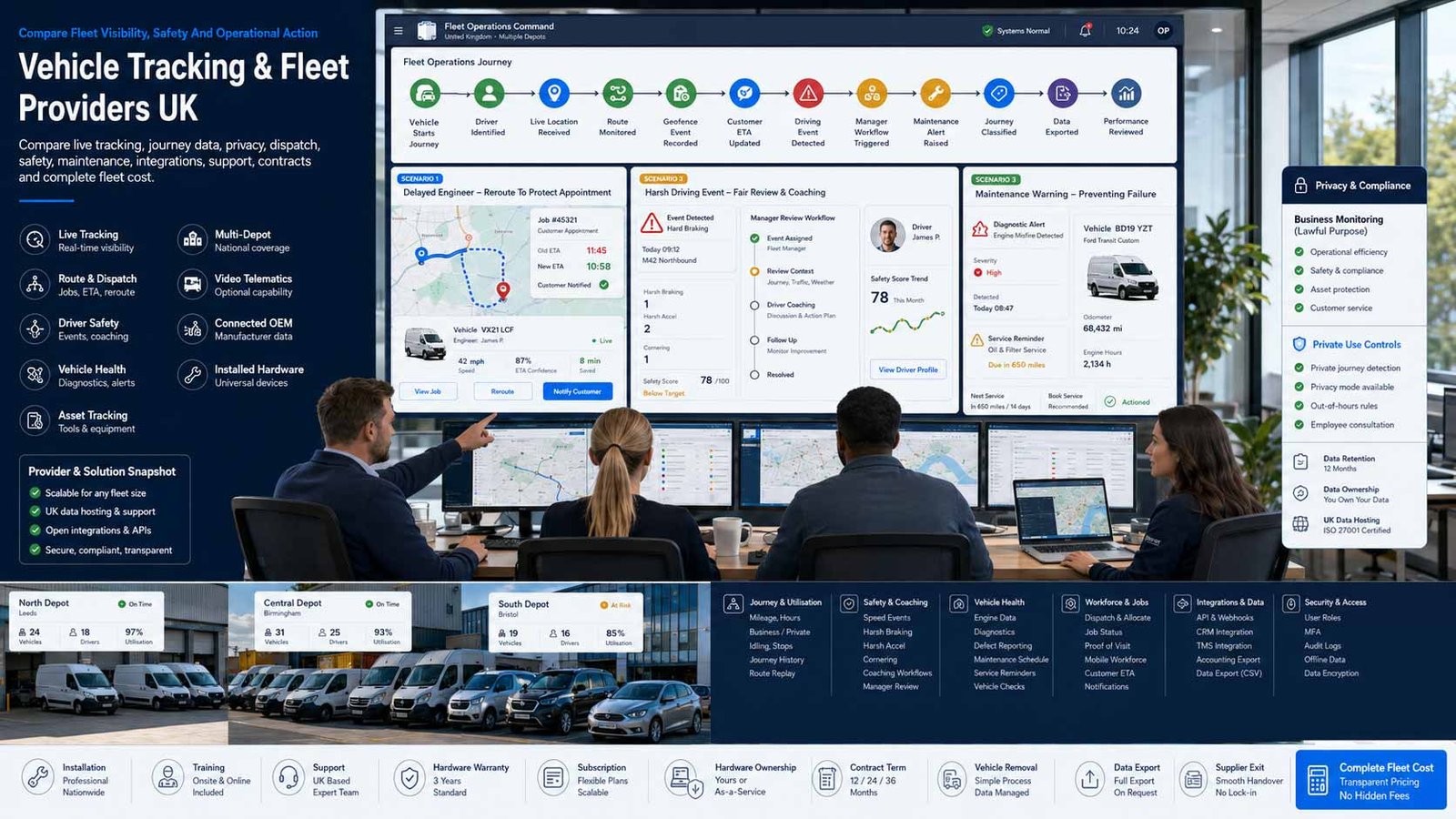
Buy Actionable Fleet Visibility, Not A Moving Dot On A Map
Useful vehicle tracking connects location and journey evidence to dispatch, customer service, utilisation, driver safety, maintenance, mileage and accountable management decisions.
- Define the operational decisions the system must improve
- Keep company and private-use monitoring rules explicit
- Separate hardware, software, implementation and optional modules
- Measure adoption and outcomes rather than collecting unused data
Vehicle tracking and fleet telematics combine an in-vehicle device or supported manufacturer connection with cloud software that records location, journeys and selected vehicle information. Depending on the platform, the service can support live maps, historic route replay, geofences, dispatch, mileage classification, driver identification, driving-behaviour events, maintenance planning, vehicle inspections, asset tracking and integrations.
The right specification depends on fleet size, vehicle mix, business/private use, operating hours, dispatch model, road-risk responsibilities, customer commitments, existing systems and internal capacity to act on the information. Basic location tracking may be enough for a small service fleet, while logistics, passenger, construction or multi-depot operations may need richer telematics, compliance workflows and specialist integrations.
This page compares vehicle tracking and fleet-management technology. It does not compare fleet insurance or fuel-card purchasing. Insurance underwriting, policy cover and fuel-payment networks have separate commercial intent, provider evidence and pricing models.
Choose The Right Vehicle Tracking And Fleet Model
The correct model depends on whether the priority is visibility, dispatch, safety, vehicle health, compliance, mixed assets, video evidence or connected business processes.
| Fleet Model | What It Usually Includes | Best-Fit Question |
|---|---|---|
| Basic GPS Vehicle Tracking | Live map, vehicle status, journey history, mileage, geofences, alerts and standard reports for smaller fleets that need straightforward visibility. | Will the entry package provide all required data, users, history and alerts without paid upgrades? |
| Service And Field Fleet Platform | Tracking combined with nearest-vehicle visibility, dispatch, customer ETAs, timesheets, job status, mobile workflows or proof-of-visit evidence. | Can the platform fit the current scheduling and customer-service process without creating duplicate administration? |
| Driver Safety And Behaviour Telematics | Speed, harsh-event, idling and risk indicators with configurable rules, coaching workflows, trend reports and manager follow-up. | Are events contextual, explainable and governed through a fair documented coaching process? |
| Maintenance And Vehicle-Health Platform | Mileage, engine information where supported, service schedules, defect workflows, inspection records and reminders intended to reduce missed maintenance and downtime. | Which data comes directly from the vehicle, which is manually entered and who owns each maintenance action? |
| Mixed Fleet And Asset Tracking | Cars, vans, HGVs, trailers, plant, powered equipment and unpowered assets displayed through one estate view with appropriate hardware. | Does the proposed hardware, reporting and billing model work across every asset type and operating environment? |
| Transport And Compliance Telematics | Tracking combined with tachograph, drivers’ hours, route execution, trailer, temperature, delivery or transport-management functions for regulated operations. | Which legal and operational records are in scope, and is specialist compliance advice included or excluded? |
| Video-Connected Fleet Platform | GPS and event data linked to road-facing or multi-camera video, incident review and safety workflows. | Is video necessary and proportionate, and are camera privacy, retention, access and disclosure controls separately documented? |
| OEM-Connected And Integrated Fleet Data | Vehicle-manufacturer data, APIs, data warehouses, leasing, maintenance, ERP, CRM or scheduling systems connected without relying solely on aftermarket hardware. | Are coverage, data consistency, integration limits and supplier responsibilities proven for the actual fleet? |
Eight Areas That Determine Vehicle Tracking Provider Fit
Use the same fleet inventory, operating requirements, monitoring rules, integrations, service levels and contract assumptions for every provider.
Comparison Criterion
Fleet Profile, Use Cases And Outcome Baseline
Document vehicle types, ownership, depots, operating hours, business/private use, jobs, mileage, idling, downtime, customer commitments, current tools and accountable owners. Define measurable outcomes such as fewer missed jobs, reduced unauthorised use, better ETA accuracy, improved utilisation or more complete maintenance records before comparing suppliers.
Comparison Criterion
Location Quality, Journey History And Geofences
Compare update frequency, ignition and status information, map quality, trip start and end logic, route replay, address accuracy, geofence rules, dwell events, alert delay, history retention and export. Test representative urban, rural and depot journeys rather than relying on a sales demonstration with ideal coverage.
Comparison Criterion
Driver Identification, Privacy And Lawful Monitoring
Review driver assignment, shared vehicles, private-use mode, outside-hours controls, transparency notices, lawful basis, DPIA screening, access roles, retention, subject-access support and disciplinary governance. Monitoring should be necessary and proportionate, and workers should understand what is collected, why it is used and who can see it.
Comparison Criterion
Safety, Behaviour And Managerial Workflow
Assess speeding context, harsh braking, acceleration, cornering, distraction or other available indicators, configurable thresholds, false-positive handling, score transparency, coaching records, trend analysis and escalation. Data should support road-risk management and constructive intervention rather than unexplained automated judgement.
Comparison Criterion
Vehicle Health, Maintenance And Daily Checks
Compare odometer quality, engine diagnostics where supported, service and inspection schedules, defect reporting, document expiry, vehicle checks, workshop integrations, alerts, closure evidence and downtime reporting. Confirm whether the provider supplies maintenance functionality or only data that another system must process.
Comparison Criterion
Dispatch, Mobile Workflows And Customer Service
Review nearest-resource views, route planning, job dispatch, driver messaging, mobile applications, forms, proof of arrival or delivery, ETA sharing and exception handling. The platform should improve the operating process without encouraging unsafe interaction while driving or duplicating an existing field-service system.
Comparison Criterion
Data, APIs, Security And Administration
Assess user roles, MFA or identity integration, audit logs, encryption, hosting, backups, incident handling, device security, mobile controls, API coverage, rate limits, webhooks, data dictionaries and export. Confirm who is controller and processor, where data is stored and how integrations are supported after implementation.
Comparison Criterion
Implementation, Support, Contract And Exit
Compare survey, device compatibility, installation, downtime, driver communication, training, implementation management, support hours, hardware warranty, replacement, subscription changes, minimum term, renewal, vehicle transfers, de-installation, data export and secure deletion. A low monthly price can conceal installation and exit exposure.
Measures To Define Before Vehicle Tracking Goes Live
Translate broad efficiency and safety claims into auditable coverage, privacy, adoption, service and commercial evidence.
| Measure | What It Should Define | Evidence To Request | Common Weakness |
|---|---|---|---|
| Fleet coverage | Whether every vehicle, asset, depot, driver type and operating period is supported | Compatibility matrix, sample devices, installation method, coverage assumptions and exception list | A proposal says “all vehicles” without checking model, power, warranty or private-use needs |
| Location and trip accuracy | Whether live and historic data matches real journeys closely enough for the intended decision | Pilot routes, timestamps, status, addresses, trip rules, geofence tests and alert-delay results | Map screenshots are accepted without comparing them to known journeys |
| Privacy control effectiveness | Whether monitoring can be limited, explained and audited | DPIA screening, privacy mode, schedules, driver notice, role matrix, logs, retention and subject-access process | Private mileage is collected because the system default was never changed |
| Driver identification quality | Whether data is reliably assigned where vehicles are shared | Driver keys, apps or vehicle assignment method, exception handling and unidentified-journey report | Scores are attributed to the wrong person and then used in performance discussions |
| Safety workflow completion | Whether events lead to proportionate review and recorded action | Thresholds, event evidence, manager queue, coaching record, dispute process and trend report | A league table exists but no one validates or follows up the underlying events |
| Maintenance completeness | Whether reminders and defects produce closed actions | Odometer source, schedules, inspection workflow, notifications, owner, closure and audit report | Alerts are generated but maintenance completion is recorded elsewhere or not at all |
| Operational adoption | Whether dispatchers, managers and drivers use the platform consistently | Active users, login frequency, alert response, mobile completion and agreed process measures | The business buys advanced modules that teams do not use |
| Integration reliability | Whether connected systems exchange the right data and recover from failure | Field mapping, authentication, latency, retry, monitoring, logs, support boundary and test evidence | The API exists, but the required objects, history or write-back actions do not |
| Service performance | Whether faults, device failures and support requests are restored within business need | Support hours, response, diagnosis, replacement, engineer visit, escalation and monthly SLA report | Hardware is covered by warranty but no restoration target exists |
| Commercial transparency | Whether the complete term and exit cost is understood | Device, installation, subscription, modules, SIM/data, support, transfer, de-installation, increases and notice schedule | The per-vehicle price excludes features shown during the demonstration |
Vehicle Tracking And Fleet Providers UK Businesses Can Consider
Shortlist providers whose hardware, platform, privacy controls, operating workflows, support and contract model fit the fleet. Confirm every live proposal and term before award.
Provider Profile
Webfleet
Webfleet provides cloud fleet-management and vehicle-tracking services covering live tracking, trip and status information, driver behaviour, workflow applications, asset options and integrations. Include it where a business wants a mature fleet platform spanning small vehicles through larger or mixed operations. Confirm the contracting entity, exact LINK or OEM-connected hardware, update frequency, privacy mode, history, users, driver identification, mobile tools, vehicle-health data, APIs, installation, support, minimum term, renewal, hardware return and which optional products are separately charged.
Review official Webfleet servicesProvider Profile
Verizon Connect
Verizon Connect offers GPS fleet-tracking software, live maps, history, alerts, reports, driver and vehicle insights and related fleet-management capabilities. Include it where configurable dashboards, multi-vehicle visibility, operational reporting and a broader telematics roadmap matter. Confirm the UK legal entity, Reveal package, device compatibility, location refresh, retained history, private-use controls, safety events, maintenance, mobile functions, API availability, installation, support, contract length, pricing changes, transfer between vehicles and the treatment of hardware at termination.
Review official Verizon Connect UK servicesProvider Profile
Geotab
Geotab provides the MyGeotab fleet-management platform, GO devices, OEM-connected options, near-real-time location, trip history, rules, vehicle data, privacy features, marketplace integrations and support through its ecosystem. Include it where open-platform capability, mixed fleets, analytics, EV data or extensive integration options are important. Confirm whether the quote is direct or through a reseller, the exact hardware and rate plan, data availability by vehicle, Privacy Mode configuration, support ownership, marketplace charges, implementation, cyber controls, data residency, contract terms and exit assistance.
Review official Geotab UK servicesProvider Profile
Samsara
Samsara offers a connected-operations platform with vehicle telematics, real-time GPS tracking, routing, diagnostics, safety and optional video, equipment or workflow modules. Include it where a business wants one platform across vehicles, assets, safety and operations. Confirm the exact licence bundle, gateways and accessories, update frequency, camera exclusion or inclusion, driver workflows, privacy configuration, vehicle compatibility, implementation, integrations, data retention, support, hardware warranty, minimum commitment, module dependencies and how data and devices are handled when the agreement ends.
Review official Samsara telematicsProvider Profile
Quartix
Quartix provides UK commercial vehicle tracking with live maps, route and trip information, timesheets, geofences, driver-performance tools, maintenance alerts and published package information. Include it where a small or medium fleet wants a focused tracking service with a relatively straightforward operating model. Confirm the selected plan, update intervals, history, privacy settings, driver identification, reporting, check or maintenance modules, installation, support, hardware warranty, vehicle changes, minimum term, renewal and whether features shown in demonstrations require higher packages.
Review official Quartix vehicle trackingProvider Profile
RAM Tracking
RAM Tracking supplies GPS vehicle tracking, fleet dashboards, alerts, reports, driver-performance tools and related job or asset-management options for UK businesses. Include it where smaller fleets want a UK-focused provider and clear entry-level tracking requirements. Confirm the live quoted price rather than relying on general website figures, and verify hardware, installation, update frequency, users, history, alerts, privacy, reports, support, warranty, optional modules, contract term, annual increases, vehicle transfer, cancellation and complete exit cost.
Review official RAM fleet trackingProvider Profile
Microlise
Microlise provides UK telematics, fleet performance, journey, driver, trailer, delivery and transport-technology solutions, with capability ranging from lighter fleet requirements to complex logistics operations. Include it where route execution, transport compliance, driver performance, customer communication or integration depth matters. Confirm the exact platform and modules, hardware, vehicle and trailer coverage, tachograph or ePOD scope, implementation, privacy, retention, support, specialist services, interfaces, service levels, contract structure and whether the proposed solution is proportionate for the fleet size.
Review official Microlise telematicsProvider Profile
Movolytics By ABAX
Movolytics by ABAX offers vehicle tracking, live locations, routing support, customer ETA information, predictive-maintenance features, reports and broader asset or inventory tracking options. Include it where a service or trade fleet wants vehicle and equipment visibility from one supplier. Confirm the contracting entity, tracking hardware, installation, update frequency, journey and privacy controls, reports, maintenance logic, asset modules, support commitments, hardware guarantee terms, minimum subscription, price increases, vehicle changes, data export and device removal at exit.
Review official Movolytics servicesWhat Changes Vehicle Tracking And Fleet Cost
Headline per-vehicle pricing is only one element. Compare the complete hardware, implementation, subscription, support, integration and exit cost across the intended term.
| Cost Driver | Why It Changes Spend | What A Comparable Quote Should Show |
|---|---|---|
| Tracking hardware and installation | Hard-wired, plug-in, battery or OEM-connected options have different device, engineer, downtime, warranty and removal costs | Exact device, purchase or rental status, installation, travel, replacement, transfer and de-installation |
| Subscription package | Live maps may be included while history, driver behaviour, maintenance, checks, APIs or video require higher tiers | Per-vehicle fee, included users, data, history, reports, alerts, modules, support and usage limits |
| Location update and data depth | Faster updates, CAN-bus or diagnostic information and richer reporting may increase price or restrict compatible vehicles | Update frequency, collected fields, vehicle coverage, data latency, retention and export |
| Driver and privacy functions | Driver ID, private-use controls, mileage classification and workforce workflows can require accessories or configuration | Keys, apps, readers, privacy mode, schedules, licences, setup and replacement costs |
| Safety and video modules | Scoring, incident workflows, cameras, storage and review services add hardware, connectivity, retention and governance cost | Each device and channel, storage, event rules, access, coaching, support and deletion |
| Maintenance and compliance | Vehicle checks, defects, service schedules, document control, tachograph or specialist transport modules may be separate | Vehicles, drivers, records, integrations, user licences, support and implementation |
| Integrations and APIs | Standard exports may be included while real-time APIs, middleware, bespoke development and support create extra cost | API entitlement, limits, setup, development, testing, monitoring, support and future changes |
| Implementation and training | Fleet survey, compatibility, installation scheduling, policy work, configuration, integrations and user adoption affect launch effort | Project days, responsibilities, sites, travel, training, documentation, acceptance and delay terms |
| Support and hardware service | Warranty alone does not define support response, replacement speed or engineer availability | Hours, channels, response, restoration, advance replacement, engineer visit, exclusions and escalation |
| Contract and exit | Long terms, automatic renewal, annual increases, vehicle-count commitments and device return can dominate lifecycle cost | Minimum term, notice, increases, reduction rights, transfer, early termination, removal, return and data export |
| Buying Scenario | Typical Scope | What Must Be Confirmed |
|---|---|---|
| Entry tracking package | Typically basic live tracking, journey history, geofences and standard reports for straightforward fleets | Check users, update frequency, retained history, installation, privacy mode and support before treating it as complete |
| Operational fleet package | Adds driver identification, behaviour, maintenance, checks, dispatch or richer analytics | Confirm which workflows are native, which are optional and how managers will use the extra data |
| Advanced connected platform | May combine telematics, APIs, video, assets, compliance, transport workflows and enterprise administration | Require module-by-module pricing, integration ownership, privacy controls, service levels and a phased adoption plan |
| Bespoke or multi-system programme | Complex mixed fleets, multi-depot rollout, specialist hardware, integrations and formal change management | Price implementation, pilot, migration, governance, support, de-installation and internal resource separately |
Match The Provider To The Fleet Operating Model
The right shortlist depends on vehicle type, job workflow, road risk, business/private use, integrations, compliance and the internal team that will act on the data.
Small Trade Or Service Fleet
Prioritise reliable live location, journey history, straightforward geofences, business/private mileage controls, usable mobile access, simple reports, transparent installation and support. Avoid paying for enterprise analytics or specialist compliance modules that no one will operate.
Field Service And Multi-Depot Operation
Prioritise nearest-resource visibility, dispatch, customer ETAs, job evidence, driver identification, depot geofences, integrations, exception alerts and management reporting. Confirm that tracking complements rather than duplicates the scheduling or field-service platform.
Construction, Plant Or Mixed Assets
Prioritise durable hardware, powered and unpowered asset options, theft and movement alerts, utilisation, geofences, battery life, site coverage and clear installation responsibility. Test each vehicle, trailer, plant and tool category separately.
Logistics, HGV Or Regulated Transport
Prioritise route execution, driver and vehicle performance, maintenance, trailer data, tachograph or compliance integrations, delivery evidence, customer communication, service levels, scalable administration and specialist implementation. Keep legal interpretation with competent advisers.
How To Compare Vehicle Tracking Proposals
Issue one fleet brief containing vehicles, assets, ownership, operating hours, private use, depots, journeys, dispatch, road-risk processes, maintenance, existing systems, users, data retention, privacy controls, service levels, expected growth and exit needs. Require a response matrix so every package can be compared line by line.
- Exact hardware, connection method and compatible vehicles are named
- Included tracking, safety, maintenance and workflow modules are separated
- Private-use, driver notice, access and retention controls are documented
- Implementation, installation, training and integrations are priced
- Support, replacement and service-restoration terms are measurable
- Minimum term, increases, vehicle changes and exit costs are explicit
Compare The Same Fleet And Data Standard
Ask every provider to configure the same vehicles, update frequency, history, driver ID, privacy mode, reports, alerts, integrations and support assumptions.
A lower monthly price is not comparable when it excludes installation, required modules, users, data retention, APIs, hardware replacement or de-installation.
Six Questions To Put To Every Fleet Provider
The answers expose incomplete packages, intrusive defaults, weak service commitments and long-term contract risk.
What Hardware And Data Will Each Vehicle Use?
Request the exact device or OEM connection, installation method, compatible makes and models, update frequency, collected fields, warranty, replacement and transfer process.
How Are Drivers Identified And Private Use Protected?
Confirm shared-vehicle assignment, privacy mode, monitoring schedules, worker information, access roles, retention, audit logs and support for data-rights requests.
Which Features Are Included In The Quoted Package?
Separate live tracking, history, geofences, driver behaviour, mileage, maintenance, checks, assets, video, APIs, mobile workflows and support.
How Will The System Fit Daily Operations?
Ask the supplier to demonstrate dispatch, customer ETA, exception, maintenance, coaching and reporting workflows with representative vehicles and users.
What Happens When A Device Or Integration Fails?
Review monitoring, alerting, support hours, remote diagnosis, replacement, engineer attendance, API logs, escalation and business-continuity arrangements.
What Are The Full Term, Renewal And Exit Conditions?
Confirm minimum commitment, vehicle-count flexibility, annual increases, notice, automatic renewal, early termination, device removal, return, data export and deletion.
A Seven-Stage Vehicle Tracking Provider Evaluation
Move from fleet evidence and lawful purposes to a tested operating service rather than selecting a platform from a live-map demonstration.
- Create a verified fleet inventory covering vehicle and asset type, registration, ownership, warranty, base, driver assignment, private use, annual mileage, operating hours, current hardware, existing contracts and responsible manager.
- Define business outcomes and baseline measures for dispatch, ETA accuracy, mileage, idling, utilisation, road risk, maintenance, theft, compliance, customer service and administration. Remove measures that no team is prepared to own.
- Complete privacy and workforce planning covering purpose, lawful basis, necessity, proportionality, DPIA screening, worker consultation where appropriate, private-use controls, retention, access, automated decisions and complaint routes.
- Prepare one supplier brief with mandatory and optional modules, vehicle compatibility, update frequency, history, driver ID, integrations, implementation, support, security, data export, contract and exit requirements.
- Shortlist providers by relevant fleet experience, hardware fit, demonstrable privacy controls, platform usability, integration capability, implementation capacity, support coverage, financial stability and referenceable customers.
- Run a controlled pilot with representative vehicles, shared drivers, depots, routes, weak-signal areas, private-use cases, alerts, reports, mobile users and at least one integration. Record acceptance evidence and operational feedback.
- Contract and roll out through controlled installation, configuration, training, driver communication, baseline reporting, support monitoring and review. Remove unused alerts, verify benefits and maintain an improvement and exit plan.
Vehicle Tracking And Fleet Comparison Checklist
Use this table before installing tracking devices, replacing a telematics supplier or extending the service across a larger fleet.
| No. | Requirement | Evidence To Obtain Before Award | Confirmed |
|---|---|---|---|
| 01 | Fleet and asset inventory complete | Vehicles, assets, ownership, bases, drivers, private use, mileage, hours, warranties and current devices | |
| 02 | Business outcomes and owners agreed | Operational measures, baseline, target, accountable manager, review frequency and corrective action | |
| 03 | Monitoring purpose and lawful basis documented | Necessity, proportionality, transparency, private use, DPIA screening and worker communication | |
| 04 | Hardware and compatibility confirmed | Exact device or OEM connection, vehicle model, power, installation, warranty, removal and transfer | |
| 05 | Location and journey standard tested | Update frequency, status, trip rules, map accuracy, geofences, alert delay, history and export | |
| 06 | Driver identity and privacy controls accepted | Driver assignment, shared vehicles, privacy mode, schedules, roles, audit and disputes | |
| 07 | Safety workflow approved | Thresholds, context, event review, coaching, escalation, records and fair use of scores | |
| 08 | Maintenance and vehicle checks mapped | Odometer, schedules, defects, inspections, documents, alerts, closure and responsible team | |
| 09 | Operational workflows demonstrated | Dispatch, ETA, mobile app, proof of visit, exceptions, alerts and reporting with real users | |
| 10 | Security and data governance completed | Controller/processor roles, hosting, access, MFA, encryption, logs, retention, incidents and deletion | |
| 11 | Integrations accepted | Fields, authentication, latency, limits, errors, retries, monitoring, support and change process | |
| 12 | Implementation and training ready | Sites, installation plan, downtime, configuration, communications, training, pilot and acceptance | |
| 13 | Support and hardware SLA agreed | Hours, response, restoration, replacement, engineer attendance, escalation and reporting | |
| 14 | Complete commercial schedule approved | Hardware, installation, subscriptions, modules, data, support, expenses, increases and VAT | |
| 15 | Contract change and exit tested | Vehicle additions/removals, transfer, minimum term, notice, renewal, termination, de-installation, export and deletion |
Common Vehicle Tracking And Fleet Buying Mistakes
Most avoidable failures begin with weak fleet evidence, intrusive defaults, unused data, incomplete pricing or untested supplier exit.
| Mistake | Why It Creates Risk | Better Control |
|---|---|---|
| Buying from the live map alone | Location display does not prove privacy, workflow, vehicle data, support, adoption or contract quality | Score the complete operating service |
| Tracking outside work by default | Unnecessary private-use monitoring can be intrusive and difficult to justify | Configure monitoring to the documented purpose |
| Using scores without context | Harsh events, speed and route data can be misunderstood or assigned to the wrong driver | Validate evidence and use a fair review process |
| Installing before checking vehicle warranty and compatibility | Incorrect devices or installation can create faults, downtime or disputed responsibility | Approve a vehicle-by-vehicle compatibility matrix |
| Creating too many alerts | Managers ignore high-volume notifications that have no owner or action | Keep only actionable rules with escalation |
| Assuming telematics equals legal compliance | Software can support records but does not determine which rules or exemptions apply | Keep competent compliance ownership |
| Not piloting private use and shared vehicles | Driver assignment and privacy failures appear after wide rollout | Test representative edge cases first |
| Ignoring adoption and workflow change | The organisation collects data but dispatchers, drivers and managers continue using old processes | Define accountable operational routines |
| Comparing per-vehicle price without modules and exit | Installation, APIs, video, support, increases and removal can dominate total cost | Normalise complete term cost |
| Leaving data export until termination | History, configuration and evidence may be difficult to retrieve under time pressure | Test export and transition before award |
Frequently Asked Questions
Answers to common questions from UK businesses comparing GPS vehicle tracking, fleet telematics and connected fleet-management providers.
What Is Business Vehicle Tracking?
Business vehicle tracking uses an installed telematics device or supported manufacturer connection to send location and selected vehicle data to fleet software. The service can show live position, journey history, mileage, geofences and alerts, with optional driver, safety, maintenance, asset, dispatch, video or integration functions depending on the package.
Is It Legal To Track Company Vehicles In The UK?
Employers can monitor work vehicles, but the processing must be lawful, fair, transparent, necessary and proportionate. The ICO says private use will rarely justify continuous monitoring, so suitable controls may be required. Businesses should document purpose, lawful basis, retention, access, worker information and whether a DPIA is needed.
Can A Driver Turn Tracking Off For Private Journeys?
Some platforms provide privacy mode, schedules or driver controls that stop or limit location recording during authorised private use. The correct setup depends on the vehicle policy and purpose. Confirm exactly what data remains visible, who can override the setting, how misuse is handled and how the configuration is audited.
How Much Does Vehicle Tracking Cost In The UK?
Cost depends on hardware, installation, update frequency, history, driver identification, maintenance, safety, video, asset tracking, integrations, support and contract length. Some suppliers publish entry prices, while others quote. Compare the complete term cost, annual increases, vehicle changes and exit charges rather than one monthly figure.
What Is The Difference Between GPS Tracking And Fleet Telematics?
GPS tracking commonly focuses on location, journeys and geofences. Fleet telematics can combine GPS with vehicle, driver, diagnostics, safety, maintenance and workflow data. Suppliers use the terms differently, so compare the actual fields, devices, modules and business processes rather than relying on product labels.
Can Vehicle Tracking Reduce Fuel Use?
Tracking can reveal idling, unnecessary mileage, route issues and driving patterns that managers may address through planning, coaching and maintenance. It does not create savings automatically, and this page does not compare fuel-card purchasing. Establish a baseline, define responsible actions and measure results using the business’s own operational data.
Does Vehicle Tracking Replace Tachographs Or Drivers Hours Compliance?
Not automatically. Some platforms integrate tachograph or compliance functions, but legal scope depends on vehicle, construction, use, route and applicable rules. GOV.UK provides separate drivers’ hours and tachograph guidance. Confirm exactly which records the system supports and retain competent operational and legal responsibility.
Should A Small Business Choose Hard-Wired Or Plug-In Trackers?
Plug-in devices may simplify deployment and vehicle transfer, while hard-wired units can be less visible and may support different data or reliability needs. Vehicle compatibility, warranty, installation quality, tamper risk, power use, diagnostic access and removal should determine the decision rather than convenience alone.
How Long Should Fleet Tracking Data Be Kept?
There is no universal retention period for every purpose. Keep data only as long as necessary for the documented operational, legal or evidential need. Define separate retention where appropriate for live location, journeys, incidents, maintenance, video and audit logs, then confirm deletion, legal hold and subject-access processes.
How Should UK Businesses Compare Vehicle Tracking Providers?
Give every provider the same fleet inventory and response template. Compare hardware, live and historic data, driver identity, privacy, safety, maintenance, workflows, integrations, security, installation, support, complete cost, contract flexibility and exit. Run a representative pilot and score evidence rather than sales claims.
Official Guidance And Provider Resources
Reviewed by Bhav Giva, Founder & Lead Analyst at CompareServices.co.uk, on 31 July 2026.
Use official data-protection, road-safety, transport and provider documentation to verify current requirements, product capability and contract terms. Fleet features, device coverage, ownership, pricing and packages can change. Monitoring, employment, drivers’ hours and transport duties depend on the organisation and operation, so obtain competent advice where required.
- ICO — Monitoring Work Vehicles And Other Monitoring Methods
- ICO — Employee Monitoring For Small Organisations
- HSE — Employers: Driving And Riding Safely For Work
- GOV.UK — Drivers’ Hours And Tachographs For Goods Vehicles
- Webfleet — Fleet Management And Vehicle Tracking
- Verizon Connect — UK Fleet Management
- Geotab — UK Fleet Tracking And Telematics
- Samsara — Vehicle Telematics
- Quartix — UK Vehicle Tracking
- RAM Tracking — Fleet Tracking
- Microlise — Fleet Telematics
- Movolytics By ABAX — Vehicle And Asset Tracking