
Compare Courier / Shipping Services Providers UK
Compare Collection, Delivery Speed, Tracking, Claims, Returns, International Shipping, Integrations, Surcharges, Support And Complete Shipping Cost
Compare business courier services UK providers by domestic and international coverage, collection windows, delivery commitments, parcel size and weight rules, tracking events, proof of delivery, recipient options, returns, claims, compensation limits, packaging requirements, restricted goods, customs support, shipping software, ecommerce integrations, account management, peak-capacity plans, invoice detail, fuel and area surcharges, contract terms and complete cost per successful delivery. Give every provider the same shipment profile, destinations, parcel dimensions, declared values, service speeds, collection sites and exception assumptions before comparing proposals.
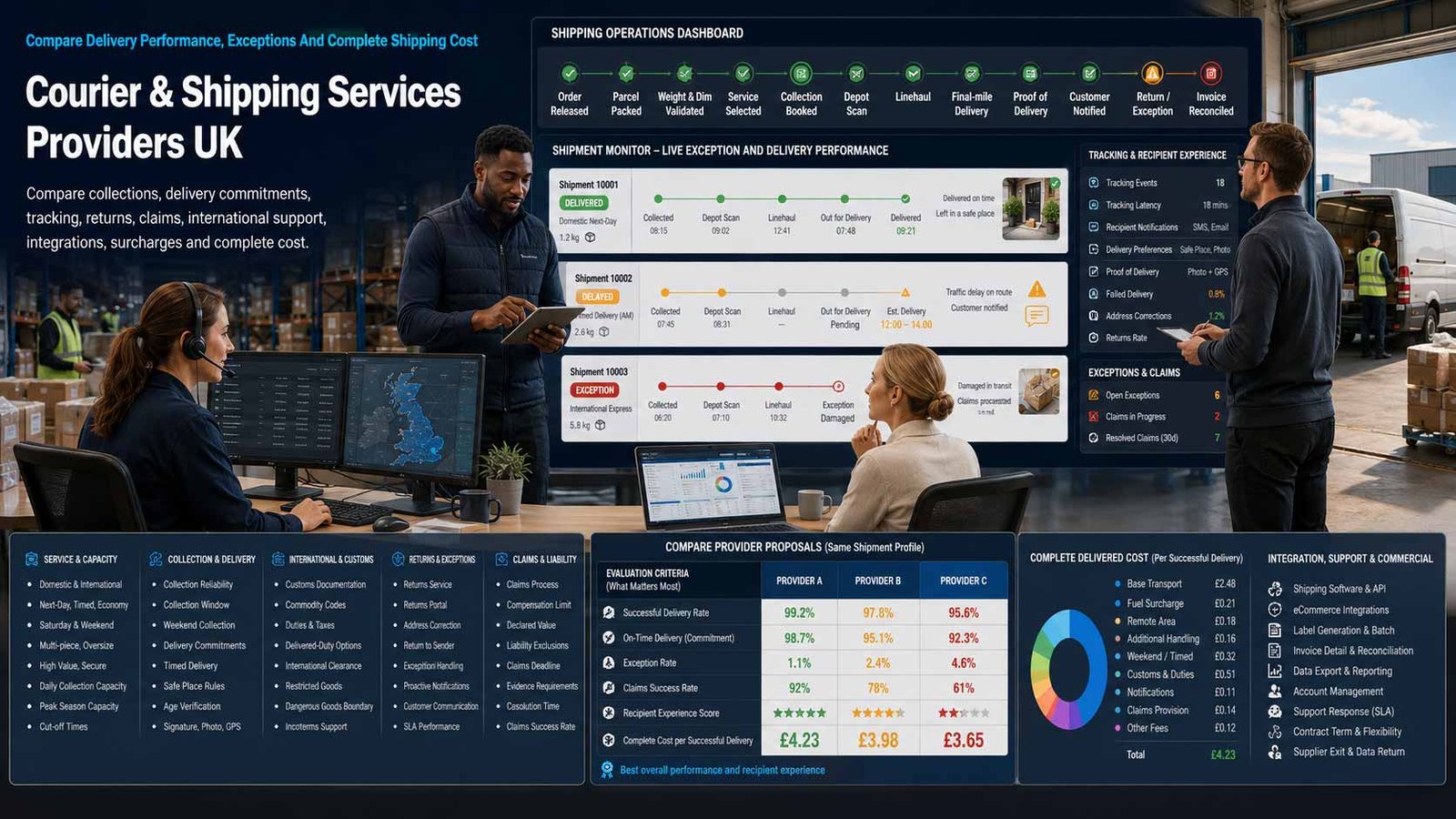
Buy A Delivery Operation, Not Just A Label Price
A useful courier agreement should move the right goods to the right destinations with predictable collections, usable tracking, controlled exceptions and clear financial responsibility when delivery fails.
- Model real weights, dimensions, destinations and weekly volumes
- Separate delivery price from surcharges, claims and redelivery cost
- Test tracking, returns, customs and customer-service workflows
- Confirm prohibited goods, liability, packaging and exit in writing
Business courier and shipping services collect, transport, track and deliver parcels, documents or consignments under published or negotiated service terms. A provider may offer domestic next-day delivery, economy services, timed delivery, international express, ecommerce parcels, returns, multi-piece shipments, secure items, larger parcels or specialist collections. The commercial value sits in the full operating system: collection reliability, sortation, linehaul, final-mile performance, data, exception management, claims, invoicing and support.
The right provider depends on parcel profile, shipment frequency, destination mix, recipient type, promised delivery speed, order cut-off, collection capacity, seasonality, value, fragility, customs exposure, return rates, ecommerce platform, internal labour and customer expectations. A low headline parcel rate can become expensive when remote-area, oversize, additional-handling, fuel, address-correction, failed-delivery or claims costs are added.
This page compares courier and shipping services for organisations. It does not provide a consumer-only parcel price comparison. One-off personal shipments, removals, pallet haulage and full freight-forwarding projects may require different comparison criteria.
Choose The Right Courier And Shipping Operating Model
Match the delivery model to shipment urgency, parcel profile, recipient expectations, destination reach and internal fulfilment capability.
| Service Model | What It Usually Includes | Best-Fit Question |
|---|---|---|
| Pay-As-You-Go Parcel Service | Online booking, label generation, drop-off or collection and published tariffs without a negotiated account commitment. | Is irregular volume worth a simple tariff even when collection, support and discounts are limited? |
| Negotiated Business Account | Volume-based rates, scheduled collections, account billing, shipping tools, reports and a defined support route. | Are minimum volumes, annual reviews, surcharges and forecast commitments reasonable? |
| Domestic Tracked Parcel Network | National parcel delivery with tracking, proof of delivery, recipient notifications and standard or next-day options. | Does the service match parcel sizes, UK coverage and the promised customer delivery proposition? |
| Timed Or Guaranteed Delivery | Earlier delivery windows, date or time commitments, enhanced tracking and potentially stronger service remedies. | Which postcode, day, collection and exception conditions qualify for the commitment? |
| International Express Courier | Door-to-door global delivery, customs data, commercial documentation, tracking and time-definite options. | Who is responsible for commodity codes, values, duties, licences, customs delays and consignee charges? |
| Ecommerce Parcel And Returns Service | Store integrations, batch labels, delivery options, customer notifications, returns portals and volume collections. | Can the provider support peak order volume, branded tracking, delivery preferences and rapid returns processing? |
| Same-Day Or Dedicated Courier | Direct vehicle collection and delivery for urgent, high-value, sensitive or operationally critical consignments. | Is the service dedicated, subcontracted or co-loaded, and what chain-of-custody evidence is supplied? |
| Multi-Carrier Shipping Platform | One technology layer routes shipments across several carriers by rules, rate, service, capacity or destination. | Does the platform improve resilience without obscuring carrier liability, data ownership or support responsibility? |
Eight Areas That Determine Courier Service Fit
Use the same shipment file, destination mix, parcel profile, service promises and exception assumptions for every provider.
Comparison Criterion
Shipment Coverage And Service Commitments
Compare postcode and country coverage, delivery days, standard, economy, next-day, timed and weekend options, excluded areas and peak restrictions. Require clear definitions for delivery aim, service commitment and refund or credit conditions. A nominal next-day service is not comparable when cut-offs, postcodes or collection performance differ.
Comparison Criterion
Collection, Cut-Off And Capacity
Assess collection windows, late cut-off options, missed-collection response, depot or drop-off alternatives, trailer or cage provision, daily capacity, peak forecasting and emergency uplift. Model the operational impact when the provider cannot collect the planned volume.
Comparison Criterion
Weight, Dimensions And Goods Acceptance
Confirm actual and volumetric weight rules, maximum length, girth, multi-piece treatment, packaging standards, fragile or high-value exclusions, batteries, liquids, perishables, dangerous goods and prohibited items. Test representative products before contract award.
Comparison Criterion
Tracking, Proof And Recipient Experience
Compare scan frequency, live tracking, estimated delivery windows, proof of delivery, photo or signature options, safe-place controls, delivery preferences, notifications, accessibility, failed-delivery handling and branded communications. Tracking must support both customer service and evidence.
Comparison Criterion
International Customs And Border Support
Assess EORI, commodity-code, origin, value, commercial invoice, licences, duty and tax, incoterm, broker, paperless trade, recipient-charge and return-to-sender workflows. Carrier tools can assist, but the exporter remains responsible for accurate declarations and product compliance.
Comparison Criterion
Claims, Liability And Exception Management
Review included compensation, declared-value options, excluded goods, packaging conditions, notification windows, evidence requirements, loss and damage investigation, claim decision times, service-failure remedies and escalation. Measure recovery in practice, not only the stated maximum cover.
Comparison Criterion
Shipping Technology And Data
Compare portals, batch processing, APIs, ecommerce and marketplace integrations, address validation, label formats, user roles, order references, customs data, tracking webhooks, reports, invoice reconciliation, data retention, security and continuity when an integration fails.
Comparison Criterion
Pricing, Support, Contract And Exit
Compare tariffs, discounts, fuel and area surcharges, oversize, additional handling, residential, address correction, remote collection, returns, customs, storage, duty advancement, annual review and minimum-volume terms. Confirm support ownership, renewal, data export and account closure.
Measures To Define Before Awarding A Courier Contract
Translate broad speed, network and reliability claims into auditable service, cost, customs, claims and support evidence.
| Measure | What It Should Define | Evidence To Request | Common Weakness |
|---|---|---|---|
| On-time delivery | Whether consignments arrive within the contracted delivery definition | Service definition, postcode eligibility, scan data, monthly result and exclusions | A broad percentage hides late deliveries in critical regions or services |
| Collection reliability | Whether planned volume leaves the site on time | Collection-window compliance, missed collections, recovery time and peak capacity | Delivery performance is measured after a failed or late collection is excluded |
| First-attempt delivery | Whether the recipient receives the parcel without another visit or diversion | Attempt result, safe-place policy, recipient options, photo, signature and postcode split | High delivery volume hides repeat handling and customer inconvenience |
| Scan and tracking quality | Whether events are timely, complete and usable | Event map, timestamp, location, webhooks, proof, exceptions and sample data | Tracking shows a label created but not the physical custody point |
| Loss and damage | How often goods fail and how responsibility is handled | Claims ratio, excluded goods, packaging audit, compensation, evidence and resolution time | Low reported claims reflect difficult notification rules rather than low failure |
| Surcharge exposure | The difference between base tariff and invoiced cost | Surcharge schedule, representative invoice, zone, weight, dimension and event triggers | A low base rate is offset by routine additional-handling charges |
| Customs quality | Whether international data supports clearance without avoidable delay | Commercial invoice, code, origin, value, paperless data, exception ownership and broker route | Carrier tooling is mistaken for legal responsibility for the declaration |
| Returns performance | How quickly returned goods re-enter inventory or resolution | Portal, label, collection/drop-off, tracking, reason codes, consolidation and cycle time | The outbound service is strong but returns are slow and poorly referenced |
| Support and claims response | How operational and financial issues are owned | Named contacts, hours, severity, response targets, escalation, claim milestones and reporting | Sales support does not continue after implementation |
| Data and contract portability | Whether the operation can change provider without losing control | API and report export, label transition, tracking history, claims, notice and account closure | The business cannot retrieve shipment or invoice evidence after exit |
Courier And Shipping Providers UK Businesses Can Consider
Shortlist providers whose network, collection, service standards, parcel rules, tracking, claims, customs and commercial model fit the operation. Confirm current written terms before award.
Provider Profile
Royal Mail Business
Royal Mail offers business parcel and mail services including tracked and time-sensitive UK options, account billing and shipping tools. Include it where letter-and-parcel coverage, broad address reach, smaller parcels or integration with an existing mail operation are important. Confirm account eligibility, annual volume, service selection, size and weight limits, collection, tracking, compensation, excluded goods, surcharges, returns, international documentation, invoice detail, support and contract terms.
Review official Royal Mail business parcel servicesProvider Profile
Parcelforce Worldwide
Parcelforce Worldwide provides UK and international parcel services, business accounts, scheduled collections, shipping systems, tracking and larger-parcel options. Include it where next-day, timed, international or heavier-parcel requirements fit its network. Confirm the current account model, service postcodes, parcel limits, collection arrangements, weekend options, compensation, additional handling, customs support, returns, API or shipping software, invoicing and escalation.
Review official Parcelforce business servicesProvider Profile
DPD UK
DPD provides tracked domestic and international parcel services, timed options, recipient notifications, delivery preferences, pickup locations and business shipping tools. Include it where customer-facing tracking and next-day parcel delivery are priorities. Confirm the contracted service, collection cut-off, parcel limits, postcode and weekend coverage, proof options, returns, claims, fuel and area surcharges, ecommerce integration, account support, peak-capacity process and annual rate review.
Review official DPD business servicesProvider Profile
DHL Express And DHL eCommerce UK
DHL operates distinct UK propositions for international express and ecommerce parcel delivery. Include the appropriate division where global time-definite delivery, customs assistance, domestic next-day parcels or international ecommerce reach are required. Confirm which legal entity and service is quoted, transit definition, destination coverage, collections, remote-area and fuel charges, customs brokerage, duties, prohibited goods, claims, integrations, returns, support and data ownership.
Review official DHL UK shipping servicesProvider Profile
UPS
UPS offers domestic and international shipping, account tools, collections, tracking, customs resources and business visibility services. Include it where cross-border reach, integrated tracking, scheduled pickups or multi-site shipping are important. Confirm service levels, account rates, dimensional weight, additional handling, area surcharges, brokerage and duty advancement, declared value, claims, dangerous-goods eligibility, technology, user permissions, invoice reconciliation and contract commitments.
Review official UPS UK servicesProvider Profile
FedEx
FedEx provides domestic, international, ecommerce and freight-related shipping services with account pricing, pickups, tracking, customs support and digital shipping tools. Include it where global express, day-definite international delivery, specialist destinations or integrated ecommerce shipping are relevant. Confirm the selected service, transit conditions, dimensions, remote areas, fuel and handling surcharges, customs clearance, returns, dangerous-goods acceptance, liability, claims, API support and account-management model.
Review official FedEx UK shipping servicesProvider Profile
Evri Business
Evri offers business parcel accounts for frequent sellers, SMEs and larger corporate shippers, with discounted pricing, integrations, collections, tracking and returns options. Include it where ecommerce parcels, parcel-shop or locker networks, cost control and scalable returns are important. Confirm volume band, collection frequency, service standards, parcel limits, excluded goods, compensation, recipient options, customer-service route, surcharge schedule, peak arrangements, integrations, reporting and renewal terms.
Review official Evri business servicesProvider Profile
DX
DX provides parcel, document, freight, secure and business delivery services across the UK and Ireland. Include it where B2B deliveries, irregular items, secure consignments or network-specific service options fit the operating requirement. Confirm which DX service is proposed, collection and delivery areas, parcel or freight limits, tracking, proof, chain of custody, subcontracting, compensation, failed-delivery process, surcharges, technology, support and contract exit.
Review official DX servicesWhat Changes Courier And Shipping Cost
Compare complete cost per successful delivery, including routine surcharges, redelivery, returns, claims and internal exception work.
| Cost Driver | Why It Changes Spend | What A Comparable Quote Should Show |
|---|---|---|
| Service speed and commitment | Economy, standard, next-day, timed, weekend and same-day services use different networks, capacity and remedies | Service definition, qualifying postcodes, cut-off, collection, exceptions and refund or credit rule |
| Actual and volumetric weight | Carriers may charge the greater of physical weight and a dimensional calculation | Dimensions, divisor, rounding, packaging and worked examples for representative products |
| Length, girth and additional handling | Long, irregular, heavy, non-conveyable or poorly packaged items can trigger extra handling or refusal | Maximums, surcharge thresholds, manual handling, palletisation and rejected-item process |
| Destination and area | Remote, island, highlands, international, residential or difficult-access areas can change price and delivery time | Zone file, postcode list, area surcharge, delivery days and excluded locations |
| Collection model | Scheduled, ad hoc, late, multi-site or peak collections change transport and operational cost | Collection frequency, window, missed collection, additional vehicle, depot option and cancellation |
| Fuel and index-linked surcharges | Published fuel or other variable surcharges can change independently of the base tariff | Formula, publication source, effective date, cap, services covered and invoice line |
| International customs and brokerage | Clearance, duty advancement, storage, disbursement, inspection and return costs may apply | Brokerage, duties and taxes, incoterm, recipient refusal, storage and abandoned shipment treatment |
| Returns and failed delivery | Second attempts, redirection, return-to-sender, disposal or international return can materially increase cost | Attempt policy, recipient choices, return tariff, reason codes, consolidation and inventory cycle |
| Compensation and declared value | Included liability may be limited and may exclude particular goods or consequential loss | Cover, declared value fee, exclusions, packaging, notification window, evidence and claim timeline |
| Technology, support and contract | Integrations, labels, printers, onboarding, account management, minimum volume and annual review affect lifecycle cost | Setup, licences, API, support, minimum spend, forecast variance, renewal, notice and data export |
| Indicative Commercial Model | Typical Position | What Must Be Confirmed |
|---|---|---|
| Published Pay-As-You-Go Tariff | Suitable for irregular or low volume, with online booking and no negotiated commitment | Confirm VAT, collection, compensation, remote-area, oversize, address and failed-delivery charges |
| Negotiated Per-Parcel Account Rate | Rate varies by annual volume, weight profile, destinations, service mix, collections and risk | Require the full rate card, volume bands, minimums, surcharge formulas and annual review method |
| Blended Or Profile-Based Tariff | One or several rates reflect a defined mix of weights, zones or services | Test whether the real mix remains inside the profile and how variance is reconciled |
| Dedicated Or Same-Day Quote | Cost is based on vehicle, distance, urgency, waiting, tolls and specialist handling | Confirm dedicated use, subcontracting, chain of custody, cancellation, waiting and out-of-hours charges |
Match The Provider To The Shipping Pattern
The right shortlist depends on volume, parcel profile, destination, recipient, promised delivery, claims exposure, returns and customs complexity.
Low-Volume Business Or Professional Office
Prioritise simple booking, reliable collections or convenient drop-off, tracked delivery, sensible compensation, clear prohibited-goods rules and support that does not require a large account commitment.
Growing Ecommerce Retailer
Prioritise batch labels, store integration, late collection cut-offs, capacity, recipient delivery options, branded tracking, first-attempt delivery, returns, address quality, peak planning and invoice reconciliation.
B2B Parts, Documents Or Field-Service Operation
Prioritise next-day or timed service, commercial-address performance, proof of delivery, reference capture, secure handling, multi-site collections, critical-item escalation and rapid claims ownership.
International Exporter
Prioritise destination reach, customs data, paperless documentation, commodity and origin workflows, duties and taxes, restricted goods, broker support, returns, landed-cost visibility and accountable exception management.
How To Compare Courier Proposals
Issue one shipment profile containing weekly and annual volume, collection sites, cut-off times, parcel weights and dimensions, destinations, residential and business mix, delivery promises, declared values, excluded or regulated goods, international lanes, customs data, returns, claims history, ecommerce integrations, support hours, invoice fields and contract period. Require a response matrix rather than relying on a base-rate table.
- Every provider reprices the same representative shipment file
- All surcharges and failure events are itemised
- Service definitions, postcodes and collection assumptions are explicit
- Tracking, proof, returns and claims workflows are demonstrated
- Customs responsibility and data requirements are documented
- Capacity, support, renewal and exit are contractual
Compare Cost Per Successful Delivery
Start with the invoiced shipment cost, then add failed collections, repeated delivery, returns, lost or damaged goods, claims labour, customs delays, support time and customer compensation.
A lower base rate is not better when the provider creates more exceptions, weaker evidence or a slower recovery path.
Six Questions To Put To Every Courier Provider
The answers expose weak service definitions, hidden surcharges, incomplete goods acceptance, customs ambiguity and support risk.
What Exactly Is The Service Commitment?
Ask for the delivery definition, qualifying locations, collection assumptions, cut-off, operating days, exceptions, measurement method and remedy when the commitment is missed.
Which Charges Can Appear Beyond The Base Rate?
Obtain the complete schedule for fuel, remote areas, oversize, additional handling, residential, address correction, redelivery, return, customs, storage, duties, claims and account events.
How Will Tracking And Exceptions Work In Practice?
Request the scan map, recipient notifications, proof options, exception codes, customer-service workflow, escalation, data feeds and a demonstration using representative failed-delivery scenarios.
What Goods Are Excluded Or Subject To Special Rules?
Confirm batteries, aerosols, liquids, perishables, alcohol, medicines, high-value, fragile, dangerous and prohibited goods, packaging, declarations, licences and liability.
Who Owns Customs Accuracy And International Charges?
Clarify EORI, commodity code, origin, value, commercial invoice, incoterm, broker, duties, tax, recipient refusal, storage, return and abandoned-shipment responsibility.
What Happens At Peak Volume, Claim Or Exit?
Confirm forecast tolerances, capacity reservations, missed collections, surge controls, claims milestones, account support, annual review, minimums, notice, data export and open-shipment handling.
A Seven-Stage Courier Provider Evaluation
Move from real shipment data to tested service, claims and cost evidence rather than selecting a carrier from headline rates.
- Create a verified shipping baseline covering collection sites, order cut-offs, weekly and seasonal volume, weights, dimensions, destinations, recipient mix, delivery promises, returns, claims, losses, damage, surcharges, customer contacts and accountable owners.
- Clean and analyse a representative shipment file. Separate domestic and international lanes, service speeds, postcode zones, actual and volumetric weight, oversize items, values, failed attempts, return reasons, customs delays and exceptional goods.
- Define mandatory service outcomes: collection window, delivery commitment, tracking events, proof, recipient options, returns, claims, compensation, customs data, integrations, invoice fields, support, reporting, security and retention.
- Issue one supplier brief with the same shipment sample, rate period, service mix, annual volume, peak forecast, packaging assumptions, customs responsibilities, contract term and implementation dates.
- Shortlist providers by usable network, collection capacity, service performance, parcel acceptance, claims quality, international competence, technology, financial stability, account support and relevant customer evidence.
- Run a controlled pilot covering typical parcels, an oversize or exception item, a failed delivery, return, damage or claim simulation, international declaration, tracking integration, invoice reconciliation and support escalation.
- Implement through collection planning, label and integration testing, packaging standards, prohibited-goods controls, customs training, customer communications, claims procedure and baseline reporting. Review cost per successful delivery and provider fit before renewal.
Courier And Shipping Services Comparison Checklist
Use this table before appointing, replacing or renewing a business courier provider.
| No. | Requirement | Evidence To Obtain Before Award | Confirmed |
|---|---|---|---|
| 01 | Shipment and cost baseline complete | Volumes, seasons, collections, weights, dimensions, zones, services, returns, claims, surcharges and owners | |
| 02 | Representative shipment file prepared | Domestic and international orders, parcel profile, values, recipient mix, failures and customs fields | |
| 03 | Collection model proven | Sites, windows, cut-offs, capacity, missed collection, peak uplift, equipment and depot alternatives | |
| 04 | Service coverage and commitment approved | Postcodes, countries, days, delivery definition, exceptions, weekend and timed-service eligibility | |
| 05 | Weight and dimension rules tested | Actual and volumetric weight, length, girth, rounding, packaging and additional handling | |
| 06 | Goods acceptance confirmed | Restricted, prohibited, fragile, high-value, battery, liquid, perishable and dangerous-goods rules | |
| 07 | Tracking and proof accepted | Scan events, notifications, ETA, photo, signature, GPS, safe place, audit trail and data feed | |
| 08 | Failed delivery and returns mapped | Attempts, diversion, redelivery, return-to-sender, disposal, returns portal and inventory cycle | |
| 09 | Claims and compensation approved | Included cover, declared value, exclusions, packaging, reporting window, evidence and resolution | |
| 10 | Customs and international responsibilities agreed | EORI, code, origin, value, invoice, licence, incoterm, broker, duties, storage and return | |
| 11 | Technology and data controls validated | Portal, users, API, ecommerce integration, labels, webhooks, reports, security, backup and retention | |
| 12 | Complete surcharge schedule obtained | Fuel, area, remote, residential, oversize, handling, address, customs, storage, payment and annual changes | |
| 13 | Support and escalation contracted | Hours, severity, named owner, collection failure, lost item, customs, claim and executive escalation | |
| 14 | Implementation and capacity plan approved | Onboarding, testing, printers, labels, collections, training, forecast, peak and contingency | |
| 15 | Contract, data and exit controlled | Minimum volume, term, renewal, notice, open shipments, claims, reports, invoices, data export and closure |
Common Courier And Shipping Buying Mistakes
Most avoidable problems begin with rate-only selection, weak shipment data, unclear exceptions or untested claims and customs workflows.
| Mistake | Why It Creates Risk | Better Control |
|---|---|---|
| Selecting on base parcel rate alone | Routine surcharges, redelivery, returns, claims and internal support can reverse the apparent saving | Model total cost per successful delivery |
| Using average weight but ignoring dimensions | Bulky light parcels can be billed at a higher volumetric weight | Price actual dimensions from a shipment sample |
| Assuming next day means every postcode | Service commitments may exclude locations, days, collections or peak periods | Obtain the exact service definition and postcode rules |
| Not testing collection reliability | A missed or late collection can invalidate the promised delivery and disrupt fulfilment | Contract collection windows, recovery and capacity |
| Treating tracking as customer proof | A few generic scans may not show custody, attempt quality or useful exception detail | Review the event map and real proof records |
| Ignoring goods restrictions | Batteries, liquids, aerosols, perishables, fragile or high-value goods may be refused or excluded from cover | Map products to provider acceptance rules |
| Delegating customs accuracy to the carrier | Carrier tools do not remove the exporter’s responsibility for accurate values, codes, origin and licences | Define ownership and validation before shipping |
| Assuming headline compensation protects the order | Cover can exclude goods, packaging, indirect loss or late notification | Review liability and run a sample claim |
| Using one provider without contingency | Capacity, systems, weather, industrial action or network events can interrupt dispatch | Define an approved fallback and routing rules |
| Renewing without shipment re-profiling | Products, destinations, returns, dimensions, surcharges and customer promises change | Reprice real data before the notice date |
Frequently Asked Questions
Answers to common questions from UK businesses comparing courier networks, parcel rates, tracking, claims, customs and contracts.
What Are Business Courier Services?
Business courier services collect, transport, track and deliver parcels, documents or consignments under published or negotiated commercial terms. Services may include scheduled collections, domestic and international delivery, tracking, proof of delivery, returns, claims support, integrations and account billing.
How Should A UK Business Compare Courier Providers?
Give every provider the same representative shipment file, including weights, dimensions, destinations, service speeds, collection sites, declared values, returns and exception assumptions. Compare complete invoiced cost, service performance, tracking, claims, customs, support and contract terms.
Is The Cheapest Parcel Rate Usually The Best Option?
Not necessarily. A low base rate can be offset by volumetric weight, remote-area, fuel, residential, oversize, additional-handling, address-correction, failed-delivery, return or customs charges. The better measure is cost per successful delivery at the required service level.
What Is Volumetric Weight?
Volumetric or dimensional weight estimates the space a parcel occupies. A carrier may compare that calculated weight with the parcel’s physical weight and charge the higher figure. The formula and divisor vary, so businesses should price representative packaged dimensions.
What Courier Surcharges Should A Business Check?
Check fuel, remote-area, residential, oversize, additional handling, non-conveyable item, address correction, redelivery, return, weekend, timed delivery, customs brokerage, duty advancement, storage, paper invoice, late payment and annual rate changes.
Who Is Responsible For Customs Information?
The exporter or importer remains responsible for accurate customs information and compliance, even when a carrier or customs agent provides tools or submits declarations. Businesses should confirm EORI, commodity code, origin, value, commercial invoice, licences, duties, taxes and incoterms.
Can A Courier Carry Batteries Or Dangerous Goods?
Some carriers accept selected batteries or dangerous goods under strict service, packaging, labelling, quantity, documentation and training rules; others prohibit them. The business must classify the goods correctly and obtain written acceptance before dispatch.
How Should A Business Protect High-Value Or Fragile Goods?
Check whether the goods are accepted, the required packaging, included compensation, declared-value options, exclusions, evidence and notification windows. High-value, fragile or consequential-loss exposure may require a specialist service or separate insurance.
Should A Business Use More Than One Courier?
A primary provider can simplify operations, but an approved secondary route can protect against capacity, system, weather, industrial or destination-specific disruption. Multi-carrier use should have clear routing rules, responsibility, data and claims ownership.
What Should Be Tested Before Signing A Courier Contract?
Test collection, representative weights and dimensions, tracking events, proof, a failed delivery, return, claim workflow, invoice reconciliation, international declaration, API or store integration, support escalation and a peak-capacity scenario.
Official Guidance And Provider Resources
Reviewed by Bhav Giva, Founder & Lead Analyst at CompareServices.co.uk, on 31 July 2026.
Use current GOV.UK, ICO and carrier documentation to verify customs, dangerous-goods, packaging, data, service, claims and contract requirements. Networks, tariffs, surcharges, service definitions and restricted-goods rules can change. Obtain professional customs, tax, insurance, legal or dangerous-goods advice where required.
- GOV.UK — Export Goods From The UK
- GOV.UK — Find Commodity Codes
- GOV.UK — Shipping Dangerous Goods
- GOV.UK — Packaging Environmental Responsibilities
- GOV.UK — Extended Producer Responsibility For Packaging
- ICO — Data Sharing Advice
- Royal Mail — Business Parcel Services
- Parcelforce Worldwide — Business Parcels
- DPD — Business Delivery Services
- DHL — UK Shipping Services
- UPS — United Kingdom Shipping
- FedEx — United Kingdom Shipping Services
- Evri — Business Courier Services
- DX — Delivery And Logistics Services