
Compare Access Control Systems Providers UK
Compare Doors, Credentials, Readers, Controllers, Wireless Locks, Cloud Management, Mobile Access, Biometrics, Fire-Egress Design, Installation, Support And Full Lifecycle Cost
Compare business access control systems UK providers by protected doors and zones, user groups, visitor and contractor access, card, fob, PIN, mobile or biometric credentials, reader and controller security, online and offline operation, door hardware, emergency release, fire-alarm interfaces, wireless locking, multi-site administration, event logs, role-based permissions, integrations, data retention, installer competence, commissioning, maintenance, response times, software licences, subscriptions, upgrades, handover and whole-life cost. Give every provider the same door schedule, risk profile, fire-safety constraints, credential policy, data requirements and support assumptions before comparing proposals.
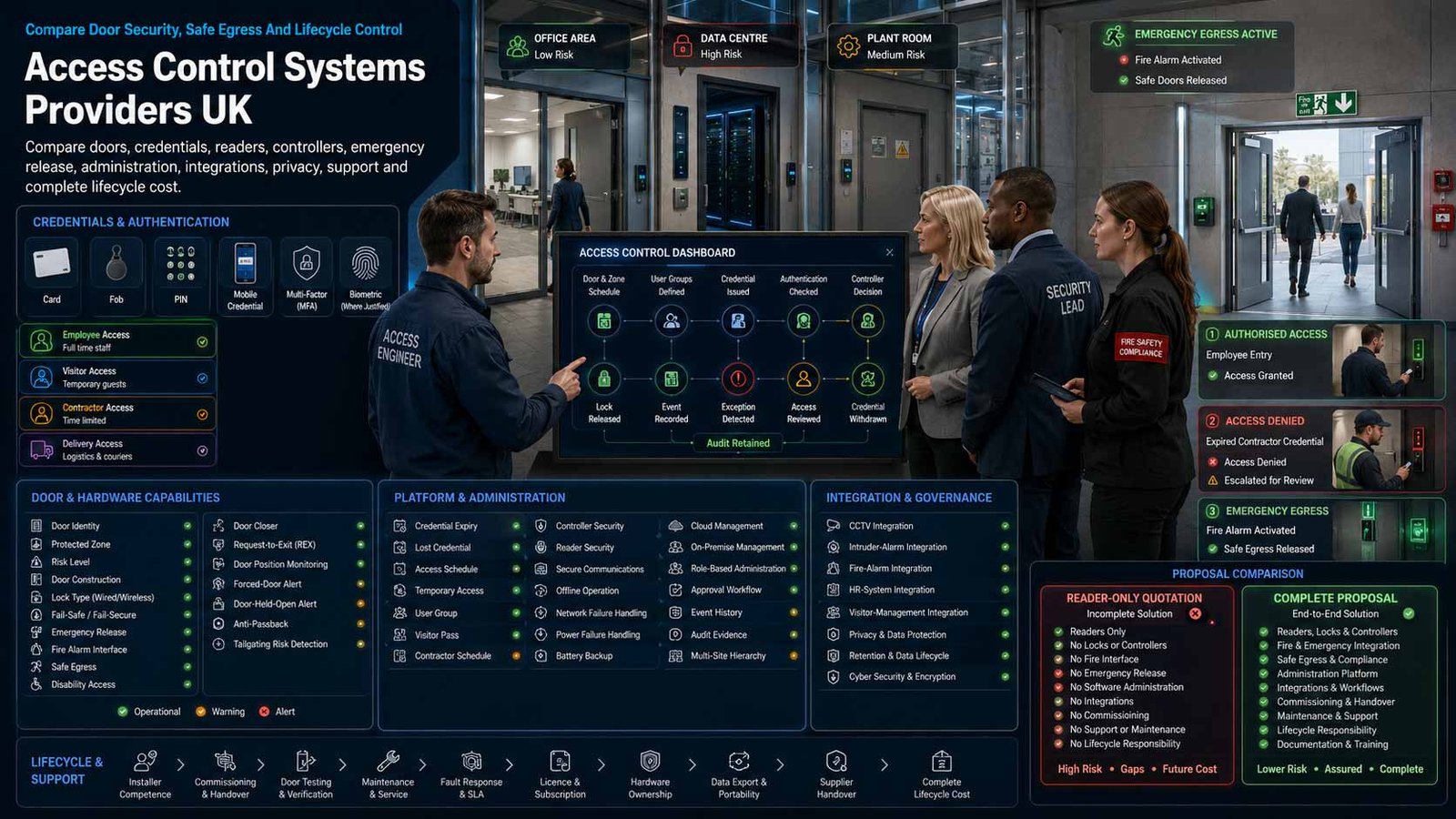
Buy A Safe, Governed Door-Control System—Not Just Readers And Fobs
A reliable access-control system must protect the intended areas while allowing lawful, accessible and immediate escape in an emergency. It should remain manageable during network, server, power, credential and supplier failures.
- Start with a door, zone, user and threat schedule
- Design security and emergency egress together
- Choose credentials and readers as one security architecture
- Contract installation, software, support and exit responsibilities explicitly
An electronic access-control system decides who may enter a business-controlled door or area, at what times and under which conditions. A typical system combines credentials, readers, controllers, locking hardware, exit devices, power supplies, network connections, management software and event records. The security result depends on the complete door assembly and operating process—not a single component.
Requirements differ materially between a two-door office, a retail back-of-house area, a multi-tenant building, a warehouse, a school, a healthcare site and regulated or critical infrastructure. Door construction, fire strategy, evacuation, disability access, tailgating exposure, visitor flows, contractors, cleaning staff, out-of-hours working and the consequences of a failed lock all change the design.
This page compares commercial physical access-control systems. It does not compare cyber identity and access-management software or domestic smart locks. CCTV and business security systems should be assessed separately where video surveillance, intrusion detection or monitoring is required.
Choose The Right Access-Control Operating Model
The correct architecture depends on door risk, user volumes, change frequency, network availability, emergency behaviour, administration and the consequence of failure.
| System Model | What It Usually Includes | Best-Fit Question |
|---|---|---|
| Standalone Keypad Or PIN System | A local keypad and controller operate one or a small number of doors without central user administration. | Can codes be changed quickly, audited appropriately and protected from sharing or observation? |
| Standalone Card Or Fob System | Local credentials replace keys, with permissions programmed at the door or through a simple enrolment method. | How are lost credentials revoked and how much administration is required at every door? |
| Networked Wired Access Control | Readers connect to door controllers and central software, supporting schedules, role-based access, logs and multiple doors. | Does each controller continue enforcing safe rules when the server or network is unavailable? |
| Wireless Electronic Locking | Battery-powered handles, cylinders or escutcheons extend electronic control to doors where new cabling is disruptive. | Are online, offline and update methods appropriate for the risk and required speed of revocation? |
| Cloud-Managed Access Control | Browser or app administration, remote support and subscriptions reduce on-site server requirements. | Which functions remain available during internet, cloud, subscription or supplier outages? |
| Mobile-Credential System | A smartphone or wearable acts as a credential through supported readers and securely issued digital passes. | How are devices enrolled, replaced, revoked and supported for users without a compatible phone? |
| Biometric Access Control | Facial or fingerprint recognition verifies a person using biometric templates, sometimes with a card or PIN. | Is biometric processing necessary and proportionate, and is a less intrusive credential genuinely insufficient? |
| Enterprise Integrated Platform | Multi-site access combines alarms, monitoring, visitor workflows, lifts, barriers or other security functions under central governance. | Are integrations documented, supported and portable without creating a single-vendor operational dependency? |
Eight Areas That Determine Access-Control Fit
Use the same door schedule, credential policy, emergency scenarios, integration scope, privacy requirements and support targets for every provider.
Comparison Criterion
Door, Zone And User Requirements
Build a door schedule showing location, construction, fire and escape role, internal or external exposure, normal traffic, accessible use, visitors, contractors, out-of-hours users and protected assets. Define which identities may enter each zone, when permissions begin and end, and who approves exceptions.
Comparison Criterion
Door Hardware, Locking And Safe Egress
Compare electric strikes, magnetic locks, motor locks, electronic cylinders, wireless handles, request-to-exit devices, emergency release, door contacts, closers and power arrangements. Require the installer and fire-safety owner to confirm that security does not obstruct escape, fire-door performance or accessible use.
Comparison Criterion
Credentials, Readers And Authentication
Assess cards, fobs, PINs, mobile credentials and biometrics as complete security methods. Compare credential encryption, copying resistance, reader-to-controller communication, multi-factor options, lost-credential revocation, issuance, temporary passes, anti-passback and support for a controlled migration from legacy technology.
Comparison Criterion
Controllers, Network, Power And Offline Resilience
Confirm decision-making location, controller capacity, local event storage, fail-safe or fail-secure behaviour, battery-backed power, network segmentation, time synchronisation, server dependency and recovery. Test what each door does during internet, server, controller, reader, lock, power and fire-alarm events.
Comparison Criterion
Administration, Permissions And Audit Evidence
Review role-based administration, approval workflows, joiner-mover-leaver processes, bulk changes, temporary access, visitor and contractor expiry, event searches, alarms, reports, tamper evidence and operator logs. The system should show who changed a permission as well as who used a door.
Comparison Criterion
Integrations And Multi-Site Operations
Assess supported interfaces to visitor management, lifts, barriers, intercoms, alarm systems, video, building management, directories or workforce systems only where there is a defined business need. Require version, ownership, testing, support and failure responsibility for every integration.
Comparison Criterion
Privacy, Cybersecurity And Data Retention
Treat names, credential identifiers and entry events as personal data where they relate to identifiable people. Define lawful purpose, transparency, access rights, retention, exports, incident handling, hosting, encryption, administrator security, updates and deletion. Biometric identification requires additional special-category data controls.
Comparison Criterion
Installer, Maintenance, Support And Exit
Compare site survey quality, design responsibility, recognised certification, manufacturer competence, documentation, commissioning, training, maintenance coverage, emergency response, spare parts, software support, licence renewal and end-of-life planning. Require administrator access, configuration exports and a usable handover pack.
Evidence To Define Before Selecting A System
Translate security, integration and convenience claims into door-level tests, responsibilities and auditable handover evidence.
| Measure | What It Should Define | Evidence To Request | Common Weakness |
|---|---|---|---|
| Door and risk coverage | Whether the proposed design protects every required opening and zone at an appropriate level | Annotated drawings, door schedule, threat and consequence assessment, user groups and exclusions | A generic door count hides fire doors, gates, lifts, shared areas and high-risk rooms |
| Emergency egress | How doors unlock, release or remain secure during fire, evacuation and component failure | Fire strategy review, interface design, release devices, fail state, cause-and-effect test and sign-off | Entry security is designed without proving immediate safe escape |
| Credential security | How credentials, readers and controllers resist copying, replay, substitution and unauthorised issuance | Credential technology, encryption, reader protocol, keys, issuance process, migration and revocation test | A modern-looking reader uses weak legacy credentials or insecure communication |
| Offline and power resilience | Which decisions and records remain available during network, server, internet or mains failure | Controller logic, event capacity, batteries, outage duration, fail state, alarms and restoration test | Cloud or server loss changes door behaviour in an undocumented way |
| Administrative governance | Whether permissions are authorised, time-limited, reviewed and traceable | Role matrix, approvals, expiry, operator logs, joiner/mover/leaver workflow and review reports | Permanent access accumulates because nobody owns periodic review |
| Data protection | Whether access events and identity records are lawful, transparent, minimal and retained appropriately | Purpose, privacy information, lawful basis, retention, rights, exports, deletion, processor terms and DPIA where needed | Logs are retained indefinitely or reused for staff monitoring without governance |
| Cybersecurity and updates | How software, controllers, readers and remote access are secured and maintained | Architecture, supported versions, patch process, encryption, MFA, backups, vulnerability route and end-of-life dates | Security hardware remains operational but unsupported and exposed |
| Installation and commissioning | Whether the complete door assembly is installed, labelled, tested and documented | Installer competence, certificates, as-built drawings, test sheets, cable and power records, training and acceptance | Individual components work but the complete door fails real scenarios |
| Service performance | How faults, lockouts and safety-critical failures are owned and restored | Support hours, severity definitions, response, restoration, remote access, spares, escalation and service reports | An engineer response target is presented as guaranteed restoration |
| Portability and exit | Whether the business can operate, expand or change supplier without losing control or evidence | Admin credentials, licences, database and configuration export, credential ownership, documentation and deletion | The incumbent alone holds passwords, programming knowledge or usable records |
Access-Control Technology Providers UK Businesses Can Consider
Shortlist ecosystems and accredited integrators whose door hardware, credentials, controllers, administration, safety design and support model fit the site. The manufacturer, installer, software host and maintenance contractor may be different legal parties, so confirm the complete responsibility chain.
Provider Profile
Paxton
Paxton offers standalone, Net2 and Paxton10 access-control options, including networked controllers, cards and fobs, mobile-capable credentials, wireless door handles and installer support. Include Paxton where a UK-developed ecosystem, straightforward administration and an established installer route suit small, medium or growing sites. Confirm the exact system, door and user capacity, credential technology, server or cloud dependency, video or entry integration, smart-credential licensing, installer certification, software support, backups, fire interfaces, maintenance and migration path.
Review official Paxton access-control systemsProvider Profile
SALTO
SALTO provides electronic locking and smart-access platforms across wired wall readers, wireless locks, cards, mobile credentials and cloud or on-premises administration. Include SALTO where many internal doors, wireless retrofit, flexible spaces, multiple sites or mobile access are important. Confirm online versus offline behaviour, update timing, gateway coverage, battery maintenance, credential and mobile licensing, emergency opening, integrations, hosting, data location, installer responsibilities, replacement hardware and exit portability.
Review official SALTO smart-access solutionsProvider Profile
HID
HID supplies access-control readers, smart credentials, mobile access and related identity technologies that are commonly used within wider systems delivered by integrators and platform providers. Include HID where credential security, reader choice, mobile credentialing or migration from older cards is central. Confirm the management platform and controller provider, credential technology, encryption keys, reader protocol, mobile issuance model, wallet support, per-user fees, backwards compatibility, key ownership, revocation and the party responsible for the complete installed system.
Review official HID access-control solutionsProvider Profile
Gallagher Security
Gallagher provides an integrated access-control ecosystem centred on Command Centre, controllers and readers for multi-site, enterprise and higher-security environments. Include it where central monitoring, detailed permissions, alarms, reporting, automation or broader physical-security integration is required. Confirm approved channel partners, exact editions and licences, controller and reader architecture, credential encryption, cybersecurity support, redundancy, remote access, integrations, operator training, service coverage, upgrade obligations and the cost of scaling doors, users and sites.
Review official Gallagher access-control solutionsProvider Profile
Suprema
Suprema provides RFID, mobile and biometric access-control readers with BioStar on-premises and cloud-oriented security platforms. Include it where facial or fingerprint authentication, mobile credentials or integration flexibility is being considered. Confirm whether biometrics are genuinely necessary, the template architecture, lawful basis, special-category condition, DPIA, enrolment alternatives, false acceptance and rejection handling, retention, hosting, device security, liveness functions, non-biometric fallback, installer competence and ongoing software support.
Review official Suprema access-control platformsProvider Profile
dormakaba
dormakaba offers door hardware, mechanical keying, electronic locks, credentials and access-management platforms through UK products and authorised partners. Include it where a coordinated door, lock and access solution or a building-wide hardware relationship is valuable. Confirm the exact platform, supported credentials, wired and wireless mix, door certification, fire and escape compatibility, mobile or cloud services, partner responsibility, batteries, licensing, commissioning, maintenance, spare-parts availability and the handover of mechanical and electronic keying records.
Review official dormakaba access solutionsProvider Profile
ASSA ABLOY Aperio
ASSA ABLOY Aperio is a wireless electronic-locking technology designed to extend compatible access-control systems to additional doors through battery-powered cylinders, handles, escutcheons and locks. Include it where cabling disruption or the number of internal doors makes wired control uneconomic. Confirm the host access-control platform, online or offline configuration, integration certification, hub coverage, update and revocation speed, battery monitoring, credential compatibility, door suitability, emergency access, maintenance ownership and long-term integration support.
Review official ASSA ABLOY Aperio solutionsProvider Profile
Honeywell Security
Honeywell provides access-control options for smaller sites through MAXPRO Access and broader enterprise security management through Pro-Watch and related hardware. Include it where remote multi-site management, video or alarm integration, browser administration or an established Honeywell security estate is relevant. Confirm the supported current product, controller and reader bill, cloud or server architecture, offline behaviour, licences, mobile credentials, integrations, partner competence, firmware and software lifecycle, cybersecurity notices, support scope, data export and migration from discontinued products.
Review official Honeywell Security solutionsWhat Changes Access-Control System Cost
Compare the surveyed and commissioned cost of every controlled opening, not a reader price or software subscription in isolation.
| Cost Driver | Why It Changes Spend | What A Comparable Quote Should Show |
|---|---|---|
| Door condition and preparation | Existing doors may need new frames, reinforcement, closers, hinges, panic hardware, cable routes or repair before electronic locking can operate safely | Surveyed door schedule, remedial works, exclusions, making-good, fire-door responsibility and test criteria |
| Lock and reader type | Maglocks, strikes, motor locks, cylinders, wireless handles, keypads and biometric readers have different hardware, wiring and maintenance requirements | Exact manufacturer and model, certification, power, fail state, environmental rating, accessories and warranty |
| Controllers, enclosures and power | Networked doors require controllers, protected enclosures, power supplies, batteries, inputs, outputs and sometimes local expansion modules | Capacity, spare ports, battery duration, monitoring, cabinet location, tamper detection and future doors |
| Credentials and issuance | Cards, fobs, mobile credentials and biometric enrolment create purchase, subscription, administration and replacement cost | Initial and replacement quantity, unit cost, mobile term, wallet fees, printing, key ownership and revocation |
| Software, hosting and licences | On-premises servers, cloud subscriptions, support plans, mobile services, integrations and reporting modules may be separate charges | One-off and recurring licences, included doors and users, storage, upgrades, support, renewal and price-change terms |
| Cabling, network and electrical works | Door loops can require containment, fire stopping, network ports, PoE, fused supplies, isolation and coordination with other contractors | Surveyed route, access, out-of-hours work, decoration, testing, certificates and who provides network/security configuration |
| Fire and emergency interfaces | Release devices, alarm interfaces, cause-and-effect testing and fire-strategy review can add design and commissioning work | Responsible designer, interface module, test method, witnessing, documents and recurring maintenance |
| Biometric and privacy controls | Biometric readers, licences, enrolment equipment, privacy assessment, alternatives and governance increase implementation effort | DPIA, legal review, template storage, fallback, notices, retention, support and deletion |
| Integration and migration | Visitor, lift, barrier, alarm, video, directory or legacy credential integration requires development, licences and coordinated testing | Supported versions, interface fee, data mapping, test cases, ownership, upgrades and failure support |
| Maintenance and support | Preventive visits, batteries, remote support, emergency callout, software support and parts cover affect operating cost | Hours, inclusions, exclusions, severity, response, restoration, annual increase, spares and service reporting |
| Expansion, renewal and exit | Added doors, increased users, cloud renewal, end-of-life hardware, credential migration and supplier change affect lifecycle value | Rate card, licence tiers, notice, data/configuration export, administrator access, decommissioning and deletion |
| Indicative Planning Band | Broad Budget Position | What Must Be Confirmed |
|---|---|---|
| Standalone Single-Door Control | Approximately £500–£1,500 as an early budget allowance for a simple keypad or local card solution | Door and lock condition, fire/escape role, power, release device, credentials, installation, documentation and VAT |
| Networked Single Door | Approximately £1,250–£3,500 before major door remediation or complex integration | Controller, enclosure, reader, lock, exit, contact, power, software, network, commissioning and maintenance |
| Five-Door SME System | Approximately £6,000–£18,000 depending on door hardware, wiring, credentials and software | Surveyed door bill, shared controller capacity, cabling, fire interfaces, licences, training and support |
| Ten-To-Twenty-Five Doors Or Several Sites | Approximately £15,000–£60,000+ where design, resilience, wireless mix and integrations vary materially | Exact doors, site works, network, hosting, redundancy, migration, project management and service coverage |
| Enterprise Or Higher-Security Deployment | Custom project pricing commonly starts above smaller-site bands and can rise substantially with scale and assurance | Threat model, secure credentials, redundancy, control room, integrations, compliance, testing, support and lifecycle roadmap |
Match The System To The Premises And Risk
The right shortlist depends on doors, protected assets, user turnover, emergency arrangements, administration, sites and the consequences of unauthorised entry or lockout.
Small Office, Shop Or Clinic
Prioritise a small networked or carefully selected standalone system, simple credential issue, rapid lost-card revocation, clear exit operation, dependable local installer support and low administration. Avoid consumer smart locks and unmanaged shared PINs for business-critical doors.
Flexible, Multi-Tenant Or Serviced Workplace
Prioritise time-limited permissions, tenant separation, visitor and contractor access, mobile options, audit evidence, lift and common-area coordination, scalable wireless doors and clear responsibility between landlord, operator, tenant and installer.
Multi-Site SME Or Field Operation
Prioritise central administration, delegated site roles, standard credentials, offline controller resilience, remote diagnostics, consistent joiner and leaver workflows, multi-site reporting, predictable licences and nationwide support with documented escalation.
Industrial, Regulated Or Higher-Security Site
Prioritise risk-led zoning, secure credentials, anti-passback or multi-factor rules where justified, resilient controllers and power, alarm integration, detailed operator audit, controlled remote access, formal commissioning, tested emergency behaviour and a supported lifecycle roadmap.
How To Compare Access-Control Proposals
Issue one controlled-access brief containing site drawings, a door and hardware schedule, fire and evacuation constraints, user groups, working hours, visitors, contractors, accessible-use requirements, credential policy, administration roles, privacy and retention rules, integrations, network standards, outage behaviour, support targets, maintenance and expansion assumptions. Require every bidder to return the same compliance matrix and itemised door bill.
- Every opening and exclusion is listed against a drawing
- Normal, outage, fire and emergency behaviour is documented
- Credentials, readers, controllers and software are named precisely
- Licences, subscriptions, support and annual increases are itemised
- Installation, commissioning and acceptance tests are scheduled
- Administrator access, documents, exports and exit are contractual
Compare The Same Door Schedule
A lower total is not comparable when doors, power supplies, exit devices, batteries, software modules, fire interfaces, documentation, training or maintenance have been omitted.
Require bidders to identify assumptions, provisional sums and third-party dependencies at door level before evaluating price.
Six Questions To Put To Every Access-Control Provider
The answers expose omitted doors, unsafe release logic, weak credential architecture, cloud dependency, intrusive data use and incomplete lifecycle pricing.
Which Doors, Risks And Users Does The Design Cover?
Request marked drawings and a door schedule showing each lock, reader, credential rule, protected zone, user group, operating time, exception and excluded work.
How Will Security And Safe Escape Work Together?
Require written normal, fire, evacuation, power, network, server, controller and component-failure behaviour, with the competent parties responsible for approval and testing.
How Secure Are The Credentials And Reader Path?
Ask for the credential technology, encryption, reader-to-controller protocol, key ownership, mobile issuance, copying resistance, migration plan and lost-credential revocation test.
What Works During Outages And How Is It Recovered?
Confirm local decision-making, event storage, battery duration, fail state, alarms, manual override, cloud dependency, backup, restore and the process for reconciling events after service returns.
How Are Access Logs And Biometrics Governed?
Define purposes, lawful basis, transparency, retention, subject rights, administrator access, exports, hosting, processor terms and a DPIA plus non-biometric alternative wherever biometric recognition is proposed.
What Is The Complete Cost, Support And Exit Position?
Itemise hardware, works, licences, credentials, maintenance, callouts, subscriptions, annual changes, added doors, replacements, upgrades, notice, exports, decommissioning and secure deletion.
A Seven-Stage Access-Control Provider Evaluation
Move from risk, doors and emergency behaviour to a tested system with clear ownership rather than selecting products from a feature list.
- Create a verified baseline covering sites, doors, locks, keys, users, visitors, contractors, incidents, fire strategy, evacuation, disability access, current credentials, administration, network, support and accountable owners.
- Classify every opening by protected asset, threat, consequence, traffic, door construction, external exposure, fire and escape function, working pattern, accessibility, tailgating exposure and failure impact.
- Define mandatory security and operational controls: credentials, authentication, access groups, approval, expiry, visitor rules, offline operation, event evidence, privacy, retention, network, updates, backups, emergency behaviour and service levels.
- Prepare one supplier brief with drawings, door schedule, user volumes, migration needs, integrations, data requirements, maintenance, expansion assumptions, contract term and a mandatory itemised response matrix.
- Shortlist manufacturers and integrators by architectural fit, installer competence, certified design process, credential security, product support, cyber lifecycle, financial stability, local coverage and comparable customer evidence.
- Witness a pilot or acceptance test covering authorised and denied entry, lost credentials, door forced and held alarms, fire release, request to exit, power and network failure, controller restart, event reporting, administrator audit and privacy settings.
- Roll out through controlled credential issue, training, documentation, administrator separation, backup and recovery. Review access groups, expired users, alarms, batteries, updates, incidents, service performance, lifecycle status and renewal dates on a defined schedule.
Access-Control Systems Comparison Checklist
Use this table before installing, replacing, extending or renewing a commercial access-control system.
| No. | Requirement | Evidence To Obtain Before Award | Confirmed |
|---|---|---|---|
| 01 | Premises and access baseline complete | Sites, drawings, doors, locks, keys, users, visitors, incidents, working hours, current systems and owners | |
| 02 | Door and zone risk schedule approved | Protected assets, threats, consequences, external exposure, traffic, user groups, time zones and exclusions | |
| 03 | Fire and emergency egress design accepted | Fire strategy, escape doors, release method, fail state, alarm interface, emergency override, testing and sign-off | |
| 04 | Door hardware condition verified | Door and frame, fire rating, closer, hinges, lock, exit device, contact, accessibility, making-good and warranty | |
| 05 | Credential and reader architecture approved | Card/fob/PIN/mobile/biometric method, encryption, keys, reader protocol, issue, loss, revocation and migration | |
| 06 | Controller and outage behaviour tested | Local decisions, event capacity, network/server/cloud loss, restart, fail-safe/fail-secure, alarms and reconciliation | |
| 07 | Power and network responsibilities agreed | Supply, batteries, duration, monitoring, cabling, containment, ports, segmentation, certificates and fire stopping | |
| 08 | Cybersecurity baseline accepted | Admin MFA, roles, remote access, encryption, supported versions, patching, backups, logs, incidents and end-of-life | |
| 09 | Privacy and retention controls documented | Purpose, lawful basis, notices, access events, recipients, retention, rights, exports, deletion and processor contract | |
| 10 | Biometric necessity and DPIA approved if applicable | Necessity, proportionality, special-category condition, alternatives, templates, accuracy, fallback and deletion | |
| 11 | Exact bill of materials itemised | Manufacturer, model, quantity, door allocation, licences, credentials, accessories, software, subscriptions and spares | |
| 12 | Installer competence and certification verified | Manufacturer training, NSI or equivalent evidence where required, insurance, references, design responsibility and subcontractors | |
| 13 | Commissioning and acceptance plan agreed | Functional, fire, fault, outage, alarm, accessibility, reporting, backup, restore, training, defects and certificates | |
| 14 | Maintenance and lifecycle support accepted | Preventive visits, batteries, support hours, response, restoration, callouts, parts, updates, annual increases and service reports | |
| 15 | Handover, renewal and exit documented | Admin accounts, drawings, configuration, backups, keys, licences, exports, notice, decommissioning and secure deletion |
Common Access-Control Buying Mistakes
Most avoidable problems begin with product-first selection, unsafe door assumptions, weak credentials, intrusive monitoring or incomplete handover.
| Mistake | Why It Creates Risk | Better Control |
|---|---|---|
| Buying readers before surveying the doors | The lock, frame, closer, escape function and power route determine whether the design can work safely | Approve a door-level survey and bill of materials first |
| Using domestic smart locks for business-critical access | Consumer products may lack governance, audit, support, lifecycle and safe integration required for commercial premises | Use a supported commercial system with clear administrator and maintenance ownership |
| Treating fire release as an installer detail | Incorrect lock or release behaviour can obstruct escape or undermine fire-door protection | Coordinate access design with the fire strategy and witness cause-and-effect tests |
| Keeping weak legacy credentials indefinitely | Older low-security cards or reader communication can undermine new controllers and software | Plan a credential, key and reader migration as one security project |
| Choosing biometrics because they appear convenient | Biometric identification processes special-category data and may be disproportionate where cards or mobile credentials work | Document necessity, DPIA, lawful conditions and a practical alternative |
| Sharing administrator accounts | Shared access prevents accountability and increases the impact of credential compromise | Use named roles, least privilege, MFA and operator audit |
| Assuming cloud access means doors need the internet | Unclear outage design can cause lockouts, permissive failover or lost administration | Test local controller operation and recovery before acceptance |
| Assuming every advertised integration is supported | Licences, versions, data mapping and support boundaries may differ from a marketing statement | Contract exact versions, test cases and fault ownership |
| Omitting maintenance and lifecycle planning | Batteries, locks, firmware, servers and credentials degrade or become unsupported | Fund preventive maintenance, updates and end-of-life migration |
| Letting the installer retain all knowledge and credentials | Supplier change becomes risky when the customer lacks admin access, drawings, backups or configuration | Make a complete handover and export a contractual acceptance requirement |
Frequently Asked Questions
Answers to common questions from UK businesses comparing electronic door access, credentials, biometrics, safety, installation and support.
What Is A Business Access-Control System?
A business access-control system manages who can enter controlled doors or areas, when entry is allowed and under which conditions. It normally combines credentials, readers, controllers, locking hardware, exit devices, power, software and event records. The complete door and operating process determine the security result.
How Does Electronic Door Access Control Work?
A user presents a card, fob, PIN, phone or biometric at a reader. The reader and controller evaluate that credential against current permissions and either release or keep the door locked. The system may record the decision and raise alarms for forced, held or tampered doors.
Which Access-Control Type Is Best For A Small Business?
A small business often benefits from a simple networked system or a carefully selected standalone commercial solution. The choice depends on door count, staff changes, lost-credential risk, audit needs, fire and escape arrangements, remote administration and support—not business size alone.
How Much Does A Commercial Access-Control System Cost?
Cost depends on door and frame condition, locking hardware, readers, controllers, credentials, cabling, power, fire interfaces, software, subscriptions, installation and maintenance. A simple door may cost hundreds or low thousands, while multi-door and integrated sites require a surveyed custom proposal.
Should A Business Use Cards, Fobs Or Mobile Credentials?
Cards and fobs are widely understood and can be issued to users without phones. Mobile credentials can simplify remote issue and reduce physical stock but may introduce device, app, licence and support dependencies. Compare credential security, copying resistance, revocation, user inclusion and total recurring cost.
Can Employers Use Fingerprint Or Facial Recognition For Door Access?
Potentially, but biometric recognition used to identify people processes special-category biometric data. The organisation must show necessity and proportionality, identify a lawful basis and special-category condition, complete a DPIA where required, provide transparency, secure templates and consider a less intrusive alternative.
Can Access-Control Locks Be Fitted To Fire Exit Doors?
Security can be combined with safe escape only where the door, locking and release arrangements fit the fire strategy and applicable requirements. Emergency doors must be openable as required in an emergency. The competent fire and access-control parties should design, commission and witness the interface.
Is Cloud Access Control Better Than On-Premises?
Cloud management can simplify remote administration, updates and multi-site access. On-premises systems can provide local control and integration flexibility. Neither is automatically better. Compare offline door operation, hosting, data location, administrator security, subscriptions, updates, backup, recovery and supplier exit.
How Often Should Access-Control Systems Be Maintained?
The appropriate schedule depends on doors, locks, batteries, environment, manufacturer guidance, risk and contractual requirements. Businesses should combine planned inspection with prompt fault response, periodic user and permission review, software and firmware updates, backup testing and fire-interface testing where applicable.
How Should UK Businesses Compare Access-Control Providers?
Give every bidder the same drawings, door schedule, user groups, credential policy, emergency scenarios, privacy requirements, integrations, support levels and contract assumptions. Compare the exact bill of materials, safe behaviour, credential security, installer competence, commissioning, licences, maintenance, lifecycle support and handover—not the reader price alone.
Official Guidance, Standards And Provider Resources
Reviewed by Bhav Giva, Founder & Lead Analyst at CompareServices.co.uk, on 31 July 2026.
Use current fire-safety, data-protection, system-standard, certification and manufacturer information to verify design, installation, credential, biometric, maintenance and lifecycle claims. Access control affects both security and safe escape. Obtain competent site-specific advice for door, fire, electrical, accessibility, privacy and higher-security requirements.
- GOV.UK — Workplace Fire Safety And Evacuation Plans
- GOV.UK — Fire Safety Risk Assessment For Offices And Shops
- ICO — Biometric Data For Time And Access Control
- ICO — Biometric Recognition Guidance
- ICO — Monitoring Workers Guidance
- NSI — Access Control Systems For Business Premises
- NSI — Access Control, Safe Escape And NCP 109
- BSI — BS EN 60839-11-1 Electronic Access-Control Systems
- BSI — BS 7273-4 Door Release Mechanisms
- NPSA — Door Security Guidance
- Paxton — Access-Control Systems
- SALTO — Smart Access Solutions
- HID — Access-Control Solutions
- Gallagher Security — Access-Control Solutions
- Suprema — Access Control And Biometrics
- dormakaba UK — Door And Access Solutions
- ASSA ABLOY — Aperio Wireless Access Control
- Honeywell Security — Access-Control Solutions