
Compare IoT / M2M SIM Connectivity Providers UK (2026)
Compare Coverage, Security, Data Control And Device Lifecycle Support
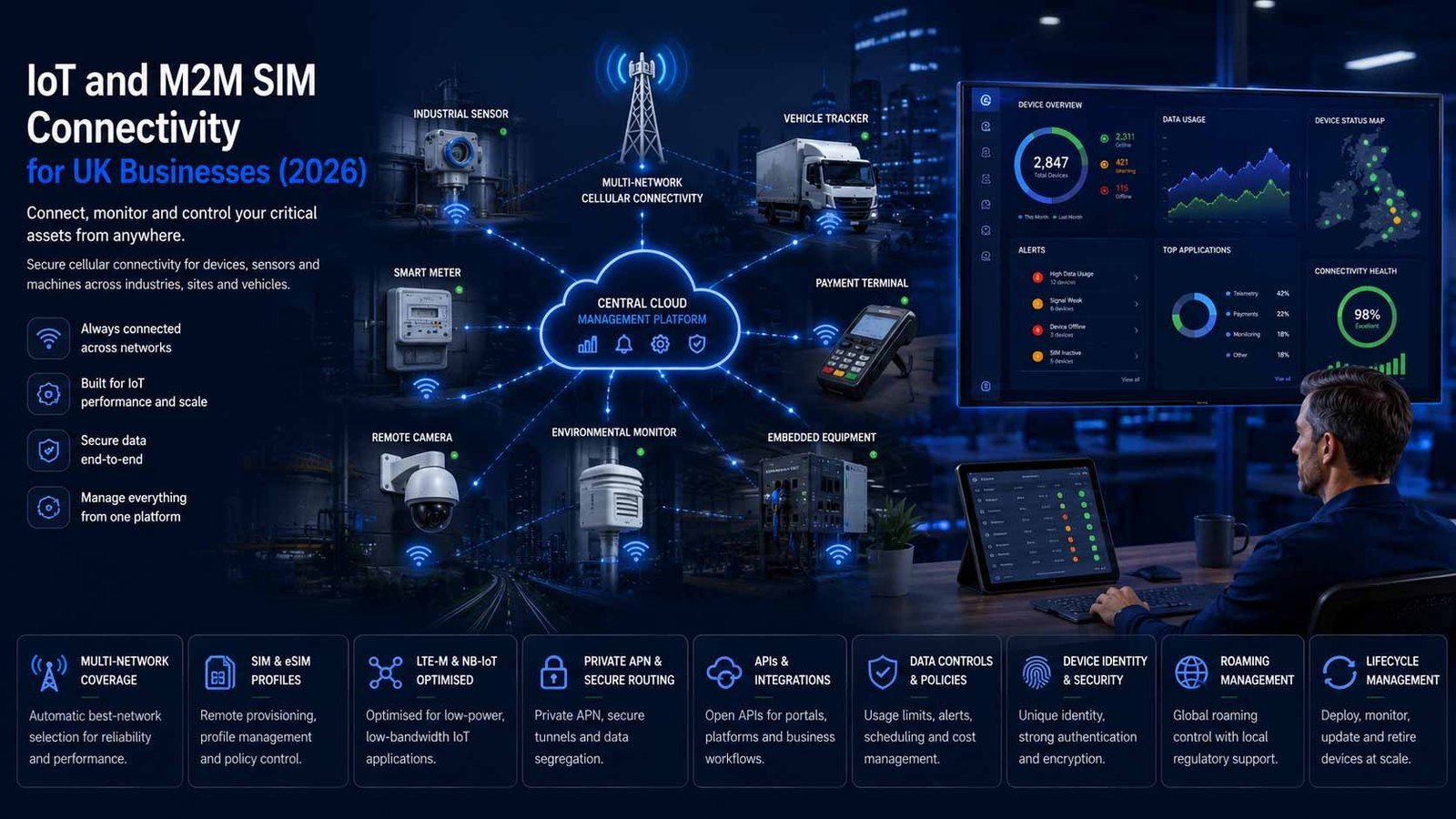
Compare IoT SIM providers UK businesses can shortlist for sensors, trackers, payment terminals, vehicles and remote equipment. Assess UK and global coverage, multi-network access, LTE-M and NB-IoT support, eSIM options, private APNs, security, data controls, management platforms, APIs and lifecycle support before deploying connected devices reliably and securely at scale.
Why IoT Connectivity Is A Lifecycle Decision
An IoT SIM is not merely a data allowance. It becomes part of the product, operational process and remote-support model for every device placed in the field.
- Match radio technology and network access to the device use case
- Control exposure through APN, IP, VPN and application-layer security
- Manage thousands of SIMs without manual spreadsheet administration
- Plan for roaming policy, hardware life and future network change
IoT and M2M connectivity links machines, sensors, terminals, trackers, cameras, vehicles and embedded products to applications or cloud platforms. The correct provider depends on where devices operate, how much data they send, whether they move between networks or countries, how they are powered, how they are accessed remotely and what happens when connectivity fails.
A reliable comparison should treat the SIM, mobile core, management platform, security controls, APIs, commercial model and support service as one connected operating model. A low-cost SIM that cannot be diagnosed remotely or migrated cleanly can create far greater field-service cost later.
Purpose-built IoT and M2M connectivity is designed for machines, embedded products and unattended equipment. Employee phone contracts, handset bundles and general mobile plans use different commercial, security and support models.
Match The Device Estate To The Correct Connectivity Model
Start with device behaviour, geography, power, data flow and service criticality before choosing a network or tariff.
| Deployment Need | Likely Connectivity Model | Evidence To Request | Main Comparison Risk |
|---|---|---|---|
| Fixed UK sensors or terminals | Single-network or multi-network IoT SIM with suitable 4G, LTE-M or NB-IoT support | Postcode and indoor coverage evidence, device-module compatibility and field-test results | Consumer coverage assumptions are used instead of testing the exact installation position |
| Vehicles, trackers or mobile assets | Unsteered or managed multi-network roaming with location-aware diagnostics | Available UK networks, steering policy, handover behaviour, roaming restrictions and recovery process | The SIM can see several networks but does not select or recover in the way the application requires |
| Products sold across countries | Global SIM or eUICC/eSIM model with approved regional profiles and local-breakout options | Country list, permitted permanent-roaming terms, latency routes, profile-management process and regulatory responsibilities | A global coverage map hides country restrictions, unsupported radio bands or long-stay roaming limits |
| Low-power remote devices | LTE-M or NB-IoT where device, network and application requirements align | Radio availability, power-saving support, latency tolerance, mobility requirements and firmware compatibility | A low-power radio is selected without checking mobility, message size, roaming or fallback requirements |
| Critical alarms, healthcare or infrastructure | Resilient multi-network connectivity with private routing, alerts, escalation and tested recovery | Support SLA, network operations coverage, incident path, security controls and continuity test evidence | Marketing claims are accepted without an end-to-end failure and restoration test |
| High-data cameras or digital signage | 4G/5G plans with capacity controls, local routing and commercial protection against abnormal usage | Expected throughput, data pooling, overage rules, traffic shaping, remote diagnostics and device security | Low-volume IoT tariffs are used for sustained video or software-update traffic |
Eight Areas That Separate An IoT Platform From A Basic Data SIM
Use these criteria to compare deployment suitability, operational control and long-term risk.
Comparison Criterion
Network And Geographic Coverage
Compare the actual networks, countries, radio technologies and roaming rules available to the SIM. Coverage must be tested at the device location and with the selected modem, antenna, enclosure and installation position.
Comparison Criterion
SIM, eSIM And Hardware Fit
Check removable SIM formats, industrial-grade options, soldered MFF2, eUICC/eSIM profile management, temperature ratings, retention expectations and whether the modem supports every required band and radio standard.
Comparison Criterion
Private APN, IP And Routing
Establish whether devices use public internet, private APN, VPN, private addressing, fixed IP, inbound access, cloud interconnect or regional breakout. The design should minimise unnecessary exposure and preserve supportability.
Comparison Criterion
Management Platform And APIs
The portal should support activation, suspension, grouping, usage, alerts, diagnostics, network history, audit logs, reporting and role control. APIs and webhooks matter when connectivity operations must integrate with a product platform.
Comparison Criterion
Data Plans And Cost Control
Compare pooled and per-SIM allowances, minimum commitments, dormant states, SMS, overage, roaming zones, high-usage protection and billing granularity. Model normal, abnormal and firmware-update traffic separately.
Comparison Criterion
Security And Device Identity
Assess IMEI locking, access lists, private routing, encryption responsibilities, credential management, traffic restrictions, anomaly detection and the separation between network security and application-layer security.
Comparison Criterion
Lifecycle And Migration
Understand ordering, provisioning, labelling, activation, stock states, replacement, ownership transfer, profile change, number or identity retention, estate migration and secure decommissioning before devices are deployed.
Comparison Criterion
Support And Service Ownership
Confirm who supports the SIM, network, APN, portal, API and device integration. Compare escalation routes, NOC coverage, incident data, response targets, planned maintenance and support for field troubleshooting.
Compare Cellular Options By Device Behaviour And Service Requirement
The right radio and SIM model depends on mobility, power, message size, latency, coverage and the expected life of the product.
| Technology Or SIM Model | Typical Fit | Questions To Ask | Common Misbuy |
|---|---|---|---|
| 4G / 5G IoT Connectivity | Routers, cameras, payment terminals, signage, vehicles and devices needing regular or higher-volume data | Which bands and networks are supported? Is 5G required, or is stable 4G coverage more important? What happens during network fallback? | Buying headline speed when the application needs predictable coverage, latency and recovery |
| LTE-M | Mobile or battery-powered devices needing lower power, modest data and broader feature support than narrowband-only designs | Is LTE-M available in every target country? Does the device require mobility, SMS, voice features or roaming? How is power saving configured? | Assuming LTE-M support is identical across all networks and countries |
| NB-IoT | Low-throughput stationary sensors where deep coverage and long battery life are more important than mobility or fast response | What message size, latency and mobility can the application tolerate? Is roaming supported? Does the module and firmware match the network implementation? | Using NB-IoT for moving assets, time-critical commands or deployments that require broad roaming |
| Multi-Network Roaming SIM | Assets that move or fixed sites where one network may not provide sufficient resilience | Is roaming steered or unsteered? Which networks are genuinely available? How quickly can the SIM recover after loss of service? | Counting network logos without testing selection logic, recovery time and commercial restrictions |
| eUICC / IoT eSIM | Embedded products, global estates or long-life devices where remote profile change can reduce physical SIM replacement | Who controls profiles and remote provisioning? Which standards are supported? What are the commercial and operational exit arrangements? | Treating eSIM as automatic operator independence without checking profile ownership and migration rights |
| Industrial Or Embedded SIM | Devices exposed to vibration, temperature, moisture, long service life or inaccessible installation | Which form factor, operating range, retention, write endurance and manufacturing process apply? How will identities be tracked through production? | Using consumer-grade removable SIMs where field replacement is difficult or costly |
IoT SIM Providers UK Businesses Can Include In A Shortlist
Use these provider profiles to build an initial shortlist, then confirm network access, countries, radio technologies, platform functions, tariffs, support and deployment availability for your exact requirements.
Provider Profile
Vodafone Business
Managed IoT connectivity with a dedicated platform for SIM visibility, control, reporting, APIs, APN configuration and global deployment options. Include it where an established mobile operator, enterprise controls and international scale are important.
Review official service informationProvider Profile
EE Business
Purpose-designed IoT SIM options on EE’s UK mobile network, with ruggedised formats and business IoT support. Include it for UK-centred estates where direct-network coverage and device compatibility are central to the shortlist.
Review official service informationProvider Profile
O2 Business
O2 Smart Connect provides IoT SIM activation, suspension, provisioning, billing and estate visibility through a management platform. Consider it for UK deployments needing direct operator capability and access to LTE-M or NB-IoT options.
Review official service informationProvider Profile
Wireless Logic
Specialist managed IoT connectivity with multi-network SIMs, private APN and VPN options, estate-management tools and global coverage. Include it where network independence, secure routing or multi-operator estate control is important.
Review official service informationProvider Profile
Eseye
Global IoT connectivity using multi-IMSI and eUICC technology with central lifecycle management. Its model is relevant to manufacturers and enterprises deploying one product across multiple countries and network environments.
Review official service informationProvider Profile
CSL
Managed IoT SIMs and connectivity platforms aimed at business-critical and life-safety use cases, with multi-network roaming, private APNs, flexible data options and remote estate management.
Review official service informationProvider Profile
1NCE
IoT connectivity and software with a long-duration prepaid commercial model aimed mainly at lower-bandwidth device estates. Include it where predictable lifetime cost and simple international deployment are more important than high data usage.
Review official service informationProvider Profile
Soracom
Cloud-native IoT connectivity with global and multi-network SIM options, central device control, private networking and developer-facing platform services. Include it where APIs, cloud integration and flexible technical control matter.
Review official service informationWhat Changes The Cost Of IoT SIM Connectivity
Compare total estate economics, not only the monthly price of one active SIM.
| Cost Driver | How It Affects The Quote | Evidence To Request | Buyer Risk |
|---|---|---|---|
| SIM volume and active states | Per-SIM fees, minimum commitments and discounts may change with ordered, stocked, activated, suspended and live quantities | State definitions, monthly minimums, activation fees, suspension pricing and volume bands | Paying full recurring charges for warehouse stock, pilots or seasonal devices |
| Data, SMS and traffic pattern | Low-volume sensors, periodic uploads, firmware updates and video use need very different commercial models | Normal and peak usage model, pooled allowances, overage, SMS pricing and traffic-shaping rules | Average data hides rare but expensive updates, faults or runaway devices |
| Countries and network access | Domestic single-network, multi-network roaming and global local-profile models carry different wholesale and platform costs | Country and network list, zone definitions, restrictions, local breakout and permanent-roaming terms | A low tariff applies only to a narrow country or network set |
| Security and private networking | Private APN, VPN, fixed IP, cloud interconnect, access control and managed security may add setup or recurring charges | Architecture, implementation fees, IP allocation, support ownership and change charges | Security is purchased but not integrated into the actual application design |
| Platform, APIs and support | Advanced analytics, API calls, sub-organisations, premium support, NOC monitoring and custom reports may sit outside base connectivity | Feature matrix, user limits, API terms, SLA, support hours and professional-services rates | The portal demo includes functions not included in the quoted edition |
| Hardware and deployment services | Industrial SIMs, eSIM integration, routers, antennas, device certification, staging and logistics add project cost | Bill of materials, device responsibility matrix, test plan, replacement process and warranty boundaries | The connectivity price excludes the work needed to make devices connect reliably |
How The Use Case Changes The Provider Shortlist
The best provider for a fixed UK sensor estate may not be the best fit for mobile, critical or global devices.
Fixed Monitoring And Metering
Prioritise deep-site coverage, low power, predictable data use, long device life and remote diagnostics. Validate the exact radio technology and installation environment.
Fleet, Logistics And Asset Tracking
Prioritise mobility, multi-network access, roaming, location diagnostics, recovery speed and commercial protection as assets move between regions.
Retail, Payments And Digital Signage
Prioritise resilience, remote access, security, higher data options, estate visibility and fast incident escalation across many customer-facing sites.
Manufacturers And Global Product Companies
Prioritise embedded form factors, eUICC/eSIM control, one-SKU deployment, country compliance, profile ownership, lifecycle APIs and long-term migration rights.
How To Compare IoT SIM Provider Proposals
Give each provider the same deployment brief covering countries, networks, radio support, SIM formats, eSIM control, routing, security, estate management, APIs, tariffs, lifecycle operations, support and exit requirements. Request written evidence for every assumption, limitation and responsibility.
- Purpose-built IoT capability rather than consumer mobile packaging
- Evidence for coverage, network access and radio compatibility
- Operational controls for large or distributed device estates
- Security architecture and clear responsibility boundaries
- Commercial transparency across deployment and device lifecycle
Compare The Whole Connectivity Operating Model
A provider should be able to explain how a SIM is ordered, provisioned, connected, secured, monitored, suspended, diagnosed, replaced, migrated and decommissioned. If those processes are unclear before rollout, they will be harder and more expensive after thousands of devices are live.
Six Questions To Put To Every IoT Connectivity Provider
Use the answers to expose coverage assumptions, security gaps, platform limitations and future lock-in.
What Networks And Countries Are Actually Available?
Ask for the exact network and country list, steering policy, radio technologies and any restrictions. A logo-filled coverage map is not enough for deployment approval.
How Is Device Traffic Kept Private And Controlled?
Request a data-flow diagram showing APN, IP addressing, VPN or cloud interconnect, inbound access, traffic restrictions, encryption responsibilities and application endpoints.
Can The Platform Support Our Operating Model?
Demonstrate bulk activation, suspension, grouping, alerts, usage analysis, session history, user roles, audit logs, APIs, webhooks and sub-customer management using realistic estate data.
What Happens When A Device Stops Communicating?
Define first-line diagnostics, network-session evidence, remote actions, escalation, support hours, replacement procedures and how responsibility is divided between device, network and application teams.
How Will We Migrate Or Exit Later?
Clarify SIM ownership, profile control, identifiers, APN migration, data export, contract end, device recall assumptions, remote profile change and charges for moving the estate.
How Are Abnormal Usage And Security Events Managed?
Ask about thresholds, automatic suspension, anomaly detection, IMEI binding, access lists, alerts, audit evidence and who investigates suspected compromise or runaway devices.
A Six-Stage IoT Connectivity Selection And Rollout Process
Control risk before devices leave the workshop or enter the field.
- Define device functions, data flows, geographies, power, mobility, criticality and expected operational life.
- Confirm modem bands, radio technologies, SIM form factor, firmware and antenna design with the device engineering team.
- Build a coverage, security, platform, tariff, support and lifecycle requirement schedule for every provider.
- Run a controlled pilot across representative sites, countries, networks, failure conditions and expected traffic patterns.
- Document provisioning, identity, activation, monitoring, incident, replacement, update and decommissioning workflows.
- Approve rollout only when technical evidence, commercial terms, support ownership and exit arrangements are complete.
IoT SIM Provider Comparison Checklist
Use this checklist before accepting a commercial proposal or approving production deployment.
- Device use case, countries, mobility, expected life and service criticality are documented
- Modem, antenna, bands, radio technologies and SIM form factors are confirmed
- Coverage has been tested in representative real-world installation conditions
- Network steering, roaming, local-profile and recovery behaviour are understood
- APN, IP addressing, VPN, inbound access and cloud routing are documented
- Application encryption, authentication, credential and update responsibilities are assigned
- Portal, API, reporting, alerts, audit and user-role requirements are demonstrated
- Data assumptions include normal use, faults, updates and abnormal consumption
- Support, incident escalation, planned maintenance and replacement processes are agreed
- SIM ownership, eSIM profile control, migration, export and exit rights are written into the contract
Common IoT Connectivity Mistakes To Avoid
Most costly failures begin with assumptions that were never tested before scale.
| Mistake | Why It Causes Problems | Better Control |
|---|---|---|
| Using employee or consumer SIMs in deployed equipment | Management, security, lifecycle, support and commercial controls may not suit unattended devices | Use a purpose-built IoT service with documented estate-management and support functions |
| Choosing by theoretical coverage only | Building materials, antenna design, installation position and modem behaviour can change real performance | Run field tests using production-equivalent hardware at representative locations |
| Assuming multi-network means instant resilience | Steering, registration, signal thresholds and recovery timing can prevent the expected failover outcome | Test network loss, reselection and restoration under controlled conditions |
| Treating a private APN as complete security | Device firmware, credentials, application endpoints and remote access can still create exposure | Use layered security covering device, network, transport, platform and operational access |
| Ignoring firmware and fault data spikes | A low-data tariff can become expensive when updates, retries or compromised devices create unusual traffic | Model peak events and apply alerts, caps, automatic actions and staged updates |
| Leaving migration and profile ownership until contract end | Embedded or remote devices may be costly to revisit if the SIM or profile cannot be changed remotely | Agree ownership, remote provisioning, export and exit processes before production |
Frequently Asked Questions
Answers to common questions from UK organisations comparing IoT and M2M SIM connectivity.
What is an IoT SIM card?
An IoT SIM is a subscriber identity designed for machines and connected devices rather than employee smartphones. Purpose-built services can add central activation, monitoring, private routing, APIs, multi-network access, lifecycle states and commercial models suited to large unattended device estates.
What is the difference between IoT and M2M connectivity?
M2M commonly describes direct machine-to-machine communication for a defined application, while IoT often describes a broader connected system involving devices, platforms, data and business processes. In procurement, the terms overlap and providers may use both for cellular device connectivity.
How is an IoT SIM different from a normal business mobile SIM?
A normal business SIM is usually packaged for people, phones, calls, texts and mobile data. An IoT SIM is designed for devices and may include industrial form factors, multi-network access, private APNs, low-usage tariffs, APIs, bulk lifecycle control, diagnostics and long deployment periods.
Should a business choose a single-network or multi-network IoT SIM?
A single-network SIM can suit predictable UK deployments where coverage is proven and direct operator support is preferred. Multi-network connectivity can improve deployment flexibility or resilience, but buyers must test steering, network selection, recovery timing, roaming rules and commercial restrictions.
What are LTE-M and NB-IoT?
LTE-M and NB-IoT are cellular technologies designed for IoT use cases. LTE-M can suit mobile or moderately interactive devices, while NB-IoT can suit low-throughput stationary sensors. Availability, roaming, latency, power saving, module compatibility and fallback differ, so the use case must be validated.
What is a private APN for IoT?
A private APN is a controlled gateway or routing configuration used to separate device traffic from ordinary public mobile-data access. It can support private addressing, access policies and connection to a business network or cloud environment. It does not replace device authentication, encryption or secure application design.
Do IoT devices need static IP addresses?
Many devices send outbound data and do not need directly reachable public addresses. Static private or public IPs may be useful for certain remote-access models, but they also affect security and architecture. The provider should explain how devices are reached, authenticated and restricted.
How much data does an IoT SIM need?
Usage varies from a few small sensor messages to continuous video or software downloads. Estimate normal telemetry, keep-alives, acknowledgements, retries, remote diagnostics and firmware updates separately. Pilot measurements are more reliable than assumptions, and alerts should protect against abnormal traffic.
Can an IoT eSIM change network provider remotely?
Some eUICC and IoT eSIM implementations support remote profile provisioning or change, but capability depends on the device, standard, platform, commercial agreement and who controls the profiles. Buyers should confirm ownership, supported profiles, migration process and exit rights in writing.
How should a UK business compare IoT SIM provider quotes?
Give providers the same device, country, network, radio, data, security, platform, API, support and lifecycle requirements. Compare tested coverage, operational control, total estate cost, incident ownership, migration rights and deployment evidence—not only price per SIM or number of network logos.
Provider Information And Connected-Device Security Resources
Use the official resources below to verify current network access, country coverage, radio support, platform functions, tariffs, security controls and support terms before committing to an IoT deployment.
Test production-equivalent hardware in representative locations, confirm permanent-roaming rules, document data flows and security responsibilities, and obtain specialist legal, security or engineering advice where the deployment requires it.
Reviewed by: Bhav Giva. Last reviewed: 16 July 2026.
- Vodafone Business — Managed IoT Connectivity Platform
- Vodafone Business — IoT SIM Plans
- EE Business — Internet Of Things Connectivity
- O2 Business — Internet Of Things Solutions
- O2 Business — LTE-M And NB-IoT
- Wireless Logic — Local Multi-Network IoT SIM
- Eseye — AnyNet+ Global IoT SIM
- CSL — IoT SIM Cards
- 1NCE — IoT SIM Card UK
- Soracom — Global IoT SIM
- NCSC — Device Security Principles For Manufacturers
- NCSC — Organisational Use Of Enterprise Connected Devices