
Compare Internet Backup / 4G-5G Failover Providers UK (2026)
Compare Automatic Failover, Coverage, Recovery And Support
Compare business 4G failover broadband and 5G internet backup options for UK sites. Assess automatic switching, mobile-network coverage, router compatibility, data allowances, static IP behaviour, monitoring, recovery testing and support ownership. Shortlist resilient solutions that keep payments, cloud systems, communications and customer service operating when the primary connection fails unexpectedly.
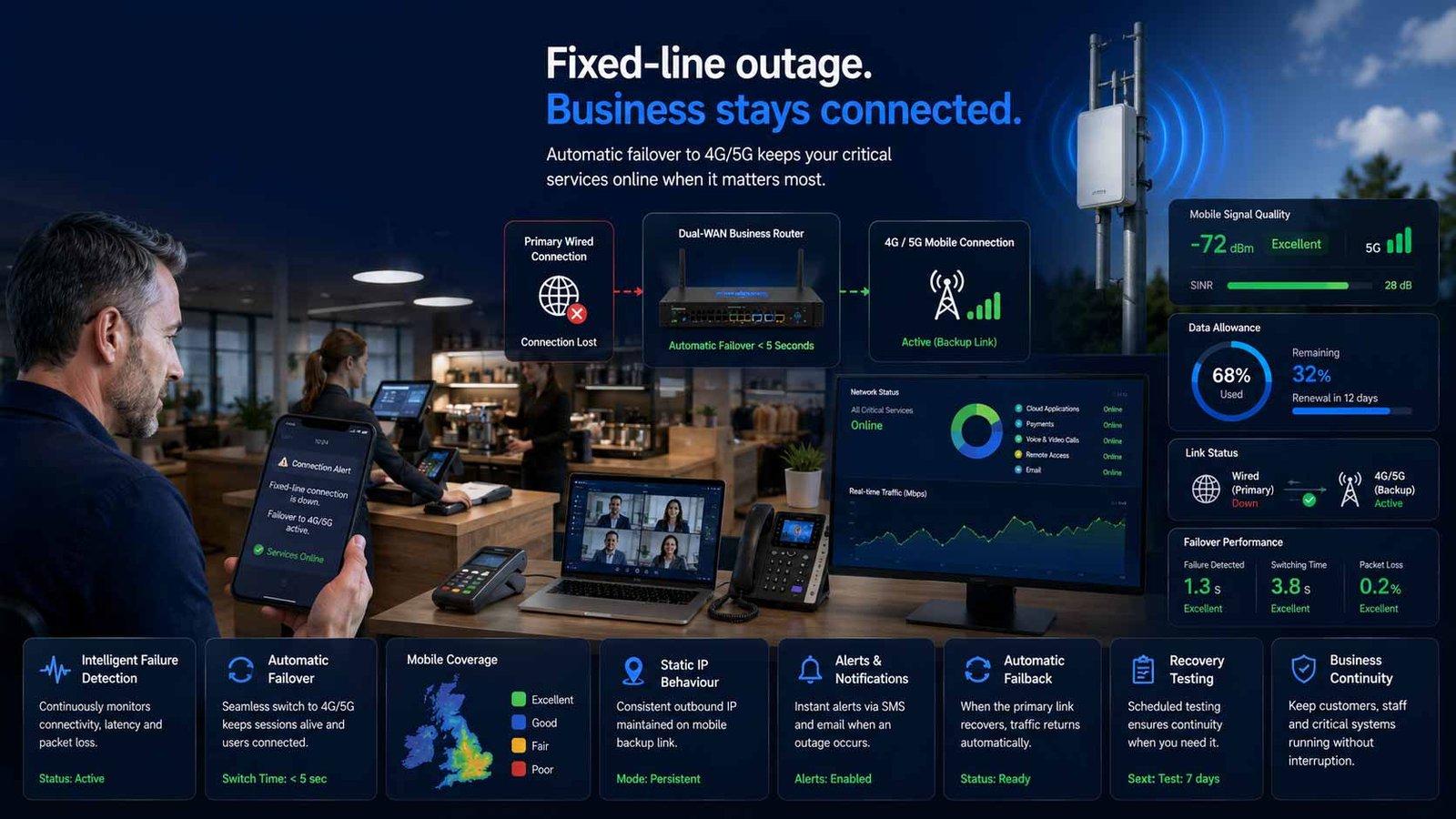
Why Internet Backup Is A Resilience Decision
A backup connection is valuable only when it protects the applications and workflows that matter during a real outage. The comparison must test automatic switching, mobile coverage, network design and operational ownership rather than treating a SIM and router as sufficient evidence of resilience.
- Identify which business processes must continue during a connectivity failure
- Validate 4G or 5G signal at the router and antenna location
- Test failover, failback, VPN, voice, payment and cloud behaviour
- Define monitoring, escalation, data usage and recovery responsibilities
The strongest designs reduce shared failure points. A secondary service should reduce exposure to the same duct, exchange, street cabinet, provider core, router, power supply or building incident that could interrupt the primary connection. Mobile access can remove dependence on the fixed local access path, but it does not automatically protect the router, firewall, mains power or internal network.
Automatic switching also needs precise definition. Some products change the WAN path when the fixed service becomes unavailable; others require compatible provider hardware, manual intervention or a separately configured dual-WAN firewall. The buyer should understand detection time, route selection, session interruption, failback behaviour and whether public IP addresses change.
Capacity during an outage is usually lower and less predictable than the main connection. Critical payments, customer communications, cloud applications and remote access may need priority while software updates, guest traffic, backups and large transfers are restricted. A credible design includes traffic policy and data-allowance controls for the degraded operating state.
The correct outcome is not a promise that an outage can never be noticed. It is a tested recovery plan showing which services continue, how quickly they recover, who receives alerts, what users should expect and how the provider restores normal operation.
Compare Internet Backup Providers By Resilience Fit
Available options range from bundled broadband backup to managed 4G/5G services and mobile-access components. Compare the complete recovery design because providers may include different routers, monitoring tools, switching methods, data policies and support responsibilities.
| Provider | Positioning | Relevant Strengths | Potential Fit | Points To Verify |
|---|---|---|---|---|
| BT Business | Hybrid Backup and 4G Assure | Provider-integrated backup options designed to work with compatible BT Business broadband equipment and the EE mobile network. | Smaller UK sites wanting a bundled route with one provider supporting the primary service and mobile backup. | Confirm compatible package and hub, 4G signal, failover behaviour, backup throughput, guest-network limitations, power protection and whether static IP or hosted services behave differently. |
| Virgin Media Business | Constant Connect 4G Back-up | Automatic switch to a 4G connection when the fixed Voom service loses connectivity, with return to the fixed service after restoration. | Voom Fibre customers seeking a provider-managed add-on and proactive fault awareness. | Check package eligibility, contract alignment, mobile coverage, data and performance policy, static IP treatment, supported traffic and the published boundary that broadband backup does not necessarily protect separate voice services. |
| Vodafone Business | Hybrid Broadband with automatic 4G backup | Integrated business broadband proposition combining fixed access, automatic 4G resilience and managed security options. | SMEs and multi-site organisations wanting a packaged fixed-and-mobile service with central provider accountability. | Verify the exact plan, router, mobile network coverage, security licence, contract term, support level, switching time, traffic policy, public IP behaviour and whether the backup route is independent enough for the risk. |
| TalkTalk Business | 4G and 5G backup connectivity | Business continuity positioning with 4G/5G services and multi-network SIM options for backup, rapid deployment and remote sites. | Organisations prioritising mobile-network choice, central support and resilience across several UK locations. | Confirm which networks are available, selection logic, router and antenna design, data allowance, static IP, monitoring, security, installation, service-level terms and failover testing. |
| Daisy | 4G dongle and Rapid Connectivity | Mobile backup options ranging from ready-to-use 4G devices to 5G SIM-and-router services positioned for continuity and rapid connectivity. | SMEs needing a straightforward backup route or a managed mobile connection with options such as static IP. | Clarify whether the proposed product performs automatic failover or only supplies access, who configures the router, included data, speed management, network choice, support hours, replacement and integration with the existing firewall. |
| XLN | 4G Backup for small businesses | Straightforward 4G backup proposition aimed at smaller organisations, with an active-out-of-box device and published indicative performance. | Shops, offices and service businesses seeking a simple resilience add-on without an enterprise network project. | Check signal at the actual site, automatic versus manual switching, router compatibility, data allowance, contract term, traffic limitations, monitoring, support and whether critical devices reconnect correctly. |
| Focus Group | 4G backup and dual-connectivity failover | Options spanning reactive 4G backup and business failover using two access connections, supported by a UK managed communications provider. | Businesses wanting advice on whether mobile backup or a second fixed path is the more appropriate resilience design. | Verify physical and carrier diversity, router/firewall scope, monitoring, failover and failback logic, critical-traffic policy, support boundaries, installation and regular test arrangements. |
| EE Business | Rapid Site and mobile broadband access | Managed 4G/5G connectivity options that can provide rapid or alternative site access and can form part of a backup design when integrated with suitable routing. | Temporary sites, hard-to-serve locations and organisations needing a mobile access component backed by a major UK network. | Confirm whether the proposal includes automatic failover, the router and management platform, installation, coverage survey, antenna, data policy, static IP, security, monitoring, 24/7 support scope and integration with the primary WAN. |
Coverage, packages, prices, hardware, network partners and support terms can change. Ask each shortlisted provider to confirm the proposed failure domains, switching method, expected degraded performance, data policy and responsibility matrix in writing.
Evaluate The Complete Failover Operating Model
A resilient solution combines independent access, suitable hardware, controlled degraded performance, monitoring and tested recovery. Compare the service as an operating model rather than a mobile data add-on.
Comparison Criterion
Failure Detection And Switching
Define how the service detects failure, how long it waits before switching, whether it reacts to total line loss or wider internet reachability, and whether intervention is required. Compare failback rules as carefully as failover because unstable switching can create a second incident.
Comparison Criterion
Mobile Coverage And Antenna Design
Run postcode checks, then validate the signal where the router or external antenna will be installed. Indoor construction, location, mast loading and network maintenance affect performance. Multi-network options may improve resilience, but selection and roaming behaviour need written confirmation.
Comparison Criterion
Router, Firewall And WAN Compatibility
Establish whether backup is integrated into the provider hub, delivered through a dongle, connected to a dual-WAN firewall or managed as part of SD-WAN. Confirm supported ports, power, firmware, configuration ownership, high availability and whether existing security policies remain enforced.
Comparison Criterion
Capacity And Critical-Traffic Policy
Estimate the minimum bandwidth required for payments, telephony, customer service, cloud systems, remote access and operational devices. Use quality-of-service, application policy or temporary restrictions so lower-priority transfers do not consume the backup path during an outage.
Comparison Criterion
Data Allowance And Usage Controls
Compare monthly allowance, overage, throttling, fair-use terms, alert thresholds and what happens during an extended incident. Unlimited wording should still be checked for traffic-management conditions. The provider should show how administrators monitor consumption across one or many sites.
Comparison Criterion
Static IP, NAT And Session Behaviour
A mobile route may use different public addressing or carrier-grade NAT. Verify inbound services, VPN tunnels, allowlists, hosted systems, remote management, payment devices and voice platforms. Ask whether the same static addresses are retained and how active sessions behave during switching.
Comparison Criterion
Monitoring, Alerts And Support Ownership
Decide who receives outage and recovery alerts, who opens the primary-line fault, and whether the provider monitors the backup path while it is idle. Compare support hours, severity definitions, escalation, hardware replacement, mobile-network liaison and incident reporting.
Comparison Criterion
Testing, Maintenance And Evidence
Require commissioning tests and scheduled recovery exercises. Evidence should include switching time, application outcomes, mobile signal, throughput, packet loss, data use, alerts and failback. Re-test after router, firewall, network, application or site changes.
Understand The Full Cost Of Backup Connectivity
Pricing depends on whether resilience is bundled with the primary service or engineered as a separate managed solution. Compare the cost of hardware, mobile data, support, testing and operational risk rather than the monthly SIM charge alone.
| Cost Area | Indicative UK Range | What It May Include | Commercial Checks |
|---|---|---|---|
| Bundled 4G backup add-on | Usually low tens of pounds per site each month | Compatible provider broadband, backup device or integrated modem, SIM and basic switching | Package eligibility, contract re-signing, data limits, device return, support hours and whether voice or static IP services are protected |
| Managed 4G/5G router and SIM | Commonly about £25–£100+ per site each month | Business SIM, managed router, monitoring and support, with price influenced by data, hardware and service level | Network choice, allowance, overage, static IP, antenna, replacement, remote management and automatic failover configuration |
| Multi-network or enterprise wireless backup | Often about £75–£250+ per site each month | Enhanced carrier resilience, managed hardware, monitoring, policy and support for more critical sites | How networks are selected, whether carrier diversity is genuine, control-plane dependence, SLA, security and cross-site reporting |
| Hardware and installation | Approximately £150–£1,500+ one-off per site | Router, modem, external antenna, cabling, mounting, configuration, survey and commissioning | Ownership, warranty, licence, power protection, firewall changes, roof work, landlord permissions and engineer attendance |
| Dual-access resilience design | Quote-based and commonly higher than mobile-only backup | Second fixed circuit, diverse carrier/path design, dual-WAN firewall or SD-WAN and managed operations | Physical route diversity, shared exchange/core risk, installation lead time, routing, failover policy, testing and combined SLA |
| Testing and managed continuity service | May be included or charged as a recurring/one-off service | Scheduled exercises, reports, configuration review, alert testing and recovery assurance | Frequency, scope, application evidence, remediation, change control and ownership of unresolved findings |
Ranges are planning estimates, not quotations or guaranteed market prices. VAT, site complexity, coverage, data volume, equipment, service level, contract length and provider scope can materially change the final proposal.
Match The Resilience Design To The Cost Of Downtime
The right service depends on what stops during an outage, the recovery time the organisation can tolerate, the quality of local mobile coverage and whether a mobile path is sufficiently independent from the primary failure risks.
Retail And Hospitality
Card payments, bookings, ordering and customer service can stop when connectivity fails. Prioritise rapid switching, payment-terminal behaviour, adequate mobile signal, traffic controls and a simple support path.
Professional And Cloud-Dependent Offices
Cloud documents, CRM, video meetings, remote access and voice services create broad dependency. Test VPNs, identity services, DNS, static IP requirements and whether backup capacity supports the minimum productive workforce.
Healthcare, Care And Community Services
Operational continuity may involve scheduling, records, communications and connected devices. Define critical systems, privacy and security controls, support escalation, recovery testing and any sector-specific governance before relying on mobile backup.
Warehouses, Manufacturing And Logistics
Scanners, labels, inventory, dispatch and operational systems may require continuous access. Check indoor signal, external antennas, local network resilience, application tolerance, device reconnection and whether a second fixed route is more appropriate.
Construction, Temporary And New Sites
4G/5G can support rapid activation before permanent access arrives and later act as backup. Confirm installation times, coverage, data volume, public addressing, ruggedisation, remote monitoring and transition into the final network design.
Multi-Site SMEs
Central monitoring and consistent policy reduce operational burden. Compare estate reporting, templates, network diversity by location, shared support, bulk data management, replacement logistics and the ability to test sites without disrupting trading.
High-Uptime Or Regulated Operations
Mobile backup may be one layer rather than the full resilience answer. Consider diverse fixed access, dual power, high-availability firewalls, SD-WAN, documented recovery objectives, formal testing and stronger contractual accountability.
Small Offices And Sole-Site Businesses
A simple provider-integrated backup can materially reduce disruption when configured and tested. Focus on signal, automatic switching, critical devices, data policy, power backup and knowing exactly who to call.
Build A Tested Recovery Path, Not An Untested Standby Device
Installation should finish with evidence that the business can operate in a controlled degraded mode and return safely to the primary service.
- Complete a business-impact review identifying the applications, devices, users and customer journeys that must continue during an outage.
- Map the primary connection, provider, physical path, router, firewall, power supply and internal dependencies so shared failure points are visible.
- Check Ofcom coverage information, then survey and test the proposed mobile networks at the actual router or antenna position during representative operating periods.
- Define the degraded operating policy: minimum users, critical applications, quality-of-service rules, blocked traffic, data thresholds and communication procedures.
- Configure the router, firewall, VPNs, DNS, public addressing, security and monitoring so the backup path enforces an approved network policy.
- Run controlled failover and failback tests covering payments, calls, remote access, cloud systems, alerts, data use and support escalation.
- Record results, remediate weaknesses, train staff and schedule recurring tests after material technology, provider, premises or process changes.
Ask These Questions Before Signing A Failover Contract
Clear answers expose whether the proposal is a tested managed service or simply a mobile-access product that leaves design and recovery responsibility with the customer.
What Exactly Triggers Failover?
Ask whether switching responds to physical line loss, gateway failure, DNS failure or wider internet reachability. Define detection and hold-down timers.
Is The Backup Truly Independent?
Check mobile carrier, mast coverage, router, firewall, power and provider core dependencies. A different access medium does not remove every shared risk.
Which Applications Must Survive?
List payments, cloud systems, remote access, telephony, customer service and operational devices, then test each workflow instead of relying on a generic speed test.
What Happens To IP Addresses And Sessions?
Confirm static IP retention, NAT, VPN re-establishment, inbound access, allowlists and whether active calls or sessions are expected to restart.
How Long Can The Site Run On Mobile Data?
Model normal and peak usage, allowance, overage, throttling and traffic restrictions for an outage lasting hours or days.
Who Owns The Incident?
Define alerts, fault logging, mobile and fixed carrier escalation, hardware replacement, user communications, failback approval and post-incident reporting.
Choose The Service Model That Matches Your Recovery Requirement
A cheap standby device may suit a small site, while a high-dependency operation needs engineered diversity and managed recovery. Use the outage impact and test evidence to set the shortlist.
| Requirement | Typical Signal | Likely Service Route | Critical Checks |
|---|---|---|---|
| Essential continuity | Short interruptions stop payments, bookings or core cloud work | Provider-integrated automatic 4G backup with verified signal and tested critical devices | Switching time, application tests, data limits, power, support and failback |
| Higher-capacity mobile recovery | More users or heavier cloud use must continue | Managed 5G-capable router, external antenna where needed and traffic prioritisation | Real measured capacity, network congestion, antenna, data policy, security and monitoring |
| Carrier-diverse mobile resilience | One mobile network is not dependable enough at every site | Multi-network SIM or managed service with documented network selection | Actual carrier independence, steering logic, roaming limits, public IP, support and reporting |
| Multi-site managed resilience | Dozens of sites need consistent policy and central visibility | Managed routers or SD-WAN with cellular backup, templates and estate monitoring | Rollout, central policy, alerting, hardware logistics, reporting, SLA and testing |
| Very low outage tolerance | Mobile backup alone cannot meet recovery or performance needs | Diverse fixed circuits, dual power, high-availability edge and mobile as an additional layer | Physical diversity, routing, firewall HA, recovery objectives, application design and formal exercises |
How To Compare Internet Backup Provider Proposals
Ask every provider to respond to the same site list, primary-connection details, critical applications, recovery target, mobile-network requirements, support expectations and contract term. This makes differences in design, hardware, data allowances and managed-service scope easier to identify.
Compare written evidence for failure-domain independence, automatic switching, coverage, router and firewall compatibility, degraded-mode capacity, monitoring, testing, support ownership, pricing and exit. Record every assumption, exclusion and customer responsibility before choosing a provider.
Shortlist providers only after receiving a site-specific design, commercial schedule, implementation plan, responsibility matrix and acceptance criteria. These documents should show what will be delivered, how recovery will be tested and who owns each action during an outage.
What A Strong Proposal Should Confirm
A product description or speed claim does not prove that critical systems will recover. Strong proposals connect the site survey, technical design, switching rules, data policy and support model to measurable recovery outcomes.
- Evidence from the exact site and antenna location
- Application-level test results rather than speed alone
- Documented support and escalation ownership
- Repeatable testing after material changes
Use A Procurement Checklist Before Comparing Quotes
Give every provider the same resilience requirement and request written evidence. This makes commercial differences visible and reduces the risk of buying an untested standby service.
- Document the financial, customer and operational impact of 15-minute, one-hour, four-hour and full-day outages.
- List the critical applications, devices, inbound services, VPNs and voice systems that must continue.
- Map the primary connection’s provider, access path, router, firewall, power and internal network dependencies.
- Check Ofcom mobile coverage and complete an on-site signal survey for each candidate network.
- Confirm automatic switching trigger, timing, failback, session interruption and manual override.
- Verify router/firewall compatibility, security policy, firmware management and configuration ownership.
- Confirm public IP, carrier-grade NAT, VPN, allowlist and inbound-service behaviour.
- Set backup bandwidth priorities, restricted traffic, data alerts, allowance and overage controls.
- Define support hours, incident severity, alert recipients, escalation and replacement targets.
- Protect the router, modem, firewall and local switching with suitable power continuity where required.
- Run commissioning tests for payments, cloud systems, communications, remote access and operational devices.
- Schedule recurring failover exercises and reviews after provider, router, application or premises changes.
- Document cancellation, hardware return, configuration export, number/SIM ownership and exit assistance.
Frequently Asked Questions
Answers to common commercial, technical and operational questions from UK organisations comparing internet backup and 4G/5G failover solutions.
What is business 4G failover broadband?
Business 4G failover broadband is a secondary internet path that uses a mobile network when the primary fixed connection becomes unavailable. A suitable router or managed platform detects the failure, changes the active route and later returns traffic to the restored primary service. The commercial value depends on coverage, configuration, capacity, testing and support.
Is 5G always better than 4G for internet backup?
Not necessarily. 5G may offer greater capacity where coverage is strong, but resilience depends on the actual indoor or antenna-location signal, network congestion, router support and carrier availability. Stable 4G can be a better backup than variable 5G. Providers should test both technologies at the site and explain how the device selects them.
How quickly should an automatic failover connection switch?
Switching can range from seconds to several minutes depending on detection rules, router design and the type of failure. A fast timer is not automatically better if it causes false switches during brief instability. Define the target recovery time, test it under controlled conditions and measure when critical applications become usable rather than when the router merely changes links.
Will active calls, VPNs and cloud sessions continue during failover?
Some sessions may reconnect while others may drop because the public IP address, network path or NAT state changes. Voice, VPN, payment and remote-access behaviour depends on the platform and configuration. These workflows should be tested individually, and users should know which applications require a restart or re-authentication.
Can a 4G or 5G backup connection keep a whole office working?
It can support an office when signal and capacity are suitable, but the backup path may not match the main connection. Prioritise critical users and applications, limit large transfers and guest traffic, and model the degraded workload. Larger sites may need higher-capacity wireless, multiple links or a diverse fixed circuit.
Does mobile failover work during a power cut?
Only if the router, mobile modem, firewall, switches, access points and relevant devices have suitable backup power. A mobile connection removes dependence on the fixed access line, not on mains electricity or the local network. The continuity design should include power requirements and a realistic runtime target.
Will the business keep the same static IP address on backup?
That depends on the provider and design. Some integrated services preserve addressing through their network, while many mobile paths use a different address or carrier-grade NAT. Verify inbound services, VPNs, allowlists, hosted systems and remote management in writing before purchase.
Should the backup SIM use a different network from company mobiles?
Using a different mobile network can reduce exposure to a single carrier incident, but the best choice depends on signal, capacity, mast and core-network dependencies. A multi-network service may help, provided the contract explains which networks are available and how selection works.
How often should internet failover be tested?
Test at commissioning and on a scheduled basis appropriate to the business risk, commonly quarterly or at least twice a year. Re-test after changes to routers, firewalls, providers, applications, payment devices, VPNs, telephony, premises or mobile coverage. Record switching time, application results, alerts and failback.
When is a second fixed connection better than 4G or 5G backup?
A second fixed connection may be more appropriate when the required outage capacity is high, mobile coverage is weak, public addressing is essential or the organisation needs stronger contractual performance. The second service should have genuine physical and carrier diversity. Many high-dependency sites use both diverse fixed access and cellular backup.
Provider Information And Business Resilience Resources
Use the resources below to verify current product eligibility, mobile-network coverage, hardware, data policies, support terms and resilience guidance. Test the proposed design at every site because signal quality, capacity and service availability can vary by location.
Reviewed by: Bhav Giva for CompareServices.co.uk. For complex network, security or business-continuity requirements, include the appropriate technical and operational specialists in the supplier review.
Reviewed: 16 July 2026.
- BT Business Hybrid Backup Guidance
- BT Business 4G Assure Guidance
- Virgin Media Business Constant Connect 4G Back-up
- Vodafone Business Complete Connectivity Hybrid Broadband
- TalkTalk Business 4G And 5G Backup Connectivity
- Daisy 4G Dongle And Rapid Connectivity
- XLN 4G Connectivity Backup
- Focus Group Broadband Backup And Failover
- EE Business Rapid Site Connectivity
- Ofcom Map Your Mobile Coverage Checker
- NCSC Resilient Networks And Systems Guidance
- ICO Business Continuity Management Guidance