
Compare SD-WAN & Managed WAN Providers UK (2026)
Compare Routing, Resilience, Security, Visibility And Support
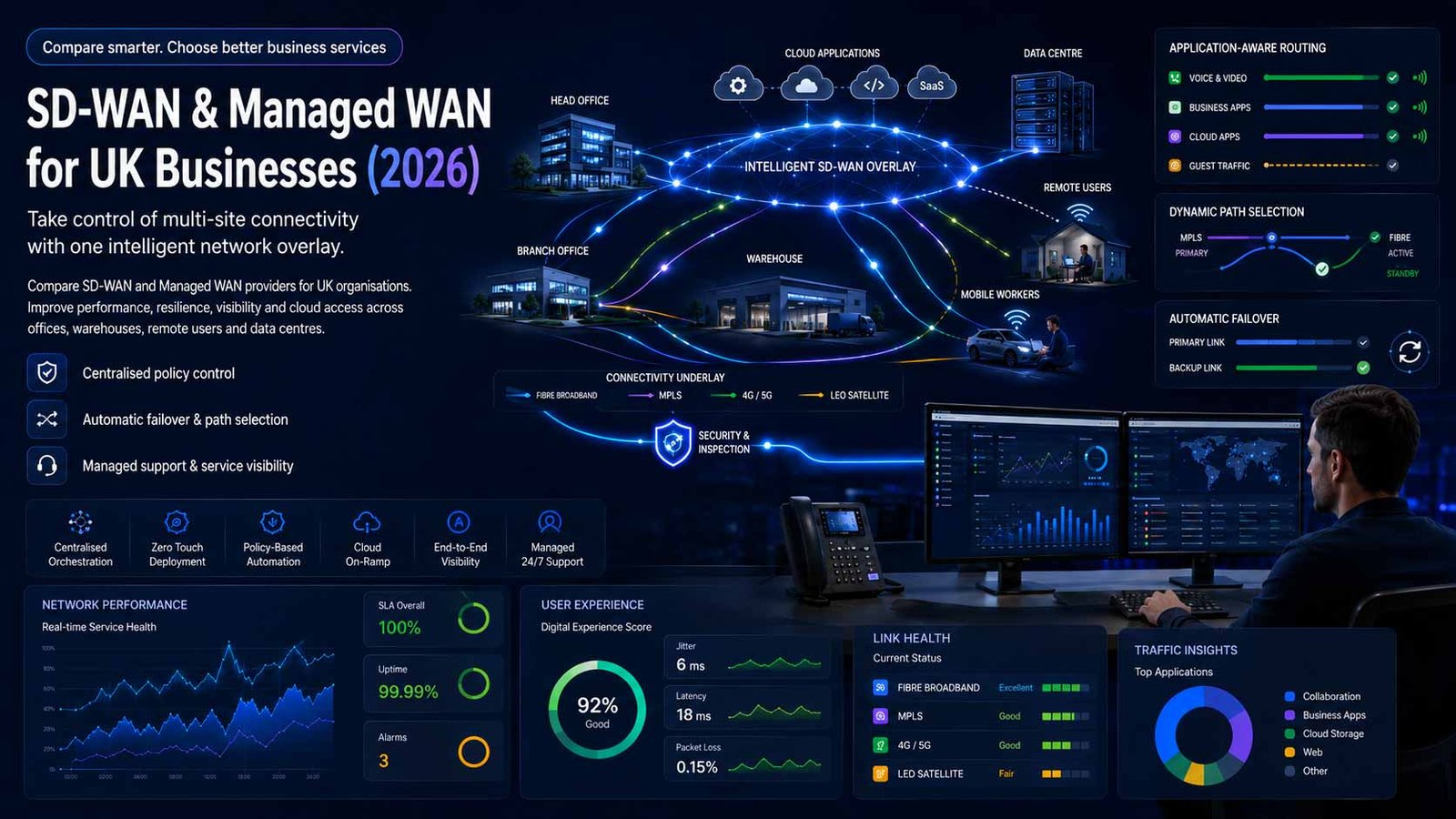
Compare SD-WAN and managed WAN providers for UK multi-site businesses by application routing, circuit choice, failover, cloud access, security, visibility, SLAs and support ownership. Assess how providers design, deploy and manage the network overlay and underlying connections before selecting architecture, rollout scope, commercial terms and long-term operational accountability with confidence.
Why SD-WAN Is A Separate Buying Decision
SD-WAN adds a centrally controlled overlay that applies business policies to traffic across multiple sites, access types and cloud destinations. The commercial decision is therefore about network architecture, management and accountability rather than a single connection.
- Prioritise critical applications by latency, jitter, loss and business policy
- Use diverse underlay connections without managing every branch separately
- Improve cloud access and reduce unnecessary backhaul through central policy
- Gain shared visibility across sites, applications and provider incidents
SD-WAN is an operating model for a distributed network. It does not remove the need for suitable access, LAN design, security controls or operational ownership. It coordinates those components so that traffic can follow policy and performance conditions.
The distinction matters because providers package the service differently. One may supply the overlay, appliances, underlay circuits, monitoring and service desk under one SLA. Another may manage only the overlay while the customer retains several carriers and security suppliers.
A sound comparison begins with application dependencies, site criticality, current contracts, cloud destinations, security boundaries and change-control requirements. It then tests whether a provider can design, migrate and operate the target model without creating unclear fault boundaries.
Choose the Leased Lines comparison when the primary decision is a dedicated site circuit. Compare SD-WAN providers when the requirement is to control and manage traffic across a wider multi-site WAN.
Compare SD-WAN Providers By Architecture And Service Fit
Provider suitability depends on platform choice, underlay reach, migration capability, security scope, operational control and who owns incidents across the complete service.
| Provider | Positioning | Relevant Strengths | Potential Fit | Points To Verify |
|---|---|---|---|---|
| BT Business | Managed enterprise SD-WAN and SASE | Multiple technology options, UK and international reach, managed underlays, security integration and established enterprise service management. | Larger UK or multinational estates needing design, migration and operational support across mixed sites and applications. | Confirm the selected platform, underlay diversity, portal rights, security scope, service credits, change process and local support model. |
| Vodafone Business | Multi-site SD-WAN with fixed and mobile underlays | Support for MPLS, internet and LTE/5G paths, Cisco options, secure networking choices and experience with complex UK estates. | Medium and large organisations seeking one provider across fixed, mobile and managed networking services. | Check site availability, platform choice, mobile failover design, managed-security boundary, cloud connectivity and escalation ownership. |
| Virgin Media Business | End-to-end managed SD-WAN | Managed overlay and underlay options, central visibility, application-aware routing, deployment support and optional resilient access. | UK multi-site organisations wanting a single provider for access, SD-WAN deployment and ongoing management. | Verify geographic reach, access diversity, appliance choice, portal controls, service levels, implementation assumptions and third-party circuit handling. |
| TalkTalk Business | SD-WAN and hybrid networking | UK network services, Cisco partnership, hybrid-network positioning and managed support around evolving multi-site requirements. | Organisations that want an SD-WAN migration assessed alongside current private WAN and internet connectivity. | Request current platform documentation, support coverage, circuit sourcing, security options, cloud on-ramps, SLA detail and transition responsibilities. |
| Gamma | Managed Cisco SD-WAN options | Cisco Meraki and Catalyst SD-WAN choices, centralised control, mixed transport support, monitoring and UK enterprise managed-service capability. | UK organisations that value a communications-focused managed provider with several Cisco architecture choices. | Confirm which Gamma entity or partner delivers the service, platform fit, underlay management, security operations, portal access and change charges. |
| Wavenet | UK managed SD-WAN and SASE services | Fortinet-led managed options, central policy, broad underlay support, implementation assistance and 24/7 managed-service positioning. | Growing multi-site organisations seeking a UK MSP to manage connectivity, security and network operations together. | Validate supplier independence, hardware lifecycle, monitoring depth, incident ownership, service credits, security licensing and exit arrangements. |
| GTT | Global managed SD-WAN | Global Tier 1 network reach, managed orchestration, multiple access types, security integration and enterprise portal visibility. | International businesses that need one managed framework across UK and overseas locations. | Check local access suppliers, country coverage, platform and SSE choices, support handoffs, data residency, commercial entities and minimum commitments. |
| Colt Technology Services | Versa-based SD-WAN and SASE | European and global network footprint, Versa orchestration, self-service controls, managed connectivity and integrated SASE development. | Enterprises with significant European locations, cloud workloads or requirements for a consistent cross-border service model. | Confirm on-net reach, access procurement outside core markets, portal permissions, managed-versus-customer control, migration scope and support language. |
Compare current platform options, geographic reach, underlay choices, managed-service scope and contract terms directly with each shortlisted provider. Product availability and delivery models can change.
Evaluate The Complete SD-WAN Operating Model
The overlay, underlay, security controls, cloud paths and service desk must work as one governed service across every location.
Comparison Criterion
Application-Aware Routing
Compare how the platform identifies applications and selects a path using latency, jitter, packet loss, availability and business priority. Ask how quickly routing reacts and how policies are tested before production.
Comparison Criterion
Underlay Choice And Diversity
Map each site to suitable access types and carriers. Real resilience requires independent failure domains, not two services that share the same local infrastructure, building entry or upstream dependency.
Comparison Criterion
Failover And Session Behaviour
Establish what happens to active voice, video, virtual desktop and transaction sessions during degradation or circuit loss. Compare brownout detection, failback rules, packet duplication and continuity expectations.
Comparison Criterion
Cloud And SaaS Connectivity
Review local internet breakout, cloud on-ramps, regional gateways, DNS behaviour and inspection paths. The design should improve access to cloud applications without bypassing required security or compliance controls.
Comparison Criterion
Security Architecture
Confirm encryption, segmentation, firewalling, secure web access, intrusion prevention, identity integration and logging. SD-WAN can support security policy, but it should not be treated as a complete cyber-security programme.
Comparison Criterion
Monitoring And Experience Data
Compare dashboards, application visibility, synthetic tests, circuit telemetry, user-experience indicators, alerting and retained data. Buyers need evidence that explains performance before and after a change.
Comparison Criterion
Managed Service Boundary
Define who configures policies, patches controllers, replaces appliances, manages carriers, investigates LAN faults and coordinates security incidents. The contract should remove ambiguity rather than create another supplier layer.
Comparison Criterion
Change And Lifecycle Governance
Review approval workflows, maintenance windows, policy versioning, rollback, hardware refresh, software support dates and exit assistance. A flexible platform still requires controlled operational governance.
Compare Total Managed WAN Cost, Not A Headline Site Price
Commercial value depends on design, licences, access, rollout, managed operations, security and exit obligations across the full contract term.
| Cost Area | What It Can Include | Commercial Check |
|---|---|---|
| Discovery And Design | Application mapping, site audit, traffic baselining, resilience design, security review and target architecture. | Clarify whether discovery is chargeable, what documents are produced and whether the design remains usable if another provider is selected. |
| Platform And Licensing | Per-site, per-device, bandwidth-tier, security-feature or subscription licensing for the selected SD-WAN technology. | Compare the exact licence edition, included features, renewal basis, growth bands and consequences if a site or circuit changes. |
| Edge Hardware | Physical or virtual edge appliances, power supplies, LTE modules, switches and installation accessories. | Establish ownership, warranty, spares, replacement targets, refresh cycles and charges at contract end. |
| Underlay Connectivity | Dedicated access, business fibre, private WAN, internet, mobile or third-party circuits beneath the overlay. | Model each site separately and identify installation, excess construction, termination and carrier-change costs. |
| Deployment And Migration | Staging, site visits, configuration, testing, project management, change windows and coexistence with the existing WAN. | Request a priced migration plan with assumptions, failed-visit rules, rollback responsibilities and acceptance criteria. |
| Managed Operations | Monitoring, service desk, carrier management, reporting, configuration changes and lifecycle administration. | Compare support hours, included change allowance, severity definitions, response targets and whether incidents are managed end to end. |
| Security Services | Firewall, secure web gateway, intrusion prevention, DNS security, SASE or SSE features and security operations. | Separate mandatory security from optional modules and confirm logging, retention, incident response and licence ownership. |
| Exit And Transition | Configuration export, circuit cessation, hardware return, knowledge transfer, overlap and migration to a successor. | Price exit obligations before signing so that portability and business continuity do not depend on goodwill. |
Ask each provider to price the same site list, bandwidth assumptions, resilience model, security scope, project plan and support boundary. A lower recurring charge is not comparable when design, secondary access, monitoring or changes are excluded.
Decide Whether SD-WAN Fits The Network Estate
Value is strongest when the organisation has multiple locations, important cloud applications, varied access and a clear need for central policy and operational visibility.
Multi-Site Cloud-First Organisation
Strong fit when branches depend on SaaS and cloud platforms and need application-aware routing, local breakout and central policy.
Retail Or Hospitality Estate
Useful where many locations require repeatable deployment, central visibility, resilient payment or operational traffic and limited local IT support.
Professional Services Group
Relevant for offices using collaboration, virtual desktops, document systems and cloud workloads that need consistent performance and controlled access.
Manufacturing Or Logistics Network
Can support distributed plants, warehouses and depots where site criticality, diverse access and application prioritisation vary by location.
Organisation Leaving A Legacy Private WAN
Potentially suitable when the existing model is inflexible or cloud traffic is backhauled, provided migration and security are designed carefully.
International Enterprise
Strong fit where a provider can combine global orchestration with credible local access, support and regulatory handling across countries.
Single-Site Business
Usually limited value unless the organisation has complex cloud, resilience or segmentation needs that justify central overlay management.
Poorly Documented Network Estate
High delivery risk until applications, circuits, addressing, dependencies, security policies and site ownership have been discovered and baselined.
Discovery And Baselines Determine Migration Risk
Providers should not design an SD-WAN solely from circuit inventories. They need application flows, cloud destinations, traffic peaks, latency sensitivity, site criticality, security zones, current routing, carrier contracts and operational processes.
Collect baseline data before any policy change. Without pre-migration evidence, it becomes difficult to prove whether performance improved, identify regressions or resolve disputes between the overlay provider, access carrier, LAN team and application owner.
Security teams should review controller exposure, administrative access, encryption, segmentation, logging and patch responsibilities. NCSC guidance emphasises secure network design, data-in-transit protection and protecting management interfaces.
Roll Out In Controlled Waves
A pilot should represent real risk, not only the easiest office. Include cloud-heavy users, voice or video, a critical application, more than one access type and a realistic failover test.
- Validate application identification and path-selection policies
- Test degradation, full failure, recovery and session behaviour
- Confirm monitoring, alerts and service-desk escalation paths
- Document acceptance criteria before each migration wave
- Inventory sites, circuits, contracts, applications, cloud services, addressing, security zones and business owners.
- Define the target architecture, underlay strategy, security boundary, service responsibilities and measurable outcomes.
- Pilot representative locations and record application performance, failover behaviour, user impact and operational effort.
- Migrate in waves with approved change plans, rollback, hypercare, issue tracking and formal acceptance.
- Optimise policies after stabilisation and maintain lifecycle, patch, capacity, security and exit governance.
Ask Questions That Expose Architecture And Support Risk
Detailed answers reveal whether the proposal is an integrated managed service or a collection of products with unresolved responsibilities.
Which Platform And Licence Edition Is Proposed?
Ask for the vendor, product family, software release and licence level. Different editions can change routing, security, analytics, cloud integration and support capabilities.
Who Supplies And Manages Every Underlay?
Identify whether the provider manages all circuits, selected circuits or only the overlay. Establish how third-party carrier faults are diagnosed and escalated.
How Is Diversity Proven At Critical Sites?
Request evidence covering local access, building entry, exchange or aggregation, mobile dependency and upstream carrier paths rather than accepting a generic dual-circuit claim.
What Happens During Degradation, Not Only Failure?
Ask how brownouts are detected, when traffic moves, what happens to active sessions and how policy prevents unstable links from repeatedly flapping.
Which Changes Are Included In The Managed Service?
Compare routine policy changes, new applications, bandwidth changes, branch moves, security updates and emergency work against the contracted allowance and lead times.
How Can The Business Leave The Service?
Confirm configuration export, documentation, hardware ownership, licence portability, circuit transfer, overlap support, data deletion and reasonable exit charges.
Build A Weighted SD-WAN Provider Shortlist
Score every provider against the same evidence pack and business priorities rather than allowing demonstrations or brand recognition to determine the outcome.
| Score Area | Suggested Weight | Evidence To Review |
|---|---|---|
| Architecture And Application Fit | 20% | Application mapping, policy design, cloud paths, segmentation and compatibility with the current and target estate. |
| Underlay Reach And Resilience | 18% | Site availability, access diversity, mobile options, carrier management, failover design and evidence of independent paths. |
| Managed Service And Support | 18% | Monitoring, service desk, incident ownership, carrier escalation, proactive management, reporting and included changes. |
| Security And Governance | 15% | Encryption, administrative access, patching, logging, segmentation, security integration, change control and auditability. |
| Migration And Delivery Capability | 12% | Discovery, project governance, pilot design, site rollout, testing, rollback, acceptance and hypercare. |
| Visibility And Control | 9% | Portal depth, application analytics, alerting, data retention, customer permissions and operational reporting. |
| Commercial Clarity And Exit | 8% | Transparent pricing, licence ownership, service credits, renewal terms, hardware treatment and transition assistance. |
Adjust the weighting for the organisation. A retailer may increase site deployment and failover weighting; an international firm may prioritise geographic reach; a regulated organisation may increase security, audit and governance weighting.
How To Compare SD-WAN Provider Proposals
Ask each shortlisted supplier to respond to the same site, application, security and support brief. A like-for-like proposal should explain the platform, access services, rollout responsibilities, monitoring, change allowances, service levels and exit arrangements.
- Architecture diagram showing the overlay, underlay, cloud paths and security boundaries
- Site-by-site access, capacity and resilience assumptions
- Implementation plan with pilot, testing, rollback and acceptance criteria
- Support matrix covering the provider, access carriers, security teams and customer responsibilities
- Complete price schedule including licences, hardware, circuits, changes, renewals and exit costs
Compare written commitments, exclusions and dependencies before choosing a provider. Demonstrations and headline feature lists should support the decision, not replace contractual evidence.
What A Strong Proposal Should Confirm
A strong proposal explains how the provider will migrate the estate, operate the selected platform, manage access carriers and restore service during a complex incident.
Request diagrams, service schedules, support matrices, acceptance tests, sample reports and named responsibilities. These documents show how the service will operate after implementation.
Use This Sequence Before Signing An SD-WAN Contract
A disciplined procurement sequence protects the architecture, migration and operating model from vague assumptions.
- Define business outcomes such as cloud performance, branch resilience, visibility, faster deployment or reduced operational effort.
- Create a verified inventory of sites, circuits, applications, traffic, cloud services, security zones, contracts and owners.
- Issue one common brief covering target architecture, underlay strategy, security, support, rollout, reporting and exit requirements.
- Require providers to identify assumptions, exclusions, third parties, unsupported sites and all one-off or recurring charges.
- Run technical workshops using real application flows, branch scenarios, failure conditions and operational processes.
- Score written evidence, references, service schedules, implementation plans and commercial terms using agreed weightings.
- Pilot representative sites and test performance, brownout, failover, recovery, monitoring and service-desk ownership.
- Approve the wider rollout only after acceptance criteria, governance, security, documentation and exit provisions are complete.
Frequently Asked Questions
Answers to common commercial and technical questions from UK organisations comparing SD-WAN and managed WAN providers.
What is SD-WAN?
SD-WAN is a software-defined approach to managing a wide-area network. It applies centrally controlled policies to steer application traffic across one or more underlying connections according to performance, availability, security and business priorities.
What is the difference between SD-WAN and a managed WAN?
SD-WAN is a technology architecture. A managed WAN is the broader operational service that may include design, underlay connections, SD-WAN appliances, monitoring, security, carrier management, support and lifecycle governance. Buyers should establish exactly which elements are included.
Does SD-WAN replace MPLS?
It can replace, reduce or operate alongside MPLS depending on application, security, performance and geographic requirements. Some organisations use internet and mobile connections; others retain private paths for selected traffic. The correct design should follow measured business needs rather than a default technology preference.
How many connections should each site have?
That depends on site criticality, application demand, local availability and the cost of downtime. Critical locations may need two independently routed fixed connections or a fixed service plus mobile backup. The provider should prove that proposed paths do not share hidden dependencies.
Can SD-WAN improve Microsoft 365 and other cloud applications?
It can improve cloud access by selecting better paths, enabling local breakout and avoiding unnecessary backhaul. Results depend on underlay quality, DNS, security inspection, cloud gateways and policy design. Baseline and pilot testing are needed to prove the benefit.
Is SD-WAN secure by itself?
SD-WAN commonly includes encrypted tunnels, segmentation and policy controls, but it is not a complete security strategy. Buyers must also consider administrative access, controller protection, firewalls, secure web access, identity, monitoring, patching and incident response.
What should an SD-WAN service-level agreement cover?
The SLA should address managed components, support hours, severity definitions, response and restoration targets, appliance replacement, carrier escalation, planned maintenance, reporting, service credits and exclusions. Application experience targets may be more useful than circuit uptime alone.
How long does an SD-WAN rollout take?
Timescales depend on site count, access orders, discovery quality, platform complexity, security integration and change windows. Existing circuits can sometimes support early pilots, while new access may take longer. A controlled rollout normally uses discovery, pilot, phased migration and hypercare.
Should a business buy the overlay and underlay from one provider?
A single provider can simplify accountability, billing and fault coordination. A multi-provider model can increase access choice and avoid concentration, but it requires stronger internal governance. The decision should reflect procurement leverage, technical capability and the provider’s ability to manage third-party circuits.
What happens if the SD-WAN provider is changed later?
Transition can involve controller configurations, licences, appliances, circuits, security policies, monitoring data and operational knowledge. Contracts should define export, documentation, hardware ownership, data deletion, overlap support and exit charges before the service begins.
Provider Information And Network Security Resources
Use these official provider and NCSC resources to check current platform options, geographic availability, access choices, security controls and managed-support scope.
Product capabilities and contract terms can change. Confirm the proposed architecture, licences, third-party dependencies, service levels, security responsibilities and exit arrangements in the final quotation and service schedule.