
Compare Sustainability / ESG Reporting Providers UK
Compare ESG Data Collection, Carbon Accounting, UK SRS And SECR Support, Framework Mapping, Controls, Assurance Readiness, Dashboards, Reporting, Pricing And Complete Programme Cost
Compare ESG reporting services UK business providers by reporting-scope assessment, mandatory and voluntary disclosure support, UK Sustainability Reporting Standards readiness, Streamlined Energy and Carbon Reporting, greenhouse-gas calculation, Scope 1, 2 and 3 data, environmental, workforce, social and governance metrics, materiality, framework mapping, supplier questionnaires, evidence collection, data ownership, controls, approvals, audit trails, assurance readiness, narrative reporting, dashboards, targets, progress tracking, risk and opportunity reporting, integrations, APIs, security, implementation, specialist support, subscription and consultancy fees, contract terms and complete lifecycle cost. Give every provider the same legal entities, sites, reporting boundary, frameworks, metrics, data sources, supplier population, assurance ambition, deadlines, users and growth assumptions before comparing proposals.
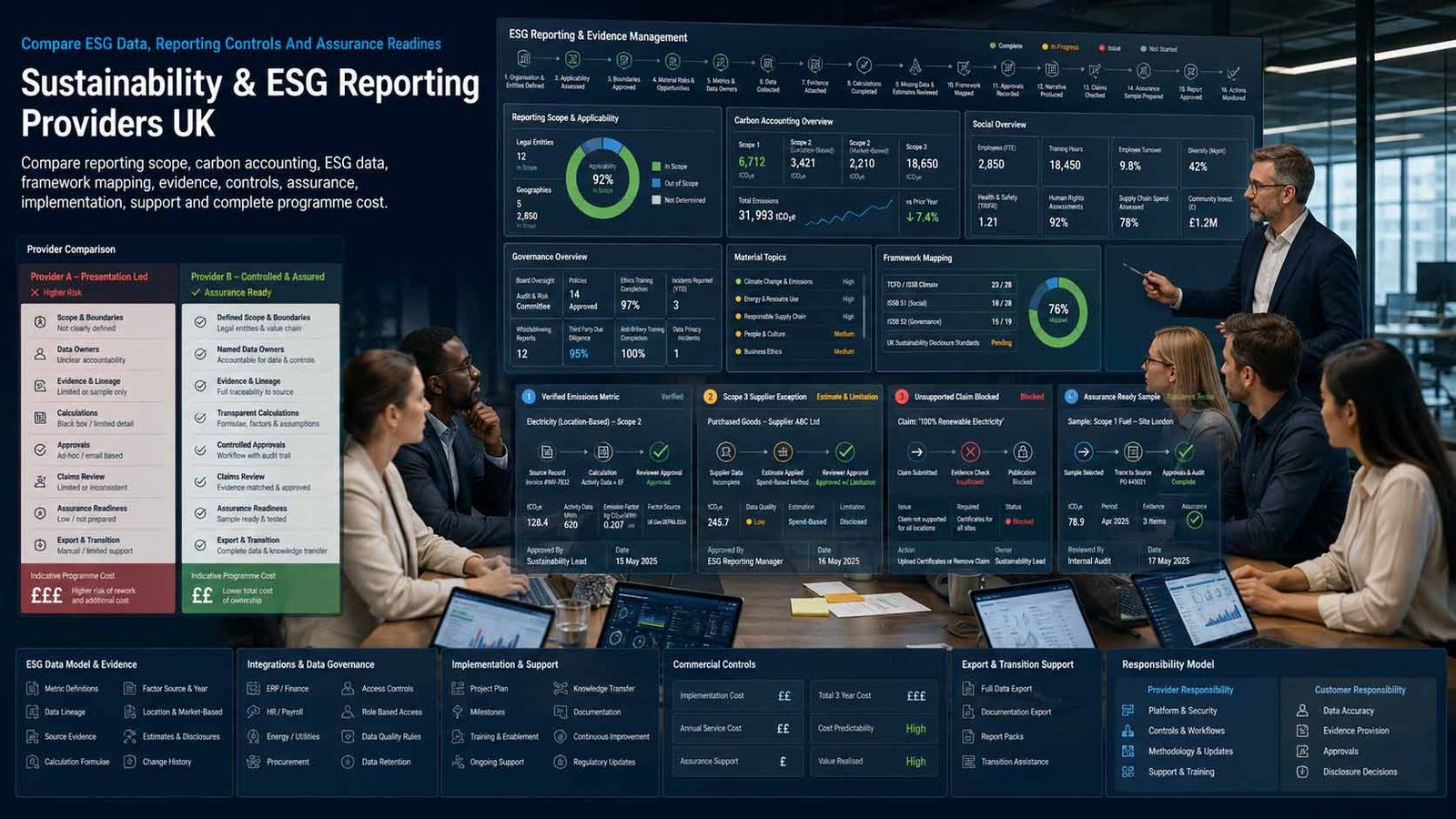
Buy A Reporting Control System, Not A Sustainability Badge
A useful provider should identify which disclosures are required, voluntary or customer-driven, establish ownership and evidence, calculate consistently and leave a reporting process that management can explain and repeat.
- Separate mandatory duties from voluntary frameworks and buyer questionnaires
- Define organisational, operational, time and value-chain boundaries
- Preserve source evidence, methods, approvals, estimates and changes
- Connect reported claims to accountable owners and operational action
Sustainability and ESG reporting services help organisations collect, calculate, control, explain and disclose environmental, social and governance information. Depending on the buyer, the work can cover statutory annual-report requirements, SECR energy and emissions disclosures, voluntary UK SRS use, lender or customer questionnaires, supply-chain data requests, climate and wider sustainability risks, workforce and governance metrics, voluntary reports and evidence prepared for independent assurance.
The UK government issued UK SRS S1 and UK SRS S2 on 25 February 2026 for voluntary use. They are not automatically mandatory for every UK company. Existing obligations continue to depend on company type, size, listing status, sector and reporting rules. SECR remains a mandatory framework for specified quoted companies and large unquoted companies and LLPs. FCA-listed-company rules are also evolving, with proposed UK SRS-aligned rules intended for 2027.
This page compares sustainability and ESG reporting services. It must not cover green energy tariffs alone. Energy purchasing can affect reported emissions and transition plans, but choosing a tariff is a separate procurement decision. This page instead evaluates the reporting boundary, data, calculations, governance, disclosures, evidence and assurance readiness across relevant environmental, social and governance topics.
Choose The Right Sustainability Reporting Model
Match the solution to legal exposure, stakeholder demand, data maturity, internal capability, assurance ambition and reporting complexity.
| Operating Model | What It Usually Includes | Best-Fit Question |
|---|---|---|
| Reporting Readiness And Gap Assessment | Legal and stakeholder requirement review, current-state assessment, material topics, data gaps, governance design and implementation roadmap. | Will the provider distinguish mandatory, voluntary and commercially requested disclosures? |
| Carbon And SECR Reporting Service | Energy and emissions data collection, Scope 1 and 2 calculations, selected Scope 3 categories, intensity metrics, methodology and annual disclosure support. | Does the organisation need only environmental reporting, or a broader ESG operating model? |
| SME Sustainability Reporting Platform | Guided data collection, carbon calculations, questionnaires, dashboards, report generation and specialist support for a smaller reporting team. | Can the platform produce credible evidence without enterprise-level implementation overhead? |
| Enterprise ESG Data Management Platform | Multi-entity data capture, calculations, controls, workflows, framework mapping, dashboards, targets, supplier engagement and audit trails. | Can it operate as a controlled system of record across finance, sustainability, HR and operations? |
| Disclosure And Narrative Reporting Platform | Linked data, collaborative report drafting, framework mapping, review, consistency checks, version control, tagging and publication workflows. | Does the business need finance-grade reporting control more than detailed operational decarbonisation tools? |
| Supply-Chain And Scope 3 Programme | Supplier questionnaires, primary data collection, estimates, category calculations, engagement, scoring and value-chain reporting. | How will supplier evidence, estimates, non-response and methodological changes be governed? |
| Assurance-Readiness And Managed Reporting | Controls, evidence packs, reconciliations, methodology files, audit support, annual reporting production and remediation under a managed service. | Will the provider strengthen internal ownership rather than become the only holder of the process? |
| Multi-Framework Sustainability Programme | One controlled data model mapped to UK SRS, GRI, CDP, SASB, ESRS, customer requests and internal performance reporting. | Can metrics be collected once and reused without losing framework-specific definitions and context? |
Eight Areas That Determine ESG Reporting Fit
Use the same entities, metrics, frameworks, evidence, integrations, assurance and service assumptions for every provider.
Comparison Criterion
Reporting Scope, Applicability And Materiality
Compare how the provider determines reporting entities, consolidation boundary, sites, operations, value chain, reporting period, mandatory rules, voluntary frameworks, customer requirements and material sustainability-related risks and opportunities. Require written rationale for included and omitted topics. Avoid buying a platform before deciding what the organisation must and intends to report.
Comparison Criterion
ESG Data Model, Ownership And Evidence
Assess metric definitions, units, source systems, responsible owners, collection frequency, evidence attachments, approvals, estimates, missing data, restatements, changes, lineage and audit trail. Environmental, workforce, social and governance data should have the same discipline as other management information. A dashboard without traceable source evidence is not assurance ready.
Comparison Criterion
Carbon Accounting And Environmental Metrics
Review organisational and operational boundaries, Scope 1, 2 and 3 categories, location and market-based electricity reporting, emission factors, renewable instruments, refrigerants, transport, waste, water, intensity metrics, base years, recalculation and targets. Confirm support for current UK government conversion factors and transparent calculation-level evidence.
Comparison Criterion
Social, Workforce And Governance Reporting
Compare employee and worker data, health and safety, diversity, pay, training, turnover, community, human rights, supply chain, ethics, whistleblowing, board oversight, policies, incidents and controls. Confirm definitions, populations, privacy, equality considerations and consistency with HR, payroll, compliance and company records rather than relying on narrative claims.
Comparison Criterion
Framework Mapping And Disclosure Production
Assess UK SRS S1 and S2, SECR, GHG Protocol, GRI, SASB, CDP, TCFD legacy reporting, CSRD and ESRS exposure, voluntary SME frameworks and customer questionnaires. Require mapping to exact disclosure requirements, reusable responses, gap flags, linked data, narrative review, version control and clear identification of voluntary versus mandatory statements.
Comparison Criterion
Controls, Assurance Readiness And Green-Claims Risk
Review segregation of duties, review thresholds, evidence standards, reconciliations, change logs, methodology approval, management sign-off, audit samples, limited or reasonable assurance support and correction of prior information. Claims should be specific, substantiated and consistent across reports, websites, bids and marketing. A certification logo does not replace reliable underlying data.
Comparison Criterion
Integrations, Security, Privacy And AI
Compare finance, utility, procurement, HR, travel, fleet, facilities, supplier and data-warehouse integrations; APIs; file ingestion; access roles; encryption; data regions; subprocessors; international transfers; retention; backups; incidents and deletion. For AI extraction, drafting or anomaly detection, require transparency, human review, accuracy testing and controls over confidential data and model training.
Comparison Criterion
Implementation, Support, Pricing And Exit
Compare discovery, framework design, data mapping, configuration, factors, migration, integrations, supplier onboarding, testing, training, report production, assurance support, service levels, specialist advisers, licence units, usage limits, additional modules, professional services, contract term, annual increases, full data and evidence export, transition and verified deletion.
Measures To Define Before Selecting An ESG Provider
Translate sustainability claims into auditable reporting-boundary, metric, calculation, control and assurance evidence.
| Measure | What It Should Define | Evidence To Request | Common Weakness |
|---|---|---|---|
| Reporting applicability | Whether each disclosure is mandatory, voluntary, contractual or internally chosen | Legal entity, rule, threshold, period, framework, decision owner and documented rationale | Every framework is presented as mandatory for every business |
| Metric definition | Whether every KPI has a stable meaning, unit, population and calculation | Definition, boundary, owner, source, frequency, formula, exclusions and prior-year consistency | The same label is used for different populations across reports |
| Source evidence | Whether reported figures can be traced to reliable operational records | Invoice, meter, ledger, HR extract, supplier return, calculation file, approval and retention | A manually typed spreadsheet total is treated as primary evidence |
| GHG calculation quality | Whether emissions are calculated transparently and consistently | Activity data, factor source and year, unit conversion, Scope, method, estimate and recalculation | A single spend-based estimate is presented as precise operational data |
| Supplier and Scope 3 data | Whether primary and estimated value-chain information is controlled | Supplier identity, category, period, method, evidence, response, estimate hierarchy and change | Non-responding suppliers are excluded without disclosure |
| Narrative and claim support | Whether written statements are consistent with approved data and evidence | Claim owner, metric link, methodology, limitation, target basis, review and publication approval | Marketing language overstates a partial or estimated result |
| Target and progress tracking | Whether targets have baselines, scope, method, owners and credible progress evidence | Base year, boundary, target year, pathway, action, actual result, variance and recalculation | A net-zero ambition is reported without defined emissions coverage |
| Assurance readiness | Whether an independent practitioner can reproduce and test reported information | Control matrix, evidence index, calculations, approvals, reconciliations, changes and management sign-off | Evidence is assembled after the report has already been published |
| Framework consistency | Whether one data point remains consistent across annual reports, questionnaires and disclosures | Mapping, source metric, framework rule, response version, exception and reconciliation | Different teams submit conflicting values to different stakeholders |
| Portability and exit | Whether data, calculations, factors, evidence, mappings and reports can move cleanly | Bulk export, attachments, formulas, audit history, users, APIs, notice, transition and deletion | The business receives a final PDF but loses the underlying reporting system |
Sustainability And ESG Reporting Providers UK Businesses Can Consider
Shortlist providers whose reporting scope, calculation depth, framework support, controls, implementation and commercial model fit the organisation. Confirm current written terms before award.
Provider Profile
Workiva
Workiva provides sustainability reporting and management capabilities designed to connect financial and non-financial data, coordinate cross-functional workflows, map disclosures and produce controlled, audit-ready reports. Include it where finance, sustainability, legal, internal audit and investor-relations teams need linked data and formal reporting governance. Confirm the selected sustainability modules, entities, users, framework content, carbon-calculation depth, source integrations, linked documents, approvals, tagging, AI use, assurance access, implementation partner, migration, support, annual licence, professional services and complete export.
Review official Workiva sustainability reporting informationProvider Profile
Diligent ESG
Diligent ESG supports ESG data collection, carbon calculations, framework reporting, dashboards, surveys and board-level visibility within Diligent’s wider governance environment. Include it where board governance, risk, entity or compliance teams need sustainability information connected to senior oversight and reporting. Confirm metric and emissions methodology, frameworks, workflow, evidence, supplier surveys, board reporting, users, integrations, AI, assurance support, data processing, implementation, support, pricing, wider Diligent dependencies and whether detailed operational carbon or disclosure-production requirements need additional tools.
Review official Diligent ESG informationProvider Profile
IBM Envizi
IBM Envizi provides ESG data management, greenhouse-gas accounting, reporting-framework content, planning, analytics and disclosure support for complex organisations. Include it where a multi-entity or property-intensive business needs a controlled sustainability-data system, broad environmental calculations and enterprise integration. Confirm the exact modules, entities, accounts, meters, emission sources, Scope 3 capability, social and governance metrics, factors, framework questions, data capture, assurance trail, AI features, implementation, integrations, hosting, users, pricing estimator assumptions, support and transition.
Review official IBM Envizi informationProvider Profile
Watershed
Watershed provides an enterprise sustainability platform covering emissions measurement, targets, supply-chain engagement, ESG metrics and disclosure workflows, including AI-assisted reporting with review and source transparency. Include it where detailed carbon and value-chain work must connect to broader ESG disclosure and operational action. Confirm organisational boundary, Scope 3 methods, supplier data, non-carbon metrics, UK SRS and SECR mapping, narrative drafting, model controls, human review, evidence, integrations, implementation, adviser support, data regions, users, pricing basis, contract term and complete calculation export.
Review official Watershed sustainability reporting informationProvider Profile
Sweep
Sweep provides sustainability data management for carbon and wider ESG metrics, supplier collaboration, reporting and performance tracking. Include it where a business needs distributed data ownership, value-chain engagement and a platform that connects reporting information to reduction initiatives and business decisions. Confirm environmental, social and governance metric coverage, calculation methods, supplier workflows, framework mapping, approvals, evidence, scenario and target functions, AI, integrations, user and entity model, implementation partner, support, data hosting, licence and usage fees, minimum term and data portability.
Review official Sweep sustainability reporting informationProvider Profile
EcoOnline ESG
EcoOnline’s ESG software, powered by Ecometrica capabilities, supports emissions calculations, environmental data, framework reporting, dashboards and audit-ready evidence alongside EcoOnline’s wider workplace-risk products. Include it where environmental reporting, emissions factors and operational ESG data need structured management, particularly across sites. Confirm the precise ESG modules, environmental versus social and governance depth, factor libraries, SECR and framework support, data ingestion, evidence, supplier and site workflows, users, integration, implementation, assurance support, hosting, support, pricing and any wider EcoOnline product dependencies.
Review official EcoOnline ESG software informationProvider Profile
Novisto
Novisto provides enterprise sustainability management software for ESG data, metrics, workflows, approvals, framework mapping, disclosures, audit trails, benchmarking and programme management. Include it where a business wants a finance-grade sustainability system of record covering environmental, social and governance topics rather than a carbon-only tool. Confirm the metric library, UK SRS and international frameworks, calculations, custom metrics, data owners, evidence, approvals, AI and anomaly detection, report production, integrations, migration, implementation, assurance support, users, pricing, service levels and full structured-data export.
Review official Novisto sustainability management informationProvider Profile
Greenly
Greenly provides carbon-accounting and sustainability software with guided data collection, dashboards, expert support and reporting products for organisations including SMEs. Its Sustainable Suite includes ESG and voluntary SME reporting options alongside carbon and climate capabilities. Include it where a smaller reporting team needs a guided platform and adviser support rather than a large enterprise implementation. Confirm UK entity and support, frameworks, environmental versus social and governance depth, Scope 3 methods, accounting integrations, evidence, assurance readiness, supplier data, AI use, user and entity limits, onboarding, report exports, pricing, minimum term and upgrade path.
Review official Greenly sustainability suite informationWhat Changes Sustainability And ESG Reporting Cost
Compare the complete cost of producing reliable, reusable and assurance-ready information—not the lowest dashboard subscription.
| Cost Driver | Why It Changes Spend | What A Comparable Quote Should Show |
|---|---|---|
| Entities, sites and reporting boundaries | More legal entities, business units, countries, facilities and consolidation rules increase configuration and data work | Entities, sites, ownership changes, reporting period, consolidation method and historical restatement |
| Metrics and reporting frameworks | Environmental-only reporting is narrower than multi-topic ESG reporting across several mandatory and voluntary frameworks | Exact metrics, disclosures, framework mappings, questionnaires, languages and annual updates |
| Carbon and Scope 3 calculation depth | Detailed activity data, supplier information, product data and category models require more integration and specialist review | Scopes, categories, factors, primary data, estimates, market-based reporting, base year and recalculation |
| Data sources and integrations | Meters, invoices, ledgers, HR, procurement, travel, fleet, facilities and supplier systems can require connectors or custom APIs | Source systems, files, frequency, transformations, failures, ownership, monitoring and maintenance |
| Users, contributors and suppliers | Distributed data collection can involve many internal owners, reviewers, external suppliers and assurance users | Named and contributor users, suppliers, workspaces, roles, questionnaires, support and true-up |
| Migration and prior-year data | Historical emissions, metrics, evidence, factors and reports need cleansing and reconciliation before trend reporting | Years, formats, attachments, factor versions, recalculations, mapping, validation and acceptance |
| Managed reporting and specialist support | Consultants can provide applicability, calculation, materiality, narrative, controls, report production and assurance support | Included hours, named advisers, deliverables, response, annual cycle, additional projects and independence |
| Assurance and control requirements | Formal assurance readiness, evidence indexing, reconciliations and practitioner access require stronger controls and support | Control matrix, testing, evidence packs, auditor access, remediation, assurance level and recurring work |
| AI, analytics and planning modules | Automated extraction, anomaly detection, narrative drafting, forecasting and scenario tools may be separate modules or usage charges | Models, credits, users, data use, review, accuracy, audit, disable options and commercial limits |
| Contract, annual changes and exit | Minimum terms, framework updates, entity growth, implementation dependency and data extraction affect lifecycle cost | Term, indexation, volume bands, reduction, support, export, transition, archive and deletion |
| Indicative Commercial Model | Typical Position | What Must Be Confirmed |
|---|---|---|
| Fixed Readiness Or Reporting Project | A defined assessment, methodology, dataset, disclosure or annual report is delivered for a project fee | Confirm reporting period, entities, metrics, evidence, revisions, management approval and assurance support |
| Annual Software Subscription | Recurring fees are based on entities, sites, users, metrics, emissions sources, suppliers or selected modules | Model implementation, contributors, frameworks, storage, support, volume growth and annual price changes |
| Software Plus Managed Service | A platform is combined with specialist data collection, calculations, reporting, controls and improvement support | Separate software, adviser hours, annual deliverables, client responsibilities, additional work and exit |
| Enterprise Platform And Assurance Programme | Multi-year licences, integrations, migration, governance, professional services and assurance readiness are contracted together | Require a full implementation plan, responsibility matrix, milestones, service levels and total cost of ownership |
Match The Provider To The Reporting Obligation
The right shortlist depends on legal exposure, stakeholder requirements, data maturity, value chain, assurance ambition and internal capability.
Small Business Responding To Customer Or Lender Requests
Prioritise a proportionate requirement assessment, basic carbon and workforce data, clear definitions, reusable questionnaires, evidence storage, guided reporting, adviser access and predictable cost. Avoid adopting every global framework when a focused, credible dataset will answer the commercial need.
Growing UK Company Preparing For SECR Or Voluntary UK SRS Use
Prioritise entity and reporting-boundary design, UK conversion factors, emissions methodology, governance, material risks and opportunities, linked narrative, repeatable annual collection, management approval and an upgrade path to assurance-ready controls.
Multi-Site Or Supply-Chain-Intensive Business
Prioritise distributed data owners, meter and invoice integration, Scope 3 category depth, supplier engagement, evidence, exception management, site comparison, target tracking, operational dashboards, data-quality monitoring and managed support for non-response and estimates.
Listed, International Or Assurance-Ready Organisation
Prioritise UK SRS and international framework mapping, finance-grade controls, linked data, multi-entity consolidation, governance, board reporting, assurance access, audit trails, data security, AI controls, formal implementation and complete structured-data portability.
How To Compare ESG Reporting Proposals
Issue one requirements pack containing legal entities, ownership, sites, countries, reporting period, company size and listing status, mandatory and voluntary frameworks, customer and lender questionnaires, environmental, workforce, social and governance metrics, Scope 1, 2 and 3 ambition, suppliers, source systems, prior-year data, materiality process, targets, report formats, board governance, assurance ambition, users, integrations, security, deadlines, internal team and contract period. Require a metric-to-evidence demonstration rather than a dashboard tour.
- Every provider assesses the same applicability and reporting boundary
- Metrics, factors, estimates, owners and evidence are demonstrated
- Mandatory and voluntary framework statements are separated
- Controls, restatements and assurance support are tested
- Implementation, advisers, users, suppliers and integrations are itemised
- Three-year cost uses the same growth and reporting assumptions
Compare The Same Metric End To End
Ask each provider to collect one energy metric, one Scope 3 estimate, one workforce metric and one governance disclosure; show source evidence, calculation, review, approval, framework mapping, narrative, correction, dashboard, assurance sample and complete export.
A polished sustainability report is not reliable when the business cannot reproduce the calculation, identify the owner or explain why a disclosure applies.
Six Questions To Put To Every ESG Reporting Provider
The answers expose inflated compliance claims, weak data lineage, shallow non-carbon reporting, uncontrolled AI, inadequate assurance support and hidden lifecycle cost.
Which Reporting Requirements Actually Apply To Us?
Request a written applicability matrix covering entities, thresholds, listing or sector status, SECR, UK SRS, customer and lender requests, international exposure, voluntary choices, deadlines and legal or assurance review.
How Will Every Metric Be Defined And Evidenced?
Ask for metric dictionaries, boundaries, source systems, owners, evidence, frequency, estimates, factor versions, approvals, missing-data rules, restatements, prior-year reconciliation and audit trail.
How Deep Is The Environmental And Scope 3 Capability?
Confirm Scope 1, 2 and 3 categories, activity and spend methods, supplier data, market-based electricity, refrigerants, waste, water, factors, base years, recalculations, targets and assurance evidence.
Can The Platform Manage Social And Governance Data Properly?
Demonstrate workforce populations, diversity, health and safety, training, turnover, supply-chain and governance metrics, privacy, definitions, approvals, links to source systems and reporting limitations.
How Are Reporting Controls, AI And Assurance Governed?
Request segregation, review, reconciliations, methodology approval, AI use, human checks, model training restrictions, evidence packs, practitioner access, correction, management sign-off and claim consistency.
What Is The Complete Three-Year Cost And Exit Plan?
Obtain software, entities, users, metrics, frameworks, carbon, suppliers, integrations, migration, advisers, assurance support, AI, implementation, overage, increases, export, transition and deletion costs.
A Seven-Stage ESG Reporting Provider Evaluation
Move from actual reporting obligations and data to tested evidence rather than choosing a provider from framework logos or dashboard design.
- Create a verified reporting baseline covering entities, sites, countries, size and listing status, mandatory duties, voluntary frameworks, customers and lenders, environmental and social metrics, governance, source systems, suppliers, targets, prior reports, assurance and accountable executives.
- Define the reporting boundary and operating model. Decide which disclosures are mandatory, voluntary or commercially requested; which entities and value-chain activities are included; which metrics are material; who owns data; and what level of assurance and public claim is appropriate.
- Prepare a prioritised requirement catalogue covering carbon, wider environmental, workforce, social, governance, frameworks, materiality, data collection, calculations, evidence, controls, narrative, dashboards, suppliers, integrations, security, AI, implementation, support, pricing and exit.
- Issue one supplier brief and scripted metric set using the same entities, energy data, Scope 3 estimate, workforce record, governance disclosure, supplier questionnaire, framework mapping, correction, assurance sample, users, timeline and three-year commercial assumptions.
- Shortlist providers by applicability expertise, ESG breadth, calculation transparency, data controls, framework depth, supplier capability, implementation, assurance readiness, security, service reliability, financial stability, adviser competence and relevant reference customers.
- Complete due diligence and a controlled pilot. Test source ingestion, factor version, missing data, estimate, approval, restatement, framework response, AI draft, claim review, supplier non-response, assurance evidence, report generation and complete data and attachment export.
- Implement through named metric owners, approved definitions, data calendar, controls, integrations, supplier engagement, management review, assurance preparation and publication approval. Monitor completeness, late data, estimates, control failures, restatements, claims, usage and provider support before renewal.
Sustainability And ESG Reporting Comparison Checklist
Use this table before appointing, implementing or renewing an ESG reporting platform or managed service.
| No. | Requirement | Evidence To Obtain Before Award | Confirmed |
|---|---|---|---|
| 01 | Reporting applicability baseline complete | Entities, thresholds, listing, sectors, SECR, UK SRS, customer, lender, international and voluntary requirements | |
| 02 | Service boundary approved | Sustainability and ESG reporting scope does not become a green energy tariff comparison | |
| 03 | Organisational and operational boundaries agreed | Entities, ownership, sites, operations, joint arrangements, value chain, period and consolidation | |
| 04 | Material topics and disclosure scope approved | Risks, opportunities, impacts, stakeholders, metrics, omissions, rationale and review trigger | |
| 05 | Metric dictionary controlled | Definition, unit, population, owner, source, frequency, formula, evidence, exclusions and prior-year consistency | |
| 06 | GHG methodology accepted | Scope 1, 2 and 3, factors, location and market methods, estimates, base year and recalculation | |
| 07 | Social and governance metrics validated | Workforce, safety, diversity, training, supply chain, ethics, board, controls, privacy and source reconciliation | |
| 08 | Framework mappings verified | UK SRS, SECR, GHG Protocol, GRI, SASB, CDP, ESRS exposure, customer requests and voluntary reports | |
| 09 | Supplier and Scope 3 process tested | Supplier identity, questionnaire, evidence, primary data, estimates, non-response, quality and engagement | |
| 10 | Data collection and integrations proven | Finance, utilities, HR, procurement, travel, fleet, facilities, files, APIs, failures and monitoring | |
| 11 | Controls and assurance readiness accepted | Roles, segregation, approvals, reconciliations, evidence, change log, restatement, testing and sign-off | |
| 12 | Claims, narrative and AI governance complete | Metric linkage, limitations, targets, approvals, model use, human review, consistency and correction | |
| 13 | Implementation and support contracted | Discovery, configuration, history, integrations, suppliers, testing, training, annual cycle and service levels | |
| 14 | Three-year commercial model complete | Entities, sites, users, metrics, frameworks, carbon, suppliers, advisers, assurance, AI and internal resource | |
| 15 | Contract, evidence and exit controlled | Term, renewal, reduction, data, factors, calculations, mappings, attachments, reports, transition and deletion |
Common Sustainability And ESG Reporting Buying Mistakes
Most avoidable problems begin with framework-led buying, undefined metrics, carbon-only scope, uncontrolled estimates, unsupported claims or evidence and exit left outside the programme.
| Mistake | Why It Creates Risk | Better Control |
|---|---|---|
| Treating every ESG framework as mandatory | The business purchases unnecessary scope and may make disclosures without understanding their basis | Create an applicability and voluntary-choice matrix |
| Buying software before defining metrics | Different teams collect incompatible figures and the platform automates confusion | Approve boundaries, definitions and owners first |
| Focusing only on carbon | Important workforce, social, governance and business-risk information remains unmanaged | Define the full reporting scope proportionately |
| Using one spend estimate as the final footprint | Spend-based calculations can be useful estimates but may not reflect operational change accurately | Use a documented data-improvement hierarchy |
| Changing emission factors without version control | Reported trends can move because methodology changed rather than performance | Record factor year and restatement policy |
| Collecting supplier data without quality rules | Questionnaires produce inconsistent boundaries, periods and unsupported claims | Set evidence, validation and estimate rules |
| Publishing targets without a controlled baseline | Progress cannot be measured and later boundary changes undermine credibility | Approve scope, base year and recalculation rules |
| Using AI-generated disclosure without human review | Narrative can overstate evidence, omit limitations or apply the wrong framework requirement | Require accountable review and source linkage |
| Preparing assurance evidence after publication | Missing source records and approvals are difficult or impossible to reconstruct | Build controls into the annual reporting process |
| Leaving data export until termination | The business may lose calculations, evidence, mappings and prior-year comparability | Test complete structured export before signing |
Frequently Asked Questions
Answers to common questions from UK businesses comparing ESG reporting software, sustainability data, UK SRS, SECR, carbon accounting, assurance and pricing.
What Is Sustainability And ESG Reporting?
Sustainability and ESG reporting is the structured collection and disclosure of environmental, social and governance information. It can cover emissions, energy, workforce, health and safety, diversity, supply chain, ethics, board oversight, risks, opportunities, targets and progress.
Are The UK Sustainability Reporting Standards Mandatory?
UK SRS S1 and UK SRS S2 were issued by the UK government on 25 February 2026 and are currently available for voluntary use. They are not automatically mandatory for every UK company. Future mandatory application depends on rules issued for particular entities or markets.
What Is SECR?
Streamlined Energy and Carbon Reporting is a UK reporting framework requiring specified quoted companies and large unquoted companies and LLPs to disclose energy use, greenhouse-gas emissions, intensity information and energy-efficiency actions in annual reports. Applicability should be assessed against current thresholds and rules.
Does A Small UK Business Need ESG Reporting?
Many small businesses are not subject to broad mandatory ESG reporting, but customers, lenders, investors, public-sector buyers and supply-chain partners may request sustainability information. A proportionate report can also support risk management and bids. The scope should match the actual requirement.
What Is The Difference Between Carbon Accounting And ESG Reporting?
Carbon accounting measures greenhouse-gas emissions across defined scopes and categories. ESG reporting is broader and can include carbon plus other environmental, workforce, social and governance information, risks, opportunities, policies, targets and performance. Some providers specialise in one area more deeply than the other.
How Much Do ESG Reporting Services Cost?
Cost depends on entities, sites, frameworks, metrics, carbon categories, suppliers, users, source systems, integrations, historical data, assurance requirements, implementation and support. Commercial models include fixed projects, annual software subscriptions, software plus managed service and enterprise programmes.
What Data Is Needed For ESG Reporting?
Data may come from utility bills, fuel and travel records, finance systems, procurement, HR, payroll, health and safety, compliance, facilities, suppliers, policies and board records. Every metric should have a clear definition, owner, period, source, evidence, calculation and review process.
What Does Assurance Ready Mean?
Assurance-ready reporting means an independent practitioner can understand the boundary, reproduce calculations, inspect evidence, test controls and trace reported information to approved sources. It does not mean the report has already received independent assurance or that every metric is error free.
Can ESG Software Prevent Greenwashing?
Software can improve definitions, evidence, consistency, approvals and audit trails, but it cannot by itself prevent misleading claims. Businesses still need accountable review, clear limitations, consistent public statements, appropriate legal and regulatory input, and correction when information changes.
How Should UK Businesses Compare ESG Reporting Providers?
Give every provider the same entities, reporting obligations, frameworks, metrics, source systems, carbon categories, suppliers, evidence, assurance ambition, users, deadlines and growth assumptions. Compare data quality, controls, reporting fit, implementation and complete cost—not framework logos alone.
Official Guidance And Provider Resources
Reviewed by Bhav Giva, Founder & Lead Analyst at CompareServices.co.uk, on 1 August 2026.
Use current GOV.UK, FRC, FCA, GHG Protocol and provider documentation to verify reporting applicability, UK SRS status, SECR, conversion factors, listed-company rules, strategic reporting, assurance readiness, methodologies, product capabilities, frameworks, pricing and contract terms. Sustainability requirements and provider platforms continue to evolve. Obtain legal, accounting, audit, assurance, tax, environmental, employment or sector-specific advice where required.
- GOV.UK — UK Sustainability Reporting Standards S1 And S2
- GOV.UK — UK Sustainability Reporting Standards Guidance
- FRC — Sustainability Reporting Developments FAQs
- GOV.UK — Environmental Reporting And SECR Guidance
- GOV.UK — Company Greenhouse-Gas Conversion Factors
- FCA — Sustainability Reporting Requirements
- FRC — Updated Strategic Report Guidance
- FRC — Sustainability Reporting Assurance Developments
- GHG Protocol — Corporate Accounting And Reporting Standard
- Workiva — Sustainability Reporting
- Diligent — ESG Software
- IBM — Envizi ESG Suite
- Watershed — Sustainability And ESG Reporting
- Sweep — Sustainability Reporting Software
- EcoOnline — ESG Software
- Novisto — Sustainability Management Software
- Greenly — Sustainable Suite