
Compare Business Telecoms Audit Providers UK
Compare Invoice Validation, Contract Review, Asset Inventory, Usage Analysis, Recovery, Benchmarking, Governance, Security, Fees And Verified Savings
Compare telecoms audit business UK providers by audit independence, invoice and contract validation, service and asset inventory, historic overcharge recovery, unused-line and licence identification, mobile estate analysis, usage and tariff alignment, supplier dispute handling, benchmarking, contract and renewal review, cost allocation, management reporting, data security, access controls, implementation support, fee model, evidence standards, conflict management, ongoing telecom expense management and verified net savings. Give every provider the same invoices, contracts, service inventory, locations, users, devices, cost centres, historic changes and commercial assumptions before comparing proposals.
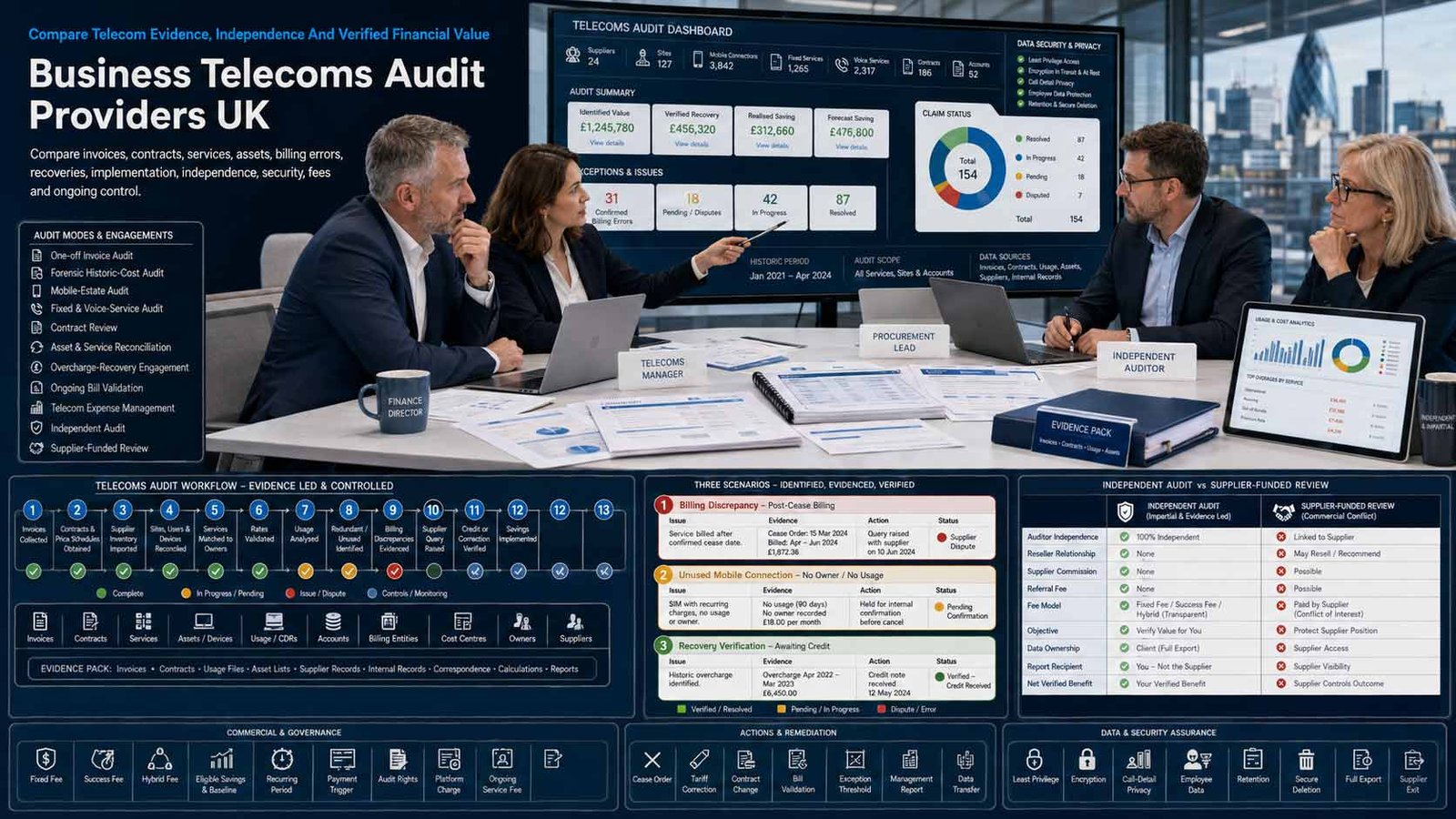
Buy Independent Evidence, Not A Disguised Sales Exercise
A useful telecoms audit should establish what the business owns, uses, contracts and pays for before recommending any operational or commercial change.
- Reconcile invoices, contracts, orders, inventory and real usage
- Separate verified errors from forecast or negotiable savings
- Declare commissions, supplier relationships and implementation incentives
- Protect data, preserve evidence and define recovery responsibility
A business telecoms audit is a structured review of an organisation’s communications services, assets, contracts, invoices, usage, operational ownership and supplier records. The audit may identify billing errors, services that should have ceased, unused mobile connections, incorrect rates, expired discounts, duplicate charges, mismatched cost centres, contract risks, missing inventory, renewal exposure, weak change controls and opportunities to simplify administration or reduce cost.
The right scope depends on estate size, number of suppliers, sites, mobile users, historic acquisitions, billing complexity, service changes, contract dates, internal procurement maturity, finance processes, dispute backlog and whether the organisation wants a one-off health check or ongoing telecom expense management. The auditor must distinguish recoverable overcharges, preventable future leakage, commercial opportunities and operational recommendations.
This page compares telecoms audit and expense-management providers. It does not compare broadband products or VoIP providers. The auditor may review existing connectivity, voice, mobile, collaboration and related contracts as evidence, but any later product or supplier comparison belongs on the relevant dedicated service page.
Choose The Right Business Telecoms Audit Model
Match the engagement to the estate, evidence available, financial objective, internal capacity and need for ongoing control.
| Audit Model | What It Usually Includes | Best-Fit Question |
|---|---|---|
| One-Off Telecoms Health Check | A high-level review of invoices, suppliers, contract dates, service inventory and obvious usage or billing issues. | Will the output be detailed enough to support action, or only identify areas for another paid phase? |
| Forensic Historic Cost Audit | Line-by-line analysis of historic and current billing to identify overcharges, incorrect rates, redundant services and possible recovery. | How far back will the provider analyse, and who proves, claims and tracks each recovery? |
| Contract Compliance Audit | Validation of invoice charges against signed agreements, pricing schedules, order forms, discounts, credits and change records. | Can every billed amount be linked to a contractual entitlement and actual live service? |
| Mobile Estate Audit | Review of mobile numbers, users, devices, tariffs, data usage, roaming, inactive lines, upgrades, insurance and ownership. | Can HR, IT and finance records be reconciled without exposing more employee data than necessary? |
| Inventory And Service Audit | Creation or validation of a service inventory across sites, circuits, numbers, devices, licences, suppliers and cost centres. | How will the provider prove that a billed service is live, assigned, required and correctly located? |
| Procurement-Readiness Audit | Baseline creation, requirement analysis, benchmark pricing, contract review and a prioritised plan before a formal sourcing exercise. | Is the auditor independent of the supplier selection and any commission earned from implementation? |
| Ongoing Bill Validation | Regular checking of invoices against contracts, inventory and approved changes, with disputes managed through to resolution. | Will the process prevent new leakage, or only report errors after payment? |
| Telecom Expense Management | Continuous invoice capture, audit, inventory, cost allocation, order and change management, disputes, reporting and optimisation. | Does the organisation need an enduring control function rather than a single audit report? |
Eight Areas That Determine Telecoms Audit Quality
Use the same invoices, contracts, inventory, evidence and savings definitions for every provider.
Comparison Criterion
Independence And Conflict Management
Compare ownership, carrier relationships, reseller status, supplier commissions, referral fees, implementation incentives and restrictions on using the findings elsewhere. Require written disclosure before data is shared. A no-fee audit funded by later sales is not equivalent to an independent review.
Comparison Criterion
Data Collection And Estate Discovery
Assess how the provider obtains invoices, contracts, order forms, service schedules, asset lists, site records, mobile user data, supplier portals and change history. Confirm missing-data assumptions, evidence hierarchy, access method, secure transfer and the work required from finance, IT, HR and procurement.
Comparison Criterion
Invoice, Rate And Contract Validation
Review line-level invoice testing, tax and surcharge treatment, contracted rates, minimums, discounts, credits, cease dates, notice, automatic renewal, equipment rental, licence quantities and change orders. Findings should show the source document, calculation, affected period and financial value.
Comparison Criterion
Inventory, Usage And Ownership Analysis
Compare methods for matching billed services to locations, users, devices, departments, cost centres and actual usage. Assess inactive mobile lines, closed sites, duplicate services, zero-use assets, former employees, unreturned devices, abandoned numbers, expired licences and unknown service ownership.
Comparison Criterion
Recovery, Dispute And Implementation Support
Confirm who prepares supplier claims, supplies evidence, communicates with providers, handles rejection, tracks credits, validates recurring corrections and implements ceases or contract changes. Distinguish an identified opportunity from a realised and verified financial benefit.
Comparison Criterion
Benchmarking And Commercial Analysis
Assess benchmark data sources, recency, comparability, volume adjustments, service specifications, contractual assumptions and confidence ranges. A credible audit separates market benchmark, contractual error, usage right-sizing, supplier negotiation and service-design recommendations.
Comparison Criterion
Security, Privacy And Audit Trail
Review controller and processor roles, employee and call-detail data, secure access, least privilege, encryption, retention, subprocessors, incident handling, deletion, subject rights, audit logs and separation between customers. The final evidence pack should remain complete without retaining unnecessary personal data.
Comparison Criterion
Reporting, Fees, Governance And Exit
Compare executive summaries, detailed findings, evidence registers, savings classification, cost-centre reports, dashboards, open disputes, implementation plans, governance meetings, fee calculations, performance measures, contract term, notice, data export, open-case transfer and verified deletion.
Measures To Define Before Appointing An Auditor
Translate savings claims into auditable invoice, contract, inventory, recovery and implementation evidence.
| Measure | What It Should Define | Evidence To Request | Common Weakness |
|---|---|---|---|
| Billing accuracy | Whether invoices reflect contracted services, rates and approved changes | Invoice sample, contract mapping, error rule, affected period and recalculation | The report states an error without showing the contractual source |
| Service existence | Whether each billed service is live, located, assigned and required | Inventory, supplier record, site test, user owner, order and cease evidence | An unused service is assumed redundant without checking dependency |
| Contract compliance | Whether minimums, discounts, notice, renewals and change terms were applied correctly | Signed agreement, schedules, order forms, amendments and invoice linkage | A proposal or quotation is treated as the final contract |
| Usage suitability | Whether tariff, licence or service quantities reflect actual demand | Usage period, zero-use test, peaks, roaming, shared pools and business need | A short usage period produces misleading right-sizing |
| Recoverable value | Whether a historical error can be evidenced and pursued | Legal entity, supplier, claim basis, amount, period, correspondence and status | Potential recovery is presented as cash already secured |
| Ongoing saving | Whether a cease, correction or renegotiation reduces future cost | Baseline, implementation date, recurring invoice check and annualised value | Savings are annualised before the change is live |
| Benchmark validity | Whether market comparisons use equivalent scope and risk | Source, date, volume, service specification, term, support and exclusions | A low benchmark omits service levels, equipment or implementation |
| Data and security control | Whether sensitive account and usage data is protected | Access matrix, secure transfer, encryption, retention, audit logs and deletion | Supplier portal credentials are shared informally |
| Provider performance | Whether the audit, disputes and implementation meet agreed milestones | Plan, deliverables, response targets, aged cases, realised value and governance minutes | The engagement has no target beyond producing a report |
| Exit readiness | Whether findings, evidence and open cases can transfer cleanly | Data export, inventory, contracts, dispute log, calculation files, notice and deletion | The client receives a summary PDF but not the working evidence |
Business Telecoms Audit Providers UK Organisations Can Consider
Shortlist providers whose independence, audit method, estate capability, evidence, dispute support, security and fee model fit the organisation. Confirm current written terms before appointment.
Provider Profile
StableLogic
StableLogic provides independent telecoms cost-optimisation and audit services for complex estates, supported by its Veroxos telecom expense platform. Its published proposition covers fixed, mobile and data-service expenditure, invoice and inventory analysis, savings implementation and a contingent fee model for relevant engagements. Include it where an organisation wants a technology-led independent audit and ongoing visibility. Confirm audit scope, baseline, evidence ownership, savings definition, fee calculation, supplier independence, implementation responsibility, security, platform access, minimum estate size and exit data.
Review official StableLogic telecoms cost-optimisation informationProvider Profile
Inspired PLC
Inspired offers forensic telecoms cost audits, bill validation, procurement and related telecom cost-control services. Its forensic audit proposition examines historic and current invoices, contracts and inventory to identify recoveries and ongoing savings, with supplier claims support. Include it where historic billing complexity, overcharge recovery and continuous validation are priorities. Confirm analysis period, claim basis, share-of-savings calculation, excluded taxes or undercharges, evidence, recovery responsibility, supplier communication, recurring correction checks, service scope and post-audit options.
Review official Inspired forensic telecoms audit informationProvider Profile
Nuvoli
Nuvoli provides audit and benchmarking, historic overcharge recovery and ongoing telecom expense management across mobile and fixed estates. Its service model includes invoice and contract validation, asset and cost-centre management, supplier queries and management reporting. Include it where an organisation needs a structured inventory, mobile audit, public-sector experience or ongoing vendor and billing control. Confirm data sources, benchmark scope, user and device reconciliation, contract validation, reporting, dispute ownership, system access, implementation, security, fees, service levels and complete export.
Review official Nuvoli audit and benchmarking informationProvider Profile
Beaconplus
Beaconplus provides telecoms contract management and operational cost-control services for UK organisations, including contract review, historic-cost checks, procurement support and ongoing supplier issue management. Include it where a business wants a consultancy-led review combined with implementation and supplier administration. Confirm independence, supplier relationships, consultancy rates, historical review depth, inventory method, fee guarantee, contract negotiation role, service scope, data security, reporting, support ownership and whether recommendations can be implemented independently.
Review official Beaconplus telecoms contract-management informationProvider Profile
Auditel
Auditel is a UK procurement and cost-management consultancy network with experience across telecommunications and other indirect expenditure categories. Include it where the organisation values a broader procurement review, consultant-led analysis and ongoing supplier-cost management. Confirm the individual consultant and specialist team, telecom audit methodology, current market data, conflicts, supplier commissions, evidence, fee model, procurement role, implementation accountability, reporting, security and whether the engagement remains focused on the approved telecoms-audit scope.
Review official Auditel telecom cost-management informationProvider Profile
ERA Group
ERA Group provides cost optimisation, supplier and contract management and telecommunications analysis through a network of category specialists. Include it where a larger or multi-category organisation wants independent benchmark, negotiation and implementation support alongside telecom expenditure review. Confirm the UK delivery team, audit scope, benchmark data, contingency or project fees, supplier relationships, savings verification, contract-management role, implementation support, data security, governance, cross-category dependencies and ownership of the working analysis.
Review official ERA Group telecommunications expertiseProvider Profile
ENGIE Impact
ENGIE Impact provides telecom expense and lifecycle management for complex organisations, including data capture, invoice-to-contract audit, cost allocation, exception and dispute management, payment support, reporting, inventory and service-order processes. Include it where a distributed enterprise needs ongoing operational control rather than a one-off review. Confirm UK and regional coverage, supported suppliers, platform and service boundaries, invoice ingestion, inventory accuracy, payment controls, cost allocation, service levels, security, hosting, implementation, minimum scale, pricing and transition assistance.
Review official ENGIE Impact telecom expense-management informationProvider Profile
Calero
Calero provides telecom management software and managed services covering auditing and dispute management, inventory, ordering, procurement and wider technology expense management. Include it where an organisation wants automated invoice reconciliation, dispute workflows and continuous governance across a large or international telecom estate. Confirm UK suitability, implementation, supported carriers, invoice formats, contract and inventory data, analyst responsibilities, audit rules, dispute ownership, integrations, security, AI features, service levels, pricing, data portability and whether the platform is proportionate to estate complexity.
Review official Calero telecom auditing informationWhat Changes Business Telecoms Audit Cost
Compare net realised value, audit quality, internal workload and future control—not the lowest headline fee.
| Cost Driver | Why It Changes Spend | What A Comparable Quote Should Show |
|---|---|---|
| Audit scope and estate size | The number of suppliers, invoices, accounts, services, sites, mobile lines, devices and years analysed changes workload | Included estate, sample or full review, historic period, missing data and scope exclusions |
| Data preparation | Poorly indexed invoices, missing contracts and inconsistent asset records require additional collection and cleansing | Client tasks, provider retrieval, portal access, file formats, assumptions and data-quality report |
| One-off review versus ongoing service | A health check, forensic audit, bill validation and full TEM programme have different deliverables and recurring effort | Deliverables, term, implementation, platform, analyst support, service levels and exit |
| Historic recovery work | Supplier claims can require detailed evidence, negotiation, escalation and repeated validation | Eligible period, claim ownership, legal support, rejected cases, credit verification and fee trigger |
| Savings implementation | Ceases, tariff changes, asset recovery, contract corrections and procurement support require operational action | Implementation owner, authority, change control, service risk, supplier fees and realised-value check |
| Technology and reporting | Platforms, invoice ingestion, integrations, dashboards, cost allocation and inventory can create setup and licence costs | Users, suppliers, invoices, integrations, storage, reporting, customisation and recurring licence |
| Security and compliance | Sensitive account credentials, employee usage, location and cost-centre data require controlled processing | Due diligence, access, transfer, encryption, retention, hosting, incident handling and deletion |
| Benchmark and procurement support | Market analysis, specification, tender, negotiation and implementation are separate from identifying errors | Benchmark basis, sourcing scope, supplier commissions, conflict controls and project fee |
| Fee basis and verification | Fixed, time-based, contingent or hybrid models allocate risk differently | Fee calculation, VAT, excluded savings, baseline, implementation cost, payment timing and audit rights |
| Contract term and exit | Minimum terms, renewal, notice, platform dependency and open disputes affect lifecycle cost | Term, termination, open-case handover, full evidence export, transition support and deletion |
| Indicative Commercial Model | Typical Position | What Must Be Confirmed |
|---|---|---|
| Fixed-Fee Audit | A defined scope and deliverable is priced in advance, regardless of findings | Confirm full versus sample testing, change control, recovery support, implementation and revalidation |
| Share-Of-Savings Or Contingent Fee | The provider receives a percentage of accepted, recovered or realised value | Define baseline, eligible value, recurring period, taxes, internal cost, disputed items and payment trigger |
| Hybrid Project Model | A lower fixed fee is combined with a success payment for recovery or implemented savings | Separate work products, recovery, future savings, procurement and supplier commissions |
| Ongoing TEM Or Bill-Validation Service | Recurring charges cover invoice audit, inventory, disputes, reporting and possibly orders and payment support | Confirm scale metric, implementation, minimum term, service levels, annual increase and complete exit data |
Match The Audit Model To The Telecom Estate
The right shortlist depends on supplier count, billing complexity, historic change, internal ownership, data quality and need for ongoing control.
Small Business With Several Suppliers Or Old Contracts
Prioritise a proportionate fixed-scope health check, clear contract-date register, invoice validation, redundant-service identification and practical recommendations. Avoid an enterprise platform whose implementation costs exceed likely recoveries.
Growing Multi-Site UK Organisation
Prioritise site and cost-centre inventory, service ownership, mobile starter and leaver controls, recurring bill validation, contract calendar, dispute management and clear implementation responsibility across finance, IT and procurement.
Large Or Acquisitive Enterprise
Prioritise forensic historic analysis, multiple supplier feeds, complex inventory, mergers and closed-site reconciliation, benchmark evidence, governance, automated audit rules, service-order controls, security and formal transition support.
Public Sector Or Regulated Organisation
Prioritise framework or procurement compliance, transparent independence, evidence retention, data security, audit trail, accessibility, supplier accountability, recovery governance, service continuity and reporting suitable for finance and oversight bodies.
How To Compare Telecoms Audit Proposals
Issue one audit brief containing legal entities, locations, suppliers, account numbers, service categories, invoice count, annual spend, contract dates, known disputes, historic acquisitions and closures, mobile users and devices, cost centres, available order and cease records, data formats, security restrictions, required outputs, recovery authority, implementation expectations and contract period. Require a response matrix and sample finding rather than a savings percentage alone.
- Every provider audits the same estate and historic period
- Errors, recoveries, future savings and benchmarks are classified separately
- Evidence, dispute and implementation ownership are explicit
- Commissions, supplier relationships and conflicts are disclosed
- Security, retention, reporting and exit are demonstrated
- Fees are calculated against the same verified-value definition
Compare A Sample Finding End To End
Ask each provider to show how it would identify a charge, link it to the contract and service inventory, calculate the affected period, validate operational impact, raise the supplier dispute, verify the credit and prevent recurrence.
A large theoretical saving is not comparable with a smaller value that has clear evidence, low implementation risk and confirmed recurring invoices.
Six Questions To Put To Every Telecoms Audit Provider
The answers expose conflicts, weak evidence, unclear recovery ownership, insecure data handling and ambiguous fees.
Are You Independent Of The Suppliers You May Recommend?
Request written disclosure of reseller status, carrier commissions, referral fees, procurement incentives, implementation revenue and any restriction on using the findings with another provider.
What Data Will You Need And How Will You Protect It?
Confirm invoices, contracts, supplier portal access, usage records, employee and device data, secure transfer, access roles, hosting, subprocessors, retention, incidents and verified deletion.
How Do You Prove Each Error Or Saving?
Ask for the evidence hierarchy, contract linkage, inventory validation, calculation method, baseline, historic period, confidence, operational check and classification of recovery, correction, cease or benchmark.
Who Owns Supplier Disputes And Implementation?
Confirm whether the provider prepares claims, communicates with suppliers, handles rejection, tracks credits, implements ceases or changes, validates recurring invoices and reports open risk.
How Is Your Fee Calculated?
Define fixed fees, contingent percentages, recurring periods, VAT, excluded taxes, undercharges, implementation costs, internal savings, supplier commissions, payment triggers and the client’s audit rights.
What Will We Receive If The Engagement Ends?
Require the full inventory, contract register, invoice analysis, evidence files, calculations, dispute log, implemented changes, reporting data, open cases, transition support and deletion confirmation.
A Seven-Stage Telecoms Audit Provider Evaluation
Move from fragmented billing to verified findings and controlled implementation rather than selecting an auditor from a savings promise.
- Create a verified estate baseline covering legal entities, sites, suppliers, accounts, invoices, contracts, orders, services, numbers, circuits, mobile connections, devices, licences, cost centres, users, historic changes, disputes, annual spend and accountable owners.
- Collect evidence in a controlled repository. Prioritise signed agreements, pricing schedules, order and cease confirmations, supplier inventory, detailed electronic billing, usage records, service tests, site records and finance postings. Record missing or conflicting information.
- Define the audit objectives and savings taxonomy. Separate billing error, historic recovery, unused service, usage optimisation, contract compliance, benchmark opportunity, procurement recommendation, operational risk and data-quality issue.
- Issue one supplier brief with the same estate, audit period, sample files, security conditions, required outputs, recovery authority, implementation responsibilities, fee assumptions, timetable, governance and exit requirements.
- Shortlist providers by independence, specialist expertise, audit method, evidence quality, relevant estate experience, security, dispute capability, implementation support, fee transparency, financial stability and referenceable outcomes.
- Run due diligence and a controlled sample. Test one fixed-service invoice, one mobile account, one contract discrepancy, one inactive or unknown asset, one historic claim, one benchmark recommendation, one sensitive-data scenario and one complete evidence export.
- Implement through signed findings, risk assessment, supplier disputes, approved ceases or corrections, contract controls, ownership updates, invoice revalidation and management reporting. Track realised cash, recurring value, service impact and open risks before final fee settlement.
Business Telecoms Audit Comparison Checklist
Use this table before appointing, extending or replacing a telecoms audit or expense-management provider.
| No. | Requirement | Evidence To Obtain Before Award | Confirmed |
|---|---|---|---|
| 01 | Telecom estate baseline complete | Entities, sites, suppliers, accounts, services, users, devices, licences, contracts, spend and owners | |
| 02 | Service boundary approved | Audit scope does not become a broadband or VoIP provider-comparison exercise | |
| 03 | Independence and conflicts disclosed | Reseller status, commissions, referral fees, implementation incentives and procurement restrictions | |
| 04 | Evidence repository controlled | Contracts, schedules, orders, ceases, invoices, usage, inventory, disputes and access permissions | |
| 05 | Audit period and sampling agreed | Historic years, current invoices, full or sample testing, missing-data assumptions and materiality | |
| 06 | Invoice and contract rules documented | Rates, discounts, minimums, rental, surcharges, credits, taxes, renewals and change records | |
| 07 | Inventory validation method accepted | Site, user, device, number, circuit, licence, cost centre, service status and dependency checks | |
| 08 | Savings taxonomy signed off | Recovery, correction, cease, right-sizing, benchmark, procurement, avoided cost and operational benefit | |
| 09 | Dispute and recovery process contracted | Claim evidence, supplier contact, rejection, escalation, credit, recurring validation and aged cases | |
| 10 | Implementation risk controlled | Ceases, changes, contract amendments, user impact, continuity, approval and rollback | |
| 11 | Security and privacy due diligence complete | Access, credentials, employee data, encryption, hosting, subprocessors, incidents, retention and deletion | |
| 12 | Reporting and governance agreed | Executive summary, detailed findings, evidence register, inventory, open cases, KPIs and meetings | |
| 13 | Fee calculation tested | Baseline, percentage, recurring period, exclusions, VAT, internal cost, commission and payment trigger | |
| 14 | Ongoing controls and ownership agreed | Contract calendar, starter and leaver process, closed sites, changes, invoice validation and accountable teams | |
| 15 | Contract, data and exit controlled | Term, renewal, notice, complete working files, open disputes, transition and deletion evidence |
Common Business Telecoms Audit Buying Mistakes
Most avoidable problems begin with hidden incentives, incomplete evidence, unverified savings or changes made without operational checks.
| Mistake | Why It Creates Risk | Better Control |
|---|---|---|
| Accepting a free audit without checking incentives | The provider may be paid through later supply, commission or contract replacement | Require complete conflict disclosure |
| Providing only summary invoices | Material errors can sit in line-level rental, usage, adjustment and change data | Supply detailed billing and source contracts |
| Treating supplier inventory as fact | Supplier records may include ceased, moved, duplicated or wrongly assigned services | Validate against sites, users and operational owners |
| Counting identified savings as realised savings | The value may require cease action, supplier agreement, credit or contract change | Verify implementation and subsequent invoices |
| Using a short usage window | Seasonality, roaming, peak events and temporary inactivity can distort right-sizing | Analyse a representative period |
| Ceasing services without dependency checks | Legacy numbers, alarms, lifts, payment terminals or resilience paths may still depend on them | Complete operational validation before change |
| Ignoring undercharges or contract ambiguity | An audit can identify exposure as well as overpayment | Report both financial benefit and liability |
| Allowing employee usage data to circulate widely | Call and mobile records can contain personal and sensitive operational information | Apply minimisation and least privilege |
| Comparing fees without a common baseline | Contingent percentages can appear lower while applying to more years or broader value | Use one verified-fee model |
| Ending the project with only a presentation | The organisation cannot maintain controls without inventory, evidence and open-case data | Require complete working files and handover |
Frequently Asked Questions
Answers to common questions from UK organisations comparing telecoms audit, bill-validation, recovery and expense-management providers.
What Is A Business Telecoms Audit?
A business telecoms audit is a structured review of communications invoices, contracts, services, assets, usage, supplier records and internal ownership. It can identify billing errors, redundant services, unused mobile connections, incorrect rates, contract risks, missing inventory and opportunities to improve ongoing control.
What Information Is Needed For A Telecoms Audit?
The auditor may need detailed invoices, signed contracts, pricing schedules, order and cease records, supplier inventories, site lists, mobile user and device records, usage data, cost centres, historic changes, known disputes and access to relevant supplier portals. Data should be shared securely and proportionately.
Does A Telecoms Audit Compare Broadband Or VoIP Providers?
No. The audit may review existing connectivity and voice contracts, billing and usage as part of the estate, but this page does not compare broadband products or VoIP suppliers. Any later sourcing exercise should use the dedicated comparison page for that service.
Can A Telecoms Audit Recover Historic Overcharges?
Potentially. A forensic audit may identify historic billing discrepancies and support claims against suppliers, but recovery depends on the evidence, contract, affected period, supplier response and applicable legal position. Identified value should not be treated as recovered cash until a credit or payment is verified.
How Do Telecoms Audit Providers Charge?
Common models include a fixed project fee, a percentage of recovered or realised savings, a hybrid of fixed and success fees, or a recurring telecom expense-management charge. The business should define the baseline, eligible value, recurring period, exclusions, payment trigger and audit rights.
What Is Telecom Expense Management?
Telecom expense management is an ongoing service or platform that can capture invoices, validate charges, maintain service and asset inventory, allocate cost, manage disputes, support orders and changes, report spend and identify optimisation opportunities. It is broader than a one-off audit.
How Can A Business Check Auditor Independence?
Ask whether the provider resells telecom services, receives supplier commission, earns referral fees, benefits from contract replacement or restricts use of its findings. Require written disclosure and compare an independent audit with any supplier-funded review on a like-for-like basis.
What Security Risks Exist During A Telecoms Audit?
Invoices and usage files can contain account credentials, employee names, telephone numbers, location, call-detail and cost-centre information. The provider should use secure transfer, least-privilege access, encryption, controlled retention, audit logs, incident procedures and verified deletion.
How Long Does A Business Telecoms Audit Take?
Timescales depend on estate size, supplier count, invoice detail, contract availability, historic period, data quality, sample versus full testing, supplier cooperation and whether recovery or implementation is included. A credible proposal should include dependencies, milestones and acceptance criteria.
How Should UK Businesses Compare Telecoms Audit Providers?
Give every provider the same estate, evidence, historic period, savings definitions, recovery authority, security requirements, implementation scope and fee assumptions. Compare independence, methodology, working evidence, realised-value controls, support, reporting and exit—not headline savings alone.
Official Guidance And Provider Resources
Reviewed by Bhav Giva, Founder & Lead Analyst at CompareServices.co.uk, on 31 July 2026.
Use current Ofcom, ICO, NCSC and provider documentation to verify contract rights, service levels, data handling, audit scope, fee models, recovery claims and ongoing expense-management controls. Provider methods, platforms, terms and savings claims can change. Obtain legal, procurement, data-protection, tax or technical advice where required.
- Ofcom — Advice For Businesses
- Ofcom — General Conditions Protecting Business Customers
- Ofcom — Choosing A Communications Service And Provider
- ICO — Data Sharing Advice
- NCSC — Business Communications Security Guidance
- StableLogic — Telecoms Cost Optimisation
- Inspired PLC — Forensic Telecoms Cost Audit
- Nuvoli — Audit And Benchmark
- Beaconplus — Telecoms Contract Management
- Auditel — Managing Telecom Costs
- ERA Group — Telecommunications Expertise
- ENGIE Impact — Telecom Expense Management
- Calero — Telecom Auditing And Dispute Management