
Compare Compliance / GDPR Services Providers UK
Compare GDPR Audits, Outsourced DPOs, Data Mapping, DPIAs, Rights Requests, Complaints, Breach Support, PECR, Training, Governance, Fees And Complete Service Scope
Compare GDPR compliance services UK providers by audit methodology, accountability framework, records of processing, lawful-basis review, privacy notices, data mapping, retention, data protection impact assessments, controller and processor contracts, international transfers, data-subject rights, complaints, breach response, outsourced Data Protection Officer service, PECR and direct-marketing support, cookie and tracking governance, training, board reporting, implementation, privacy-management technology, professional experience, independence, response times, data security, evidence, pricing, contract terms and complete lifecycle cost. Give every provider the same processing profile, data flows, risk, jurisdictions, current documentation, incident history, rights-request volumes, marketing activity and growth assumptions before comparing proposals.
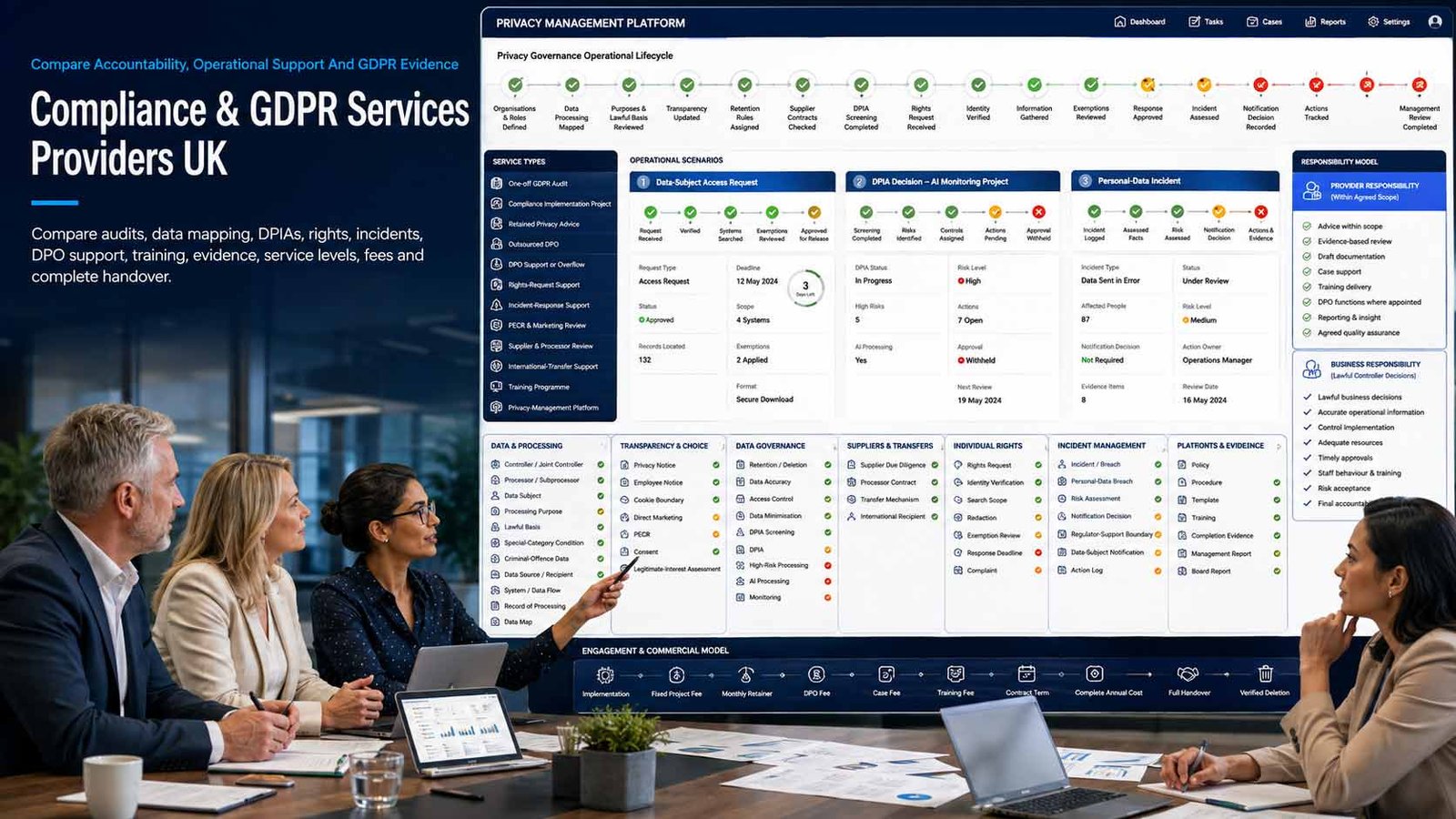
Buy An Accountable Privacy Programme, Not A Folder Of Templates
A useful provider should understand how the organisation actually uses personal information, prioritise risk, implement practical controls and leave evidence that management can maintain.
- Map real processing, data flows, purposes, recipients and retention
- Separate mandatory duties, risk-led controls and optional good practice
- Define provider responsibility without transferring controller accountability
- Preserve working records, decisions, actions and exit evidence
Compliance and GDPR services help organisations assess, design, implement, monitor and evidence how they handle personal information under the UK’s data-protection and electronic-marketing framework. The work may include a gap analysis, records of processing, lawful-basis review, privacy notices, retention schedules, policies, data-subject-right procedures, complaints handling, data protection impact assessments, processor contracts, data sharing, international transfers, breach readiness, direct-marketing and cookie governance, training, outsourced DPO support and ongoing privacy operations.
The right service depends on the organisation’s role as controller or processor, sectors, data subjects, special-category or criminal-offence data, scale, monitoring, automated decisions, marketing, international activity, suppliers, technology changes, existing documentation, staff capability, rights-request volumes, incident exposure and whether a formal DPO appointment is required or voluntarily chosen.
This page compares data-protection compliance services. It does not compare cybersecurity services or legal services. A privacy provider can assess governance, organisational measures, processor due diligence and incident procedure, but technical security testing belongs on the appropriate cybersecurity page. Reserved legal advice, litigation, regulatory representation as legal counsel and contract disputes may require a suitably qualified solicitor or barrister.
Choose The Right GDPR Compliance Service Model
Match the engagement to current maturity, legal role, processing risk, internal capacity and need for ongoing oversight.
| Service Model | What It Usually Includes | Best-Fit Question |
|---|---|---|
| GDPR Gap Analysis Or Audit | Interviews and evidence review against an agreed framework, followed by findings, risk ratings and a prioritised action plan. | Will the provider test operating practice and evidence, or only review policies? |
| Compliance Implementation Project | Data mapping, records, notices, policies, retention, contracts, rights procedures, breach process, training and action delivery. | Who owns implementation decisions, operational change and final approval? |
| Retained Privacy Consultancy | Regular access to specialists for projects, documentation, DPIAs, contracts, transfers, marketing, incidents and complex queries. | Are hours, response times, named resources, rollover and urgent support clear? |
| Outsourced Data Protection Officer | A named external DPO with independence, reporting access, monitoring, advice, DPIA support, regulator and data-subject contact responsibilities. | Does the service satisfy the required DPO role without creating a conflict of interest? |
| Interim Privacy Manager Or Overflow Support | Temporary leadership or additional capacity for transformation, absence cover, large projects, rights requests or remediation. | What authority, handover, knowledge transfer and internal ownership are required? |
| Rights, Complaints And Breach Support | Procedures, triage, searches, redaction, response packs, complaint handling, incident assessment, notification support and record keeping. | What work remains with the organisation, technology teams and legal advisers? |
| International Transfer Or Representation Service | Transfer mapping, safeguards, risk assessments, contractual support and UK or EU representative services where applicable. | Which jurisdictions, entities, processing chains and local rules are actually covered? |
| Privacy Operations, Training And Workflow Service | Managed registers, assessments, task tracking, training, policy attestation, reporting and specialist support delivered through a platform or service desk. | Does the technology improve accountability without locking evidence into a proprietary system? |
Eight Areas That Determine GDPR Service Quality
Use the same processing profile, risk, evidence, response and implementation requirements for every provider.
Comparison Criterion
Scope, Legal Framework And Provider Boundary
Compare coverage of UK GDPR, Data Protection Act 2018, PECR and relevant Data (Use and Access) Act 2025 changes. Confirm whether the provider covers only advice and implementation, acts as formal DPO or representative, or coordinates with legal counsel. Exclude vague promises of complete compliance or immunity from enforcement.
Comparison Criterion
Accountability, Governance And Senior Ownership
Assess governance structure, controller and processor roles, board reporting, designated owners, policy framework, risk register, records, management review, complaints process, assurance calendar and internal escalation. A consultant should strengthen accountability, not become an unmonitored substitute for it.
Comparison Criterion
Data Mapping, Lawful Use, Transparency And Retention
Compare information-asset discovery, records of processing, purposes, lawful bases, special-category conditions, transparency, consent, legitimate-interest assessments, data minimisation, accuracy, retention, deletion and data-flow mapping. Require links between documents, systems and real operating activity.
Comparison Criterion
Individual Rights, Complaints And Case Management
Review access, correction, erasure, restriction, objection, portability and automated-decision procedures; identity checks; searches; redaction; extensions; exemptions; records and quality assurance. Since 19 June 2026, organisations also need a data-protection complaints process under the DUAA changes.
Comparison Criterion
DPIAs, Privacy By Design, Suppliers And Transfers
Assess screening, DPIA method, project gates, risk ownership, residual-risk escalation, processor due diligence, Article 28 terms, data sharing, joint-controller analysis, international transfer mechanisms, transfer risk and change control. Templates should lead to evidence-based decisions, not automatic approval.
Comparison Criterion
Incidents, Security Interface And Records
Compare incident triage, risk assessment, breach log, regulator and individual notification support, evidence preservation, lessons learned, exercises and availability. The privacy provider should define data-protection responsibilities and coordinate with security specialists without pretending to deliver technical cybersecurity testing.
Comparison Criterion
PECR, Cookies, Direct Marketing And Training
Assess marketing permissions, consent, soft opt-in, suppression, preference records, electronic mail, calls, cookies and similar technologies, transparency, third-party tags, training, role-based awareness, completion evidence and behavioural reinforcement. Confirm that 2026 ICO guidance and DUAA changes are reflected.
Comparison Criterion
Expertise, Independence, Support, Fees And Exit
Compare named consultants, qualifications, sector experience, conflicts, DPO independence, quality assurance, subcontracting, professional insurance, response times, urgent support, deliverables, fee basis, contract term, annual changes, working-file ownership, full export, handover and verified deletion.
Measures To Define Before Appointing A GDPR Provider
Translate broad compliance claims into auditable governance, case, project, supplier and training evidence.
| Measure | What It Should Define | Evidence To Request | Common Weakness |
|---|---|---|---|
| Processing inventory | Whether the organisation can explain what personal data it uses, why, where, with whom and for how long | Records of processing, data-flow map, systems, owners, recipients, lawful basis and retention | A spreadsheet exists but is not linked to real systems or owners |
| Accountability framework | Whether duties are assigned, reviewed and evidenced | Governance chart, policies, risk register, board reports, annual plan and action log | The consultant owns documents but management does not own decisions |
| Transparency and lawful use | Whether notices and lawful bases reflect actual processing | Purpose map, lawful-basis analysis, notice matrix, consent or LIA evidence and change control | One privacy notice is used for incompatible audiences and purposes |
| Rights and complaints | Whether requests and complaints are identified, searched, assessed and answered reliably | Procedure, intake, identity, search plan, redaction, exemptions, deadlines, QA and case log | The provider supplies a template but no operational search or review method |
| DPIA and design control | Whether high-risk processing is identified before implementation | Screening criteria, DPIA, consultation, risk owner, mitigations, residual-risk decision and review | The assessment is completed after the project has already launched |
| Supplier and transfer control | Whether processors, sharing and international transfers are understood and governed | Due diligence, Article 28 terms, data-sharing record, transfer mechanism, assessment and monitoring | A standard contract is accepted without checking the actual processing chain |
| Incident and breach readiness | Whether incidents are contained, assessed, recorded and escalated appropriately | Triage, breach record, risk test, notification decision, evidence, contacts, exercises and lessons | A 72-hour target is treated as the time allowed to discover or investigate an incident |
| PECR and tracking governance | Whether marketing and storage technologies have valid permissions and evidence | Consent record, soft opt-in test, suppression, cookie and tag inventory, notices and change log | A consent banner is deployed without controlling non-essential technologies |
| Training effectiveness | Whether staff understand actions relevant to their roles | Role map, induction, refreshers, completion, assessment, scenarios, incident reporting and follow-up | Annual generic training is treated as the entire compliance programme |
| Data and contract portability | Whether the organisation retains working evidence and can change provider | Registers, assessments, policies, case files, logs, source documents, export, handover and deletion | Only final PDFs are delivered; the underlying evidence remains in the provider platform |
GDPR Compliance Service Providers UK Organisations Can Consider
Shortlist providers whose service model, independence, privacy expertise, operational capacity, evidence and commercial terms fit the organisation. Confirm current written terms before appointment.
Provider Profile
The DPO Centre
The DPO Centre provides outsourced DPO, consultancy, UK and EU representation, data-subject access support, training and specialist privacy services across commercial and public-sector organisations. Include it where an organisation wants a large dedicated privacy team, formal DPO capability, overflow case support or international representation. Confirm the named lead, support team, service hours, DPO registration, sector experience, included consultancy, DSAR and breach capacity, independence, quality assurance, data processing, retainer use, urgent support, contract term and full handover.
Review official DPO Centre servicesProvider Profile
Evalian
Evalian provides data-protection consultancy, GDPR audits, outsourced DPO and related privacy-governance services across UK and international clients. Include it where an organisation wants a named DPO, practical implementation, DPIA, rights-request, breach and policy support delivered through a consultancy team. Confirm the exact package, named resource, monthly hours, sector expertise, audit scope, legal-support boundary, security interface, response times, travel, additional project rates, data-processing locations, annual review and exit evidence.
Review official Evalian data-protection servicesProvider Profile
Data Protection People
Data Protection People provides data-protection consultancy, audits, outsourced DPO, interim support, SAR services and ongoing advice, supported by wider information-governance capabilities. Include it where a business or public-interest organisation wants flexible project support, a formal DPO or additional capacity for operational privacy work. Confirm which team delivers the service, DPO independence, sector references, audit framework, project allocation, help-desk response, SAR and incident support, platform use, data retention, pricing, minimum term and complete working-file export.
Review official Data Protection People consultancy servicesProvider Profile
Data Privacy Advisory Service
Data Privacy Advisory Service, often abbreviated to DPAS, provides outsourced DPO, GDPR consultancy, audits, breach assistance, international-transfer support, rights-request and documentation services. Include it where an organisation wants a broad menu of project and retained privacy support, including specialist case-handling services. Confirm scope, named consultant, DPO status, on-site and remote delivery, service limits, urgent incident availability, redaction and search responsibility, documentation ownership, professional boundaries, charges, contract period and transition support.
Review official Data Privacy Advisory Service informationProvider Profile
DataGuard
DataGuard combines external DPO and GDPR consultancy with a privacy-management platform and access to specialist support. Include it where an organisation wants recurring expert guidance, structured task management, registers, assessments and evidence in one operating environment. Confirm the UK service entity, named DPO, package scope, platform ownership, user roles, integrations, AI or automation use, hosting and transfers, support hours, service capacity, module and licence pricing, contract term, full export of registers and attachments, and deletion after termination.
Review official DataGuard GDPR consultancy informationProvider Profile
Bulletproof
Bulletproof provides GDPR gap analysis, audits, implementation, outsourced DPO, DPIA and ongoing data-protection support alongside separate security services. Include its privacy proposition where a business wants a structured gap review followed by implementation or retained DPO support. Confirm that the quoted scope is limited to data protection, the exact audit framework and documents, named privacy consultants, DPO time, support response, incident and rights assistance, technical-security exclusions, additional work rates, evidence ownership, contract minimum and exit.
Review official Bulletproof data-protection servicesProvider Profile
Privacy Culture
Privacy Culture provides consultancy, DPO as a Service and a managed Privacy Operations Centre model for ongoing assessments, policy maintenance, rights requests and privacy programme support. Include it where an organisation wants a managed operating capability rather than isolated documents or annual review. Confirm the named DPO or lead, team availability, task and case ownership, service hours, platform and reporting, international coverage, representation, data access, subprocessors, fees, minimum term, performance measures, evidence export and operational handover.
Review official Privacy Culture servicesProvider Profile
VinciWorks
VinciWorks provides UK data-protection training, configurable e-learning, compliance workflows and registers that can support policy attestation, task management, rights requests, breach logs and accountability reporting. Include it where an organisation already has privacy leadership but needs scalable training and workflow evidence. Confirm that it is not being purchased as a substitute for an independent DPO or specialist legal advice, and compare course scope, DUAA updates, customisation, accessibility, reporting, workflow configuration, implementation, user pricing, data hosting, support and export.
Review official VinciWorks UK data-protection trainingWhat Changes GDPR Compliance Service Cost
Compare complete programme cost, internal workload, implementation quality and evidence—not the lowest monthly headline.
| Cost Driver | Why It Changes Spend | What A Comparable Quote Should Show |
|---|---|---|
| Organisation and processing profile | Headcount alone does not show privacy complexity; data subjects, special-category data, monitoring, marketing, jurisdictions and suppliers matter | Entities, sectors, controller and processor roles, systems, data subjects, purposes, risk and countries |
| Current maturity and data quality | Missing records, outdated policies and unknown suppliers require discovery before implementation | Existing documents, evidence quality, gaps, interviews, data mapping and remediation assumptions |
| One-off versus ongoing scope | An audit, implementation project, retained consultant, formal DPO and managed operations service have different responsibilities | Deliverables, authority, named resources, hours, service levels, governance and transition |
| Formal DPO appointment | The DPO role requires appropriate expertise, independence, access and defined tasks; not every organisation must appoint one | Legal assessment, voluntary or mandatory status, named DPO, conflicts, reporting line and registration |
| Rights, complaints and incidents | High request volumes, complex searches, redaction, complaints and urgent breaches can create variable workload | Included cases, response hours, search responsibility, redaction, QA, incident availability and overage |
| DPIAs, suppliers and international work | Complex projects, processors, sharing, AI, monitoring and transfers need detailed analysis and stakeholder involvement | Number of assessments, contract reviews, jurisdictions, transfer tools, risk ownership and escalation |
| PECR, cookies and direct marketing | Websites, applications, tracking, advertising, email, text and calling activities require separate evidence and technical coordination | Sites, domains, tags, campaigns, channels, audiences, consent records, tools and remediation |
| Training and privacy technology | Course licences, customisation, workflows, registers, integrations and administration add recurring cost | Users, languages, modules, configuration, reporting, platform support, hosting and export |
| Specialist and sector requirements | Health, education, finance, charities, children, surveillance, public-sector and research contexts may need deeper expertise | Named specialists, standards, public-law duties, sector references and exclusions |
| Contract, annual change and exit | Retainers, unused hours, minimum terms, annual increases, project rates and platform dependency affect lifecycle cost | Term, rollover, overage, travel, urgent work, indexation, notice, full export, handover and deletion |
| Indicative Commercial Model | Typical Position | What Must Be Confirmed |
|---|---|---|
| Fixed-Scope Audit Or Gap Analysis | A defined assessment, evidence review, report and action plan is priced as a project | Confirm interviews, documents, systems, sampling, framework, presentation, remediation and follow-up |
| Fixed Implementation Project | Specific records, notices, policies, procedures, DPIAs or supplier work are delivered against a statement of work | Define assumptions, drafts, consultations, operational change, sign-off, training and change control |
| Monthly Consultancy Or DPO Retainer | A named specialist and wider team provide a set allocation, response level and governance cadence | Confirm included hours, case limits, urgent support, unused time, overage, independence and annual increases |
| Platform, Training Or Managed Operations Subscription | Recurring fees cover users, workflows, registers, learning, reporting and specialist support | Model implementation, admin time, licences, modules, storage, support, term and full data portability |
Match The Provider To The Privacy Risk And Operating Model
The right shortlist depends on processing risk, internal ownership, evidence maturity, sector, jurisdictions and case workload.
Small Business Building Its First Privacy Framework
Prioritise a proportionate gap analysis, data map, notices, retention, rights and complaint procedures, processor contracts, basic incident readiness, practical training and clear ownership. Avoid a complex DPO retainer when a formal appointment is not required.
Growing SME With Customers And Suppliers Demanding Evidence
Prioritise repeatable records, DPIAs, supplier due diligence, contracts, international-transfer review, direct-marketing controls, board reporting and retained advice that can answer customer questionnaires without creating unsupported compliance claims.
High-Risk Or Regulated Data Operation
Prioritise experienced sector specialists, formal DPO assessment, independence, special-category data, children or monitoring expertise, rapid incident and rights support, rigorous DPIAs, secure case handling, regulator communication and documented quality assurance.
International Or Technology-Led Organisation
Prioritise UK and EU roles, data-flow and transfer mapping, product privacy, AI and automated-decision governance, global vendor chains, multiple notices, PECR and tracking, scalable training, platform evidence and support across jurisdictions.
How To Compare GDPR Service Proposals
Issue one requirements pack containing legal entities, controller and processor roles, sectors, data subjects, special-category or criminal-offence data, systems, data flows, countries, suppliers, marketing channels, cookies and tracking, monitoring, AI or automated decisions, existing records, policies, DPIAs, incidents, rights and complaints volumes, current DPO arrangements, planned projects, training population, internal owners, support hours and contract period. Require a deliverable and responsibility matrix rather than a general promise to make the organisation compliant.
- Every provider assesses the same processing and risk profile
- Mandatory duties, recommendations and legal-advice boundaries are separated
- Implementation, internal ownership and acceptance are explicit
- Rights, complaints, incidents and urgent support are scenario tested
- DPO independence, conflicts, data processing and evidence are documented
- Three-year cost uses the same cases, projects, users and exit assumptions
Compare The Same Privacy Scenario
Ask each provider to map a new service, identify purposes and lawful basis, draft transparency information, assess suppliers and transfers, screen for a DPIA, define retention, handle an objection or complaint, respond to an incident and report the decision to management.
A polished policy pack is not comparable with a service that demonstrates how evidence is created, reviewed, challenged and maintained.
Six Questions To Put To Every GDPR Service Provider
The answers expose unclear responsibility, superficial discovery, DPO conflicts, weak case support, hidden fees and difficult exit.
What Exactly Will You Take Responsibility For?
Request a responsibility matrix covering assessment, advice, drafting, implementation, DPO duties, decisions, sign-off, case handling, security coordination, regulator contact and legal escalation.
How Will You Understand Our Real Processing?
Ask how the provider maps systems, purposes, data subjects, lawful bases, recipients, suppliers, transfers, retention, marketing, monitoring, automated decisions and operating evidence.
Do We Need A DPO, And Can You Act Independently?
Require a documented appointment assessment, named DPO, reporting line, access to senior management, conflict analysis, resources, continuity, absence cover and ICO contact arrangements.
How Will You Handle Rights, Complaints And Breaches?
Confirm intake, identity, searches, redaction, deadlines, exemptions, quality assurance, urgent availability, breach assessment, notifications, records, lessons and case limits.
How Are Fees, Additional Work And Technology Structured?
Obtain fixed, monthly, hourly, per-case, platform, training, travel, urgent, overage and annual-increase charges, including unused time, module dependencies and third-party costs.
What Evidence And Data Will We Keep At Exit?
Require records, maps, policies, assessments, contracts, notices, training reports, case files, action logs, board reports, source files, platform export, handover and verified deletion.
A Seven-Stage GDPR Service Provider Evaluation
Move from generic compliance claims to tested accountability, operational support and maintainable evidence.
- Create a verified privacy baseline covering entities, controller and processor roles, sectors, data subjects, purposes, systems, special-category data, suppliers, transfers, marketing, cookies, monitoring, AI, documents, incidents, rights, complaints, DPO status, training and accountable owners.
- Define the service boundary and outcomes. Decide whether the organisation needs an audit, implementation, retained advice, formal outsourced DPO, overflow capacity, specialist case support, international representation, training, workflows or a phased combination.
- Prepare a prioritised requirement catalogue covering accountability, records, lawful use, transparency, retention, rights, complaints, DPIAs, suppliers, transfers, incidents, PECR, training, reporting, response, quality assurance, data processing, evidence and exit.
- Issue one provider brief and scripted scenario using the same processing profile, documents, project, rights case, complaint, incident, direct-marketing activity, supplier chain, international transfer, timeline, internal resource and three-year commercial assumptions.
- Shortlist providers by relevant privacy expertise, sector experience, DPO independence, operational capacity, evidence quality, implementation capability, case response, data security, quality assurance, financial stability, insurance and referenceable customers.
- Complete due diligence and a controlled pilot or sample. Test data mapping, a notice or policy, DPIA screening, processor review, rights case, complaints process, incident decision, PECR issue, management report, urgent support and complete working-file export.
- Implement through named owners, approved documentation, operational workflows, staff training, management reporting, evidence repositories, project gates and review dates. Track actions, cases, incidents, complaints, training, supplier changes and provider performance before renewal.
Compliance And GDPR Services Comparison Checklist
Use this table before appointing, extending or replacing a GDPR consultancy or outsourced DPO provider.
| No. | Requirement | Evidence To Obtain Before Award | Confirmed |
|---|---|---|---|
| 01 | Processing and risk baseline complete | Entities, roles, systems, data subjects, purposes, sensitive data, suppliers, transfers, marketing and owners | |
| 02 | Service boundary approved | GDPR scope clearly excludes cybersecurity delivery and legal representation | |
| 03 | DPO requirement assessed | Mandatory or voluntary appointment, rationale, independence, reporting line, resources and continuity | |
| 04 | Accountability framework agreed | Governance, policies, records, risk, actions, board reporting, complaints and review calendar | |
| 05 | Data map and records controlled | Systems, flows, purposes, lawful bases, recipients, transfers, owners, retention and evidence links | |
| 06 | Transparency and consent evidence approved | Notices, audiences, layers, lawful basis, consent, legitimate interests, changes and withdrawal | |
| 07 | Rights and complaints process tested | Intake, identity, search, redaction, deadlines, exemptions, QA, records, escalation and DUAA complaint duties | |
| 08 | DPIA and privacy-by-design gate accepted | Screening, high-risk triggers, assessment, consultation, mitigations, residual risk and review | |
| 09 | Supplier and transfer controls complete | Due diligence, Article 28 terms, sharing, joint control, safeguards, assessments and monitoring | |
| 10 | Incident and breach readiness tested | Detection, triage, record, risk, notification, evidence, contacts, exercise and lessons | |
| 11 | PECR and marketing governance approved | Channels, audiences, consent, soft opt-in, suppression, cookies, tracking, notices and change control | |
| 12 | Training and awareness programme agreed | Roles, induction, refreshers, scenarios, completion, assessment, reporting and remedial action | |
| 13 | Provider security and quality due diligence complete | Access, transfer, hosting, subprocessors, retention, incidents, QA, insurance and staff vetting | |
| 14 | Three-year commercial model complete | Projects, retainer, DPO, cases, urgent support, platform, training, overage, increases and internal resource | |
| 15 | Contract, evidence and exit controlled | Term, renewal, notice, working files, platform export, open cases, handover and deletion evidence |
Common GDPR Service Buying Mistakes
Most avoidable problems begin with template-led buying, unclear accountability, conflicted roles, weak prioritisation or evidence locked into a provider system.
| Mistake | Why It Creates Risk | Better Control |
|---|---|---|
| Buying a template bundle as a compliance programme | Documents may not reflect the organisation’s processing, roles or operating practice | Start with discovery and evidence |
| Assuming a consultant transfers accountability | Controllers and processors remain responsible for their own duties and decisions | Assign senior internal ownership |
| Appointing a DPO with a conflict of interest | The same person may determine processing purposes while being expected to monitor them independently | Test role independence and reporting |
| Collecting more personal data during data mapping | An audit can create new uncontrolled copies of sensitive information | Use minimisation and secure evidence methods |
| Treating all gaps as equally urgent | Low-value documentation work can distract from high-risk processing, rights or incidents | Prioritise by risk and dependency |
| Using consent as the default lawful basis | Consent may be inappropriate, invalid or difficult to withdraw in some relationships | Assess each purpose and relationship |
| Confusing privacy governance with cybersecurity testing | Policies and supplier questions do not prove technical controls are effective | Use the appropriate security specialists |
| Leaving PECR outside the privacy programme | Email, text, calls, cookies and tracking can create separate compliance failures | Map channels, technologies and permissions |
| Counting training completion as behavioural assurance | People may finish a course but still fail to recognise requests, complaints or incidents | Use role scenarios and follow-up |
| Ignoring data export until termination | Registers, assessments and case evidence may be locked inside the provider platform | Test full portability before signing |
Frequently Asked Questions
Answers to common questions from UK organisations comparing GDPR audits, consultancy, outsourced DPO, privacy operations and training providers.
What Are GDPR Compliance Services?
GDPR compliance services are specialist advisory, assessment, implementation and operational support services that help organisations understand, manage and evidence how they use personal information. They may include audits, records of processing, notices, retention, DPIAs, rights requests, complaints, incidents, PECR, training and outsourced DPO support.
Does Every UK Business Need A Data Protection Officer?
No. A formal DPO is required in specified circumstances, including certain public-authority, large-scale monitoring and large-scale special-category or criminal-offence processing. Other organisations can appoint one voluntarily. The decision should be assessed and documented against the organisation’s actual processing.
Can A Business Outsource Its DPO?
Yes. An external provider can perform the DPO role under a service contract, provided the individual or team has appropriate expertise, independence, resources, access to senior management and no conflict of interest. The organisation remains accountable for its own compliance.
What Changed Under The Data Use And Access Act 2025?
The Act amended parts of the UK data-protection and privacy framework, with provisions phased in through June 2026. Changes include updated rules and regulatory arrangements, and organisations are now required to operate a data-protection complaints process. Current ICO guidance should be used when scoping provider work.
Can A GDPR Consultant Guarantee Compliance?
No credible provider can guarantee that an organisation will always be compliant or avoid every complaint, breach or enforcement action. The organisation’s own decisions, staff, systems, suppliers and processing change over time. A provider should improve governance, evidence, implementation and response capability.
What Should A GDPR Audit Include?
A proportionate audit can cover governance, records of processing, lawful bases, transparency, rights, complaints, retention, DPIAs, suppliers, data sharing, international transfers, incidents, PECR, training, security governance and evidence. Scope, sampling, framework and remediation support should be explicit.
How Much Do GDPR Compliance Services Cost?
Cost depends on organisation and processing complexity, current maturity, audit or implementation scope, whether a formal DPO is required, rights and incident workload, projects, international activity, training population, platform licences, response levels and contract term. Compare complete lifecycle cost using one brief.
What Is The Difference Between A GDPR Consultant And A Solicitor?
A GDPR consultant typically provides operational privacy assessment, governance, implementation, training and DPO support. A solicitor can provide reserved or privileged legal advice, interpret disputes, negotiate legal positions and conduct litigation. Some matters require both disciplines, with responsibilities kept clear.
Do GDPR Services Cover Cookies And Electronic Marketing?
They can include PECR and related data-protection support for email, text, calls, cookies, pixels, device fingerprinting and similar technologies. The provider should assess purposes, permissions, consent or soft opt-in, notices, suppression, tag behaviour and evidence using current ICO guidance.
How Should UK Businesses Compare GDPR Service Providers?
Give every provider the same processing profile, risks, documents, rights and complaint volumes, incident requirements, projects, DPO assessment, PECR activity, internal resource, response level, evidence and exit assumptions. Compare expertise, independence, implementation, case support, security and three-year cost.
Official Guidance And Provider Resources
Reviewed by Bhav Giva, Founder & Lead Analyst at CompareServices.co.uk, on 31 July 2026.
Use current ICO, GOV.UK, legislation and provider documentation to verify the applicable data-protection framework, DUAA changes, complaints, accountability, DPIAs, PECR, fees, service scope, DPO status, response, pricing and contract terms. Guidance and provider propositions can change. Obtain legal, cybersecurity, employment, regulatory or other specialist advice where required.
- GOV.UK — The UK Data-Protection Legislation
- ICO — Data Use And Access Act 2025
- ICO — Data-Protection Complaints Law In Force
- ICO — Accountability And Governance
- ICO — Data Protection Impact Assessments
- ICO — Guide To PECR
- ICO — Storage And Access Technologies Guidance
- ICO — Data-Protection Fee Self-Assessment
- The DPO Centre — Data-Protection Services
- Evalian — Data-Protection Services
- Data Protection People — GDPR Consultancy
- Data Privacy Advisory Service — Services
- DataGuard — GDPR Consultancy
- Bulletproof — Data-Protection Services
- Privacy Culture — Privacy Consultancy And Services
- VinciWorks — UK Data-Protection Training