
Compare HR Software / Services Providers UK
Compare Employee Records, Self-Service, Onboarding, Documents, Leave, Performance, Reporting, Privacy, Support, Integrations And Complete Lifecycle Cost
Compare HR software UK business providers by employee record structure, organisational data, role-based access, employee and manager self-service, onboarding and offboarding workflows, electronic documents and acknowledgements, leave and absence administration, performance and development, surveys, reporting, people analytics, automation, AI features, integrations, mobile access, implementation, data migration, UK support, advisory options, security, retention, subject access support, contract terms and complete lifecycle cost. Give every provider the same headcount, organisation structure, process map, data fields, user roles, reporting needs, integrations and growth assumptions before comparing proposals.
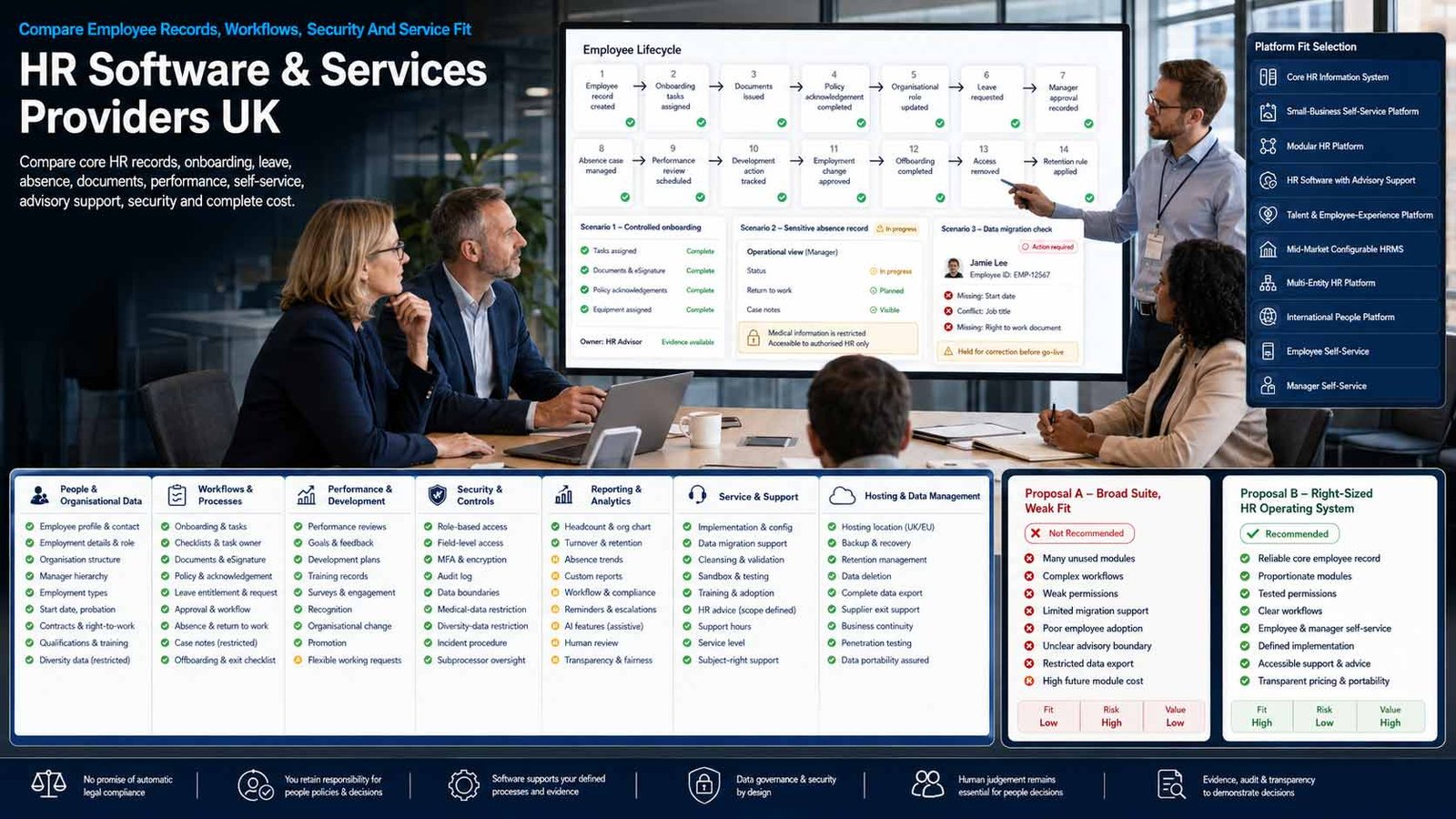
Buy A Reliable People System, Not A Feature Checklist
A useful HR platform should create one controlled employee record, standardise routine workflows, give managers and employees appropriate self-service and preserve evidence throughout the employment lifecycle.
- Map employee data, roles, workflows and retention before demonstrations
- Separate core requirements from attractive optional modules
- Test privacy, automation, AI, reporting and exit with real scenarios
- Confirm implementation, support, data ownership and contract terms in writing
HR software is a controlled system for storing employee information and managing defined people processes across joining, employment changes, leave, performance, development, communication and leaving. Depending on the provider, the service may include employee and manager self-service, organisational structures, document generation and e-signature, policy acknowledgements, onboarding tasks, absence workflows, performance reviews, surveys, case notes, reporting, workflow automation and HR advisory support.
The right solution depends on headcount, growth, legal entities, locations, employment types, HR maturity, manager capability, employee access, existing records, special-category data, process variation, reporting, international requirements, integration architecture, support expectations and internal ownership. A broad platform is not automatically better when adoption is low, workflows are over-engineered or data cannot be exported cleanly.
This page compares HR software and closely related HR administration or advisory services. It does not compare payroll processing, time and attendance systems or customer relationship management software. Those services have different operating data, legal duties, controls, provider capabilities and buying criteria.
Choose The Right HR Software And Service Model
Match the operating model to HR capability, headcount, process complexity, advisory need and implementation resource.
| Operating Model | What It Usually Includes | Best-Fit Question |
|---|---|---|
| Core HR Information System | Central employee records, organisational structure, documents, leave administration, employee self-service, workflows and standard reports. | Can the platform become the authoritative employee record without forcing unrelated modules? |
| Small-Business Self-Service Platform | Quick setup, simple employee database, holiday and absence, documents, onboarding tasks, reminders and owner or manager administration. | Can a business without a dedicated HR team operate it accurately and consistently? |
| Modular HR Platform | A core system with selectable performance, recruitment, learning, expenses, engagement, compensation or other modules. | Which functions are genuinely required now, and what changes when modules are added later? |
| Talent And Employee-Experience Platform | Performance, goals, feedback, surveys, recognition, career development, succession and people analytics alongside core records. | Are the talent tools connected to usable manager workflows rather than separate data islands? |
| Workflow-Led HR Automation | Configurable approvals, notifications, task routing, document generation, e-signatures, lifecycle changes and cross-system actions. | Can administrators safely maintain workflows without expensive consultancy for every change? |
| HR Software With Advisory Support | Software combined with employment-document templates, policy resources, helplines, named advisers or managed HR support. | What advice is included, who provides it, when is it available and where does liability remain? |
| Mid-Market Or Enterprise HRIS | Multiple entities, complex permissions, configurable data, analytics, integrations, auditability, implementation services and formal support governance. | Does the implementation effort and ongoing administration match the organisation’s capability? |
| Global Or Multi-Country People Platform | International employee records, localisation, multiple currencies and entities, global analytics, regional permissions and integrations. | Which local employment, privacy, document and retention requirements are native, configured or unsupported? |
Eight Areas That Determine HR Software Fit
Use the same data model, workflow, reporting, privacy, integration and service requirements for every provider.
Comparison Criterion
Employee Record And Organisation Model
Compare personal, contractual, job, manager, location, entity, emergency, qualification, equipment and custom fields. Test effective-dated changes, history, duplicate prevention, data validation, organisational charts and authoritative ownership. The system should distinguish current values from historical evidence.
Comparison Criterion
Employee And Manager Self-Service
Assess profile updates, document access, requests, approvals, task lists, notifications, mobile experience, delegation, accessibility and language support. Confirm which changes update the core record automatically, which require approval and how every action is logged.
Comparison Criterion
Onboarding, Changes And Offboarding
Compare preboarding, forms, document collection, contracts, e-signatures, right-to-work evidence storage, probation, equipment, policy acknowledgement, role changes, family leave, leavers, references and deletion or retention triggers. Workflow ownership must remain clear when tasks cross HR, managers, IT and finance.
Comparison Criterion
Leave, Absence And Employee Documents
Review holiday rules, carry-over, sickness records, family and other leave, attachments, return-to-work workflows, reminders, document templates, acknowledgements, version history and sensitive-data restrictions. This criterion covers HR administration, not time-clock or payroll processing.
Comparison Criterion
Performance, Development And Engagement
Assess goals, review cycles, one-to-ones, competencies, feedback, development plans, succession, surveys, anonymity thresholds, recognition and action tracking. Require manager usability, consistent calibration and controls that prevent sensitive comments being exposed inappropriately.
Comparison Criterion
Reporting, Analytics, Automation And AI
Compare headcount, turnover, absence, diversity, lifecycle, performance and custom reporting; workflow automation; natural-language queries; predictive or generative features; source transparency; human review; bias testing; access controls and data-use restrictions. AI output must support—not silently replace—accountable judgement.
Comparison Criterion
Privacy, Security And Records Governance
Assess controller and processor roles, UK GDPR support, lawful use, data minimisation, special-category data, role-based access, multifactor authentication, encryption, audit logs, hosting, subprocessors, breach handling, retention, deletion, subject access, data correction, backups and continuity.
Comparison Criterion
Implementation, Integration, Support And Exit
Compare discovery, configuration, migration, cleansing, testing, training, adoption, admin capability, APIs, identity management, document tools, finance or learning connections, support hours, service levels, release management, customer success, contract changes, data export and secure termination.
Measures To Define Before Selecting An HR Platform
Translate broad feature and compliance claims into auditable data, workflow, security, implementation and service evidence.
| Measure | What It Should Define | Evidence To Request | Common Weakness |
|---|---|---|---|
| Authoritative employee record | Whether employee information is complete, accurate, historical and governed | Field map, effective dates, validation, change history, ownership and duplicate controls | The platform stores data but cannot show which record is authoritative |
| Role and permission control | Whether HR, managers, employees and specialists see only what they need | Role matrix, field-level access, delegation, segregation, audit logs and test accounts | Broad manager access exposes health, pay or case information |
| Workflow reliability | Whether lifecycle tasks complete consistently and exceptions are visible | Workflow map, owners, conditions, reminders, escalation, failure queue and audit evidence | Automation hides incomplete tasks instead of resolving them |
| Document evidence | Whether contracts, policies, acknowledgements and changes remain reliable | Template control, version, e-signature, timestamp, access, retention and export | A current document overwrites the evidence of an earlier version |
| Leave and absence administration | Whether balances, requests, approvals and absence evidence reflect policy | Rule configuration, carry-over, family leave, sickness, triggers, reporting and audit | The platform is easy to use but cannot represent the organisation’s policies |
| Reporting quality | Whether decision-makers can obtain accurate, explainable people information | Metric definitions, filters, historical snapshots, permissions, exports and reconciliation | Dashboard totals cannot be traced back to individual source records |
| AI and automated decision control | Whether AI features are fair, transparent, limited and subject to human review | Use cases, training or grounding data, prompts, logs, human override, bias testing and DPIA | A convenience feature starts influencing significant decisions without governance |
| Implementation readiness | Whether configuration, migration, testing and adoption are controlled | Plan, data templates, cleansing, sign-off, environments, training, risks and ownership | A fast launch moves inaccurate spreadsheets into a new system |
| Support and change management | Whether operational issues and product changes are owned | Hours, severity, response, escalation, release notice, customer success and admin guidance | Sales support is strong but post-launch issues enter a generic queue |
| Data and contract portability | Whether the business can change provider without losing evidence | Full export, attachments, history, audit logs, APIs, notice, deletion and exit assistance | Only current employee fields are exportable; documents and history remain locked in |
HR Software Providers UK Businesses Can Consider
Shortlist providers whose employee record, workflows, usability, reporting, security, implementation and service model fit the organisation. Confirm the current product, package and complete terms before award.
Provider Profile
Breathe
Breathe provides cloud HR software aimed at UK small and growing organisations, with core employee records, leave and absence, documents, onboarding, performance and self-service capabilities, plus optional adjacent tools. Include it where a straightforward SME implementation and predictable administration are priorities. Confirm the selected plan, employee limit, included functionality, optional modules, document capacity, workflows, reporting, security, support, data migration, annual changes, contract flexibility and complete export at exit.
Review official Breathe HR software informationProvider Profile
BrightHR
BrightHR combines HR administration software with document resources, absence tools, employee applications and optional employment-law or health-and-safety support through its wider service model. Include it where a smaller business values software and access to practical HR guidance. Confirm the exact package, adviser availability, scope of advice, documents, data storage, manager access, integrations, mobile functions, support hours, contract term, renewal, exclusions, data portability and the division of responsibility between the business and adviser.
Review official BrightHR software informationProvider Profile
CharlieHR
CharlieHR offers HR software designed for smaller UK teams, covering employee records, onboarding, time off, documents, performance and engagement, with optional HR advice. Include it where rapid setup, a simple employee experience and support for founders or operations teams are important. Confirm headcount pricing, core and optional functionality, adviser service, workflow depth, permissions, reporting, data migration, document controls, integrations, support, cancellation and whether the system will remain suitable as structures and processes become more complex.
Review official CharlieHR informationProvider Profile
Sage HR
Sage HR is a modular cloud platform for growing businesses, with core HR and leave management plus selectable performance, recruitment, expenses, scheduling or timesheet modules. Include its core HR proposition where a business wants mobile self-service, employee records, onboarding, workflows and modular expansion. Confirm the chosen modules, per-employee basis, Sage ecosystem connections, permissions, document and e-signature capabilities, reporting, implementation, support, data hosting, contract flexibility, future module cost and export.
Review official Sage HR informationProvider Profile
Ciphr
Ciphr provides a configurable HR platform for UK organisations, with core HR, employee self-service, workflows, reporting and integrated suite options. Include it where a mid-sized organisation needs structured implementation, configurable processes, more complex permissions, multiple integrations and formal support. Confirm the proposed components, implementation scope, data model, workflow ownership, reporting, AI functions, security certifications, integrations, environments, service levels, customer-success model, licence growth, consultancy charges and exit assistance.
Review official Ciphr HR software informationProvider Profile
HiBob
HiBob’s Bob platform provides core HR, workflows, documents, employee experience, performance, surveys, analytics and wider people-management capabilities for growing and international organisations. Include it where engagement, flexible workflows, analytics and multi-country structures are important. Confirm the exact modules, UK localisation, entity and permission model, survey anonymity, integrations, AI use, implementation, support regions, data processing locations, subprocessors, pricing basis, release management and complete historical export.
Review official HiBob platform informationProvider Profile
Personio
Personio provides an HR platform for growing organisations with core employee data, organisation, workflows, documents, time off, analytics, talent and wider HR functions. Include it where an organisation wants configurable lifecycle automation and a connected European HR technology stack. Confirm UK-specific configuration, modules, implementation, permissions, workflow administration, reporting history, document controls, AI features, integrations, support, data residency and transfers, contract commitments, licence changes and exit support.
Review official Personio HR software informationProvider Profile
BambooHR
BambooHR provides a broad people platform covering HR data and reporting, onboarding, performance, employee experience, compensation and additional connected capabilities. Include it where usability, reporting and an integrated employee lifecycle are priorities for a growing organisation. Confirm the UK proposition, included applications, localisation, adviser options, pricing basis, implementation, integrations, permissions, AI and analytics governance, support location and hours, data processing, retention, contract minimums and the format of employee, document and audit-history export.
Review official BambooHR UK informationWhat Changes HR Software And Service Cost
Compare three-year lifecycle cost, internal administration, implementation effort and exit—not the headline subscription alone.
| Cost Driver | Why It Changes Spend | What A Comparable Quote Should Show |
|---|---|---|
| Employee count and pricing unit | Platforms may charge a flat monthly amount, per employee, per active worker, per user or by headcount band | Pricing definition, minimum charge, employee categories, leavers, contractors and headcount true-up |
| Core platform and module scope | A low core price may exclude performance, surveys, documents, e-signature, advanced reporting or advisory support | Included functionality, module dependencies, future activation, test access and recurring price |
| Implementation and configuration | Discovery, configuration, workflow design, permissions, forms, templates and project management can be material costs | Fixed or time-and-material basis, assumptions, deliverables, environments, change control and sign-off |
| Data migration and cleansing | Legacy spreadsheets, documents, history and inconsistent fields require mapping, validation and correction | Templates, included records, attachments, history, cleansing ownership, test migrations and reconciliation |
| Integrations and identity | Single sign-on, directories, finance, learning, benefits, document, recruitment or other connections may need licences or consultancy | Connector, API, middleware, setup, maintenance, data ownership, failure handling and decommissioning |
| Administrator and employee access | Some packages limit administrator seats, roles, report builders, API calls, storage or employee applications | User types, role limits, mobile access, storage, e-signature, audit logs and overage charges |
| Advisory and support service | Helplines, named advisers, template libraries, implementation support and premium service levels change total cost | Service scope, hours, named contacts, response targets, exclusions, liability and escalation |
| Analytics, automation and AI | Advanced dashboards, benchmark data, workflow builders, assistants or predictive tools may be separate modules | Feature, data source, human review, usage limits, model changes, auditability and licence cost |
| Security, resilience and assurance | Enhanced identity, sandbox, audit, retention, backup, recovery or assurance requirements may affect package and project cost | Controls, certifications, testing, business continuity, incident support and customer responsibilities |
| Contract growth, renewal and exit | Minimum terms, annual increases, employee growth, module changes, notice and migration assistance affect lifecycle cost | Term, price review, reduction rights, renewal, termination, export, deletion and exit-service rates |
| Indicative Commercial Model | Typical Position | What Must Be Confirmed |
|---|---|---|
| Flat Monthly Small-Business Plan | A defined headcount band receives a standard core feature set, sometimes with optional fixed-price add-ons | Confirm headcount thresholds, included modules, storage, support, annual increases and cancellation |
| Per-Employee-Per-Month Model | Recurring cost scales with employee count and selected functionality | Define who counts as an employee, minimum fee, inactive records, contractors, leavers and true-up dates |
| Modular Platform Licence | Core HR is combined with separately priced performance, engagement, recruitment, learning, compensation or advisory modules | Model the three-year module roadmap and avoid buying functions that belong to separate service pages |
| Configured Mid-Market Agreement | Licence, implementation, migration, integrations and support are quoted for organisation complexity and scope | Require a detailed statement of work, acceptance criteria, change rates, service levels and exit assistance |
Match The Platform To The People Operation
The right shortlist depends on HR capability, headcount, organisational complexity, employee access, data sensitivity and implementation resource.
Owner-Led Business Or Small Team
Prioritise rapid setup, clear employee records, holiday and absence, documents, onboarding, simple reviews, employee self-service and practical support. Avoid enterprise configuration that no one has time to administer.
Growing UK SME With An HR Generalist
Prioritise configurable workflows, manager self-service, reliable reporting, performance, engagement, document control, integrations, role-based access and a platform that can scale without forcing an early replacement.
Mid-Sized Multi-Site Organisation
Prioritise entity and location structures, delegated administration, complex permissions, workflow conditions, reporting history, data quality, formal implementation, identity management, service levels and controlled releases.
International Or Rapidly Scaling Organisation
Prioritise global records, local configuration, regional access, multi-entity analytics, integration architecture, data-transfer controls, talent processes, support coverage, acquisition onboarding and strong export or transition capability.
How To Compare HR Software Proposals
Issue one requirements pack containing headcount, employment types, legal entities, locations, organisation structure, current systems, employee fields, special-category data, lifecycle events, leave and absence policies, documents, user roles, approval paths, performance cycles, reports, integrations, identity controls, migration volumes, retention, support needs, growth and contract period. Require a response matrix and scenario demonstration rather than a generic product tour.
- Every provider demonstrates the same employee lifecycle scenarios
- Core, optional and future modules are clearly separated
- Migration, configuration, integrations and support are itemised
- Privacy, AI, access, retention and subject rights are evidenced
- Acceptance, service levels, data ownership and exit are explicit
- Three-year cost uses the same headcount and growth assumptions
Compare The Same Employee Journey
Ask each provider to create a starter, collect and approve documents, change a manager and role, process leave, record an absence, complete a review, restrict a sensitive field, produce a historical report, answer a subject-access scenario and export the full record.
A platform is not comparable when one demonstration uses preconfigured workflows and another assumes custom consultancy that is absent from the price.
Six Questions To Put To Every HR Software Provider
The answers expose unclear packages, weak data controls, hidden implementation cost, ungoverned AI and difficult exit.
What Is Included In The Core Licence?
Ask for a feature and service matrix separating core HR, documents, leave, onboarding, performance, surveys, analytics, AI, integrations, advisory support and future modules.
How Will Our Data Be Structured And Protected?
Request the employee data model, role matrix, field restrictions, audit logs, encryption, multifactor authentication, hosting, subprocessors, retention, backup, breach and deletion controls.
What Does Implementation Actually Deliver?
Confirm discovery, configuration, migration, cleansing, workflows, templates, permissions, integrations, testing, training, adoption, acceptance, timeline, customer responsibilities and change rates.
How Are Automation And AI Governed?
Ask which features use AI or automated decision-making, what data they use, whether customer data trains models, how outputs are explained, logged, reviewed, corrected and disabled, and when a DPIA is expected.
How Will Reporting And Subject Rights Work?
Test historical headcount, turnover, absence and custom reports, correction, restriction, deletion, data portability and subject access, including documents, comments, attachments and audit history.
What Happens When We Grow, Need Help Or Leave?
Confirm licence growth, entity changes, support hours, severity, named contacts, service credits, release communication, renewal, reduction rights, full export, transition assistance and verified deletion.
A Seven-Stage HR Software Provider Evaluation
Move from real employee data and workflows to tested evidence rather than choosing a platform from a polished feature demonstration.
- Create a verified HR baseline covering headcount, entities, sites, employment types, organisation structure, employee records, spreadsheets, documents, workflows, leave and absence, performance, reporting, integrations, access, retention, subject requests, support and accountable owners.
- Define the future operating model. Decide which information becomes authoritative, who owns each field and process, what employees and managers can self-serve, which approvals remain human, what evidence must be retained and what is explicitly outside scope.
- Prepare a prioritised requirement catalogue covering core employee data, onboarding, changes, documents, leave, absence, performance, engagement, reporting, automation, AI, privacy, security, integration, implementation, support, service levels and exit.
- Issue one supplier brief and demonstration script using the same sample organisation, employee personas, data volumes, documents, workflow conditions, reports, integration assumptions, growth, timeline and three-year commercial model.
- Shortlist providers by business fit, usability, data governance, workflow depth, reporting, security, UK support, implementation capability, roadmap, financial stability and referenceable customers with comparable HR maturity and scale.
- Complete due diligence and a controlled proof or pilot. Test migration, permissions, lifecycle workflows, document evidence, reporting history, API or identity connection, AI controls, mobile access, subject rights, support escalation and complete export.
- Implement through cleansed data, signed configuration, test environments, role-based training, manager readiness, employee communication, adoption measures and baseline reporting. Review data quality, workflow completion, support, licences, modules and exit readiness before renewal.
HR Software And Services Comparison Checklist
Use this table before appointing, replacing or renewing an HR software provider.
| No. | Requirement | Evidence To Obtain Before Award | Confirmed |
|---|---|---|---|
| 01 | HR and data baseline complete | Headcount, entities, sites, employment types, records, documents, workflows, reports, integrations and owners | |
| 02 | Service boundary approved | HR software scope clearly excludes payroll processing, time and attendance comparison and CRM | |
| 03 | Authoritative data model agreed | Fields, owners, effective dates, history, validation, special-category data and duplicate control | |
| 04 | User roles and access tested | HR, administrators, managers, employees, advisers, field restrictions, delegation and segregation | |
| 05 | Employee lifecycle workflows mapped | Preboarding, onboarding, probation, changes, family leave, absence, performance, offboarding and retention | |
| 06 | Document evidence controlled | Templates, e-signatures, acknowledgements, versions, attachments, access, history and export | |
| 07 | Leave and absence rules configured | Holiday, carry-over, sickness, family leave, approvals, triggers, evidence and reporting | |
| 08 | Performance and engagement model accepted | Goals, reviews, feedback, development, surveys, anonymity, calibration and action tracking | |
| 09 | Reporting definitions signed off | Headcount, turnover, absence, diversity, history, filters, custom reports and reconciliation | |
| 10 | AI and automation governance approved | Use cases, data, transparency, human review, bias, significant decisions, logs, DPIA and disable controls | |
| 11 | Security and privacy due diligence complete | Controller and processor, lawful use, access, MFA, encryption, hosting, subprocessors, incidents and SAR support | |
| 12 | Migration and implementation contracted | Discovery, cleansing, mapping, test loads, workflows, integrations, training, acceptance and change control | |
| 13 | Support and service governance agreed | Hours, severity, response, escalation, customer success, releases, continuity and service reporting | |
| 14 | Three-year commercial model complete | Headcount, modules, users, migration, consultancy, integrations, support, increases and internal resource | |
| 15 | Contract, data and exit controlled | Term, renewal, reduction, notice, full export, documents, history, audit logs, transition and deletion evidence |
Common HR Software Buying Mistakes
Most avoidable problems begin with feature-led selection, poor data, weak permissions, unclear implementation or automation without governance.
| Mistake | Why It Creates Risk | Better Control |
|---|---|---|
| Choosing the longest feature list | Unused modules increase cost and complexity without improving HR outcomes | Prioritise real processes and adoption |
| Migrating every legacy field without review | Old, duplicated or excessive data creates privacy and reporting problems in the new system | Clean, minimise and validate before migration |
| Giving managers broad access by default | Sensitive health, pay, case or personal information may be exposed inappropriately | Design and test a field-level role matrix |
| Automating a poor or unfair process | Workflow speed can make inconsistent decisions happen faster and at greater scale | Redesign the process before automation |
| Treating AI output as objective | Generated summaries, risk indicators or recommendations may be incomplete, biased or difficult to explain | Require human review, transparency and challenge |
| Confusing software with legal compliance | A configured platform can support records and workflow, but the employer remains accountable for lawful decisions | Assign policy, legal and data owners |
| Underestimating implementation ownership | Vendors cannot resolve unclear fields, inconsistent policies and weak manager responsibility alone | Name internal data, process and adoption owners |
| Buying optional modules too early | The organisation pays for functions before core records and manager use are stable | Phase modules against measurable readiness |
| Testing only the administrator experience | Employees and managers may avoid a system that is difficult, inaccessible or confusing | Pilot every major persona and device |
| Ignoring export until contract exit | Current fields may export while documents, comments, history and audit evidence remain locked in | Test a complete export before signing |
Frequently Asked Questions
Answers to common questions from UK businesses comparing HR platforms, data controls, implementation, AI, support and pricing.
What Is HR Software?
HR software is a digital system used to store employee information and manage defined people processes such as onboarding, organisational changes, documents, leave, absence, performance, development, surveys, reporting and offboarding. The available functions and service model vary by provider.
What Is The Difference Between HRIS, HRMS And HCM?
The terms overlap. HRIS commonly describes a core employee information system; HRMS often adds wider workflow and administration; HCM usually describes a broader suite covering talent, workforce and strategic people processes. Buyers should compare actual capabilities rather than labels.
Can A Small UK Business Use HR Software?
Yes. Several platforms are designed for owner-led and small organisations without a dedicated HR team. The business should prioritise simple setup, reliable employee records, documents, holiday and absence, onboarding, self-service, clear support and pricing that remains proportionate as headcount changes.
Does HR Software Make A Business Compliant With Employment Law?
No. Software can support consistent records, reminders, approvals and evidence, but the employer remains responsible for lawful policies, decisions, data use and fair treatment. Legal or professional advice may still be required for individual circumstances.
What Employee Data Can HR Software Store?
Platforms can store identity, contact, employment, role, organisation, document, leave, absence, performance, qualification and other agreed data. Employers should collect only what they need, define a lawful purpose, restrict access, keep it accurate and apply appropriate retention and deletion.
How Much Does HR Software Cost In The UK?
Pricing may be flat monthly, based on headcount bands, charged per employee or built from a core licence plus modules. Complete cost can also include implementation, migration, integrations, advisory support, premium service, storage, e-signatures, AI or analytics and exit assistance.
What Security Features Should HR Software Include?
Look for role-based and preferably field-level access, multifactor authentication, encryption, audit logs, secure hosting, backup and recovery, incident procedures, subprocessor transparency, retention controls, subject-right support and complete data export. Controls should be tested with real user roles.
How Should A Business Assess AI Features In HR Software?
Identify the use case, personal data involved, output, decision impact, human review, fairness, transparency, logging, correction, supplier access and whether customer data is used for model improvement. Higher-risk uses may require a data protection impact assessment and additional legal review.
How Long Does HR Software Implementation Take?
A simple small-business platform may be configured quickly, while a mid-market implementation with complex data, workflows, permissions and integrations can take considerably longer. The reliable timeline depends on data quality, internal decisions, testing, training, availability and acceptance criteria.
How Should UK Businesses Compare HR Software Providers?
Give every provider the same employee population, data model, workflow, document, reporting, privacy, security, integration, support, growth and exit requirements. Use scripted scenarios, reference checks, due diligence and a comparable three-year cost model rather than a generic product demonstration.
Official Guidance And Provider Resources
Reviewed by Bhav Giva, Founder & Lead Analyst at CompareServices.co.uk, on 31 July 2026.
Use current ICO, ACAS and provider documentation to verify employment-record, privacy, monitoring, automated-decision, holiday-record, security, implementation and contract requirements. Product modules, pricing, AI features, data processing and service terms can change. Obtain employment-law, data-protection, information-security or other professional advice where required.
- ICO — Employment Practices And Keeping Employment Records
- ICO — Monitoring Workers
- ICO — Subject Access Requests For Employers
- ICO — AI Tools Used In Recruitment
- ICO — Automated Decision-Making And Profiling
- ACAS — Keeping Holiday And Holiday-Pay Records
- Breathe — HR Software
- BrightHR — HR Software
- CharlieHR — HR Software And Advice
- Sage — Sage HR
- Ciphr — HR Software
- HiBob — Bob HR Platform
- Personio — HR Software
- BambooHR — United Kingdom HR Platform