
Compare eSignature / Contract Management Providers UK
Compare Electronic Signatures, Identity, Audit Evidence, Templates, Approvals, Negotiation, Obligations, Renewals, Integrations, Security, Pricing And Complete Contract Lifecycle Cost
Compare e signature software UK business providers by simple, advanced and qualified electronic-signature options, signer authentication, identity verification, witness and multi-party workflows, tamper evidence, time stamps, completion certificates, templates, fields, bulk sending, approvals, negotiation, clause and version control, contract creation, repository metadata, obligation and renewal tracking, search, reporting, APIs, CRM and HR integrations, mobile and guest signing, accessibility, data protection, retention, UK and international processing, administrator controls, implementation, support, usage limits, contract terms and complete lifecycle cost. Give every provider the same document types, signature assurance, user and sender population, monthly envelope or contract volume, workflow, signers, integrations, retention, reporting and growth assumptions before comparing proposals.
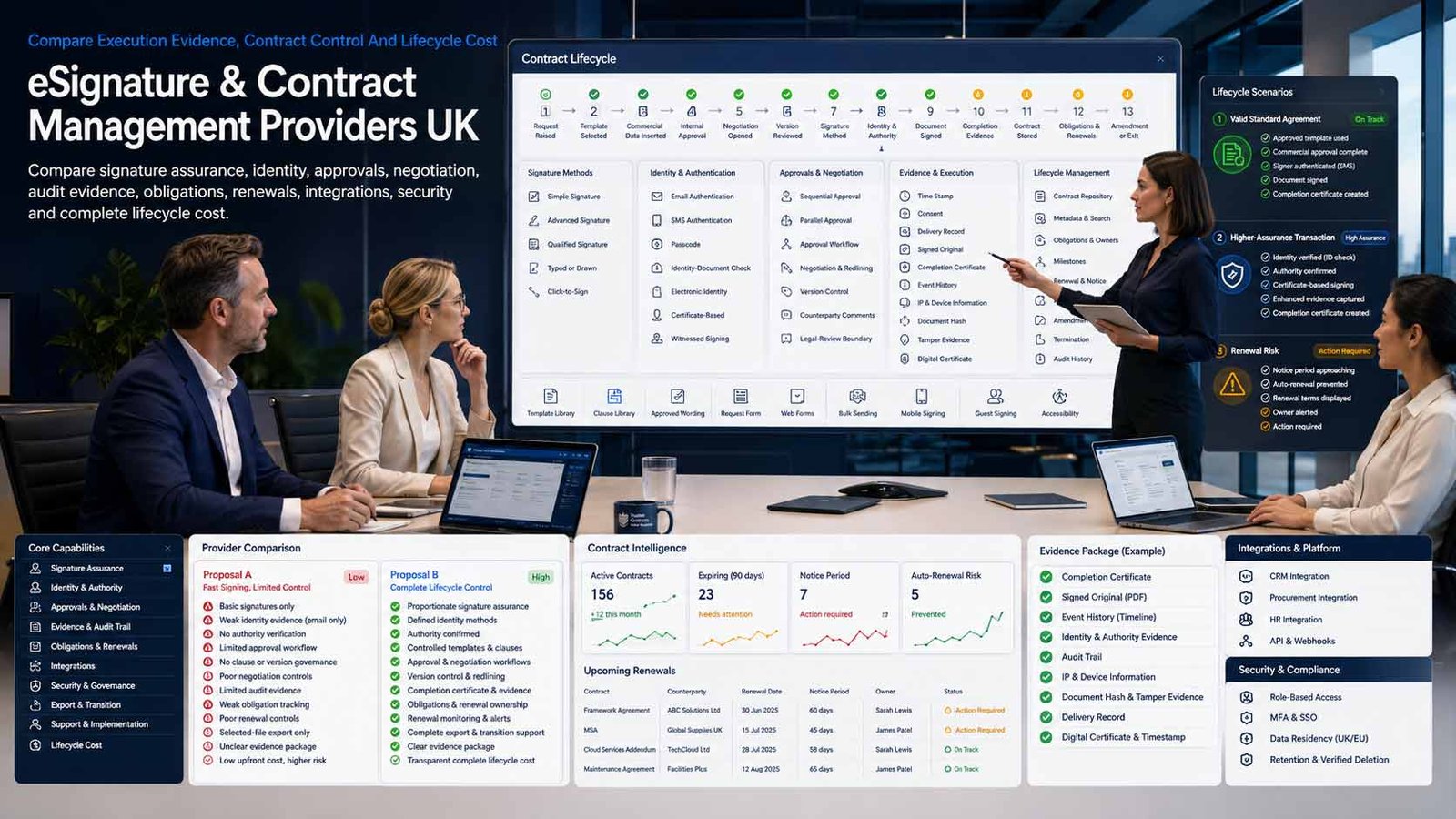
Buy A Controlled Agreement Process, Not A Signature Button
A useful platform should match the signature method to the document, preserve trustworthy execution evidence and keep approvals, versions, obligations and renewals under control.
- Classify document formality, signer authority and evidence requirements
- Separate drafting, approval, signing and post-signature ownership
- Test disputed, expired, amended and failed-signing scenarios
- Compare senders, envelopes, contracts, identity and integration costs together
Electronic-signature software enables a person to show agreement or authenticate a document electronically, while contract-management software controls some or all of the process before and after signature. Depending on the platform, that lifecycle can include templates, clause libraries, document generation, internal approvals, negotiation, version history, signer authentication, electronic seals, time stamps, audit evidence, signed-contract records, obligations, renewal reminders, reporting and integrations.
Electronic signatures can be valid for many UK transactions, including where legislation requires a signature, but document formality, governing law, company authority, witnessing, registration, identity assurance and evidential risk still matter. Some documents or use cases require a particular process, stronger signature level or specialist legal review. HM Land Registry, regulators, counterparties and overseas jurisdictions can impose their own requirements.
This page compares eSignature and contract-lifecycle solutions. It does not cover general document storage or legal advice only. File drives, records repositories and content-management platforms may store signed files, while lawyers determine legal form, drafting and enforceability for specific circumstances. Neither is a substitute for a controlled signing and contract-management workflow.
Choose The Right eSignature And Contract Model
Match the platform to document formality, contract volume, workflow complexity, identity assurance and post-signature obligations.
| Operating Model | What It Usually Includes | Best-Fit Question |
|---|---|---|
| Basic Electronic Signature Service | Upload or prepare a document, add fields, send to signers, track status and download the completed file and evidence. | Is straightforward signing sufficient, or are approval and renewal failures already creating risk? |
| Advanced Or Qualified Signature Service | Stronger signer identification, certificate-based signing, tamper detection, trust-service integration or qualified-signature options. | Which documents genuinely require higher assurance, and how will signer friction and cost change? |
| Template And Workflow eSignature Platform | Reusable templates, bulk sends, conditional fields, signer order, internal approval, reminders, branding, web forms and integrations. | Can administrators control templates and workflows without creating unapproved variants? |
| Sales Proposal And Agreement Platform | Document creation, pricing tables, content blocks, collaboration, eSignature, payments and CRM-connected sales workflows. | Does the platform improve commercial agreements without becoming a substitute for CRM or finance systems? |
| End-To-End Contract Lifecycle Management | Intake, authoring, clauses, approvals, negotiation, redlines, execution, repository metadata, obligations, renewals and analytics. | Is the organisation ready to govern contract data and processes beyond signing? |
| AI-Assisted Contract Platform | Contract search, extraction, summaries, clause suggestions, risk flags, playbooks, obligation capture and conversational queries. | How are accuracy, legal review, confidential data and model change controlled? |
| Embedded eSignature API | Signing is built into a website, application, portal or product through APIs, SDKs, webhooks and branded signer journeys. | Who owns identity, consent, document generation, errors, evidence, monitoring and service continuity? |
| Managed Contract Operations Service | Platform configuration, templates, migration, workflow, metadata, contract administration, renewals, reporting and improvement are managed externally. | Which legal and commercial decisions stay in-house, and can operations transfer without rebuilding? |
Eight Areas That Determine eSignature And Contract Fit
Use the same documents, signers, evidence, approvals, obligations, integrations and service assumptions for every provider.
Comparison Criterion
Document Formality And Signature Assurance
Classify agreements by governing law, value, risk, signatory, company authority, witnessing, registration and counterparty rules. Compare simple, advanced and qualified electronic signatures, electronic seals, time stamps and trust-service options. Require a documented method for choosing the level rather than using the strongest or weakest method for every document.
Comparison Criterion
Signer Identity, Authority And Signing Experience
Assess email, access code, SMS, knowledge-based, document, bank or electronic-ID verification; delegated and corporate signing; witnesses; multi-party order; in-person signing; mobile and browser usability; language; accessibility; refusal; expired links and authentication failure. Confirm how the business proves the person and authority behind a signature.
Comparison Criterion
Audit Evidence, Integrity And Dispute Readiness
Compare tamper evidence, document hashes, digital certificates, time stamps, event history, IP and device data, authentication events, consent and intention evidence, completion certificates, signed-file integrity, provider validation and long-term access. Test what can be produced when a signer denies receipt, identity, authority or agreement.
Comparison Criterion
Templates, Approvals, Negotiation And Version Control
Review template ownership, clause libraries, locked and editable text, conditional logic, data fields, approval thresholds, segregation of duties, comments, redlines, comparison, internal and counterparty versions, fallback language, amendment, cancellation and publication. Prevent users from signing the wrong version or bypassing required approval.
Comparison Criterion
Post-Signature Obligations, Renewals And Reporting
Assess contract metadata, parties, owners, effective and expiry dates, notice periods, obligations, milestones, pricing reviews, service credits, insurance, certificates, data-protection terms, assignment, amendments and termination. Require reminders, escalation, dashboards, search and evidence of action—not merely a folder containing signed PDFs.
Comparison Criterion
Integrations, APIs And Data Quality
Compare CRM, HR, finance, procurement, identity, storage, productivity and ticketing integrations; APIs; webhooks; embedded signing; field mapping; document generation; duplicate control; failed sync; retry; idempotency; monitoring and decommissioning. Define which system owns party, value, status, renewal and signed-document data.
Comparison Criterion
Security, Privacy, AI And Records Governance
Review controller and processor roles, personal data, lawful use, notices, model training, redaction, access, single sign-on, multifactor authentication, encryption, tenant isolation, data regions, subprocessors, international transfers, retention, legal hold, deletion, audit logs, incident response, backups, AI accuracy and confidential-contract handling.
Comparison Criterion
Implementation, Administration, Pricing And Exit
Compare discovery, process design, template and clause work, migration, metadata cleansing, integrations, testing, training, support, administrator permissions, release management, envelope or contract allowances, identity credits, API usage, storage, professional services, minimum term, annual increase, complete export, transition and verified deletion.
Measures To Define Before Selecting A Platform
Translate signature and automation claims into auditable identity, document, workflow, obligation and exit evidence.
| Measure | What It Should Define | Evidence To Request | Common Weakness |
|---|---|---|---|
| Signing authority | Whether the individual is authorised to bind the relevant person or organisation | Identity, role, delegation, board or policy authority, counterparty record and approval | The named email recipient signs, but corporate authority is never checked |
| Signature assurance | Whether the signature method is proportionate to the document and evidential risk | Signature level, authentication, certificate, trust provider, witness and use-case rule | A simple signature is presented as suitable for every transaction |
| Document integrity | Whether the completed document can be shown not to have changed after signing | Hash, seal, certificate, validation method, signed original and evidence retention | Only a flattened PDF is retained without verifiable execution evidence |
| Intention and consent to sign | Whether the signer understood the document and took a clear signing action | Journey, disclosure, required fields, confirmation, audit event, refusal and copy delivery | A signature image is inserted without evidence of the signing process |
| Approval and version control | Whether the correct authorised version reaches the correct signers | Template version, clause source, approval log, redlines, final comparison and send authority | Negotiated changes are copied into an old template and signed outside the workflow |
| Contract cycle time | How long approved contracts take from request through agreement and execution | Intake, drafting, approval, counterparty review, signature, delay reason and exception | Signature speed is measured while internal approval delays are excluded |
| Obligation and renewal control | Whether owners act on notices, milestones, prices, documents and termination dates | Metadata, owner, reminder, escalation, action, evidence and completed outcome | Renewal emails are sent to former employees or after the notice deadline |
| Signer and administrator accessibility | Whether disabled users can understand, complete and manage the workflow | Keyboard, screen reader, focus, instructions, errors, alternative formats and support | The document is accessible but the signature fields and authentication are not |
| Platform security and privacy | Whether contract and signer data remain protected throughout processing and retention | Access, MFA, encryption, regions, processors, transfers, incidents, logs and deletion | Signed contracts are shared widely because repository permissions are too broad |
| Data and exit portability | Whether documents, evidence, metadata, workflows and reports can move cleanly | Bulk export, original files, certificates, audit history, fields, APIs, notice and deletion | The business exports PDFs but loses renewal data, workflow history and validation evidence |
eSignature And Contract Management Providers UK Businesses Can Consider
Shortlist providers whose signature assurance, signer experience, workflow, contract lifecycle, integrations, security and commercial model fit the use case. Confirm current written terms before award.
Provider Profile
Docusign
Docusign provides eSignature, identity and verification options, web forms, document generation, contract lifecycle management and wider agreement-management capabilities. Include it where a business needs established electronic-signature workflows, broad integrations, APIs or an enterprise CLM path. Confirm the exact eSignature and CLM products, sender and envelope allowances, signature levels, identity credits, witnesses, templates, bulk send, data regions, authentication, integrations, AI and analytics, implementation, support, minimum term, annual increases, overage, contract-data migration and complete evidence export.
Review official Docusign productsProvider Profile
Adobe Acrobat Sign
Adobe Acrobat Sign provides business electronic-signature workflows within Adobe Acrobat and as a standalone enterprise service, with templates, forms, bulk sending, tracking, integrations, digital-signature and trust-service options. Include it where PDF preparation and signature are closely connected or Adobe tools are already standard. Confirm the selected Acrobat or Sign plan, sender and transaction model, advanced and qualified options, identity, web forms, bulk sends, records, integrations, APIs, data processing, administrator controls, implementation, support, storage, annual commitment and the extent of post-signature contract management.
Review official Adobe Acrobat Sign informationProvider Profile
Signable
Signable is a UK-based electronic-signature provider offering document preparation, templates, branded sending, tracking, audit evidence, API capability and advanced-signature options. Include it where a UK SME wants a focused eSignature service, local support and a simpler commercial model rather than a full enterprise CLM platform. Confirm users and envelope allowance, pay-as-you-go or subscription terms, simple and advanced signature availability, two-factor authentication, witness workflow, templates, bulk send, API, branding, data hosting, support, legal-evidence pack, overage, cancellation and whether separate tools are needed for negotiation, obligations and renewals.
Review official Signable informationProvider Profile
Dropbox Sign
Dropbox Sign provides legally binding electronic signatures, templates, reminders, audit trails, team administration, API and embedded-signing options, with connection to Dropbox and other business tools. Include it where straightforward signature workflows, developer integration or Dropbox use are priorities. Confirm the current plan, signature requests, users, templates, bulk send, qualified-signature or identity options, embedded and API usage, branding, signer experience, data location, subprocessors, support, storage relationship, annual term, cancellation and whether contract metadata, obligations and renewals require another system.
Review official Dropbox Sign informationProvider Profile
PandaDoc
PandaDoc combines document creation, content and pricing blocks, approvals, collaboration, electronic signatures, audit evidence, CRM integrations and contract-management features. Include it where sales proposals, quotes and commercial agreements need to move from structured content to signature in one workflow. Confirm the plan, workspace and sender licences, templates, catalogue and pricing functions, payments, approvals, recipient verification, signing evidence, CRM integration, contract repository and renewal functions, AI, implementation, support, transaction limits, data handling, annual commitment and exit.
Review official PandaDoc electronic-signature informationProvider Profile
Oneflow
Oneflow provides an end-to-end digital-contract platform covering creation, collaboration, negotiation, electronic signatures, templates, approvals, contract data, lifecycle tracking and integrations. Include it where teams want structured contracts rather than static files moving between separate authoring, signature and repository tools. Confirm the edition, users, workspaces, PDF and native contracts, signature methods, eID and premium-signature credits, templates, approvals, redlines, reminders, lifecycle metadata, AI, integrations, implementation, data regions, support, price changes and full contract and evidence export.
Review official Oneflow contract platformProvider Profile
Juro
Juro provides an AI-enabled contract platform for contract intake, creation, collaboration, approvals, negotiation, native electronic signature, repository, search and post-signature management. Include it where legal and business teams need a controlled contract workflow and searchable contract data rather than a signing utility alone. Confirm workflow scope, template and clause governance, native signing assurance, counterparties, bulk signing, AI uses and human review, integrations, migration, metadata, permissions, data processing, implementation team, service levels, pricing basis, contract term and export of documents, audit evidence and structured data.
Review official Juro contract platformProvider Profile
Zoho Sign
Zoho Sign provides electronic signatures, workflows, templates, reminders, authentication, reports, APIs, mobile applications and integrations with Zoho and third-party services. Include it where a smaller business wants a cost-conscious signature platform or already uses the Zoho application suite. Confirm the selected plan, users, monthly documents, API credits, bulk send, forms, advanced and qualified-signature options, authentication, witness and signer controls, data regions, integrations, administrator roles, support, annual pricing, overage and whether a separate CLM capability is needed for drafting, negotiation and obligations.
Review official Zoho Sign informationWhat Changes eSignature And Contract Management Cost
Compare complete cost per correctly executed and actively managed contract—not the lowest sender licence.
| Cost Driver | Why It Changes Spend | What A Comparable Quote Should Show |
|---|---|---|
| Users, senders and administrators | Providers may licence every user, only senders, named administrators, workspaces or concurrent users | User types, reassignment, minimums, inactive users, guests, external collaborators and true-up |
| Envelope, transaction or document volume | Plans may include monthly or annual signature requests, envelopes, documents or completed transactions | Unit definition, voided and declined sends, reminders, corrections, bulk sends, overage and rollover |
| Signature and identity assurance | SMS, identity documents, bank or electronic ID, advanced or qualified signatures and trust-service transactions add cost | Method, country, credit, failed checks, retries, signer payment, trust provider and evidence |
| Contract lifecycle functionality | Authoring, clauses, approvals, redlines, repository metadata, obligations and analytics may require higher editions | Core and optional modules, dependencies, environments, users, contract volume and future roadmap |
| Templates, forms and bulk workflows | High-volume onboarding, HR, supplier, sales and customer workflows can require web forms, bulk send and reusable templates | Template limits, submissions, fields, conditions, branding, abuse control and archive |
| API, embedded signing and integrations | Programmatic document generation, embedded signer journeys, webhooks and enterprise connectors create usage and implementation costs | API calls, signature credits, environments, support, connector licence, custom code and monitoring |
| Migration and metadata cleansing | Moving signed contracts, audit evidence, renewal dates and obligations requires mapping and validation | Files, formats, certificates, metadata, extraction, deduplication, test loads and reconciliation |
| AI, analytics and search | Extraction, summaries, clause analysis, risk flags and conversational contract search may be separate capabilities | Models, data use, accuracy, user limits, credits, review, audit, regions and disable controls |
| Support, assurance and regulated use | Premium support, private environments, data regions, SSO, legal hold, validation and specialist signature methods can change package | Support hours, service levels, controls, certifications, incident response and customer responsibility |
| Contract, renewal and exit | Annual minimums, price reviews, unused envelopes, data access and transition services affect lifecycle cost | Term, reduction, renewal, notice, export, validation after exit, migration help and deletion |
| Indicative Commercial Model | Typical Position | What Must Be Confirmed |
|---|---|---|
| Per-User eSignature Subscription | Named users receive an allowance and standard templates, tracking, reminders and administration | Confirm sender limits, transaction allowance, advanced identity, bulk send, API and annual commitment |
| Envelope Or Pay-As-You-Go Model | Charges scale with signature requests, completed documents or prepaid transaction credits | Model voided, declined, corrected, resent, bulk and peak-volume transactions consistently |
| CLM Platform Licence Plus Implementation | User, contract or enterprise licensing is combined with process design, migration, templates and integrations | Separate software, professional services, internal legal and commercial work, future modules and support |
| Embedded API And Identity Consumption | Application owners pay for API usage, envelopes, identity verification, trust services and technical support | Build low, expected and peak scenarios including failed checks, test environments and retry behaviour |
Match The Platform To The Agreement Process
The right shortlist depends on document formality, signer experience, contract complexity, transaction volume, identity, integrations and internal ownership.
Small Business Sending Routine Agreements
Prioritise simple setup, mobile and browser signing, reusable templates, reminders, audit evidence, reasonable send allowance, UK support, accessible signer journeys and easy export. Avoid paying for enterprise CLM modules when ownership and renewal can be managed proportionately.
Growing Sales, HR Or Supplier Operation
Prioritise template governance, approvals, conditional fields, CRM or HR integration, bulk workflows, identity options, reporting, team administration, data protection and a clear path from simple signing to obligation and renewal control.
Legal And Commercial Team Managing Negotiated Contracts
Prioritise intake, clause and template control, approvals, redlines, version comparison, native eSignature, repository metadata, obligations, search, renewal reporting, permissions, migration, AI governance and measurable adoption across business teams.
Enterprise, Regulated Or High-Assurance Use
Prioritise formal signature-classification rules, identity verification, advanced or qualified signatures where required, electronic seals, data regions, SSO, audit, legal hold, private integrations, resilience, service levels and long-term validation and exit evidence.
How To Compare eSignature Proposals
Issue one requirements pack containing document types, jurisdictions, governing law, company and individual signers, witnesses, required signature levels, identity methods, monthly and peak volume, senders, guests, templates, fields, approvals, negotiation, clauses, amendments, bulk workflows, web forms, contract metadata, obligations, notice periods, renewals, retention, legal hold, integrations, APIs, accessibility, security, data regions, migration, support and contract period. Require an end-to-end demonstration and evidence export rather than a signature-only demo.
- Every provider processes the same document and signer scenarios
- Signature method and identity are matched to the use case
- Approval, version, audit and dispute evidence are demonstrated
- Obligations, notices, renewals and amendments are tested
- Licences, envelopes, identity, API and implementation are itemised
- Three-year cost uses the same volume and growth assumptions
Compare The Same Contract End To End
Ask each provider to generate an agreement from approved data, route internal approval, negotiate one clause, verify two signers, handle a witness or stronger-authentication scenario, produce the completed file and certificate, capture a renewal obligation, issue a notice reminder and export the full record.
A fast signature is not a controlled agreement when the wrong version is signed, authority is unclear, evidence cannot be validated or a renewal passes unnoticed.
Six Questions To Put To Every eSignature Provider
The answers expose inappropriate signature assurance, weak evidence, uncontrolled versions, unmanaged obligations, unclear data use and unpredictable lifecycle cost.
Which Signature Method Fits Each Document Type?
Ask for a document-classification matrix covering simple, advanced and qualified signatures, seals, time stamps, witnesses, identity, governing law, regulatory or registry rules and legal-review triggers.
How Do You Prove Identity, Authority And Intention?
Request the signer journey, authentication, corporate authority, consent to electronic signing, required actions, time and device evidence, completion certificate, signed original and independent validation method.
How Are Templates, Approvals And Versions Controlled?
Confirm owners, permissions, locked language, clauses, conditions, approval thresholds, segregation, redlines, final comparison, send authority, amendments, cancellations and audit reporting.
What Happens After Signature?
Demonstrate metadata, owners, obligations, prices, notices, renewals, documents, amendments, termination, reminders, escalation, dashboards, search, reporting and evidence of completed action.
How Are Data, AI And Integrations Governed?
Obtain the data map, regions, subprocessors, model training rule, access, encryption, retention, deletion, AI accuracy, APIs, source systems, field ownership, failed-sync handling and incident process.
What Is The Complete Three-Year Cost And Exit Plan?
Require user, sender, envelope, identity, trust-service, API, storage, AI, implementation, migration, integration, support, overage, increase, export, transition and post-exit validation costs.
A Seven-Stage eSignature Provider Evaluation
Move from real documents and contract obligations to tested evidence rather than choosing a platform from signature speed or brand familiarity.
- Create a verified agreement baseline covering document types, jurisdictions, value, formality, signers, witnesses, authority, transaction volumes, current tools, templates, approvals, negotiation, execution time, failed signatures, disputes, obligations, renewals, storage, integrations and accountable owners.
- Define the target operating model. Decide which documents use simple, advanced or qualified methods; which require legal review, witnesses or registry processes; who owns templates and clauses; how approval works; and which post-signature obligations enter operational systems.
- Prepare a prioritised requirement catalogue covering signer identity, authority, experience, audit evidence, integrity, templates, approvals, redlines, contract creation, metadata, obligations, renewals, integrations, accessibility, privacy, security, AI, implementation, pricing and exit.
- Issue one supplier brief and scripted agreement using the same document, data, approval, negotiation, signers, witness or stronger-authentication requirement, renewal date, integration, dispute scenario, volume, internal resource and three-year commercial assumptions.
- Shortlist providers by exact use-case fit, signer experience, signature assurance, evidence quality, contract-lifecycle depth, integrations, security, accessibility, implementation capability, service reliability, financial stability and relevant reference customers.
- Complete due diligence and a controlled pilot. Test an ordinary contract, a higher-assurance document, a failed identity check, a signer decline, an amendment, an inaccessible field, an approval exception, an integration failure, a renewal reminder and a complete evidence export.
- Implement through approved signature policy, templates, permissions, integrations, migration, training, support, exception management and reporting. Review execution time, failed sends, template drift, missing metadata, overdue obligations, licence use, support and export readiness before renewal.
eSignature And Contract Management Comparison Checklist
Use this table before appointing, migrating or renewing an electronic-signature or contract-lifecycle provider.
| No. | Requirement | Evidence To Obtain Before Award | Confirmed |
|---|---|---|---|
| 01 | Agreement and volume baseline complete | Document types, jurisdictions, signers, witnesses, authority, volumes, workflow, disputes, obligations and owners | |
| 02 | Service boundary approved | eSignature and contract lifecycle scope excludes general document storage and legal-advice-only services | |
| 03 | Document formality classified | Governing law, execution method, company authority, witnessing, registration, regulator and legal-review triggers | |
| 04 | Signature assurance mapped | Simple, advanced, qualified, seals, time stamps, authentication and evidence by use case | |
| 05 | Signer experience and accessibility tested | Browser, mobile, language, keyboard, screen reader, instructions, errors, alternative route and support | |
| 06 | Identity and authority controls accepted | Email, access code, SMS, eID, documents, corporate authority, delegation, witnesses and failed checks | |
| 07 | Audit and integrity evidence proven | Signed original, certificate, hash, time, events, authentication, validation, retention and dispute export | |
| 08 | Templates and clauses controlled | Owners, permissions, versions, locked text, fields, logic, publication, retirement and fallback language | |
| 09 | Approval and negotiation workflow approved | Intake, thresholds, segregation, redlines, comparison, counterparty version, exceptions and final send authority | |
| 10 | Post-signature lifecycle configured | Metadata, owners, obligations, prices, notices, renewals, amendments, termination, reminders and escalation | |
| 11 | Integrations and data ownership agreed | CRM, HR, finance, procurement, identity, APIs, fields, source systems, retries, monitoring and decommissioning | |
| 12 | Privacy, AI and security due diligence complete | Roles, purpose, access, MFA, encryption, regions, subprocessors, model use, retention, incidents and deletion | |
| 13 | Implementation and support contracted | Discovery, templates, migration, integrations, testing, training, acceptance, service levels and release control | |
| 14 | Three-year commercial model complete | Users, senders, envelopes, identity, trust services, API, storage, AI, implementation, support and overage | |
| 15 | Contract, evidence and exit controlled | Term, renewal, reduction, export, certificates, audit data, metadata, workflows, transition and deletion |
Common eSignature And Contract Management Buying Mistakes
Most avoidable problems begin with one-size-fits-all signing, unclear authority, incomplete evidence, ungoverned templates or lifecycle and exit left outside the project.
| Mistake | Why It Creates Risk | Better Control |
|---|---|---|
| Assuming every document can use the same signature method | Formality, witnessing, authority, registration and evidential risk vary by document and jurisdiction | Create an approved signature-classification matrix |
| Buying CLM before defining the contract process | Technology reproduces unclear approvals, inconsistent clauses and missing ownership at greater scale | Standardise intake, authority and lifecycle first |
| Treating an email address as proof of authority | A recipient may access the mailbox but lack power to bind the organisation | Verify identity and signing authority proportionately |
| Keeping only the signed PDF | The business may lose authentication, time, event and integrity evidence needed in a dispute | Retain and test the complete evidence package |
| Allowing uncontrolled template copies | Users can send obsolete clauses, terms, prices or data-protection language | Use governed templates and retirement controls |
| Measuring only time to signature | Approval, negotiation, implementation, obligations and renewal failures remain hidden | Measure the complete contract lifecycle |
| Enabling AI analysis without review | Summaries and risk flags can omit context, misread clauses or expose confidential data | Require human review and tested use cases |
| Ignoring signer accessibility | Customers, employees or suppliers may be unable to authenticate, read fields or complete the process | Test assistive technology and alternatives |
| Comparing licence prices without transaction rules | Envelope, identity, API, bulk, storage and overage definitions can materially change spend | Model a common low, expected and peak scenario |
| Leaving export until contract termination | Documents may transfer while certificates, metadata, obligations and workflow evidence remain locked in | Test a complete export before signing |
Frequently Asked Questions
Answers to common questions from UK businesses comparing electronic signatures, identity, evidence, contract lifecycle, pricing and implementation.
What Is An Electronic Signature?
An electronic signature is electronic data attached to or logically associated with other electronic data and used by a person to sign. It can include a typed name, drawn signature, click action or certificate-based method, depending on the platform and required assurance.
Are Electronic Signatures Legally Valid In The UK?
Electronic signatures can be used validly for many UK transactions, including many documents that require a signature. Validity still depends on the document, intention, authority, formalities, evidence, governing law and any registry, regulator or counterparty requirements. Specific legal advice may be needed.
What Is The Difference Between Simple, Advanced And Qualified Electronic Signatures?
A simple electronic signature is the broad basic category. An advanced electronic signature must meet stronger identification, control and tamper-detection requirements. A qualified electronic signature adds a qualified certificate and device or service requirements. Higher assurance can increase cost and signer friction.
Can A Deed Be Signed Electronically?
Some deeds can be signed electronically when the applicable execution and witnessing formalities are met. The correct process depends on the parties, document, jurisdiction and registration requirement. HM Land Registry publishes separate rules for documents submitted to it. Obtain legal advice for the specific deed.
What Is Contract Lifecycle Management?
Contract lifecycle management controls an agreement from request and drafting through approval, negotiation, signature, storage, obligations, amendments, renewal and termination. A CLM platform can provide templates, clauses, workflows, metadata, reminders, reporting, search, integrations and audit history.
How Much Does eSignature Software Cost?
Pricing may be per user, sender, envelope, document, completed transaction or API request. Identity verification, advanced or qualified signatures, bulk sends, web forms, storage, AI, integrations, CLM modules, implementation, support and overage can add to the complete cost.
What Evidence Should An eSignature Platform Produce?
Useful evidence can include the signed original, completion certificate, event history, signer authentication, dates and times, IP or device information, document hash, digital certificate, time stamp, consent and delivery record. Required evidence depends on the transaction and dispute risk.
Can eSignature Software Verify Signer Identity?
Yes. Methods can include email access, passcodes, SMS, document verification, bank or electronic identity and qualified trust services. No single method proves every form of authority or eliminates fraud. Businesses should match identity assurance to the document and verify corporate authority separately.
Does Contract Management Software Replace A Lawyer?
No. Software can control templates, workflow, clauses, signatures, records and obligations, but it does not replace legal judgement about drafting, enforceability, negotiation, disputes, governing law or unusual formalities. Legal and operational responsibilities should be explicit.
How Should UK Businesses Compare eSignature Providers?
Give every provider the same document types, signature levels, signers, identity requirements, templates, approval and negotiation workflow, contract volume, obligations, integrations, security, retention, support and exit assumptions. Compare valid execution evidence and lifecycle control—not signing speed alone.
Official Guidance And Provider Resources
Reviewed by Bhav Giva, Founder & Lead Analyst at CompareServices.co.uk, on 1 August 2026.
Use current GOV.UK, Law Commission, HM Land Registry, ICO, legislation and provider documentation to verify electronic-signature validity, document formalities, UK eIDAS and trust services, identity and digital-verification developments, data protection, records, product capabilities, signature levels, pricing and contract terms. The correct execution method depends on the document and circumstances. Obtain legal, tax, property, company-secretarial, data-protection or sector-specific advice where required.
- GOV.UK — Electronic Execution Of Documents
- Law Commission — Electronic Execution Of Documents
- HM Land Registry — Electronic Signatures Practice Guide 82
- ICO — UK eIDAS Key Definitions
- GOV.UK — Adoption Of Trust Services Government Response
- ICO — Accountability, Processor Contracts And Records Governance
- Docusign — eSignature And Contract Products
- Adobe — Acrobat Sign
- Signable — UK Electronic Signatures
- Dropbox — Dropbox Sign
- PandaDoc — Electronic Signature Software
- Oneflow — Digital Contract Platform
- Juro — Contract Automation Platform
- Zoho — Zoho Sign