
Compare AI Chatbots & Virtual Assistants Providers UK
Compare Knowledge Grounding, Resolution, Human Handover, Actions, Voice, Channels, Languages, Accessibility, Privacy, Security, Analytics, Pricing And Complete Lifecycle Cost
Compare AI chatbots business UK providers by use-case fit, knowledge grounding, retrieval quality, conversation design, response accuracy, hallucination controls, confidence and fallback rules, human handover, ticket and workflow actions, identity and authentication, website and application deployment, email, messaging and voice channels, languages, accessibility, consumer transparency, personal-data handling, model and subprocessor controls, prompt-injection protection, monitoring, evaluation, analytics, implementation, integrations, managed services, support, per-resolution or usage pricing, contract terms and complete lifecycle cost. Give every provider the same conversation sample, knowledge sources, channel mix, user volumes, actions, escalation rules, data restrictions, service targets and growth assumptions before comparing proposals.
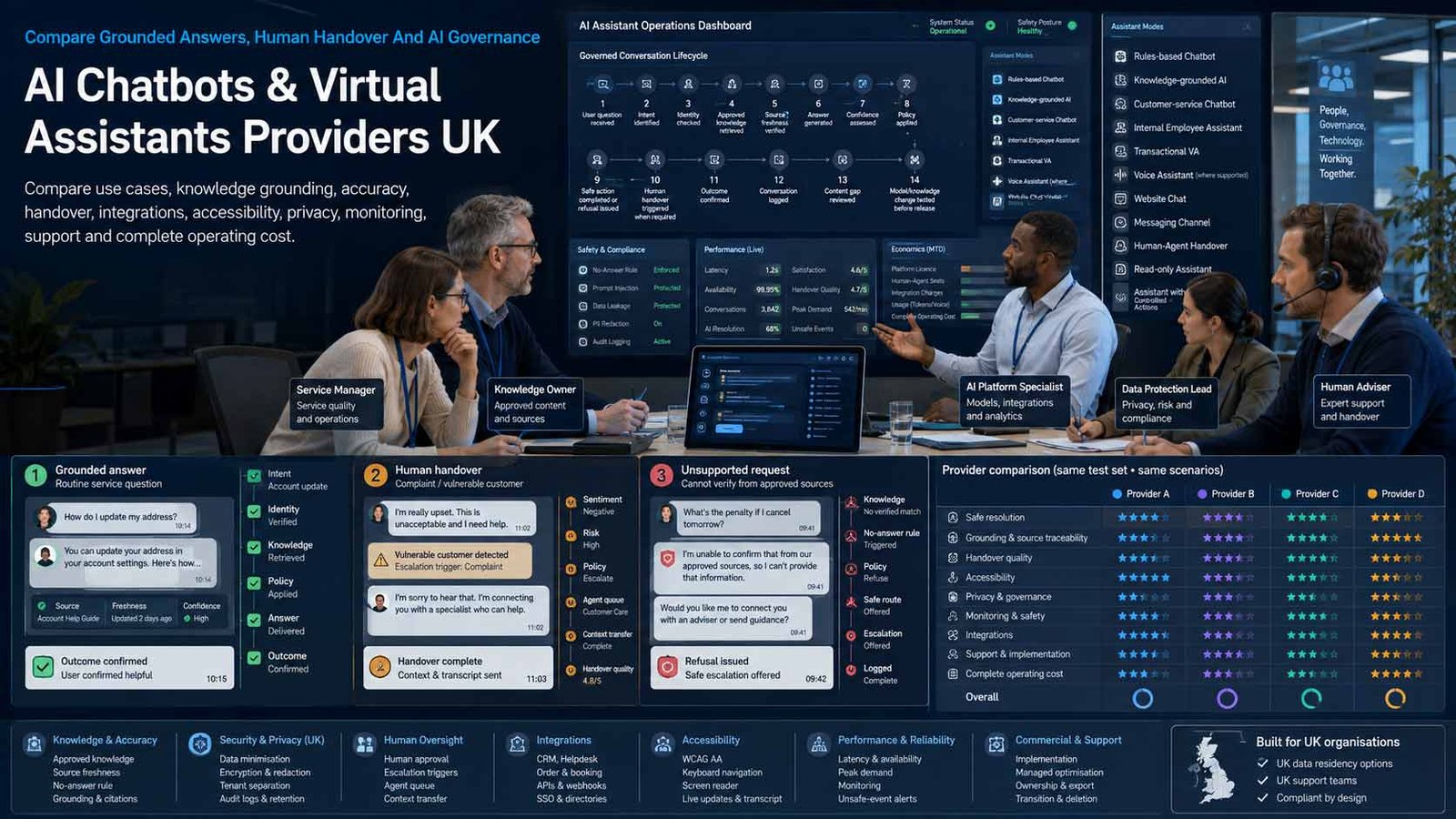
Buy A Controlled Conversation Service, Not A Demonstration Bot
A useful chatbot should answer approved questions accurately, complete clearly defined tasks, identify uncertainty, transfer safely to people and produce evidence that the business can monitor.
- Start with user intents, trusted knowledge and measurable outcomes
- Define what the assistant may answer, recommend or do
- Test failure, abuse, privacy, accessibility and human escalation
- Measure cost per safe resolution rather than messages generated
An AI chatbot or virtual assistant is a conversational interface that interprets written or spoken requests and responds using approved knowledge, rules, workflows or connected systems. A basic chatbot may answer frequently asked questions. A more capable AI agent may authenticate a user, retrieve account information, complete a transaction, create a case, schedule an appointment, update an order or hand a structured summary to a human adviser.
The right solution depends on the business outcome, user group, conversation volume, question complexity, approved knowledge, languages, channels, identity requirements, actions, risk, data sensitivity, human-service model, accessibility, operational ownership, evaluation capability and tolerance for incorrect or incomplete answers. A conversational demo is not production evidence; live service requires content ownership, guardrails, testing, monitoring, fallback and change control.
This page compares AI chatbots and virtual assistants as a specific conversational service. It does not compare general Business AI platforms or CRM software. Broader AI strategy, productivity copilots, analytics, content generation and customer-database selection use different requirements and belong on their dedicated service pages.
Choose The Right AI Chatbot And Virtual Assistant Model
Match the assistant to the conversation, action, risk, channel and internal operating capability.
| Assistant Model | What It Usually Includes | Best-Fit Question |
|---|---|---|
| Rule-Led FAQ Chatbot | Predefined intents, buttons, decision paths and approved responses for narrow, predictable questions. | Would deterministic answers be safer and cheaper than a generative agent? |
| Knowledge-Grounded Generative Chatbot | Natural-language answers retrieved from approved help content, policies, product information or documents. | How does the provider prove that answers remain grounded in the authorised sources? |
| Customer-Service AI Agent | End-to-end resolution across chat, email or messaging, including context, policy guidance, ticket creation and human handover. | Which enquiries are genuinely resolved, and which are merely deflected or closed? |
| Transactional Virtual Assistant | Authentication, information retrieval and approved actions such as booking, cancellation, status updates or form completion. | What authority, confirmation, rollback and audit evidence controls each action? |
| Voice AI Agent | Speech recognition, natural-language understanding, text-to-speech, telephony integration and transfer to human teams. | Can it handle accents, noise, interruption, accessibility, recording and urgent escalation reliably? |
| Internal Employee Or Service-Desk Assistant | Answers and guided actions for policies, IT help, facilities, onboarding, knowledge search and internal requests. | How are employee permissions, confidential sources and incorrect operational advice controlled? |
| Multilingual And Omnichannel Assistant | Consistent conversational service across languages, websites, applications, messaging, social, email or voice. | Are translations and outcomes tested per language and channel rather than assumed equivalent? |
| Managed Conversational AI Service | Platform, design, implementation, content, integration, testing, monitoring, optimisation and specialist support under one service. | What remains owned by the business, and can the service move to another provider without rebuilding? |
Eight Areas That Determine AI Chatbot Fit
Use the same conversations, knowledge, actions, handover, data and service targets for every provider.
Comparison Criterion
Use Cases, Outcomes And Conversation Scope
Define target intents, audiences, channels, service hours, excluded topics, actions, escalation and success measures before selecting technology. Separate information retrieval, triage, lead or appointment capture, account service and transaction completion. Avoid a universal assistant that is expected to answer every question.
Comparison Criterion
Knowledge Grounding And Content Governance
Compare supported sources, ingestion, permissions, retrieval, citation, versioning, freshness, conflict resolution, unpublished drafts, language variants and source removal. Require named content owners, approval, test sets and re-indexing controls. The assistant should know which source is authoritative and when not to answer.
Comparison Criterion
Accuracy, Guardrails And Evaluation
Assess factual accuracy, task completion, hallucination rate, confidence, refusal, unsupported-topic detection, policy constraints, prompt-injection defence, toxicity, bias, sensitive-content handling and regression testing. Use representative and adversarial conversations, not provider-selected examples, and monitor performance after every model or content change.
Comparison Criterion
Human Handover And Service Continuity
Review transfer triggers, customer choice, repeated-failure rules, urgency, vulnerability, complaint, cancellation and high-risk scenarios; queue availability; context and transcript transfer; agent summary; fallback outside staffed hours; and recovery when the model, integration or channel is unavailable.
Comparison Criterion
Actions, Integrations, Identity And Permissions
Compare APIs, connectors, webhooks, ticketing, booking, ecommerce, payments, order status and internal workflow actions. Confirm authentication, consent, step-up verification, least privilege, field restrictions, confirmation, transaction limits, duplicate prevention, idempotency, audit logs, error handling and rollback.
Comparison Criterion
Channels, Voice, Languages And Accessibility
Assess website, application, email, messaging, social and telephony deployment; speech quality; interruption; accents; latency; translation; right-to-left support; keyboard and screen-reader operation; text resizing; focus; dismissibility; error recovery; consistent human-help access; transcripts and alternative channels.
Comparison Criterion
Privacy, Consumer Transparency And Security
Review controller and processor roles, lawful use, data minimisation, notices, disclosure that the user is interacting with AI, conversation retention, model training, subprocessors, international transfers, redaction, encryption, tenant separation, secrets, prompt injection, data exfiltration, abuse, incident handling and secure end of life.
Comparison Criterion
Analytics, Operations, Support, Pricing And Exit
Compare resolution definition, containment, repeat contact, escalation, satisfaction, accuracy, latency, cost, unsafe-event and content-gap reporting; administrator roles; release control; support; service levels; usage pricing; model changes; implementation; ownership; full export; transition and deletion.
Measures To Define Before Deploying An AI Assistant
Translate automation claims into auditable resolution, accuracy, handover, accessibility, privacy and operational evidence.
| Measure | What It Should Define | Evidence To Request | Common Weakness |
|---|---|---|---|
| Safe resolution | Whether the user’s objective is completed correctly without unnecessary human contact or hidden risk | Intent, answer, action, policy compliance, confirmation, user outcome and repeat contact | A conversation is counted as resolved because no ticket was created |
| Grounding quality | Whether responses are supported by current approved knowledge | Source record, retrieval evidence, citation, freshness, conflict handling and no-answer rule | The assistant produces plausible wording without a traceable source |
| Accuracy and refusal | Whether the assistant answers correctly and declines when it should | Test set, scoring method, unsupported topics, hallucinations, refusals and regression history | The provider reports only overall accuracy and hides high-risk failures |
| Handover quality | Whether people receive the conversation at the right time with usable context | Trigger, user choice, queue, transcript, summary, identity, priority and fallback | The bot offers human help but sends the user back to the beginning |
| Action reliability | Whether connected tasks execute once, with authority and evidence | Authentication, permissions, validation, confirmation, idempotency, log, error and rollback | A successful message is shown before the downstream action is confirmed |
| Accessibility | Whether disabled users can find, operate, understand and exit the assistant | Keyboard, screen reader, focus, contrast, spacing, errors, transcripts and human alternative | The widget is technically visible but traps focus or obscures page content |
| Privacy and security | Whether conversation and connected data are protected throughout the lifecycle | Data map, notice, retention, model use, processors, access, encryption, testing and incident response | Customer prompts are reused for training without clear control |
| Consumer transparency | Whether users understand they are dealing with AI and its practical limits | Opening disclosure, capability description, material limitations, human route and complaint path | The assistant presents itself as a person or overstates its authority |
| Operational performance | Whether the assistant remains effective as content, users and models change | Volume, latency, failures, repeat contact, satisfaction, content gaps, drift and release log | Initial pilot results are treated as permanent performance |
| Portability and exit | Whether knowledge, flows, tests, analytics and records can move cleanly | Source export, prompts, flows, integrations, transcripts, evaluations, logs and deletion | The business owns content but not the configuration needed to reproduce the service |
AI Chatbot And Virtual Assistant Providers UK Businesses Can Consider
Shortlist providers whose conversation model, knowledge controls, actions, handover, channels, governance, implementation and commercial structure fit the use case. Confirm current written terms before award.
Provider Profile
Intercom Fin
Fin is Intercom’s AI customer agent for customer service and related customer-facing conversations. It can use support knowledge, operate across service channels, monitor performance and hand conversations to people. Include it where a growing business wants an AI agent closely connected to a modern support inbox and knowledge operation. Confirm the required Intercom components or external-platform option, successful-resolution definition, channel support, knowledge sources, actions, handover, AI disclosure, model and data controls, usage allowance, additional resolution cost, implementation, monitoring, support and full export.
Review official Intercom Fin informationProvider Profile
Zendesk AI Agents
Zendesk AI Agents automate customer-service enquiries across messaging, email and voice and can use trusted knowledge, multi-step workflows and connected systems. Include them where an organisation already uses Zendesk or wants AI agents within a broader service environment. Confirm plan and resolution allowance, channels, knowledge grounding, actions, language coverage, human routing, quality assurance, model architecture, customer-data handling, successful outcome definition, professional services, support, annual commitment, overage and portability.
Review official Zendesk AI Agents informationProvider Profile
Ada
Ada provides enterprise AI customer-service agents across chat, voice, email and messaging channels, with playbooks, knowledge, actions, handover and operational improvement capabilities. Include it where a larger organisation needs multilingual, omnichannel automation and structured agent operations. Confirm minimum scale, implementation, approved knowledge, action framework, authentication, voice, channel and language scope, testing, safety controls, human handover, analytics, data residency and transfers, subprocessors, service levels, pricing metric, managed expertise and exit artefacts.
Review official Ada platform informationProvider Profile
NiCE Cognigy
NiCE Cognigy provides enterprise conversational and generative AI agents for digital and voice customer service, including low-code design, integrations, contact-centre deployment and operational controls. Include it where complex conversations, telephony, multi-agent orchestration or enterprise integration are important. Confirm the exact platform components, deployment model, model choice, voice stack, contact-centre dependencies, languages, actions, authentication, human transfer, testing, AI operations, security certifications, partner implementation, licences, usage charges, support and configuration portability.
Review official NiCE Cognigy informationProvider Profile
boost.ai
Boost.ai provides a conversational AI platform for building and operating virtual agents, including customer-service and regulated-industry use cases. Include it where an organisation wants structured intent management, controlled generative capability, scalable self-service and the option to develop the assistant internally or through a partner. Confirm knowledge and intent approach, generative features, human handover, voice and channels, languages, integrations, administrator skills, testing, security, hosting, partner scope, analytics, implementation, licence and usage basis, support and export.
Review official boost.ai platform informationProvider Profile
Tidio Lyro
Lyro is Tidio’s AI customer-service agent designed for small and medium-sized businesses. It uses the business’s support content, can answer common enquiries, perform selected tasks and transfer unsupported questions to people or a connected support process. Include it where rapid website deployment, a combined live-chat environment and lower operational complexity are priorities. Confirm content ingestion, plan limits, conversation or resolution allowance, channels, ecommerce actions, human handover, languages, data use, training controls, branding, reporting, support, overage and suitability for sensitive or regulated conversations.
Review official Tidio Lyro informationProvider Profile
Microsoft Copilot Studio
Microsoft Copilot Studio is a low-code platform for building, connecting, publishing and governing conversational agents and agent flows across websites, Microsoft services and other channels. Include it where an organisation has Microsoft identity, data and workflow capability and wants a configurable assistant rather than an off-the-shelf service bot. Confirm licence and consumption model, environments, connectors, generative knowledge, model choice, data boundaries, identity, actions, voice, external channels, security, testing, analytics, maker governance, specialist implementation, support and the effort needed to maintain the agent.
Review official Microsoft Copilot Studio informationProvider Profile
Google Cloud Conversational Agents
Google Cloud Conversational Agents, including Dialogflow CX flows and generative playbooks, support text and voice virtual agents for websites, applications, devices and contact centres. Include them where a technical team or implementation partner needs detailed conversation control, multimodal service, telephony or complex integrations. Confirm the selected edition, region, model and data use, deterministic versus generative design, voice services, channels, authentication, contact-centre integration, logging, evaluation, security, consumption pricing, cloud architecture, implementation ownership and long-term operational skill.
Review official Google Cloud Conversational Agents informationWhat Changes AI Chatbot And Virtual Assistant Cost
Compare cost per safe, accepted resolution and the internal operating effort—not the lowest monthly subscription.
| Cost Driver | Why It Changes Spend | What A Comparable Quote Should Show |
|---|---|---|
| Platform and packaging | A chatbot may be included in a service suite, sold as a separate agent, licensed by environment or bundled with human-agent seats | Required products, minimum plan, environments, administrators, channels, features and dependencies |
| Conversation, resolution or outcome volume | Providers may charge per conversation, automated resolution, outcome, session or monthly allowance | Exact unit, qualifying outcome, abandoned sessions, repeat contact, disputes, included allowance and overage |
| Model, token and knowledge usage | Generative answers can incur input, output, retrieval, embedding or model-specific consumption | Models, token calculation, caching, context size, retrieval, tool calls, limits and price changes |
| Voice and telephony | Speech recognition, synthesis, call minutes, telephone numbers, carrier charges and contact-centre connections add cost | Inbound and outbound minutes, languages, voices, recording, transfer, carrier, latency and concurrency |
| Implementation and conversation design | Discovery, intent design, knowledge preparation, prompts, flows, policies, testing and launch governance require specialist work | Deliverables, sample size, content ownership, environments, acceptance, project rate and change control |
| Actions and integrations | Authentication, APIs, booking, order, payment, ticket and workflow connections add build, security and maintenance effort | Connector, custom code, middleware, credentials, transaction controls, monitoring and decommissioning |
| Content and ongoing optimisation | Knowledge changes, new intents, evaluation, transcript review, regression tests and service reporting create recurring work | Included content volume, monthly optimisation, test maintenance, specialist hours, reporting and backlog |
| Security, privacy and assurance | Higher-risk data, regulated sectors, penetration testing, private networking, regional processing and custom retention may affect package | Controls, regions, processors, testing, assurance, incident support and customer responsibilities |
| Support, availability and scale | Premium support, named success, uptime, latency, concurrency, peak capacity and 24-hour operations can change cost | Support level, service targets, limits, incidents, peak plan, service credits and disaster recovery |
| Contract, model change and exit | Minimum term, annual increases, provider model changes, proprietary flows and transition services affect lifecycle cost | Term, price review, model substitution, notice, full export, transition, deletion and post-exit access |
| Indicative Commercial Model | Typical Position | What Must Be Confirmed |
|---|---|---|
| Bundled Support Platform With AI Allowance | Human service software includes a defined quantity of AI resolutions or basic agent capability | Confirm required seats, allowance, resolution definition, overage, channels and optional AI modules |
| Per-Conversation Or Per-Resolution Model | Recurring cost scales with automated interactions or successfully completed outcomes | Model repeat contacts, transfers, short sessions, disputes, peak volume and failed resolutions |
| Consumption-Based Builder Platform | Charges combine messages, model tokens, requests, voice minutes, cloud services and connected components | Create low, expected and peak scenarios using real conversation length, actions, retrieval and channels |
| Enterprise Licence Plus Implementation | A platform agreement is combined with design, integration, governance, support and managed optimisation | Separate recurring licence, consumption, partner work, internal team, releases, service levels and exit |
Match The Assistant To The Conversation And Risk
The right shortlist depends on knowledge quality, task complexity, user vulnerability, channels, actions, data sensitivity and internal ownership.
Small Business With Repetitive Website Questions
Prioritise rapid setup, trusted website and help content, clear AI disclosure, simple live handover, low minimum commitment, predictable allowance, useful reporting and an easy way to correct answers. Avoid complex agentic actions before the knowledge base is reliable.
Growing Ecommerce Or Subscription Business
Prioritise order and account self-service, policy-grounded answers, authenticated actions, multilingual service, peak capacity, delivery and return workflows, human context transfer, repeat-contact measurement and commercial pricing tied to real outcomes.
Service Operation With Complex Journeys
Prioritise structured playbooks, integration, verification, transaction controls, complaints and vulnerable-user escalation, quality assurance, traceable knowledge, human oversight, operational dashboards and managed optimisation across chat, email or voice.
Enterprise Or Regulated Organisation
Prioritise model and data governance, private and role-based knowledge, robust evaluation, adversarial testing, regional processing, security assurance, audit logs, multi-language quality, contact-centre integration, formal service levels, change control and exit portability.
How To Compare AI Chatbot Proposals
Issue one requirements pack containing target users, channels, monthly and peak conversations, top intents, languages, approved knowledge, content owners, unsupported topics, user identity, actions, systems, human teams, staffed hours, escalation rules, complaints and vulnerable-user routes, personal data, model restrictions, retention, accessibility, service targets, analytics, implementation, internal skills, support and contract period. Require a scripted demonstration and measured test rather than a provider-prepared conversation.
- Every provider answers the same representative and adversarial questions
- Resolution, containment, transfer and failure are defined consistently
- Knowledge, actions, identity and human handover are demonstrated
- Privacy, consumer transparency, security and accessibility are evidenced
- Implementation, operations, support and model changes are explicit
- Three-year cost uses the same usage and growth assumptions
Compare The Same End-To-End Conversation
Ask each provider to answer a policy question, retrieve an account-specific fact, complete one approved action, reject one unsupported request, identify one complaint or vulnerable-user scenario, transfer to a person with context and show the audit and performance evidence.
A fluent answer is not a successful outcome when the source is wrong, the action fails, the user cannot reach a person or the business cannot explain what happened.
Six Questions To Put To Every AI Chatbot Provider
The answers expose inflated resolution claims, weak grounding, poor handover, unsafe actions, unclear data use and unpredictable consumption cost.
What Counts As A Successful Resolution?
Define completed user objective, correct answer, approved action, policy compliance, no avoidable repeat contact, no unsafe event and any exclusion from the billable resolution.
How Is Every Answer Grounded And Tested?
Ask for supported sources, retrieval evidence, citations, freshness, conflict handling, test sets, accuracy measures, hallucination review, regression, unsupported-topic rules and administrator approval.
When And How Does A Human Take Over?
Confirm user choice, repeated-failure, complaint, cancellation, vulnerability, urgency and high-risk triggers; queue hours; transcript and summary transfer; fallback; priority and service targets.
What Can The Assistant Do In Connected Systems?
List every read and write action, identity check, permission, confirmation, transaction limit, duplicate prevention, error response, rollback, audit log and customer remedy.
How Are Personal Data And AI Risks Controlled?
Request data flows, lawful purpose, disclosure, retention, model training rule, processors, locations, access, encryption, prompt-injection controls, abuse testing, incidents, monitoring and secure deletion.
How Will Pricing, Model Changes And Exit Work?
Obtain the complete licence, resolution, conversation, token, voice, integration, implementation, support and overage model; model-substitution rights; term; notice; export; transition and deletion.
A Seven-Stage AI Chatbot Provider Evaluation
Move from real conversations and controlled tests to measurable production evidence rather than choosing a provider from a fluent demonstration.
- Create a verified conversation baseline covering channels, volumes, peaks, languages, top intents, current answers, human handling time, repeat contacts, complaints, service failures, knowledge sources, systems, actions, personal data, accessibility needs and accountable owners.
- Define the operating boundary. Decide what the assistant may answer, retrieve, recommend or execute; which topics it must refuse; when it must authenticate; when it must hand over; which users or circumstances require special treatment; and which outcomes remain human-only.
- Prepare a prioritised requirement catalogue covering knowledge, conversation design, accuracy, guardrails, actions, identity, handover, channels, voice, languages, accessibility, privacy, consumer transparency, security, analytics, implementation, support, pricing and exit.
- Issue one supplier brief and evaluation set containing representative, ambiguous, adversarial, outdated, sensitive and out-of-scope conversations, plus one authenticated action, one integration failure, one human transfer and one high-volume scenario.
- Shortlist providers by exact use-case fit, evidence of safe resolution, knowledge governance, action control, human-service integration, accessibility, data and security controls, operational capability, service levels, commercial transparency and relevant references.
- Complete due diligence and a controlled pilot. Use approved content, test users, limited actions and measurable success criteria. Review wrong answers, unsafe outputs, missed handovers, identity failures, latency, accessibility, data flow, costs, operational workload and recovery.
- Launch through content ownership, approval, monitoring, transcript review, regression tests, support, incident response, human-team readiness and a change calendar. Review safe resolution, repeat contact, satisfaction, handover, accuracy, cost and provider fit before renewal.
AI Chatbots And Virtual Assistants Comparison Checklist
Use this table before appointing, launching or renewing an AI chatbot or virtual-assistant provider.
| No. | Requirement | Evidence To Obtain Before Award | Confirmed |
|---|---|---|---|
| 01 | Conversation and demand baseline complete | Channels, volumes, peaks, languages, intents, handling, repeat contacts, complaints, failures and owners | |
| 02 | Service boundary approved | Specific chatbot scope does not become a general Business AI or CRM comparison | |
| 03 | Permitted and prohibited use cases agreed | Answers, recommendations, actions, sensitive topics, refusals, human-only decisions and vulnerable users | |
| 04 | Knowledge governance proven | Sources, ownership, approvals, permissions, citations, freshness, conflicts, removal and re-indexing | |
| 05 | Evaluation set accepted | Representative, ambiguous, outdated, adversarial, multilingual, sensitive and out-of-scope conversations | |
| 06 | Accuracy and guardrails tested | Correctness, grounding, hallucination, refusal, policy, bias, toxicity, prompt injection and regression | |
| 07 | Human handover contracted | Triggers, user choice, queue hours, priority, transcript, summary, identity, fallback and service targets | |
| 08 | Actions and identity controlled | Authentication, permissions, confirmation, limits, duplicate prevention, logs, errors, rollback and remedy | |
| 09 | Channels, voice and language quality tested | Website, app, messaging, email, telephony, accents, interruption, latency, translation and channel consistency | |
| 10 | Accessibility and alternative support approved | Keyboard, screen reader, focus, text spacing, dismissibility, errors, transcript and human contact | |
| 11 | Privacy and consumer transparency complete | Notice, AI disclosure, purpose, minimisation, retention, training rule, processors, transfers and rights | |
| 12 | Security and resilience due diligence complete | Access, secrets, encryption, isolation, injection, exfiltration, abuse, incidents, availability and recovery | |
| 13 | Analytics and operational ownership agreed | Resolution, repeats, handover, satisfaction, accuracy, latency, content gaps, unsafe events and review cadence | |
| 14 | Three-year commercial model complete | Platform, seats, resolutions, conversations, tokens, voice, integrations, implementation, support and overage | |
| 15 | Contract, model change and exit controlled | Term, price review, model substitution, notice, knowledge, flows, tests, logs, export, transition and deletion |
Common AI Chatbot Buying Mistakes
Most avoidable problems begin with demo-led buying, weak content, misleading metrics, hidden human support or actions deployed before controls are ready.
| Mistake | Why It Creates Risk | Better Control |
|---|---|---|
| Starting with technology rather than conversations | The provider optimises a demo instead of solving real user needs | Build a verified intent and outcome baseline |
| Publishing unapproved website content as knowledge | Old, contradictory or marketing-led pages create confident wrong answers | Create authoritative content ownership |
| Using containment as the main success measure | Users can abandon, repeat contact or accept an incorrect answer without a human ticket | Measure safe resolution and repeat contact |
| Hiding the route to a person | Customers become trapped during complaints, vulnerability, urgency or unusual cases | Provide consistent human help and clear triggers |
| Allowing write actions before controls are mature | The assistant can create duplicate, unauthorised or irreversible transactions | Start read-only, then add controlled actions |
| Assuming every language performs equally | Translation quality, intent recognition, policy meaning and escalation can vary materially | Test and approve each important language |
| Treating a chatbot widget as automatically accessible | Focus, keyboard, screen-reader, text and dismissal failures can block disabled users | Complete assistive-technology testing |
| Sending unrestricted conversation data to models | Prompts can contain identifiers, account details, complaints or sensitive information | Minimise, redact and govern data flows |
| Ignoring prompt injection and malicious users | Attackers can attempt to reveal instructions, retrieve restricted data or trigger actions | Use layered controls and adversarial testing |
| Leaving evaluation and content export until exit | The business may lose prompts, flows, test sets, analytics and operational knowledge | Test full portability before signing |
Frequently Asked Questions
Answers to common questions from UK businesses comparing AI chatbots, virtual agents, voice assistants, implementation, safety and pricing.
What Is An AI Chatbot?
An AI chatbot is a conversational interface that interprets written or spoken questions and responds using approved knowledge, rules, workflows or connected systems. Capability ranges from answering frequently asked questions to authenticating users and completing controlled transactions.
What Is The Difference Between A Chatbot And A Virtual Assistant?
A chatbot often focuses on a defined conversation or support channel. A virtual assistant usually has broader context, can connect to business systems and may complete tasks across several steps or channels. Provider terminology varies, so buyers should compare actual authority and controls.
Can A Small UK Business Use An AI Chatbot?
Yes. Small businesses can use knowledge-grounded agents for common website, order, booking or service questions. The business should have accurate content, a clear human-support route, a proportionate budget, someone responsible for monitoring and limits on sensitive or high-risk conversations.
Can An AI Chatbot Replace Customer-Service Staff?
It can handle suitable repetitive questions and transactions, but it should not be assumed to replace every human interaction. Complaints, vulnerability, unusual circumstances, judgement, negotiation, empathy and high-risk decisions often require people. The handover model is a core buying criterion.
How Accurate Are AI Chatbots?
Accuracy varies by use case, knowledge quality, model, prompt, retrieval, language, integrations and testing. A fluent answer can still be wrong. Businesses should use representative test sets, track unsupported answers and repeat contacts, maintain approved sources and review performance after changes.
How Much Do AI Chatbots Cost In The UK?
Pricing can include platform licences, human-agent seats, AI resolutions, conversations, model tokens, voice minutes, integrations, implementation, managed optimisation and support. Compare low, expected and peak usage using a common definition of successful resolution.
Do Businesses Need To Tell Users They Are Speaking To AI?
Clear disclosure is prudent and may be necessary to meet transparency, consumer and data-protection expectations depending on the use. Users should understand that the assistant is automated, what it can do, material limitations and how to reach a person or make a complaint.
What Personal-Data Risks Do AI Chatbots Create?
Conversations can contain identity, account, complaint, health, financial or other sensitive information. Risks include excessive collection, unclear model use, long retention, international transfers, unauthorised access, prompt injection, data leakage and decisions made without adequate human review.
How Should A Business Test Chatbot Accessibility?
Test keyboard operation, focus order, screen readers, text resizing and spacing, contrast, error messages, live updates, dismissal, transcripts, language clarity and a consistent route to human help. Include disabled users and assistive technologies in acceptance testing.
How Should UK Businesses Compare AI Chatbot Providers?
Give every provider the same conversations, knowledge sources, actions, handover rules, channels, languages, data restrictions, accessibility tests, service targets and usage assumptions. Compare safe resolution, repeat contact, governance, operational workload and three-year cost—not conversational fluency alone.
Official Guidance And Provider Resources
Reviewed by Bhav Giva, Founder & Lead Analyst at CompareServices.co.uk, on 1 August 2026.
Use current ICO, CMA, NCSC, W3C and provider documentation to verify data protection, consumer transparency, AI governance, security, accessibility, model use, channels, performance, pricing and contract terms. AI products, models, capabilities, subprocessors and commercial units change frequently. Obtain legal, data-protection, cybersecurity, accessibility, consumer-law or sector advice where required.
- ICO — Artificial Intelligence And Data Protection
- ICO — Transparency In AI
- ICO — AI Accuracy And Statistical Accuracy
- CMA — Complying With Consumer Law When Using AI Agents
- NCSC — Guidelines For Secure AI System Development
- W3C — WCAG 2.2 Consistent Help
- Intercom — Fin AI Agent
- Zendesk — AI Agents
- Ada — AI Customer-Service Platform
- NiCE Cognigy — Conversational AI Agents
- boost.ai — Conversational AI Platform
- Tidio — Lyro AI Agent
- Microsoft — Copilot Studio
- Google Cloud — Conversational Agents