
Compare Tax Loans / VAT Finance Providers UK (2026)
Compare VAT And Tax Funding, HMRC Payment Routes, Terms, Rates, Fees, Security, Guarantees And Total Repayment Cost
Use this tax loans business UK comparison to assess providers by VAT, Corporation Tax and other verified HMRC funding; lender and broker identity; application evidence; direct-to-HMRC payment; decision and transfer timing; repayment term; interest or fixed fees; total repayable; personal guarantees; debentures; arrears treatment; early settlement; account reconciliation and future-tax affordability. Give every provider the same confirmed liability, due date and cash-flow forecast before comparing speed or one monthly rate.
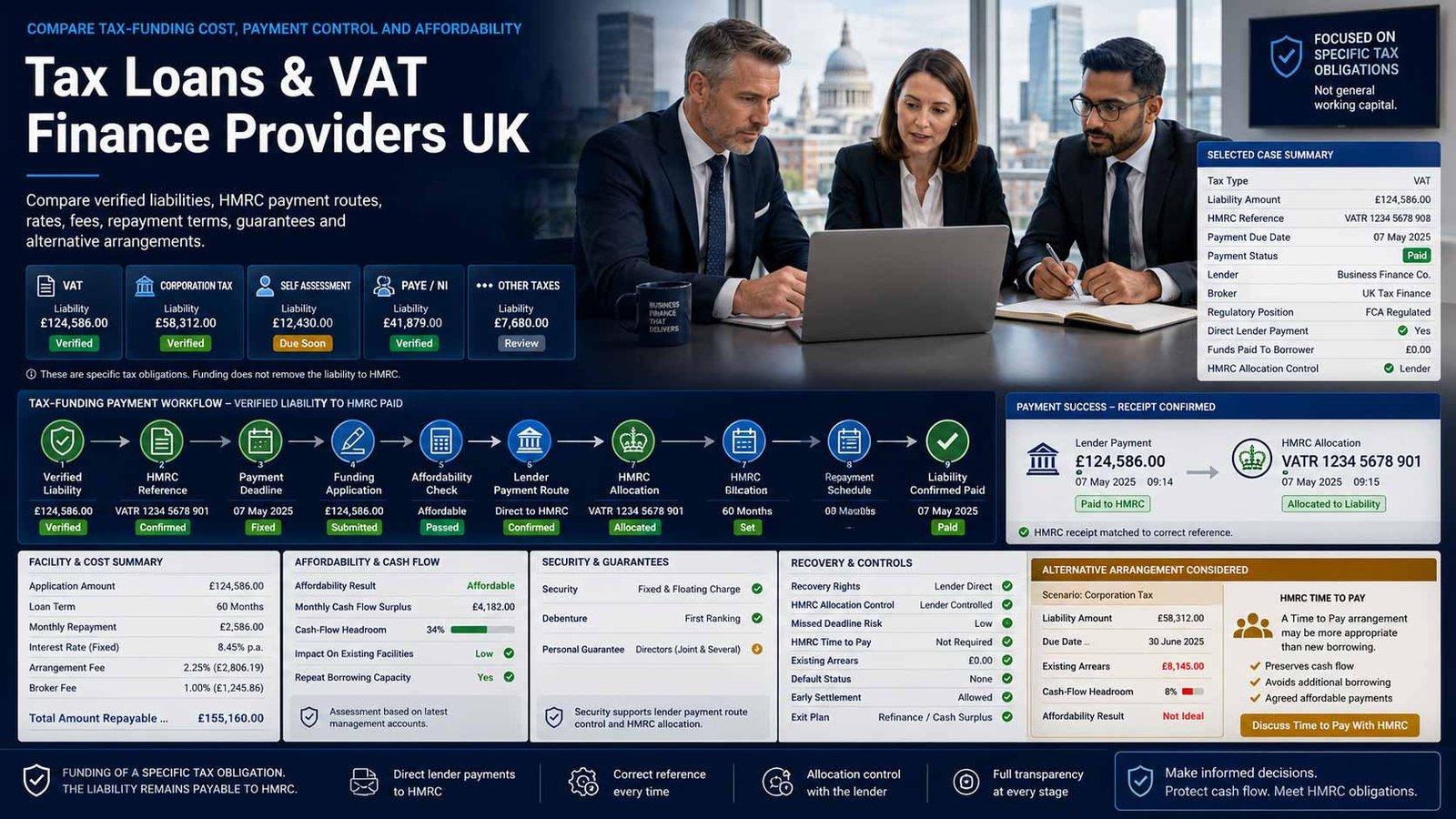
Fund A Verified Tax Liability, Not A General Cash Gap
The tax type, legal taxpayer, amount, deadline and HMRC reference should remain identifiable from application through final reconciliation.
- Start with filed or adviser-verified evidence
- Compare commercial finance with HMRC options
- Confirm who pays HMRC and when
- Protect capacity for the next tax period
Tax loans and VAT finance provide short-term funding for a defined business tax liability that must be paid to HMRC. The lender assesses the business, advances the approved amount or pays HMRC directly, then collects principal and finance charges over an agreed schedule.
The product can help a viable business manage a temporary timing mismatch, but it does not reduce the tax owed, replace an accurate return or guarantee that HMRC will suspend interest, penalties or collection. A business with arrears should map its complete HMRC position and consider a Time to Pay discussion where appropriate before adding new commercial debt.
This page compares purpose-specific tax and VAT finance only. It does not compare general unsecured business loans used for payroll, stock, marketing, expansion or unrestricted working capital. Those facilities have a broader use case and a separate service boundary.
Choose The Right Tax-Funding Structure
Liability type, HMRC status, payment route, borrower structure and expected repayment source change the appropriate facility.
| Finance Structure | What It Usually Provides | Best-Fit Question |
|---|---|---|
| Quarterly VAT loan | A short-term facility funds a known VAT liability so the business can pay HMRC by the due date and repay the lender over an agreed schedule. Some lenders remit the approved amount directly to HMRC, while others release funds to the business with evidence-of-payment conditions. | Does the repayment schedule fit the next trading cycle without creating a second cash-flow shortage before the following VAT quarter? |
| Corporation Tax finance | A limited company spreads an identified Corporation Tax payment over monthly instalments rather than using one large cash outflow. The lender normally assesses the filed or forecast liability, recent accounts, bank conduct, profitability, existing debt and ability to repay after the tax is settled. | Is the tax figure sufficiently final, and can the company service the loan after dividends, PAYE, VAT and normal operating commitments? |
| PAYE and National Insurance funding | Short-duration finance supports a defined employer PAYE and National Insurance payment when payroll timing, customer receipts or seasonal trading create a temporary mismatch. Providers may apply tighter terms where the business already has arrears or persistent cash-flow stress. | Is the liability current and affordable, or does repeated reliance on finance indicate a deeper payroll-cost or working-capital problem? |
| Combined business-tax facility | One facility covers several verified HMRC liabilities, such as VAT, Corporation Tax and employer taxes, under a single repayment schedule. This can simplify administration but must not obscure which liability is being paid, each statutory deadline or the cost allocated to each tax bill. | Can the business reconcile every funded liability and avoid refinancing old tax debt into a longer and more expensive obligation? |
| Direct-to-HMRC tax finance | The lender pays HMRC directly after validating the tax reference, amount and deadline. Direct remittance can reduce misuse risk and provide payment evidence, although the borrower must still confirm the credit reaches the correct HMRC account and period. | Which HMRC reference will the lender use, when will payment clear and who resolves an allocation error or rejected transfer? |
| Tax-arrears or catch-up funding | A specialist lender or broker may consider finance where a business has an agreed arrears position, subject to affordability, HMRC engagement and evidence that future liabilities can be met. Approval is usually more difficult and may require additional security, guarantees or restructuring. | Is new borrowing genuinely sustainable after arrears, late-payment interest, current taxes and future instalments are all included? |
| Commercial-property VAT bridge | A short bridge funds VAT due on a qualifying commercial property transaction where the business expects an eligible VAT reclaim. The exit normally depends on a correctly submitted return and timely HMRC repayment, so tax, legal and property evidence must be coordinated. | Has an adviser verified recoverability, timing, partial-exemption risk and the fallback repayment route if the VAT reclaim is delayed or reduced? |
| Broker-panel tax finance | A credit broker or finance marketplace compares specialist tax-loan and short-term funding options from a lender panel. This can widen access, but the broker is not necessarily the lender and may receive commission from the selected provider. | Are the broker, lender, payment route, commission, security and complete repayment terms clearly separated before the application proceeds? |
Eight Areas That Determine Tax-Finance Fit
Use the same confirmed liability, due date, borrower evidence and cash-flow assumptions for every quote so cost and security differences are genuinely comparable.
Comparison Criterion
Verified Tax Liability, Reference And Deadline
Start with the filed return, HMRC statement, calculation or accountant-confirmed liability. Record the tax type, accounting period, legal taxpayer, payment reference, exact due date and whether the amount is final, estimated, disputed or already overdue. Finance should solve a defined timing requirement, not replace accurate tax reporting or fund an unverified estimate.
Comparison Criterion
Lender, Broker And Regulatory Position
Identify the legal lender, any broker or introducer, the firm receiving an application and the entity paying HMRC. Much limited-company business lending sits outside consumer-credit regulation, while lending to sole traders or small partnerships can fall within a regulated perimeter. Check applicable FCA permissions, disclosures, complaints routes and broker status for the exact borrower and agreement.
Comparison Criterion
Payment Route And HMRC Allocation Control
Confirm whether funds go directly to HMRC or to the business, the payment method, settlement time, reference validation and evidence supplied. A funded tax bill is not complete until the payment appears against the correct HMRC account and period. Require a process for rejected, duplicated or misallocated payments and keep the lender confirmation with the tax records.
Comparison Criterion
Loan Amount, Term And Repayment Profile
Compare the funded liability, deposit or contribution, drawdown date, first payment, monthly or weekly schedule, final payment and any balloon. Tax finance is normally short term because the liability does not create a productive asset. The repayment period should match conservative cash receipts and finish before the next major tax bill creates overlapping debt.
Comparison Criterion
Rate, Fees And Complete Repayment Cost
Request the interest rate or fixed fee, whether interest is calculated on the original or reducing balance, arrangement and broker fees, documentation costs, transfer fees, default interest, missed-payment charges and total amount repayable. A low monthly rate can still be expensive over a short term when fixed charges and broker economics are included.
Comparison Criterion
Affordability, Cash Flow And Repeat-Use Risk
Stress-test repayments after payroll, suppliers, rent, existing debt, drawings and future taxes. Use a rolling cash-flow forecast that includes the next VAT quarter, Corporation Tax period and PAYE dates. Repeated tax borrowing can signal underpricing, weak collection, excessive drawings or insufficient tax reserves rather than a one-off timing mismatch.
Comparison Criterion
Security, Guarantees And Recovery Rights
Confirm whether the facility is unsecured, supported by a personal or corporate guarantee, secured by a debenture, property, deposit or other assets, or subject to set-off and cross-default. Review enforcement, default, guarantor liability, information duties and whether missed payments can affect unrelated finance. Tax purpose does not make the debt lower risk.
Comparison Criterion
HMRC Time To Pay, Arrears And Exit Planning
Compare commercial finance with an HMRC Time to Pay discussion where appropriate. A lender cannot guarantee HMRC treatment, stop enforcement or erase penalties already due. Where arrears exist, require a complete schedule covering current tax, arrears, interest, lender repayments and future liabilities, plus an exit plan that does not depend on another loan.
Measures To Define Before A Tax-Finance Agreement Is Signed
Translate fast approval and manageable instalments into auditable HMRC payment, complete cost, affordability and exit evidence.
| Measure | What It Should Define | Evidence To Request | Common Weakness |
|---|---|---|---|
| Verified liability coverage | The proportion of the confirmed tax bill funded by the facility | Tax return or statement, liability, borrower contribution, financed amount, payment reference and due date | The business borrows against an estimate that later changes |
| On-time HMRC payment | Whether cleared funds reach the correct HMRC account by the statutory or agreed deadline | Lender release date, bank cut-off, HMRC reference, payment confirmation, allocation date and exception process | Approval is mistaken for completed tax payment |
| Total repayment cost | Every amount payable to lender, broker and related parties over the facility term | Principal, interest, fixed fee, arrangement, commission, transfer, default, legal and early-settlement costs | A monthly rate is compared without fixed charges or total repayable |
| Debt-service coverage | The headroom between conservative operating cash flow and scheduled tax-loan repayments | Cash receipts, essential expenditure, tax accruals, existing debt, drawings, payment schedule and downside case | Repayments are tested before the next tax liability and seasonal low point |
| Next-liability headroom | Cash available for the next major tax payment after servicing the current facility | Rolling 12-month forecast, VAT dates, PAYE, Corporation Tax, loan payments and minimum cash balance | The loan solves one quarter but creates a larger shortage in the next |
| Funding completion time | The elapsed time from complete application to cleared HMRC payment | Document-complete timestamp, credit approval, agreement, conditions, drawdown, transfer and allocation | Marketing approval time excludes verification, documents and bank transfer |
| Security exposure | The total value and people exposed beyond the funded tax amount | Guarantee cap, debenture, property charge, set-off, cross-default, indemnity and enforcement rights | The director assumes a purpose-specific loan has no personal or wider security |
| Arrears resolution | Whether overdue tax, interest, penalties and current liabilities are addressed in one sustainable plan | HMRC statement, Time to Pay status, arrears, current tax, lender facility, future forecast and adviser review | New finance pays one item while other HMRC debt continues to increase |
| Early-settlement outcome | The amount saved or charged if the facility is repaid before maturity | Outstanding principal, interest rebate, fixed minimum charge, notice, administration fee and settlement date | The borrower assumes unused future interest will always be removed |
| Tax-account reconciliation | Whether the financed payment is correctly recorded and supported after completion | HMRC account, payment reference, receipt, lender statement, ledger entry, tax adviser confirmation and retention | The lender says payment was sent but the business never verifies allocation |
Tax-Loan And VAT-Finance Providers UK Businesses Can Consider
Shortlist lenders and finance platforms whose liability scope, payment process, underwriting, pricing and service fit the business. Confirm the actual lender, live credit decision and full agreement before commitment.
Provider Profile
White Oak UK
White Oak UK provides specialist SME finance and publishes dedicated VAT-loan and business-tax-loan options. Include it where a company wants a purpose-led facility designed around a known HMRC payment rather than an open-ended general loan. Confirm the White Oak contracting entity, borrower eligibility, minimum and maximum amount, liability evidence, whether payment is made directly to HMRC, term, fixed or variable pricing, arrangement fee, personal or corporate guarantee, debenture or other security, early repayment, default terms, broker involvement and the process for correcting an HMRC reference or allocation issue.
Review official White Oak VAT loansProvider Profile
Fleximize
Fleximize publishes VAT and tax finance for established UK SMEs, delivered through its business-loan products with short and longer repayment options subject to credit assessment. Include it where speed, reducing-balance interest and flexible repayment features are important. Confirm the exact Fleximize product, amount, trading-history requirement, rate offered, whether the quoted monthly rate is comparable with other proposals, total repayable, term, direct-to-HMRC or business-account payment route, security or personal guarantee, repayment holiday conditions, top-up interaction, early repayment calculation and whether the facility remains suitable before the next tax deadline.
Review official Fleximize VAT and tax financeProvider Profile
iwoca
iwoca explains tax loans and VAT loans as short-term business funding that can spread a known liability while preserving working capital. Include it where a small business values an online application, revolving or term-style flexibility and fast access subject to underwriting. Confirm the legal lender, available facility structure, drawdown mechanics, amount, fee or interest basis, term, repayment frequency, personal guarantee where applicable, whether funds are restricted to the tax purpose, payment evidence, early settlement, repeated-draw risk and how an existing iwoca balance affects affordability and the next tax period.
Review official iwoca tax-loan guidanceProvider Profile
VAT Loans Limited
VAT Loans Limited specialises in finance for VAT payments and states that the funded amount is paid to HMRC, followed by scheduled business repayments. Include it where a borrower wants a narrow VAT-specific process and direct remittance rather than a general-purpose credit line. Confirm the lending and servicing legal entities, regulatory status for the borrower type, loan amount, VAT-return evidence, HMRC payment reference, decision and transfer timetable, repayment count, rate and fees, guarantees, security, late-payment treatment, early settlement, complaint route and what happens if HMRC changes the liability or rejects the payment allocation.
Review official VAT Loans LimitedProvider Profile
Bluestone
Bluestone publishes VAT-loan finance in which the lender can settle an eligible VAT bill and the business repays over an agreed period. Include it where a company wants a specialist finance team and a structured repayment plan linked to the quarterly liability. Confirm whether Bluestone is the lender, broker or arranger for the quoted facility; the named funding entity; borrower and amount criteria; fixed rate; term; direct payment; arrangement and documentation fees; personal guarantee or security; credit searches; early settlement; missed-payment terms and any commission or panel relationship.
Review official Bluestone VAT loansProvider Profile
Funding Options by Tide
Funding Options, part of Tide, operates as a credit broker rather than a direct lender and publishes a route for VAT and tax finance through its lender panel. Include it where a business wants one application considered across several possible funders. Confirm the broker entity and permissions, lender panel search, selected lender, commission, exclusivity, credit-search process, amount, rate, fees, security, personal guarantee, payment route, timescale, data sharing, complaint responsibility and whether the recommended product is a genuine purpose-specific tax facility or a general business loan.
Review official Funding Options VAT financeProvider Profile
Funding Circle Marketplace
Funding Circle provides a VAT-finance marketplace route that can introduce eligible businesses to a panel of specialist lenders when an alternative product may fit. Include it where a company wants support comparing more than one possible tax-funding structure. Confirm whether Funding Circle or another lender provides the final finance, the selected lender and agreement, broker disclosures, commission, credit searches, eligibility, total repayable, term, direct HMRC payment, security, personal guarantee, early repayment and the division of support and complaints between marketplace and lender.
Review official Funding Circle VAT marketplaceProvider Profile
Swoop Funding
Swoop Funding is a finance platform and broker that publishes VAT-loan guidance and can search lender options for eligible UK businesses. Include it where a buyer wants broker-led market access and help packaging a tax-finance application. Confirm that Swoop is not automatically the lender, identify the final funding entity, FCA and broker disclosures where applicable, commission, panel coverage, amount, rate, fixed fees, repayment term, HMRC payment route, guarantees, security, credit searches, information sharing, early settlement and whether an HMRC Time to Pay discussion should be considered before commercial borrowing.
Review official Swoop VAT-loan guidanceWhat Changes Tax-Loan And VAT-Finance Cost
Pricing depends on liability, urgency, borrower strength, HMRC conduct, term, security and provider structure. Compare complete repayment cost rather than one monthly rate.
| Cost Driver | Why It Changes Spend | What A Comparable Quote Should Show |
|---|---|---|
| Confirmed tax amount and deadline | Lenders price and size finance against the verified liability, urgency and evidence quality | Tax type, return or statement, accounting period, amount, payment reference, due date and whether overdue |
| Borrower legal form and trading history | Limited companies, sole traders and partnerships can face different underwriting and regulatory treatment | Legal entity, ownership, trading period, accounts, management information, bank statements and director details |
| Credit profile and HMRC conduct | Existing arrears, missed payments, judgments, insolvency indicators and weak bank conduct can increase cost or prevent approval | Business and director credit searches, HMRC status, Time to Pay, arrears, defaults and explanations |
| Facility term and repayment frequency | Longer terms reduce each instalment but increase cost and can overlap future tax dates | Drawdown, first payment, monthly or weekly dates, maturity, final payment and next tax deadlines |
| Interest calculation or fixed fee | Reducing-balance interest, flat monthly rates and fixed-fee structures are not directly comparable | Annual or monthly rate, calculation basis, principal schedule, fixed fee, examples and total repayable |
| Arrangement, broker and transfer fees | Fixed charges can materially change the effective cost of a short facility | Lender arrangement, broker commission, documentation, legal, transfer, servicing and VAT treatment of fees |
| Personal guarantee and security | Additional recovery support can affect approval, amount and price but increases director or asset exposure | Guarantee amount, debenture, property or asset charge, set-off, indemnity, cross-default and release |
| Direct HMRC payment and urgency | Same-day or direct-remittance processes can require additional verification and operational work | Payment route, cut-off, reference validation, transfer fee, evidence, allocation and exception handling |
| Arrears and Time to Pay position | Overdue liabilities and enforcement risk usually require more assessment than an upcoming current bill | HMRC correspondence, penalties, interest, arrangement status, current compliance and full debt schedule |
| Early repayment and refinancing | Some products reduce future interest while others retain minimum fixed charges | Settlement formula, rebate, minimum interest, administration fee, notice and repeat-borrowing restrictions |
| Cash-flow volatility and affordability | Seasonality, customer concentration, delayed invoices and thin headroom change default risk | Rolling forecast, sensitivity, bank transactions, debt service, drawings, tax accrual and minimum cash |
| Broker panel and lender economics | A broker can improve access but commission and panel limits can influence recommendations | Broker status, lenders searched, commission, exclusivity, alternative quotes and selected lender rationale |
How Liability Type And Cash Flow Change The Shortlist
The right provider depends on tax type, due date, legal entity, arrears, affordability, security, repayment source and the next statutory payment cycle.
VAT-Registered Seasonal SME
Prioritise verified VAT-return funding, a repayment schedule aligned to seasonal receipts, direct HMRC payment where useful, low fixed fees, early-settlement clarity and enough headroom to accrue the next quarterly liability without overlapping debt.
Profitable Company With A Corporation Tax Peak
Prioritise a final tax computation, monthly affordability after dividends and other taxes, a term that finishes before the next annual liability, transparent total repayable, limited security and the ability to settle early when retained cash becomes available.
Employer Facing A Temporary PAYE Timing Gap
Prioritise rapid evidence-led underwriting, a current rather than recurring shortfall, repayment aligned to customer receipts, no dependence on future tax borrowing and a parallel review of payroll cost, debtor collection and tax-reserve controls.
Commercial Property Buyer Funding Recoverable VAT
Prioritise specialist tax and legal confirmation, direct completion-payment coordination, evidence that VAT is recoverable, a realistic reclaim timetable, interest retained for delay, fallback exit, property security and clear interaction with the commercial mortgage or bridge.
How To Compare Tax-Finance Quotes
Give every provider the same legal taxpayer, tax type, confirmed amount, HMRC reference, due date, financial evidence, current debt, arrears position and rolling cash-flow forecast. Require a standardised total-repayment schedule.
- The lender, broker and payment roles are identified
- The funded tax amount and borrower contribution are separated
- Every repayment and fee is dated
- HMRC payment and allocation evidence are defined
- Security and guarantees are fully mapped
- The next tax liability remains affordable
Price The Same Liability On The Same Dates
Use the same confirmed HMRC bill, drawdown date, repayment term and cash-flow scenario.
Compare the amount reaching HMRC, complete repayment cost and future-tax headroom before comparing speed.
Six Questions To Put To Every Tax-Finance Provider
The answers expose unverified liabilities, hidden lender relationships, incomplete pricing, payment risk and repeat-borrowing dependence.
Which Tax Liability Is The Facility Paying?
Request the tax type, taxpayer, accounting period, confirmed amount, HMRC reference, due date and evidence that the liability is final or appropriately verified.
Who Is The Lender And Who Is The Broker?
Identify every legal entity, applicable FCA status, commission, credit-search role, payment provider, complaint route and party responsible after drawdown.
How And When Will HMRC Receive The Money?
Confirm direct or indirect payment, bank cut-off, reference checking, clearance time, receipt evidence and the procedure for a rejected or misallocated payment.
What Is The Complete Repayment Cost?
Ask for principal, rate or fixed fee, calculation method, arrangement, broker, transfer, default and settlement charges plus every dated payment and total repayable.
What Security And Personal Liability Apply?
Review personal guarantees, corporate guarantees, debentures, property or asset charges, set-off, cross-default, indemnities and enforcement rights.
What Prevents The Same Problem Next Quarter?
Require a forecast that includes future VAT, PAYE and Corporation Tax, current loan instalments, tax-reserve contributions, downside trading and the agreed exit from repeated borrowing.
A Seven-Stage Tax-Finance Evaluation
Move from verified HMRC evidence and route comparison to completed payment, sustainable repayment and a controlled future-tax reserve.
- Confirm the legal taxpayer, tax type, accounting period, filed return or calculation, exact liability, HMRC reference, due date, current arrears and responsible finance owner.
- Compare internal cash, an HMRC Time to Pay discussion where appropriate and commercial tax finance without assuming that borrowing is automatically the cheapest or safest route.
- Prepare accurate lender evidence including accounts, management information, bank statements, cash-flow forecast, tax returns, HMRC statements, existing debt, ownership and director information.
- Issue one comparison brief requiring the lender and broker identities, financed liability, payment route, decision conditions, repayment schedule, rate basis, fees, security and total repayable.
- Normalise every proposal into dated cash flows and stress-test lower receipts, delayed customers, future tax dates, current debt, arrears, personal guarantees and early settlement.
- Complete credit, legal, tax and authority review before signing; verify HMRC references, agreement parties, bank details, direct-payment instructions, guarantees and all drawdown conditions.
- Manage the live facility through HMRC-account reconciliation, lender statements, repayment monitoring, future tax accruals, covenant and security review, early-warning triggers and documented closure.
Tax Loans And VAT Finance Comparison Checklist
Use this table before approving a VAT loan, Corporation Tax facility, broker-led tax-finance proposal, arrears refinance or commercial-property VAT bridge.
| No. | Requirement | Evidence To Obtain Before Award | Confirmed |
|---|---|---|---|
| 01 | Tax liability and accountable owner agreed | Tax type, legal taxpayer, accounting period, amount, due date, finance owner, adviser and approver | |
| 02 | HMRC evidence obtained | Filed return, calculation, statement, reference, correspondence, arrears, interest, penalties and payment status | |
| 03 | Alternatives considered | Internal cash, tax reserve, HMRC Time to Pay discussion, collection action and adviser recommendation | |
| 04 | Borrower legal and regulatory position checked | Company, sole trader or partnership status, lender, broker, FCA permissions, disclosures and complaints route | |
| 05 | Application evidence completed | Accounts, management information, bank statements, forecast, ownership, IDs, existing debt and credit explanations | |
| 06 | Financed amount and contribution confirmed | Liability, borrower contribution, principal, retained fees, net payment and any unfunded balance | |
| 07 | HMRC payment route approved | Direct or business-account payment, bank details, reference, cut-off, clearance, receipt and allocation exception | |
| 08 | Repayment schedule accepted | Drawdown, first payment, frequency, term, maturity, final payment and dates of future tax liabilities | |
| 09 | Rate and total cost normalised | Interest or fixed fee, calculation basis, arrangement, broker, transfer, legal, default and total repayable | |
| 10 | Security and guarantees approved | Personal guarantee, corporate guarantee, debenture, charge, set-off, cross-default, cap and release | |
| 11 | Affordability stress test passed | Base and downside cash flow, payroll, suppliers, existing debt, drawings, tax accrual, minimum cash and repayments | |
| 12 | Arrears and Time to Pay position documented | Current compliance, HMRC arrangement, arrears schedule, enforcement correspondence and lender awareness | |
| 13 | Early settlement and repeat borrowing reviewed | Settlement formula, rebate, minimum charge, top-up, refinance, new search and future eligibility | |
| 14 | HMRC reconciliation process agreed | Payment confirmation, online tax account, ledger, adviser check, lender statement and record retention | |
| 15 | Future tax-reserve and exit plan agreed | Monthly reserve, next VAT, PAYE and Corporation Tax dates, trigger levels, escalation and facility closure evidence |
Common Tax-Finance Buying Mistakes
Most avoidable problems begin with an unverified bill, hidden lender relationship, incomplete cost, missed HMRC allocation or no plan for the next liability.
| Mistake | Why It Creates Risk | Better Control |
|---|---|---|
| Borrowing against an estimated bill | The final liability can be lower or higher, leaving surplus debt or an unfunded tax balance | Use filed or adviser-verified evidence |
| Treating approval as tax payment | HMRC may not receive or allocate funds before the deadline | Verify cleared payment and reference |
| Comparing only a monthly rate | Fixed fees and short terms can create a much higher effective cost | Compare every payment and total repayable |
| Ignoring the next tax period | Repayments can overlap the next VAT or PAYE bill | Use a rolling 12-month forecast |
| Not identifying the actual lender | A broker or brand may not provide or service the finance | Map lender, broker and payment roles |
| Assuming tax loans are always regulated | Business-lending protections depend on borrower and agreement | Check the exact regulatory perimeter |
| Using new debt without fixing tax reserves | The same liquidity gap returns and debt accumulates | Create a recurring tax-reserve policy |
| Accepting an unlimited personal guarantee | A short tax facility can expose substantial personal assets | Review caps, enforcement and release |
| Financing arrears without HMRC engagement | Penalties, interest or enforcement can continue outside the funded item | Document the complete HMRC position |
| Failing to reconcile the HMRC account | A payment error can remain unnoticed until collection action or the next return | Retain evidence and verify allocation |
Frequently Asked Questions
Answers to common questions from UK businesses comparing VAT loans, Corporation Tax finance, direct-to-HMRC funding and broker-led tax finance.
What Is A Tax Loan For A Business?
A business tax loan is short-term finance used to pay a defined HMRC liability, such as VAT, Corporation Tax or employer taxes. The business repays the lender with interest or fees over an agreed period. It does not change the underlying tax liability or reporting obligation.
How Does A VAT Loan Work?
The business supplies evidence of its VAT bill and applies for finance. If approved, the lender may pay HMRC directly or release funds subject to payment conditions. The business then repays the principal and agreed finance cost over a short term, often before later VAT liabilities fall due.
Can A Tax-Loan Provider Pay HMRC Directly?
Some providers pay HMRC directly after checking the liability and payment reference. Others transfer funds to the business. In either case, the business should confirm that cleared funds reach the correct HMRC account and accounting period and retain the payment evidence.
Is A Tax Loan The Same As HMRC Time To Pay?
No. A tax loan is commercial borrowing from a lender. Time to Pay is an arrangement agreed directly with HMRC to spread an existing liability. Eligibility, cost, disclosure, security and consequences differ, so businesses should consider the available routes with appropriate tax and finance advice.
How Much Does Tax And VAT Finance Cost?
Cost depends on the amount, term, credit profile, trading history, urgency, arrears, security, guarantees and provider. Charges can include interest or a fixed fee, arrangement and broker fees, transfer costs and default charges. Compare every dated payment and the total repayable.
Can A Business Get Finance For Tax Arrears?
Some specialist lenders or brokers may consider a business with tax arrears, but approval is generally harder and can require stronger evidence, security or guarantees. The business must include current taxes, arrears, HMRC interest, lender repayments and future liabilities in one affordable plan.
Does A Tax Loan Require A Personal Guarantee?
It may. Many SME lenders request a director personal guarantee, especially for limited-company borrowing without other security. The guarantee amount, continuing liability, enforcement, independent advice and release conditions should be reviewed before signing.
Are Business Tax Loans Regulated By The FCA?
Not all are. Lending to many limited companies is outside consumer-credit regulation, while some agreements with sole traders or small partnerships can be regulated. Credit brokers may also require permissions. Check the legal borrower, agreement and each firm on the FCA Register where applicable.
Is Interest On A Tax Loan Tax Deductible?
Tax treatment depends on the borrower, purpose, accounting and applicable tax rules. Do not assume that interest, fees or penalties are deductible. Ask the business accountant or tax adviser to confirm the treatment of the specific facility and liability.
How Should A UK Business Compare Tax-Loan Providers?
Give every provider the same verified liability, due date, legal entity, accounts, bank evidence and cash-flow forecast. Compare lender and broker identity, HMRC payment route, total repayable, repayment dates, security, guarantees, arrears treatment, early settlement and future-tax affordability—not only speed or one rate.
Official Guidance And Tax-Finance Resources
Reviewed by Bhav Giva, Founder & Lead Analyst at CompareServices.co.uk, on 30 July 2026.
Use HMRC, the British Business Bank, the FCA Register and official provider documentation to confirm current tax-payment, Time to Pay, regulatory, pricing, security and contract requirements. Tax rules, lender appetite and product terms can change.
- HMRC — If You Cannot Pay Your Tax Bill On Time
- HMRC — Pay Your VAT Bill
- HMRC — VAT Payments On Account
- HMRC — VAT Penalties And Interest
- British Business Bank — VAT Loans
- FCA Register — Check Financial Services Firms
- White Oak UK — VAT Loans
- Fleximize — VAT Loans And Tax Finance
- iwoca — Tax Loans
- VAT Loans Limited — VAT Funding
- Bluestone — VAT Loans
- Funding Options — VAT And Tax Finance
- Funding Circle Marketplace — VAT Finance
- Swoop Funding — VAT Loans