
Compare Card Machines / Payment Terminals Providers UK (2026)
Compare Devices, Transaction Pricing, Connectivity, Settlement, Support, Security And Contract Cost
Compare card machines business providers by countertop, portable, mobile, smart-terminal and Tap to Pay options, card and wallet acceptance, Wi-Fi and cellular resilience, transaction pricing, terminal purchase or rental, settlement timing, refunds, chargebacks, receipts, tipping, accessibility, PCI support, reporting, device replacement, customer service, contract length and complete card-present cost. Use the same monthly turnover, average transaction value and card mix for every quote.
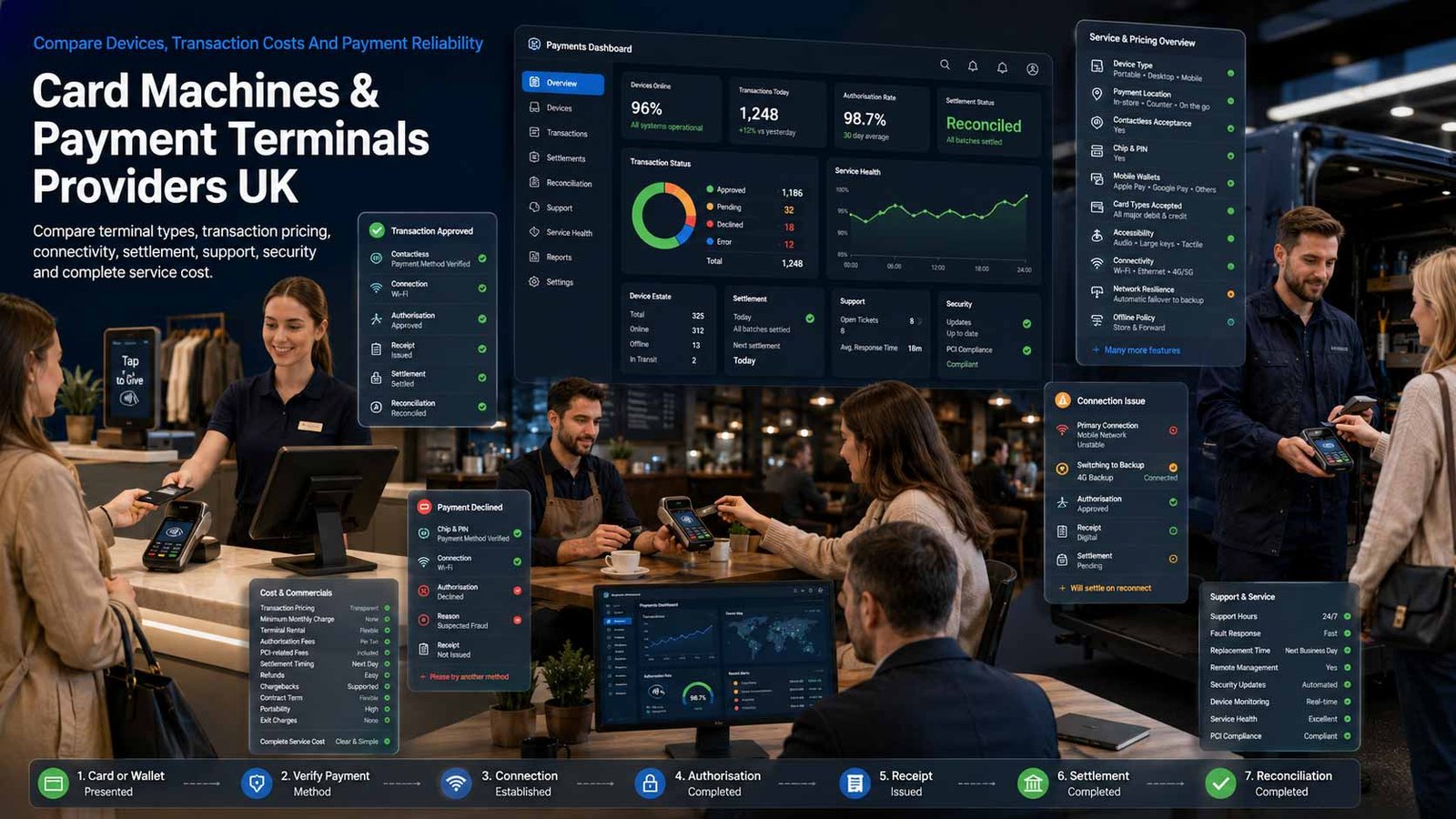
Compare The Entire Card-Present Service
A low transaction headline can be offset by terminal rental, monthly minimums, authorisation charges, PCI fees, premium support, settlement charges or early termination.
- Use the same turnover, card mix and average transaction value
- Separate terminal cost from transaction and service charges
- Test connectivity and replacement support at the actual premises
- Record contract term, notice, renewal and equipment-return duties
A card machine or payment terminal accepts a card or digital-wallet payment where the customer and device are physically present. The device reads contactless credentials or chip data, obtains cardholder verification when required, encrypts and sends the transaction for authorisation, then records the result for settlement and reconciliation.
Businesses can choose small app-linked readers, standalone smart terminals, fixed countertop devices, portable terminals for tableside service, mobile terminals using cellular data, or software-based Tap to Pay on a compatible phone. The best option depends on transaction volume, customer location, connectivity, receipts, tipping, refunds, accessibility, settlement and support.
This page compares physical and software-based card-present acceptance only. It does not compare online checkout gateways, ecommerce integrations or complete EPOS platforms. Merchant-account underwriting and acquiring structure are covered separately, although every terminal proposal should still disclose the transaction pricing, settlement and contractual relationship needed for card-present payments.
Choose The Right Card-Present Device
Device format changes connectivity, staff workflow, receipt handling, support and failure risk. Compare the payment environment before comparing hardware appearance.
| Terminal Model | What It Usually Provides | Best-Fit Question |
|---|---|---|
| App-linked mobile reader | Pairs with a compatible phone or tablet and normally has a low upfront device cost | Is reliable Bluetooth, mobile data and charged phone availability realistic during every trading period? |
| Standalone smart terminal | Combines touchscreen, payment application, Wi-Fi or SIM connectivity and sometimes receipt options | Does the device operate independently without introducing unnecessary business-management software? |
| Countertop terminal | Stays connected at a fixed till, reception or service desk | Are fixed power, Ethernet or Wi-Fi and cable routing suitable for the payment location? |
| Portable terminal | Uses a base, Wi-Fi or local network for tableside or within-premises payments | Does coverage remain reliable across dining areas, treatment rooms, yards or multiple floors? |
| Mobile 4G or 5G terminal | Uses cellular connectivity for deliveries, markets, events and field teams | Which networks are supported, what happens in weak-signal areas and is data included? |
| Tap to Pay on phone | Uses a compatible smartphone to accept contactless cards and wallets without separate reader hardware | Is contactless-only acceptance, staff phone governance and battery dependence acceptable? |
| Multi-terminal estate | Uses several managed devices across one or more sites with central reporting and support | Can terminals, users, settlements and replacements be controlled without an EPOS dependency? |
| Unattended payment terminal | Accepts payments at kiosks, vending, parking or self-service equipment | Does the provider support unattended certification, environmental protection, vandal resistance and remote monitoring? |
Eight Areas That Determine Card Machine Fit
Use one card-present payment profile for every provider so differences in price and service reflect the proposal rather than different turnover assumptions.
Comparison Criterion
Device Type, Payment Location And Accessibility
Compare where staff and customers pay, whether the device is fixed or mobile, physical keypad and touchscreen usability, PIN privacy, screen readability, audio or accessibility features, battery life, charging, receipt method and protective accessories. A stylish terminal is unsuitable if it cannot survive the actual trading environment.
Comparison Criterion
Accepted Cards, Wallets And Verification
Confirm Visa, Mastercard, American Express and other relevant schemes, commercial and foreign-issued cards, contactless, chip and PIN, magnetic-stripe fallback where supported, Apple Pay, Google Pay, gratuities, cashback if required and offline or deferred functionality. Do not assume every payment type has the same fee or settlement treatment.
Comparison Criterion
Connectivity And Transaction Resilience
Compare Ethernet, Wi-Fi, Bluetooth, multi-network SIM, automatic failover, roaming, connection monitoring and transaction behaviour during outages. Ask whether a failed authorisation is safely retried, whether duplicate-payment controls exist and how the provider supports sites with weak signal or restrictive corporate networks.
Comparison Criterion
Transaction Pricing And Complete Cost
Review blended percentage pricing or interchange-plus structure, pence-per-transaction charges, terminal purchase or rental, minimum monthly service, PCI administration, SIM, authorisation, refund, chargeback, international-card, replacement and termination costs. Model the actual card mix rather than one advertised rate.
Comparison Criterion
Settlement, Reconciliation And Cash Flow
Compare standard and accelerated settlement, cut-off times, weekends and bank holidays, reserve or hold conditions, statement clarity, payment references, multi-site allocation, refunds, chargebacks and downloadable reports. Next-day settlement claims should state the transaction cut-off and exceptions.
Comparison Criterion
Security, PCI Scope And Device Management
Assess current PCI DSS support, PCI PTS device status, point-to-point encryption, tamper checks, password and user controls, software updates, inventory, remote disablement, replacement, incident response and staff guidance. A compliant provider or terminal does not remove the merchant’s own PCI responsibilities.
Comparison Criterion
Reliability, Support And Replacement
Compare service hours, technical support, onboarding, remote diagnostics, terminal replacement target, weekend and holiday coverage, spare devices, engineer attendance, status communication, complaint escalation and service credits. A small price saving can be lost quickly if a busy site cannot accept cards.
Comparison Criterion
Contract, Portability And Exit
Review legal provider, merchant-acquiring dependency, terminal ownership, minimum term, automatic renewal, price changes, notice, early termination, replacement fees, equipment return, data export, outstanding chargebacks and switching support. Keep card-present acceptance separable from unrelated services wherever possible.
Measures To Define Before A Terminal Contract Is Signed
Translate fast, secure and reliable payment claims into consistent transaction, settlement, support and cost evidence.
| Measure | What It Should Define | Evidence To Request | Common Weakness |
|---|---|---|---|
| Authorisation success rate | The share of valid payment attempts successfully submitted and authorised | Device, connection, card type, result, decline reason, retry, time and duplicate control | All declines are treated as customer-funds issues even when connectivity or device faults contributed |
| Transaction completion time | The customer-facing time from payment initiation to approved result | Contactless, chip and PIN, device, network, time, receipt and peak-period result | Average speed excludes network outages and slow chip transactions |
| Terminal availability | The percentage of required trading time each device is operational | Terminal, hours, fault, connectivity, software, acknowledgement, recovery and replacement | Provider uptime excludes merchant connectivity even when the supplied SIM also failed |
| Settlement timeliness | Whether approved batches reach the nominated bank account as promised | Transaction date, batch cut-off, settlement date, amount, deduction, hold and exception | Next-day settlement excludes weekends, selected cards or transactions after an early cut-off |
| Pricing accuracy | Whether invoice and statement charges match the agreed commercial schedule | Turnover, card mix, transactions, percentages, pence fees, rental, extras, VAT and credit | Blended statements prevent the merchant from checking the quoted rate by card type |
| Refund completion | How quickly correctly initiated refunds are processed and reconciled | Original transaction, refund date, amount, fee treatment, cardholder timing and status | Staff believe a terminal receipt means the customer has already received the funds |
| Chargeback incidence | The level and cause of disputed card-present transactions | Transaction, card-present evidence, reason code, response date, evidence, outcome and fee | Chargebacks are reported without separating fraud, service disputes and processing errors |
| Device replacement time | Elapsed time from confirmed terminal failure to usable replacement | Fault time, diagnosis, dispatch, delivery, setup, test, return and lost trading | Replacement arrives quickly but cannot transact because configuration is incomplete |
| PCI completion status | Whether the merchant completes the required validation and remediation on time | SAQ or validation route, date, scope, provider support, failure, fee and action | PCI support is marketed as automatic compliance with no merchant action |
| Total card-present cost | The complete device, transaction, service, support and failure cost | Turnover, transactions, card mix, hardware, rental, fees, chargebacks, downtime and exit | The comparison uses percentage rate alone and ignores fixed costs at lower volumes |
Card Machine And Payment Terminal Providers UK Businesses Can Consider
Shortlist providers whose devices, pricing and support fit the way customers pay. Confirm current fees, eligibility, hardware and contract terms directly before signing.
Provider Profile
SumUp Card Readers
SumUp offers mobile readers, standalone terminals and Tap to Pay for small and growing businesses, generally using straightforward hardware purchase and flat card-present pricing rather than traditional terminal rental. Include it where low setup friction, seasonal trading or variable volume matters. Confirm the chosen device, upfront cost, current transaction rate, accepted cards, phone dependency, built-in SIM or Wi-Fi, receipts, tipping, settlement, refunds, chargebacks, PCI route, support hours, replacement, account review, reserves and whether any optional SumUp business tools create separate terms.
Review official SumUp card readersProvider Profile
PayPal Zettle
PayPal Zettle provides an app-linked card reader and a standalone Terminal with integrated payment application and mobile data. Include it where a microbusiness wants simple hardware, broad card and wallet acceptance and a PayPal-linked payment service. Confirm device price, transaction fee, SIM and data terms, compatible phones, printer or dock cost, settlement to bank or PayPal, staff access, refunds, chargebacks, support availability, replacement, PCI responsibility, account limitations and the boundary from Zettle’s wider point-of-sale functions.
Review official PayPal Zettle terminalsProvider Profile
Square Card Readers And Terminal
Square offers a compact Reader and all-in-one Terminal for contactless, chip and PIN and mobile-wallet payments, normally with upfront hardware and transparent standard pricing. Include it where a small business values rapid setup, no traditional terminal lease and one dashboard for card-present transactions. Confirm hardware, device compatibility, transaction pricing, keyed-payment restrictions, settlement schedule, instant-transfer fees, receipt options, tipping, refunds, disputes, offline-payment conditions, connectivity, replacement, PCI scope, account review and the boundary from Square’s optional business-management software.
Review official Square TerminalProvider Profile
Dojo Card Machines
Dojo provides touchscreen card machines with Wi-Fi and 4G connectivity, tailored transaction pricing, settlement and extended technical support for small and larger merchants. Include it where reliable mobile connectivity, fast service and a managed terminal contract are priorities. Confirm terminal model, rental or other fixed charges, minimum monthly payment, transaction and authorisation rates, card mix, settlement cut-off, SIM, tipping, refunds, chargebacks, PCI support, contract term, early termination, replacement target, support hours, integration boundary and any switching incentive conditions.
Review official Dojo card machinesProvider Profile
Tyl By NatWest
Tyl by NatWest offers portable smart terminals, other card-machine options and Tap to Pay, with published device fees and transaction pricing routes for eligible UK businesses. Include it where a merchant values a bank-backed service, named hardware and support around card acceptance. Confirm the current device, monthly rental, minimum term, transaction schedule, international-card treatment, phone-payment functions if requested, settlement, refunds, chargebacks, PCI support, SIM and app costs, receipt supplies, replacement, account eligibility, notice and whether the merchant relationship depends on any other NatWest service.
Review official Tyl card machinesProvider Profile
Worldpay Card Machines
Worldpay provides countertop, portable and mobile card machines for small businesses and larger merchants, supported by an established acquiring and payments operation. Include it where a business needs multiple device formats, tailored pricing, broad acceptance and structured support. Confirm the exact terminal, connectivity, rental or purchase, transaction model, authorisation and service fees, minimum charge, settlement, dynamic currency conversion where relevant, PCI route, device security, receipt rolls, refunds, chargebacks, replacement, contract length, annual changes, early termination and data access.
Review official Worldpay card machinesProvider Profile
Barclaycard Payments Card Readers
Barclaycard Payments provides card readers for fixed and portable acceptance alongside merchant payment services. Include it where a business wants a major bank-linked provider, established card-processing support and a conventional terminal arrangement. Confirm current hardware options, service fee, transaction and authorisation pricing, contract term, card and wallet acceptance, connectivity, settlement, PCI support, statement detail, refunds, chargebacks, device replacement, engineer or telephone support, price-review clauses, early termination, equipment return and whether bank-account choice affects the offer.
Review official Barclaycard card readersProvider Profile
takepayments Card Machines
takepayments supplies countertop, portable and mobile card machines with tailored transaction pricing, next-working-day settlement on qualifying transactions and a published twelve-month contract proposition. Include it where an SME wants guided setup, several terminal formats and a shorter stated commitment than some traditional contracts. Confirm legal contracting and acquiring parties, terminal model, monthly rental, card rates, authorisation fee, minimum service, settlement exceptions, PCI support, receipt and connectivity costs, refunds, chargebacks, support hours, replacement, price changes, renewal, cancellation notice and equipment return.
Review official takepayments card machinesWhat Changes Card Machine And Payment Terminal Cost
Terminal pricing depends on turnover, card mix, transaction count, hardware and contract. Compare the complete annual cost at realistic trading volumes.
| Cost Driver | Why It Changes Spend | What A Comparable Quote Should Show |
|---|---|---|
| Terminal purchase or monthly rental | Readers may be bought upfront while managed terminals commonly carry monthly rental or service fees | Device, quantity, purchase, rental, minimum term, replacement, accessories, VAT and ownership |
| Card-present transaction percentage | The percentage can differ by provider, card type, business size and pricing method | Debit, credit, consumer, commercial, domestic, international, premium and blended or interchange-plus basis |
| Per-transaction and authorisation charges | A fixed pence fee has greater impact on businesses with low average transaction values | Transactions, pence fee, authorisation, reversals, declines, refunds and monthly total |
| Minimum monthly service or processing charge | Some contracts require a minimum spend even when seasonal or low-volume trade falls | Minimum, included service, shortfall calculation, seasonal month and annual impact |
| Settlement and accelerated-transfer fees | Faster access to funds can be included, conditional or separately charged | Cut-off, working days, weekends, instant option, fee, reserve, hold and exception |
| Connectivity and receipt costs | SIM data, broadband, printer docks, paper rolls and accessories can change operating cost | Wi-Fi, cellular, data allowance, roaming, paper, printer, cradle, charger and replacement |
| PCI and security administration | Providers can charge PCI programme or non-compliance fees while merchants remain responsible | Validation route, support, fee, deadline, non-compliance charge, P2PE status and evidence |
| Chargeback, retrieval and refund treatment | Disputes and manual administration can create fixed fees and staff cost | Chargeback fee, retrieval, refund fee, evidence portal, deadline, representment and outcome |
| Support, replacement and engineer service | Premium support or rapid replacement may be included or separately priced | Support hours, target, courier, spare, engineer, setup, service credit and lost-trading assumption |
| Contract renewal and exit | Long terms, automatic renewal, annual increases and equipment-return fees affect lifetime cost | Start, minimum term, notice, renewal, price change, termination, return, damage and final charges |
How Trading Pattern Changes The Shortlist
The right provider depends on location, transaction volume, average value, card mix, connectivity, receipt and tipping needs, settlement and tolerance for fixed commitments.
Market Trader, Mobile Service Or Seasonal Business
Prioritise low fixed commitment, portable hardware, strong battery life, phone or standalone connectivity, quick setup, simple pricing, digital receipts and a suspension or cost model that remains economical during quiet months.
Retail Counter Or Professional Reception
Prioritise reliable fixed connectivity, accessible customer interface, fast chip and contactless acceptance, receipt options, refund controls, statement clarity, spare-device planning and support during every opening hour.
Hospitality, Beauty Or Tableside Service
Prioritise portable Wi-Fi and cellular failover, tipping, split or partial refunds where supported, battery life, multiple terminals, staff permissions, spill resistance, quick replacement and stable performance during peak service.
Multi-Site Or Higher-Volume Merchant
Prioritise tailored card pricing, terminal estate management, site-level reporting, consolidated settlement, permissions, P2PE options, PCI governance, device inventory, service levels, business continuity and controlled contract changes.
How To Compare Card Machine Quotes
Give every provider the same legal entity, trading locations, turnover, transaction count, average value, card mix, terminal quantity, connectivity, receipt, tipping, refund, settlement and support requirements. Require a complete annual-cost schedule and specimen contract.
- Every quote uses the same card-present turnover and card mix
- Hardware, fixed, percentage and pence fees are separated
- Settlement cut-offs and exceptions are documented
- PCI, replacement and support responsibilities are explicit
- All renewal, price-change and termination clauses are reviewed
- The terminal can operate at the actual premises before rollout
Make Every Provider Price The Same Month
Use identical debit, credit, commercial and international card values, transaction counts, refunds and chargebacks.
Compare annual cost and operational resilience before comparing one headline percentage.
Six Questions To Put To Every Terminal Provider
The answers expose unsuitable devices, incomplete fee schedules, weak settlement evidence and contracts that are expensive to leave.
What Will We Pay At Our Actual Card Mix?
Request a worked month showing each card category, percentage, pence fee, terminal charge, minimum, settlement, PCI and total deduction.
Which Device And Connectivity Are Included?
Confirm terminal model, purchase or rental, Wi-Fi, Ethernet, SIM, data, battery, charger, printer, receipts, accessories, ownership and replacement.
When Will Funds Reach Our Bank?
Review batch cut-off, working-day definition, weekends, bank holidays, accelerated options, reserves, holds, reconciliation reference and exceptions.
How Will Security And PCI Validation Work?
Ask for PCI DSS responsibilities, validation route, PTS and P2PE information, tamper checks, software updates, user controls, support and non-compliance fees.
What Happens When A Terminal Fails?
Confirm support hours, diagnosis, workaround, replacement target, courier, engineer, configuration, spare option, service credit and return process.
How Can The Contract Change Or End?
Review minimum term, automatic renewal, price changes, notice, early termination, equipment return, damage, data export, chargebacks and switching assistance.
A Seven-Stage Card Machine Evaluation
Move from verified transaction data and payment locations to a controlled terminal contract rather than choosing a device from one advertised rate.
- Collect recent card-present statements, turnover, transaction count, average value, card mix, refunds, chargebacks, settlement records, existing terminal contracts, connectivity issues and accountable owners.
- Define terminal locations, fixed or mobile use, device quantity, contactless and chip acceptance, receipts, tipping, accessibility, staff controls, settlement, support and continuity requirements.
- Test Wi-Fi, Ethernet, mobile coverage, power, customer flow, PIN privacy, accessibility, environmental exposure and business-network restrictions at every payment location.
- Issue one written specification and obtain comparable provider quotations with hardware, complete fee schedule, settlement, PCI, support, contract and exit documentation.
- Normalise every quote using the same turnover, card mix, transaction count, refunds, chargebacks, terminal quantity, settlement and support assumptions.
- Pilot or test the selected device, then approve only after underwriting, bank details, user access, PCI route, staff guidance, replacement and escalation are ready.
- Operate through daily settlement checks, terminal inspection, statement audit, refund and chargeback control, PCI validation, access review, support monitoring and renewal management.
Card Machines And Payment Terminals Comparison Checklist
Use this table before approving a mobile reader, standalone terminal, managed card-machine contract or multi-site rollout.
| No. | Requirement | Evidence To Obtain Before Award | Confirmed |
|---|---|---|---|
| 01 | Card-present scope and accountable owner agreed | Legal entity, sites, payment locations, finance owner, operations owner, approver and support contacts | |
| 02 | Transaction baseline validated | Monthly turnover, transactions, average value, debit, credit, commercial, international, refunds and chargebacks | |
| 03 | Terminal model and quantity accepted | Countertop, portable, mobile, smart terminal, Tap to Pay, devices, spare and expected users | |
| 04 | Connectivity tested | Ethernet, Wi-Fi, Bluetooth, SIM networks, coverage, failover, firewall, power, battery and outage process | |
| 05 | Accepted payments confirmed | Card schemes, chip and PIN, contactless, wallets, foreign cards, gratuity, cashback and limitations | |
| 06 | Complete fee schedule normalised | Hardware, rental, percentage, pence, authorisation, minimum, PCI, SIM, refund, chargeback and support | |
| 07 | Settlement model verified | Batch cut-off, standard timing, weekends, holidays, accelerated option, fee, reserve, hold and statement reference | |
| 08 | PCI and terminal security reviewed | Validation route, PTS, P2PE, tamper checks, updates, user controls, credentials, incidents and evidence | |
| 09 | Refund and chargeback controls agreed | Permissions, original transaction, partial refund, fees, evidence, deadlines, alerts and reconciliation | |
| 10 | Support and replacement tested | Hours, acknowledgement, remote fix, spare, dispatch, engineer, setup, service credit and escalation | |
| 11 | Staff and accessibility requirements met | Training, PIN privacy, receipt, tipping, language, physical access, screen, audio and customer assistance | |
| 12 | Reporting and data access accepted | Transactions, fees, settlements, sites, users, exports, retention, permissions and end-of-contract access | |
| 13 | Contract and price-change terms approved | Legal providers, start, minimum term, renewal, notice, increases, termination, equipment return and damage | |
| 14 | Complete annual cost compared | Expected turnover, transaction mix, fixed fees, support, settlement, chargebacks, downtime and exit | |
| 15 | Implementation and switching plan controlled | Underwriting, bank verification, delivery, configuration, test, PCI, old contract, staff and first settlement |
Common Card Machine And Payment Terminal Buying Mistakes
Most avoidable failures begin with headline-rate comparisons, untested connectivity, unclear PCI responsibility or contract terms that were not modelled.
| Mistake | Why It Creates Risk | Better Control |
|---|---|---|
| Choosing the lowest advertised percentage | The rate may exclude fixed, pence, minimum and card-category charges | Model the actual card mix |
| Buying the wrong device format | A fixed, app-linked or contactless-only device may not fit customer flow | Test the payment location |
| Ignoring weak connectivity | Dropped authorisations create queues, retries and possible duplicate payments | Test networks and failover |
| Assuming all cards cost the same | Commercial, premium and international cards can carry different pricing | Request category-specific rates |
| Confusing settlement with authorisation | An approved payment is not the same as cleared funds in the bank | Review cut-offs and exceptions |
| Treating provider PCI support as automatic compliance | The merchant still has validation and operational duties | Confirm the PCI route |
| Ignoring replacement support | A cheap terminal can be costly when it fails during peak trade | Compare recovery targets |
| Accepting a verbal cancellation promise | Minimum terms, renewal and return duties remain in the written contract | Review the signed terms |
| Bundling unnecessary software | Extra applications can add cost, complexity and a wider security environment | Keep terminal scope focused |
| Skipping the first statement audit | Incorrect rates, rental or settlement deductions can continue unnoticed | Reconcile immediately |
Frequently Asked Questions
Answers to common questions from UK businesses comparing card readers, terminals, fees, settlement, security and contracts.
What Is A Card Machine Or Payment Terminal?
A card machine or payment terminal accepts a card-present payment by reading contactless credentials or chip data, obtaining verification when required and securely sending the transaction for authorisation. Devices include app-linked readers, standalone terminals, countertop, portable and mobile machines.
How Much Does A Business Card Machine Cost?
Cost can include hardware purchase or monthly rental, percentage and pence-per-transaction charges, minimum monthly service, authorisation, PCI administration, SIM, refunds, chargebacks, support and termination. Compare a complete annual model using the business’s actual card mix.
What Is The Difference Between Countertop, Portable And Mobile Terminals?
A countertop terminal stays at a fixed payment point. A portable terminal moves around the premises using local connectivity. A mobile terminal uses cellular data for payments away from the premises. The correct option depends on customer flow, signal, power and receipts.
Can A Phone Accept Contactless Payments Without A Card Reader?
Compatible phones can use Tap to Pay software to accept contactless cards and digital wallets without separate reader hardware. Suitability depends on supported devices, contactless-only acceptance, staff-phone governance, connectivity, battery, receipt and provider terms.
What Is The UK Contactless Card Limit?
The standard UK contactless card limit is £100. Transactions can still require a PIN or other verification, and mobile wallets can use device authentication. Merchants should follow the terminal and provider prompts rather than manually splitting transactions.
Does A Small Business Need PCI DSS Compliance?
Yes. PCI DSS applies to merchants that accept payment cards regardless of size or transaction volume. The validation method depends on the payment environment. A PCI-listed P2PE solution can reduce scope, but the merchant still has responsibilities.
How Quickly Do Card Payments Reach A Business Bank Account?
Settlement varies by provider, transaction cut-off, working days, card type, reserves and optional accelerated services. A next-day claim may exclude transactions after the cut-off, weekends, bank holidays or accounts subject to review.
Can A UK Business Add A Surcharge For Card Payments?
For most retail payments, businesses cannot add a fee because a consumer chooses a consumer credit card, debit card or similar payment method. The merchant should price goods and services lawfully and seek advice for unusual business-to-business payment arrangements.
What Happens If A Card Terminal Stops Working?
The provider should diagnose connectivity, power, device and account issues, offer a safe workaround and replace failed equipment within the agreed service target. Businesses with critical card volumes should consider a spare device or alternative acceptance method.
How Should A UK Business Compare Card Machine Providers?
Give every provider the same turnover, transaction count, card mix, terminal quantity and support needs. Compare device fit, connectivity, accepted payments, complete fees, settlement, security, replacement, reporting, contract and exit—not only the headline transaction rate.
Official Guidance And Card Terminal Provider Resources
Reviewed by Bhav Giva, Founder & Lead Analyst at CompareServices.co.uk, on 24 July 2026.
Use PCI Security Standards Council, UK government, FCA Register, UK Finance and official provider documentation to confirm current device security, payment rules, terminal features, pricing and contract terms. Offers and hardware can change.
- PCI SSC — Merchant Resources
- PCI SSC — PCI Data Security Standard
- PCI SSC — Payment Terminal Security Standard
- PCI SSC — Validated P2PE Solutions
- UK Government — Payment Surcharge Rules
- FCA — Financial Services Register
- UK Finance — £100 Contactless Limit
- SumUp — Card Readers
- PayPal Zettle — Terminal
- Square — Terminal
- Dojo — Card Machines
- Tyl By NatWest — Card Machines
- Worldpay — Card Machines
- Barclaycard Payments — Card Readers
- takepayments — Card Machines