
Compare Merchant Accounts Providers UK (2026)
Compare Acquiring Rates, Underwriting, Settlement, Reserves, Chargebacks, PCI Support And Total Cost
Compare merchant accounts UK providers by acquiring model, underwriting, merchant category, card mix, blended or interchange-plus pricing, authorisation and scheme fees, settlement timing, gross or net settlement, reserves, chargeback administration, refunds, multi-currency acceptance, PCI support, reporting, account changes, contract terms and complete annual cost. Use the same transaction profile for every quote and identify the regulated acquirer behind each offer.
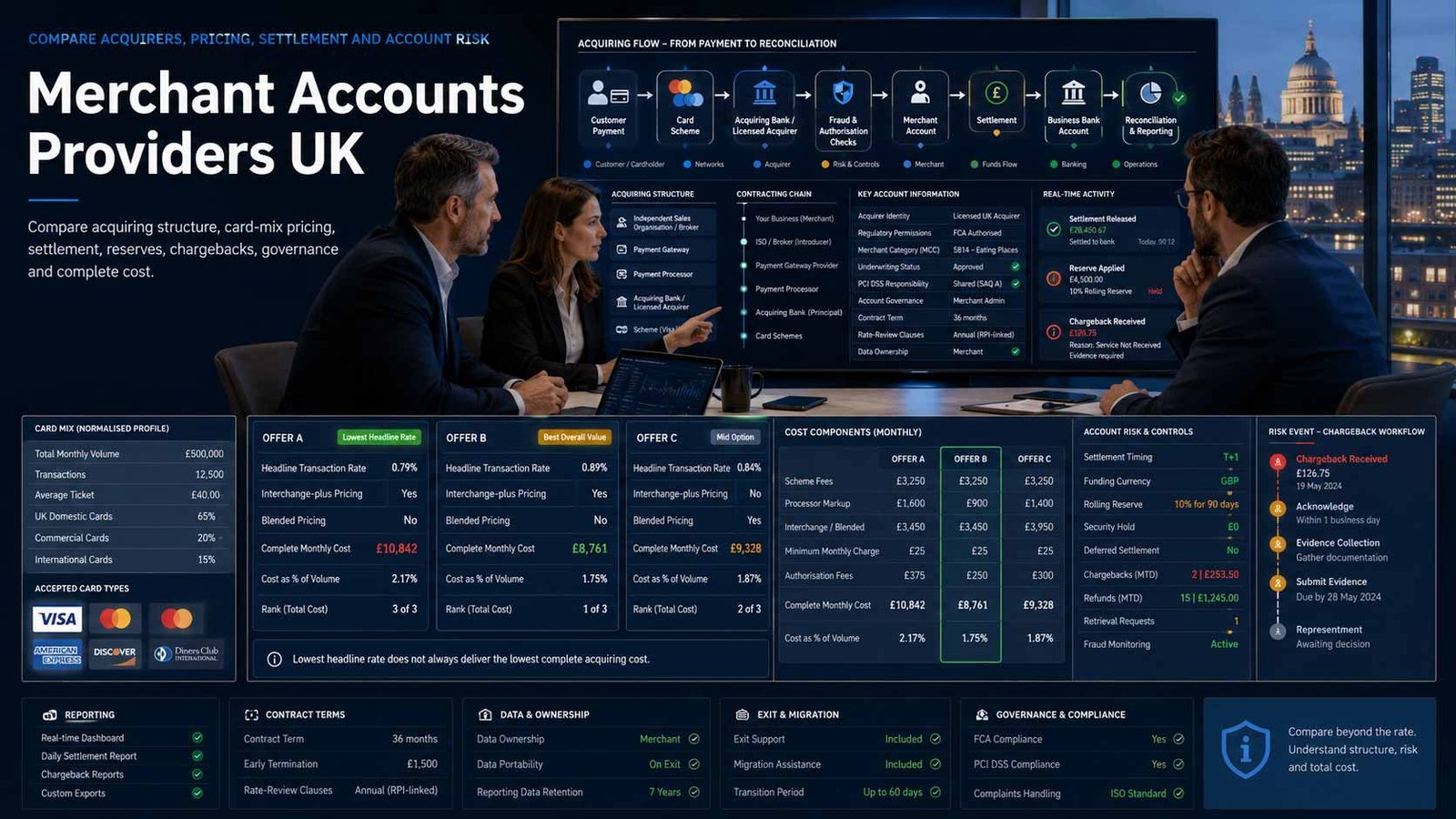
Identify The Acquirer Behind The Offer
The organisation selling the package may be the regulated acquirer, a payment facilitator, an independent sales organisation or a reseller. Contract, settlement and chargeback responsibilities can therefore sit with different legal entities.
- Check the contracting entity and FCA status
- Confirm which firm underwrites and settles transactions
- Separate acquiring charges from hardware and software fees
- Record every reserve, hold and termination right
A merchant account is the commercial acquiring arrangement that enables a business to accept card payments and receive settled funds. The acquirer or acquiring partner authorises the merchant, processes transactions through the card schemes, receives funds from issuers, deducts agreed charges and transfers the balance to the nominated business bank account.
Some providers allocate a dedicated merchant identification number and underwrite each business directly. Others use an aggregated or payment-facilitator model in which many smaller sellers operate under a master arrangement. Dedicated acquiring can provide greater pricing and operating flexibility, while aggregation can simplify onboarding. The correct model depends on turnover, card mix, risk, refund profile, sector and sales channels.
This page compares merchant acquiring and account administration only. It does not compare card-machine hardware, terminal connectivity, EPOS functionality or online payment-gateway integrations. Those services can connect to the merchant account but have separate commercial and technical requirements.
Choose The Right Merchant Acquiring Structure
The account model changes underwriting, pricing transparency, settlement control and the way the business can switch or add payment channels.
| Account Model | What It Usually Provides | Best-Fit Question |
|---|---|---|
| Direct acquiring relationship | The business contracts directly with an authorised acquirer and receives one or more merchant identification numbers | Does the merchant need negotiated pricing, multi-channel control or higher underwriting limits? |
| Independent sales organisation | An ISO sells and supports a package while an underlying acquirer processes and settles the card transactions | Are the ISO, acquirer, contracts, fees and support responsibilities clearly separated? |
| Payment facilitator or aggregate model | The provider onboards smaller merchants under a master acquiring arrangement and remits proceeds | Are settlement, reserves, account suspension and data portability suitable for the business risk? |
| Blended pricing account | The merchant pays one percentage or small set of rates covering several cost components | Does the simplicity outweigh reduced visibility of interchange, scheme and acquirer margin? |
| Interchange-plus or IC++ account | Interchange, scheme fees and acquirer margin are shown separately | Can the finance team reconcile variable card costs and compare provider margin accurately? |
| Multi-currency merchant account | The business can accept and sometimes settle transactions in more than one currency | Which currencies settle without conversion and what FX, cross-border and scheme costs apply? |
| High-risk or specialist account | The acquirer accepts a sector or sales model requiring enhanced underwriting, reserves and monitoring | Are reserve, rolling hold, refund, delivery and termination obligations commercially manageable? |
| Multi-entity or multi-MID structure | Several legal entities, outlets, channels or business units receive separate identifiers and reporting | Can the structure support accounting, tax, refund, chargeback and settlement ownership without confusion? |
Eight Areas That Determine Merchant Account Fit
Use the same turnover, card mix, transaction channels, refund profile and risk assumptions for every quote so pricing and reserve differences are genuinely comparable.
Comparison Criterion
Acquirer Identity, Authorisation And Contracting Chain
Confirm the legal entity providing acquiring, the ISO or reseller where applicable, FCA authorisation or registration, card-scheme relationship, complaint route and the contract governing settlement. The brand on the proposal may not be the firm that holds the merchant account.
Comparison Criterion
Underwriting, Merchant Category And Acceptance Scope
Compare application evidence, merchant category code, business model, expected turnover, average and maximum transaction, delivery delay, recurring payments, refund levels, card-not-present exposure and prohibited activities. Inaccurate underwriting information can lead to delayed settlement or account termination.
Comparison Criterion
Pricing Model And Card-Mix Exposure
Review blended, differential and interchange-plus pricing against the actual mix of debit, credit, commercial, premium, international and card-not-present transactions. Require fixed acquirer margin, scheme and interchange treatment, authorisation fees and worked examples based on the same monthly profile.
Comparison Criterion
Settlement Timing, Funding And Reconciliation
Compare next-day or later settlement, cut-off times, weekends, bank holidays, gross versus net settlement, deductions, batch references, multiple bank accounts, negative balances, failed payments and statement detail. Faster advertised settlement may exclude certain cards, transaction times or risk events.
Comparison Criterion
Reserves, Holds And Financial Security
Assess rolling reserves, delayed settlement, fixed deposits, guarantees, right of set-off, refund funding, chargeback exposure and triggers for changing security. Model the maximum cash that could be withheld during seasonal growth, business change or elevated disputes.
Comparison Criterion
Chargebacks, Refunds And Fraud Administration
Compare alerting, evidence deadlines, portal workflow, representment support, chargeback fee, refund fee, fraud tools, retrieval requests and escalation. Require clear ownership where the provider, acquirer and payment channel are separate organisations.
Comparison Criterion
PCI DSS, Data Security And Account Governance
Review PCI support, validation route, non-compliance fees, token or account-reference portability, user roles, MFA, audit logs, bank-detail changes, legal-entity changes and incident reporting. Outsourcing processing does not remove the merchant’s PCI DSS responsibilities.
Comparison Criterion
Contract Term, Rate Changes, Reporting And Exit
Review minimum term, renewal, notice, early termination, price variation, minimum monthly charge, statement access, PSR summary box, data export, MID portability, outstanding chargebacks, reserve release and final settlement. Keep acquiring and equipment agreements separately identifiable.
Measures To Define Before A Merchant Agreement Is Signed
Translate low rates and fast settlement into auditable cost, cash-flow, security and dispute evidence.
| Measure | What It Should Define | Evidence To Request | Common Weakness |
|---|---|---|---|
| Effective acquiring rate | The total acquiring cost divided by processed card value for the defined period | Interchange, scheme, acquirer margin, fixed fees, authorisations, refunds, chargebacks and volume | A headline debit rate is presented without the weighted cost of the actual card mix |
| Settlement timeliness | Whether eligible batches reach the nominated bank account within the agreed timetable | Transaction date, batch close, settlement date, deductions, exception and reason | Next-day settlement excludes late batches, certain days or higher-risk transactions |
| Settlement accuracy | Whether deposits reconcile to transactions, refunds, fees and chargebacks | Batch, gross value, fees, reserve, refund, dispute, net value and bank reference | Net settlement obscures the fees deducted from each deposit |
| Authorisation success | The percentage of attempted transactions approved, excluding genuine customer declines | Channel, card type, response code, issuer, retry, routing and outage | Approval claims mix fraud blocks, technical failures and issuer declines |
| Reserve exposure | The maximum merchant cash held under rolling, fixed or event-driven security terms | Reserve percentage, period, cap, triggers, review, release and insolvency treatment | A reserve right exists in the terms but is absent from the commercial proposal |
| Chargeback rate and outcome | Disputes as a proportion of transactions and the result of representment | Reason code, amount, deadline, evidence, fee, outcome, recovery and root cause | The provider reports case closure without separating merchant wins and write-offs |
| Refund completion | How quickly authorised refunds reach the original card and appear in reporting | Request date, processor date, card-scheme status, customer confirmation, fee and exception | The merchant assumes a refund is complete when it has only been submitted |
| PCI validation status | Whether the merchant has completed the required PCI DSS validation for its environment | SAQ or ROC route, attestation, scan where required, expiry, provider confirmation and fee | A bundled PCI service is mistaken for automatic compliance |
| Statement transparency | Whether finance teams can identify every price component and contract change | Summary box, card mix, rates, fees, settlement, adjustments, rate notice and export | Statements group several charges under undefined service descriptions |
| Switch and final-settlement control | Whether the business can move provider without lost funds, data or unresolved disputes | Notice, termination, new MID, cutover, reserve, chargebacks, final statement and data export | The old account is closed before refunds and late chargebacks are operationally covered |
Merchant Account Providers UK Businesses Can Consider
Shortlist providers whose acquiring model, underwriting appetite, pricing and account service fit the business. Confirm the regulated acquirer, live quote and complete terms directly before award.
Provider Profile
Worldpay
Worldpay provides merchant acquiring and card-payment processing for small businesses through to large international organisations, with settlement, reporting, chargeback support and multi-channel acceptance. Include it where a business wants an established direct acquiring relationship and a provider able to support growth across channels. Confirm the contracting Worldpay entity, FCA permissions, pricing model, card categories, authorisation and scheme fees, settlement, reserves, PCI service, chargeback fees, multi-currency support, contract term, equipment separation, rate-change rights, portal access, final settlement and any channel-specific agreements.
Review official Worldpay merchant servicesProvider Profile
Global Payments
Global Payments provides merchant acquiring, settlement, reporting and dispute-management services to UK SMEs, larger organisations and partner channels. Include it where a business values direct acquiring scale, detailed merchant reporting and support for multiple entities or markets. Confirm the legal entity, FCA status, pricing schedule, interchange or blended structure, MID design, settlement currency, cross-border costs, minimum charges, reserves, dispute tools, PCI support, user permissions, contract term, online quotation summary, equipment or software agreements, data export and responsibility for any introduced or partner-supplied component.
Review official Global Payments acquiringProvider Profile
Elavon Merchant Services
Elavon provides merchant accounts and acquiring for in-person, online and remote card acceptance, supported by merchant portals, reporting, security and risk services. Include it where a business wants a direct acquiring relationship with a large international processor and multi-currency capability. Confirm the Elavon contracting entity and UK regulatory position, merchant category, pricing model, Faster Payments or standard settlement, net or gross deductions, currency treatment, reserve powers, PCI service and fees, chargeback administration, operating-guide obligations, contract term, variation rights, third-party gateway or ISO involvement and final-account procedures.
Review official Elavon merchant servicesProvider Profile
Lloyds Bank Cardnet
Lloyds Bank Cardnet provides merchant acquiring, account reporting, settlement and support for new, growing and corporate merchants. Include it where a business values a bank-branded acquiring relationship, UK support and dedicated service for more complex structures. Confirm whether banking with Lloyds is required for the selected product, the Cardnet and processing entities, pricing, card mix, settlement timetable, merchant identification numbers, reserve and set-off rights, PCI services, chargeback management, multi-currency settlement, account-change processes, contract term, notice, rate variation, reporting portal, final settlement and any Fiserv-delivered component.
Review official Lloyds CardnetProvider Profile
Tyl by NatWest
Tyl provides acquiring and merchant services for eligible UK businesses through a NatWest-backed proposition, with simple pricing categories, settlement and UK support. Include it where an SME values a comparatively straightforward package and next-business-day settlement for eligible transactions. Confirm the actual acquiring entity, eligibility, quoted card categories, transaction rates, authorisation and non-standard card costs, settlement cut-off, gross or net settlement, minimum or monthly fees, PCI service, disputes, reserves, contract length, early termination, rate changes, terminal or online-service separation and whether charity, high-risk or international activity is supported.
Review official Tyl merchant servicesProvider Profile
AIB Merchant Services
AIB Merchant Services UK provides authorised merchant acquiring and card-processing services to businesses in Great Britain and Northern Ireland, supported by Fiserv infrastructure. Include it where a merchant wants a direct acquiring relationship, sector experience and access to detailed contractual and pricing documentation. Confirm the First Merchant Processing UK contracting entity, FCA permissions, card-scheme acceptance, blended or interchange pricing, settlement, reserve rights, refund funding, PCI and operating-guide duties, chargeback fees, DCC or multi-currency terms, contract and termination, online quotation output, equipment separation, ownership changes and any effect of current corporate ownership developments.
Review official AIB Merchant ServicesProvider Profile
Paymentsense
Paymentsense arranges merchant accounts and payment services for UK businesses and works with underlying acquiring partners. Include it where an SME wants an adviser-led quotation, onboarding support and one commercial contact across payment acceptance. Confirm whether Paymentsense, Clover or another acquirer contracts for each service; the FCA status of the relevant entities; pricing and commission; settlement; reserve powers; transaction categories; PCI fees; chargebacks; minimum monthly charges; contract term; cancellation; rate reviews; equipment agreement; data access; support split and the process if the underlying acquiring relationship changes.
Review official Paymentsense merchant accountsProvider Profile
takepayments
takepayments specialises in arranging merchant services for independent UK businesses and operates as an ISO or member-service provider working with merchant acquirers. Include it where a smaller merchant wants guided application support, tailored transaction pricing and a shorter published service term. Confirm the named underlying acquirer, every agreement and legal entity, card-rate assumptions, settlement, minimum charges, PCI service, reserve and underwriting decisions, chargeback responsibility, equipment or channel agreements, renewal, notice, early termination, introducer remuneration, data export, support ownership and what happens if the acquirer declines or later changes the merchant’s risk terms.
Review official takepayments merchant accountsWhat Changes Merchant Account Cost
Merchant pricing depends on card mix, transaction value, channel, risk and contract structure. Compare the effective annual cost rather than one advertised percentage.
| Cost Driver | Why It Changes Spend | What A Comparable Quote Should Show |
|---|---|---|
| Interchange | The card issuer receives interchange based on card, transaction and regulatory category | Debit, credit, commercial, premium, domestic, international, card-present and card-not-present assumptions |
| Card-scheme fees | Visa, Mastercard and other schemes charge assessment, processing and service fees | Scheme, fee name, percentage or fixed amount, cross-border treatment, change process and reporting |
| Acquirer margin | The acquirer or provider adds its commercial margin and risk cost | Blended rate or margin, card category, volume tier, term, minimum and review |
| Authorisation and processing fees | Fixed transaction charges can materially affect low-value or high-volume merchants | Authorisation, capture, reversal, refund, verification, batch and declined-transaction fees |
| Monthly and minimum charges | Service, statement, PCI, account, portal or minimum monthly fees add fixed cost | Fee, included service, VAT, minimum, waiver, annual amount and cancellation treatment |
| Chargebacks and fraud services | Disputes, retrievals, alerts and fraud tools can create per-case or subscription cost | Chargeback fee, alert fee, evidence service, fraud licence, liability and result |
| Settlement and funding | Faster settlement, gross settlement or multi-currency funding can carry cost or conditions | Cut-off, days, weekends, gross or net, fee, currency, reserve, negative balance and exception |
| International and commercial cards | Cards outside the standard domestic consumer profile can attract higher interchange, scheme and margin | Card type, country, currency, cross-border fee, premium card, business card and DCC |
| Reserve and security requirement | Rolling reserves, deposits or guarantees restrict cash flow and can change after risk review | Percentage, duration, cap, triggers, review, release, set-off and insolvency treatment |
| Contract, equipment and exit | Acquiring, terminal and software agreements can have different terms and cancellation costs | Each contract, start, minimum term, renewal, notice, early exit, transfer, final fees and reserve release |
How Card Mix And Risk Change The Shortlist
The right provider depends on turnover, average transaction, delivery model, refunds, disputes, card categories, currencies, legal entities and cash-flow tolerance.
New Or Low-Volume Merchant
Prioritise simple onboarding, clear blended pricing, low fixed fees, understandable PCI validation, predictable settlement and no unnecessary long contract. Check whether an aggregate model is more practical than a dedicated account.
Established Retail Or Hospitality Business
Prioritise competitive weighted pricing, reliable settlement, multiple merchant IDs where needed, refunds, chargeback support, reconciliation, seasonal limits and a contract that remains workable as transaction volume changes.
Subscription, Travel Or Delayed-Delivery Merchant
Prioritise underwriting appetite, future-delivery exposure, recurring-payment rules, refund funding, rolling reserves, chargeback monitoring, evidence, account updater or token portability and clear triggers for risk-term changes.
Multi-Entity Or International Organisation
Prioritise legal-entity and MID design, multi-currency settlement, cross-border costs, central reporting, user permissions, entity-level reconciliation, direct acquiring relationships, service governance, data export and controlled market expansion.
How To Compare Merchant Account Quotes
Give every provider the same legal entity, turnover, monthly transaction count, average and maximum value, card mix, channels, currencies, refund and chargeback history, delivery period and settlement requirements. Require a standardised annual-cost schedule.
- The regulated acquirer and every introducer are identified
- Pricing uses the same card categories and transaction volumes
- Settlement, deductions and reserves are modelled as cash flow
- Chargeback, refund and PCI fees are included
- Each acquiring, equipment and software contract is separated
- Switching, final settlement and reserve release are documented
Make Every Provider Price The Same Card Mix
Use the same debit, credit, commercial, premium, international, refund and chargeback volumes.
Compare the complete annual cost and cash-flow impact before comparing one transaction rate.
Six Questions To Put To Every Merchant Provider
The answers expose hidden acquiring entities, incomplete pricing, cash-flow risk and contracts that are difficult to unwind.
Who Is The Regulated Acquirer?
Request the contracting entity, FCA reference, ISO or reseller, card-scheme role, settlement entity, support ownership and complaint route.
Which Transactions Created The Quote?
Confirm card categories, countries, currencies, channels, monthly value, transaction count, average value, refunds and chargebacks.
Which Charges Sit Outside The Headline Rate?
Ask for interchange, scheme, authorisation, refund, chargeback, PCI, minimum, statement, international, reserve and exit costs.
When Can Settlement Be Delayed Or Withheld?
Review cut-offs, exceptions, rolling reserves, deposits, negative balances, risk reviews, suspicious activity, delivery exposure and release.
How Will Disputes And Fraud Be Managed?
Confirm alerts, deadlines, evidence portal, representment support, fees, fraud controls, liability, escalation and reporting.
What Happens During Switching And Closure?
Confirm notice, new MID, cutover, refunds, recurring payments, tokens, open chargebacks, final statements, reserves, data export and access removal.
A Seven-Stage Merchant Account Evaluation
Move from verified transaction evidence and underwriting requirements to a controlled acquiring relationship rather than accepting a rate based on partial card data.
- Collect twelve months of statements, settlement reports, card mix, transaction counts, refunds, chargebacks, PCI status, current contracts, reserves, complaints and accountable owners.
- Define the required acquiring model, settlement, currencies, merchant IDs, reporting, risk tolerance, PCI support, dispute service and change-control requirements.
- Prepare accurate underwriting information covering ownership, sector, products, delivery, turnover, maximum transaction, channels, countries, refunds and financial position.
- Issue one written request and obtain comparable quotes identifying the acquirer, introducer, pricing schedule, settlement, reserves, support, contracts and annual cost.
- Normalise every quote using the same card mix, transaction counts, refunds, chargebacks, international activity, fixed fees and cash-flow assumptions.
- Contract only after legal entities, merchant category, limits, security, settlement bank, PCI route, user access, notices, equipment separation and cutover are confirmed.
- Operate through settlement reconciliation, monthly fee review, dispute control, PCI renewal, risk updates, bank-detail security, PSR summary-box review and controlled switching.
Merchant Account Comparison Checklist
Use this table before approving a direct acquirer, ISO-arranged account, aggregate service, renewal or multi-entity acquiring structure.
| No. | Requirement | Evidence To Obtain Before Award | Confirmed |
|---|---|---|---|
| 01 | Merchant-account scope and owner agreed | Legal entity, trading names, finance owner, payments owner, approver, fraud owner and contacts | |
| 02 | Current acquiring structure mapped | Acquirer, ISO, MID, channels, equipment, gateway, contracts, settlement bank and support | |
| 03 | Underwriting profile validated | Ownership, sector, MCC, products, delivery, turnover, maximum value, countries, refunds and disputes | |
| 04 | Transaction profile normalised | Monthly value, count, average, debit, credit, commercial, premium, international and channel | |
| 05 | Pricing schedule completed | Interchange, scheme, margin, authorisation, refund, chargeback, PCI, minimum, account and other fees | |
| 06 | Settlement model accepted | Cut-off, settlement day, weekends, gross or net, deductions, bank references, currencies and exceptions | |
| 07 | Reserve and security terms approved | Rolling reserve, deposit, guarantee, set-off, triggers, review, cap, release and insolvency | |
| 08 | Chargeback and refund controls agreed | Alerts, deadlines, portal, evidence, fees, liability, refund funding, escalation and reporting | |
| 09 | PCI and data responsibilities confirmed | SAQ or ROC route, scans, attestation, provider service, fees, users, MFA, logs and incident process | |
| 10 | Authorisation and reporting tested | Response codes, batches, statements, summary box, portal, exports, reconciliation and user permissions | |
| 11 | All legal and regulated entities verified | FCA register, acquirer, processor, ISO, reseller, complaint route, card-scheme role and agreement | |
| 12 | Contract and rate-change terms accepted | Minimum term, renewal, notice, variation, minimum volume, early termination and separate agreements | |
| 13 | Account-change security approved | Bank changes, directors, trading address, legal entity, new MID, verification, authority and audit trail | |
| 14 | Complete annual and cash-flow cost compared | Transaction fees, fixed fees, disputes, PCI, FX, settlement delay, reserve, internal effort and tax | |
| 15 | Switch and exit plan agreed | Notice, new MID, cutover, recurring payments, refunds, open disputes, reserve, final statement, export and closure |
Common Merchant Account Buying Mistakes
Most avoidable failures begin with incomplete card data, hidden acquiring relationships, misunderstood reserves or contracts that do not align.
| Mistake | Why It Creates Risk | Better Control |
|---|---|---|
| Comparing one advertised rate | The rate may apply only to a narrow domestic debit-card category | Model the full card mix |
| Not identifying the acquirer | The seller, processor and settlement provider may be different legal entities | Map the contracting chain |
| Providing inaccurate underwriting data | The account can be repriced, restricted or terminated when actual trading differs | Disclose the real business model |
| Ignoring fixed and per-item fees | Authorisation, refund, chargeback, PCI and minimum fees can outweigh a lower percentage | Calculate annual cost |
| Treating next-day settlement as universal | Cut-offs, weekends, risk events and certain transaction types can delay funds | Test the settlement timetable |
| Accepting broad reserve rights | The provider may retain material cash during growth or increased disputes | Negotiate triggers and release |
| Assuming bundled PCI means compliant | The merchant still owns validation and operational controls | Complete the correct PCI route |
| Signing linked contracts without mapping them | Acquiring, equipment and software may have different dates and cancellation terms | Record every agreement |
| Failing to review the PSR summary box | The business misses evidence designed to support comparison and switching | Review it with monthly billing |
| Closing the old account too early | Refunds, late chargebacks and reserve releases can remain outstanding | Run a controlled transition |
Frequently Asked Questions
Answers to common questions from UK businesses comparing merchant acquirers, independent sales organisations and aggregate payment services.
What Is A Merchant Account?
A merchant account is the acquiring arrangement that allows a business to accept card payments. The acquirer authorises the merchant, processes transactions through card schemes, receives funds from card issuers and settles the agreed balance to the merchant's business bank account.
Is A Merchant Account The Same As A Business Bank Account?
No. A merchant account is part of card-payment processing and temporarily records or controls card-sale funds before settlement. The business bank account is the ordinary account into which the acquirer pays settled proceeds. The two accounts can be provided by different organisations.
Does Every Business Need A Dedicated Merchant Account?
Not always. Some small businesses use an aggregate or payment-facilitator service rather than a dedicated merchant identification number. Dedicated acquiring can offer more pricing and operating flexibility, while aggregation can simplify onboarding. Compare risk, turnover, settlement and contract needs.
How Much Does A Merchant Account Cost?
Cost can include interchange, card-scheme fees, acquirer margin, authorisation fees, minimum monthly charges, PCI services, refunds, chargebacks, international-card fees and settlement services. Compare the weighted annual cost using the business's actual card mix and transaction count.
How Long Does Merchant Account Approval Take?
Timing depends on the provider and the completeness and risk of the application. Straightforward low-risk merchants can be approved quickly, while complex ownership, delayed delivery, international sales, higher values or incomplete documents can require enhanced underwriting and longer review.
What Is A Merchant Identification Number?
A merchant identification number, or MID, identifies a merchant account or payment-acceptance arrangement within the acquiring system. A business may need separate MIDs for legal entities, outlets, currencies or channels. Confirm how transactions and settlements map to each identifier.
Why Might An Acquirer Hold A Reserve?
An acquirer may require a rolling reserve, deposit, delayed settlement or guarantee to cover refunds, chargebacks, future delivery and other exposure. Buyers should review the amount, triggers, review process, right of set-off and release timing before accepting the agreement.
Does PCI DSS Apply To Small Merchants?
Yes. PCI DSS is intended for merchants regardless of their size or transaction volume. The validation route depends on how card data is accepted, processed, stored or transmitted. A provider's PCI support can help, but the merchant remains responsible for its own applicable controls.
Can A Business Change Merchant Account Provider?
Yes, subject to the existing contract, notice and technical arrangements. A controlled switch should cover the new MID, settlement, recurring payments, refunds, chargebacks, tokens where relevant, final statements, reserve release, data export and closure of old access.
How Should A UK Business Compare Merchant Account Providers?
Give every provider the same turnover, transaction count, card mix, channels, refunds, disputes and settlement requirements. Compare the regulated acquirer, underwriting, effective annual cost, reserves, settlement, PCI support, chargebacks, reporting, contract and exit—not only one headline rate.
Official Guidance And Merchant-Service Resources
Reviewed by Bhav Giva, Founder & Lead Analyst at CompareServices.co.uk, on 29 July 2026.
Use the FCA Register, Payment Systems Regulator, PCI Security Standards Council and official provider documentation to confirm current authorisation, pricing, settlement, security and contract requirements. Provider entities, acquiring partners and offers can change.
- FCA Register — Check Financial Services Firms
- Payment Systems Regulator — Card-Acquiring Market Review
- PCI SSC — Merchant Resources
- UK Government — Payment Surcharge Rules
- Worldpay — UK Merchant Services
- Global Payments — UK Payment Acceptance
- Elavon — Merchant Services UK
- Lloyds Bank Cardnet — Merchant Acquiring
- Tyl By NatWest — Merchant Services
- AIB Merchant Services — UK Acquiring
- Paymentsense — Merchant Accounts
- takepayments — Merchant Accounts