
Compare Invoice Factoring / Finance Providers UK (2026)
Compare Advance Rates, Eligible Debt, Service Fees, Discount Charges, Credit Control, Debtor Protection, Reporting And Exit
Compare invoice factoring UK providers and invoice-finance facilities by factoring or discounting model, disclosed or confidential operation, whole-turnover or selective funding, debtor eligibility, advance percentage, concentration limits, service fee, discount charge, reference rate, reserves, recourse, bad-debt protection, credit-control responsibility, customer communication, ledger reporting, audits, contract term and complete annual cost. Use the same aged-debtor ledger and funding assumptions for every proposal.
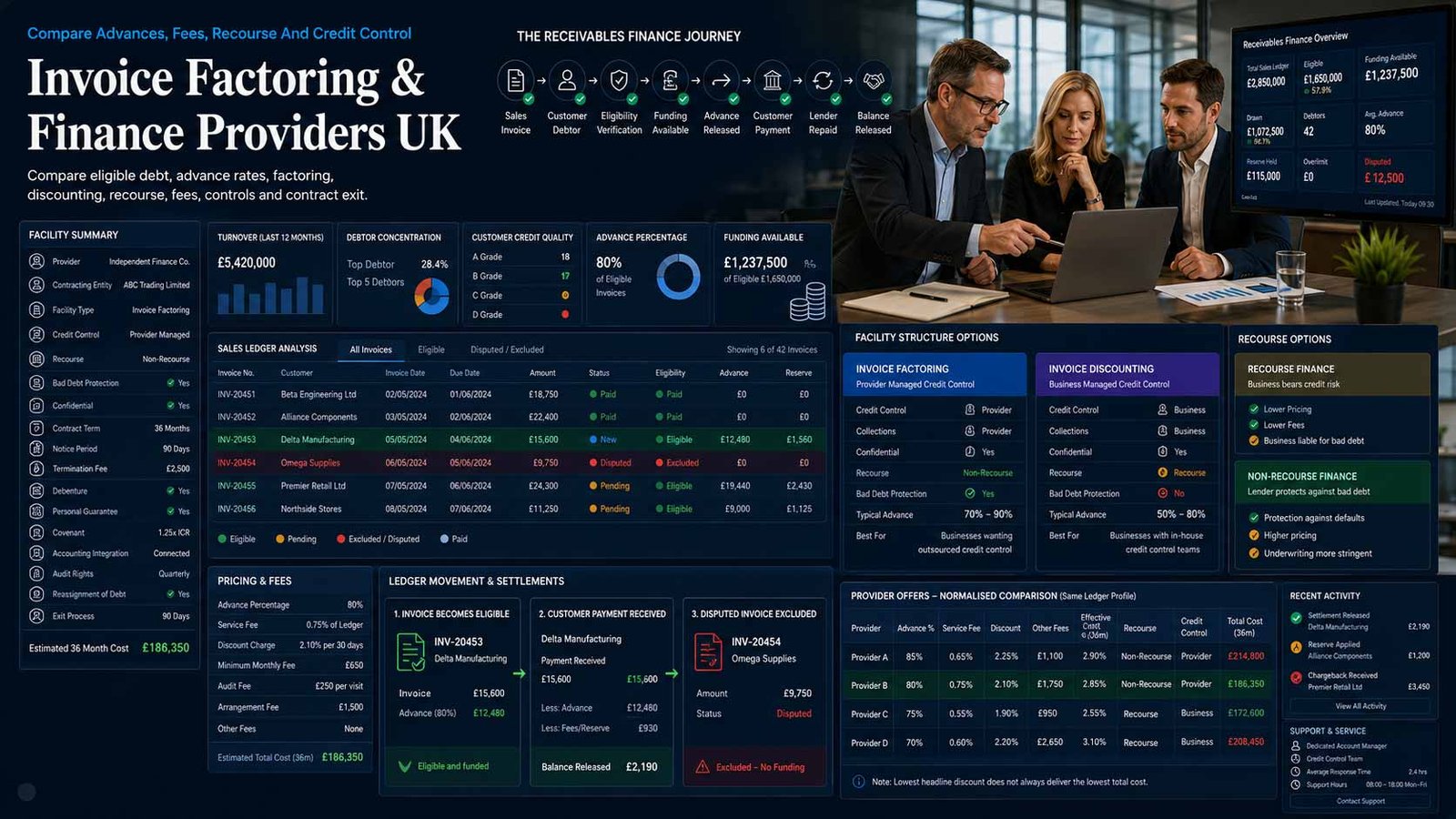
Finance Verified Receivables, Not General Borrowing
Invoice finance releases cash against eligible business invoices. The quality and collectability of the debtor book therefore matter as much as the applicant’s own financial position.
- Separate factoring from invoice discounting
- Calculate availability after exclusions and reserves
- Define who owns credit control and customer contact
- Model service fees, discount charges and exit together
Invoice finance is a receivables-based funding arrangement that provides earlier access to cash tied up in unpaid invoices. The provider advances an agreed proportion of eligible debt. The remaining balance is accounted for after customer payment, funding used, fees, credit notes, disputes and other agreed adjustments.
Invoice factoring normally combines funding with sales-ledger administration and collection. Invoice discounting normally leaves collection with the business. Facilities can be disclosed or confidential, whole-turnover or selective, recourse or supported by defined debtor protection. These differences change customer communication, internal workload, effective availability and cost.
This page compares invoice factoring and invoice-finance providers only. It does not compare general business loans or business credit cards. Those products have different underwriting, repayment and pricing structures and must remain separate from a receivables-finance evaluation.
Choose The Right Invoice-Finance Structure
The model determines who controls collections, whether customers are notified, which invoices are funded and how cost and risk are shared.
| Facility Model | What It Usually Provides | Best-Fit Question |
|---|---|---|
| Full-service invoice factoring | The provider advances eligible invoice value, administers the sales ledger and usually collects directly from customers | Does the business need outsourced credit control and is the customer-contact approach appropriate? |
| Confidential factoring | Funding and some ledger support are provided while customer-facing disclosure is reduced or managed through agreed processes | Which notices, trust-account arrangements and verification steps preserve confidentiality? |
| Disclosed invoice discounting | Funding is advanced against the ledger while the business remains responsible for collections and customers are notified of assignment | Does the finance team have strong credit control, reconciliation and reporting capability? |
| Confidential invoice discounting | The business retains collections and normally operates the facility without routine customer awareness | Can the business satisfy the provider’s controls, audits and ledger-quality requirements? |
| Whole-turnover invoice finance | The facility applies to most or all eligible invoices in the agreed ledger rather than selected transactions | What debt is excluded and how do minimum fees compare with expected utilisation? |
| Selective invoice finance | The business chooses particular invoices or customer accounts to finance when cash is required | Are transaction-level fees, eligibility rules and funding speed suitable for occasional use? |
| Export receivables finance | Eligible invoices due from overseas trade customers are funded, sometimes with collection or protection support | Which countries, currencies, debtors and cross-border documents are accepted? |
| Invoice finance with debtor protection | Funding is combined with agreed protection against specified customer insolvency or protracted default events | What percentage is protected, which limits and exclusions apply, and when does recourse return? |
Eight Areas That Determine Invoice-Finance Fit
Use the same ledger, debtor concentration, funding need, credit-control model and utilisation assumptions for every quote.
Comparison Criterion
Provider Identity, Standards And Contracting Entity
Identify the legal funder, any broker or introducer, the party purchasing or taking security over debts, and the applicable complaints process. Check whether the provider participates in the UK Finance Invoice Finance and Asset-Based Lending Standards Framework. Do not assume that bank branding or wider FCA authorisation makes every commercial term or complaint route equivalent.
Comparison Criterion
Eligibility, Underwriting And Debtor Quality
Compare minimum turnover, trading history, business-to-business invoice requirements, sectors, ownership, financial information, customer concentration, debtor credit quality, payment terms, contractual rights, disputes, contra-trading, construction applications, export exposure and existing security. Accurate disclosure is essential because availability can change when the real ledger differs from the application.
Comparison Criterion
Eligible Debt, Advance Percentage And Availability
Review the stated advance against the amount actually available after ineligible invoices, ageing limits, concentration restrictions, reserves, credit notes, dilution, retentions, stage payments, overdue accounts, disputed debts and funding already drawn. Require a worked availability calculation using the current aged-debtor ledger rather than relying on one headline percentage.
Comparison Criterion
Factoring, Discounting And Credit-Control Ownership
Decide whether the provider or the business will issue statements, chase debts, allocate cash, resolve queries, agree payment plans and escalate disputes. Confirm disclosed or confidential operation, customer notices, collection accounts, call standards, system access, service levels and how the arrangement affects important customer relationships.
Comparison Criterion
Service Fee, Discount Charge And Complete Cost
Separate the service or administration fee from the discount charge applied to funds used. Confirm the reference rate, margin, calculation basis, minimum fee, arrangement fee, audit charges, refactoring or collection fees, payment charges, credit-protection cost, legal costs, VAT treatment and early-termination exposure. Compare annual cost at realistic utilisation.
Comparison Criterion
Recourse, Reserves And Bad-Debt Protection
Establish who bears loss when a customer does not pay and when the provider can recourse an invoice back to the business. Review debtor limits, protection percentage, first loss, exclusions, dispute treatment, waiting periods, credit approvals, concentration, reserves, indemnities, personal or corporate guarantees and the effect of customer insolvency.
Comparison Criterion
Ledger Reporting, Audit And Systems Integration
Compare the client portal, daily availability, cash allocation, aged debt, funding requests, statements, fees, audit trail, accounting integration, file import, open-item reconciliation, credit-note controls, user permissions and data export. Confirm how often the provider audits the ledger and what happens when records are incomplete or systems fail.
Comparison Criterion
Contract Term, Covenants, Change And Exit
Review minimum term, notice, renewal, termination events, minimum utilisation, information covenants, prohibited changes, new entities, acquisitions, debtor-book changes, refinancing, debenture or security release, collect-out, termination fee, final reconciliation, outstanding disputes and return of any reserve. The exit process should be agreed before the facility goes live.
Measures To Define Before An Invoice-Finance Agreement Is Signed
Translate fast cash and high advances into auditable availability, cost, customer-service and risk evidence.
| Measure | What It Should Define | Evidence To Request | Common Weakness |
|---|---|---|---|
| Effective availability | Cash genuinely available after all eligibility tests and deductions | Gross debt, ineligible debt, concentration, advance, reserves, credits, prior draw and net availability | The headline advance is treated as available cash |
| Eligible-debt ratio | The proportion of the ledger accepted for funding | Invoice status, ageing, dispute, retention, contra, country, customer and contractual eligibility | A large ledger contains material unfundable balances |
| Debtor concentration | Exposure to the largest customers and limits placed on them | Top-customer balances, provider limits, excess treatment and replacement plan | Growth with one customer reduces availability unexpectedly |
| Dilution and credit-note rate | The extent to which invoices are reduced after issue | Credits, returns, rebates, disputes, write-offs and reason codes | Historical credits are excluded from cash-flow assumptions |
| Debt turn and ageing | How quickly customers pay and how old balances become | Invoice date, due date, payment date, overdue bands and trend | Availability is lost as debts pass the provider’s ageing limit |
| Funding utilisation | The average and peak amount drawn from the facility | Daily draw, repayment, reference rate, margin and unused availability | Annual cost is calculated using maximum rather than realistic use |
| Collection performance | How factoring or internal credit control converts invoices to cash | Contact activity, promises, disputes, payment plans, ageing movement and recovery | Customer-contact quality is not measured |
| Bad-debt protection | The amount genuinely protected after limits and exclusions | Approved debtor limit, protected percentage, first loss, exclusions, claim and payout | Non-recourse is assumed to cover commercial disputes |
| Ledger accuracy | Whether uploaded invoices and payments reconcile to accounting records | Invoice, credit, cash, allocation, control account, exception and audit trail | Errors create reserves, audit findings and delayed funding |
| Exit balance | Amounts and obligations remaining when the facility ends | Outstanding debt, funding, fees, collect-out, reserve, security and final statement | The new provider cannot take over until old security is released |
Invoice-Finance Providers UK Businesses Can Consider
Shortlist providers whose facility model, eligible-debt rules, credit-control service, risk appetite and contract fit the real debtor book. Confirm every live term directly before award.
Provider Profile
Bibby Financial Services
Bibby Financial Services is an independent specialist offering invoice factoring, invoice discounting and related receivables solutions for UK businesses. Include it where a buyer wants a broad specialist provider with credit-control options, sector experience and facilities that can develop as the ledger grows. Confirm eligible sectors and debtors, advance calculation, service and discount charges, minimum fees, collection model, debtor protection, concentration limits, audits, guarantees, contract term, export treatment, data integration, termination and the legal entity providing the facility.
Review official Bibby Financial Services invoice financeProvider Profile
Close Brothers Invoice Finance
Close Brothers Invoice Finance provides factoring, invoice discounting and receivables-led funding for UK business-to-business organisations. Include it where a buyer values a specialist funder, direct client management and a choice between outsourced and retained credit control. Confirm turnover and ledger criteria, eligible debt, concentration, advance, client service, discount charge, reference rate, minimum fee, audits, recourse, protection options, confidential operation, online reporting, security, linked facilities, contract term and collect-out arrangements.
Review official Close Brothers Invoice Finance invoice financeProvider Profile
HSBC Receivables Finance
HSBC offers invoice discounting and invoice finance with sales-ledger management through its UK business-banking receivables-finance range. Include it where an established business wants bank-backed receivables funding, multi-currency capability or the option to combine funding with collection support. Confirm the HSBC contracting entity, eligibility, ledger and debtor requirements, advance, currencies, concentration, recourse, credit protection, discount margin, service fees, collection responsibilities, audits, banking dependencies, security, portal, notice and final reconciliation.
Review official HSBC Receivables Finance invoice financeProvider Profile
Lloyds Bank Invoice Finance
Lloyds Bank provides invoice-finance solutions designed to release funds against unpaid invoices, with confidential invoice discounting and optional debtor-protection support. Include it where a UK business wants a bank-led facility, sector expertise and funding that can increase with an eligible debtor book. Confirm application criteria, stated and effective advance, UK and overseas debt, debtor limits, discount and service charges, protection terms, reserves, audit frequency, security, bank-account requirements, portal controls, contract term, rate variation and exit.
Review official Lloyds Bank Invoice Finance invoice financeProvider Profile
NatWest Invoice Finance
NatWest offers invoice discounting and wider invoice-finance support for eligible businesses, including online facility management. Include it where a business has established in-house credit control and wants a bank-led confidential discounting facility. Confirm current turnover thresholds, eligible invoice types, advance, multiple currencies, concentration, ledger-system expectations, discount charge, service fee, minimums, audits, covenants, recourse, debtor protection, FacFlow operation, security, banking relationship, notice and collect-out.
Review official NatWest Invoice Finance invoice financeProvider Profile
Aldermore Invoice Finance
Aldermore provides invoice factoring and invoice discounting facilities for growing UK businesses, with funding linked to eligible unpaid invoices. Include it where a buyer wants a specialist bank with both credit-control and confidential-ledger options. Confirm eligibility, up-to-date advance terms, debt-turn requirements, reserves, set-off, concentration, service fee, discount charge, minimum fee, audits, debtor protection, collection responsibilities, security, accounting integration, variation rights, contract term and release of security at exit.
Review official Aldermore Invoice Finance invoice financeProvider Profile
Time Finance
Time Finance offers invoice factoring and invoice discounting to UK SMEs, with optional credit-control support and facilities linked to the sales ledger. Include it where a smaller or mid-sized business wants direct access to an independent finance provider and a choice between disclosed factoring and confidential discounting. Confirm facility size, sector appetite, eligibility, advance, reference rate and margin, service fee, minimums, debtor limits, recourse, bad-debt options, audit and reporting, guarantees, term, notice and settlement on termination.
Review official Time Finance invoice financeProvider Profile
eCapital UK
eCapital UK provides invoice finance, invoice discounting and selective invoice-finance options for businesses that need working capital against receivables. Include it where a buyer wants flexibility over whole-ledger or selected-customer funding and specialist support for more complex cash-flow requirements. Confirm the UK contracting entity, eligible debts, selection rules, advance, funding frequency, service and discount costs, concentration, reserves, credit control, debtor protection, audits, security, digital reporting, minimum commitment, cancellation and data export.
Review official eCapital UK invoice financeWhat Changes Invoice Factoring And Finance Cost
Cost depends on service depth, funding used, ledger quality, debtor risk, minimum commitments and the work required to manage the facility.
| Cost Driver | Why It Changes Spend | What A Comparable Quote Should Show |
|---|---|---|
| Service or administration fee | Pays for facility administration, ledger handling and, for factoring, credit-control activity | Percentage or fixed basis, turnover definition, minimum, included services, review points, VAT treatment and annual estimate |
| Discount charge | Applies to the amount of funding used and operates similarly to interest on a revolving balance | Reference rate, provider margin, daily calculation, compounding, floor, change notice, utilisation and annual scenario |
| Reference-rate movement | A variable reference rate can alter cost even when the provider margin remains unchanged | Named rate, reset frequency, floor, notification, margin and sensitivity at higher and lower utilisation |
| Arrangement and legal fees | Initial due diligence, documentation, security and onboarding can create one-off cost | Arrangement, legal, valuation, registration, third-party, renewal and amendment fees with VAT |
| Minimum fees and minimum utilisation | A low-use facility can still incur contracted minimum charges | Monthly, quarterly or annual minimum, turnover covenant, shortfall method, review and waiver conditions |
| Audit and survey fees | Providers may inspect the ledger, systems, customer evidence and controls before and during the facility | Frequency, included visits, remote or onsite basis, day rate, expenses, failed-audit consequences and reinspection |
| Credit-control and collection services | Factoring can include statements, chasing, cash allocation and query handling | Included activities, contact frequency, dedicated team, collection fee, refactoring fee, legal escalation and service levels |
| Debtor protection or credit insurance | Optional protection against defined non-payment events adds cost and underwriting conditions | Protected percentage, debtor limit, first loss, exclusions, waiting period, disputes, premium basis and claim process |
| Reserves, concentration and ineligible debt | These reduce cash availability even when the nominal advance percentage appears high | Concentration threshold, ageing, dilution, retentions, contra, disputes, export debt, reserves, review and worked availability |
| Termination and collect-out | Leaving can trigger notice costs while the provider continues collecting or controlling the ledger | Notice, early termination, minimum-period charge, collect-out fee, security release, final audit, reserve retention and final statement |
How Ledger Quality And Internal Capability Change The Shortlist
The right facility depends on customer type, invoice validity, debtor concentration, credit-control capability, utilisation, disclosure preference and cash-flow tolerance.
Smaller B2B Business With Limited Credit Control
Prioritise full-service factoring, clear customer-contact standards, simple ledger submission, transparent minimum fees, practical debtor limits and responsive support. Test whether outsourced collections improve cash flow without harming key customer relationships.
Established Business With A Strong Finance Team
Prioritise confidential invoice discounting, detailed availability reporting, accounting integration, competitive discount margin, flexible debtor limits, low administration burden and controls that allow the business to retain credit-control ownership.
Fast-Growth Or Working-Capital-Intensive Business
Prioritise a facility that grows with eligible sales, tolerates seasonal peaks, supports customer concentration, provides rapid funding, handles credit notes and dilution accurately and can be amended without repeated disruption as turnover, entities or sectors change.
Exporter Or Multi-Currency Debtor Book
Prioritise country and debtor eligibility, currency funding and settlement, export collections, cross-border documentation, concentration, bad-debt protection, reporting and a clear boundary between receivables finance and separate trade-finance products.
How To Compare Invoice-Finance Proposals
Give every provider the same aged-debtor ledger, customer concentration, credit-note history, bad debts, monthly funding need, credit-control preference and contract requirements. Require a standardised availability and annual-cost schedule.
- The funder, broker and applicable standards are identified
- Eligibility and reserves are applied to the same ledger
- Service and discount charges use the same utilisation
- Credit-control and customer-contact responsibilities are explicit
- Recourse, protection and disputes are modelled separately
- Security, collect-out and exit are documented
Compare Net Cash, Not One Advance Percentage
Apply exclusions, concentration, reserves, credit notes and current funding before deciding how much working capital is genuinely available.
Then compare the annual cost of using that amount.
Six Questions To Put To Every Invoice-Finance Provider
The answers expose weak eligibility, overstated availability, hidden cost, unclear customer control and difficult exits.
Which Debts Are Actually Eligible?
Ask for ageing, customer, country, currency, dispute, retention, stage-payment, concentration and contractual exclusions, then test them against the current ledger.
How Is Daily Availability Calculated?
Request a worked example showing gross eligible debt, advance, reserves, concentration, credit notes, dilution, prior funding and the amount available to draw.
Who Controls Customers And Collections?
Confirm disclosed or confidential operation, notices, statements, calls, payment plans, collection account, query handling, complaints and escalation ownership.
What Is The Complete Annual Cost?
Require service fee, discount charge, reference rate, minimums, arrangement, audits, protection, payments, collections, legal, amendment and exit costs at realistic utilisation.
When Does Recourse Or A Reserve Apply?
Review non-payment, disputes, insolvency, overdue debt, breach, concentration, credit-limit withdrawal, fraud, dilution and the timing for recourse or reserve release.
What Happens When We Switch Or Leave?
Confirm notice, collect-out, customer communication, outstanding invoices, reserve, security release, final audit, data export, reconciliations and continuing chargebacks or disputes.
A Seven-Stage Invoice-Finance Evaluation
Move from a clean ledger and defined operating model to a controlled facility, rather than accepting a quote based on turnover alone.
- Collect at least twelve months of aged-debtor data, invoices, credit notes, disputes, bad debts, payment history, concentration, customer contracts, current finance documents and monthly cash-flow requirements.
- Define whether the business needs factoring, invoice discounting, disclosed or confidential operation, whole-turnover or selective use, credit control, debtor protection, export support and target availability.
- Clean the ledger by separating overdue, disputed, retention, stage, contra, intercompany, consumer, overseas, concentration and other potentially ineligible balances before issuing the request.
- Issue one written data pack and require every provider to return a standard schedule covering eligibility, advance, reserves, services, all fees, recourse, protection, reporting, security, term and exit.
- Normalise each proposal using the same ledger and monthly utilisation. Calculate effective availability, total annual cost, cash-flow benefit, internal effort and cost if the reference rate rises.
- Complete legal, financial, customer-contract and operational due diligence; verify notices, collection accounts, accounting integration, permissions, fraud controls, audit process and migration plan.
- Operate the facility through daily reconciliation, debtor-limit control, credit-note discipline, monthly fee review, covenant reporting, customer-service monitoring, audit readiness and an annually refreshed exit plan.
Invoice Factoring And Finance Comparison Checklist
Use this table before approving a factoring, invoice-discounting, selective, confidential or debtor-protected facility.
| No. | Requirement | Evidence To Obtain Before Award | Confirmed |
|---|---|---|---|
| 01 | Funding objective and accountable owner agreed | Cash-flow need, growth plan, facility type, finance owner, credit-control owner, approver and review date | |
| 02 | Aged-debtor ledger validated | Invoice date, due date, amount, customer, currency, dispute, credit note, retention, stage and payment history | |
| 03 | Customer concentration assessed | Top debtors, connected parties, sectors, countries, credit limits, payment behaviour and replacement customers | |
| 04 | Eligible-debt rules documented | Ageing, contracts, disputes, contra, retentions, stage payments, consumer debt, export debt and exclusions | |
| 05 | Advance and availability model completed | Gross debt, eligible debt, advance, concentration, reserves, dilution, existing draw and available funds | |
| 06 | Factoring or discounting model selected | Credit-control ownership, disclosure, notices, collection account, customer communications and service levels | |
| 07 | Complete fee schedule received | Service, discount, reference rate, minimum, arrangement, audit, protection, payment, collection, legal and exit fees | |
| 08 | Recourse and protection terms approved | Recourse period, debtor limits, insolvency, protracted default, disputes, exclusions, first loss and claims | |
| 09 | Reserves and security accepted | Reserve, concentration, set-off, debenture, guarantees, bank mandates, covenants and release conditions | |
| 10 | Portal and integration tested | Invoice upload, accounting link, availability, cash allocation, statements, users, MFA, exports and audit trail | |
| 11 | Audit and reporting obligations understood | Initial survey, ongoing audit, frequency, fees, records, exceptions, remediation and information deadlines | |
| 12 | Customer-contract assignment reviewed | Assignment restrictions, notices, public-sector or framework terms, confidentiality, disputes and legal advice | |
| 13 | Contract and variation rights accepted | Minimum term, renewal, notice, rate changes, minimum turnover, breach, amendments and termination events | |
| 14 | Annual cost and cash-flow impact compared | Realistic utilisation, reference-rate sensitivity, minimum fees, reserves, internal staff, tax and transition cost | |
| 15 | Switch, collect-out and exit plan agreed | Customer notices, outstanding debts, final audit, reserve, security release, data export, reconciliation and closure |
Common Invoice-Finance Buying Mistakes
Most avoidable failures begin with an unclean ledger, a headline-rate comparison or weak control of customer contact, recourse and exit.
| Mistake | Why It Creates Risk | Better Control |
|---|---|---|
| Comparing only the headline advance | Reserves, concentration and ineligible debt can make effective availability much lower | Use the current ledger for a worked calculation |
| Treating factoring and discounting as interchangeable | They place credit control, customer communication and administration with different parties | Choose the operating model before requesting prices |
| Sending an unclean ledger | Disputed, overdue or concentrated debts distort quotations and later availability | Classify every material balance first |
| Ignoring minimum fees | Low utilisation can produce a high effective cost despite an attractive rate | Model the contracted minimum over twelve months |
| Comparing discount margins without the reference rate | Different bases, floors and calculation methods prevent a fair comparison | Standardise the rate and utilisation assumptions |
| Assuming debtor protection covers every non-payment | Disputes, excluded debtors, withdrawn limits and procedural failures can prevent recovery | Review limits, exclusions and claim duties |
| Underestimating customer impact | Poor collection conduct or unclear notices can damage important relationships | Agree scripts, service levels and escalation |
| Overlooking audit and covenant duties | Late or inaccurate information can reduce availability or trigger breach | Assign owners and maintain audit-ready records |
| Signing before reviewing assignment restrictions | Customer contracts can complicate debt assignment or notification | Complete contract review and obtain advice |
| Planning the exit after notice is served | Collect-out, security release and outstanding debt can delay refinancing | Agree a transition plan at implementation |
Frequently Asked Questions
Answers to common questions from UK businesses comparing factoring, invoice discounting and receivables-finance providers.
What Is Invoice Factoring?
Invoice factoring is a form of invoice finance in which a provider advances an agreed percentage of eligible unpaid business invoices and normally manages sales-ledger administration and customer collections. When the customer pays, the provider releases the remaining eligible balance after agreed fees, funding and other deductions.
What Is The Difference Between Factoring And Invoice Discounting?
Both release funding against eligible invoices. With factoring, the provider normally manages credit control and collects from customers. With invoice discounting, the business usually retains responsibility for its sales ledger and collections. Discounting may be confidential where the provider’s involvement is not routinely disclosed.
How Much Of An Invoice Can A Business Receive In Advance?
Many UK providers advertise advances of up to around 90% of eligible invoice value, subject to underwriting. The effective amount can be lower after ageing rules, concentration, reserves, credit notes, disputes and other ineligible debt. Compare a worked availability calculation using the real ledger.
How Much Does Invoice Finance Cost?
Typical cost components include a service or administration fee, a discount charge on funding used, a reference rate, minimum fees, arrangement and legal costs, audits, payments, credit protection and termination charges. Compare the total annual cost at realistic utilisation rather than one percentage.
Will Customers Know That A Business Uses Invoice Finance?
It depends on the facility. Factoring is commonly disclosed because the provider manages collections. Confidential invoice discounting is designed so the business continues collecting in its own name, although legal notices, verification or trust-account arrangements can still apply. Confirm the exact process.
Which Invoices Are Usually Eligible For Funding?
Providers commonly focus on valid business-to-business invoices for completed goods or services. Overdue, disputed, concentrated, retention, stage-payment, contra, intercompany, consumer or certain overseas debts may be restricted or excluded. Eligibility varies by provider, sector, contract and debtor quality.
What Happens If A Customer Does Not Pay?
Under a recourse facility, the business usually remains responsible and the invoice may be charged back after an agreed period. Debtor protection can cover defined insolvency or protracted-default events, subject to limits, exclusions and procedures. Commercial disputes are commonly excluded.
Is Invoice Finance Regulated By The FCA?
Commercial invoice-finance protections can differ from regulated consumer financial products. Some providers are banks or authorised firms for other activities, but buyers should ask which rules, standards, complaints process and compensation arrangements apply specifically to the proposed facility. UK Finance maintains a Standards Framework for participating IF/ABL members.
Can A New Business Use Invoice Factoring?
Some providers can consider newer businesses where there is a genuine business-to-business debtor book and creditworthy customers. Approval depends on ownership, contracts, invoicing evidence, sector, debtor quality, concentration, controls and the provider’s risk appetite. Minimum fees can be important for a small ledger.
How Should A UK Business Compare Invoice Finance Providers?
Give every provider the same aged-debtor ledger, customer concentration, invoice profile, credit notes, disputes, funding need and service requirement. Compare effective availability, complete annual cost, credit-control model, recourse, protection, reporting, audits, security, contract changes and exit—not only the advance rate.
Official Guidance And Invoice-Finance Provider Resources
Reviewed by Bhav Giva, Founder & Lead Analyst at CompareServices.co.uk, on 30 July 2026.
Use the British Business Bank, UK Finance Standards Framework, HMRC guidance and official provider documentation to confirm current product, eligibility, fee, service, tax and contract requirements. Provider appetite, reference rates, debtor limits and facility terms can change.
- British Business Bank — Invoice Finance
- British Business Bank — Invoice Finance Checklist
- UK Finance — Invoice Finance And Asset-Based Lending Standards Framework
- UK Finance — Invoice Finance And Asset-Based Lending
- HMRC — VAT Notice 701/49: Finance
- Bibby Financial Services — Invoice Finance
- Close Brothers Invoice Finance — Invoice Finance
- HSBC UK — Receivables Finance
- Lloyds Bank — Invoice Finance
- NatWest — Invoice Finance
- Aldermore — Invoice Finance
- Time Finance — Invoice Finance
- eCapital UK — Invoice Finance