
Compare Foreign Exchange / International Payments Providers UK (2026)
Compare Exchange Rates, Payment Routes, Multi-Currency Accounts, Forward Contracts, Controls And Complete Cost
Compare business foreign exchange UK providers by legal entity, FCA permissions, executable exchange rate, provider margin, transfer and intermediary fees, supported currencies, local and SWIFT payment routes, beneficiary amount, delivery timing, multi-currency balances, incoming collections, forward contracts, batch payments, API capability, approval controls, fraud prevention, safeguarding, support and complete annual cost. Use the same currency pair, amount and quote time for every provider.
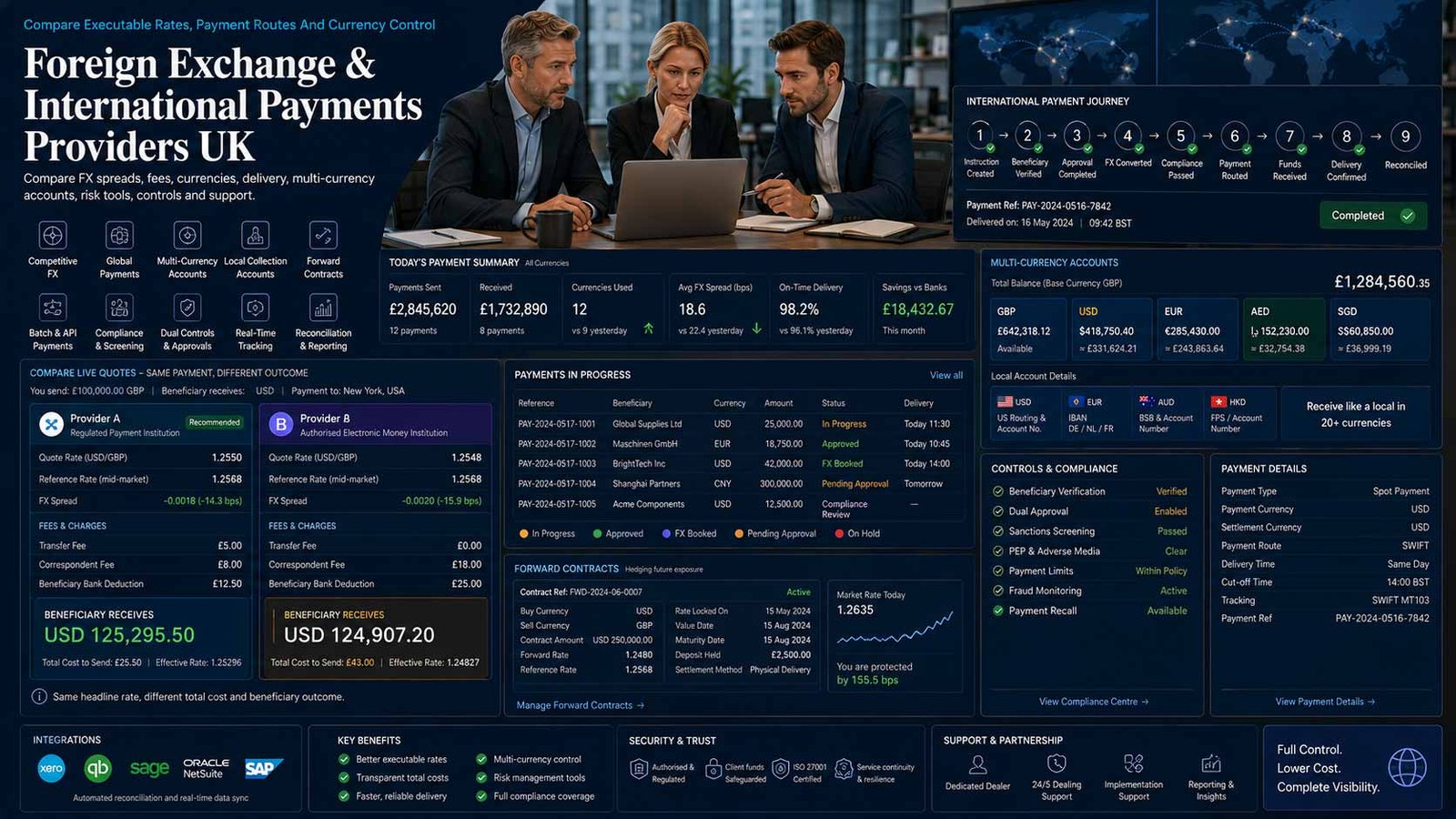
Compare The Executable Rate, Not A Marketing Rate
Foreign exchange cost is determined by the rate the business can actually execute, the amount converted, every payment charge and the amount the beneficiary receives.
- Time-stamp every comparable quote
- Separate the market reference from provider margin
- Include SWIFT and intermediary-bank deductions
- Verify the regulated entity and funds protection
Business foreign exchange and international payments services help UK organisations convert currencies, send and receive cross-border payments, hold selected currency balances and manage the financial risk created by future foreign-currency cash flows.
The provider may be a bank, authorised payment institution, electronic-money institution or specialist foreign-exchange firm. Different legal entities can provide the account, safeguard funds, execute currency conversions, deliver payments or offer forward contracts. Buyers should map that chain before transferring material balances or entering future-dated obligations.
This page compares foreign exchange and international business payments only. It does not compare card acquiring, merchant accounts, payment gateways or domestic business bank accounts. Those services may connect to international operations, but their pricing, regulation and operational requirements belong on separate comparison pages.
Choose The Right International Payment And FX Structure
The appropriate model depends on whether the business pays, receives, holds, batches or hedges foreign currency—and how much operational control it requires.
| Service Model | What It Usually Provides | Best-Fit Question |
|---|---|---|
| Spot international payment | The business buys or sells currency at an agreed live rate for near-term settlement and sends the resulting funds to an overseas beneficiary. Spot payments suit known invoices where the amount and payment date are already fixed. | Does the quote show the provider margin, transfer fee, correspondent deductions, settlement date and exact amount expected by the beneficiary? |
| Multi-currency account and local collection details | The provider supplies named or virtual account details in selected currencies so the business can receive, hold, convert and pay funds without converting every receipt immediately. | Which legal entity holds the funds, which currencies have local details, and how are safeguarding, access, dormancy and account closure handled? |
| Forward contract for commercial exposure | The business agrees an exchange rate for a future payment or receipt connected to genuine trade, payroll, property, investment or another permitted commercial purpose. A deposit, variation margin or credit line may be required. | Does the business understand the maturity, drawdown, collateral, cancellation and adverse-market consequences rather than treating a forward as a guaranteed saving? |
| Market order and rate alert | The provider monitors the market and executes or alerts when a target rate is reached, subject to the agreed order terms and available liquidity. | Who controls execution, can the order be amended or cancelled, and what happens during fast markets, gaps or unavailable currency routes? |
| Regular supplier, payroll or contractor payments | The business schedules repeated transfers to overseas suppliers, employees or contractors, potentially using templates, approval rules or batch files. | Can finance preserve beneficiary verification, payment purpose, invoice reference, approval evidence and payroll confidentiality at scale? |
| Mass payments and API-led payouts | The provider processes bulk files or API instructions for marketplaces, platforms, payroll providers, refunds or high-volume supplier payments. | What validation, idempotency, duplicate prevention, sanctions screening, reconciliation, failure handling and service support are included? |
| Incoming international receipts and collections | The business receives customer or marketplace funds in foreign currencies and either holds them, converts them or pays them onward. | Are payer references, local collection routes, returned-payment handling, source-of-funds evidence and reconciliation sufficient for the sales model? |
| Treasury and currency-risk programme | A larger business combines spot, forwards, balances, exposure reporting, policy limits, forecasting and dealing support across entities or currencies. | Does the provider support a documented hedging policy, delegated authority, counterparty limits, independent valuation and board-level reporting? |
Eight Areas That Determine Provider Fit
Use the same currencies, amounts, quote time, payment routes, beneficiary assumptions, user controls and forward scenarios for every provider.
Comparison Criterion
Provider Identity, Permissions And Contracting Entity
Identify the brand, contracting company, payment institution, e-money institution, bank, appointed agent, FX counterparty and any separate platform or liquidity provider. Check the FCA Register and the permissions relevant to payment services, e-money and any hedging products. A familiar trading name does not prove which legal entity holds funds or executes the conversion.
Comparison Criterion
Exchange Rate, Spread And Quote Transparency
Compare the reference rate, provider margin, time stamp, quote validity, minimum fee, transfer charge, currency-pair pricing, weekend treatment and how the recipient amount is calculated. “No transfer fee” can still include a material exchange-rate margin, while a mid-market reference does not guarantee that every currency or route is priced the same way.
Comparison Criterion
Payment Routes, Currencies And Delivery Certainty
Review supported send and receive currencies, local rails, SWIFT, SEPA, cut-off times, same-day availability, intermediary banks, beneficiary-bank deductions, payment tracking, returns, recalls and proof of delivery. A wide country list is less useful if the business’s priority routes are slow, unsupported or dependent on correspondent banks.
Comparison Criterion
Multi-Currency Balances, Collections And Reconciliation
Assess named account details, virtual accounts, local collection capability, permitted payer types, balance currencies, conversion controls, interest treatment, statements, references and mapping to invoices or entities. Confirm whether the service is an account, e-money wallet or payment arrangement rather than assuming it is a domestic business bank account.
Comparison Criterion
Beneficiary, Fraud, Sanctions And Approval Controls
Compare beneficiary verification, dual approval, role-based access, MFA, payment limits, trusted recipients, callback procedures, bank-detail change controls, device security, sanctions screening, transaction monitoring and incident response. International payments are difficult to recover, so preventive controls should be tested before live use.
Comparison Criterion
Forward Contracts, Orders And Currency-Risk Tools
Where the provider offers forwards, limit orders or other risk tools, review eligibility, permitted purpose, term, drawdown, deposit, margin calls, credit limits, early close-out, cancellation, extension and valuation. These tools can support budget certainty but can create losses or liquidity demands when the underlying exposure changes.
Comparison Criterion
Workflow, Batch Payments, APIs And Accounting Integration
Review payment templates, bulk upload, maker-checker approval, API authentication, duplicate controls, scheduled payments, ERP or accounting connections, webhooks, statement exports, reconciliation, failed-payment queues and audit logs. Automation should preserve accountability and payment evidence rather than simply move errors faster.
Comparison Criterion
Funds Protection, Service Resilience And Exit
Confirm whether eligible funds are bank deposits or safeguarded payment/e-money funds, where balances are held, insolvency treatment, operational resilience, outage communication, support hours, complaint route, data export, open forwards, outstanding payments, beneficiary records and closure. FSCS protection should never be assumed for a non-bank payment provider.
Measures To Define Before A Provider Is Selected
Translate low-fee and fast-payment claims into auditable rate, cost, delivery, control and risk evidence.
| Measure | What It Should Define | Evidence To Request | Common Weakness |
|---|---|---|---|
| Effective FX rate | The actual foreign currency delivered divided by the sterling cost, after all provider and payment-route charges | Quoted reference rate, provider margin, transfer fee, intermediary deduction, beneficiary amount and time stamp | The provider presents a market rate without the executable customer rate |
| Total payment cost | Every direct and indirect cost of sending or receiving the defined payment | FX margin, fixed fee, receiving fee, SWIFT fee, correspondent charge, platform cost and internal effort | A zero-fee claim excludes the exchange-rate spread |
| Payment delivery time | Elapsed time from approved instruction and cleared funds to beneficiary availability | Instruction time, cut-off, funding, route, intermediary, recipient credit, exception and confirmation | Provider completion is mistaken for beneficiary receipt |
| Beneficiary amount certainty | Whether the recipient receives the invoiced amount without unexpected deductions | Payment method, charge instruction, intermediary banks, receiving-bank fee, currency and invoice amount | Shared charges leave the supplier underpaid |
| Conversion timing control | Whether authorised users convert at the intended rate and within policy | Exposure, quote, approver, execution time, reason, rate, settlement and exception | Finance cannot distinguish planned conversions from ad hoc dealing |
| Forward coverage and maturity match | How closely contracted forwards match the amount and timing of real commercial exposures | Forecast, committed invoice, hedge amount, maturity, drawdowns, amendments and residual exposure | Over-hedging creates a new speculative exposure |
| Failed and returned payment rate | The number and value of payments delayed, rejected or returned | Beneficiary data, compliance request, reason code, fees, repair, return date and owner | Failures are closed without identifying repeated data or route problems |
| Reconciliation completion | Whether payments and receipts are matched to invoices, entities and accounting records | Payment ID, beneficiary or payer, invoice, currency, fees, rate, journal, exception and closure | One net bank entry obscures multiple payments and FX costs |
| Fraud-control adherence | Whether changes and high-risk payments follow the defined approval and verification process | Beneficiary creation, bank-detail change, approvers, callback, device, limit, alert and outcome | Urgent payment exceptions bypass maker-checker controls |
| Provider and counterparty exposure | The amount of money, open trades and operational dependency held with each provider | Balances, unsettled payments, forwards, deposits, credit lines, safeguarding entity and limit | The business concentrates funds and hedges with one provider without limits |
Foreign Exchange And International Payment Providers UK Businesses Can Consider
Shortlist providers whose currencies, payment routes, pricing, balances, risk tools and control model fit the business. Confirm live terms and the exact regulated entity directly before use.
Provider Profile
Wise Business
Wise Business provides an international account for paying, receiving, holding and converting currencies, with transparent transaction pricing, local account details in supported markets, batch payments and accounting integrations. Include it where an SME values self-service execution and visible fees for routine international supplier, contractor or customer flows. Confirm the Wise contracting entity, FCA permissions, safeguarding, available currencies and local details, one-off setup or transaction charges, exchange pricing by pair and volume, transfer route, recipient deductions, account access, payment limits, approval roles, API or batch capability, support, restricted activities and the treatment of balances if the account is closed.
Review official Wise Business servicesProvider Profile
Airwallex
Airwallex provides multi-currency business accounts, international transfers, local collection details, cards and payment infrastructure for businesses operating across markets. Include it where a company wants one platform for receiving, holding and paying currencies alongside broader finance operations. Confirm the UK contracting and regulated entities, safeguarding, supported collection and payout routes, FX mark-ups, platform or plan fees, payment cut-offs, intermediary charges, beneficiary controls, account permissions, batch and API functions, ERP integrations, support, prohibited sectors, balance access and the commercial separation between international payments, cards and online payment acceptance.
Review official Airwallex UK business accountProvider Profile
Revolut Business
Revolut Business offers multi-currency balances, currency exchange and international transfers within tiered business plans, with team permissions and finance-platform features. Include it where a digitally managed company wants frequent conversions, local and international transfers and integrated controls. Confirm the exact Revolut legal entity and UK permissions, whether funds are bank deposits or e-money for the selected arrangement, plan allowances, exchange and transfer charges outside allowances, market-hour and weekend treatment, supported currencies and destinations, SWIFT charges, payment limits, approval flows, account access, support, fair-use conditions and any transition between regulated entities.
Review official Revolut Business transfersProvider Profile
WorldFirst
WorldFirst provides international business payments, multi-currency collection and holding through its World Account, with a strong focus on UK SMEs, online sellers and overseas supplier payments. Include it where a business receives from marketplaces or customers and pays suppliers across several markets. Confirm the WorldFirst contracting entity, FCA permissions, safeguarding, supported local collection currencies, payment destinations, FX margin and promotional pricing conditions, transfer fees, same-day eligibility, beneficiary deductions, account permissions, approval controls, integrations, funding services, restricted sectors, support, account dormancy and closure.
Review official WorldFirst UK servicesProvider Profile
Moneycorp
Moneycorp provides corporate foreign exchange, international payments, multi-currency account capability, bulk payments, APIs and risk-management tools including spot and forward contracts. Include it where a business values dealer support and a structured approach to recurring commercial exposures. Confirm the Moneycorp contracting and regulated entities, payment and hedging permissions, safeguarding, rate margin, transfer fees, forward eligibility, deposit or margin requirements, cancellation and extension rights, payment routes, batch controls, online permissions, API support, complaint process, counterparty exposure, restricted currencies and the treatment of open contracts if the relationship ends.
Review official Moneycorp business servicesProvider Profile
Equals Money
Equals Money provides international business payments, multi-currency balances, spot trades, forward contracts, mass payments and dedicated account support. Include it where a UK organisation wants specialist FX service combined with payment workflows and operational finance tools. Confirm the Equals contracting entity and FCA status, safeguarding, supported currencies, local account details, payment rails, FX margin, platform charges, forward-contract purpose and term, deposits or variation requirements, approval roles, mass-payment validation, account access, support, cards or domestic services kept outside this comparison, data export and exit treatment.
Review official Equals Money international paymentsProvider Profile
Convera
Convera provides cross-border business payments, currency conversion, holding balances, receivables and risk-management services for SMEs, institutions and larger organisations. Include it where a business needs broad global payment reach, collection options, batch processing and supported currency-risk management. Confirm the UK Convera contracting entity, FCA permissions, safeguarding or client-money treatment, payment currencies and countries, pricing, receiving options, forward and order terms, collateral, cut-offs, intermediary deductions, user access, platform and API controls, sanctions and compliance requests, service support, complaints, open-trade valuation and final settlement on closure.
Review official Convera global paymentsProvider Profile
Corpay Cross-Border
Corpay Cross-Border provides international payments, multi-currency accounts, payment automation and currency-risk management for SMEs and larger global organisations. Include it where a company wants dealer support, treasury workflows and scalable global payment operations. Confirm the UK contracting entity and permissions, safeguarding, currencies and settlement routes, pricing, payment-tracking, local account availability, forward and hedging eligibility, collateral and credit terms, approval workflows, invoice or ERP automation, API security, sanctions controls, service levels, account-manager responsibilities, data portability and the treatment of balances and open contracts at exit.
Review official Corpay Cross-Border servicesWhat Changes Foreign Exchange And International Payment Cost
Compare how much foreign currency is delivered for the same sterling cost, then add payment-route, account, hedging and operating charges.
| Cost Driver | Why It Changes Spend | What A Comparable Quote Should Show |
|---|---|---|
| Exchange-rate margin | The provider may add a percentage or points to a market or wholesale reference rate | Reference rate, executable rate, margin, currency pair, amount tier, time stamp and quote validity |
| Transfer and payment-route fees | Local rails, SWIFT, urgent payments or special routes can carry fixed charges | Sending fee, receiving fee, SWIFT charge, priority fee, correspondent treatment and payer option |
| Intermediary and beneficiary-bank deductions | Correspondent or receiving banks may deduct fees before the payment reaches the supplier | Charge instruction, expected recipient amount, likely deductions, payment route and repair process |
| Account or platform plans | Some services charge setup, monthly, user, account, API or premium-support fees | Plan, included currencies and transfers, users, integrations, overage, support and annual cost |
| Incoming payment and local-account fees | Receiving, collecting or holding currencies can have per-payment or account charges | Local details, SWIFT receipts, sender type, currency, fee, conversion requirement and return fee |
| Forward-contract pricing and collateral | The forward rate reflects interest-rate differences and provider pricing; deposits or margin may restrict cash | Contract rate, amount, maturity, drawdown, deposit, variation margin, extension, close-out and credit cost |
| Batch, API and automation costs | High-volume files, API usage, ERP connections or implementation can create fixed and usage charges | Implementation, licence, transaction fee, support, testing, maintenance, failure and internal resource |
| FX options or specialist risk tools | Optional risk products can involve premiums, limits, complex terms or suitability checks | Product, purpose, premium, participation, maximum loss, expiry, exercise and provider permissions |
| Failed, returned or amended payments | Incorrect beneficiary data, compliance holds, recalls and cancellations can cause extra charges | Repair, trace, recall, cancellation, return, compliance review, re-send and exchange difference |
| Internal treasury and control cost | Forecasting, approvals, reconciliation, audit and exception handling consume finance time | Users, payment volume, approval time, reconciliation, support cases, training and control review |
How International Cash Flow Changes The Shortlist
The right provider depends on whether the business imports, exports, pays people, manages multiple entities or operates a formal treasury policy.
Importer Paying Overseas Suppliers
Prioritise executable landed cost, beneficiary amount certainty, supplier currencies, payment cut-offs, recurring templates, purchase-order references and forward capability for committed imports. Model currency movement between order, shipment and payment dates.
Exporter Receiving Foreign Currency
Prioritise local receiving details, payer references, balance currencies, conversion timing, reconciliation, refund capability and the ability to match receipts to customer invoices without automatic conversion or unexpected deductions.
International Payroll Or Contractor Business
Prioritise batch accuracy, beneficiary validation, payment deadlines, supported countries, local rails, payroll confidentiality, approval segregation, returned-payment handling and reliable evidence for every employee or contractor.
Multi-Entity Or Treasury-Led Group
Prioritise entity-specific accounts, currency balances, delegated dealing limits, exposure reporting, forward books, credit and collateral, APIs, independent reconciliation, counterparty limits, audit logs and controlled provider diversification.
How To Compare FX And Payment Quotes
Give every provider the same currency pairs, payment amounts, dates, recipient countries, payment routes, incoming-currency needs, user roles, batch volumes and sample forward exposures. Require a standardised cost and controls schedule.
- The contracting and regulated entities are identified
- Quotes use the same amount and time stamp
- The expected beneficiary amount is stated
- All transfer and intermediary charges are included
- Forward collateral and close-out terms are modelled
- Safeguarding, fraud controls and exit are documented
Time-Stamp Every FX Comparison
A quote taken at 09:00 cannot be fairly compared with another taken after the market has moved.
Record the reference rate, executable rate, provider margin, total sterling cost and expected beneficiary amount at the same time.
Six Questions To Put To Every Provider
The answers expose unclear legal entities, incomplete pricing, weak beneficiary controls and forward terms that can create liquidity risk.
Which Legal Entity Holds And Moves The Money?
Request the contracting entity, FCA reference, permissions, safeguarding method, banking partners, complaint route and the entity used for forwards or other FX products.
What Exact Rate And Recipient Amount Will We Get?
Require the reference rate, provider margin, fixed fee, intermediary treatment, charge instruction, quote time and expected amount credited to the beneficiary.
Which Routes, Currencies And Cut-Offs Apply?
Confirm local or SWIFT route, supported payer and beneficiary countries, settlement day, holiday calendar, cut-off, priority options and tracking.
How Are Beneficiaries And Payment Changes Controlled?
Review creation, bank-detail changes, callback, MFA, dual approval, trusted recipients, transaction limits, urgent exceptions and fraud escalation.
What Happens If A Forward Is No Longer Needed?
Confirm commercial purpose, maturity, drawdown, deposit, margin calls, extension, early delivery, cancellation, close-out loss and credit consequences.
How Do We Exit Without Losing Access Or Evidence?
Confirm open payments, balances, forwards, beneficiary records, statements, API data, complaints, support, export, retention and final closure timetable.
A Seven-Stage FX And Payments Evaluation
Move from verified transaction evidence and currency exposures to a controlled provider relationship rather than choosing on one headline rate.
- Collect twelve months of international payments and receipts by currency, country, value, frequency, supplier or customer, payment route, fees, exchange rate, delivery time and accountable owner.
- Define the required currencies, local receiving details, payment destinations, beneficiary-amount rules, cut-offs, approval model, multi-entity structure, integration, support and risk-management needs.
- Map current and forecast currency exposures, separating committed invoices from probable forecasts and identifying when exchange rates affect pricing, margin, payroll, property or cash flow.
- Issue one written request to providers using the same sample payment file, currency pairs, values, dates, receiving needs, forward scenarios, user roles and compliance information.
- Run live or indicative comparisons using the same time stamp, then calculate effective exchange rate, total fees, beneficiary amount, delivery time, account cost, collateral and internal operating effort.
- Verify every contracting and regulated entity, funds-protection model, payment route, sanctions and fraud controls, forward terms, service support, implementation and exit before approval.
- Operate through exposure forecasting, payment approval, beneficiary verification, daily reconciliation, rate and fee review, counterparty limits, sanctions governance, incident response and periodic re-tendering.
Foreign Exchange And International Payments Checklist
Use this table before approving a specialist FX provider, multi-currency platform, payment institution, forward facility or provider switch.
| No. | Requirement | Evidence To Obtain Before Award | Confirmed |
|---|---|---|---|
| 01 | Scope, currencies and accountable owners agreed | Legal entities, currencies, countries, use cases, payment owners, approvers, treasury owner and finance reviewer | |
| 02 | Historic payment and receipt profile completed | Currency, country, value, count, supplier or customer, route, rate, fee, timing, failure and owner | |
| 03 | Current provider and account chain mapped | Brand, contracting entity, FCA status, bank or safeguarding partner, account details, payment rails and support | |
| 04 | Reference-rate and margin method confirmed | Market reference, executable rate, margin, tiers, time stamp, quote validity, weekend treatment and rounding | |
| 05 | All payment fees identified | Transfer, SWIFT, intermediary, receiving, urgent, return, repair, trace, recall, cancellation and platform charges | |
| 06 | Beneficiary amount and delivery agreed | Payment route, charge instruction, cut-off, settlement date, expected credit, tracking and evidence | |
| 07 | Multi-currency balances and collections approved | Currencies, local details, permitted payers, holding, conversion, reconciliation, dormancy, access and closure | |
| 08 | Fraud and beneficiary controls tested | MFA, roles, maker-checker, callback, bank-detail changes, limits, devices, alerts and urgent exceptions | |
| 09 | Sanctions and compliance process understood | Screening, payment purpose, source of funds, invoices, beneficial owners, information requests, holds and escalation | |
| 10 | Forward and order terms reviewed where needed | Commercial purpose, amount, maturity, drawdown, deposit, margin, credit, cancellation, extension and valuation | |
| 11 | Batch, API and integration controls tested | File validation, duplicate prevention, authentication, approvals, webhooks, failures, reconciliation and audit logs | |
| 12 | Funds protection and concentration limits approved | Deposit or safeguarding status, holding entity, insolvency treatment, balances, open trades and provider limits | |
| 13 | Support and resilience accepted | Service hours, dealer access, outage status, incident communication, payment trace, complaint route and escalation | |
| 14 | Complete annual cost compared | FX margin, fees, account plans, incoming payments, forwards, collateral, automation, failures and internal effort | |
| 15 | Exit and contingency plan agreed | Open balances, payments, forwards, recipients, local details, statements, data export, alternative provider and closure |
Common Foreign Exchange And International Payment Mistakes
Most avoidable failures begin with non-comparable rates, incomplete payment charges, weak beneficiary controls or currency hedges that do not match the underlying exposure.
| Mistake | Why It Creates Risk | Better Control |
|---|---|---|
| Comparing only the advertised transfer fee | A provider can charge no fixed fee while earning a wider exchange-rate margin | Compare the executable rate and total recipient amount |
| Using quotes taken at different times | FX markets move continuously, so non-synchronised quotes are not comparable | Time-stamp comparable quotes |
| Assuming the market rate is the customer rate | A reference or mid-market rate may not be the rate available for the payment | Record reference, margin and executable rate |
| Ignoring intermediary-bank deductions | The supplier may receive less than the invoice value and treat the payment as short | Confirm the payment route and charge instruction |
| Treating every multi-currency account as a bank account | Payment and e-money balances can have safeguarding rather than FSCS protection | Verify the legal entity and protection model |
| Adding beneficiaries without independent verification | Compromised email or invoice fraud can redirect an irreversible international payment | Use controlled callback and dual approval |
| Hedging forecasts that are not sufficiently certain | An over-sized forward can become a new currency exposure if the underlying transaction disappears | Match hedges to approved commercial exposure |
| Ignoring collateral and close-out terms | Forward deposits, margin calls or cancellation losses can create unexpected liquidity pressure | Stress-test the contract before signing |
| Automating bad payment data | Bulk files and APIs can multiply incorrect beneficiary, currency or reference information | Validate and reconcile every batch |
| Keeping all balances and hedges with one provider | Operational failure or account restriction can stop global payments and trap working capital | Set limits and maintain a contingency route |
Frequently Asked Questions
Answers to common questions from UK businesses comparing foreign exchange specialists, international payment platforms, multi-currency accounts and forward facilities.
What Is Business Foreign Exchange?
Business foreign exchange is the conversion of one currency into another for commercial payments, receipts, payroll, supplier invoices, property, investment or other legitimate business activity. The complete service can include spot conversions, international transfers, multi-currency balances, collection details and currency-risk tools.
How Do International Business Payments Work?
The business submits beneficiary and payment information, funds the provider, agrees any required currency conversion and uses a local payment rail or correspondent banking route to deliver funds. Timing, fees and the final recipient amount depend on the currencies, countries, cut-offs, banks and compliance checks involved.
How Should A Business Compare FX Providers?
Use the same currency pair, amount and time stamp. Compare the executable rate, provider margin, transfer and intermediary fees, expected beneficiary amount, delivery time, regulated entity, funds protection, approval controls, supported routes, service support and complete annual cost.
Is A No-Fee International Transfer Free?
Not necessarily. A provider can remove a fixed transfer fee but include its earnings in the exchange-rate margin. Businesses should calculate how much foreign currency the recipient receives for the same sterling cost, then include any correspondent or receiving-bank deductions.
What Is A Multi-Currency Business Account?
It is an arrangement that lets a business receive, hold, convert or pay selected currencies from one platform. Depending on the provider, it may be a bank account, e-money wallet or payment account. Check the legal provider, local account details, protection model, fees and permitted use.
What Is A Forward Contract?
A forward contract fixes an exchange rate today for delivery on an agreed future date or window. It can help budget a genuine commercial exposure, but the business may need a deposit or credit line and can face close-out losses or margin demands if the underlying payment changes.
Are Business Funds Protected By The FSCS?
Only eligible deposits with an authorised bank, building society or credit union can fall within FSCS deposit protection. Funds held by a payment or e-money institution are generally subject to safeguarding rules instead. Confirm the exact legal entity and arrangement before holding material balances.
How Long Does An International Payment Take?
Some local routes can complete quickly, while SWIFT, less common currencies, weekends, bank holidays, compliance checks and intermediary banks can extend delivery. Ask for the cut-off, value date, expected beneficiary credit date and tracking evidence for each priority route.
Can International Payments Be Recalled?
A provider may attempt a trace or recall, but recovery is not guaranteed once funds have reached another bank or beneficiary. Strong beneficiary-verification, dual approval and bank-detail-change controls are therefore more reliable than depending on recovery after a fraudulent payment.
Can A Business Use More Than One FX Provider?
Yes. Using more than one approved provider can support price comparison, route resilience and counterparty limits. The business should still maintain consistent approval, sanctions, reconciliation, exposure and data controls across every provider rather than creating uncontrolled parallel payment processes.
Official Guidance And International Payment Resources
Reviewed by Bhav Giva, Founder & Lead Analyst at CompareServices.co.uk, on 30 July 2026.
Use the FCA Register, FCA safeguarding guidance, Bank of England exchange-rate data, OFSI sanctions guidance and official provider documentation to confirm current permissions, funds protection, payment routes, FX pricing, forward terms and contract requirements. Provider entities, currencies, pricing and features can change.
- FCA Register — Check Financial Services Firms
- FCA — Using Payment Service Providers
- FCA — Safeguarding Requirements For Payment And E-Money Institutions
- Bank Of England — Exchange Rates
- OFSI — UK Financial Sanctions General Guidance
- Wise Business — International Business Account
- Airwallex UK — Business Account
- Revolut Business — International Transfers
- WorldFirst UK — International Business Payments
- Moneycorp — Business FX And Global Payments
- Equals Money — International Business Payments
- Convera — Global Business Payments
- Corpay — Cross-Border Payments