
Compare Expense Management / Spend Cards Providers UK (2026)
Compare Spend Controls, Physical And Virtual Cards, Receipts, Reimbursements, Accounting Integrations, FX, Security And Total Cost
Compare expense management software UK business providers by account and card model, regulated entities, physical and virtual cards, employee limits, merchant controls, purchase requests, approvals, receipt capture, reimbursements, mileage, foreign spending, accounting integrations, user roles, implementation, support and complete annual cost. Use the same employee, transaction, currency and workflow profile for every proposal and confirm whether company funds are bank deposits, safeguarded e-money, prepaid balances, debit funds or credit.
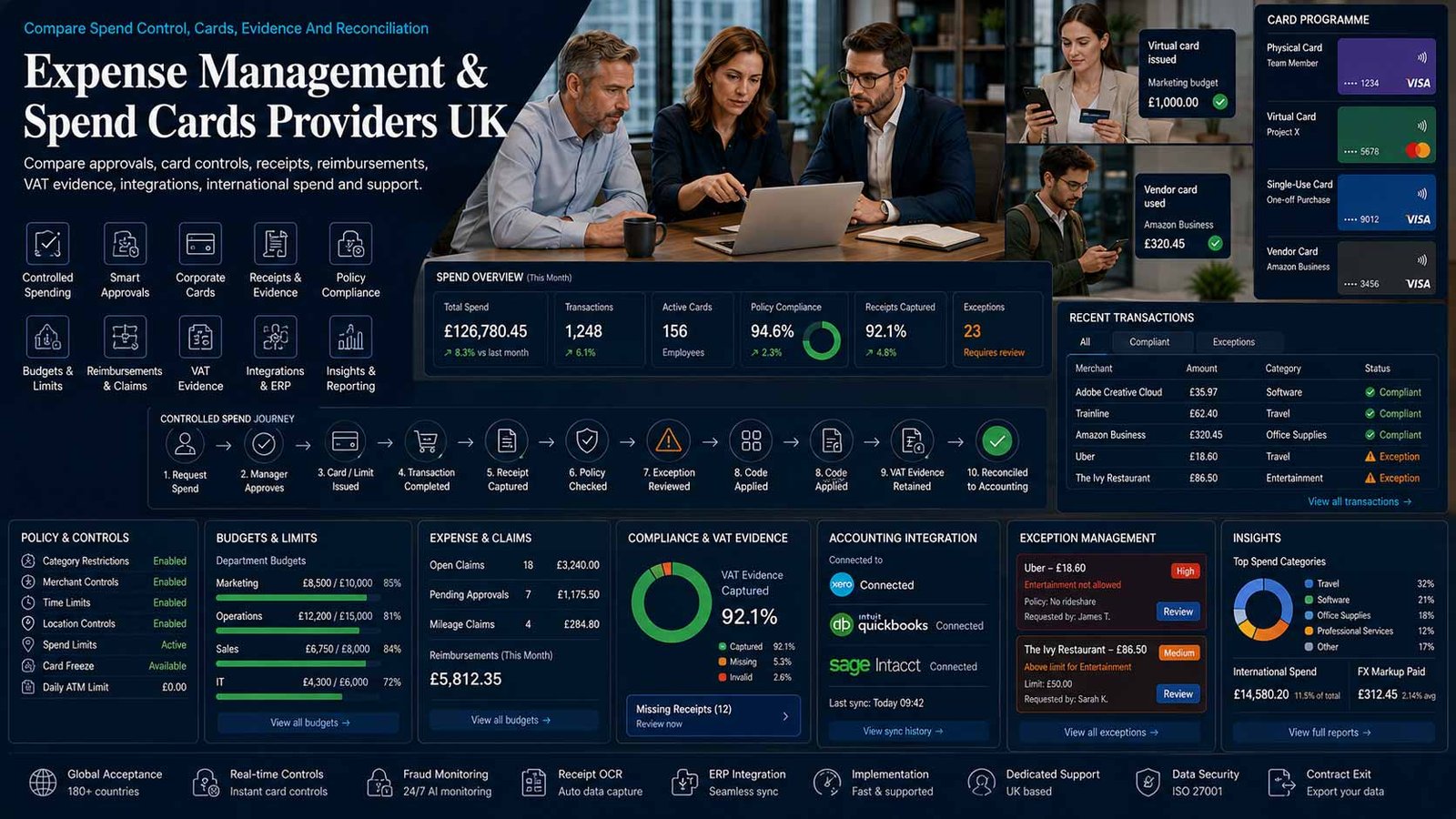
Control Business Spend Before And After Payment
A strong platform should connect authority, payment, evidence, accounting and review without turning every purchase into finance-team administration.
- Verify the provider, account and card entities
- Apply policy before spend where possible
- Capture evidence at transaction time
- Preserve accounting and audit ownership
Expense management and spend-card platforms help businesses distribute purchasing authority while retaining central visibility and control. They can issue physical or virtual cards, route purchase requests, enforce limits, capture receipts, process reimbursements, code expenses and transfer approved data into accounting systems.
The card can be prepaid, debit-funded, credit or charge-based. Those models affect cash flow, liability, regulation and protection of funds. The software can also include procurement, supplier invoices, travel or accounts payable, but buyers should compare only the modules they genuinely need and identify which legal entity provides each regulated service.
This page compares business expense management software and spend-card platforms only. It does not cover consumer prepaid cards or bookkeeping software used on its own. It also does not replace the separate comparison of revolving business credit cards, even where a spend platform offers a credit option.
Choose The Right Spend-Management Structure
Funding, liability, employee workflow, international use and integration depth change the appropriate platform.
| Platform Model | What It Usually Provides | Best-Fit Question |
|---|---|---|
| Prepaid pooled-funds platform | The business transfers money into a central wallet and allocates controlled balances to employee, project or department cards. Spending cannot normally exceed available funds, which can reduce credit exposure and simplify budget control. | Does the funding, safeguarding, top-up and emergency-balance process fit the organisation’s cash controls? |
| Debit-funded spend cards | Cards draw against a business payment account or designated wallet while the platform applies card-level limits, merchant rules and approvals. This model can combine live cash visibility with fewer reimbursements. | Can finance separate operating cash from employee spend and stop one card from exposing the wider account balance? |
| Corporate credit or charge-card platform | The provider issues company-liability credit or charge cards with expense controls, receipt capture and periodic repayment. This can support cash flow but introduces credit assessment, repayment and liability terms. | Are the company liability, personal guarantee, credit limit, repayment date and interest or late-payment consequences acceptable? |
| Virtual and single-use cards | Finance teams issue virtual cards for suppliers, subscriptions, projects or one-off purchases with defined limits, expiry dates and merchant restrictions. | Can the platform create, approve, revoke and reconcile cards at the scale required without uncontrolled duplication? |
| Reimbursement and mileage workflow | Employees submit out-of-pocket expenses, mileage or per diem claims for approval and repayment. The platform captures evidence and routes claims without requiring every user to hold a card. | Does the workflow preserve HMRC evidence, prevent self-approval and complete repayment quickly enough for employees? |
| Travel and multi-currency spend platform | Cards, cash withdrawals, travel expenses and reimbursements are managed across currencies, countries and entities with policy and FX controls. | Which FX rates, mark-ups, weekend charges, cash fees, travel controls and country restrictions apply? |
| Multi-entity enterprise spend management | A group manages cards, budgets, approvals, reimbursements, supplier payments and accounting rules across several legal entities. | Can each transaction retain the correct entity, currency, tax code, cost centre, approver and audit trail? |
| Integrated procurement and accounts-payable platform | The service combines purchase requests, approvals, cards, invoices, bills and reimbursements so finance controls spend before and after payment. | Is the broader platform needed, or will additional procurement and invoice modules create unnecessary cost and implementation complexity? |
Eight Areas That Determine Expense-Platform Fit
Use the same users, spend channels, currencies, policy rules, accounting requirements and growth assumptions for every proposal.
Comparison Criterion
Provider, Issuer, Card Type And Funds Protection
Identify the platform company, card issuer, regulated bank or e-money institution, card network, legal account holder and exact card type. Confirm whether funds are bank deposits, safeguarded e-money, prepaid balances, debit funds or credit. FSCS protection does not automatically apply to money held by a non-bank payment or e-money provider, so check the operating entity and protection model rather than relying on the brand name.
Comparison Criterion
Spend Policies, Requests And Approval Routing
Compare pre-purchase requests, approval thresholds, delegated authority, cost-centre ownership, merchant-category rules, project budgets, recurring spend, temporary exceptions and emergency approvals. The workflow should enforce policy without forcing finance to approve every routine transaction or allowing employees to approve their own claims.
Comparison Criterion
Physical, Virtual And Vendor Card Controls
Review card issuance, named and shared cards, physical delivery, virtual cards, single-use cards, card limits, per-transaction caps, daily or monthly controls, countries, currencies, cash withdrawals, online use, contactless, mobile wallets, merchant locks, freeze and termination. Require a controlled joiner, mover and leaver process.
Comparison Criterion
Receipt Capture, Evidence And Policy Compliance
Assess mobile receipt capture, email forwarding, OCR, transaction matching, missing-receipt reminders, duplicate detection, policy flags, business-purpose fields, attendee details, VAT extraction and exception handling. Automation should improve evidence quality, not hide incorrect tax codes or unsupported claims.
Comparison Criterion
Reimbursements, Mileage And Out-Of-Pocket Claims
Compare claim creation, mileage rates, per diem, personal-card expenses, cash expenses, approvals, repayment method, payroll interaction, duplicate controls and employee visibility. Confirm whether reimbursement payments are made by the provider, through the business account or by exported payment files.
Comparison Criterion
Accounting, ERP, VAT And Month-End Integration
Review direct integrations, chart-of-accounts mapping, tax codes, tracking categories, cost centres, projects, dimensions, attachments, journal creation, reconciliation, export formats, correction workflow and closed-period handling. The platform should support accounting, but it must not become a substitute for finance policy, tax judgement or bookkeeping review.
Comparison Criterion
International Spend, FX And Travel Controls
Compare supported currencies, local or global cards, exchange-rate basis, mark-ups, weekend pricing, international merchant fees, cash withdrawal charges, country restrictions, travel booking, per diems and emergency support. Model the actual travel and supplier-spend profile instead of accepting a generic low-FX claim.
Comparison Criterion
Security, Data Governance, Implementation And Support
Review MFA, single sign-on, role-based access, audit logs, approval integrity, card-token security, device controls, fraud alerts, dispute handling, data residency, retention, APIs, sandbox, implementation, training, support hours, service status, incident communication, export and termination. A card platform becomes a finance-control system and should be governed accordingly.
Measures To Define Before A Spend Platform Is Selected
Translate automation and control claims into measurable policy, evidence, accounting, employee and cost outcomes.
| Measure | What It Should Define | Evidence To Request | Common Weakness |
|---|---|---|---|
| Policy-compliant spend rate | The proportion of transactions and claims that meet the configured policy without retrospective override | Transaction, policy rule, approver, merchant category, limit, exception, reason and outcome | The provider reports approved spend but not policy exceptions |
| Receipt completion time | How quickly evidence is attached and validated after a transaction | Transaction date, reminder, receipt date, OCR result, reviewer, exception and closure | Receipt capture is measured without checking quality |
| Unreconciled transaction backlog | The number and value of transactions not ready for accounting close | Owner, age, missing field, missing receipt, coding, tax, approver and escalation | Old items are exported as suspense without ownership |
| Approval turnaround | Elapsed time from request or claim submission to final decision | Request time, route, approvers, reminders, delegation, decision and payment | Average timing hides blocked high-value requests |
| Card-control effectiveness | Whether attempted out-of-policy spend is prevented or escalated as designed | Limit, merchant rule, country rule, declined transaction, override and reason | Declines are treated as system errors instead of control evidence |
| Expense-processing cost | Internal and provider cost per card transaction or reimbursement | Licence, card fees, finance time, employee time, corrections, support and payment cost | Software price is compared without implementation and admin effort |
| Reimbursement completion | Time from employee submission to cleared repayment | Claim, evidence, approval, payment file, bank confirmation and exception | Approval is mistaken for employee repayment |
| Accounting sync accuracy | Percentage of approved items posted with correct account, tax and dimensions | Source transaction, mapped fields, journal, error, correction and period | Successful API transfer is treated as accurate accounting |
| Foreign-spend effective cost | Complete sterling cost of overseas transactions and withdrawals | Network rate, provider rate, mark-up, weekend fee, cash fee and refund treatment | A zero-FX headline excludes rate spreads and card fees |
| User and card closure control | Whether departing users lose access and cards are closed within the required time | HR trigger, user status, card freeze, balance, subscriptions, receipts, export and closure | Cards remain active after account access is removed |
Expense Management And Spend-Card Providers UK Businesses Can Consider
Shortlist providers whose card model, controls, expense workflow, international capability and integrations fit the business. Confirm the live plan, issuing entity and complete terms before award.
Provider Profile
Pleo
Pleo provides company cards, expense capture, reimbursements, approvals, budgets and accounting integrations for UK and European businesses. Include it where a growing company wants employee self-service with central controls and a broad spend-management workflow. Confirm the UK contracting and issuing entities, whether the proposed card is prepaid, debit or credit, account-funding method, protection of held funds, physical and virtual card allowances, approval features by plan, reimbursement payment route, accounting integrations, FX and cash charges, card replacement, cashback eligibility, user pricing, implementation, data export and closure.
Review official Pleo spend managementProvider Profile
Soldo
Soldo combines prepaid business cards with budgets, card rules, real-time transaction visibility, receipt capture and expense reporting. Include it where a business prioritises prepaid control, team or project budgets and reduced employee reimbursement. Confirm the legal provider and issuer, supported card currencies, top-up and funding process, safeguarding, physical and virtual card limits, merchant and cash controls, app workflow, accounting integrations, plan and card charges, FX, replacement fees, inactivity or closure terms, support and the process for returning unused balances.
Review official Soldo expense managementProvider Profile
Spendesk
Spendesk brings company cards, purchase requests, expense claims, invoices, budgets and accounting workflows into one spend-management platform. Include it where finance wants pre-spend approvals and broader control across cards and non-card expenses. Confirm the UK service and issuing entities, card funding or credit model, physical and virtual card rules, approval depth, invoice and procurement modules, reimbursement route, ERP integrations, VAT and receipt controls, FX and cash fees, minimum contract, implementation, support, data export and whether optional modules materially change total cost.
Review official Spendesk platformProvider Profile
Payhawk
Payhawk combines corporate cards, expense management, accounts payable, reimbursements, approvals and multi-entity controls. Include it where a scale-up or larger group needs complex workflows, global entities and ERP integration. Confirm the contracting entity, card and account provider for each country, debit or credit structure, card currencies, credit underwriting where relevant, funding, approvals, entity separation, NetSuite or other ERP scope, travel and bill-pay modules, FX and cash charges, pricing basis, implementation, service levels, API access, data migration and termination.
Review official Payhawk spend managementProvider Profile
Moss
Moss offers corporate credit and debit options alongside cards, invoices, reimbursements, approvals and ERP integrations for UK and European businesses. Include it where finance wants a choice between cash-funded control and company credit within one platform. Confirm eligibility for the UK product, issuing and lending entities, credit assessment, company liability or guarantees, repayment cycle, debit-wallet funding, card limits, approval workflows, interest and late-payment rules, FX, rewards, invoice modules, integrations, implementation, support and the treatment of balances and outstanding credit at closure.
Review official Moss spend platformProvider Profile
Airwallex
Airwallex provides multi-currency company and employee cards, expense management, reimbursements, bill pay and global account functionality. Include it where international operations, currencies and multi-entity payments are central. Confirm the UK contracting and regulated entities, card issuing markets, wallet funding, safeguarding or deposit position, supported currencies, card and approval controls, FX pricing, international fees, cash-withdrawal capability, accounting integrations, reimbursement countries, bill-pay scope, roles, APIs, plan charges, support and the effect of using wider Airwallex account services.
Review official Airwallex SpendProvider Profile
Revolut Business
Revolut Business provides team cards, spend controls, receipt capture, approvals, reimbursements, mileage and accounting integrations within its business-account platform. Include it where a business already values multi-currency account functionality and wants expense tools in the same environment. Confirm which Revolut entity supplies the account, cards and expense add-on, bank-deposit or e-money treatment, plan and per-user fees, card allowances, approval features, permitted categories, trusted merchants, FX and cash charges, reimbursement workflow, integrations, API access, user closure, support and data export.
Review official Revolut Business expensesProvider Profile
Equals Money
Equals Money provides prepaid and debit expense cards, multi-currency functionality, spend limits, real-time tracking, receipt capture and platform controls. Include it where a UK business wants controlled card funding and dedicated expense-card administration. Confirm the exact Equals entity and card issuer, prepaid or debit structure, safeguarding and funding process, supported currencies, card and transaction limits, virtual cards, cash access, FX pricing, user and card charges, accounting integration, receipt workflow, support, replacement, dormant balances, export and closure.
Review official Equals Money expense managementWhat Changes Expense Management And Spend-Card Cost
Pricing depends on users, cards, currencies, modules, integrations and implementation. Compare complete first-year and steady-state cost rather than one monthly plan.
| Cost Driver | Why It Changes Spend | What A Comparable Quote Should Show |
|---|---|---|
| Platform subscription | Providers may charge per company, entity, module, administrator or monthly plan | Plan, minimum commitment, included users, features, entities, support and annual price |
| Per-user and per-card fees | Costs can increase with cardholders, approvers, claimants, physical cards and virtual-card volume | Active and inactive user rules, card allowance, extra card, replacement, delivery and cancellation |
| Card funding or credit cost | Prepaid, debit and credit models create different cash-flow and financing costs | Deposit or wallet funding, credit limit, repayment cycle, interest, late fee, guarantee and security |
| Foreign exchange and international use | Rate spreads, mark-ups, weekend pricing and foreign merchant charges affect travel and supplier spend | Rate source, mark-up, supported currencies, weekend rule, international fee, refund and reversal |
| Cash withdrawals | ATM access may be restricted or charged and can weaken expense evidence | Availability, daily limit, provider fee, network fee, FX, receipt requirement and policy control |
| Reimbursements and payouts | Some platforms charge for reimbursement payments, bank transfers or international payouts | Included volume, domestic fee, international fee, payment speed, failure and recall |
| Advanced approvals and modules | Procurement, invoice management, travel, AP, custom workflows and AI controls may sit on higher plans | Feature, module, user scope, workflow limits, implementation and recurring price |
| Accounting and ERP integrations | Basic exports may be included while premium ERP connectors, APIs or implementation cost extra | Integration, entities, dimensions, support, connector fee, API limits and change work |
| Implementation, migration and support | Configuration, policy design, training, data migration and premium support can materially affect first-year cost | Setup, workshops, training, migration, testing, support tier, service hours and renewal |
| Exit and data retention | Contract notice, minimum term, outstanding balances and paid archive access can create switching cost | Term, renewal, notice, data export, receipt archive, card closure, balance return and final invoice |
How Team Structure And Spend Profile Change The Shortlist
The right platform depends on employee count, entities, travel, currencies, approval complexity, accounting stack and tolerance for implementation.
Small Business Replacing Shared Cards
Prioritise simple setup, clear card funding, low fixed fees, easy receipt capture, sensible card limits, Xero or QuickBooks integration and quick card freezing. Avoid an enterprise platform whose workflow and minimum contract exceed the control problem.
Growing Multi-Department Company
Prioritise approval routing, department and project budgets, virtual cards, reimbursements, policy exceptions, management reporting and role-based administration. Check how the price changes as users and entities grow.
International Or Travel-Heavy Business
Prioritise card acceptance, multi-currency balances, transparent FX, travel controls, per diems, cash policy, emergency support, reimbursements across countries and accounting by legal entity.
Multi-Entity Or Enterprise Finance Team
Prioritise entity segregation, complex approval matrices, SSO, audit logs, ERP dimensions, APIs, procurement and AP integration, implementation governance, service levels, data retention and controlled rollout.
How To Compare Spend-Management Proposals
Give every provider the same legal entities, users, physical and virtual cards, monthly transactions, currencies, cash withdrawals, reimbursements, mileage, approval rules, accounting stack and implementation dates. Require a standardised cost and responsibility schedule.
- Every provider, account and card entity is identified
- The funding and liability model is explicit
- Policy and approval features are tested
- Receipts and accounting fields are validated
- All card, FX and module costs are included
- Exit and continuity evidence is documented
Test The Same Real Expense Scenarios
Run one domestic card purchase, one foreign transaction, one reimbursement, one missing receipt, one subscription and one leaver through every platform.
Compare control, evidence, accounting outcome and complete cost—not only the visual demo.
Six Questions To Put To Every Spend Platform
The answers expose unclear issuing relationships, weak policy controls, incomplete pricing, evidence gaps and difficult exits.
Who Provides The Account And Issues The Cards?
Request every legal entity, regulator, card issuer, network, account type, funds-protection model and complaint route.
What Spend Is Controlled Before Payment?
Confirm requests, budgets, limits, merchant and country rules, approval routing, recurring spend and exception authority.
Which Costs Sit Outside The Platform Price?
Ask for card, user, FX, cash, reimbursement, transfer, integration, implementation, support, replacement and exit fees.
How Are Receipts And Tax Evidence Validated?
Review capture channels, OCR, matching, VAT fields, missing-evidence escalation, duplicate detection, retention and human review.
How Does Data Reach The Accounts?
Confirm account codes, tax rates, dimensions, attachments, sync frequency, errors, corrections, closed periods and audit history.
What Happens When A User Or Provider Is Exited?
Confirm card freeze, subscriptions, outstanding claims, wallet balance, credit repayment, export, archive, access removal and final support.
A Seven-Stage Spend-Management Evaluation
Move from current-process evidence and policy design to a controlled pilot, integrated rollout and measurable monthly governance.
- Map current employee cards, personal reimbursements, petty cash, subscriptions, travel, supplier spend, accounting workflow, policy breaches, monthly volumes and accountable owners.
- Define the target funding model, card types, users, entities, currencies, approval thresholds, budgets, receipt requirements, reimbursements, tax fields, integrations and reporting.
- Prepare one provider brief using representative card, claim, mileage, travel and subscription scenarios, including peak users and future entities rather than only today’s volume.
- Obtain comparable proposals identifying the platform, account and issuing entities, card model, protection of funds, plans, usage fees, FX, implementation, support and contract terms.
- Run demonstrations and controlled tests for requests, virtual cards, merchant controls, lost receipts, reimbursements, VAT coding, accounting sync, user closure, disputes and exports.
- Complete legal, regulatory, security, data-protection and finance review; configure roles, policies, limits, approvers, tax codes, integrations, training and cutover evidence.
- Operate through monthly control reporting, receipt backlog review, card and user access review, policy tuning, accounting reconciliation, provider incidents, renewal and exit testing.
Expense Management And Spend-Card Comparison Checklist
Use this table before approving a prepaid, debit, credit, travel, reimbursement or multi-entity spend-management platform.
| No. | Requirement | Evidence To Obtain Before Award | Confirmed |
|---|---|---|---|
| 01 | Spend-management scope and owner agreed | Legal entities, employees, departments, cardholders, approvers, finance owner, IT owner and executive sponsor | |
| 02 | Current spend channels mapped | Cards, reimbursements, cash, mileage, subscriptions, travel, supplier spend, invoices and petty cash | |
| 03 | Provider and card entities verified | Platform, bank or EMI, card issuer, network, account holder, regulator, permissions and complaint route | |
| 04 | Funds protection and liability accepted | Deposit or e-money status, safeguarding, FSCS position, prepaid or debit funding, credit liability and guarantees | |
| 05 | Policy and approval matrix approved | Categories, thresholds, budgets, cost centres, projects, delegates, exceptions, self-approval prevention and evidence | |
| 06 | Card controls tested | Physical, virtual, single-use, limits, merchant rules, countries, cash, mobile wallets, freeze and replacement | |
| 07 | Receipt and evidence workflow approved | Capture, OCR, matching, mandatory fields, VAT, duplicate checks, reminders, escalation and retention | |
| 08 | Reimbursement process accepted | Claims, mileage, per diem, approval, payment route, employee status, duplicates and completion timing | |
| 09 | Accounting integration validated | Accounts, tax rates, dimensions, projects, attachments, journals, sync, errors, corrections and closed periods | |
| 10 | International-spend cost modelled | Currencies, FX rate, mark-up, weekend fee, international fee, cash, refunds and travel support | |
| 11 | Security and access approved | MFA, SSO, roles, audit logs, devices, card data, fraud alerts, disputes, leavers and emergency controls | |
| 12 | Complete pricing normalised | Platform, users, cards, FX, cash, reimbursements, modules, integration, setup, support and exit | |
| 13 | Implementation and adoption plan agreed | Configuration, migration, pilot, testing, training, communications, policy launch, support and success measures | |
| 14 | Contract and service terms accepted | Minimum term, renewal, notice, service availability, support, changes, liability, data processing and subcontractors | |
| 15 | Exit and continuity plan tested | Card freeze, alternative payment method, balance return, credit repayment, data export, receipt archive and access removal |
Common Expense-Platform Buying Mistakes
Most avoidable failures begin with unclear card funding, weak policy design, incomplete cost or poor integration and exit planning.
| Mistake | Why It Creates Risk | Better Control |
|---|---|---|
| Choosing a card without mapping the account model | The business can misunderstand credit, safeguarding, cash exposure or legal responsibility | Verify provider, issuer and funding structure |
| Automating a weak expense policy | Software makes inconsistent rules faster rather than better | Approve policy and authority first |
| Comparing only the monthly licence | Card, FX, cash, implementation and module costs can dominate | Model complete annual cost |
| Issuing cards to every employee by default | Unused cards increase cost, access and fraud exposure | Use role-based eligibility and reviews |
| Trusting OCR without finance checks | Receipts and VAT can be misread or matched incorrectly | Retain validation and exception controls |
| Ignoring reimbursements and mileage | Employees continue parallel manual processes outside the platform | Test all spend channels |
| Treating accounting sync as reconciliation | Transferred data can still have wrong accounts, tax or dimensions | Reconcile and review exceptions |
| Forgetting subscriptions during leavers | Recurring charges can continue after the user leaves | Use vendor cards and ownership transfer |
| Assuming zero FX means zero foreign cost | Rate spreads, weekends, cash and merchant conversion still matter | Test real foreign transactions |
| Failing to plan provider outage or exit | Employees can lose purchasing ability and finance can lose evidence access | Maintain continuity and export procedures |
Frequently Asked Questions
Answers to common questions from UK businesses comparing employee spend cards, expense software, reimbursements and multi-entity spend platforms.
What Is Expense Management Software?
Expense management software controls, captures, approves and records employee and company spending. It can include spend requests, cards, receipt capture, reimbursements, mileage, policy checks, accounting integrations and reporting. The exact scope varies by provider and plan.
What Is A Business Spend Card?
A business spend card is issued for company expenditure and linked to controls such as budgets, limits, merchant rules and receipt requirements. It may be prepaid, debit, credit or charge-based, so the funding, liability and protection model should be checked.
Are Spend Cards The Same As Business Credit Cards?
No. Some spend cards use company credit, but many are prepaid or debit-funded. Business credit cards focus on borrowing and repayment, while spend-management platforms focus on distributed employee purchasing, approvals, evidence and reconciliation. Compare the actual card model.
Are Funds On Expense-Card Platforms Protected By FSCS?
Not automatically. Eligible deposits held by a UK bank can have FSCS protection, while money held by an authorised payment or e-money institution is generally protected through safeguarding rather than FSCS. Check the exact entity and account used for the service.
Can Expense Software Replace Bookkeeping?
No. It can capture and code transactions and send data to accounting software, but finance remains responsible for policy, evidence, tax treatment, reconciliation, corrections and financial records. The page does not compare bookkeeping-only products.
Can Employees Use Personal Cards And Claim Reimbursement?
Yes, where company policy permits. A suitable platform should capture the claim, receipt, business purpose, approvals and repayment status. Businesses should avoid making employees finance routine company spend unnecessarily and should prevent duplicate claims.
What Controls Should Spend Cards Have?
Useful controls include per-card and per-transaction limits, budgets, merchant categories, permitted countries, cash restrictions, virtual cards, approval rules, real-time alerts, freeze and cancellation. Controls should match roles and be reviewed regularly.
How Much Does Expense Management Software Cost?
Pricing can include a platform subscription, per-user or per-card fees, premium modules, FX, cash withdrawals, reimbursements, transfers, integrations, implementation, support and replacement cards. Compare the complete first-year and steady-state cost at realistic user volumes.
What Expense Records Should A UK Employer Keep?
HMRC requires employers to keep records supporting expenses and benefits, including dates, details and information used for reporting. The required evidence depends on the expense. A platform should preserve receipts, approvals, business purpose, tax fields and a reliable audit trail.
How Should A UK Business Compare Expense Management Providers?
Give every provider the same user count, card mix, spend profile, currencies, approval rules, reimbursements, integrations and evidence requirements. Compare provider and issuer identity, funds protection, controls, workflow, accounting accuracy, security, implementation, total cost and exit—not only card rewards or app design.
Official Guidance And Spend-Management Resources
Reviewed by Bhav Giva, Founder & Lead Analyst at CompareServices.co.uk, on 30 July 2026.
Use HMRC, the FCA Register, FCA payment-provider guidance and official provider documentation to confirm current record-keeping, regulated-entity, funds-protection, card, pricing, integration and contract requirements. Provider entities, products and plan features can change.
- HMRC — Employer Expense And Benefit Record Keeping
- HMRC — Expenses And Benefits Overview
- HMRC — Checking Expense Payments And Evidence
- FCA — Using Non-Bank Payment Service Providers
- FCA Register — Check Financial Services Firms
- Pleo — Business Spend Management
- Soldo — UK Expense Management
- Spendesk — Spend Management Platform
- Payhawk — Spend Management Platform
- Moss — UK Spend Management
- Airwallex — UK Spend Management
- Revolut Business — Expense Management
- Equals Money — Expense Management