
Compare Commercial Mortgages Providers UK (2026)
Compare Property Appetite, LTV, Valuation, Rates, Repayment, Fees, Security, Covenants And Total Mortgage Cost
Use this commercial mortgage comparison UK to assess lenders by owner-occupied and commercial investment appetite, borrower structure, property type, loan-to-value, deposit, valuation, trading cash flow or rental income, debt-service cover, fixed or variable rate, term, amortisation, interest-only options, fees, legal charge, guarantees, covenants, property due diligence, early repayment and refinance risk. Give every lender the same property and financial case before comparing one rate.
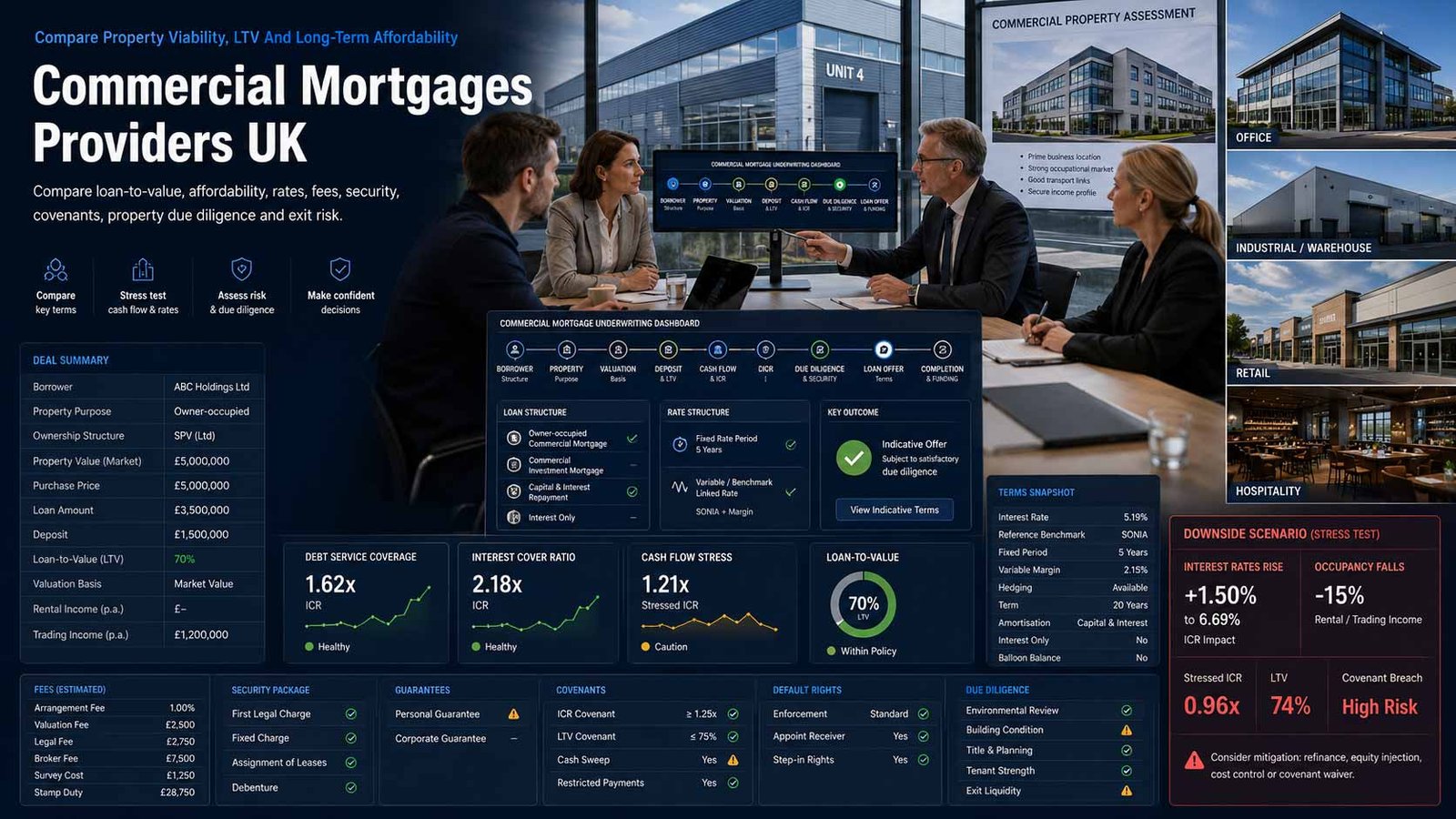
Finance A Viable Commercial Property, Not An Optimistic Valuation
The borrower, property, cash flow and exit must remain supportable throughout underwriting, completion and repayment.
- Start with a verified property value
- Stress-test repayment and interest cover
- Separate trading and investment income
- Document covenants and refinance exit
A commercial mortgage helps a business purchase, refinance or raise capital against commercial property over an agreed term. The lender takes security over the property and assesses the borrower, cash flow, valuation, property condition and exit as one connected credit decision.
Owner-occupied mortgages are normally repaid from the trading business. Commercial investment mortgages rely more heavily on sustainable rent, tenant covenant and lease terms. Refinancing can change lender or release equity, but it also increases secured exposure and completion cost.
This page compares mortgages secured on commercial premises and commercial investment property. It does not compare residential buy-to-let mortgages. Pure residential lending, short-term bridging and unsecured business borrowing require different underwriting, protections and comparison criteria.
Choose The Right Commercial Mortgage Structure
Property use, borrower structure, rental income, repayment, taxation, regulation and exit change materially between owner-occupied, investment, mixed-use and portfolio lending.
| Mortgage Structure | What It Usually Provides | Best-Fit Question |
|---|---|---|
| Owner-occupied commercial mortgage | A trading business borrows against offices, retail premises, industrial units, warehouses, healthcare property or other premises it will occupy and operate from. Repayment is assessed against the business cash flow as well as the property security. | Can the trading business demonstrate sustainable repayment capacity after allowing for rates, maintenance, tax, insurance and a higher interest-rate scenario? |
| Commercial investment mortgage | A company, partnership, pension vehicle or property investor borrows against commercial premises let to third-party business tenants. Underwriting usually considers lease quality, rent, void risk, tenant covenant and the borrower’s wider financial position. | Does the rental income remain sufficient after realistic voids, incentives, repairs, management costs and stressed interest? |
| Commercial remortgage or refinance | Existing property-backed borrowing is replaced to change lender, rate, term, repayment structure or covenants. Refinancing may also consolidate an existing commercial mortgage where the property and business remain acceptable security. | Will the new facility improve complete cost and flexibility after early-repayment charges, valuation, legal fees and arrangement costs? |
| Capital raise against commercial property | A business releases equity from property it already owns to fund an eligible business purpose. The new loan remains secured on the property and increases debt-service and covenant exposure. | Is the capital purpose productive enough to justify placing additional secured debt against a core business property? |
| Semi-commercial or mixed-use mortgage | The security contains commercial and residential elements, such as a shop with accommodation above. Valuation, taxation, lender appetite and regulatory treatment depend on the exact use and occupancy. | Has the borrower obtained specialist legal and regulatory advice on the commercial and dwelling elements without treating the case as residential buy-to-let? |
| SIPP or SSAS commercial property loan | A pension trustee or pension scheme borrows within applicable rules to acquire qualifying commercial property, potentially leasing it to a connected trading business on arm’s-length terms. | Have the scheme trustees, administrator, tax adviser and lender confirmed ownership, connected-party rent, borrowing limits and prohibited-use risks? |
| Green or energy-efficient commercial mortgage | A lender supports the purchase, refinance or improvement of qualifying commercial property with defined energy-performance or sustainability criteria, sometimes through pricing or fee incentives. | Which EPC, improvement, reporting and ongoing eligibility conditions must be maintained to retain the quoted commercial terms? |
| Multi-property or portfolio facility | One facility or coordinated set of loans supports several commercial properties, legal entities or trading sites. Cross-collateralisation and portfolio covenants can improve flexibility but increase interconnected default risk. | Can the borrower add, release, sell or refinance individual properties without placing the whole portfolio under unnecessary restriction? |
Eight Areas That Determine Commercial Mortgage Fit
Use the same borrower, property, purchase price, deposit, valuation assumptions, repayment profile and completion timetable for every quote.
Comparison Criterion
Borrower, Property Purpose And Ownership Structure
Confirm the borrowing entity, property-owning entity, trading occupier, tenants, group companies, pension trustees and beneficial owners. Distinguish owner-occupied premises from commercial investment property and mixed-use security. The lender must understand how rent, trading income and group support reach the borrower, and the legal structure must be workable for tax, security, succession and exit.
Comparison Criterion
Loan-To-Value, Deposit And Valuation Basis
Compare the advance against purchase price and the lender’s valuation, not the seller’s asking price. Require the maximum loan, cash deposit, valuation basis, market value, investment value where relevant, vacant-possession assumptions and any retention. A down-valuation can increase the deposit or stop the transaction, while specialist property may attract a lower acceptable LTV.
Comparison Criterion
Affordability, Interest Cover And Cash-Flow Stress
For owner-occupied property, compare repayment against sustainable business cash flow after wages, tax, working capital, maintenance and other borrowing. For commercial investment, assess rent, lease length, tenant quality, voids and operating costs. Require lender calculations for debt-service cover, interest cover, sensitised rates and lower income rather than relying on one current-year profit figure.
Comparison Criterion
Interest Rate, Benchmark, Fixing And Hedging
Review fixed or variable pricing, benchmark, lender margin, minimum lending rate or floor, review dates and break costs. Fixed rates can protect payment certainty but may carry early-repayment charges. Variable facilities can fall or rise with the benchmark. Larger or more complex borrowers may be offered separate hedging, which must be explained and contracted independently.
Comparison Criterion
Term, Amortisation, Interest-Only And Balloon Risk
Compare legal term, repayment profile, capital-and-interest schedule, straight-line capital, interest-only period and final balloon. A longer term lowers scheduled payments but increases total interest and refinancing exposure. Interest-only can support cash flow but leaves capital outstanding. The mortgage term should remain compatible with property life, lease expiry and the borrower’s exit plan.
Comparison Criterion
Complete Acquisition And Finance Cost
Add arrangement, broker, valuation, legal, survey, security, monitoring, account and early-repayment fees to interest. Include deposit, non-residential SDLT or the relevant devolved property tax, VAT where applicable, searches, insurance, repairs and working capital. A commercial mortgage quote is incomplete until the business can see the total cash required to complete and the total debt cost.
Comparison Criterion
Security, Guarantees, Covenants And Default Rights
Review the first legal charge, debenture, assignment of rent, personal or corporate guarantees, intercompany support, cross-default, set-off and restrictions on sale, lease, alteration or additional borrowing. Record financial and property covenants, reporting frequency, valuation rights, cure periods, default interest, receiver appointment and the process for releasing security after repayment.
Comparison Criterion
Property Due Diligence, Condition And Exit Liquidity
Assess title, planning use, environmental risk, asbestos, flood, contamination, access, building condition, EPC, leases, service charges, insurance and capital expenditure. The lender’s valuation is for lending purposes and is not a substitute for the buyer’s survey. Stress-test resale, reletting, refinancing and vacant possession so the exit does not depend on an optimistic valuation or permanent tenant occupancy.
Measures To Define Before A Commercial Mortgage Is Signed
Translate attractive rates and high leverage into auditable affordability, valuation, security, covenant and exit evidence.
| Measure | What It Should Define | Evidence To Request | Common Weakness |
|---|---|---|---|
| Loan-to-value | The commercial mortgage balance as a percentage of the lower relevant property value or purchase price used by the lender | Purchase price, lender valuation, retained amount, loan, deposit, additional security and post-completion works | The buyer assumes the seller’s price is the value accepted for lending |
| Debt-service coverage | How many times sustainable cash flow covers capital and interest payments over the test period | Normalised EBITDA or property net income, tax, drawings, maintenance, other debt and annual mortgage service | Coverage is calculated before essential expenditure or other borrowing |
| Interest-cover ratio | The capacity of business profit or net rent to cover interest, especially for interest-only or investment lending | Net operating income, interest expense, benchmark, lender margin, stress rate, voids and non-recoverable costs | Current rent or profit is used without a higher-rate and lower-income scenario |
| Debt yield | The property’s sustainable net operating income divided by the proposed loan amount | Contracted rent, market rent, voids, incentives, management, repairs, service costs and debt amount | Gross rent is compared with debt without normalising property costs |
| Completion cash requirement | The total cash the borrower must provide before and at completion | Deposit, SDLT or devolved tax, VAT, valuation, survey, legal, arrangement, broker, insurance, repairs and reserves | The business budgets only for the deposit and arrangement fee |
| Total mortgage cost | The complete interest and fee cost over the chosen comparison horizon | Dated payments, fixed or variable assumptions, fees, balloon, early repayment, legal and valuation costs | A headline margin or monthly payment is compared without total interest and fees |
| Valuation headroom | The fall in property value the facility can absorb before reaching a covenant or lender limit | Opening value, loan, required LTV, revaluation rights, cure process, amortisation and stress value | The borrower assumes property values cannot fall during the term |
| Covenant headroom | The distance between forecast performance and every financial or property covenant | Covenant definition, test date, forecast, downside case, exclusions, cure rights and waiver costs | Only the opening covenant is checked and later reporting is ignored |
| Lease and tenant coverage | The extent to which contracted commercial rent supports debt through lease events and possible voids | Tenant covenant, lease expiry, break, review, arrears, incentives, void, reletting cost and concentration | A single tenant’s current rent is treated as permanent |
| Refinance and exit risk | The outstanding balance and property position when the fixed period or legal term ends | Balloon, future value, lease length, business plan, amortisation, sale costs, refinance criteria and timing | The proposal assumes a future lender will refinance on equal or better terms |
Commercial Mortgage Providers UK Businesses Can Consider
Shortlist lenders whose borrower, property, LTV, affordability, pricing and service appetite fit the transaction. Confirm the live credit decision, valuation and legal offer directly before commitment.
Provider Profile
NatWest Commercial Mortgage
NatWest offers commercial mortgages for businesses buying premises to trade from or refinancing property-backed borrowing, with fixed and variable repayment options subject to assessment. Include it where an SME values an established relationship-led bank, a long repayment horizon and a defined application route. Confirm the borrowing entity, property purpose, minimum facility, deposit, lender valuation, fixed-rate period, benchmark and margin, repayment profile, arrangement and valuation fees, security, guarantees, covenants, bank-account requirements, early-repayment terms and whether investment, mixed-use or specialist property requires a different real-estate product.
Review official NatWest commercial mortgageProvider Profile
Barclays Commercial Mortgages
Barclays provides commercial mortgages and commercial property investment finance for eligible UK businesses, with facilities secured by a first legal charge over the property. Include it where a business wants to purchase or refinance trading premises or a commercial investment through a major UK bank. Confirm the exact Barclays product, borrower eligibility, loan size, acceptable property type, LTV, repayment profile, fixed or variable rate, green-property criteria where relevant, arrangement and valuation fees, legal costs, security, guarantees, covenants, early repayment and the distinction between owner-occupied, investment, pension and other property lending.
Review official Barclays commercial mortgagesProvider Profile
Santander Commercial Mortgage
Santander Corporate and Commercial Banking offers commercial mortgages for eligible UK businesses buying property for business use, refinancing an existing secured loan or raising funds against existing commercial property. Include it where a borrower wants fixed or variable facilities and tailored repayment structures through a relationship-led lender. Confirm that the purpose fits Santander’s current appetite, including any restriction on real-estate investment; then compare loan amount, term, amortisation or interest-only option, benchmark, margin, minimum lending rate, fees, valuation, security, guarantees, covenants, account conditions and early-repayment costs.
Review official Santander commercial mortgageProvider Profile
HSBC UK Commercial Mortgage
HSBC UK includes commercial mortgages within its business and corporate lending range for property purchase, refinance and improvement where the transaction fits current credit appetite. Include it where an established business wants commercial-property finance integrated with broader banking, cash-management or international requirements. Confirm the HSBC lending entity, direct or broker route, customer eligibility, property use, loan size, LTV, valuation, term, fixed or variable pricing, benchmark, fees, security, guarantees, covenants, sustainability conditions, account requirements, early repayment and whether development or investment activity requires a specialist property-finance team.
Review official HSBC UK finance and borrowingProvider Profile
Lloyds Bank Commercial Property Lending
Lloyds Bank supports eligible businesses with larger secured loans that can be used to acquire premises or remortgage commercial property, alongside sector and relationship support. Include it where a trading business wants a major-bank lending relationship and a tailored facility above standard small-business lending limits. Confirm whether the facility is documented as a business loan or commercial mortgage, the legal charge, property and borrower eligibility, loan amount, deposit, valuation, rate and benchmark, amortisation, fees, guarantees, debenture, covenants, account conditions, early repayment, property-release mechanics and the responsible Lloyds entity or specialist team.
Review official Lloyds Bank larger secured lendingProvider Profile
Allica Bank Commercial Mortgages
Allica Bank specialises in lending to established UK SMEs and commercial-property investors, including owner-occupied and commercial investment mortgage cases through relationship managers and introducers. Include it where a borrower needs individual underwriting, specialist property appetite or a multi-property structure. Confirm the eligible borrower and property types, direct or broker route, loan range, LTV, deposit, valuation, fixed or variable pricing, interest-only availability, arrangement and broker fees, security, guarantees, covenants, EPC or energy-efficiency incentives, legal process, early repayment, portfolio cross-collateralisation and current product guide.
Review official Allica Bank commercial mortgagesProvider Profile
Shawbrook Commercial Mortgages
Shawbrook provides specialist commercial mortgage finance for trading businesses and commercial-property investors across offices, retail, industrial and selected mixed-use property. Include it where the transaction is complex, the property is specialist, or the borrower needs an individually assessed alternative to a high-street bank. Confirm the current product route, applicant and property eligibility, minimum loan, maximum LTV, fixed or variable pricing, interest-only option, valuation, arrangement and broker fees, security, guarantees, covenants, mixed-use treatment, early repayment, product-transfer options and whether the case is commercial trading, commercial investment or bridging.
Review official Shawbrook commercial mortgagesProvider Profile
YBS Commercial Mortgages
YBS Commercial Mortgages, part of Yorkshire Building Society, lends to UK trading businesses and commercial-property investors through a specialist commercial team. Include it where a borrower values published product information, direct specialist underwriting and finance for owner-occupied or investment property. Confirm applicant and property eligibility, current rate and fee schedule, LTV, valuation basis, repayment or interest-only structure, term, rent and debt-service tests, legal and valuation costs, security, guarantees, covenants, early-repayment charges, property-release rules and whether the application must proceed directly or through an approved intermediary.
Review official YBS Commercial MortgagesWhat Changes Commercial Mortgage Cost
Commercial mortgages are priced around the borrower, property, LTV, cash flow, repayment profile, security and marketability. Compare total cost and refinance risk rather than one headline rate.
| Cost Driver | Why It Changes Spend | What A Comparable Quote Should Show |
|---|---|---|
| Loan amount and loan-to-value | Higher leverage reduces the borrower’s deposit but increases lender loss exposure and can change margin, amortisation or eligibility | Property price, lender value, loan, deposit, retained amount, additional security and stressed LTV |
| Benchmark and lender margin | Variable pricing can reference Bank Rate, SONIA or a lender base rate, while fixed pricing embeds market funding and break risk | Benchmark, margin, floor, reset dates, fixed period, reversion, hedging, default rate and worked payments |
| Borrower financial strength | Profitability, cash generation, leverage, trading history, management, credit conduct and sector risk influence approval and pricing | Accounts, management information, forecasts, tax position, bank conduct, other borrowing, guarantees and downside case |
| Property type, location and condition | Specialist use, weak resale demand, short leasehold title, contamination, repair needs or planning restrictions can reduce acceptable value and increase risk | Tenure, use class, survey, valuation, environmental report, EPC, capex, insurance and resale evidence |
| Owner-occupied or investment purpose | Trading-business affordability and third-party rental income are underwritten differently | Occupier, tenants, leases, rent, business cash flow, void assumptions, covenant and property-management costs |
| Repayment profile and term | Interest-only, balloons and long amortisation lower early payments but retain more capital and refinancing risk | Legal term, amortisation, interest-only period, balloon, payment dates, final balance and refinance assumption |
| Arrangement, broker and lender fees | Commercial facilities can include percentage arrangement fees, broker commission, account fees and amendment charges | Fee amount, VAT, payer, payment date, refundability, capitalisation, commission and total over the comparison period |
| Valuation, survey and legal work | The borrower normally funds lender valuation and legal security work as well as its own due diligence | Valuer scope, survey type, legal estimate, searches, environmental work, abortive-cost treatment and payment timing |
| Property tax and completion costs | SDLT or devolved transaction tax, VAT, Land Registry, insurance and urgent repairs can materially increase required cash | Jurisdiction, property classification, purchase structure, tax estimate, VAT status, registration, insurance and capex |
| Security, guarantees and covenants | Additional collateral or support can improve approval but exposes more business or personal value and creates monitoring cost | Legal charge, debenture, guarantee, rent assignment, covenant definitions, reporting, valuation rights and release conditions |
How Property Purpose And Borrower Profile Change The Shortlist
The right lender depends on property type, use, location, value, tenant profile, borrower strength, deposit, repayment capacity and exit plan.
Owner-Occupier SME
Prioritise sustainable business cash flow, a conservative deposit, repayment certainty, useful premises, condition, EPC, capital expenditure, covenants and the ability to trade through a rate or demand shock.
Commercial Property Investor
Prioritise tenant covenant, lease length, rent review, void and reletting cost, net operating income, interest cover, portfolio concentration, professional management and a refinanceable exit balance.
Mixed-Use Or Specialist Property
Prioritise lender appetite, regulatory classification, separate residential and commercial valuation, planning, licensing, environmental risk, alternative-use value and specialist legal advice.
Multi-Site Or Property Portfolio
Prioritise facility flexibility, property-level reporting, cross-collateralisation, release prices, covenant headroom, central cash flow, valuation governance and the ability to refinance or sell individual sites.
How To Compare Commercial Mortgage Quotes
Give every lender the same borrower, property, purchase price, deposit, valuation information, financial evidence, repayment profile, fixed or variable preference and completion deadline. Require a full cost and covenant schedule rather than an indicative rate alone.
- The lender, broker, borrower and property owner are identified
- The purchase price, valuation and loan basis are separated
- Every payment, fee and balloon amount is dated
- Security, guarantees and covenants are fully mapped
- Property tax and VAT assumptions are independently checked
- Early repayment and refinance exit are documented
Price The Same Property On The Same Assumptions
Use one purchase price, lender valuation assumption, deposit, term, repayment profile and completion date.
Compare affordability, security, covenants and exit before comparing the initial rate or monthly payment.
Six Questions To Put To Every Commercial Mortgage Provider
The answers expose unclear valuation, incomplete pricing, wider security, covenant pressure and refinance obligations that are easy to miss.
Who Owns And Occupies The Property?
Confirm borrower, property owner, trading company, tenants, group support, pension involvement, beneficial owners and whether any dwelling element changes the legal or regulatory position.
How Was The Loan-To-Value Calculated?
Request purchase price, lender valuation, valuation basis, loan, deposit, retention, additional security, capex and the effect of a lower valuation before exchange.
What Cash Flow Supports Repayment?
Require normalised trading cash flow or net property income, debt-service and interest-cover calculations, other debt, stress rate, voids and a downside scenario.
How Can The Rate And Payments Change?
Confirm fixed or variable basis, benchmark, margin, floor, review dates, reversion, interest-only period, amortisation, balloon and any hedging or break cost.
Which Costs Sit Outside The Headline Rate?
Ask for arrangement, broker, valuation, survey, legal, security, tax, insurance, account, monitoring, amendment and early-repayment costs.
What Happens On Sale, Refinance Or Default?
Confirm notice, early repayment, security release, property substitution, covenant breach, cure, default interest, receiver rights, valuation, final statement and guarantee release.
A Seven-Stage Commercial Mortgage Evaluation
Move from a verified property requirement and financial case to controlled completion, repayment, covenant and exit governance.
- Confirm the property objective, borrower, ownership structure, trading or investment purpose, purchase timetable, existing leases, tax advice and accountable decision-makers.
- Collect financial evidence including filed accounts, management information, forecasts, bank statements, tax records, existing debt, rent schedule, leases, business plan and source of deposit.
- Complete property due diligence covering title, tenure, planning, valuation, survey, environmental risk, EPC, insurance, repairs, access, services, tenancy and expected capital expenditure.
- Issue one lender brief stating price, required loan, deposit, property use, borrower structure, repayment profile, fixed or variable preference, term, security, guarantees and completion deadline.
- Normalise every proposal into dated cash flows and compare LTV, debt-service cover, interest cover, total fees, completion cash, covenants, security and the outstanding balance at each exit date.
- Complete credit, legal, valuation, tax and property review before exchange or drawdown; do not assume a decision in principle is an unconditional mortgage offer.
- Manage the live mortgage through payment reconciliation, covenant reporting, insurance, lease and tenant monitoring, property maintenance, rate reviews, fixed-period expiry and a documented refinance or sale plan.
Commercial Mortgage Comparison Checklist
Use this table before approving an owner-occupied, commercial investment, refinance, capital-raise, mixed-use or portfolio facility.
| No. | Requirement | Evidence To Obtain Before Award | Confirmed |
|---|---|---|---|
| 01 | Property purpose and accountable owners agreed | Purchase, refinance or capital raise, owner-occupied or investment rationale, borrower, property owner, occupier, tenants, finance owner and approver | |
| 02 | Borrower and group structure verified | Companies, partnerships, pension trustees, beneficial owners, intercompany leases, guarantees, tax advice and authority | |
| 03 | Property title and use confirmed | Freehold or leasehold title, plan, rights, restrictions, planning use, licences, occupancy and proposed changes | |
| 04 | Purchase price and valuation plan accepted | Price, valuation basis, valuer, market value, vacant-possession assumptions, retention, down-valuation response and expiry | |
| 05 | Deposit and completion cash evidenced | Source of funds, deposit, SDLT or devolved tax, VAT, legal, survey, fees, insurance, repairs and working-capital reserve | |
| 06 | Trading or rental affordability validated | Normalised cash flow, rent, voids, operating costs, other debt, debt service, interest cover and stress case | |
| 07 | Rate basis and payment profile approved | Benchmark, margin, floor, fixed period, reversion, amortisation, interest-only, balloon and payment dates | |
| 08 | Complete fees and total cost compared | Arrangement, broker, valuation, legal, survey, security, account, monitoring, amendment, early repayment and total interest | |
| 09 | Security package accepted | First charge, debenture, rent assignment, personal and corporate guarantees, additional security, set-off and release terms | |
| 10 | Covenants and reporting approved | LTV, debt service, interest cover, information, valuation, lease, occupancy and capex covenants, test dates and cure rights | |
| 11 | Property condition and environmental risks checked | Building survey, asbestos, contamination, flood, fire, utilities, roof, structure, EPC, repairs, warranties and insurance | |
| 12 | Tenancies and income verified where relevant | Lease, rent, break, review, arrears, deposit, guarantor, tenant covenant, service charge, void and reletting cost | |
| 13 | Legal and regulatory perimeter checked | Pure commercial or mixed-use status, dwelling percentage, FCA implications, tax jurisdiction, planning and specialist advice | |
| 14 | Exit and refinance plan stress-tested | Fixed-period end, balloon, projected balance, property value, lease expiry, sale timing, refinance criteria and early repayment | |
| 15 | Completion and live governance agreed | Conditions precedent, drawdown, Land Registry, insurance, payment controls, covenant calendar, complaints, security release and document retention |
Common Commercial Mortgage Buying Mistakes
Most avoidable problems begin with an incomplete property budget, optimistic valuation, weak affordability test, underestimated security or an unplanned refinance date.
| Mistake | Why It Creates Risk | Better Control |
|---|---|---|
| Comparing only the headline interest rate | Fees, deposit, repayment profile, floor and early-repayment costs can outweigh a lower margin | Compare complete dated cash flows |
| Exchanging contracts before finance is unconditional | A valuation, title issue or credit condition can reduce or stop funding after the buyer is committed | Coordinate legal and finance conditions |
| Budgeting only for the deposit | Tax, VAT, legal, valuation, survey, repairs and arrangement fees can create a large completion shortfall | Build a full completion-cost schedule |
| Using the seller’s price as the lending value | The lender may value the property lower or apply different market and vacant-possession assumptions | Stress-test a down-valuation |
| Overstating sustainable profit or rent | Underwriting can fail or covenants can breach when exceptional income, voids or repairs appear | Normalise cash flow and rent |
| Selecting interest-only without a capital plan | The outstanding balance remains and may be difficult to refinance at maturity | Document amortisation or exit funding |
| Ignoring personal guarantees and debentures | The lender may have recourse beyond the property and across the wider business | Map every security document |
| Treating the lender valuation as a buyer survey | It may not identify defects, repairs or operational suitability for the purchaser | Commission appropriate independent surveys |
| Missing fixed-rate expiry and break terms | Payments can rise on reversion and early refinance can trigger substantial costs | Set rate and exit alerts |
| Allowing lease or property events to drift | Tenant breaks, short leases, EPC issues and deferred repairs can weaken value and refinanceability | Operate a property covenant calendar |
Frequently Asked Questions
Answers to common questions from UK businesses comparing owner-occupied, commercial investment, refinance and mixed-use property mortgages.
What Is A Commercial Mortgage?
A commercial mortgage is a loan secured against commercial property. A business may use one to buy premises it will trade from, refinance an existing commercial property loan, raise capital against property it owns or finance qualifying commercial investment property.
How Is A Commercial Mortgage Different From A Business Loan?
A commercial mortgage is specifically secured against land or buildings and is underwritten using the property as well as the borrower’s ability to repay. A business loan can be secured or unsecured and may fund broader business purposes without being structured around commercial property.
How Much Deposit Is Needed For A Commercial Mortgage?
The deposit depends on lender appetite, property type, valuation, borrower strength, repayment profile and purpose. Commercial lenders commonly require meaningful borrower equity. Buyers should stress-test a lower lender valuation because the deposit is normally based on the accepted lending value, not only the purchase price.
How Long Does A Commercial Mortgage Last?
Commercial mortgage terms can range from short facilities to long repayment periods, depending on lender, property, borrower and purpose. The fixed-rate period can be shorter than the legal term, so borrowers must compare reversion pricing, amortisation and the balance remaining when the fixed period ends.
Can A Commercial Mortgage Be Interest-Only?
Some lenders offer interest-only or partly interest-only structures where the property, rental income and exit plan support the risk. Interest-only reduces scheduled capital repayment but leaves a larger balance to repay, sell or refinance later.
What Costs Apply Besides Commercial Mortgage Interest?
Costs can include arrangement and broker fees, valuation, survey, legal and security work, non-residential SDLT or the relevant devolved tax, VAT where applicable, insurance, searches, repairs, account fees, monitoring charges and early-repayment costs.
Are Commercial Mortgages Regulated By The FCA?
A loan secured only on commercial premises is generally not a regulated mortgage contract because the property is not used as or in connection with a dwelling. Mixed-use property or personal occupancy can change the analysis, so the borrower should verify the exact regulatory perimeter and adviser permissions.
Can A Business Remortgage Commercial Property To Raise Money?
Yes, subject to valuation, existing debt, lender appetite, affordability and an acceptable business purpose. Raising capital increases the secured balance and can expose a core property to greater repayment and covenant risk, so compare it with other suitable finance structures.
Does A Lender Valuation Replace A Building Survey?
No. The lender commissions a valuation for its lending decision and security. The buyer should obtain appropriate legal, structural, environmental and condition advice for its own decision, because defects and future repair costs may not be covered by the lender’s valuation scope.
How Should A UK Business Compare Commercial Mortgage Providers?
Give every lender the same borrower, property, price, deposit, purpose, financial evidence and repayment requirement. Compare LTV, valuation basis, affordability tests, rate, fees, term, amortisation, security, guarantees, covenants, property appetite, service, early repayment and refinance risk—not only one quoted rate.
Official Guidance And Commercial-Mortgage Resources
Reviewed by Bhav Giva, Founder & Lead Analyst at CompareServices.co.uk, on 30 July 2026.
Use the British Business Bank, FCA Handbook and Register, GOV.UK property-tax guidance, RICS valuation standards and official lender documentation to confirm current eligibility, regulation, valuation, pricing, security, covenants and contract requirements. Product appetite and terms can change.
- British Business Bank — How To Finance A Commercial Property Purchase
- British Business Bank — Choosing Suitable Business Premises For Growth
- British Business Bank — What Is A Commercial Finance Broker?
- FCA Handbook — What Is A Regulated Mortgage Contract?
- FCA Register — Check Financial Services Firms
- UK Government — Non-Residential And Mixed-Use SDLT Rates
- RICS — Valuation Standards
- NatWest — Commercial Mortgage
- Barclays — Commercial Mortgages
- Santander — Commercial Mortgage
- HSBC UK — Finance And Borrowing
- Lloyds Bank — Larger Business Loans And Commercial Property Refinance
- Allica Bank — Commercial Mortgages
- Shawbrook — Commercial Mortgages
- YBS Commercial Mortgages — Commercial Property Finance