
Compare Business Loans Providers UK (2026)
Compare Loan Amounts, Rates, Fees, Security, Personal Guarantees, Repayments, Covenants And Total Cost
Compare business loans UK providers by lender type, loan purpose, amount, term, fixed or variable rate, interest calculation, APR or annual rate, arrangement and completion fees, monthly repayment, total amount repayable, early-settlement terms, security, debenture, personal guarantee, affordability, covenant, reporting, default rights and complete borrowing cost. Give every lender the same accounts, forecasts, borrowing purpose and repayment assumptions.
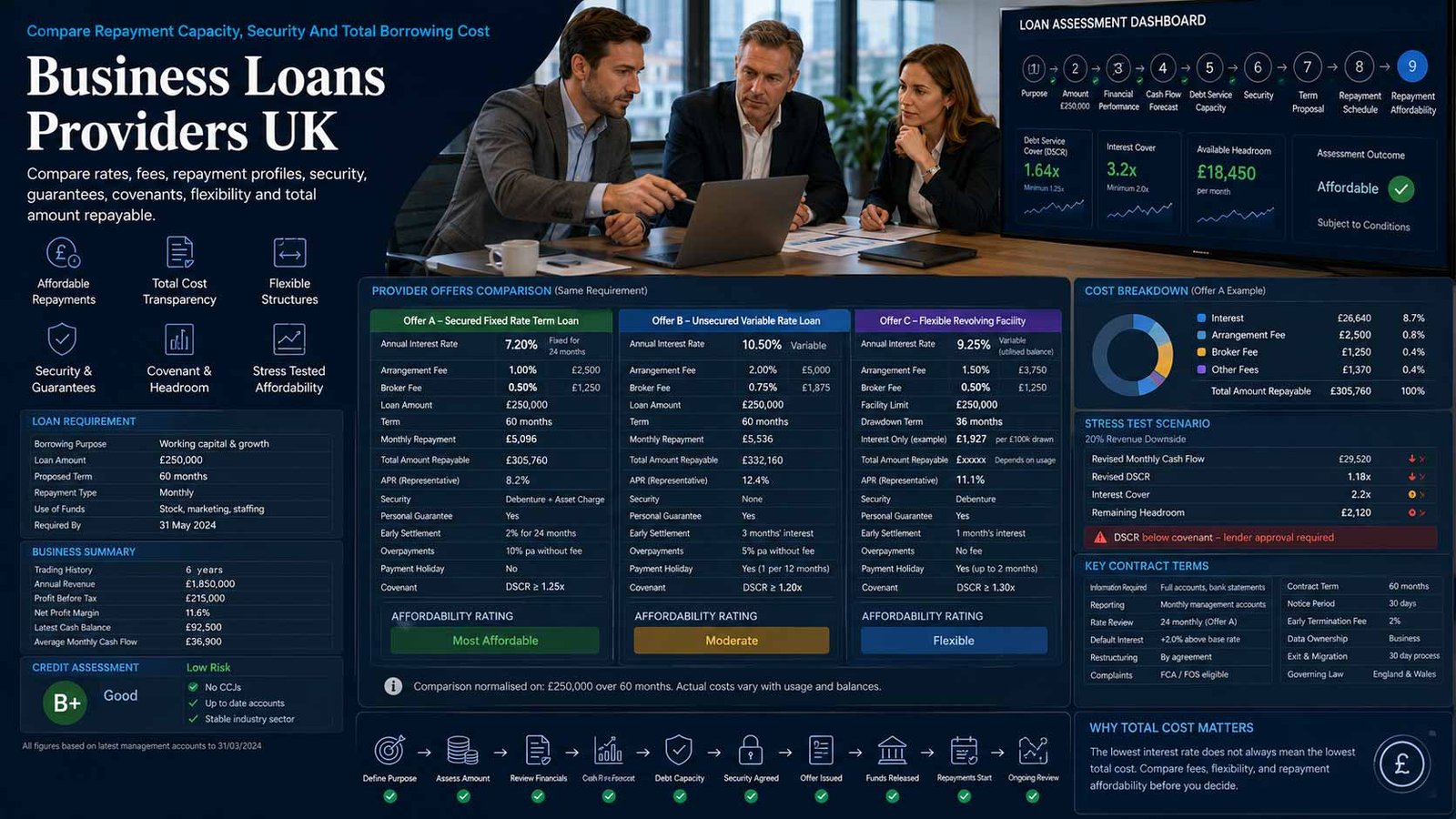
Borrow Against Repayment Capacity, Not Optimism
A business loan creates scheduled debt that must be repaid whether the funded project performs as planned or not. Affordability, downside headroom and the legal security package therefore matter as much as the amount offered.
- Match the term to the purpose and benefit period
- Compare net proceeds and total amount repayable
- Record every charge and personal guarantee
- Stress-test repayments before accepting the offer
A business loan provides a defined amount of debt finance that the business repays under a contractual schedule. The facility can be unsecured or secured, fixed or variable rate, short or long term, and direct or introduced through a broker. The lender assesses the borrower’s ability to repay, credit record, ownership, financial performance, existing commitments, purpose and available security.
The headline amount and rate do not show the entire commercial effect. Fees can reduce the cash received; frequent repayments can tighten working capital; variable rates can increase cost; and guarantees or debentures can create personal and business-asset exposure. A fair comparison therefore uses one net funding requirement, one term and one set of cash-flow assumptions.
This page compares general-purpose business loans only. It does not compare invoice factoring or business credit cards. Asset finance, commercial mortgages and tax-specific borrowing also have separate security and use-of-funds requirements and should be evaluated on their dedicated service pages.
Choose The Right Business Loan Structure
The structure determines repayment certainty, security, rate exposure, flexibility and the evidence required before funds are released.
| Loan Model | What It Usually Provides | Best-Fit Question |
|---|---|---|
| Unsecured fixed-term business loan | A lump sum is repaid over an agreed term without a specific business asset being charged as security, although a personal guarantee may still be required | Can forecast cash flow support the full repayment schedule and personal-guarantee exposure? |
| Secured business loan | The lender takes security over business assets, property, a debenture or another agreed source of repayment support | Which assets are charged, what valuation and legal costs apply, and how is security released? |
| Fixed-rate business loan | The interest rate is fixed for an agreed period, producing more predictable scheduled repayments | Is the certainty worth any higher initial rate or early-repayment restriction? |
| Variable-rate business loan | Interest changes with a reference rate or lender base rate plus an agreed margin | How far could repayments rise under a realistic rate-stress scenario? |
| Short-term business loan | Funding is normally repaid over a shorter period with frequent or monthly instalments | Does the business benefit enough from rapid funding to justify concentrated repayments and higher effective cost? |
| Longer-term growth loan | A multi-year facility supports expansion, recruitment, working capital, acquisitions or other defined growth plans | Do the term, covenants and repayment profile match the investment payback period? |
| Revolving business loan or credit facility | The borrower can draw, repay and reuse funding within an agreed limit, subject to reviews and availability | Are draw fees, commitment charges, renewal rights and on-demand repayment conditions clear? |
| Growth Guarantee Scheme-supported loan | An accredited lender may use a government-backed guarantee to support eligible lending where a normal commercial facility is not available on better terms | Is the lender accredited for the required product and does the business understand it remains responsible for repaying the entire facility? |
Eight Areas That Determine Business Loan Fit
Use the same amount, purpose, term, accounts, forecasts and repayment assumptions for every lender or broker.
Comparison Criterion
Lender Identity, Broker Role And Agreement Status
Identify the legal lender, any broker or credit intermediary, the contracting entity, the bank account receiving repayments and the complaint route. Confirm whether the agreement is regulated for the applicant’s legal form and amount, rather than assuming every business loan has the same protections. Ask how the broker is paid and whether the lender’s offer is direct, introduced or panel-based.
Comparison Criterion
Borrowing Purpose, Amount And Term Alignment
Define exactly how much is required, when it is needed, what it will fund and how long the benefit should last. Compare minimum and maximum amounts, permitted uses, drawdown conditions, staged funding, term, repayment frequency and whether refinancing is allowed. A five-year repayment commitment should not finance an expense whose commercial benefit disappears within a few months.
Comparison Criterion
Eligibility, Credit Assessment And Information Requirements
Compare trading-history rules, legal forms, turnover, profitability, credit history, sector appetite, director checks, bank statements, management accounts, filed accounts, tax position, existing debt and affordability evidence. Understand whether the initial eligibility check uses a soft search and when a full search occurs. Incomplete or optimistic data can delay approval or create a later breach.
Comparison Criterion
Interest Rate, APR And Total Amount Repayable
Separate nominal interest, annual percentage rate where supplied, flat-rate illustrations, daily or monthly calculations and lender margin. Require a complete repayment schedule showing principal, interest, fees and total amount repayable. For larger unregulated agreements where APR may not be presented, calculate a comparable annualised cost using identical loan amount, term and payment timing.
Comparison Criterion
Security, Debentures And Personal Guarantees
Record every business asset, fixed or floating charge, debenture, property security, cash collateral, corporate guarantee and personal guarantee. Confirm guarantee limits, joint and several liability, continuing obligations, independent legal-advice requirements and enforcement rights. A government-backed lender guarantee does not remove the borrower’s debt or automatically protect guarantors.
Comparison Criterion
Repayment Profile, Headroom And Early Settlement
Compare monthly, weekly or daily payments; capital-and-interest, interest-only or structured periods; payment holidays; final balloon amounts; overpayments and early repayment. Stress-test lower revenue, higher rates and delayed projects. Check whether early settlement saves future interest and whether an exit, make-whole, break or administration fee applies.
Comparison Criterion
Covenants, Monitoring And Change Control
Review financial covenants, information deadlines, bank-account requirements, use-of-funds conditions, material-adverse-change clauses, restrictions on dividends or additional borrowing, director or ownership changes and lender review rights. Confirm the cure period and communication process before a technical breach becomes an enforcement event.
Comparison Criterion
Default, Restructuring, Complaints And Exit
Understand late-payment charges, default interest, acceleration, security enforcement, guarantee claims, collections, refinancing and settlement statements. Ask how the lender handles temporary stress, payment-plan requests and formal complaints. Plan the release of charges and guarantees after final payment, and retain evidence that Companies House security records and lender mandates have been updated.
Measures To Define Before A Business Loan Is Signed
Translate an approved amount and attractive rate into auditable cash received, repayment headroom, security exposure and exit cost.
| Measure | What It Should Define | Evidence To Request | Common Weakness |
|---|---|---|---|
| Net proceeds received | Cash available to the business after every upfront deduction | Approved principal, arrangement fee, broker fee, legal cost, valuation, financed fees and bank receipt | Offers are compared using gross loan amount rather than usable cash |
| Total amount repayable | All scheduled principal, interest and compulsory fees over the full term | Dated repayment schedule, fee schedule, final payment and total | A low monthly payment hides a longer and more expensive term |
| Annualised borrowing cost | A consistent measure of finance cost across different terms and payment patterns | APR where applicable or cash-flow calculation using net proceeds and dated payments | Flat rates and reducing-balance rates are treated as equivalent |
| Debt-service headroom | Cash available after normal operating commitments and all debt payments | Monthly forecast, existing finance, proposed payment, minimum cash and downside cases | Approval is treated as proof that repayments will remain affordable |
| Rate-stress exposure | Change in payment and covenant headroom if a variable rate rises | Reference rate, margin, floor, reset date and payments at several higher rates | Only the current base rate is modelled |
| Security exposure | Business and personal value potentially available to the lender after default | Charges, debenture, valuations, guarantees, caps, ranking and enforcement | Unsecured is assumed to mean no personal liability |
| Early-settlement cost | Amount needed to repay at selected dates and the interest genuinely avoided | Settlement quote formula, notice, fee, rebate and examples | The business assumes all remaining interest disappears |
| Approval and funding certainty | Conditions that must be satisfied before the loan becomes available | Credit approval, conditions precedent, documents, bank mandate, security and expiry | A conditional offer is treated as committed cash |
| Covenant headroom | Distance between forecast performance and each contractual test | Definition, test date, threshold, forecast, downside case, cure and waiver | Accounting definitions are not aligned with the business forecast |
| Exit and security release | Evidence that repayment ends lender rights and public registrations | Final statement, zero balance, guarantee release, charge satisfaction and Companies House update | The balance is paid but charges remain registered |
Business Loan Providers UK Companies Can Consider
Shortlist lenders whose amount, term, underwriting, repayment profile, security and service fit the business. Confirm every live rate, fee and legal term directly before acceptance.
Provider Profile
Funding Circle
Funding Circle is an online UK small-business lender offering term loans to established businesses. Its current official material advertises loans from £10,000 to £750,000, terms of up to six years and decisions that can be made quickly, subject to eligibility and underwriting. Include it where a trading SME wants a digital application and a purpose-flexible term loan. Confirm the live rate, completion fee, repayment schedule, personal-guarantee requirement, eligibility, credit-search stage, early repayment treatment, missed-payment terms, Growth Guarantee Scheme availability, broker involvement, complaint route and exact Funding Circle lending entity.
Review official Funding Circle business loansProvider Profile
iwoca
iwoca provides digital business loans and revolving finance to UK SMEs, including newer and smaller businesses that may not fit a traditional bank model. Its current official business-loan material describes flexible borrowing and early repayment without a penalty on relevant products, while personal guarantees are commonly required. Include it where speed, smaller loan sizes and flexible draw or repayment options matter. Confirm whether the offer is a fixed term or revolving facility, the rate calculation, representative APR, fees on longer terms, repayment frequency, guarantee, affordability, credit search, limit reviews, default interest, data access, early settlement and total amount repayable.
Review official iwoca business loansProvider Profile
Fleximize
Fleximize is a UK digital lender offering secured and unsecured business loans with individually assessed terms. Its official pages currently describe facilities for established UK businesses, with amount and eligibility varying by legal form, location, turnover and security. Include it where a growing SME wants a tailored structure, flexible repayment features or a larger alternative-lender facility. Confirm the loan amount, fixed or variable pricing, arrangement fee, repayment term, revenue or trading-history threshold, security, personal guarantee, top-up or repayment-holiday conditions, early settlement, broker commission, legal costs, covenants, default rights and lender entity.
Review official Fleximize business loansProvider Profile
Capify
Capify provides short- and medium-term business funding to UK SMEs through a direct online and account-managed process. Its current official material promotes business loans for growth, stock, refurbishment, premises and other general business purposes, subject to assessment. Include it where a business values fast underwriting and a dedicated contact, but compare the concentrated repayment and complete cost carefully. Confirm the current minimum and maximum amount, term, repayment frequency, fixed cost or interest method, arrangement and broker fees, security or personal guarantee, bank-data access, early repayment savings, default charges, refinancing, complaint route and the entity providing credit.
Review official Capify business loansProvider Profile
HSBC UK Business Banking
HSBC UK offers small-business and commercial business loans through its business-banking range. Current official product pages describe smaller fixed-rate loans and larger commercial facilities with terms that can extend over several years, subject to status and relationship requirements. Include it where a business wants a major-bank lender, published representative examples for eligible smaller loans and access to broader relationship banking. Confirm the relevant HSBC product, amount, term, fixed or variable rate, representative APR, account requirement, security, guarantee, arrangement fee, overpayment rights, early settlement, credit assessment, GGS availability, covenants, service channel and final security release.
Review official HSBC UK Business Banking business loansProvider Profile
Lloyds Bank
Lloyds Bank provides small-business loans and larger commercial lending for investment, expansion and working capital. Its current official pages publish representative pricing for eligible loans up to a stated threshold and describe longer, tailored facilities for larger requirements. Include it where a business wants bank-led underwriting, online access for eligible smaller loans and relationship support for more complex borrowing. Confirm the live representative example, actual offered rate, amount, term, account eligibility, security, personal guarantee, arrangement fee, repayment holiday, early settlement, sustainable-finance conditions, GGS route, covenants, appeals and release of charges.
Review official Lloyds Bank business loansProvider Profile
NatWest
NatWest offers business loans and wider borrowing options for UK organisations, including fixed and variable structures and government-supported lending where available. Official guidance highlights assessment of credit history, financial performance, existing debt, cash flow and the business plan. Include it where an SME values a bank relationship, a range of borrowing structures and support through a business-banking channel. Confirm whether an existing account is required for the selected product, amount, term, rate, arrangement fee, security, guarantee, repayment frequency, overpayment, early settlement, financial information, covenant monitoring, GGS eligibility, appeal process and complaint route.
Review official NatWest business loansProvider Profile
Santander Business Banking
Santander offers unsecured business loans for eligible UK businesses through its business-banking range. Current official information publishes an indicative amount range, representative APR, repayment terms and an option to overpay without an extra charge, subject to application and status. Include it where a smaller business wants a mainstream-bank fixed-term loan with visible headline criteria. Confirm the actual rate, total amount repayable, customer or account eligibility, credit assessment, fees, guarantee, security, permitted use, repayment date, overpayment and early-settlement method, missed-payment consequences, broker involvement, complaints and any separate relationship conditions.
Review official Santander Business Banking business loansWhat Changes Business Loan Cost
Cost depends on interest method, term, payment frequency, fees, security, credit risk, broker involvement and the borrower’s ability to repay.
| Cost Driver | Why It Changes Spend | What A Comparable Quote Should Show |
|---|---|---|
| Interest rate and calculation method | A fixed or variable nominal rate drives the core finance cost, but daily, monthly, flat or reducing-balance calculations can produce different outcomes | Rate type, reference rate, lender margin, calculation basis, review dates, interest periods and worked repayment schedule |
| APR or annualised comparison | Representative APR can help compare eligible smaller loans, while larger commercial agreements may use a bespoke annual rate and fee schedule | Representative example where applicable, actual offered APR or rate, all compulsory fees and comparable annualised cost |
| Arrangement, completion and facility fees | A percentage or fixed fee can be deducted from proceeds or added to the balance, reducing usable cash and increasing interest | Fee amount, payment timing, whether financed, VAT treatment where relevant, broker share and total impact |
| Broker or intermediary remuneration | An introduced application may carry a borrower fee, lender commission or both | Named broker, panel scope, fee, commission, exclusivity, refund conditions and whether direct application is available |
| Security, valuation and legal costs | Secured lending can require legal documentation, valuations, registration and monitoring | Asset charged, valuation basis, solicitor, documentation fee, Companies House filing, insurance and release cost |
| Personal guarantee exposure | A guarantee may not create an upfront cash charge but can transfer material risk to directors or shareholders | Guarantor, capped amount, joint liability, duration, independent advice, enforcement and release evidence |
| Repayment frequency and amortisation | Weekly or daily repayments concentrate cash outflow; monthly reducing-balance repayments may be easier to forecast | Payment amount, frequency, first date, capital profile, interest split, balloon, holiday and final date |
| Early repayment and overpayment | Some loans allow cost-saving overpayments, while others charge break, settlement or administration fees | Settlement formula, notice, future-interest rebate, fee, partial-overpayment limit and worked early-exit example |
| Late payment and default cost | Missed payments can trigger fees, default interest, collections and acceleration | Grace period, fee, default rate, reporting, cure process, security enforcement and restructuring options |
| Variable-rate and stress exposure | A reference-rate increase can raise scheduled payments or extend cost on variable facilities | Current base, margin, floor, reset frequency, payment at +1%, +2% and +3%, and covenant impact |
How Purpose, Credit Strength And Security Change The Shortlist
The right lender depends on trading history, financial performance, amount, purpose, term, repayment headroom, asset support and tolerance for personal guarantees.
Established Small Business Seeking A Defined Lump Sum
Prioritise a fixed term, transparent monthly schedule, total amount repayable, sensible personal-guarantee cap and the ability to overpay. Match the loan term to the useful life of the project rather than taking the longest available term automatically.
Fast-Growth Or Digitally Trading SME
Prioritise application speed, current-management-data acceptance, flexible draw or top-up options and early repayment. Test whether the lender’s short assessment window is balanced by higher cost, frequent payments or broad data-access and guarantee requirements.
Larger Or Asset-Rich Business
Prioritise secured and relationship-led facilities, longer terms, covenant headroom and competitive margin. Map debentures, fixed charges, valuations, legal costs and intercreditor arrangements, and require a clear process for releasing security after repayment.
Business Considering Government-Supported Lending
Prioritise accredited lenders offering the required product and compare the GGS-backed offer with any better normal commercial facility. Remember that lender support does not remove the business’s obligation to repay the full debt and does not guarantee approval.
How To Compare Business Loan Offers
Give every lender the same net funding requirement, purpose, term, accounts, forecasts, existing debt and stress assumptions. Require a standardised schedule showing cash received and every payment due.
- The lender, broker, fees and commission are identified
- Every offer uses the same amount and maturity
- Rate, APR or annualised cost is calculated consistently
- Security and personal guarantees are separately recorded
- Repayment and covenant headroom are stress-tested
- Early settlement, default and charge release are documented
Compare Net Proceeds And Total Repayable
Deduct fees from the amount advanced, then add every scheduled payment, legal cost and exit charge.
A lower headline rate is not automatically the lower-cost offer.
Six Questions To Put To Every Business Loan Provider
The answers expose hidden intermediary costs, weak affordability, personal exposure, expensive settlement and broad default rights.
Who Is The Actual Lender And Who Gets Paid?
Identify the legal lender, broker, intermediary, commission, borrower fee, panel coverage, contracting entity and complaint route.
What Is The Complete Amount Repayable?
Request the principal, every interest payment, arrangement and completion fee, broker fee, legal cost and final total under one schedule.
What Security And Personal Liability Apply?
Confirm assets charged, debenture, valuation, personal guarantee, guarantee cap, joint liability, independent advice and release.
Can Cash Flow Support The Stress Case?
Model the scheduled payment against lower revenue, delayed benefits, higher variable rates and existing debt commitments.
What Does Early Repayment Actually Save?
Ask for settlement examples after six, twelve and twenty-four months, including fees and the future interest that would be avoided.
What Can Trigger Default Or Repricing?
Review missed payments, information delays, covenants, ownership changes, additional borrowing, account conduct and material-adverse-change rights.
A Seven-Stage Business Loan Evaluation
Move from a defined use of funds and tested repayment plan to controlled drawdown, rather than accepting the largest amount offered.
- Define the exact borrowing purpose, required net proceeds, draw date, project payback, preferred term, maximum affordable repayment and accountable owner before approaching lenders.
- Collect filed accounts, management accounts, forecasts, bank statements, tax information, existing borrowing, credit history, ownership records, business plan, asset schedule and evidence supporting the use of funds.
- Calculate debt-service headroom under the base case and stress cases. Include existing repayments, seasonal lows, tax, payroll, rate rises and a delay in the investment generating income.
- Issue one written borrowing brief to direct lenders or an identified broker and require standardised offers showing lender, amount, term, rate, APR where applicable, fees, repayment schedule, security, guarantee and total repayable.
- Normalise every offer to the same net amount received and comparison date. Adjust for fees deducted upfront, different payment frequencies, variable rates, early-settlement assumptions and security costs.
- Complete legal and financial review of the facility agreement, debenture, guarantees, covenants, broker terms, bank mandates, insurance, GGS conditions and Companies House registrations before drawdown.
- Operate the loan through scheduled cash forecasting, payment controls, covenant monitoring, lender reporting, guarantee records, annual refinance review and documented release of every charge after final settlement.
Business Loan Comparison Checklist
Use this table before approving an unsecured, secured, fixed-rate, variable-rate, short-term or government-supported business loan.
| No. | Requirement | Evidence To Obtain Before Award | Confirmed |
|---|---|---|---|
| 01 | Borrowing purpose and accountable owner agreed | Use of funds, net amount, project owner, finance owner, approver, target draw date and expected commercial benefit | |
| 02 | Loan term matched to benefit period | Project life, payback, repayment start, final maturity, replacement cycle and refinancing assumption | |
| 03 | Affordability and stress testing completed | Base cash flow, seasonal low, revenue downside, rate increases, delayed benefit, existing debt and minimum headroom | |
| 04 | Applicant eligibility validated | Legal form, trading history, turnover, profitability, sector, location, credit history, tax position and lender criteria | |
| 05 | Financial information pack completed | Filed accounts, management accounts, forecasts, bank statements, aged balances, tax returns and business plan | |
| 06 | Lender and broker identities confirmed | Legal lender, broker, intermediary, commission, borrower fee, panel, exclusivity, FCA status where relevant and complaints | |
| 07 | Rate and interest method documented | Fixed or variable, reference rate, margin, floor, calculation basis, review dates and annualised comparison | |
| 08 | Complete repayment schedule received | Principal, interest, fees, payment dates, frequency, first payment, balloon, total amount repayable and net proceeds | |
| 09 | Security package approved | Assets, fixed charge, floating charge, debenture, valuation, legal work, filing, insurance and release procedure | |
| 10 | Personal guarantees reviewed | Guarantors, cap, joint liability, continuing security, independent advice, enforcement, insurance and release | |
| 11 | Fees and intermediary costs included | Arrangement, completion, broker, legal, valuation, monitoring, account, transfer, early exit and default charges | |
| 12 | Covenants and information duties accepted | Financial tests, reporting dates, bank-account conduct, additional debt, dividends, ownership, cure period and waiver cost | |
| 13 | Overpayment and early settlement tested | Partial overpayment, notice, break cost, rebate, administration fee and settlement examples at several dates | |
| 14 | Default and restructuring process understood | Grace period, default rate, collections, acceleration, security, guarantee, communication, forbearance and complaints | |
| 15 | Drawdown, monitoring and exit plan agreed | Conditions precedent, net funds, payment control, annual review, refinance triggers, final statement and charge release |
Common Business Loan Buying Mistakes
Most avoidable failures begin with an unclear purpose, a rate-only comparison, weak stress testing or unreviewed security and guarantees.
| Mistake | Why It Creates Risk | Better Control |
|---|---|---|
| Comparing only the advertised interest rate | Fees, payment frequency, security and repayment term can make a lower rate more expensive overall | Compare net proceeds and total amount repayable |
| Borrowing more because it is available | Unused capital still creates interest and can weaken future borrowing capacity | Size the loan from a documented use-of-funds plan |
| Using a long-term loan for a short-lived expense | The business keeps repaying after the commercial benefit has disappeared | Match maturity to the benefit period |
| Ignoring fees deducted from the advance | The amount received can be lower than the amount on which interest is charged | Compare usable cash after every deduction |
| Signing a personal guarantee without a cap review | Directors can expose personal assets beyond the expected business risk | Record the maximum liability and obtain advice |
| Treating government support as debt forgiveness | The scheme supports lender risk but the borrower remains liable for the full facility | Read the lender and scheme terms separately |
| Failing to stress-test variable rates | Payments can rise while revenue remains unchanged | Model several rate and revenue scenarios |
| Assuming early repayment is always free | Settlement fees or limited interest rebates can reduce the expected saving | Obtain dated settlement illustrations |
| Overlooking covenants and information deadlines | A healthy business can create a technical default through late reporting or a restricted action | Assign covenant owners and calendar every duty |
| Refinancing only after cash becomes tight | Urgency reduces negotiating power and can limit lender choice | Start the annual review well before maturity |
Frequently Asked Questions
Answers to common questions from UK companies comparing bank, digital, secured, unsecured and government-supported business loans.
What Is A Business Loan?
A business loan is debt finance provided for an agreed business purpose. The lender advances a lump sum or approved facility and the borrower repays principal, interest and any fees over the agreed term. The agreement can be secured or unsecured, fixed or variable rate, and may require a personal guarantee.
How Much Can A UK Business Borrow?
The amount depends on lender limits, legal form, trading history, turnover, profitability, cash flow, credit history, existing debt, security and purpose. Providers range from small digital loans to multi-million-pound commercial facilities. Compare the amount actually received after fees with the repayment capacity of the business.
What Documents Are Needed For A Business Loan Application?
Lenders commonly request identification, ownership information, business bank statements, filed or management accounts, forecasts, tax information, existing borrowing and an explanation of how the funds will be used. Larger or secured loans can also require a business plan, asset valuations, legal documents and covenant forecasts.
What Is The Difference Between A Secured And Unsecured Business Loan?
A secured loan is supported by identified business assets, property, a debenture or other collateral. An unsecured loan does not rely on a specific asset charge, but the lender can still require a personal or corporate guarantee. Secured borrowing may support larger or longer facilities but can add valuation, legal and enforcement risk.
Do Business Loans Require A Personal Guarantee?
Many lenders require personal guarantees, particularly for unsecured limited-company borrowing. The guarantee can be capped or unlimited and may be joint and several where several guarantors sign. Review the maximum exposure, independent-advice requirement, enforcement terms and release process before acceptance.
How Much Does A Business Loan Cost?
Cost can include interest, arrangement or completion fees, broker fees, legal and valuation costs, account charges, early-settlement fees and default charges. Compare the net amount received, scheduled repayments and total amount repayable. Where an APR is not supplied, calculate a consistent annualised comparison from the complete cash-flow schedule.
Can A Business Repay A Loan Early?
Often yes, but the financial effect varies. Some lenders allow overpayments or early settlement without a penalty, while others apply break, make-whole, administration or minimum-interest charges. Ask for written settlement examples and confirm how much future interest would actually be saved.
What Is The Growth Guarantee Scheme?
The Growth Guarantee Scheme is delivered through accredited lenders to support access to finance for eligible smaller UK businesses. The lender decides whether to offer a normal commercial facility or a scheme-backed facility. The government guarantee supports the lender; the business remains responsible for repaying the full amount borrowed.
Are Business Loans Regulated By The FCA?
Protection depends on the borrower’s legal form, loan amount and agreement. Some lending to sole traders or small partnerships may fall within consumer-credit rules, while many limited-company commercial loans do not. Ask the lender which regulatory framework and complaint route apply to the specific agreement and obtain professional advice where needed.
How Should A UK Business Compare Loan Providers?
Give every lender the same amount, purpose, term, accounts, forecasts and repayment assumptions. Compare the legal lender, eligibility, interest method, APR or annualised cost, total amount repayable, fees, security, personal guarantee, repayment flexibility, covenants, default rights, service and exit—not only the headline rate.
Official Guidance And Business-Loan Provider Resources
Reviewed by Bhav Giva, Founder & Lead Analyst at CompareServices.co.uk, on 30 July 2026.
Use British Business Bank guidance, official government information and lender documentation to confirm current eligibility, rates, fees, security, guarantees, scheme status and contract requirements. Credit appetite, representative examples and loan terms can change.
- British Business Bank — Business Loans
- British Business Bank — How To Apply For A Business Loan
- British Business Bank — Types Of Business Loan
- British Business Bank — Personal Guarantees For Business Borrowing
- British Business Bank — Growth Guarantee Scheme For Businesses
- Business.gov.uk — Funding Options For Business
- Funding Circle — Small Business Loans
- iwoca — Small Business Loans
- Fleximize — Business Loans
- Capify — Small Business Loans
- HSBC UK — Finance And Borrowing
- Lloyds Bank — Business Loans
- NatWest — Business Loans And Finance
- Santander — Business Loan