
Compare Business Bank Accounts Providers UK (2026)
Compare Legal Provider, FSCS Or Safeguarding, Fees, Payments, Cash Access, Users, Integrations And Switching
Use this business bank account comparison UK guide to assess providers by legal account entity, banking or e-money status, eligibility, account tariff, Faster Payments, Direct Debits, cash and cheque access, cards, users, approval controls, accounting integrations, Open Banking, international capability, support, fraud response, switching and closure. Price every option against the same twelve-month transaction profile and check whether money is held as an eligible bank deposit or safeguarded by a non-bank payment provider.
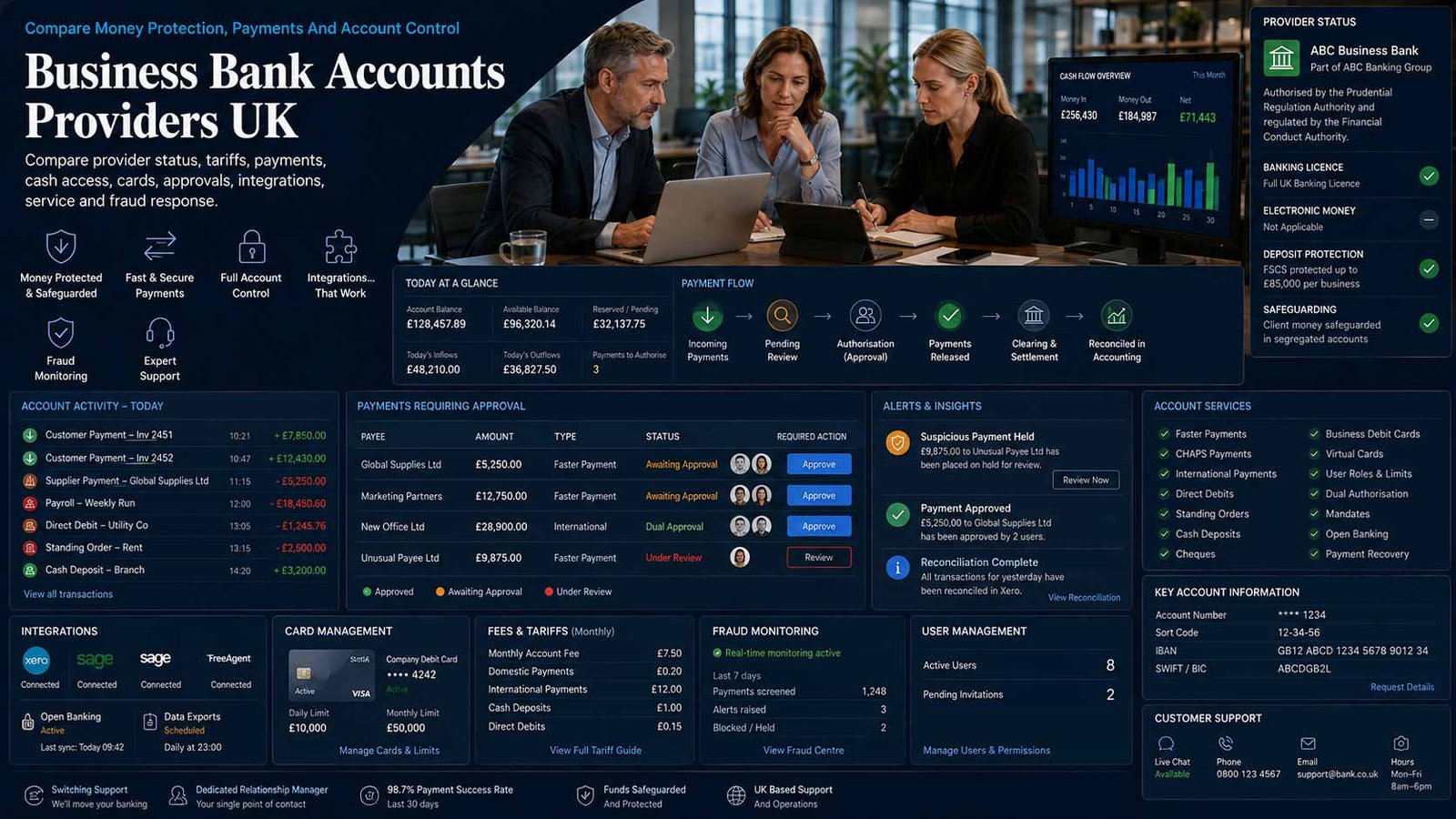
Check Who Holds The Money Before Comparing The App
The customer-facing brand, technology platform and legal account provider can be different organisations. Protection and recovery depend on the entity that actually holds or safeguards the funds.
- Identify the bank, payment institution or e-money institution
- Confirm FSCS eligibility or safeguarding arrangements
- Model the full tariff using actual account activity
- Test users, approvals, switching and closure before moving
A business current account is the operating hub for receiving income, paying suppliers and staff, collecting Direct Debits, using cards and producing financial records. The best fit depends on the legal structure, ownership, transaction volume, cash use, payment limits, users, accounting stack, countries and need for branch or relationship support.
A UK-authorised bank accepts deposits and eligible company deposits can receive FSCS protection subject to the rules and authorised-group limit. A payment or electronic-money institution must safeguard relevant customer funds instead. Safeguarding is a different legal mechanism and does not create the same compensation process as a protected bank deposit.
This page compares business operating accounts only. It does not compare personal banking or business loans. Payment acceptance through card machines, merchant acquiring and online gateways also remains separate from the account used to receive settled funds.
Choose The Right Business Account Structure
The legal provider, operating channel and governance model determine protection, access, controls and long-term suitability.
| Account Model | What It Usually Provides | Best-Fit Question |
|---|---|---|
| UK-authorised bank business current account | A current account provided by a bank authorised to accept deposits, usually with sort code, account number, Faster Payments, Direct Debits, debit card and eligible FSCS deposit protection. | Is the business and account eligible for FSCS protection, and which authorised banking licence holds the deposit? |
| Digital-first bank account | A bank account managed mainly through mobile and web channels, often with automated categorisation, invoicing, tax pots and accounting integrations. | Can every required owner, finance user and approver perform their role without branch-based workarounds? |
| High-street or relationship-led account | A bank account combining digital banking with branches, Post Office access, telephone support, cash services and potentially relationship management. | Does the business need cash, cheque, mandate, complex-payment or relationship support that a digital-only model cannot provide? |
| Sole trader business account | An account opened in the individual trader’s business capacity, with eligibility and protection assessed differently from a limited-company account. | Do the provider terms permit the actual trading activity, cash profile, turnover and payment types used by the sole trader? |
| Limited-company current account | An account held in the company’s legal name, with directors, persons with significant control and authorised users verified during onboarding. | Can the mandate support several directors, finance staff, accountants and approval levels while preserving auditability? |
| Start-up or introductory-tariff account | An account intended for newly trading businesses, sometimes with temporary fee concessions or bundled bookkeeping tools. | What is the complete tariff after the introductory period, and will the account still fit once volumes and users increase? |
| Community, charity or not-for-profit account | An account designed for clubs, societies, charities, community organisations or other non-standard governance structures. | Can trustees, officers and dual signatories operate the account under the organisation’s constitution and regulatory duties? |
| Payment or e-money business account | A payment account provided by an authorised payment institution or electronic-money institution, with customer funds safeguarded rather than held as a bank deposit. | Which legal entity provides the account, how are funds safeguarded, and what protection or recovery process applies if the firm fails? |
Eight Areas That Determine Business Account Fit
Use the same legal entity, ownership, transaction volumes, users, cash activity and international requirements for every provider.
Comparison Criterion
Provider Identity, Banking Licence And Money Protection
Identify the legal account provider, whether it is a UK-authorised bank, payment institution or electronic-money institution, and the regulatory register entries that apply. For bank deposits, confirm the authorised banking group and FSCS eligibility. For non-bank accounts, review safeguarding, insolvency and fund-return arrangements rather than assuming deposit protection.
Comparison Criterion
Eligibility, Ownership And Supported Business Activities
Compare accepted legal forms, trading history, turnover, tax residence, directors, beneficial owners, countries, merchant sectors and restricted activities. Record whether the account supports sole traders, partnerships, limited companies, charities, complex shareholding, overseas owners, client money or several businesses under one login.
Comparison Criterion
Account Tariff And Transaction Pattern
Calculate the annual cost from the real transaction pattern: monthly account fees, incoming and outgoing payments, Direct Debits, standing orders, cash, cheques, ATM use, CHAPS, additional cards, international payments and optional software. Introductory free periods should be separated from the ongoing tariff.
Comparison Criterion
Payments, Limits And Day-To-Day Controls
Compare Faster Payments, scheduled payments, Direct Debits, bulk payments, payment links where included, beneficiary controls, daily limits, cut-off times, confirmation steps and failed-payment handling. High advertised limits are not useful if authorisation controls or beneficiary workflows do not match the business.
Comparison Criterion
Cash, Cheque, Branch And Post Office Access
Map cash deposits and withdrawals, cheque imaging or counter deposit, Post Office access, branch availability, ATM limits, cash fees and processing times. Cash-heavy and cheque-receiving businesses should model volume limits and operational journeys rather than treating branch access as a simple yes-or-no feature.
Comparison Criterion
Users, Cards, Mandates And Approval Workflows
Review the number and type of users, director access, accountant access, employee cards, spending limits, dual approval, payment roles, mandate changes, leaver removal and audit logs. Confirm whether one owner must retain exclusive control or whether several people can approve and administer safely.
Comparison Criterion
Accounting, Open Banking, Exports And Automation
Compare bank feeds, Open Banking connections, accounting integrations, invoice tools, receipt capture, tax allocation, API availability, CSV exports, reconciliation references and access to historic statements. Ensure data remains exportable if the business changes accounting software or bank.
Comparison Criterion
Service, Fraud Response, Switching And Closure
Compare support hours, human escalation, fraud reporting, payment recall, complaints, service-quality disclosures, Current Account Switch Service participation, notice, account-review rights, data retention and closure procedures. Build a controlled switch plan for payroll, tax, customers, suppliers and account-linked services.
Measures To Define Before Opening Or Switching
Translate free banking, instant payments and modern apps into auditable cost, access, protection and operating evidence.
| Measure | What It Should Define | Evidence To Request | Common Weakness |
|---|---|---|---|
| Annual operating cost | Total account and transaction charges for the agreed twelve-month activity profile | Monthly fee, electronic payments, Direct Debits, cash, cheques, cards, ATM, CHAPS, international and add-ons | An introductory free period is treated as the permanent cost |
| Payment completion reliability | Whether authorised payments reach the beneficiary accurately and within the expected timetable | Initiation time, approval time, scheme, status, rejection code, retry, recall and resolution | Payment availability is measured without separating outages, limits and user errors |
| Cash and cheque accessibility | Whether physical takings and cheques can be deposited within the required time and travel burden | Locations, limits, fees, cut-offs, clearing time, deposit evidence and exception process | The account supports cash in theory but not at the business’s volume or location |
| User-control coverage | Whether each director, finance user, employee and accountant has the right access and approval level | Role matrix, card limits, payment limits, dual approval, logs, mandate and leaver process | Shared credentials are used because the account lacks suitable roles |
| Reconciliation quality | Whether statement and transaction data can be matched to invoices, payroll, tax and accounting records | Reference fields, feeds, exports, API, receipts, categories, historic access and exception reporting | Automation is available but loses payer references or fee detail |
| Deposit or fund-protection position | The legal protection that applies to money held with the provider | Bank licence, authorised group, FSCS eligibility and limit, or safeguarding method and insolvency disclosure | A fintech brand is assumed to be a bank without checking the underlying provider |
| Fraud-response effectiveness | How quickly suspicious access or payments can be stopped, investigated and recovered | 24/7 reporting, card freeze, beneficiary controls, recall, case ownership, evidence and complaint route | In-app support is available but urgent escalation is unclear |
| Service availability | Access to app, web, cards, payments, branches and support when the business needs them | Published availability, incident history, fallback channels, maintenance and service-quality information | A mobile app is treated as the only critical dependency with no fallback |
| Switch completeness | Whether incoming and outgoing payments, balance, payees and communications move correctly | CASS eligibility, switch date, redirected payments, payroll, tax, customer notices and old-account closure | The switch completes technically but suppliers or marketplaces still use old details |
| Closure and data retention | Whether the business can retrieve records and settle outstanding activity after closure | Final statements, exports, card cancellation, pending payments, chargebacks, complaints and retention period | The account is closed before records and linked services are secured |
Business Bank Account Providers UK Companies Can Consider
Shortlist providers whose legal account model, eligibility, tariff, access, controls and service fit the organisation. Confirm current terms directly before opening or switching.
Provider Profile
Monzo Business
Monzo provides UK business current accounts for eligible sole traders and limited-company directors through a branchless bank model with mobile and web access, payments, cards, account-management tools and participation in the Current Account Switch Service. Include it where a small business prioritises digital operation, modern user experience, automated administration and 24/7 support. Confirm the eligible legal forms and sectors, plan-level features, monthly fee, cash and cheque routes, card and payment limits, multi-user permissions, international-payment treatment, accounting integrations, FSCS status, CASS process, account-review rights, complaints and export or closure procedures.
Review official Monzo Business business account informationProvider Profile
Mettle by NatWest
Mettle offers a digital business bank account provided by National Westminster Bank for eligible UK sole traders and limited companies with a limited ownership profile. It combines payments with invoicing, tax and bookkeeping tools and is positioned for self-employed and small owner-managed businesses. Include it where simplicity and integrated administration matter more than complex mandates or branch services. Confirm owner and access limits, number of accounts permitted, supported sectors, balance and payment limits, cash or cheque handling, optional paid add-ons, accounting features, FSCS eligibility, service support, CASS availability, data export and the route for moving to a more complex NatWest account if the business grows.
Review official Mettle by NatWest business account informationProvider Profile
Starling Bank
Starling provides a fully licensed UK bank business current account with app and web banking, payments, debit cards, invoicing, spending controls, accounting integrations and 24/7 support. Include it where a sole trader or limited company wants a digital-first account with bank-deposit status and established business-banking features. Confirm eligibility for directors and persons connected to the company, unsupported sectors, cash deposit limits and charges, cheque options, additional cards and user access, payment limits, foreign-currency requirements, accounting or bookkeeping add-ons, FSCS eligibility, CASS, service-quality results and account-review or closure terms.
Review official Starling Bank business account informationProvider Profile
Tide Business
Tide operates a business financial platform that can provide different account arrangements through partner institutions, including business bank accounts provided by ClearBank and e-money accounts provided by PrePay Solutions. Include it where a freelancer, contractor or scaling small business wants app-led banking, invoicing, expense and accounting tools around one operational platform. Confirm which legal provider and account type is offered to the applicant, whether FSCS or safeguarding applies, transaction and cash fees, support plan, payment and card limits, additional users, international capability, accounting tools, CASS eligibility, account migration, complaints and what happens if the underlying provider or account model changes.
Review official Tide Business business account informationProvider Profile
NatWest Business
NatWest offers start-up, standard business and community current accounts alongside online banking, mobile banking, branches, Post Office access and enhanced Bankline controls for more complex organisations. Include it where a business values a broad banking relationship, cash and cheque access, several account types or advanced payment approvals. Confirm the exact account and turnover criteria, introductory and standard tariff, cash and international charges, user and Bankline fees, branch and Post Office services, CASS eligibility, FreeAgent conditions, payment limits, FSCS eligibility, service-quality disclosures, account-review duties and the process for mandate, ownership and closure changes.
Review official NatWest Business business account informationProvider Profile
Lloyds Bank
Lloyds provides business current accounts for start-ups, sole traders, established SMEs, charities and larger organisations, supported by app, online, branch and Post Office channels. Include it where the business needs conventional banking access, multiple users, cash or cheque services and an account that can sit within a wider banking relationship. Confirm turnover and ownership eligibility, account-opening evidence, introductory and ongoing tariff, domestic transaction allowance, cash and cheque pricing, user and payment controls, international payments, accounting offers, CASS, FSCS eligibility, service-quality results, mandate changes, complaints and final record access.
Review official Lloyds Bank business account informationProvider Profile
Barclays Business Banking
Barclays provides business current accounts and related digital, telephone and branch services for eligible UK businesses. Include it where a company wants a high-street banking relationship, sector support, conventional cash services and access to broader operational banking tools. Confirm the appropriate account, turnover and sector eligibility, monthly and transaction tariff after any introductory period, cash and cheque handling, payment limits, additional users and cards, online and mobile features, accounting software terms, international services, CASS, FSCS eligibility, published service information, fraud escalation, mandate changes and closure rights.
Review official Barclays Business Banking business account informationProvider Profile
HSBC UK Business Banking
HSBC UK provides small-business and relationship-led business banking accounts with online and mobile banking, debit cards, branch or Post Office access, payments, cheque services and international capability. Include it where a business values established domestic and cross-border banking channels or expects its banking requirements to become more complex. Confirm the correct account tier, tax-residence and business eligibility, introductory and ongoing price list, standard and international transaction charges, cash pricing, app and internet-banking permissions, relationship support, accounting tools, CASS, FSCS eligibility, service-quality information, account-review requirements and closure or data-export processes.
Review official HSBC UK Business Banking business account informationWhat Changes Business Bank Account Cost
Compare the ongoing two-year cost using actual payment, cash, cheque, card, user and international activity rather than one advertised fee.
| Cost Driver | Why It Changes Spend | What A Comparable Tariff Should Show |
|---|---|---|
| Monthly account fee | Some accounts have no recurring fee, while others charge for the account plan, service level or enhanced controls | Fee, VAT treatment, included users, included transactions, review date, cancellation and annual amount |
| Domestic electronic payments | Charges can apply to incoming or outgoing Faster Payments, Direct Debits, standing orders and bulk payments | Payment type, included allowance, per-item fee, failure fee, monthly volume and annual cost |
| Cash deposits and withdrawals | Cash handling can be priced by percentage, fixed amount, location or volume and may be subject to limits | Deposit route, fee, minimum, daily and annual limits, processing time and rejected-deposit handling |
| Cheque services | Cheque imaging, Post Office or branch deposits can have per-item charges and clearing delays | Deposit method, fee, cut-off, clearing time, return fee and statement evidence |
| Cards, users and spending controls | Extra debit or expense cards, additional administrators and premium permissions can create fixed or per-user cost | Included cards and users, replacement, ATM, spending controls, approval tools and annual cost |
| CHAPS and urgent payments | Same-day high-value or urgent payments can carry material per-item fees and cut-off rules | Channel, cut-off, user approval, fee, cancellation, tracking and failure handling |
| International payments and foreign exchange | Transfer fees, correspondent charges, exchange-rate margin and receiving-currency conversion affect total cost | Currency, transfer fee, FX basis, margin, intermediary fees, recipient amount and settlement time |
| Accounting and administration add-ons | Bookkeeping, invoicing, tax, payroll, expense or priority-support tools may be included only on paid plans | Feature, plan, user count, integration, data ownership, VAT, renewal and exit |
| Introductory tariff expiry | Start-up and switch offers can make first-year cost unrepresentative of the ongoing account | Offer period, qualifying conditions, standard tariff, notice of change and two-year cost |
| Switching and closure costs | Operational migration, replacement cards, stationery, accounting changes and parallel running create internal cost even when CASS is free | Switch scope, staff time, linked-service changes, dual running, final records and closure date |
How Operating Model Changes The Shortlist
The right account depends on ownership, payment volumes, cash handling, users, countries, reporting and service expectations.
Digital Sole Trader Or Owner-Managed Company
Prioritise straightforward onboarding, no unnecessary fixed cost, mobile and web access, invoicing, tax allocation, accounting integration and clear payment limits. Check whether one-owner access, cash limits or unsupported sectors could become restrictive as the business grows.
Cash, Cheque Or Location-Based Business
Prioritise nearby cash and cheque deposit routes, limits, predictable fees, branch or Post Office fallback, card replacement and support during trading hours. Model travel, deposit frequency and takings concentration rather than comparing only the monthly account fee.
Multi-Director Or Finance-Team Business
Prioritise several administrators, role separation, dual approval, payment limits, accountant access, employee cards, audit logs and controlled mandate changes. Test the full payment workflow before switching payroll, tax and supplier activity.
International Or Multi-Entity Organisation
Prioritise legal-entity coverage, multiple accounts, currency capability, international-payment transparency, user permissions, central reporting, Bankline or equivalent controls, relationship support and reliable exports. Separate the sterling operating account from specialist FX requirements where appropriate.
How To Compare Business Account Proposals
Give every provider the same legal entity, ownership, turnover, monthly payment count, Direct Debits, cash, cheques, users, cards, international activity, accounting tools and support requirements. Require a complete tariff and protection disclosure.
- The legal bank or payment provider is identified
- FSCS or safeguarding status is documented
- Charges use the same two-year transaction profile
- Users, mandates and approvals are tested
- Cash, cheque and fallback journeys are confirmed
- Switching, exports and closure are documented
Price The Account The Business Will Actually Use
Include real payment, cash, cheque, card, user and international volumes.
Compare the legal protection, operational controls and two-year cost before comparing introductory offers.
Six Questions To Put To Every Account Provider
The answers expose hidden account entities, incomplete tariffs, weak controls and switching risks.
Who Legally Provides And Holds The Account?
Identify the brand, bank, payment institution or e-money institution, regulatory status, banking licence, safeguarding method and complaint route.
Which Businesses And Owners Are Eligible?
Confirm legal form, trading activity, turnover, tax residence, directors, shareholders, overseas owners, account purpose and unsupported sectors.
What Will Our Actual Transaction Pattern Cost?
Price monthly fees, digital payments, Direct Debits, cash, cheques, cards, users, ATM, CHAPS, international payments and add-ons.
Can Every User Operate Safely?
Test directors, finance staff, accountants, approvers, cardholders, limits, dual control, audit logs, mandate changes and leaver removal.
How Are Funds Protected?
Confirm FSCS eligibility and authorised banking group for deposits, or safeguarding and insolvency arrangements for a non-bank account.
How Will We Switch And Recover If Service Fails?
Review CASS eligibility, payment redirection, fraud escalation, channel fallback, data exports, final statements, complaints and closure.
A Seven-Stage Business Account Evaluation
Move from verified activity and governance requirements to a controlled opening or switch rather than choosing from a headline offer.
- Map the business legal entity, owners, directors, persons with significant control, tax residence, trading activities, annual turnover, expected balances, cash and cheque use, countries, currencies and current banking dependencies.
- Extract twelve months of account activity covering incoming and outgoing payments, Direct Debits, standing orders, cash, cheques, cards, ATM, CHAPS, international transfers, user numbers, support incidents and current charges.
- Define the required account model, money-protection position, payment limits, physical-banking access, users, approval workflows, accounting connections, exports, support and switching date.
- Issue one written requirements brief to each shortlisted provider and require the legal provider, eligibility, complete tariff, protection status, limits, service channels, user controls, integrations and closure terms.
- Normalise every proposal to the same two-year transaction profile so introductory offers, included allowances, fixed fees, per-item charges and operational migration costs are comparable.
- Complete onboarding and financial-crime checks using accurate ownership, address, tax, trading and source-of-funds evidence. Configure user roles, cards, approval levels, alerts and accounting access before moving live payments.
- Switch through CASS where eligible or use a controlled manual plan. Reconcile redirected payments, update payroll, HMRC, customers, suppliers and marketplaces, retain final records and review charges and access quarterly.
Business Bank Account Comparison Checklist
Use this table before opening, switching, renewing or expanding a UK business current account relationship.
| No. | Requirement | Evidence To Obtain Before Selection | Confirmed |
|---|---|---|---|
| 01 | Business entity and accountable owner agreed | Legal name, trading names, company number, tax details, finance owner, approver, users and account purpose | |
| 02 | Current activity profile completed | Twelve months of payments, Direct Debits, cash, cheques, cards, ATM, CHAPS, international transfers, balances and charges | |
| 03 | Provider and regulatory status verified | Legal account provider, banking licence or FCA permissions, authorised group, safeguarding, complaints and register evidence | |
| 04 | Eligibility confirmed in writing | Legal form, directors, beneficial owners, residence, sector, turnover, countries, cash profile and restricted activities | |
| 05 | Deposit or fund protection documented | FSCS eligibility and limit or safeguarding method, customer-funds disclosure, insolvency route and recovery expectations | |
| 06 | Complete tariff modelled | Monthly fee, electronic payments, cash, cheques, cards, users, ATM, CHAPS, international, add-ons and standard tariff | |
| 07 | Payment limits and cut-offs accepted | Daily and per-payment limits, new payees, bulk payments, scheduled payments, approval, cut-offs and failure process | |
| 08 | Cash and cheque access tested | Locations, deposit methods, limits, fees, clearing time, receipts, rejected items and operational travel | |
| 09 | User and approval matrix configured | Directors, administrators, accountants, employees, cards, spending limits, dual approval, logs and leaver removal | |
| 10 | Accounting and data access validated | Bank feeds, Open Banking, API, references, CSV, statements, receipts, history, ownership and export | |
| 11 | Fraud and security controls approved | MFA, device registration, card freeze, beneficiary controls, alerts, recall, 24/7 reporting and escalation | |
| 12 | Service and fallback routes confirmed | App, web, phone, branch, Post Office, urgent support, outage fallback and published service information | |
| 13 | CASS or manual switch plan agreed | Eligibility, switch date, balance, Direct Debits, standing orders, payees, redirected payments and guarantee | |
| 14 | Linked parties and systems updated | HMRC, payroll, customers, suppliers, finance systems, payment providers, marketplaces, cards and stationery | |
| 15 | Closure and review controls agreed | Parallel-running period, final statement, record retention, old cards, complaints, access removal and quarterly review |
Common Business Account Comparison Mistakes
Most avoidable problems begin with incomplete transaction data, unclear legal-provider status or weak user and switching controls.
| Mistake | Why It Creates Risk | Better Control |
|---|---|---|
| Choosing the account with the lowest monthly fee | Per-item payment, cash, cheque, international and user charges can make it more expensive overall | Model the complete transaction profile |
| Assuming every app-based account is a bank account | Some accounts are provided by payment or e-money institutions under safeguarding rather than bank-deposit rules | Verify the legal provider and protection |
| Ignoring eligibility until application | Ownership, residence, sector or trading activity can cause delays or rejection | Pre-check the full business profile |
| Treating an introductory offer as the normal tariff | Charges can change sharply after the free or discounted period ends | Compare at least two years |
| Using shared logins for finance staff | Shared credentials weaken security, approvals and audit evidence | Choose role-based multi-user access |
| Underestimating cash and cheque operations | Deposit limits, fees, clearing time and travel can disrupt reconciliation and liquidity | Test the physical process |
| Not checking FSCS or safeguarding status | The recovery route differs materially between a bank deposit and an e-money balance | Record the protection position |
| Switching without updating linked services | Marketplaces, payroll, tax, suppliers or customer mandates can continue using old details | Maintain a dependency register |
| Closing the old account immediately | Late receipts, refunds, charge corrections and statement retrieval can remain outstanding | Run a controlled overlap |
| Failing to review account access after staff changes | Former staff can retain cards, devices or permissions | Run regular access certification |
Frequently Asked Questions
Answers to common questions from UK businesses comparing bank, digital and payment-account providers.
What Is A Business Bank Account?
A business bank account is a current account used for an organisation’s day-to-day income and expenditure. It can receive customer payments, make supplier and payroll payments, support Direct Debits and standing orders, issue debit cards and provide statements and data for accounting. The legal provider, eligible business types, charges, limits and money-protection arrangements vary.
Does A Limited Company Need A Separate Business Account?
A limited company is a separate legal entity, so company money and records must be kept separate from the finances of directors and shareholders. A dedicated account in the company’s legal name is the clearest way to maintain that separation and is normally required by account-provider terms, accounting controls and commercial counterparties.
Does A Sole Trader Need A Business Account?
A sole trader is not a separate legal entity in the same way as a limited company, but provider terms may restrict business use of other account types. A dedicated sole-trader account can make tax records, cash-flow monitoring, invoicing and reconciliation clearer. Check the provider’s eligibility and permitted-use rules.
Are Business Bank Account Deposits Protected By The FSCS?
Eligible company deposits held with a UK-authorised bank, building society or credit union can be protected by the Financial Services Compensation Scheme up to the applicable limit per eligible depositor, per authorised firm. The limit is currently £120,000. Eligibility and aggregation rules apply, and non-bank payment or e-money accounts use safeguarding rather than FSCS deposit protection.
What Is The Difference Between A Bank Account And An E-Money Account?
A bank accepts deposits under a banking licence and eligible deposits may receive FSCS protection. An electronic-money or payment institution provides payment services and must safeguard relevant customer funds under its regulatory obligations. Safeguarding is not the same as FSCS protection, and return of funds after failure can take longer or be reduced by insolvency costs.
How Much Does A Business Bank Account Cost?
Cost can include a monthly account fee, electronic-payment charges, cash and cheque fees, ATM charges, additional cards or users, CHAPS, international payments, foreign-exchange margin and optional administration tools. Use the business’s actual twelve-month transaction pattern and compare the ongoing tariff after any introductory offer.
What Information Is Needed To Open A Business Account?
Providers commonly request evidence about the business, registered and trading addresses, tax position, expected turnover, source of funds, products or services, countries, directors, partners, trustees, beneficial owners and persons with significant control. Complex ownership, overseas connections or regulated activity can require additional documents and review.
Can A Business Switch Bank Accounts Through CASS?
Eligible small businesses, charities and trusts can use the Current Account Switch Service with participating providers. A full switch normally transfers the balance and regular payments and closes the old account under the Current Account Switch Guarantee. Eligibility, account type and provider participation should be confirmed before setting the switch date.
What Should A Cash-Handling Business Compare?
Compare deposit locations, opening hours, daily and annual limits, percentage and minimum fees, cash denominations, evidence receipts, processing times, cheque options and emergency access. A low monthly fee can be outweighed by cash charges and staff travel if the deposit network does not fit the business.
How Should A UK Business Compare Account Providers?
Give every provider the same legal-entity, ownership, transaction, cash, cheque, user, payment, international and accounting requirements. Compare the legal provider, protection status, eligibility, complete tariff, limits, physical access, approvals, integrations, support, switching and closure—not only the app design or introductory offer.
Official Guidance And Business Account Resources
Reviewed by Bhav Giva, Founder & Lead Analyst at CompareServices.co.uk, on 30 July 2026.
Use official government, FCA, FSCS, CASS, CMA and provider documentation to confirm current eligibility, fees, protection, service channels, limits and switching requirements. Account providers, tariffs and legal arrangements can change.
- Business.gov.uk — Getting A Business Bank Account
- GOV.UK — Company And Accounting Records
- FSCS — Small Businesses And Limited Companies
- FSCS — Deposit Protection Limit Increase
- FCA — Using Payment Service Providers
- FCA — Safeguarding Requirements For Payment And E-Money Institutions
- Current Account Switch Service — Business Switching Process
- CMA — Retail Banking Market Investigation And Service Information
- Monzo — Business Banking
- Mettle — Business Bank Account
- Starling — Business Account
- Tide — Business Current Account
- NatWest — Business Bank Accounts
- Lloyds Bank — Business Accounts
- Barclays — Business Accounts
- HSBC UK — Business Accounts