
Compare Business Credit Cards Providers UK (2026)
Compare APR, Interest-Free Periods, Annual Fees, Guarantees, Employee Cards, Rewards, FX Charges And Total Borrowing Cost
Use this business credit cards UK comparison to assess providers by issuer, revolving or pay-in-full structure, eligibility, business and personal credit checks, personal guarantee, offered credit limit, purchase rate, representative APR, interest-free period, minimum repayment, annual fees, employee cards, virtual cards, cashback, points, foreign spending, cash charges, accounting data, fraud response and closure. Compare every card against the same monthly spend and repayment plan rather than one headline reward or advertised rate.
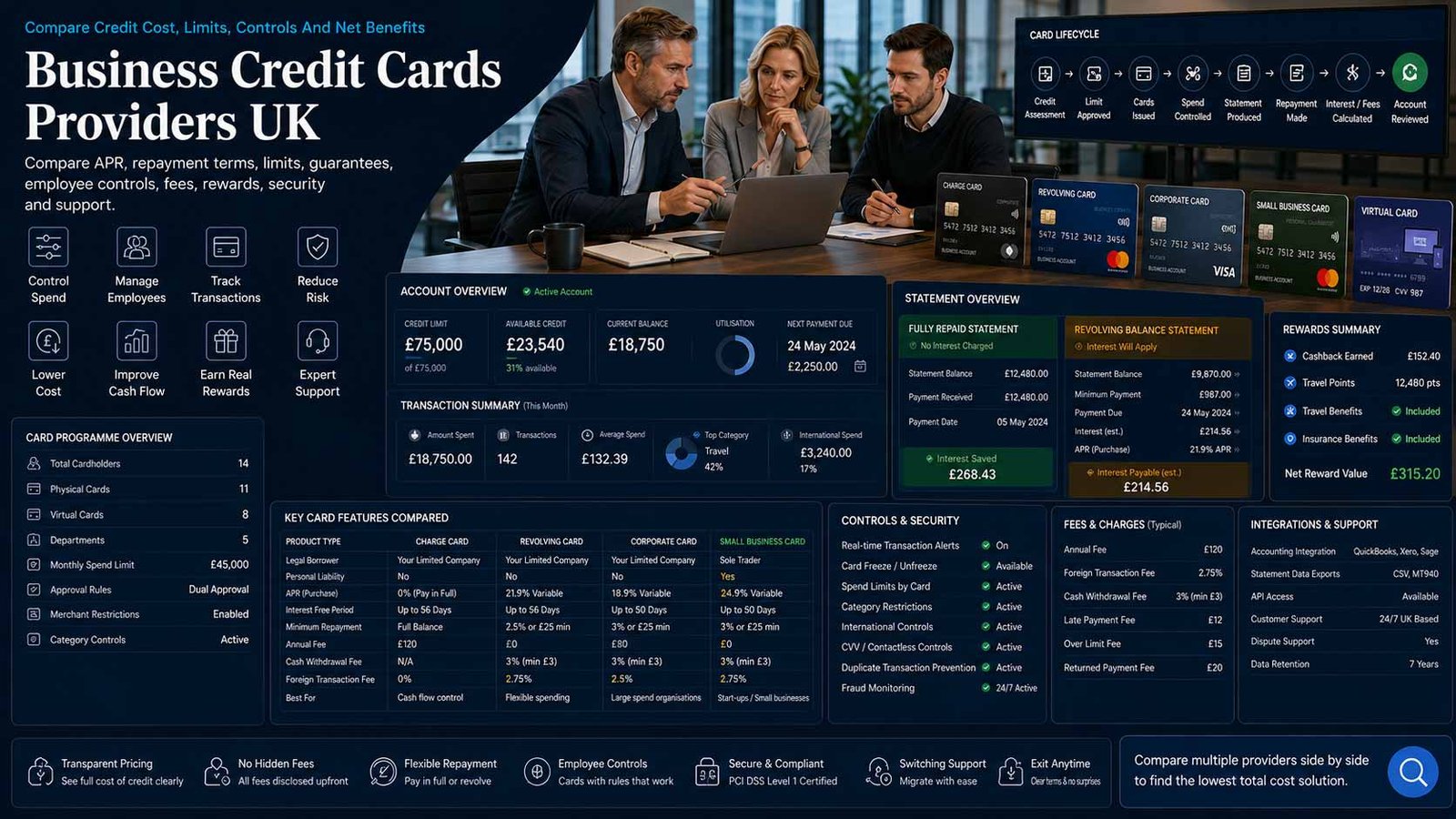
Compare The Debt Before Comparing The Rewards
Cashback, points and travel benefits have value only when the business can repay on time and the legal liability is understood.
- Identify revolving credit or pay-in-full terms
- Read the personal guarantee separately
- Model interest, fees and foreign spending
- Control every employee card and receipt
A business credit card gives a company access to a reusable credit limit for approved purchases and, where permitted, cash or cash-equivalent transactions. The issuer produces a statement and the borrower repays the account under the agreement. Paying the full eligible purchase balance on time can avoid purchase interest; paying less can turn ordinary operating spend into revolving debt.
Business charge cards can appear in the same provider range but normally require full statement payment. Corporate programmes may add central billing, advanced controls and different liability structures. Compare the agreement, borrower and repayment duty—not only the word used in marketing.
This page compares cards issued for business borrowing and payment. It does not compare personal credit cards or bank accounts. Card-acquiring products used to accept customer payments and separate expense-management or prepaid spend platforms have different commercial purposes.
Choose The Right Business Card Structure
The repayment model, liability, rewards and cardholder controls determine whether a card is useful working capital or expensive uncontrolled debt.
| Card Model | What It Usually Provides | Best-Fit Question |
|---|---|---|
| Revolving business credit card | A reusable credit facility with a stated limit. The business can pay the statement in full or carry an eligible balance while interest and minimum-payment rules apply. | Will the business clear every statement, or is the expected use likely to create interest-bearing debt? |
| Business charge card | A card account normally requiring the statement balance to be paid in full by the due date, often with rewards, travel or expense-management benefits. | Can the business reliably fund the entire monthly statement without relying on minimum repayments? |
| Cashback business card | A card that returns a percentage or fixed value on eligible purchases, sometimes by category, merchant or annual spend threshold. | Does the net cashback exceed the annual fee, interest, foreign-exchange charges and any excluded spend? |
| Points or travel-rewards card | A card that earns points, airline miles, travel credits, lounge access or related business-travel benefits. | Will the business redeem rewards at sufficient value and avoid carrying interest-bearing balances? |
| Bank-linked SME credit card | A card available mainly or only to existing business-current-account customers, with servicing integrated into the bank’s online and mobile channels. | Does the existing banking relationship improve control and convenience without reducing provider choice? |
| Independent fintech business card | A digitally managed card from a specialist issuer, often combining rapid decisions, virtual cards, employee controls, cashback and accounting integrations. | Are eligibility, personal-guarantee, support and account-suspension terms suitable for the company? |
| Corporate or commercial card programme | A card programme designed for larger organisations, multiple cardholders, central billing, policy controls, reporting and potentially corporate liability. | Does the organisation need advanced cardholder governance rather than a simple owner-managed credit card? |
| Additional-cardholder programme | A primary credit facility with extra physical or virtual cards for employees, departments, sites or projects under one account. | Can limits, merchant controls, receipts, approvals, leaver actions and liability be managed at cardholder level? |
Eight Areas That Determine Business Credit Card Fit
Use the same legal entity, monthly spend, repayment timing, cardholder count, foreign activity and rewards assumptions for every provider.
Comparison Criterion
Issuer, Product Type And Legal Agreement
Identify the legal issuer, card network, account holder, borrower, cardholder and any separate programme manager. Confirm whether the product is revolving credit, a charge card or a corporate-card arrangement; which entity owes the balance; whether a personal guarantee applies; and which complaints and regulatory routes are available. Do not assume every card sold to a business carries the same protections or liability structure.
Comparison Criterion
Eligibility, Credit Assessment And Personal Guarantee
Compare accepted legal forms, trading history, turnover, ownership, UK residency, sector restrictions, credit searches, director checks, existing-account requirements and maximum company complexity. Record whether the issuer assesses the business, the applicant or both, and obtain the personal-guarantee wording before application rather than discovering personal liability after approval.
Comparison Criterion
APR, Interest-Free Period And Repayment Mechanics
Review purchase rate, representative APR, interest-free days, statement date, payment due date, minimum payment, allocation of repayments, cash interest, default consequences and the conditions required to retain interest-free purchasing. A long headline interest-free period is valuable only when the full statement can be paid on time and every relevant transaction qualifies.
Comparison Criterion
Credit Limit, Utilisation And Spending Capacity
Compare minimum and maximum limits, initial limit methodology, increases, temporary limits, preloading where supported, overlimit handling, cash limits, per-card limits and the effect of high utilisation. Match the facility to normal monthly spend and peak purchasing without making an expensive revolving balance part of the permanent working-capital model.
Comparison Criterion
Additional Cards, Virtual Cards And Employee Controls
Review the number and cost of extra cards, physical and virtual issuance, individual limits, merchant-category restrictions, card freezing, mobile wallets, receipt capture, approval workflow and leaver removal. Confirm whether controls operate in real time and whether the company remains responsible for authorised and unauthorised employee use.
Comparison Criterion
Annual Fees, Foreign Spending, Cash And Other Charges
Compare account and cardholder fees, foreign-transaction mark-up, cash withdrawal, money transfer, returned payment, late payment, replacement card, paper statement and other charges. Apply every fee to the real use case, especially travel, advertising, software subscriptions, fuel, cash access and multiple employee cards.
Comparison Criterion
Rewards, Benefits, Acceptance And Net Value
Measure cashback, points, miles, travel credits, insurance, lounge access, merchant discounts and introductory bonuses against annual fees and redemption restrictions. Check card acceptance for actual suppliers and countries. Rewards should be treated as a secondary benefit after affordability, acceptance, controls and total cost are proven.
Comparison Criterion
Statements, Accounting, Security, Support And Exit
Compare transaction descriptions, VAT and receipt workflows, accounting feeds, CSV export, historic statements, user permissions, Strong Customer Authentication, fraud reporting, chargeback assistance, complaints, card replacement, closure and final records. Ensure the business can reconcile every cardholder and retain evidence after the account is closed.
Measures To Define Before A Card Agreement Is Signed
Translate interest-free credit, flexible limits and rewards into auditable cost, repayment, control and risk evidence.
| Measure | What It Should Define | Evidence To Request | Common Weakness |
|---|---|---|---|
| Effective annual card cost | The full annual cost after interest, card fees, foreign exchange, cash use and other charges, less reliably earned rewards | Average and peak balance, repayment timing, cardholder count, annual fee, APR, FX, cash, late fees, cashback and points value | A card is described as free because the annual fee is zero while interest and foreign spending remain unmodelled |
| Interest-free utilisation | The proportion of eligible purchase spend paid in full by the due date and therefore not charged purchase interest | Statement balance, due date, payment received, excluded transactions and interest charged | The maximum advertised number of days is treated as guaranteed for every purchase |
| Repayment adequacy | Whether monthly payments reduce the balance on an agreed timetable rather than maintaining expensive revolving debt | Opening balance, new spend, interest, fees, minimum due, payment, closing balance and forecast clearance date | Minimum payments are accepted without measuring total interest or years to repay |
| Credit utilisation | The percentage of the available limit used at statement and peak points | Limit, statement balance, peak balance, pending transactions, temporary increases and declined spend | The limit appears sufficient until a seasonal peak or delayed payment blocks essential purchases |
| Reward net value | The value actually received after fees, exclusions, expiry, redemption and financing cost | Eligible spend, earn rate, caps, excluded merchants, annual fee, points valuation, redemption and interest | A sign-up bonus drives the choice while the ongoing card is poor value |
| Foreign-spend cost | The total sterling cost of purchases and cash transactions made outside the card’s billing currency | Transaction currency, network rate, issuer mark-up, cash fee, interest start date and merchant conversion choice | A no-FX claim is checked without reviewing cash, dynamic currency conversion or excluded transactions |
| Employee-card control coverage | Whether each cardholder has appropriate limits, monitoring, evidence and removal controls | Cardholder, role, limit, merchant rules, notifications, receipts, approval, freeze and termination date | Extra cards are issued faster than finance policies and reconciliation controls can support |
| Fraud and dispute resolution | How quickly suspicious activity is blocked, investigated and resolved and what evidence the business must provide | Detection time, freeze, notification, liability, chargeback or dispute route, evidence, decision and reimbursement | The company assumes business purchases receive the same statutory protection as consumer purchases |
| Reconciliation completion | Whether every transaction is coded, evidenced and approved within the accounting timetable | Statement, cardholder, supplier, VAT receipt, category, project, approver, exception and export | Rewards and convenience hide a growing backlog of missing receipts and unexplained spend |
| Exit and residual liability | Whether the account can close without hidden interest, recurring charges, unresolved disputes or missing records | Notice, balance repayment, recurring merchants, card destruction, final interest, disputes, guarantee release and statement archive | Cards are cancelled before subscriptions and outstanding authorisations are migrated |
Business Credit Card Providers UK Companies Can Consider
Shortlist issuers whose eligibility, repayment model, limit, controls, rewards and liability fit the business. Confirm the live product summary, offered rate and agreement directly before applying.
Provider Profile
Capital on Tap
Capital on Tap provides a digitally managed Visa business credit card for eligible UK limited companies, combining revolving credit, rewards, virtual access, employee cards and online expense controls. Include it where an owner-managed company wants a specialist small-business product with rapid digital servicing and straightforward rewards. Confirm current eligibility, excluded sectors, business-bank-account requirement, credit limit, variable rate, statement and repayment rules, personal guarantee, employee-card controls, accounting connection, cash and foreign-use treatment, preloading, fraud support, suspension rights and closure. Capital on Tap states that it does not currently accept sole traders, so legal-form eligibility must be checked before application.
Review official Capital on Tap business card informationProvider Profile
American Express Business Cards
American Express offers a range of UK business cards and charge-card-style products with Membership Rewards, travel and service benefits, supplementary cards and central account management. Include it where the business pays statements in full, has material travel or supplier spend and can redeem benefits at a value exceeding the fee. Compare the exact Business Gold, Business Platinum or other available product rather than treating the range as one card. Confirm annual fee, payment-in-full or revolving terms, spending capacity, supplementary-card charges, acceptance among key suppliers, points earning and redemption, travel credits, insurance eligibility, foreign-currency charges, cash access, statement controls and cancellation treatment.
Review official American Express Business Cards business card informationProvider Profile
Barclaycard Business
Barclaycard provides business credit and charge-card options for UK SMEs and larger organisations, including cashback-focused and premium products alongside cardholder management and rewards. Include it where a company wants an established card issuer, a choice between revolving and pay-in-full structures and support for several cardholders. Confirm product eligibility, turnover threshold, representative APR, annual and cardholder fees, cashback conditions, interest-free period, credit limit, employee cards, Smart Data or reporting access, foreign and cash charges, travel benefits, card-network acceptance, personal guarantee or liability position, business-current-account requirement and closure process.
Review official Barclaycard Business business card informationProvider Profile
NatWest Business Credit Card
NatWest provides a business credit card for eligible existing business-banking customers, with flexible repayment, an interest-free purchase period when the balance is paid in full, cashback features and ClearSpend or related reporting tools. Include it where a business already banks with NatWest and values integrated servicing and card-spend visibility. Confirm current turnover eligibility, account requirement, soft and full credit checks, offered limit and rate, annual fee and waiver threshold, cardholder-level fee treatment, eligible cashback categories, foreign transaction charge, minimum repayment, additional-card process, statement and reporting access, company or personal liability terms and consequences of moving the current account.
Review official NatWest Business Credit Card business card informationProvider Profile
Lloyds Bank Business Credit Card
Lloyds Bank offers business credit and charge cards linked to its business-banking services, with online account access and options for day-to-day borrowing or full monthly settlement. Include it where a business wants card borrowing within an existing Lloyds banking relationship and needs conventional online administration. Confirm whether a Lloyds business current account is required, applicant and business eligibility, available limit, purchase and cash rates, annual fee, additional cards, interest-free period, travel or insurance benefits, foreign-use charges, credit assessment, guarantee requirements, online permissions, transaction export, fraud support, recurring-payment migration and account closure.
Review official Lloyds Bank Business Credit Card business card informationProvider Profile
HSBC UK Commercial Card
HSBC UK provides Commercial Card and corporate-card products intended to support working capital, business purchasing and multi-cardholder administration through Business Internet Banking and mobile servicing. Include it where an HSBC business customer needs established domestic and international card capability, digital controls and a pathway to more advanced corporate-card programmes. Confirm which card tier is available, relationship and turnover criteria, credit and liability structure, interest-free period, annual and cardholder fees, foreign-use and cash charges, Apple or Google wallet eligibility, primary-user permissions, reports and exports, travel or expense features, dispute handling and the effect of changing the underlying business-banking relationship.
Review official HSBC UK Commercial Card business card informationProvider Profile
Santander Business Cashback Credit Card
Santander provides a Business Cashback Credit Card for eligible existing Santander Business Current Account customers meeting its ownership, residency and legal-form conditions. Include it where a smaller owner-managed business already banks with Santander and values cashback on ordinary business spending. Confirm the live annual fee, representative APR and purchase rate, credit limit, cashback rate and exclusions, additional-card availability, interest-free period, foreign and cash charges, repayment rules, personal-guarantee request for limited companies or LLPs, allowed business use, number of owners or directors supported, statement access, support and what happens to the card if the current account closes.
Review official Santander Business Cashback Credit Card business card informationProvider Profile
Metro Bank Business Credit Card
Metro Bank provides a business credit card for eligible business-banking customers, supported by online statements, contactless payments and conventional revolving-credit servicing. Include it where a company values a straightforward bank-linked card and access to Metro Bank’s broader business-banking channels. Confirm current application availability, business-account requirement, representative APR, interest-free period, annual and additional-card fees, credit limit, cash and foreign charges, digital-wallet support, statements, payment methods, user controls, personal guarantee or company liability, fraud reporting, branch support, recurring payments and closure. Use the current product summary and agreement because published rates and conditions can change.
Review official Metro Bank Business Credit Card business card informationWhat Changes Business Credit Card Cost
Compare the annual cost and repayment outcome using actual balances, payment dates, foreign spend, cardholders and rewards rather than one representative APR.
| Cost Driver | Why It Changes Spend | What A Comparable Quote Should Show |
|---|---|---|
| Purchase interest and representative APR | Carrying a balance converts ordinary spending into borrowing and the APR can incorporate mandatory fees as well as the purchase rate | Offered purchase rate, representative APR, assumed limit, balance pattern, compounding, payment timing and total annual interest |
| Annual account or cardholder fee | Rewards and premium cards can charge per account, per card or both, while fee waivers may depend on spend | Account fee, additional-card fee, VAT treatment, waiver threshold, anniversary date, refund on closure and annual total |
| Interest-free purchase period | Up to a stated number of days may apply only when the previous and current statements are paid in full and on time | Statement date, due date, qualifying transactions, full-payment requirement, payment method and loss-of-benefit rule |
| Minimum-payment structure | Low minimum payments can extend repayment and increase total interest even when the account remains within terms | Minimum formula, floor, interest and fees included, direct-debit options, extra payments and forecast clearance date |
| Cash withdrawal and cash-equivalent cost | Cash advances and cash-like transactions can attract a fee and immediate interest without an interest-free period | Cash fee, minimum charge, cash APR, interest start date, daily limit and transactions treated as cash equivalents |
| Foreign transactions and currency conversion | Issuer mark-up, network conversion, ATM fees and merchant conversion choices affect international spend | FX percentage, network rate, cash fee, dynamic currency conversion, excluded territories and refund conversion |
| Late, returned and overlimit events | Missed or failed payments can create fees, interest, account restriction and adverse credit consequences | Fee schedule, grace, notification, direct-debit failure, overlimit handling, default rate and reporting |
| Rewards, cashback and benefit cost | Rewards can offset spend only after caps, exclusions, annual fees, redemption and financing cost are included | Earn rate, eligible spend, caps, points value, expiry, redemption, annual fee, insurance conditions and net value |
| Additional cards and administration | Employee-card fees, premium reporting or control tools can add fixed cost as the programme grows | Included cards, per-card fee, virtual cards, replacement, controls, reports, users, receipts and annual total |
| Personal guarantee and credit-risk exposure | A guarantee may not add a visible fee but can transfer unpaid company debt and enforcement risk to an individual | Guarantor, cap or unlimited amount, continuing liability, notice, enforcement, release and independent-advice recommendation |
How Repayment And Spending Patterns Change The Shortlist
The right card depends on legal structure, cash flow, statement repayment, supplier acceptance, travel, cardholders and finance controls.
New Or Owner-Managed Limited Company
Prioritise transparent eligibility, a realistic limit, no unnecessary annual fee, simple repayment, virtual access, accounting integration and a clear personal guarantee. Do not use the card to conceal an underlying inability to meet routine costs.
Established SME Paying In Full Monthly
Prioritise acceptance, cashback or points net value, a suitable interest-free cycle, multiple cardholders, receipt capture and reliable statement exports. Paying in full protects the value of rewards and prevents routine purchasing from becoming expensive debt.
Business With Frequent Overseas Spend
Prioritise foreign-transaction cost, card acceptance, travel benefits, employee limits, emergency support and accounting treatment across currencies. Compare no-FX claims against cash withdrawals, merchant conversion, refunds and annual fees.
Multi-Cardholder Finance Team
Prioritise corporate or commercial card controls, role separation, individual limits, virtual cards, policy enforcement, receipts, approvals, central billing, audit logs and rapid leaver actions. Test finance workflows before issuing cards widely.
How To Compare Business Credit Card Offers
Give every issuer the same legal entity, ownership, turnover, trading history, monthly spend, peak spend, employee-card count, foreign activity and repayment plan. Require the product summary, fee schedule and guarantee before application.
- The issuer, borrower and cardholder liabilities are identified
- The offered rate and credit limit are separated from representative examples
- Full-payment and carried-balance costs are modelled
- Every employee card, fee and control is included
- Rewards are valued after fees and redemption restrictions
- Closure, disputes and guarantee release are documented
Price The Same Balance And Payment Date
A lower APR can cost more when annual fees, foreign charges or slow repayment are included.
Compare the actual offered terms and total annual cost before comparing rewards.
Six Questions To Put To Every Card Issuer
The answers expose unsuitable repayment structures, incomplete pricing, personal liability and card programmes that are difficult to control.
Is This Revolving Credit Or Pay-In-Full?
Confirm whether the balance can be carried, which transactions accrue interest, the minimum payment and what happens if the full statement is not paid.
Who Is Liable For The Debt?
Request the borrower, company liability, cardholder liability, personal guarantee, guarantee release and complaint route in writing.
What Does The Card Cost Under Our Actual Use?
Model average and peak balance, repayment date, annual fees, employee cards, foreign spend, cash use, rewards and late-payment risk.
How Is The Credit Limit Set And Changed?
Confirm the initial assessment, business and personal searches, temporary limits, increases, reductions, preloading and suspension triggers.
Can We Control Every Employee Card?
Check individual limits, merchant categories, virtual cards, notifications, receipt evidence, freeze, leaver removal and account-wide liability.
What Happens If We Switch Or Close?
Confirm recurring payments, pending transactions, final interest, disputes, rewards, statement archive, guarantee release and card destruction.
A Seven-Stage Business Credit Card Evaluation
Move from verified spend and repayment evidence to a controlled card programme rather than applying for the largest advertised bonus.
- Collect twelve months of card or supplier-spend data, monthly peaks, foreign transactions, employee requirements, current borrowing, repayment history, accounting workflow and responsible owners.
- Define whether the need is short-term revolving credit, full monthly settlement, rewards, travel capability, employee purchasing or an advanced corporate-card programme.
- Prepare accurate application evidence covering legal entity, ownership, trading history, turnover, profits, bank details, existing debt, intended use, directors and any requested guarantor.
- Issue one comparison brief and obtain the product summary, credit agreement, representative example, fee schedule, guarantee, rewards terms, cardholder controls and complaint route.
- Normalise every option using the same average and peak balance, payment date, cardholder count, foreign spend, cash use and realistic rewards value.
- Apply only after affordability, liability, credit-search impact, limit, repayment method, employee policy, accounting integration and fraud escalation are approved.
- Operate through full-statement or planned repayments, utilisation monitoring, monthly reconciliation, receipt control, limit reviews, fraud checks and a documented closure process.
Business Credit Card Comparison Checklist
Use this table before approving a revolving credit card, charge card, rewards product or multi-cardholder programme.
| No. | Requirement | Evidence To Obtain Before Approval | Confirmed |
|---|---|---|---|
| 01 | Business-card purpose and owner agreed | Business use case, finance owner, approver, card administrator, cardholders and escalation contacts | |
| 02 | Product type confirmed | Revolving credit, charge card, corporate card, billing cycle, payment requirement and liability | |
| 03 | Legal issuer and card network verified | Issuer entity, FCA Register where applicable, programme manager, network, complaints and ombudsman route | |
| 04 | Eligibility and credit checks understood | Legal form, turnover, trading period, sector, residency, business search, personal search and decision method | |
| 05 | Personal guarantee reviewed | Guarantor, scope, cap, continuing liability, enforcement, release and independent advice | |
| 06 | Credit limit and peak capacity tested | Initial limit, monthly spend, peak spend, pending items, cash sublimit, increases and reductions | |
| 07 | APR and interest-free rules modelled | Purchase rate, representative APR, statement date, due date, full-payment condition and excluded transactions | |
| 08 | Repayment method approved | Minimum formula, full-balance Direct Debit, additional payments, failed payment and balance-clearance forecast | |
| 09 | Complete fee schedule compared | Annual, cardholder, late, returned, cash, FX, replacement, paper and other charges | |
| 10 | Rewards and benefits valued conservatively | Eligible spend, earn rate, caps, expiry, redemption, annual fee, insurance and net value | |
| 11 | Employee-card controls tested | Cards, virtual cards, limits, merchant rules, alerts, receipts, freeze, leavers and audit log | |
| 12 | Accounting and statement workflow tested | Transaction detail, VAT evidence, exports, feed, categories, approvals, missing receipts and historic access | |
| 13 | Fraud and dispute process confirmed | 24/7 reporting, freeze, unauthorised use, cardholder liability, evidence, chargeback route and complaint escalation | |
| 14 | Regulation and complaint eligibility checked | Agreement status, legal form, credit amount, FCA permissions, internal complaint and FOS eligibility | |
| 15 | Closure and guarantee-release plan agreed | Recurring merchants, pending spend, final balance, interest, rewards, statements, cards and written guarantee release |
Common Business Credit Card Buying Mistakes
Most avoidable failures begin with reward-led selection, minimum repayments, misunderstood guarantees or employee cards without policy controls.
| Mistake | Why It Creates Risk | Better Control |
|---|---|---|
| Choosing the largest sign-up bonus | Introductory value can hide a high annual fee, poor acceptance or unsuitable long-term rewards | Compare three-year net value |
| Assuming the card is interest-free | The maximum period normally depends on purchase timing and paying the full statement on time | Map statement and due dates |
| Paying only the minimum | The balance can take years to clear and absorb far more interest than the original purchases | Set a repayment timetable |
| Ignoring the personal guarantee | Company spending can become an individual liability if the business cannot repay | Review and negotiate the guarantee |
| Using one card for uncontrolled employee spend | Missing limits, receipts and leaver controls increase fraud, tax and reconciliation risk | Implement cardholder governance |
| Valuing points at marketing rates | Redemption, expiry, caps and annual fees can materially reduce real benefit | Use conservative cash value |
| Overlooking supplier acceptance | A premium rewards card may not be accepted by important suppliers or in required markets | Test actual merchants |
| Using cash withdrawals routinely | Cash fees and immediate interest can make the card an expensive source of working capital | Use cash only by exception |
| Mixing company and non-business purchases | Private spend complicates tax, expenses, director accounts and employee-benefit reporting | Enforce business-only use |
| Closing before migrating recurring payments | Subscriptions, pending transactions, refunds and disputes can fail after cards are cancelled | Run a controlled exit |
Frequently Asked Questions
Answers to common questions from UK businesses comparing revolving credit cards, charge cards, rewards and employee-card programmes.
What Is A Business Credit Card?
A business credit card is a revolving credit facility issued for business spending. The issuer pays eligible card transactions up to an agreed limit and the business repays the account. Paying the full statement by the due date can preserve an interest-free purchase period, while carrying a balance usually creates interest.
What Is The Difference Between A Business Credit Card And A Charge Card?
A business credit card normally permits eligible balances to revolve subject to minimum payments and interest. A charge card usually requires the full statement to be paid by the due date. Some providers market both under a wider business-card range, so the agreement and repayment obligation must be checked.
Can A New Business Apply For A Business Credit Card?
Some issuers accept recently incorporated businesses, while others require trading history, minimum turnover or an existing business-banking relationship. Approval and the offered limit depend on the business, owners, credit record, sector, intended use and the issuer’s current policy.
Does A Business Credit Card Require A Personal Guarantee?
Many small-business cards require a director, shareholder or owner to guarantee repayment, although liability structures vary. Read the guarantee separately from the card agreement and confirm its amount, duration, enforcement and release. Independent legal advice may be appropriate before signing.
How Much Does A Business Credit Card Cost?
Cost can include purchase interest, annual account or cardholder fees, foreign-transaction charges, cash fees, late or returned-payment charges and other service fees. Rewards can reduce net cost, but only when the card is affordable, spend qualifies and balances are repaid as planned.
How Long Is The Interest-Free Period?
Selected business cards advertise up to a stated number of days on purchases. The actual period depends on when a purchase falls in the statement cycle and usually requires the full statement balance to be paid on time. Cash and cash-like transactions may not qualify.
Can Employees Have Business Credit Cards?
Yes. Many issuers offer additional physical or virtual cards. Compare card fees, individual limits, merchant restrictions, notifications, receipt capture, card freezing, accounting feeds and leaver removal. The company should maintain a written card and expenses policy.
Are Business Credit Card Purchases Protected By Section 75?
Do not assume consumer Section 75 protection applies to every business-card purchase. Protection depends on the agreement, borrower and transaction, while card-scheme chargeback processes may also be available. Check the issuer’s dispute terms and obtain legal advice for material purchases.
Do Business Credit Cards Affect Credit Scores?
Applications and account performance can affect the business credit profile, and some issuers also search or rely on an owner’s personal credit. A personal guarantee can expose the guarantor if the company defaults. Ask whether searches are soft or hard and how account conduct is reported.
How Should A UK Business Compare Business Credit Cards?
Compare the issuer, product type, eligibility, liability, personal guarantee, offered rate, APR, interest-free conditions, limit, repayment, fees, employee controls, rewards, foreign use, accounting data, fraud support and closure. Use the same spend and repayment assumptions for every option.
Official Guidance And Business Card Resources
Reviewed by Bhav Giva, Founder & Lead Analyst at CompareServices.co.uk, on 30 July 2026.
Use official British Business Bank, FCA, Financial Ombudsman, HMRC and provider documentation to confirm current eligibility, rates, limits, guarantees, fees, rewards, tax treatment and complaints. Products, representative examples and provider terms can change.
- British Business Bank — What Is A Business Credit Card?
- British Business Bank — Finance Finder: Business Credit Cards
- FCA Register — Check Financial Services Firms
- FCA Handbook — Consumer Credit Sourcebook
- Financial Ombudsman Service For Small Businesses
- GOV.UK — Expenses And Benefits: Credit, Debit And Charge Cards
- GOV.UK — Self-Employed Legal And Financial Costs
- Capital on Tap — Business Credit Cards
- American Express — Compare Business Cards
- Barclaycard — Business Credit Cards
- NatWest — Business Credit Card
- Lloyds Bank — Business Credit Card
- HSBC UK — Commercial Card
- Santander — Business Cashback Credit Card
- Metro Bank — Business Credit Card