
Compare Asset Finance / Equipment Finance Providers UK (2026)
Compare Hire Purchase, Leasing, Refinancing, Rates, Deposits, Security, Tax, Residual Value And Total Equipment Cost
Use this asset finance business UK comparison to assess providers by hire purchase, finance lease, operating lease, equipment loan, refinancing and vendor-finance capability; asset and supplier eligibility; cash price; deposit; fixed or variable payments; term; total amount payable; residual or balloon; ownership; VAT; tax assumptions; guarantees; insurance; maintenance; early settlement; return conditions and title release. Give every provider the same asset, supplier quote and payment profile before comparing one monthly rental.
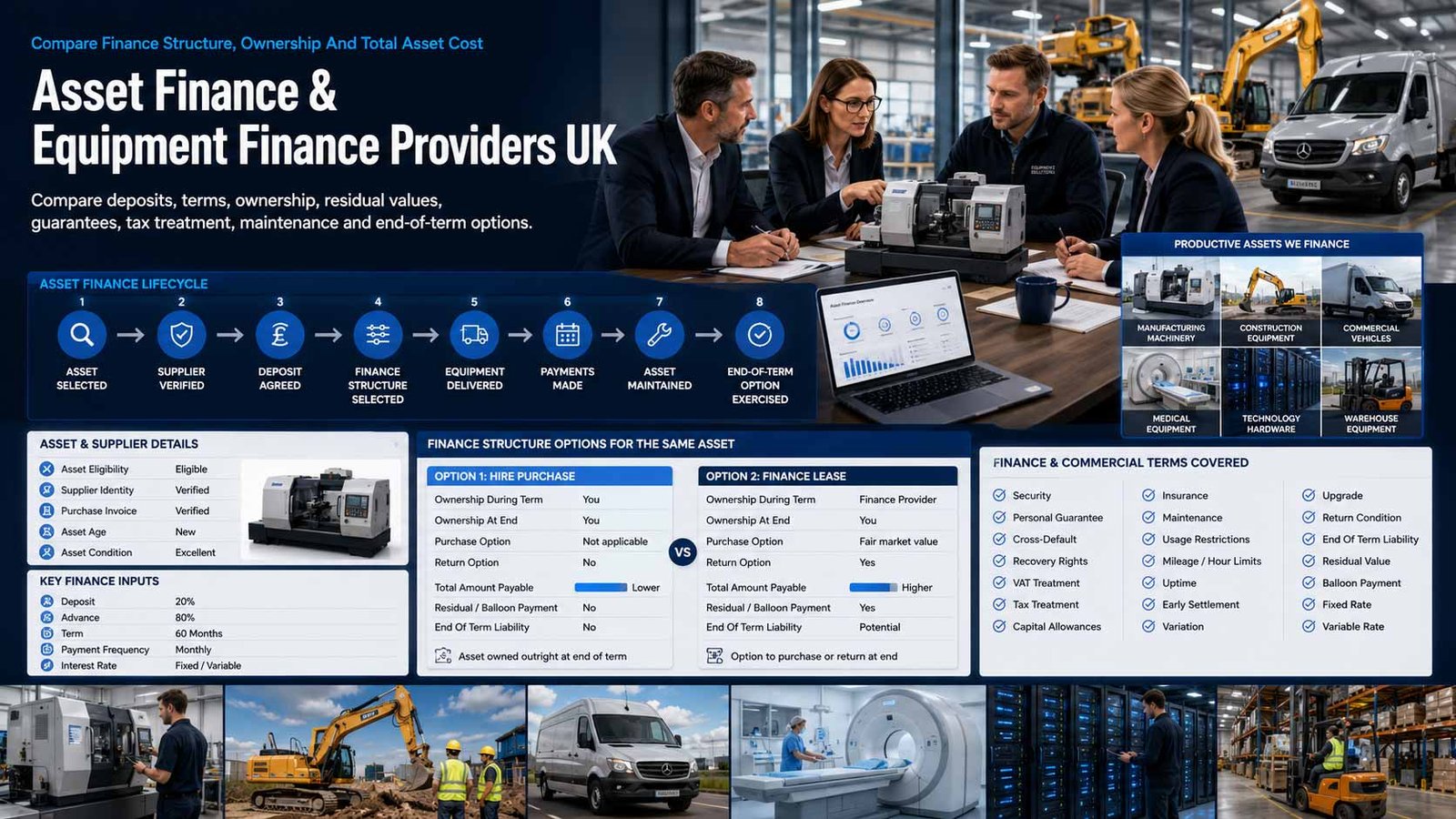
Finance The Productive Asset, Not A General Cash Gap
The asset, supplier and operating case should remain identifiable throughout underwriting, contracting and repayment.
- Start with a verified cash price
- Match the term to useful life
- Separate ownership from use rights
- Document the final title or return outcome
Asset finance helps a business acquire, use or refinance identifiable equipment while spreading the cost over an agreed period. The financed asset normally supports the facility, which can make underwriting and repayment different from a general-purpose business loan.
Hire purchase is commonly used where eventual ownership is important. Leasing can support use, replacement and residual-value management without immediate ownership. Refinancing can release value from assets already owned, provided title and valuation are verified.
This page compares asset and equipment finance only. It does not compare unsecured working-capital loans used for payroll, stock, marketing or general cash flow. A proposal should remain linked to specific plant, machinery, vehicles, technology or other productive business assets.
Choose The Right Asset Finance Structure
Ownership, useful life, residual-value risk, VAT, tax and end-of-term flexibility change materially between hire purchase, leasing and refinancing.
| Finance Model | What It Usually Provides | Best-Fit Question |
|---|---|---|
| Hire purchase | The finance company buys the identified asset and the business pays a deposit plus fixed or variable instalments. Legal ownership normally transfers only after all payments and any option-to-purchase fee are completed. | Does the business want eventual ownership, and is the payment term shorter than the asset’s reliable working life? |
| Finance lease | The funder owns the asset and leases it to the business for an agreed primary period. Rentals usually recover most or all of the asset cost and finance charge, while end-of-term proceeds or secondary rentals depend on the agreement. | Does the business need long-term use without immediate ownership, and are end-of-term obligations fully understood? |
| Operating lease | The business pays to use an asset for a defined period while the lessor retains meaningful residual-value risk. Return conditions, mileage, usage, maintenance and excess-wear charges can be material. | Is planned use predictable enough for the return and condition rules to remain economical? |
| Asset refinancing | A funder advances money against qualifying equipment already owned by the business, often through sale-and-hire-purchase-back or sale-and-leaseback documentation. | Is the objective to release value from identifiable assets without using unsecured working-capital debt? |
| Equipment loan or secured asset loan | The business borrows specifically to purchase equipment and grants security over the financed asset, while legal ownership may sit with the business from purchase subject to the lender’s charge. | Does the ownership and security structure fit the accounting, tax and supplier transaction? |
| Vendor or point-of-sale finance | A manufacturer, dealer or technology supplier introduces a finance provider so the customer can fund the equipment at the point of purchase, sometimes through a branded programme. | Are the supplier, broker and lender roles, commissions, equipment price and finance terms separately visible? |
| Green or sustainability-linked asset finance | Finance supports qualifying lower-emission vehicles, renewable-energy assets, efficient machinery, charging infrastructure or other eligible transition equipment, sometimes with differentiated pricing or reporting. | What environmental eligibility, evidence and ongoing-use conditions apply to the quoted terms? |
| Multi-asset or master facility | An agreed funding framework supports repeated purchases, several asset classes, multiple suppliers or staged drawdowns under common governance and documentation. | Can the facility control asset schedules, approvals, security, limits and end dates without creating hidden cross-default exposure? |
Eight Areas That Determine Asset Finance Fit
Use the same asset, supplier cash price, deposit, term, useful-life assumption and end-of-term requirement for every quote.
Comparison Criterion
Asset Eligibility, Supplier And Purchase Evidence
Confirm exactly which new or used assets the funder will accept, including age, condition, serial number, location, supplier, invoice, delivery, installation, warranty and ownership evidence. Specialist, bespoke, imported, software-heavy or rapidly depreciating equipment may need different underwriting. The finance should fund a defined productive asset rather than become a disguised unsecured cash facility.
Comparison Criterion
Finance Structure, Ownership And End Position
Compare hire purchase, lease, secured equipment loan and refinancing structures by legal ownership, balance-sheet treatment, use rights, disposal authority and end-of-term outcome. Record whether the business will own, return, continue renting, sell as agent or refinance the asset. Marketing descriptions such as lease-to-own should never replace the executed legal terms.
Comparison Criterion
Deposit, Advance, Term And Payment Profile
Review deposit or advance rental, financed amount, term, payment frequency, seasonal or stepped rentals, arrears or advance payments, VAT timing and any balloon. Match the term to realistic useful life, cash generation and replacement cycle. Lower initial payments can create a larger later obligation or extend payments beyond the asset’s productive value.
Comparison Criterion
Rate, Total Amount Payable And Residual Assumptions
Require the cash price, deposit, financed balance, interest or rental basis, fixed or variable rate, benchmark, margin, fees, balloon, residual value and total amount payable. For agreements where an APR is not supplied or meaningful, compare the same cash flows and internal rate of cost. Do not compare one flat rate with another provider’s APR or rental factor.
Comparison Criterion
Security, Guarantees, Cross-Default And Recovery Rights
The financed asset normally supports the facility, but the funder may also require a personal guarantee, corporate guarantee, debenture, deposit, cross-collateralisation or wider set-off rights. Review default triggers, inspection, repossession, shortfall liability, insurance proceeds and whether default on one schedule can accelerate every agreement under a master facility.
Comparison Criterion
Tax, VAT, Accounting And Capital-Allowance Treatment
Ownership and lease classification affect VAT timing, accounting entries, depreciation, rental deductions and capital-allowance eligibility. Hire purchase can permit capital allowances on qualifying assets while interest is treated separately, subject to current rules. Obtain asset-specific advice before relying on tax savings, because cars, leased assets, mixed use and specialist structures differ.
Comparison Criterion
Insurance, Maintenance, Uptime And Use Restrictions
Confirm who insures, maintains, services, licenses, stores and repairs the asset; what evidence the funder requires; and whether sub-hire, relocation, export, modification or heavy usage is restricted. Finance payments may continue during breakdown, theft or project delay. Operational resilience, warranty and replacement support therefore belong in the finance comparison.
Comparison Criterion
Variations, Early Settlement, Return And Exit
Compare early-settlement calculation, partial prepayment, asset substitution, contract transfer, additional schedules, voluntary termination where relevant, return notice, inspection, refurbishment, excess usage, balloon refinance, option-to-purchase fee and title release. A cheap initial quote can become poor value if the business needs to change equipment before the contracted end date.
Measures To Define Before An Asset Agreement Is Signed
Translate low rentals and flexible finance into auditable cost, output, security and end-of-term evidence.
| Measure | What It Should Define | Evidence To Request | Common Weakness |
|---|---|---|---|
| Total financed asset cost | The complete cost of acquiring and funding the equipment over the chosen term | Supplier cash price, deposit, financed amount, rentals, interest, fees, VAT, balloon, option fee and total payable | The monthly rental is compared without the purchase price, deposit or final payment |
| Effective finance cost | The implied annual cost produced by the actual payment schedule and fees | Dated cash flows, fixed or variable benchmark, margin, fees, deposit, balloon and settlement assumptions | A flat rate, rental factor and APR are treated as directly equivalent |
| Payment-to-output coverage | Whether conservative cash generated or cost saved by the asset covers scheduled payments | Utilisation, output, margin, savings, downtime, maintenance, tax, payment and stress scenario | The business uses supplier revenue forecasts without downtime or demand stress |
| Useful-life alignment | Whether the finance term finishes before the asset becomes unreliable, obsolete or uneconomic | Expected life, warranty, maintenance history, technology cycle, residual value, term and replacement date | Payments continue after the equipment should have been replaced |
| Residual and balloon exposure | The amount still payable or economically at risk at the scheduled end date | Balloon, residual assumption, market value, return conditions, option fee and refinance availability | Low monthly payments conceal a material final obligation |
| Asset availability | The proportion of planned operating time during which the financed equipment is productive | Downtime, failure, maintenance, parts, support response, warranty and replacement equipment | The finance decision assumes uninterrupted use while payments remain due during outages |
| Security exposure | The total assets and guarantor value exposed beyond the financed item | Title, asset charge, debenture, guarantee, cross-default, set-off, insurance assignment and shortfall | The buyer assumes the lender can recover only the financed machine |
| Early-exit cost | The amount required to settle, replace, transfer or return the equipment before maturity | Settlement quote method, outstanding capital, future rentals, rebate, fees, return cost and asset value | The business compares only scheduled payments and ignores operational change |
| Tax and VAT cash flow | The timing and value of VAT, rental deductions and capital allowances under the chosen structure | Invoice, agreement type, ownership, VAT schedule, AIA or other allowances, accounting treatment and advice | A tax benefit is treated as guaranteed without checking eligibility and timing |
| End-of-term completion | Whether title, return, sale, secondary rental or refinance is completed on time and evidenced | Notice date, inspection, final payment, option fee, title confirmation, return receipt and release of security | The primary term ends but payments or obligations continue automatically |
Asset Finance Providers UK Businesses Can Consider
Shortlist providers whose sector appetite, asset eligibility, structure, underwriting and service fit the investment. Confirm the live quote and legal agreement directly before award.
Provider Profile
Close Brothers Asset Finance
Close Brothers Asset Finance provides hire purchase, leasing and refinancing for UK SMEs across sectors including construction, manufacturing, transport, agriculture and specialist assets. Include it where sector knowledge, used-equipment capability or refinancing of owned assets matters. Confirm the financed legal entity, asset eligibility, valuation, deposit, fixed or variable pricing, payment profile, guarantees, title, insurance, early settlement, option fee, end-of-term process, broker involvement and whether several schedules are linked under wider default or security terms.
Review official Close Brothers Asset FinanceProvider Profile
Lombard
Lombard, part of NatWest Group, offers asset finance across machinery, technology, vehicles, sustainable equipment and specialist sectors. Include it where a business needs a large established funder, sector expertise or a broader asset-management solution. Confirm the Lombard contracting company, finance product, asset and supplier approval, deposit, term, payment profile, rate basis, fees, guarantees, residual or balloon, maintenance responsibilities, tax assumptions, security, end-of-term rights, title release and any relationship-banking or eligibility conditions.
Review official Lombard asset financeProvider Profile
Lloyds Bank Asset Finance
Lloyds Bank provides equipment finance, business hire purchase, leasing, green asset finance and refinancing for eligible UK businesses. Include it where a buyer values direct bank-led funding, online quotation routes or finance for plant, machinery, technology and vehicles. Confirm minimum transaction size, customer eligibility, asset categories, cash price, deposit, repayment term, fee waiver or arrangement fee, rate, VAT, option-to-purchase amount, personal or corporate guarantees, insurance, early settlement, end-of-term documentation and whether a separate vehicle or specialist agreement applies.
Review official Lloyds Bank Asset FinanceProvider Profile
Aldermore Asset Finance
Aldermore provides specialist asset finance directly and through brokers, with sector teams covering areas such as construction, transportation and business equipment. Include it where a business wants flexible underwriting for new or used assets and a specialist rather than purely automated approach. Confirm the Aldermore entity, broker commission where relevant, product, asset age, deposit, fixed or variable pricing, transition-rate terms, payment schedule, guarantees, documentation, insurance, default, early settlement, title, end-of-term treatment and whether asset refinancing is available for the proposed equipment.
Review official Aldermore asset financeProvider Profile
HSBC Equipment Finance
HSBC UK offers asset or equipment finance for businesses planning material capital expenditure, including replacement or expansion equipment. Include it where an established business wants finance integrated with a commercial-banking relationship and a structured capital-investment programme. Confirm eligibility, annual capex expectations, asset types, legal lender, direct or broker route, deposit, term, rate and benchmark, fees, security, guarantees, drawdown, supplier payment, VAT, ownership, maintenance, early settlement and end-of-term options rather than assuming standard loan terms apply.
Review official HSBC Asset FinanceProvider Profile
Siemens Financial Services
Siemens Financial Services provides equipment and technology finance, vendor-finance programmes and tailored funding for areas including industry, healthcare, infrastructure, transport and energy transition. Include it where technology expertise, vendor integration or sustainability-led investment is central to the purchase. Confirm the financing Siemens entity, supplier relationship, eligible equipment, embedded service costs, payment profile, term, residual assumptions, asset upgrades, software and maintenance components, guarantees, data requirements, early termination, return or ownership outcome and any environmental reporting conditions.
Review official Siemens Financial ServicesProvider Profile
DLL
DLL is a specialist global equipment-finance provider working with manufacturers, distributors, dealers, rental businesses and equipment users in sectors such as agriculture, construction, materials handling, healthcare, technology and clean energy. Include it where the asset is sourced through a vendor programme or needs lifecycle and residual-value expertise. Confirm the UK contracting entity, direct or vendor route, equipment price, finance product, deposit, rentals, residual, usage rules, maintenance, return condition, asset location, title, guarantees, cross-default, data sharing and end-of-term sale, renewal or return mechanics.
Review official DLL custom asset financeProvider Profile
Investec Asset Finance
Investec provides asset finance to UK SMEs, corporates and professional practices, including small-to-middle-ticket transactions and larger facilities through specialist teams and commercial brokers. Include it where the business needs tailored funding, multiple assets or a transaction requiring individual structuring. Confirm the Investec entity, direct or intermediary route, minimum and maximum deal, asset eligibility, valuation, deposit, term, rate, fees, guarantees, covenants, security, refinance, supplier payment, early settlement, end-of-term ownership and how the facility interacts with any wider Investec lending.
Review official Investec asset financeWhat Changes Asset Finance Cost
Asset finance is priced around the asset, supplier, borrower, payment profile, security and future value. Compare total cost and operational risk rather than one monthly figure.
| Cost Driver | Why It Changes Spend | What A Comparable Quote Should Show |
|---|---|---|
| Asset cash price and supplier discount | Finance should be compared against the genuine cash price, not an inflated list price or bundled supplier package | Cash invoice, discount, trade-in, delivery, installation, training, warranty, software and maintenance shown separately |
| Deposit or advance rental | A larger upfront contribution reduces finance but consumes cash and may not be refundable | Amount, VAT, payment date, treatment on cancellation, financed balance and effect on total cost |
| Credit strength and business profile | Trading history, profitability, leverage, sector, ownership and payment record affect approval and margin | Legal entity, accounts, management information, bank evidence, credit search, guarantee and conditions |
| Asset type, age and resale value | Specialist, used, bespoke or rapidly obsolete assets can produce lower advances, shorter terms or higher pricing | Make, model, age, hours, condition, serial number, valuation, market, warranty and expected residual |
| Term and payment profile | Longer or back-ended structures reduce normal payments but usually increase total cost and end risk | Number and timing of rentals, seasonal profile, stepped payment, balloon, residual and total payable |
| Fixed or variable pricing | Variable payments can change with a reference rate; fixed pricing creates certainty but may price risk upfront | Benchmark, margin, reset date, floor, cap, calculation, notice and full fixed-payment schedule |
| Arrangement, documentation and option fees | Fixed fees can materially affect smaller transactions and may be payable even when a quote is described by rate only | Arrangement, documentation, valuation, inspection, broker, legal, option-to-purchase and title-release fees |
| VAT and tax timing | VAT can arise upfront or on rentals depending on structure, while capital allowances and deductions depend on ownership and tax rules | VAT invoice and schedule, accounting classification, capital-allowance position and adviser confirmation |
| Insurance, maintenance and service bundles | Required cover and operating support can add cost but also protect asset uptime and residual value | Insurance scope, excess, maintenance, warranty, service level, replacement asset and separate supplier prices |
| Balloon, residual and end-of-term value | A funder or customer assumption about future value can lower payments while creating return or final-payment exposure | Guaranteed or estimated residual, balloon amount, mileage or usage, condition standard, disposal and shortfall allocation |
| Early settlement and contract changes | Replacing, selling, relocating or refinancing equipment before maturity can trigger additional cost | Settlement method, rebate, administration fee, transfer, substitution, partial release and return costs |
| Broker or vendor economics | Introducers can improve access and service but commission and supplier incentives must not obscure asset price or finance cost | Lender identity, broker status, commission disclosure, supplier subsidy, exclusivity and alternative cash quotation |
How Asset Type And Operating Model Change The Shortlist
The right provider depends on equipment value, useful life, sector, supplier, financial strength, maintenance, technology cycle and replacement plan.
Growing SME Buying Core Equipment
Prioritise a clear hire-purchase or lease comparison, reliable supplier evidence, affordable deposit, payments aligned to conservative output, fixed total cost, manageable guarantees and an end date before the asset becomes obsolete.
Construction, Transport Or Agricultural Operator
Prioritise used-asset appetite, sector underwriting, seasonal payments, asset inspection, maintenance, location changes, insurance, downtime, resale value, refinancing and clear treatment of trailers, attachments or ancillary equipment.
Technology, Healthcare Or Energy Project
Prioritise software and service separation, installation milestones, vendor acceptance, upgrades, cybersecurity or clinical obligations, useful life, obsolescence, sustainability eligibility, residual assumptions and staged supplier payment.
Multi-Site Or Repeated Capital Programme
Prioritise a master facility with controlled limits, schedule-level approvals, multiple suppliers, consolidated reporting, asset registers, cross-default visibility, covenant monitoring, consistent end-of-term governance and competitive repricing.
How To Compare Asset Finance Quotes
Give every provider the same legal entity, asset specification, supplier cash price, deposit, installation date, useful life, payment profile, ownership objective, insurance and end-of-term requirement. Require a complete schedule rather than a monthly-rental illustration.
- The lender, broker and supplier are identified
- The cash price and financed items are separated
- Every payment, fee and final amount is dated
- Security and guarantees are fully mapped
- Tax and VAT assumptions are independently checked
- Early settlement and end-of-term completion are documented
Price The Same Asset On The Same Term
Use one supplier cash quotation, deposit, installation date, useful life and payment profile.
Compare ownership, security and final obligations before comparing the normal monthly payment.
Six Questions To Put To Every Asset Finance Provider
The answers expose unclear ownership, incomplete pricing, wider security and end-of-term obligations that are easy to miss.
Who Owns The Asset At Each Stage?
Ask who holds legal title during the term, when ownership can transfer, what option fee applies and whether the business can sell, move or modify the equipment.
What Exactly Is Being Financed?
Confirm the cash price and separate equipment, software, installation, maintenance, warranty, training, tax and supplier charges.
What Is The Complete Payment Schedule?
Request every deposit, rental, interest amount, fee, VAT payment, balloon, residual, option payment and total amount payable with dates.
What Security Extends Beyond The Equipment?
Review personal and corporate guarantees, debenture, cross-default, cross-collateral, set-off, insurance assignment and shortfall liability.
What Happens If The Asset Fails Or Changes?
Confirm payment duties during downtime, warranty, maintenance, replacement, supplier dispute, relocation, upgrade, substitution and early settlement.
What Happens At The Contract End?
Confirm notice, inspection, return, secondary rentals, sale as agent, balloon, option to purchase, title release, security discharge and final documentation.
A Seven-Stage Asset Finance Evaluation
Move from a verified equipment need and supplier price to controlled payment, security and end-of-term governance.
- Create an asset investment case covering business need, specification, supplier, cash price, installation, useful life, expected output, savings, maintenance, risk and replacement plan.
- Decide the required commercial outcome: ownership through hire purchase, use through leasing, value release through refinancing or repeated acquisition through a master facility.
- Prepare accurate financial and asset evidence including accounts, management information, bank statements, ownership, quotes, serial details, valuation, insurance and director information.
- Issue one comparison brief requiring the lender, introducer, product, cash price, deposit, payment schedule, rate basis, fees, security, tax assumptions and end-of-term terms.
- Normalise every proposal into dated cash flows and stress-test utilisation, downtime, interest-rate changes, maintenance, residual value and early replacement.
- Complete credit, legal, tax and operational review before signing; verify supplier payment conditions, delivery acceptance, title, insurance, guarantees, authority and all linked schedules.
- Manage the live facility through an asset register, payment reconciliation, covenant and insurance monitoring, maintenance evidence, change control, end-date alerts and documented title or return completion.
Asset Finance Comparison Checklist
Use this table before approving hire purchase, leasing, refinancing, vendor finance or a multi-asset facility.
| No. | Requirement | Evidence To Obtain Before Award | Confirmed |
|---|---|---|---|
| 01 | Asset need and accountable owner agreed | Business case, budget owner, operator, finance owner, approver and asset custodian | |
| 02 | Asset specification and supplier validated | Quote, cash price, model, serial number, delivery, installation, warranty, references and bank details | |
| 03 | Useful life and replacement plan confirmed | Expected life, usage, downtime, maintenance, obsolescence, residual value and planned replacement | |
| 04 | Finance structure selected | Hire purchase, finance lease, operating lease, secured loan, refinance or master facility rationale | |
| 05 | Legal ownership and use rights understood | Title, possession, modification, relocation, sub-hire, export, disposal and end-of-term rights | |
| 06 | Deposit and payment schedule approved | Deposit, advance rental, dates, frequency, seasonal profile, stepped payments, balloon and total payable | |
| 07 | Rate and fee basis normalised | Fixed or variable benchmark, margin, interest, rental factor, arrangement, documentation, valuation and option fees | |
| 08 | Security and guarantees approved | Asset charge, debenture, personal guarantee, corporate guarantee, set-off, cross-default and shortfall | |
| 09 | VAT, accounting and tax reviewed | VAT schedule, classification, depreciation, rental deduction, capital allowances and adviser confirmation | |
| 10 | Insurance and maintenance accepted | Insured value, interested party, excess, loss process, warranty, servicing, uptime and replacement support | |
| 11 | Asset and supplier due diligence completed | Ownership, condition, valuation, liens, sanctions, authenticity, acceptance test and fraud controls | |
| 12 | Operational stress test passed | Low utilisation, downtime, higher maintenance, rate rise, delayed project, lower residual and early replacement | |
| 13 | Early settlement and change rules accepted | Settlement calculation, transfer, substitution, partial release, relocation, upgrade and administration fees | |
| 14 | End-of-term process documented | Notice, inspection, return, secondary period, balloon, option fee, title release and security discharge | |
| 15 | Live governance and exit plan agreed | Asset register, statements, approvals, alerts, complaints, default escalation, data retention and closure evidence |
Common Asset Finance Buying Mistakes
Most avoidable problems begin with an incomplete cash price, the wrong ownership model, underestimated security or a missed end date.
| Mistake | Why It Creates Risk | Better Control |
|---|---|---|
| Comparing only the monthly rental | Deposits, fees, final payments and longer terms can make the cheaper rental the higher-cost facility | Compare dated cash flows and total payable |
| Financing an inflated supplier price | A finance quote can hide loss of cash discount or bundled services | Obtain a standalone cash quotation |
| Choosing a term longer than useful life | The business keeps paying for unreliable or obsolete equipment | Match term to conservative working life |
| Confusing hire purchase with leasing | Ownership, VAT, tax and end-of-term rights differ materially | Read the executed product terms |
| Assuming the asset is the only security | Guarantees, debentures and cross-default can expose wider value | Map every security document |
| Relying on tax savings before advice | Capital allowances and deductions depend on asset, ownership and tax position | Obtain transaction-specific tax advice |
| Ignoring downtime and maintenance | Payments continue even when equipment is not productive | Stress-test uptime and support |
| Accepting an unexplained balloon or residual | Low payments create a later refinancing or return risk | Model end value and alternatives |
| Signing before delivery controls are clear | Supplier fraud, wrong equipment or failed installation can leave finance live | Use verified acceptance and payment conditions |
| Missing the end-of-term notice | Secondary rentals, return charges or delayed title can continue | Set alerts and obtain completion evidence |
Frequently Asked Questions
Answers to common questions from UK businesses comparing equipment funders, hire purchase, leasing and asset refinancing.
What Is Asset Finance?
Asset finance is a way for a business to acquire, use or refinance identifiable equipment without paying the full cost upfront. Common structures include hire purchase and leasing. The asset normally supports the finance, and ownership, tax, VAT and end-of-term treatment depend on the agreement.
What Is The Difference Between Asset Finance And Equipment Finance?
The terms are often used interchangeably. Equipment finance usually describes funding for machinery, vehicles, technology or other business equipment. Asset finance is the broader category and can also include leasing and refinancing assets the business already owns.
How Does Hire Purchase Work For A Business?
The finance company buys the asset and the business pays a deposit and scheduled instalments. The business uses and maintains the asset during the term. Legal ownership normally transfers only after all required payments and any option-to-purchase fee have been made.
What Is The Difference Between Hire Purchase And A Finance Lease?
Hire purchase is normally designed to lead to ownership after final payments. Under a finance lease, the funder owns the asset and the business pays rentals for use. End-of-term sale proceeds, continued rentals or return obligations depend on the lease terms.
Can A Business Finance Used Equipment?
Yes, many providers finance used equipment, subject to age, condition, valuation, supplier, expected life and resale market. The funder may require an inspection, larger deposit, shorter term or additional evidence for older or specialist assets.
Can Asset Finance Be Used To Release Cash From Existing Equipment?
Asset refinancing can release value from qualifying equipment already owned by the business. The funder values the asset and documents a sale-and-hire-purchase-back, sale-and-leaseback or related secured structure. Existing finance and ownership must be verified.
How Much Does Asset Finance Cost?
Cost depends on the asset price, deposit, term, credit strength, asset age, residual value, payment profile, fixed or variable rate, fees, guarantees and end-of-term structure. Compare the full dated payment schedule and total amount payable rather than one monthly rental or flat rate.
Is Asset Finance Regulated By The FCA?
Some business hire-purchase and hire agreements for sole traders and small partnerships can fall within consumer-credit regulation, while much limited-company and higher-value business finance is outside the FCA consumer-credit perimeter. Check the borrower, amount, agreement and lender permissions for the specific transaction.
Can A Business Claim Capital Allowances On Financed Equipment?
Qualifying plant and machinery bought under hire purchase may be eligible for capital allowances when the business starts using it, while interest is excluded from the qualifying cost. Leasing and specialist assets can be treated differently, so obtain current tax advice before deciding.
How Should A UK Business Compare Asset Finance Providers?
Give every provider the same asset, supplier cash price, deposit, term, payment profile and business evidence. Compare legal structure, total payable, rate basis, security, guarantees, VAT, tax assumptions, insurance, early settlement, end-of-term rights and provider service—not only the monthly payment.
Official Guidance And Asset-Finance Resources
Reviewed by Bhav Giva, Founder & Lead Analyst at CompareServices.co.uk, on 30 July 2026.
Use the British Business Bank, Finance & Leasing Association, FCA Register, HMRC guidance and official provider documentation to confirm current structure, permissions, taxation, pricing, security and contract requirements. Product eligibility and terms can change.
- British Business Bank — What Is Asset Finance?
- British Business Bank — Leasing And Hire Purchase
- British Business Bank — What Is Asset Refinancing?
- Finance & Leasing Association — Business Customer Information
- Finance & Leasing Association — Business Finance Code
- FCA Register — Check Financial Services Firms
- UK Government — Annual Investment Allowance
- Close Brothers Asset Finance — UK Asset Finance
- Lombard — Asset Finance
- Lloyds Bank — Asset Finance
- Aldermore — Asset Finance
- HSBC UK — Asset Finance
- Siemens Financial Services — Equipment And Technology Finance
- DLL — Custom Asset Finance
- Investec — Asset Finance