
Compare Managed Hosting / Colocation Providers UK (2026)
Compare Facilities, Power, Connectivity, Management, Resilience And Support
Compare managed hosting providers in the UK by facility resilience, rack or platform design, power density, cooling, connectivity, hardware ownership, monitoring, operating-system management, remote hands, service levels, recovery, compliance support and total cost. Evaluate suppliers against the same workload and operating requirements before moving business-critical servers, storage, databases or network equipment into a third-party data centre.
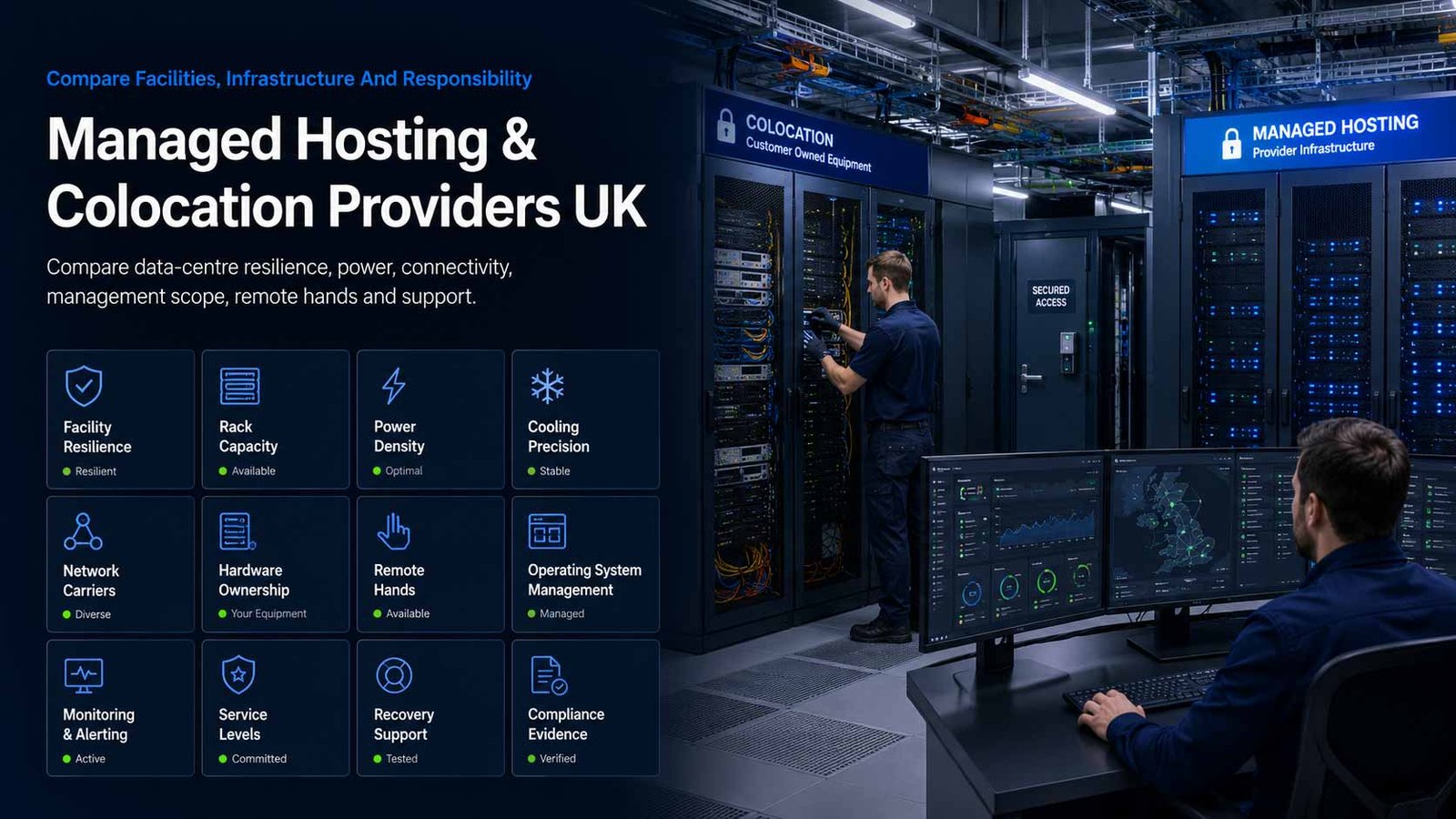
Choose The Operating Model Before The Data Centre
Colocation and managed hosting can use similar facilities, but they place very different responsibilities on the customer and provider.
- Define who owns, configures, patches and replaces every infrastructure layer
- Match power, cooling and connectivity to measured workload demand
- Plan access, remote hands, spares, recovery and out-of-hours change
- Test service levels against complete application availability, not facility marketing alone
Colocation rents secure data-centre space, power, cooling and connectivity for equipment that the customer normally owns and controls. Managed hosting goes further by supplying or operating servers, storage, virtualisation, operating systems, monitoring, patching, backup or selected application infrastructure under an agreed responsibility model.
The correct option depends on the existing hardware estate, application architecture, internal engineering capacity, compliance needs, latency, network design and change frequency. A business may colocate specialist appliances it must retain, use managed dedicated servers for predictable workloads and connect both to public-cloud services through a hybrid architecture.
This page does not compare low-cost shared hosting, reseller packages, simple domain bundles or entry-level website hosting aimed at hobby sites. It also does not repeat the broader public-cloud platform comparison. The focus is business-critical hosting and colocation where facility resilience, hardware control, operational management, connectivity and contractual responsibility materially affect service availability.
Separate Managed Hosting From Colocation Responsibility
Providers may offer several models from the same data-centre estate. Compare the service boundary as carefully as the facility.
| Service Model | What It Usually Provides | Best-Fit Question |
|---|---|---|
| Managed dedicated hosting | Provider-supplied physical servers, storage and network components operated for one customer under an agreed support boundary | Who selects and owns the hardware, which operating-system and database tasks are included, and how quickly failed components are replaced? |
| Managed private platform | Dedicated or logically isolated virtual infrastructure operated by the provider, often with managed virtualisation, storage and backup | Is the platform dedicated, what is shared, how is capacity reserved and what portability exists if the underlying technology changes? |
| Hybrid managed infrastructure | A managed combination of dedicated hosting, colocation, private platforms and public-cloud connectivity | Who owns end-to-end architecture, monitoring, incident correlation, cost control and recovery across the different environments? |
| Quarter, half or full rack colocation | Customer equipment installed in provider cabinets with contracted rack units, power, cooling, access and connectivity | Is the quoted power usable at the rack, how is consumption measured, and what happens when density or space requirements change? |
| Private cage or data hall suite | Physically separated space for larger estates, regulated workloads or organisations needing additional access control | Which security, construction, power, cooling, access and expansion features are dedicated, and which remain shared facility services? |
| High-density or AI-ready colocation | Racks designed for higher electrical load and specialised cooling required by GPU, HPC or dense compute platforms | What power density is available now, which cooling method is supported and how are capacity, heat rejection and future expansion guaranteed? |
| Secondary or recovery-site colocation | Infrastructure held away from the primary environment to support replication, backup, standby services or controlled recovery | Are power, network, identity and operational dependencies genuinely diverse from the primary site? |
| Carrier and cloud interconnection hub | Colocation selected primarily for access to carriers, exchanges, partners and private connections to cloud services | Which networks and clouds are available on-site, what cross-connects are required and how quickly can connectivity be provisioned or changed? |
Eight Areas That Determine Managed Hosting Or Colocation Fit
Use the same infrastructure and responsibility criteria for every provider so facility badges and uptime claims do not hide capacity, access or operating gaps.
Comparison Criterion
Facility Resilience And Location
Compare utility feeds, uninterruptible power, generators, fuel arrangements, cooling redundancy, fire detection and suppression, flood and environmental risk, maintenance design and facility location. Require evidence for the exact building and data hall proposed rather than a group-wide statement.
Comparison Criterion
Rack Space, Power Density And Cooling
Assess rack units, cabinet dimensions, maximum weight, committed and burst power, metering, dual feeds, PDU design, hot or cold aisle containment, liquid-cooling support and expansion. A rack with unused space may still be full because its power or cooling allocation is exhausted.
Comparison Criterion
Connectivity And Interconnection
Review carrier neutrality, available network providers, diverse building entries, cross-connects, internet transit, peering, cloud on-ramps, private circuits, DDoS dependencies and out-of-band access. Confirm lead times, fault ownership and whether routes share hidden ducts or upstream equipment.
Comparison Criterion
Physical Security And Access
Compare perimeter controls, security staffing, visitor approval, identity checks, multifactor entry, mantraps, CCTV, cage or cabinet locks, delivery handling, asset removal and emergency access. Customer procedures must align with the provider’s security model and authorised-person process.
Comparison Criterion
Managed Infrastructure Responsibility
Define hardware procurement, build, firmware, virtualisation, operating systems, patching, monitoring, backup, capacity, database tasks and incident response. The contract should show which layers are included, excluded or dependent on customer approval and application knowledge.
Comparison Criterion
Remote Hands, Spares And Engineering Support
Review included and chargeable remote-hands tasks, response targets, skill levels, escort requirements, hardware replacement, spare-parts storage, smart hands, scheduled work and emergency changes. Confirm what the provider will not do and when specialist customer engineers must attend.
Comparison Criterion
Service Levels, Monitoring And Recovery
Compare power, cooling, network and managed-service commitments separately. Review measurement points, exclusions, maintenance, credits, incident communication, problem management, recovery support and service reporting. Facility uptime alone does not guarantee that the hosted application remains usable.
Comparison Criterion
Governance, Sustainability And Exit
Assess certifications, audit evidence, data location, processor terms, supply chain, energy reporting, renewable-energy claims, capacity roadmap, change notification, equipment removal, data erasure, cross-connect cancellation, contract renewal and migration assistance.
Measures To Define Before A Hosting Contract Is Signed
Translate resilient, secure and fully managed into measurable facility, network and operational commitments.
| Measure | What It Should Define | Evidence To Request | Common Weakness |
|---|---|---|---|
| Power and cooling availability | The contracted availability of power and environmental services at the exact rack, cage or managed platform | Measurement point, redundancy, maintenance treatment, incident history, service credits and restoration process | A site-wide percentage does not show whether one rack lost a PDU feed or exceeded its cooling allocation |
| IT load and capacity headroom | Current and forecast rack power, space, weight, cooling and network demand | Measured usage, threshold alerts, reserved capacity, expansion path and lead time | The contract reserves physical rack units but not enough power for planned equipment |
| Network availability and performance | The availability, latency, packet loss and diversity required between users, sites, clouds and hosted systems | Circuit design, carrier paths, handoff, monitoring, failover test, escalation and demarcation | Two circuits are sold as diverse but share the same building entry or upstream provider |
| Remote-hands response | How quickly authorised tasks are acknowledged, started and completed during normal and emergency periods | Task catalogue, response target, skill level, evidence, charge basis and escalation | The service target covers acknowledgement but not engineer attendance or completion |
| Hardware replacement time | How failed provider-owned or customer-owned components are diagnosed and replaced | Spares list, warranty, vendor escalation, on-site stock, approval process and measured completion time | A four-hour hardware target excludes diagnosis, delivery or customer-owned components |
| Patch and change success | The proportion of managed changes completed within the window without unplanned outage or rollback | Change plan, approval, maintenance window, testing, failure rate, rollback and problem review | Patching is described as included but repeatedly deferred because application testing is unowned |
| Incident restoration and communication | How quickly service impact is detected, escalated, communicated and restored | Severity definitions, response and update intervals, restoration measure, cause report and customer actions | Facility and managed-service teams use different incident processes and no one owns the full service |
| Backup and recovery readiness | Whether protected systems can be restored at the site or an alternate environment within agreed objectives | Protection scope, test schedule, recovery sequence, network dependency, validation and recent exercise evidence | Backup is included as a product but application recovery has never been tested |
| Access and security exceptions | Whether physical and privileged access remain limited, current and traceable | Authorised-person list, visitor log, access reviews, emergency entry, privileged accounts and exceptions | Former staff remain approved for site access because customer and provider records are not reconciled |
| Energy and total service cost | The complete cost and energy impact of space, power, cooling, network, management, hardware and support | Metered consumption, PUE treatment, tariff basis, annual uplift, carbon reporting and cost per workload | A low rack price hides high power, cross-connect, remote-hands and managed-service charges |
Managed Hosting And Colocation Providers UK Businesses Can Consider
Shortlist providers whose facility, connectivity, support and responsibility model fit the workloads. Confirm current capacity, locations and commercial terms directly before award.
Provider Profile
Iomart
UK infrastructure provider offering managed hosting, cloud and colocation from a nationwide estate of company-operated data centres. Include Iomart where a business wants one supplier to combine racks or suites, connectivity, managed infrastructure, backup and related platform services. Confirm the exact site tier and design, hardware ownership, management boundary, network architecture, recovery scope, power commitment and how group-wide services map to the proposed facility.
Review official data-centre servicesProvider Profile
ANS
UK provider offering managed hosting, dedicated infrastructure and managed colocation with 24/7 support from UK data-centre operations. Include ANS where the organisation wants more operational assistance than basic rack-and-power colocation. Confirm which server, operating-system, database, backup, network and incident tasks are included, which facilities are provider-operated or partner locations, the service desk boundary and the cost of additional engineering work.
Review official managed-hosting informationProvider Profile
Node4
UK infrastructure provider operating data centres in Derby, Leeds and Northampton with colocation, connectivity and hybrid-cloud services. Include Node4 where regional UK facilities, hands-on support and connection to wider managed infrastructure are relevant. Compare the exact facility, rack power, connectivity diversity, remote hands, certifications, expansion, managed-service options and contractual responsibility for customer-owned equipment.
Review official colocation informationProvider Profile
Pulsant
Regional UK colocation provider operating an interconnected edge data-centre platform across multiple cities. Include Pulsant where proximity to users, regional resilience, UK data location or access to a distributed national network matters. Confirm availability at the selected site, rack and power density, carrier choice, private-network services, cloud connectivity, remote support, multi-site design and how the stated national platform applies to the contracted locations.
Review official colocation informationProvider Profile
Telehouse
Carrier-neutral colocation and connectivity provider with a major London Docklands campus and an established network ecosystem. Include Telehouse where dense carrier, exchange, cloud and partner connectivity is central to the design. Compare the exact London building, power allocation, cabinet or suite, cross-connects, remote or smart hands, access, expansion, network diversity and the operational work that remains with the customer or a separate managed-service partner.
Review official London data-centre informationProvider Profile
Equinix
Global colocation and interconnection provider operating UK data centres in London and Manchester, with access to network, cloud and enterprise ecosystems. Include Equinix where private interconnection, multi-provider architecture, international scale or high-density deployment is important. Confirm the selected facility, available capacity, power, cooling, Fabric or cross-connect services, remote support, required partners and whether the business needs separate managed hosting around the colocation service.
Review official UK colocation informationProvider Profile
Digital Realty
Global data-centre provider with interconnected London campuses offering cabinets, private suites, high-density capacity and carrier-neutral connectivity. Include Digital Realty where London scale, expansion, hybrid interconnection or larger dedicated environments are priorities. Compare the individual campus, available power and cooling, cross-connect ecosystem, security, remote services, fit-out responsibilities, contract structure and the operational support needed above the facility layer.
Review official London data-centre informationProvider Profile
ServerChoice
UK colocation provider offering flexible rack, suite, connectivity and remote-hands options from UK data centres, including support for higher-density requirements. Include ServerChoice where an SME or mid-market organisation values flexible space, direct provider access and migration assistance. Confirm the precise site, resilience design, included remote hands, power charging, network choices, relocation scope, high-density limits, support escalation and any separate services needed to manage the hosted operating environment.
Review official colocation informationWhat Changes Managed Hosting And Colocation Cost
The rack or server price is only one component. Power, cross-connects, remote engineering, managed layers, migration, recovery and contract change can materially alter the budget.
| Cost Driver | Why It Changes Spend | What A Comparable Proposal Should Show |
|---|---|---|
| Rack units, cabinets, cages or suites | Physical footprint, private space, cabinet type, weight and expansion rights affect the base facility charge | Current equipment, growth, dimensions, weight, security boundary, reserved space and expansion lead time |
| Committed and metered power | Providers may charge by circuit, committed kilowatts, metered consumption or a combined model | Usable kW, A and B feeds, burst terms, metering, tariff, PDU, power factor, annual uplift and high-density requirement |
| Cooling and high-density capability | Higher-density racks, liquid cooling, containment and specialist heat rejection may require different halls or engineering | Rack density, cooling design, limits, installation, monitoring, future availability and additional charge |
| Internet, carriers and cross-connects | Transit, private circuits, cloud links, peering, ports, cross-connects and resilient routes are normally separate line items | Bandwidth, commit, burst, diversity, installation, recurring charges, IP addresses, DDoS dependency and termination |
| Managed hardware and platform | Provider-owned servers, storage, virtualisation and operating systems add hardware, licensing, management and refresh charges | Configuration, ownership, warranty, lifecycle, firmware, licences, patching, monitoring, replacement and end-of-life plan |
| Remote hands and engineering | Included task allowances, smart hands, project work, escorts, scheduled changes and emergency work can be charged differently | Task catalogue, included minutes, minimum charge, hourly rates, out-of-hours uplift, response and completion targets |
| Migration and installation | Audits, design, equipment moves, racking, cabling, addressing, testing and downtime planning create one-off cost | Inventory, surveys, transport, insurance, installation, rollback, validation, customer tasks and decommissioning |
| Backup, recovery and secondary site | Managed backup, replication, standby capacity, recovery tests and secondary racks add recurring and event charges | Protected workload, retention, recovery target, secondary location, tests, data transfer, temporary capacity and recovery labour |
| Support, monitoring and service management | 24/7 monitoring, operating-system management, service reviews, reporting and priority support may sit above the facility contract | Included layers, service hours, alerts, patching, incident ownership, reporting, named contacts and chargeable changes |
| Contract, energy and exit | Energy tariffs, annual uplifts, minimum terms, cross-connect cancellation, hardware removal and data erasure affect lifetime cost | Price basis, indexation, commitment, reduction rights, exit access, removal window, assistance, erasure and final billing |
How The Infrastructure Requirement Changes The Shortlist
The right provider depends on hardware ownership, application design, location, connectivity, internal skills and how much operational responsibility the business wants to retain.
Business Leaving An Office Server Room
Prioritise migration planning, accessible regional facilities, suitable rack and power, remote hands, network redesign, recovery, monitoring and a clear decision about which infrastructure layers remain internally managed.
Specialist Or Legacy Application Estate
Prioritise hardware control, supported operating systems, vendor access, private networks, predictable performance, spare parts, application-consistent recovery and an operating model that preserves required customisation.
High-Connectivity Digital Platform
Prioritise carrier neutrality, exchanges, cloud interconnection, low latency, bandwidth growth, diverse routes, remote engineering and a facility ecosystem close to customers, partners or upstream services.
Regulated Or High-Assurance Environment
Prioritise physical separation, access evidence, facility and personnel controls, data location, audit support, change management, recovery exercises, supply-chain transparency and documented shared responsibility.
How To Compare Hosting And Colocation Proposals
Give every provider the same workload inventory, hardware, rack and power demand, connectivity, management boundary, access requirements, recovery objectives, growth assumptions and support scenarios. Require the response to identify the exact facility, service demarcation and every customer responsibility.
- The proposal names the building, data hall, rack type and committed power
- Connectivity includes carriers, routes, cross-connects and fault ownership
- Managed layers and exclusions are shown in a responsibility matrix
- Remote hands, spares, access and emergency changes are demonstrated
- Migration, recovery and capacity growth are costed
- Equipment removal, service transfer and data erasure are covered at exit
Make Every Provider Run The Same Operational Scenario
Ask each finalist to respond to the same failed server, power-feed alarm, urgent remote-hands request, circuit fault, capacity increase and recovery event.
Compare the handoffs, elapsed time, evidence and chargeable work behind the response before comparing the headline availability percentage.
Six Questions To Put To Every Hosting Provider
The answers expose facility ambiguity, hidden shared responsibility, network dependencies and expensive operational gaps before the contract starts.
Which Facility And Capacity Are We Actually Buying?
Request the exact building, hall, cabinet or platform, committed power, cooling, weight, security boundary, reserved growth and any dependency on future construction.
Who Owns And Manages Each Infrastructure Layer?
Map hardware, firmware, virtualisation, operating systems, databases, monitoring, backup, network, certificates, application support, patching and incident decisions.
How Diverse Is The Connectivity Design?
Ask for carriers, physical entrances, ducts, upstream providers, cross-connects, cloud links, failover, out-of-band access, fault demarcation and provisioning lead times.
What Happens During An Out-Of-Hours Failure?
Test incident declaration, security access, remote hands, spare parts, vendor escalation, updates, change approval, restoration, validation and post-incident reporting.
How Will We Expand Or Move The Service?
Confirm available power, adjacent space, higher-density options, second site, hardware refresh, circuit upgrades, migration windows, professional services and capacity reservation.
What Happens When The Contract Ends?
Confirm notice, access, hardware removal, cross-connect cancellation, provider-owned equipment, data export, secure erasure, transition assistance, final charges and proof of completion.
A Seven-Stage Hosting And Colocation Evaluation
Move from measured infrastructure and responsibility evidence to controlled migration rather than selecting a data-centre brand before understanding the workloads.
- Inventory applications, servers, storage, network equipment, power draw, rack units, weight, operating systems, dependencies, licences, support owners and recovery requirements.
- Classify workloads by availability, latency, data location, hardware control, connectivity, management, maintenance windows and future density.
- Choose the operating model for each workload: managed dedicated hosting, managed private platform, colocation, hybrid interconnection or secondary recovery site.
- Issue one written brief and obtain comparable facility, capacity, responsibility, migration, support, service-level and commercial responses.
- Complete site due diligence and a technical proof covering access, power, connectivity, remote hands, monitoring, managed changes and recovery.
- Migrate in controlled waves with equipment records, transport, insurance, installation, testing, network cutover, rollback and safe retirement of the old environment.
- Operate with capacity reviews, access reconciliation, service reporting, recovery exercises, patch and lifecycle governance, incident reviews and documented exit readiness.
Managed Hosting And Colocation Comparison Checklist
Use this table before approving rack space, managed infrastructure, migration work or a long-term data-centre agreement.
| No. | Requirement | Evidence To Obtain Before Award | Confirmed |
|---|---|---|---|
| 01 | Workload, hardware and dependency inventory completed | Applications, servers, storage, network, rack units, weight, power, licences, owners and dependencies | |
| 02 | Availability, latency and recovery requirements approved | Service hours, RTO, RPO, maintenance, validation, user locations and business-impact classification | |
| 03 | Managed-hosting or colocation responsibility agreed | Layer-by-layer matrix for hardware, firmware, virtualisation, OS, database, network, backup and application | |
| 04 | Exact facility and data hall identified | Address, hall, design, utility and cooling resilience, environmental risk, capacity and planned changes | |
| 05 | Rack, power, cooling and weight validated | Cabinet, U space, usable kW, dual feeds, metering, PDU, density, cooling method and expansion | |
| 06 | Connectivity diversity demonstrated | Carriers, routes, building entries, ducts, cross-connects, transit, cloud links, failover and demarcation | |
| 07 | Physical access and asset controls tested | Authorised persons, visitor process, multifactor entry, cabinet or cage locks, deliveries and removal | |
| 08 | Remote hands and spare-parts process accepted | Included tasks, response, skills, out-of-hours support, stock, warranty, approval and evidence | |
| 09 | Service levels and exclusions normalised | Power, cooling, network, hardware and managed-service targets, maintenance, credits and measurement | |
| 10 | Monitoring, incident and change process agreed | Alerts, ownership, severity, updates, restoration, patching, windows, rollback and cause review | |
| 11 | Backup and recovery responsibilities confirmed | Protected workloads, retention, alternate site, test, recovery sequence, network dependency and validation | |
| 12 | Security, compliance and processor evidence reviewed | Physical, personnel, cyber, audit, data location, subprocessors, contracts and customer obligations | |
| 13 | Migration, transport and cutover priced | Survey, hardware move, insurance, racking, cabling, addressing, testing, rollback and old-site closure | |
| 14 | Three-year total cost and capacity growth compared | Space, power, network, cross-connects, hardware, management, remote hands, recovery and uplift | |
| 15 | Exit, equipment removal and erasure agreed | Notice, access, de-rack, transport, provider assets, data return, erasure, circuit closure and assistance |
Common Hosting And Colocation Buying Mistakes To Avoid
Most avoidable problems begin with an unclear responsibility model, unmeasured capacity or a facility comparison that excludes connectivity and operational support.
| Mistake | Why It Creates Risk | Better Control |
|---|---|---|
| Comparing site-wide uptime without the service design | Facility availability does not cover customer equipment, software, circuits or operational error | Model the complete application service and every dependency |
| Buying rack space before measuring power | The cabinet can run out of electrical or cooling capacity while physical U space remains | Measure present and forecast load, dual feeds and density |
| Assuming two circuits are physically diverse | Routes may share building entries, ducts, exchanges or upstream providers | Request route evidence and test failover |
| Leaving shared responsibility undefined | Patching, firmware, backup and incident tasks are delayed because each party expects the other to act | Use a layer-by-layer responsibility matrix |
| Treating remote hands as unlimited engineering | Basic tasks may be included while diagnosis, configuration and project work are chargeable | Compare the task catalogue, skills, response and rates |
| Selecting the nearest facility only | Location can improve access but may weaken geographic diversity, connectivity or environmental resilience | Balance access, latency, route diversity and risk |
| Moving equipment without a lifecycle plan | Old servers are relocated and soon require expensive refresh or emergency replacement | Assess warranty, supportability, power efficiency and refresh before migration |
| Ignoring recovery-site dependencies | Primary and secondary environments can share identity, carriers, staff or suppliers | Map common failure domains and exercise recovery |
| Buying on rack price alone | Power, cross-connects, support, hardware, remote hands and annual uplifts dominate total cost | Normalise all recurring and event charges over three years |
| Deferring exit planning | Equipment access, circuit cancellation and data erasure become difficult under time pressure | Agree removal, transition and evidence before award |
Frequently Asked Questions
Answers to common questions from UK businesses comparing managed hosting, racks, private suites and data-centre providers.
What Is The Difference Between Managed Hosting And Colocation?
Colocation provides data-centre space, power, cooling, physical security and connectivity for equipment the customer normally owns. Managed hosting adds provider-supplied or provider-operated servers, storage, virtualisation, operating systems, monitoring or related infrastructure services. The contract should state responsibility for every layer.
When Does A UK Business Need Colocation?
Colocation can suit organisations that must retain physical hardware, specialised appliances, predictable performance or direct infrastructure control but do not want to operate an office server room. It can also support low-latency connectivity, hybrid cloud, secondary sites and equipment that is difficult to redesign for public cloud.
When Is Managed Hosting Better Than Colocation?
Managed hosting may fit when the business needs dedicated or private infrastructure but lacks the staff or desire to operate hardware and operating systems continuously. Compare the exact managed layers, patching, backup, monitoring, support, application responsibilities and portability before assuming fully managed means every task is included.
How Is Managed Hosting Different From Public Cloud?
Managed hosting commonly uses dedicated or private infrastructure with a more defined provider service boundary, while public cloud provides on-demand platform resources and services through standardised control planes. Hybrid designs can combine both. The separate Cloud Services page compares broader IaaS and SaaS platform choices.
What Does A Colocation Price Usually Include?
A basic quote may include cabinet or rack space, committed power, cooling, physical access and selected support. Internet transit, cross-connects, IP addresses, remote hands, managed firewalls, backup, hardware, migration, high-density cooling and after-hours engineering may be separate. Compare a complete schedule of recurring and event charges.
What Power Information Should A Buyer Request?
Request usable committed kilowatts, A and B feeds, circuit ratings, metering, PDU design, burst rules, tariff basis, power factor, cooling limit and available growth. Equipment nameplate ratings are not the same as measured consumption, so collect live load data and include expected refresh or high-density demand.
What Is Remote Hands In A Data Centre?
Remote hands is on-site assistance with agreed physical tasks such as visual checks, reboots, cable changes, media handling or component replacement. Smart-hands services may cover more skilled work. Confirm included tasks, response, competence, evidence, minimum charge, after-hours rates and activities requiring the customer's engineer.
How Should A Business Assess Data-Centre Resilience?
Review the exact site's utility feeds, UPS, generators, fuel, cooling, fire systems, environmental risk, maintenance design, network routes, staffing and incident history. Then assess the hosted service above the facility, including hardware, software, backup, identity, carriers and operational recovery.
How Much Does Managed Hosting Or Colocation Cost?
Cost depends on rack space, power, cooling, connectivity, cross-connects, hardware, licences, management, remote hands, backup, recovery, migration and support. Build a three-year model using measured power and bandwidth, expected engineering demand, growth, annual uplifts and realistic recovery or exit events.
How Should A UK Business Compare Hosting Providers?
Give every provider the same workload, hardware, rack, power, network, responsibility, access, recovery, growth and support requirements. Compare the exact facility, capacity, connectivity, operational evidence, service boundaries, three-year cost and exit terms—not only the data-centre brand or headline uptime.
Provider Information And UK Data-Centre Resources
Reviewed by Bhav Giva, Founder & Lead Analyst at CompareServices.co.uk, on 16 July 2026.
Use official provider documentation to confirm current facilities, available capacity, power, cooling, connectivity, certifications, managed-service scope, pricing and contractual terms. Capacity and product availability can change during a procurement cycle.
- NPSA — Data Centre Security Guidance For Users
- NCSC — Asset Protection And Resilience
- ICO — A Guide To Data Security
- Iomart — Data Centre Services
- ANS — Managed Hosting
- Node4 — Colocation
- Pulsant — Colocation
- Telehouse — London Data Centres
- Equinix — United Kingdom Data Centres
- Digital Realty — London Data Centres
- ServerChoice — UK Colocation