
Compare Cloud Services (IaaS/SaaS) Providers UK (2026)
Compare Workload Fit, Data Location, Resilience And Cost Control
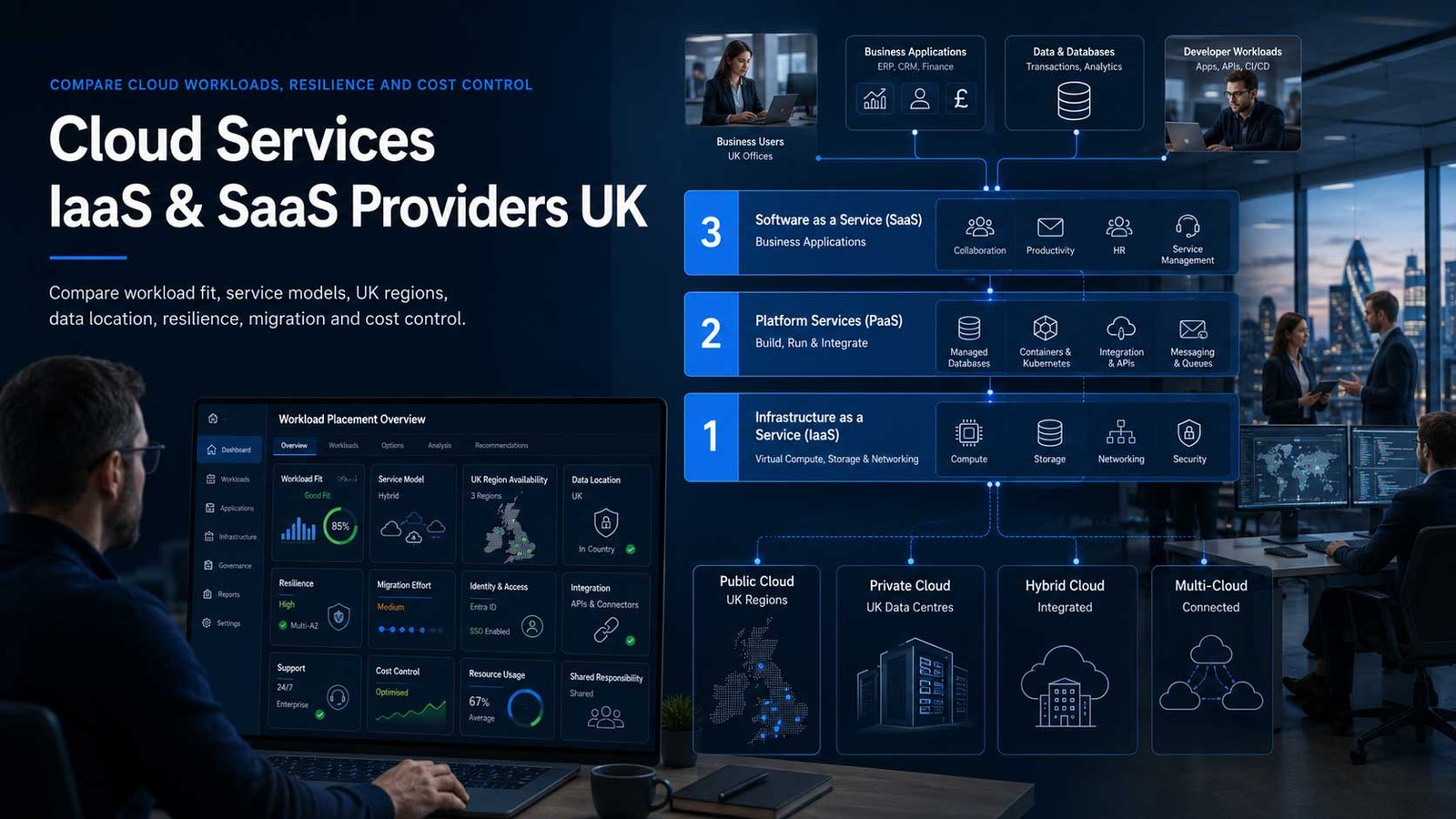
Compare cloud services for UK businesses by workload fit, service model, UK region availability, data location, resilience, migration effort, support, integration and cost control. Evaluate infrastructure, platform and software services against the same operating requirements before moving applications, data or development workloads into a public, private, hybrid or multi-cloud environment.
Cloud Choice Is An Operating-Model Decision
A cloud service can reduce infrastructure ownership, accelerate delivery and provide flexible capacity, but the provider does not automatically own every design, configuration, backup, access, resilience or cost decision.
- Place each workload in the service model that matches its operational needs
- Define who owns configuration, updates, backups, recovery and support
- Confirm where data is stored, processed, replicated and supported
- Model ongoing usage, data transfer, licences and support before migration
Cloud services include hosted infrastructure, managed application platforms and software delivered as an online service. Infrastructure as a Service gives the customer control over virtual compute, storage and networking. Platform services reduce more of the operating burden by managing databases, containers, integration or development services. Software as a Service delivers a finished application managed largely by the supplier.
A sound buying decision begins with the workload rather than the provider brand. Record performance, availability, recovery, data, integration, user, licensing, support and exit requirements for each application. A finance system, customer portal, development platform and archive workload may need different service models even when they sit under one cloud strategy.
Day-to-day user support belongs in the separate IT support comparison, while dedicated security monitoring and protection belong in the cyber-security category. The cloud brief should stay focused on platform, workload placement, migration, service ownership, resilience, data handling and commercial governance.
Match Each Workload To The Correct Cloud Model
The label “cloud” covers materially different responsibilities, cost structures and exit options.
| Model | Customer Typically Controls | Provider Typically Operates | Best-Fit Questions |
|---|---|---|---|
| Infrastructure as a Service (IaaS) | Operating systems, applications, identities, data, network rules, backup design and workload configuration | Physical facilities, hardware, virtualisation and the underlying cloud service | Does the business have the engineering capacity to design, patch, monitor and optimise the environment? |
| Platform as a Service (PaaS) | Application code, data, identity design, service configuration and release management | More of the runtime, database, container, integration or application platform | Will the managed platform reduce operational work without creating unacceptable portability or service limitations? |
| Software as a Service (SaaS) | Users, access, configuration, data governance, integrations, retention choices and business process | The application, platform, infrastructure, updates and core service availability | Can data, configuration and audit records be exported, retained and migrated on acceptable terms? |
| Private Or Hosted Cloud | Application and data requirements, while ownership varies according to the managed-service contract | Dedicated or logically isolated infrastructure and agreed platform operations | Is dedicated capacity required, and are the resilience, upgrade and commercial responsibilities explicit? |
| Hybrid Cloud | Workload placement, integration, identity, network design, data movement and cross-environment governance | Different elements across on-premises, hosted and public cloud environments | Are dependencies, latency, data flows and support boundaries manageable across both environments? |
| Multi-Cloud | Architecture standards, identity, cost allocation, observability, portability and operational coordination | Separate provider platforms and services | Does using more than one provider deliver measurable resilience or capability benefits that justify added complexity? |
Eight Areas That Determine Cloud Service Fit
Use the same criteria for every provider so platform breadth does not hide workload, governance or exit risks.
Comparison Criterion
Workload And Service Fit
Compare compute, storage, database, integration, application and software-service capabilities against the real workload. Confirm supported operating systems, runtime requirements, scaling pattern, dependencies, performance profile and service limits before choosing a platform.
Comparison Criterion
UK Regions, Data Location And Jurisdiction
Identify where primary data, backups, logs and support operations may be located. Distinguish data residency from wider legal, operational and supplier-ownership considerations, then document any contractual or regulatory restrictions that affect workload placement.
Comparison Criterion
Resilience, Backup And Recovery
Review availability zones, regional options, service dependencies, backup ownership, restore testing, replication and disaster-recovery design. A provider region does not by itself make an application resilient; the workload must be engineered and tested for the required outcome.
Comparison Criterion
Migration Method And Portability
Compare discovery, dependency mapping, data transfer, refactoring, testing, cutover, rollback and decommissioning requirements. Record proprietary services, data formats, APIs, licences and operational processes that could make a later migration expensive or slow.
Comparison Criterion
Identity, Integration And Connectivity
Confirm identity federation, access roles, API integration, private connectivity, DNS, network routing, SaaS connectors and cross-environment dependencies. The proposal should show how users, applications and administrators reach each service and how access is removed.
Comparison Criterion
Operations, Monitoring And Service Ownership
Define logging, metrics, alerts, incident routing, platform updates, capacity management, backup checks and service-health monitoring. Separate provider platform incidents from customer configuration, application and data responsibilities.
Comparison Criterion
Commercial Model And FinOps Controls
Compare usage charging, reserved or committed spend, licences, marketplace costs, support plans, data transfer, backups and idle capacity. Require tagging, budgets, alerts, allocation and regular optimisation so variable consumption remains visible to finance and workload owners.
Comparison Criterion
Support, Skills And Partner Ecosystem
Assess support channels, severity definitions, response targets, architecture guidance, partner capability, training and escalation. Confirm whether the contract provides platform support only or includes migration, application, database and operational assistance.
Measures To Define Before A Cloud Contract Is Signed
Translate broad promises such as scalable, resilient and cost-effective into measurable service requirements.
| Measure | What It Should Define | Evidence To Request | Common Weakness |
|---|---|---|---|
| Availability design | Required service hours, acceptable interruption and the workloads that need zone or region resilience | Architecture diagram, dependency list, service SLA and tested failure behaviour | Quoting a provider SLA without showing how the complete application meets the business target |
| Recovery time objective | How quickly the business needs the workload restored after a qualifying disruption | Recovery runbook, sequencing, responsibilities and exercise results | A target exists but no tested restoration process or capacity plan supports it |
| Recovery point objective | How much data loss the business can tolerate for each workload | Backup frequency, replication design, retention, immutability choices and restore evidence | Backup creation is measured but recoverability and application consistency are not |
| Performance and latency | User response, transaction throughput, storage performance and network delay under realistic demand | Baseline measurements, test plan, scaling thresholds and representative pilot results | Provider component benchmarks are treated as application performance guarantees |
| Cost allocation | How spend is assigned to workloads, teams, products, customers or environments | Account structure, tagging standard, billing exports, owner mapping and exception report | One consolidated invoice prevents accountability and hides unused resources |
| Usage and capacity | Expected normal, peak and growth consumption for compute, storage, database and data transfer | Forecast, autoscaling rules, quotas, idle-resource report and commitment assumptions | Only average usage is modelled, causing unexpected peak or minimum-spend costs |
| Change and release control | How platform, application and configuration changes are approved, tested and reversed | Environment design, deployment workflow, audit trail and rollback evidence | Rapid cloud access becomes uncontrolled production change |
| Exit readiness | How data, configuration, logs, identities and services can be exported or replaced | Exit plan, export formats, transfer estimates, deletion evidence and assistance rates | Exit is discussed only at contract end, after proprietary dependencies have grown |
Cloud Service Providers UK Businesses Can Consider
Shortlist providers whose region availability, service portfolio, support model and contract terms match the workload. Confirm current services, quotas, locations and pricing directly before approval.
Provider Profile
Amazon Web Services (AWS)
Broad public-cloud portfolio covering compute, storage, databases, containers, analytics, integration and application services. AWS operates a London Region with multiple Availability Zones. Include it where service breadth, global reach and a mature partner ecosystem matter, while checking architecture complexity and cost governance.
Review official cloud informationProvider Profile
Microsoft Azure
Cloud platform closely aligned with Microsoft identity, Windows, SQL, developer and enterprise estates. Azure lists UK South and UK West regions, with service and availability-zone support varying by region. Include it where Microsoft integration, hybrid capability and enterprise licensing relationships are important.
Review official cloud informationProvider Profile
Google Cloud
Public cloud platform covering infrastructure, data, analytics, containers, application services and AI. Google Cloud operates a London region. Include it where data platforms, cloud-native development, Kubernetes or Google technology alignment are priorities, while checking service availability and skills requirements.
Review official cloud informationProvider Profile
Oracle Cloud Infrastructure
Infrastructure and platform services with particular relevance to Oracle databases, enterprise applications, high-performance workloads and organisations seeking commercial or sovereign deployment choices. Include it where Oracle estates, database economics or UK-specific region requirements are material.
Review official cloud informationProvider Profile
IBM Cloud
Hybrid-cloud platform with infrastructure, managed services, Red Hat OpenShift and enterprise technology options. IBM operates a London multi-zone region. Include it where regulated workloads, hybrid architecture, IBM technology or OpenShift alignment matter, and verify the exact regional service catalogue.
Review official cloud informationProvider Profile
OVHcloud
European cloud provider offering public cloud, private cloud, bare metal, storage and related infrastructure services, including UK data-centre capacity. Include it where European supplier options, infrastructure control, data-location choices or a different pricing model are important.
Review official cloud informationProvider Profile
Civo
UK-founded cloud platform focused on public, private and sovereign cloud models, Kubernetes and simplified infrastructure delivery. Include it where open standards, straightforward platform operations, UK supplier engagement or sovereign-cloud discussions are relevant to the requirement.
Review official cloud informationProvider Profile
DigitalOcean
Developer-focused cloud platform offering virtual machines, managed databases, Kubernetes, application services and storage, with a London region in its availability matrix. Include it for smaller application teams that value simpler deployment and pricing, while checking enterprise governance and support needs.
Review official cloud informationWhat Changes The Cost Of Cloud Services
Cloud cost is the combined effect of architecture, consumption, licensing, support, data movement and operational discipline.
| Cost Driver | Why It Changes Spend | What A Comparable Proposal Should Show |
|---|---|---|
| Compute and runtime | Instance type, operating time, autoscaling, containers, serverless execution and committed-use choices affect recurring cost | Normal and peak capacity, environment schedule, growth assumptions, commitment term and rightsizing process |
| Storage and databases | Capacity, performance tier, transactions, replicas, snapshots, retention and managed database editions can create several charge lines | Data growth, performance class, backup copies, replication, restore testing and archival policy |
| Data transfer and connectivity | Internet egress, inter-region transfer, cross-zone traffic, private circuits, gateways and content delivery may be charged separately | Data-flow diagram, monthly transfer forecast, destination regions and abnormal-traffic assumptions |
| SaaS users and editions | User count, feature tier, minimum licences, premium add-ons, storage and API limits affect finished software services | User categories, required features, inactive-user process, add-ons, contract minimum and renewal basis |
| Support and service plans | Technical support, faster response, architecture guidance, account management and professional services may sit outside platform usage | Support edition, severity definitions, response targets, included guidance and chargeable consultancy |
| Migration and transformation | Discovery, data transfer, refactoring, testing, dual running, licence changes and decommissioning create one-off and transitional costs | Migration waves, dependencies, acceptance criteria, rollback, dual-run period and ownership matrix |
| Monitoring and operational tooling | Logs, metrics, traces, security records, backup services, configuration tools and third-party platforms can grow with usage | Retention, ingestion volumes, alerting design, included allowances and tooling responsibilities |
| Unused and unallocated resources | Idle environments, oversized instances, unattached storage and unowned services continue to generate cost | Tagging policy, budget alerts, owner report, shutdown rules, anomaly handling and optimisation cadence |
How The Workload Changes The Provider Shortlist
The right cloud environment depends on the systems being moved, the team operating them and the business impact of failure.
Small Business Replacing Ageing Servers
Prioritise simple service design, predictable administration, backup and recovery, clear support access and a migration plan that avoids recreating unnecessary legacy complexity.
Software And Digital Product Teams
Prioritise development speed, APIs, managed databases, containers, automated deployment, observability, test environments and the ability to scale without losing cost accountability.
Data-Intensive Or Analytics Workloads
Prioritise storage economics, data movement, processing services, governance, performance, region availability and the skills needed to operate the selected platform effectively.
Regulated Or Multi-Site Organisations
Prioritise data location, contractual controls, identity, audit records, resilience, private connectivity, segregation, governance and a documented shared-responsibility model.
How To Compare Cloud Service Proposals
Give each provider or implementation partner the same workload inventory, data requirements, performance profile, recovery objectives, integration dependencies, operating responsibilities and commercial assumptions. Require every response to identify exclusions, customer tasks, third-party dependencies and services that are available only in selected regions.
- Architecture maps each workload to named services and regions
- Customer and provider responsibilities are explicit
- Migration, testing, cutover and rollback are priced
- Availability and recovery claims are tied to a tested design
- Cost estimates include transfer, backup, logging and support
- Data export, assistance and deletion are covered at exit
Make Every Proposal Use The Same Workload Baseline
A low estimate may assume smaller instances, shorter log retention, less resilient architecture, lower data transfer or more customer-managed work. A higher estimate may include managed databases, backup, support, migration and operational controls that the cheaper response excludes.
Compare the architecture and responsibilities behind the figure before comparing the figure itself.
Six Questions To Put To Every Cloud Provider Or Partner
The answers expose service boundaries, migration assumptions, hidden cost and future lock-in before the contract starts.
Which Workloads Are Included And Excluded?
Ask for a named workload list, dependencies, environments, data volumes, users and any systems that remain on-premises or with another supplier.
Where Will Data And Backups Be Located?
Request the proposed regions for production, backup, logs, support and disaster recovery, together with any cross-border transfer or replication assumptions.
Who Owns Each Operational Task?
Map configuration, patching, platform updates, application support, backup, restore, monitoring, incident response, cost review and access administration.
How Is Resilience Designed And Tested?
Ask for zone and region design, service dependencies, failure scenarios, recovery objectives, exercise frequency and evidence from representative tests.
What Creates Variable Or Additional Cost?
Identify data transfer, burst capacity, storage operations, marketplace software, premium support, API use, logs, backups, early termination and overage.
How Can The Business Migrate Or Exit?
Confirm export formats, data-transfer methods, identity and configuration handover, provider assistance, deletion evidence, notice periods and charges.
A Six-Stage Cloud Evaluation And Migration Process
Move from workload evidence to a controlled production decision rather than beginning with an account and experimenting in live service.
- Inventory applications, data, users, integrations, infrastructure, licences, owners, service hours and current costs.
- Classify each workload by business criticality, performance, data sensitivity, recovery needs, lifecycle and change constraints.
- Choose an initial service model and target architecture, then define responsibilities, controls, regions and exit requirements.
- Issue one written brief and obtain comparable architecture, migration, support, commercial and contractual responses.
- Run a representative pilot that tests performance, integration, identity, backup, recovery, monitoring, cost and operational handover.
- Migrate in controlled waves with acceptance criteria, rollback, cost review, documentation and decommissioning for replaced services.
Cloud Service Provider Comparison Checklist
Use this table before approving a proposal, migration statement of work or production workload.
| No. | Requirement | Evidence To Obtain Before Award | Confirmed |
|---|---|---|---|
| 01 | Workload inventory and business owners agreed | Application list, environment map, dependencies, users, data volumes, owners and service criticality | |
| 02 | Current cost and licence baseline completed | Infrastructure, software, support, connectivity, staff effort and contract commitments | |
| 03 | Target service model selected for each workload | Written rationale for IaaS, PaaS, SaaS, private, hybrid or multi-cloud placement | |
| 04 | UK region and data-location requirements documented | Production, backup, log, support and disaster-recovery location schedule | |
| 05 | Shared responsibilities mapped | Provider, partner and customer ownership for configuration, updates, backup, restore, monitoring and support | |
| 06 | Availability, RTO and RPO approved | Business targets, architecture mapping, dependency assumptions and test plan | |
| 07 | Identity and access design demonstrated | Federation, privileged roles, approval, emergency access, review and leaver process | |
| 08 | Integration and connectivity dependencies recorded | APIs, private links, VPNs, DNS, data flows, latency and third-party services | |
| 09 | Migration, testing and rollback priced | Discovery, data transfer, refactoring, pilot, dual running, cutover and acceptance deliverables | |
| 10 | Cost allocation and budget controls configured | Account structure, tags, owners, budgets, alerts, billing export and anomaly workflow | |
| 11 | Support and escalation terms confirmed | Support plan, severity matrix, response targets, contacts, partner duties and planned maintenance | |
| 12 | Backup, restore and disaster recovery tested | Policies, retention, copies, immutability where required, runbooks and exercise evidence | |
| 13 | Service limits and regional availability checked | Quotas, feature availability, dependencies, roadmap assumptions and capacity approval | |
| 14 | Exit, export and deletion process agreed | Formats, transfer method, assistance rates, notice, handover, retention and deletion evidence |
Common Cloud Service Buying Mistakes To Avoid
Most avoidable problems begin with an incomplete workload brief, unclear responsibility or a cost model that excludes real operating conditions.
| Mistake | Why It Creates Risk | Better Control |
|---|---|---|
| Choosing a provider before classifying workloads | Applications are forced into one platform even when their performance, data or support needs differ | Score each workload before choosing the target service and region |
| Assuming cloud automatically delivers resilience | A single-zone design or shared dependency can still create a complete outage | Design and test resilience against the required business outcome |
| Ignoring the shared-responsibility model | Backups, access, configuration or application duties may remain unowned | Use a responsibility matrix covering every operational control |
| Estimating only compute and storage | Transfer, licences, support, logs, backups, gateways and migration materially change total cost | Build a complete workload-level first-year and steady-state model |
| Moving legacy problems without redesign | Unnecessary servers, manual processes and weak dependencies are recreated at variable cloud cost | Retire, retain, rehost, replatform or refactor deliberately for each workload |
| Leaving cost ownership with one central team | Product and engineering owners cannot see or act on the spend they create | Allocate cost through account structure, tags, budgets and named owners |
| Treating UK hosting as the whole data decision | Support access, replication, backups, supplier ownership and legal obligations may still matter | Document data flows, locations, access and contractual controls end to end |
| Deferring exit planning | Proprietary services, data volume and missing exports can make later migration slow and expensive | Test export and document exit rights before production adoption |
Frequently Asked Questions
Answers to common questions from UK businesses comparing infrastructure, platform and software cloud services.
What Is The Difference Between IaaS, PaaS And SaaS?
IaaS provides virtual infrastructure while the customer manages more of the operating system, applications and data. PaaS manages more of the runtime or application platform. SaaS delivers a finished application, leaving the customer responsible mainly for users, configuration, data governance, integrations and business process.
Does Moving To The Cloud Always Reduce IT Cost?
No. Cloud can reduce hardware ownership and improve flexibility, but poor sizing, idle resources, high data transfer, premium licences, support plans and weak cost governance can increase spend. Compare complete first-year and steady-state cost against the value, resilience and delivery benefits expected.
Should A UK Business Keep All Cloud Data In The UK?
The correct location depends on contracts, regulation, customer commitments, resilience, sustainability, service availability and risk. UK regions can support residency requirements, but buyers should also consider replication, backups, support access, supplier ownership, cross-border transfers and disaster-recovery needs.
Is One Cloud Provider Better Than A Multi-Cloud Strategy?
A single provider can reduce complexity and concentrate skills, while multi-cloud can provide access to specialised services or reduce selected dependencies. Using several providers does not automatically create resilience. The added identity, network, observability, cost and support complexity should have a measurable business justification.
What Is A Cloud Shared-Responsibility Model?
It explains which controls are operated by the provider and which remain with the customer. Responsibility changes by service model. Even with SaaS, the customer normally retains duties for user access, configuration, data use, integrations, retention and business continuity decisions.
How Should A Business Estimate Cloud Cost?
Start with workload demand, environments, growth, storage, databases, transfer, backup, logs, licences, support and migration. Use provider calculators for platform pricing, then add operational effort, partner charges, connectivity, dual running and exit assumptions. Apply owners, tags, budgets and regular optimisation after deployment.
What Should A Cloud Migration Plan Include?
A migration plan should cover workload inventory, dependencies, data transfer, target architecture, identity, testing, cutover, rollback, support, cost monitoring, documentation, acceptance and decommissioning. Complex migrations should be delivered in waves rather than treating every application as one move.
How Are Backup And Disaster Recovery Different In The Cloud?
Backup creates recoverable copies of data or systems. Disaster recovery defines how the complete workload is restored or failed over after a serious disruption. The provider may supply storage and replication services, but the customer still needs retention, recovery objectives, runbooks and tested restoration.
How Can A Business Reduce Cloud Vendor Lock-In?
Use clear architecture records, supported standards, portable data formats, automated deployment, contractually defined export rights and regular exit reviews. Avoid proprietary services only when portability has greater value than the capability or efficiency those services provide.
How Should A UK Business Compare Cloud Service Proposals?
Give every provider the same workload inventory, data, performance, recovery, region, integration, support and cost assumptions. Compare architecture, responsibilities, migration effort, tested resilience, total cost, service limits, skills requirements and exit terms—not only the provider brand or headline unit price.
Provider Information And Cloud Governance Resources
Reviewed by Bhav Giva, Founder & Lead Analyst at CompareServices.co.uk, on 16 July 2026.
Use official provider documentation to confirm current regions, service availability, pricing, support and contractual terms for the proposed workload. Cloud responsibilities, locations and costs can vary by service, edition, region and architecture.
- NCSC — Cloud Security Principles
- GOV.UK — Multi-Region Cloud And Software As A Service
- FinOps Foundation — FinOps Framework
- AWS — Global Infrastructure Regions And Availability Zones
- AWS — Shared Responsibility Model
- Microsoft — Azure Region List
- Microsoft — Cloud Adoption Framework
- Google Cloud — Global Locations
- Oracle — Public Cloud Regions
- IBM — Cloud Data Centres
- OVHcloud — Public Cloud Region Availability
- Civo — Public Cloud
- DigitalOcean — Regional Availability