
Compare Business AI Solutions Providers UK (2026)
Compare Use-Case Fit, Model Choice, Governance And Production Readiness
Compare business AI solutions for UK organisations by use-case value, model choice, data handling, grounding, evaluation, human oversight, security, governance, integration, support and total cost. Assess enterprise AI platforms and specialist providers against the same production requirements before approving assistants, document intelligence, predictive models, computer vision or controlled AI-agent deployments.
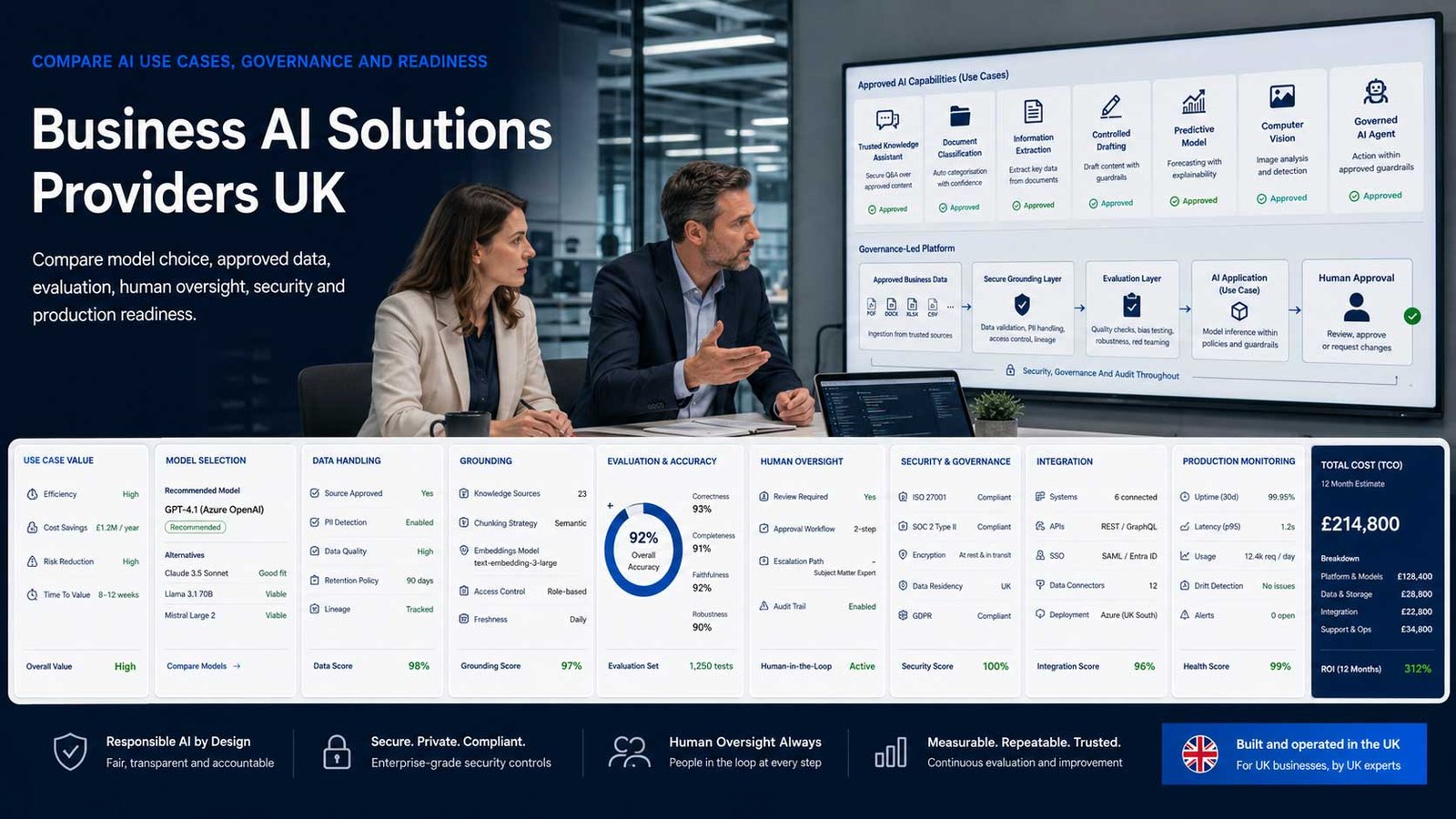
Business AI Is A Controlled Operating Capability
An impressive demonstration is not the same as a dependable production service. The selected solution must perform a defined job, use approved data, work within measurable limits and remain understandable to the people responsible for the outcome.
- Start with one measurable business decision, task or service outcome
- Use representative data and a written evaluation set before rollout
- Define human approval, exception handling and escalation boundaries
- Monitor quality, security, drift, usage and cost after deployment
Business AI solutions apply machine learning, generative AI, language, vision or agent capabilities to a defined organisational use case. They may help staff find and summarise trusted knowledge, classify documents, extract information, generate controlled drafts, predict an operational outcome, identify patterns or support a specialist workflow.
The correct comparison begins with the result the business needs and the evidence required to trust it. A provider should explain which model or models are used, what data enters the service, how outputs are grounded and tested, where human judgement remains mandatory, how errors are contained and how the system is monitored when models, prompts, data or connected tools change.
This page does not compare CRM products, day-to-day IT support providers or broad business software suites. CRM selection belongs on the dedicated CRM page, managed technical support belongs on the IT support page, workflow automation belongs on the RPA page and analytics dashboards belong on the business-intelligence page. The focus here is the AI capability itself and whether it can be deployed safely and economically for a specific business outcome.
Separate The AI Use Case Before Comparing Providers
Different AI patterns require different data, controls, evaluation methods and operating skills. Avoid buying a single platform label for several unrelated problems.
| AI Solution Pattern | Typical Business Outcome | Evidence To Request | Boundary To Protect |
|---|---|---|---|
| Enterprise knowledge assistant | Helps authorised staff find, explain and summarise approved internal information with source references | Retrieval tests, citation accuracy, access-control inheritance, content freshness and refusal behaviour | Keep the scope on governed knowledge use rather than a public website chatbot or general office-software review |
| Document intelligence | Classifies documents, extracts fields, checks completeness and routes exceptions for review | Field-level precision and recall, low-quality document tests, exception rates and human verification rules | Do not describe the surrounding workflow platform as the AI solution unless the AI capability is separately evaluated |
| Generative drafting and review | Produces first drafts, summaries, structured content or suggested responses within an approved domain | Quality rubric, prohibited-content tests, factuality checks, review time and measurable rework reduction | Generated material should not be treated as approved advice, fact or decision without the required review |
| Predictive model or decision support | Estimates demand, risk, probability, priority or another future outcome to support a human decision | Baseline comparison, validation data, calibration, false-positive and false-negative cost, drift and fairness analysis | Keep dashboards and reporting-platform selection on the separate business-intelligence page |
| Controlled AI agent | Plans and completes a bounded task by using approved tools, data and actions under policy | Tool permissions, action logs, approval gates, maximum authority, rollback and adversarial testing | Generic rules-based process automation belongs on the workflow automation and RPA page |
| Computer vision | Detects, classifies or measures objects, defects, activity or visual conditions from images or video | Representative image sets, lighting and environment tests, error rates, privacy controls and manual fallback | A strong laboratory result must not be assumed to transfer unchanged to live cameras, sites or product lines |
| Speech and language intelligence | Transcribes, translates, categorises or extracts meaning from calls, meetings or spoken records | Accent and noise testing, terminology accuracy, diarisation, retention, consent and sensitive-data controls | Telephony platform and contact-centre procurement should remain on their dedicated comparison pages |
Eight Areas That Determine Business AI Solution Fit
Use the same evidence-led criteria for every provider so a polished demonstration does not hide weak data controls, unclear responsibility or untested production behaviour.
Comparison Criterion
Use-Case Value And Process Fit
Define the exact task, user group, current baseline, expected decision or service improvement and conditions in which AI should not be used. The provider should show how the solution fits the real process instead of presenting a generic capability catalogue.
Comparison Criterion
Model Choice And Performance
Compare available foundation models, specialist models, fine-tuning or adaptation options, context limits, multimodal support, latency and model-routing controls. Require a reasoned model choice based on the use case, not an assumption that the largest or newest model is automatically best.
Comparison Criterion
Enterprise Data And Grounding
Confirm how approved information is connected, indexed, retrieved, updated and permissioned. Review data residency, retention, training-use terms, encryption, source citations, document-level access and the handling of personal, confidential or commercially sensitive information.
Comparison Criterion
Evaluation, Accuracy And Reliability
Require representative test cases, pass thresholds, failure categories, hallucination checks, adversarial testing and comparison with the current manual or rules-based baseline. Evaluation should cover the complete system, including prompts, retrieval, tools and human review—not only the underlying model.
Comparison Criterion
Human Oversight And Explainability
Define which outputs may be used directly, which need approval, how uncertain results are identified and how an affected person or internal reviewer can understand the basis of an AI-assisted decision. The solution should make responsibility clearer rather than hiding it behind automation.
Comparison Criterion
Security, Privacy And Abuse Controls
Assess identity, least privilege, network options, key management, logging, prompt-injection controls, sensitive-data filtering, model and supply-chain security, abuse monitoring and incident response. Connected agents need especially strict tool permissions and action boundaries.
Comparison Criterion
Integration And Production Operations
Review APIs, connectors, deployment environments, version control, observability, fallback, rate limits, scaling, change approval and support. Confirm whether the provider supplies only models and infrastructure or also delivers data preparation, application engineering and ongoing AI operations.
Comparison Criterion
Commercial Model And Exit Control
Compare token or request usage, platform fees, seats, reserved capacity, implementation, evaluation, support, storage, search, monitoring and third-party services. Record model portability, data export, prompt and evaluation assets, termination assistance and the cost of replacing the provider.
Measures To Define Before An AI Solution Goes Live
Translate words such as accurate, safe, intelligent and enterprise-ready into measurable acceptance and monitoring requirements.
| Measure | What It Should Define | Evidence To Request | Common Weakness |
|---|---|---|---|
| Business baseline | Current time, cost, quality, error, delay or service result for the task before AI is introduced | Baseline sample, process data, owner sign-off and target improvement | The project measures model activity but cannot show whether the business outcome improved |
| Evaluation set | Representative normal, difficult, rare and prohibited cases that reflect real production use | Versioned test set, coverage statement, expected answers or scoring rubric and ownership | A small demonstration set is reused until the system appears successful |
| Quality threshold | The minimum acceptable accuracy, completeness, relevance or task success for each output category | Scoring method, reviewer agreement, pass threshold and comparison with the current process | Average quality hides serious failure on high-impact cases |
| Human-review rate | Which outputs require approval and the expected workload created for reviewers | Approval rules, sampling plan, escalation path, review time and exception volume | The solution saves generation time but creates an unplanned checking burden |
| False action and harmful error | The maximum acceptable rate and consequence of incorrect recommendations, classifications or tool actions | Failure taxonomy, containment controls, rollback, red-team results and incident examples | Only successful outputs are reviewed while costly failure modes remain untested |
| Fairness and affected groups | Whether performance or outcomes differ materially across relevant people, customers or operating conditions | Segmented testing, data assessment, justification, mitigation and review ownership | A single overall score obscures poor performance for a smaller group |
| Latency and availability | Required response time, throughput, concurrency, service hours and fallback behaviour | Load tests, rate-limit assumptions, dependency map, service terms and degraded-mode plan | A fast prototype fails when production demand, long documents or connected tools are introduced |
| Usage and cost per outcome | Expected model, retrieval, storage, tool, monitoring and human-review cost for a completed business result | Volume model, token or request assumptions, cost allocation, budgets and variance alerts | A low model price is quoted while the complete application cost remains unknown |
| Change and drift | How model, prompt, knowledge, data and integration changes are tested before release | Version history, regression suite, approval workflow, monitoring thresholds and rollback | A provider model update changes behaviour without a repeatable acceptance test |
| Incident and complaint handling | How errors, data concerns, unsafe output and affected-user challenges are recorded and resolved | Named owners, severity levels, investigation evidence, response time and learning process | AI issues are treated as isolated user mistakes rather than system events |
Business AI Solution Providers UK Organisations Can Consider
Shortlist providers whose model access, data controls, governance, integration and support fit the approved use case. Product names and regional features change quickly, so confirm current availability and contract terms directly before award.
Provider Profile
OpenAI
Provides an API platform and enterprise offerings for building or adopting language, reasoning, multimodal and agentic AI capabilities. Include OpenAI where model capability, developer tooling and enterprise controls fit the use case. Confirm data-retention settings, residency eligibility, access controls, evaluation design and the application responsibilities that remain with the customer.
Review official business data informationProvider Profile
Microsoft Foundry
Microsoft’s unified Azure platform for enterprise AI operations, model building, application development and governed agent deployment. Include it where Azure infrastructure, Microsoft identity, enterprise data services or existing development controls are important. Verify model and feature availability by region, project isolation, connected-service costs and the skills needed to operate the complete solution.
Review official platform informationProvider Profile
Amazon Bedrock
Managed AWS service providing access to multiple foundation-model families with capabilities for agents, knowledge grounding, evaluation, guardrails and enterprise security. Include it where AWS integration, model choice and cloud-native controls matter. Compare regional model access, connected AWS services, throughput options, guardrail design and the total architecture cost beyond model usage.
Review official platform informationProvider Profile
Google Gemini Enterprise Agent Platform
Google Cloud’s evolved enterprise platform for building, scaling, governing and optimising AI models, applications and agents, including capabilities previously associated with Vertex AI. Include it where Google models, search, data services, Kubernetes or cloud-native application development are relevant. Confirm regional availability, retention configuration, grounding design and production observability.
Review official platform informationProvider Profile
Anthropic
Offers the Claude Platform and enterprise services for language, reasoning, coding and agent use cases. Include Anthropic where Claude model behaviour, long-context work, developer access or governed workforce use fits the requirement. Review organisation administration, API retention options, security evidence, model availability, usage charging and how the solution will control tools and sensitive context.
Review official enterprise informationProvider Profile
IBM watsonx
Enterprise AI portfolio covering model development, data and AI governance, monitoring and hybrid deployment options. Include it where formal governance, multi-model oversight, explainability, regulated operations or IBM and Red Hat alignment matter. Confirm which watsonx components are required, supported deployment patterns, third-party model coverage and the operating effort needed to maintain governance evidence.
Review official platform informationProvider Profile
Oracle OCI Enterprise AI
Oracle’s managed enterprise AI offering for building, deploying and governing agents and AI applications across structured and unstructured data. Include it where Oracle databases, applications, OCI infrastructure, sovereign options or integrated enterprise data are important. Verify model choice, region availability, zero-retention eligibility, integration approach and licensing dependencies.
Review official platform informationProvider Profile
Dataiku
Enterprise AI platform designed to coordinate data preparation, traditional machine learning, generative AI, agents and governance across technical and business teams. Include it where central visibility, reusable controls, multi-provider governance and collaborative delivery are priorities. Confirm infrastructure requirements, model-provider costs, deployment pattern, governance workflow and the degree of specialist implementation support required.
Review official governance informationWhat Changes The Cost Of Business AI Solutions
AI cost combines model consumption, application engineering, enterprise data, evaluation, human review, security, monitoring and ongoing change.
| Cost Driver | Why It Changes Spend | What A Comparable Proposal Should Show |
|---|---|---|
| Model and inference usage | Input and output volume, model tier, context size, images, audio, reasoning, batch use and reserved throughput affect consumption | Use-case volumes, prompt and response assumptions, peak demand, model-routing policy and cost per completed outcome |
| Enterprise seats and workspace features | Managed assistants may charge by user, usage, minimum commitment or a combination of access and consumption | User groups, expected adoption, included controls, usage basis, inactive-user process and renewal assumptions |
| Knowledge retrieval and data preparation | Document cleaning, permissions, indexing, embeddings, search, storage, refresh and data-quality work can exceed model cost | Source inventory, ingestion method, refresh frequency, access model, storage volume and data-owner responsibilities |
| Application and integration engineering | Interfaces, APIs, orchestration, tool connections, identity, workflow changes and production hardening require design and development | Named integrations, deliverables, environments, testing, customer tasks, reusable components and acceptance criteria |
| Evaluation and assurance | Representative test sets, expert review, red teaming, fairness analysis, privacy assessment and evidence maintenance create necessary work | Evaluation plan, test ownership, pass thresholds, review rates, assurance activities and repeat-testing triggers |
| Human review and exception handling | AI may reduce task time but create new checking, correction, escalation or complaint-handling demand | Expected straight-through rate, review roles, time per exception, training and operational staffing |
| Security, logging and monitoring | Private networking, key management, content controls, audit logs, observability, incident detection and retention can add platform charges | Control architecture, data volumes, retention, monitoring tools, alert ownership and incident support |
| Support, model change and lifecycle | Production support, model upgrades, regression testing, prompt maintenance, data refresh and provider changes continue after launch | Support level, service boundaries, change process, model-deprecation handling, optimisation cadence and exit assistance |
How The Use Case Changes The AI Provider Shortlist
The right provider depends on the decision or task, the sensitivity of the data, the people affected and the organisation’s capacity to operate the solution.
Document-Heavy Professional Services
Prioritise secure knowledge grounding, source references, document permissions, long-context quality, review workflows and clear restrictions on using generated content as professional advice.
Product And Engineering Teams
Prioritise APIs, model choice, evaluation tooling, observability, version control, agent orchestration, rate limits and the ability to move from experiment to a supported production service.
Regulated Or High-Impact Decisions
Prioritise explainability, human authority, fairness testing, evidence retention, data minimisation, formal approval, incident handling and a provider willing to support detailed assurance requirements.
Multi-Department Enterprise Adoption
Prioritise identity, administration, approved-model access, data boundaries, reusable guardrails, cost allocation, AI inventory, training and governance that can control many teams without blocking valid use cases.
How To Compare Business AI Proposals
Give every provider the same use-case statement, current baseline, user group, data sources, prohibited data, expected volumes, quality threshold, human-review rule, integration list, security requirements and operating assumptions. Require the response to separate platform features from implementation work and to identify every customer responsibility.
- The proposed model and architecture are justified against the use case
- Data flow, retention, training use and access are explicit
- Evaluation covers normal, difficult and harmful failure cases
- Human approval and exception handling are costed
- Production monitoring and model-change testing are included
- Exit includes data, prompts, evaluations, logs and configuration
Make Every Provider Demonstrate The Same Task
A provider-controlled demonstration can use clean data, carefully chosen prompts and ideal examples. Require each finalist to work from the same representative test pack and score the output against the same business rubric.
The winning response should be the one that produces the most dependable outcome within the required controls—not simply the most fluent answer.
Six Questions To Put To Every Business AI Provider
The answers expose weak use-case definition, unclear data handling, unmeasured quality and hidden operating work before the project starts.
What Exact Outcome Will The Solution Improve?
Ask for the current baseline, target result, users, decision boundaries, excluded use cases and the evidence that will show whether the deployment succeeded.
Which Models And Services Are Used?
Request the model names or routing policy, hosting arrangement, connected services, region availability, change process and reasons for selecting each component.
How Is Our Data Processed And Controlled?
Confirm inputs, outputs, logs, embeddings, training-use terms, retention, locations, subprocessors, access, encryption, deletion and the handling of personal or confidential data.
How Will Quality And Risk Be Tested?
Ask for the evaluation set, scoring rubric, pass thresholds, red-team work, fairness checks, human review, failure containment and repeat testing after any material change.
Who Operates The Solution After Launch?
Map prompt and data maintenance, monitoring, incident response, user support, model updates, access reviews, cost control, supplier escalation and business ownership.
What Can We Export Or Replace At Exit?
Confirm data, indexes, prompts, evaluations, configurations, logs, fine-tuned assets, documentation, assistance rates, notice, deletion evidence and replacement constraints.
A Seven-Stage Business AI Evaluation Process
Move from a defined problem to a controlled production service instead of buying access first and searching for a use case later.
- Define one business task, current baseline, affected users, owner, target improvement and conditions where AI must not act.
- Map the data, personal-information risk, confidentiality, permissions, integrations, records, retention and human decisions surrounding the task.
- Choose the solution pattern and create a representative evaluation set with expected results, scoring rules and harmful failure cases.
- Issue one written brief and obtain comparable model, architecture, data, security, assurance, support and commercial responses.
- Run a controlled pilot using representative users and data, measuring quality, review effort, latency, cost, security and operational fit.
- Approve production only after thresholds, human oversight, logging, incident response, change control, training and ownership are in place.
- Review outcome, drift, complaints, usage, cost and provider changes on a defined schedule, with authority to pause or roll back the system.
Business AI Solution Provider Comparison Checklist
Use this table before approving a provider, pilot, implementation statement of work or production launch.
| No. | Requirement | Evidence To Obtain Before Award | Confirmed |
|---|---|---|---|
| 01 | Use case, owner and non-AI baseline agreed | Written problem statement, current performance, target outcome, decision limits and accountable business owner | |
| 02 | Excluded and prohibited uses documented | Activities, decisions, data categories and circumstances in which the system must refuse, defer or require approval | |
| 03 | Data inventory and lawful handling reviewed | Sources, personal data, confidentiality, permissions, retention, locations, processors and deletion responsibilities | |
| 04 | Proposed models and architecture identified | Models, regions, services, integrations, routing, customer components and reasons for the chosen design | |
| 05 | Training-use and retention terms confirmed | Contractual treatment of inputs, outputs, files, logs, embeddings, feedback and fine-tuning data | |
| 06 | Representative evaluation set completed | Normal, difficult, rare, adversarial and prohibited cases with expected outcomes and version control | |
| 07 | Quality and risk thresholds approved | Accuracy, relevance, task success, harmful error, fairness, latency, availability and cost acceptance levels | |
| 08 | Human oversight and appeal designed | Approval rules, reviewer competence, uncertainty handling, user notice, correction, challenge and escalation process | |
| 09 | Security and abuse controls demonstrated | Identity, least privilege, encryption, network controls, prompt-injection testing, filtering, logging and incident handling | |
| 10 | Tool and agent permissions bounded | Permitted actions, approval gates, maximum authority, audit trail, rollback, spending limits and emergency shutdown | |
| 11 | Production monitoring and ownership agreed | Quality, drift, security, usage, complaints, cost, service health, alert thresholds and named responders | |
| 12 | Model and prompt change process tested | Versioning, regression suite, approval, release notes, rollback and treatment of provider model deprecation | |
| 13 | Total cost and human effort modelled | Model use, data services, storage, integration, evaluation, review, monitoring, support and steady-state maintenance | |
| 14 | Support and shared responsibilities confirmed | Provider, partner and customer duties for data, application, models, incidents, users, evaluation and operational changes | |
| 15 | Exit, export and deletion agreed | Data, prompts, evaluations, logs, configurations, fine-tuned assets, documentation, assistance, notice and deletion evidence |
Common Business AI Buying Mistakes To Avoid
Most avoidable failures begin with a vague use case, an unrealistic demonstration or a belief that the model provider owns every production responsibility.
| Mistake | Why It Creates Risk | Better Control |
|---|---|---|
| Buying a platform before defining the task | Teams collect features and licences without a measurable outcome, owner or evidence of value | Approve one use case and baseline before comparing products |
| Judging quality from a scripted demonstration | Clean examples hide difficult documents, missing context, uncertainty and harmful failure modes | Give every provider the same representative evaluation pack |
| Assuming fluent output is correct | Confident wording can conceal unsupported claims, missing evidence or incorrect reasoning | Use source grounding, factuality tests and mandatory review where impact is material |
| Ignoring data and access boundaries | Employees or agents may retrieve information they should not see or submit sensitive data to an unapproved service | Apply least privilege, approved sources, data rules and test permission inheritance |
| Treating the model as the complete solution | Retrieval, application logic, integrations, monitoring, review and support remain unowned | Compare the complete production architecture and responsibility matrix |
| Automating authority too early | An agent can turn a poor answer into a real action, transaction or customer impact | Begin read-only, add approval gates and increase authority only after evidence |
| Measuring model accuracy but not business value | A technically capable system may not reduce time, cost, delay or error in the real process | Measure outcome, review effort, adoption, exception rate and cost per completed task |
| Failing to retest after change | Model, prompt, data and integration updates can alter behaviour without obvious warning | Use versioned regression tests, release approval, monitoring and rollback |
| Leaving exit planning until renewal | Prompts, evaluations, indexes, integrations and fine-tuned assets may be difficult to transfer | Define export, documentation and replacement rights before production use |
Frequently Asked Questions
Answers to common questions from UK organisations comparing enterprise AI platforms, providers and implementation approaches.
What Counts As A Business AI Solution?
A business AI solution applies machine learning, generative AI, language, vision or agent capabilities to a defined organisational task or decision. It should include the data, application, controls, evaluation, human oversight and operating process needed to deliver a dependable outcome—not only access to a model.
How Is Business AI Different From General Business Software?
General software provides a standard set of functions such as records, tasks, finance or collaboration. Business AI performs or supports a task using learned or generative behaviour that must be tested against representative data. CRM, ERP, project-management and accounting products should be compared on their dedicated pages even when they include embedded AI features.
Should A Small UK Business Use An AI Platform Or A Finished Service?
A finished managed service may be appropriate when the use case is standard, the required controls are available and the business lacks an engineering team. A platform provides more control and integration but adds architecture, security, evaluation and operational responsibility. Compare the complete workload and skills requirement rather than assuming more flexibility is always better.
How Should A Business Test An AI Provider?
Create a representative evaluation set containing normal, difficult, rare and prohibited cases. Give the same pack to each provider, score results with a written rubric and measure human review, harmful errors, latency and cost. Repeat the test after material changes to models, prompts, knowledge sources or connected tools.
Can A Provider Use Our Business Data To Train Its Models?
Terms vary by provider, product and configuration. Obtain written confirmation covering inputs, outputs, uploaded files, logs, feedback, embeddings and fine-tuning data. Check retention, training-use defaults, opt-out controls, deletion, locations, subprocessors and whether special enterprise or API settings are required.
What Human Oversight Does An AI Solution Need?
Oversight should reflect the impact of an error. Low-risk drafting may use sampling, while financial, employment, legal, safety or customer-impacting decisions may require qualified approval for every output. Define who reviews, what evidence they see, how uncertainty is shown and how a person can challenge or correct the result.
What Is Retrieval-Augmented Generation?
Retrieval-augmented generation connects a generative model to selected knowledge sources so it can use relevant information when producing an answer. It can improve grounding and source visibility, but quality still depends on document accuracy, permissions, retrieval performance, prompt design, evaluation and the model’s handling of missing or conflicting evidence.
Are AI Agents Safe For Business Use?
They can be useful when their authority is tightly bounded. Begin with read-only or recommendation tasks, restrict tools and data, require approval for material actions, set spending and transaction limits, log every step and provide an emergency stop. An agent should not receive broader authority than the evidence and operating controls justify.
How Much Do Business AI Solutions Cost?
Cost may include model or API usage, enterprise seats, data preparation, search, storage, integration, implementation, evaluation, human review, security, monitoring and support. Build a first-year and steady-state model using representative volumes and compare cost per completed, quality-checked business outcome rather than only a token or licence price.
How Should A UK Business Compare AI Provider Proposals?
Give every provider the same use case, data rules, evaluation set, integration list, quality threshold, human-review requirement, security controls, volumes and support assumptions. Compare model and architecture fit, data handling, measured performance, governance, operating responsibilities, total cost and exit—not only brand recognition or a scripted demonstration.
Provider Information And UK AI Governance Resources
Reviewed by Bhav Giva, Founder & Lead Analyst at CompareServices.co.uk, on 16 July 2026.
Use official guidance and provider documentation to confirm current model access, service locations, retention, security, governance, pricing, support and contractual terms. AI products and model portfolios can change materially during a buying cycle.
- GOV.UK — Introduction To AI Assurance
- GOV.UK — Trusted Third-Party AI Assurance Roadmap
- ICO — Guidance On AI And Data Protection
- ICO — AI And Data Protection Risk Toolkit
- NCSC — Guidelines For Secure AI System Development
- OpenAI — Business Data Privacy, Security And Compliance
- Microsoft — What Is Microsoft Foundry?
- AWS — Bedrock Security, Privacy And Responsible AI
- Google Cloud — Gemini Enterprise Agent Platform
- Anthropic — Claude Enterprise
- IBM — watsonx.governance
- Oracle — OCI Enterprise AI
- Dataiku — Govern AI Everywhere